Introduction
Migraine headache is a common disorder that affects 6 per cent of men and 18 per cent of women.Reference Lipton, Bigal, Diamond, Freitag, Reed and Stewart1, Reference Lempert and Neuhauser2 Vestibular vertigo is also a common disorder that affects 7 per cent of the population.Reference Neuhauser, von Brevern, Radtke, Lezius, Feldmann and Ziese3 However, the incidence of migraine with accompanying vestibular vertigo (a rate of 3.2 per cent) is higher than expected if the two were unrelated.Reference Lempert and Neuhauser4 Although the prevalence of migraine in the general population is high, and the association between vertigo and migraine is also high, migrainous vertigo is often under-diagnosed.Reference Neuhauser, von Brevern, Radtke, Lezius, Feldmann and Ziese3–Reference Cass, Ankerstjerne, Yetiser, Furman, Balaban and Aydogan9 This under-diagnosis is accentuated by the fact that the International Headache Society's classification of migraines does not recognise migrainous vertigo as a category of migraine.10
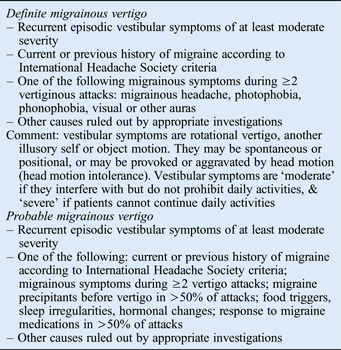
Lempert and Neuhauser have developed criteria for probable and possible migrainous vertigo (see Table I) that enable the definition and categorisation of migrainous vertigo.Reference Lempert and Neuhauser4 These criteria allow comparison between migrainous vertigo and other types of migraines. Such comparison may determine whether those with migrainous vertigo might improve with manual physical therapy (a therapy used for individuals with migraine without vertigo). In contrast, it might determine those who may be better aided with vestibular rehabilitation (the therapy used for individuals with general vestibular dysfunction).
Lempert and neuhauser diagnostic criteria for migrainous vertigoReference Lempert and Neuhauser4

The pathophysiology of migrainous vertigo remains speculative at this time.Reference Cass, Ankerstjerne, Yetiser, Furman, Balaban and Aydogan9, Reference Furman, Marcus and Balaban11–Reference Johnson13 It is known that the vestibular system includes parts of the inner ear and brain that help to control eye movements, balance and function, and that vertigo is a symptom of an abnormal vestibular system.Reference Whitney, Wrisley, Brown and Furman14 Abnormalities in vestibular ocular reflexes or vestibular spinal reflexes are associated with vestibular dysfunction (e.g. vertigo, postural instability and visual abnormalities), like those seen in migrainous vertigo.Reference Troost15 It is unknown whether the abnormal vestibular reflexes associated with migrainous vertigo are caused by abnormalities in the inner ear (the peripheral vestibular system) or the brain (the central vestibular system),Reference Brantberg, Trees and Baloh12, Reference Troost15 and whether these abnormalities exist during the non-migrainous period as well as during the migraine itself. It has been demonstrated that vertigo can lead to functional limitations and decreased quality of life in those with vestibular disorders.Reference Whitney, Wrisley, Brown and Furman14 In order to improve these factors in a person with migrainous vertigo, we must first know what (if any) aspects of the vestibular ocular reflex and the vestibular spinal reflex (such as balance) are abnormal, and in what ways they differ from a migraine without vertigo population during a non-migrainous period. This will enable therapists to develop specific treatments directed at the needs of individuals with migrainous vertigo.Reference Whitney, Wrisley, Brown and Furman14
The vestibular ocular reflex and components of the vestibular spinal reflex have been measured in several different ways in those with abnormal vestibular systems (those with vertigo, postural instability and visual abnormalities), and more specifically in those with migrainous vertigo.Reference Neuhauser and Lempert6, Reference Gallagher and Cutrer7–Reference Pang, Lam, Wong, Au and Chow26 Tests of the vestibular ocular reflex include the gaze stabilisation test, which measures how fast the head can move while maintaining a visual image, and the dynamic visual acuity test, which compares visual acuity with the head still and the head moving.Reference Pritcher, Whitney, Marchetti and Furman19 Tests of vestibular spinal reflex components, more specifically balance, include: the sensory organisation test, which examines the influence of the visual, somatosensory and vestibular systems in maintaining balance; and the head shake sensory organisation test, which measures the influence of the somatosensory and vestibular systems in maintaining balance during head movement. The utilisation of these tests in those with abnormal vestibular systems, and more specifically migrainous vertigo, has led to various conclusions.Reference Neuhauser and Lempert6, Reference Gallagher and Cutrer7–Reference Pang, Lam, Wong, Au and Chow26
Pritcher et al. Reference Pritcher, Whitney, Marchetti and Furman19 and Whitney et al. Reference Whitney, Marchetti, Pritcher and Furman20 performed studies using the gaze stabilisation test. Pritcher et al. found that the test results were abnormal in people with vestibular abnormalities, especially during pitch plane movements.Reference Pritcher, Whitney, Marchetti and Furman19 Whitney et al. found that individuals with abnormal vestibular systems had greater difficulty with gaze stabilisation in both yaw and pitch plane movements compared with a group with no vestibular dysfunction.Reference Whitney, Marchetti, Pritcher and Furman20 Whitney et al. also found that abnormal test findings in both a pitch and yaw plane were predictive of gait abnormalities.Reference Whitney, Marchetti, Pritcher and Furman20 We found no published reports regarding gaze stabilisation in migrainous vertigo or migraine without vertigo populations.
The dynamic visual acuity test has also been used to investigate those with abnormal vestibular systems. A small study by Schubert et al. found that the test results of a control group were similar to those of established age-matched, healthy norms; however, the results of a group with vestibular abnormalities were significantly worse than those of the control group.Reference Schubert, Migliaccio, Clendaniel, Allak and Carey21 In addition, dynamic visual acuity loss was reported to increase with age. This could indicate that both older people (aged 65 years and over) and those with vestibular disorders have decreased dynamic visual acuity. As with the gaze stabilisation test, the dynamic visual acuity test has not been employed to study the migraine population and more specifically the migrainous vertigo population.
Other studies have examined components of the vestibular spinal reflex, specifically balance, in those with migraine and those with migrainous vertigo. However, the results have been mixed.Reference Ishizaki, Mori, Takeshima, Fukuhara, Ijiri and Kusumi22–Reference Shepard, Cole, Bradshaw, Hyder and Parent24 Ishizaki et al. used a computerised dynamic posturography tool to examine balance in those with migraine without vertigo and those who suffered tension headaches.Reference Ishizaki, Mori, Takeshima, Fukuhara, Ijiri and Kusumi22 They found abnormalities in balance in the migraine participants compared with the tension headache group. Similarly, a pilot study by Furman et al. Reference Furman, Sparto, Soso and Marcus8 demonstrated differences in the computerised dynamic posturography results of five subjects with migrainous vertigo during a symptom-free period, as compared with five migraine without vertigo subjects and five subjects with no migraine history. Conversely, in a study of acute migrainous vertigo by von Brevern et al., there were no abnormalities in nystagmus, vestibular ocular reflex, or vestibular spinal reflex and balance in individuals with migrainous vertigo during a non-migrainous period.Reference von Brevern, Zeise, Neuhauser, Clarke and Lempert23 However, these authors found pathological nystagmus, imbalance problems and gait abnormalities in 70 per cent of the migrainous vertigo participants during the migrainous period. Shepard et al. found that sensory organisation test results can be normal in subjects with vestibular disorders who are ‘well compensated’ (fully functional) following treatment of a vestibular lesion.Reference Shepard, Cole, Bradshaw, Hyder and Parent24
The head shake sensory organisation test, which also measures balance, was developed to provide additional information on those with vestibular disorders who may be well compensated (those with an abnormal vestibular system, but normal sensory organisation test results).Reference Shepard, Cole, Bradshaw, Hyder and Parent24 Both Shepard et al. Reference Shepard, Cole, Bradshaw, Hyder and Parent24 and Mirsha et al. Reference Mirsha, Davis, Speers and Shepard25 compared test results of participants with a normal vestibular system with those with balance problems and an abnormal vestibular system. The Shepard et al. study comprised 51 participants of various ages with normal vestibular systems and 27 participants with known balance disorders.Reference Shepard, Cole, Bradshaw, Hyder and Parent24 There was a significant difference between age groups in the head fixed trials and the head shake trials for the condition in which ability to use input from the vestibular system to maintain balance was tested (condition 5), but not for the condition in which ability to use input from the somatosensory system to maintain balance was tested (condition 2). In addition, there were significant differences in the results of the head fixed trials and head shake trials for the two aforementioned conditions between the group with no vestibular problems and the group with balance disorders. In contrast to these findings, Mirsha et al., in a study comparing participants with normal and abnormal vestibular systems, found good specificity and poor sensitivity for condition 2, but found the opposite for condition 5.Reference Mirsha, Davis, Speers and Shepard25 The head shake sensory organisation test has not been employed in studies of migraine or migrainous vertigo.
The functional gait assessment is a clinical test of the vestibular ocular reflex, the vestibular spinal reflex (and balance) and function.Reference Wrisley, Marchetti, Kuharsky and Whitney27 The assessment was developed from the dynamic gait index, which is a test used to evaluate postural stability during gait.Reference Wrisley, Marchetti, Kuharsky and Whitney27 The functional gait assessment is more sensitive than the dynamic gait index when evaluating people with vestibular disorders.Reference Wrisley, Marchetti, Kuharsky and Whitney27
Walker et al. examined age-referenced norms for community dwelling adults aged 40–89 years.Reference Walker, Austin, Banke, Foxx, Gaetano and Gardner28 There was a negative correlation between age and functional gait assessment scores. Wrisley et al. conducted a study that included six participants with vestibular abnormalities, and tested them using both the dynamic gait index and the functional gait assessment.Reference Wrisley, Marchetti, Kuharsky and Whitney27 The dynamic gait index was associated with a ceiling effect for these participants as all scored the maximum number of points. The functional gait assessment (in which higher scores reflect more normal postural stability) eliminated the ceiling effect and revealed a mean score of 21 out of 30 for the six participants with vestibular abnormalities.
Collectively, previous studies of individuals with normal and abnormal vestibular systems have demonstrated differences between these groups in terms of vestibular ocular reflexes, vestibular spinal reflexes (and balance) and function.Reference Ishikawa, Cao, Wang, Wong, Tanaka and Miyazaki16–Reference Walker, Austin, Banke, Foxx, Gaetano and Gardner28 However, few studies have attempted to define these aspects of the vestibular system in those with migraine, and fewer still have focused specifically on migrainous vertigo.
The findings of previous studies are inconsistent and limited. In order to develop appropriate therapies for those with migrainous vertigo, it is important that more research is conducted using Lempert and Neuhauser's specific definition of migrainous vertigo.Reference Lempert and Neuhauser2 Examination of the vestibular system in those with migrainous vertigo, particularly if findings are compared with a migraine without vertigo group, will allow for improved, targeted treatment of migrainous vertigo. Further examination of migrainous vertigo is required during both migrainous and non-migrainous periods. This pilot study marks the first step towards this goal. This study was conducted to determine whether those with migrainous vertigo have abnormal vestibular functioning during a non-migrainous period compared with those who suffer migraine without vertigo.
Materials and methods
Sample
All subjects, who were recruited from a university campus in Midwestern USA, were required to be between the ages of 18 and 65 years, and have a history of migraine diagnosed by a physician (as reported by the participants). Exclusion criteria were: neurological or vestibular conditions other than migrainous vertigo, a history of a head trauma, any orthopaedic disorder which affects balance, and the use of an assistive device. These aspects were again verified by participant self-reports.
This study was approved by both the Western Michigan University Human Subjects Institutional Review Board and the Grand Valley State University Human Research and Review Committee. Each subject read and signed an informed consent form.
All subjects completed a demographic form as well as the Furman et al. survey,Reference Furman, Marcus and Balaban11 which is based on the Lempert and Neuhauser criteria for migrainous vertigo.Reference Lempert and Neuhauser4 The latter survey was used to determine the presence or absence of migrainous vertigo. Ten subjects were recruited for the migrainous vertigo group and 10 for the migraine without vertigo group.
Assessments and procedures
Each participant was tested during a non-migrainous period using the same battery of tests. This included the gaze stabilisation test, the dynamic visual acuity test, the sensory organisation test and the head shake sensory organisation test as measured on the Smart Balance Master system (NeuroCom International, Clackamas, Oregon, USA), and the functional gait assessment.
Vestibular ocular reflexes were measured using the gaze stabilisation test and the dynamic visual acuity test,Reference Wrisley, Whitney and Furman17–Reference Whitney, Marchetti, Pritcher and Furman20 which were performed using the inVision System™ (part of the NeuroCom Smart Balance Master system; NeuroCom International). Prior to performing these tests, static visual acuity and visual perception were measured; the results were used to provide baseline information. Each participant was seated approximately 3 metres away from the computer screen. After static visual acuity was determined, a head piece was placed on the participant's head, which monitored speed and head movement. Participants were asked to move their head side to side in a yaw (shaking head ‘no’) movement until a visual cue appeared on the computer screen. Participants were then asked to stop moving their head and to report what they saw. This image represented dynamic visual acuity. Dynamic visual acuity was compared with static visual acuity, and dynamic visual acuity loss was calculated by the computer. This loss was recorded in terms of the logarithm of the minimum angle of resolution, with possible scores ranging from 0 to 1, wherein 1 indicated a total loss of dynamic visual acuity. The gaze stabilisation test, which has shown reliability (interclass correlation coefficient = 0.75) and validity,Reference Ward, Mohammad, Whitney, Marchetti and Furman18 was measured in a similar manner; however, unlike the dynamic visual acuity test, the visual cue in the gaze stabilisation test appeared at different speeds. The gaze stabilisation test was recorded in degrees per second and could range from 0–200, with 200 being the best gaze stabilisation score.
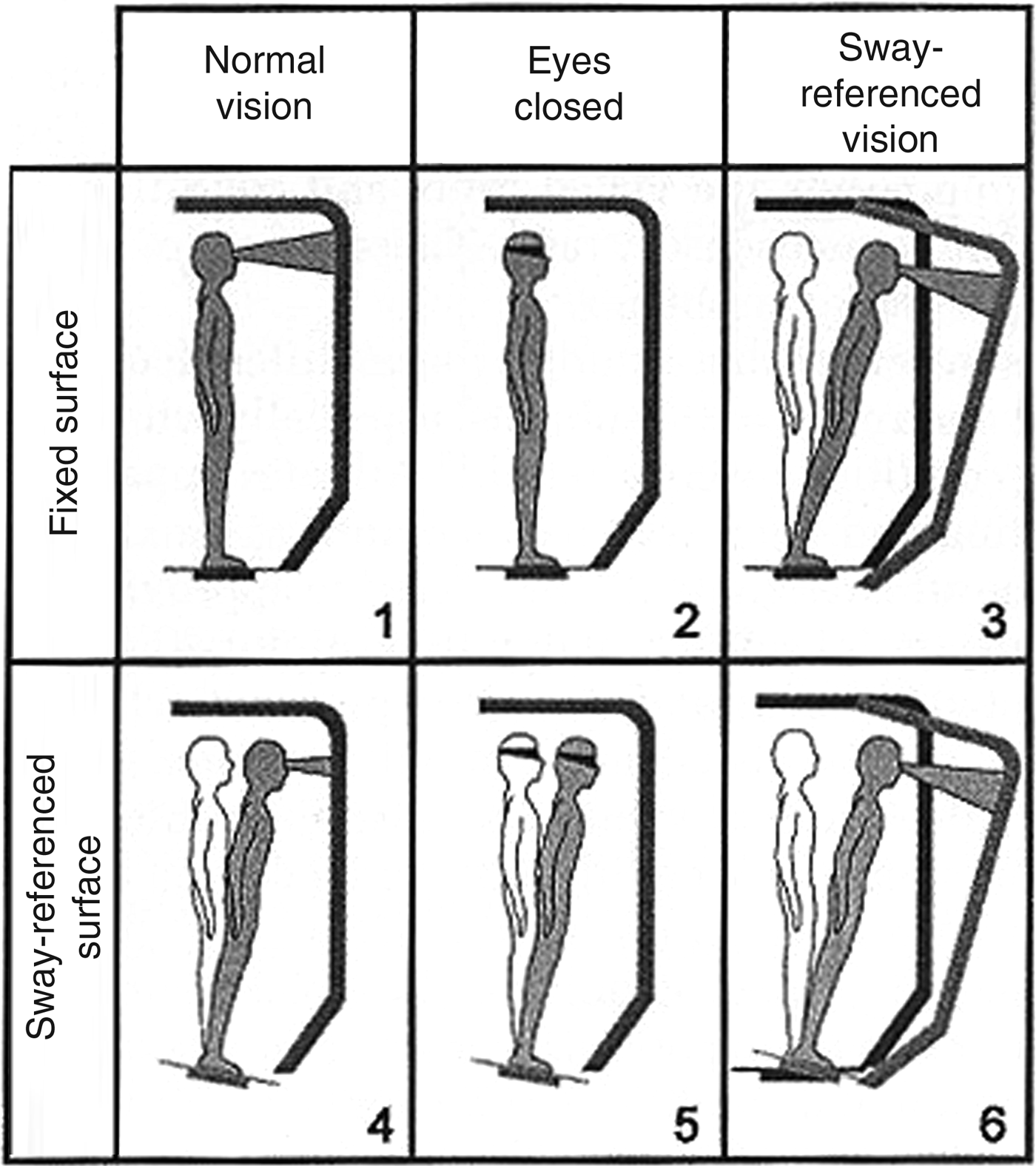
Components of the vestibular spinal reflex, specifically balance, were examined using the sensory organisation test and the head shake sensory organisation test. These are instrumental tests of the vestibular spinal reflex.Reference Shepard, Cole, Bradshaw, Hyder and Parent24 Both were performed on the Smart Balance Master system (NeuroCom International), which is a computerised dynamic posturography tool.Reference Shepard, Cole, Bradshaw, Hyder and Parent24 During the sensory organisation test, participants performed in six different conditions, each of which required combinations of sensory information from the visual system, the vestibular system and the somatosensory system (see Figure 1). A harness was placed on the participant for safety. Each participant wore flat shoes with a non-slip sole. The participant's feet were positioned as per the Smart EquiTest® (objective assessment system) protocol, and the harness was secured to the system. Participants were asked to stand quietly during three trials of six different conditions. The computer scored each condition separately and an overall composite score was calculated. These scores have been normed for different age groups,Reference Shepard, Cole, Bradshaw, Hyder and Parent24 with possible scores ranging from 0 to 100.
The six conditions of the sensory organisation test.31
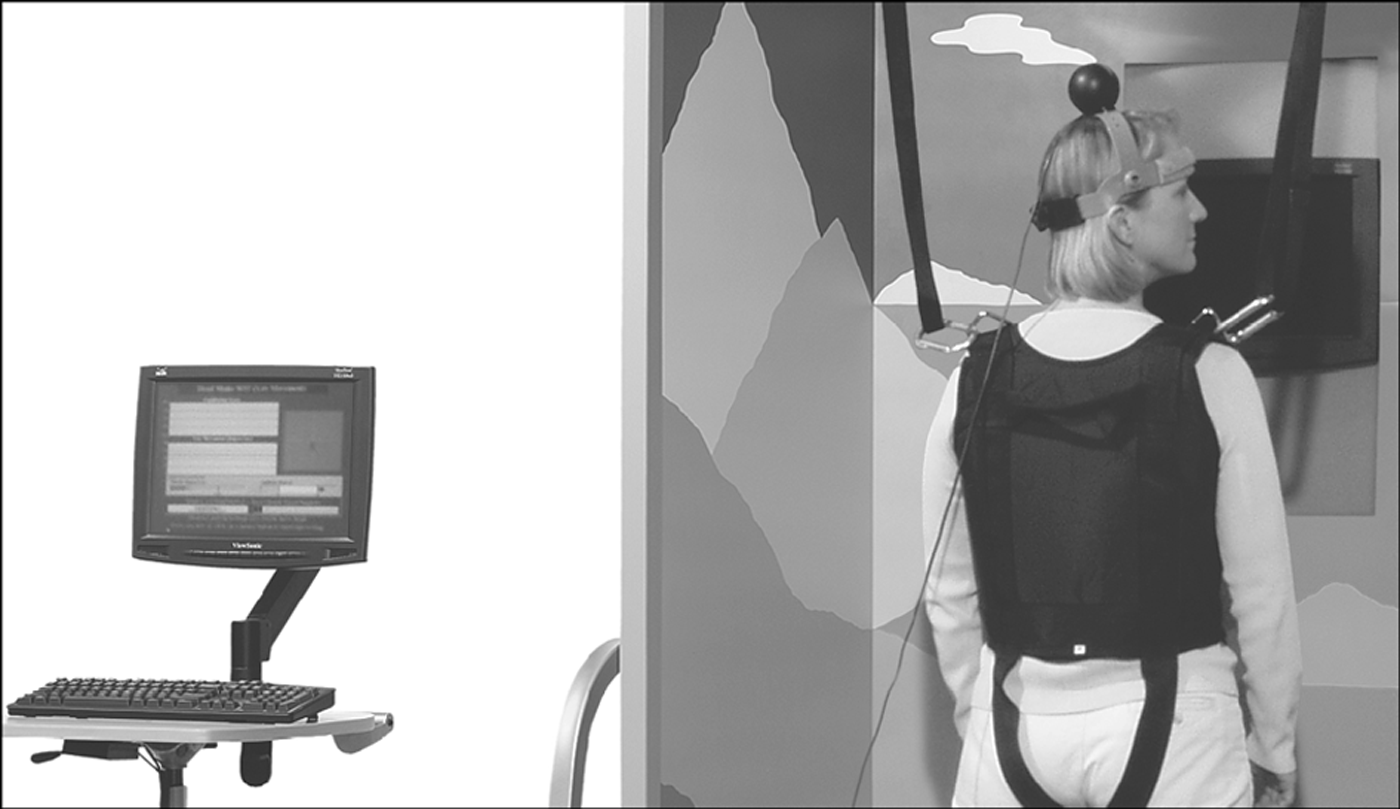
The head shake sensory organisation test was performed immediately after the sensory organisation test, with the same positioning. The head shake sensory organisation test adds head movement to the aforementioned conditions of the sensory organisation test, to further assess participants' abilities to use input from both the somatosensory system (condition 2) and the vestibular system (condition 5) to maintain balance (Figure 1).Reference Shepard, Cole, Bradshaw, Hyder and Parent24, Reference Mirsha, Davis, Speers and Shepard25, Reference Paloski, Wood, Feiveson, Black, Hwang and Reschke29, Reference Honaker, Converse and Shepard30 The head shake sensory organisation test has been shown to have good test-retest reliability for both of these conditions (0.85 and 0.78 respectively).Reference Pang, Lam, Wong, Au and Chow26 The computer compared performance in conditions 2 and 5 with their head still and with their head moving. For all trials, the head was rotating in a yaw movement (see Figure 2). The head piece was placed on the participant's head, and he or she was asked to stand with their eyes closed and to move his or her head side to side in a yaw movement, keeping time with a bell sound generated by the computer. This test, which was performed three times, is referred to as the fixed head shake sensory organisation test. Next, the participant was asked to perform the same head movement with his or her eyes closed while the force platform moved. This test, which was performed four times, is referred to as the sway head shake sensory organisation test. An equilibrium score for both conditions of the head shake sensory organisation test was determined by the computer, in which the head-still conditions of the sensory organisation test were compared with the head-moving conditions of the head shake sensory organisation test. Total possible scores on the head shake sensory organisation test range from 0 per cent to 100 per cent, with 100 per cent demonstrating the optimal postural control.
The head shake sensory organisation test, which entails modifications of the sensory organisation test conditions 2 and 5.
The final test for each participant was the functional gait assessment. This 10-item walking battery is a clinical test of the vestibular ocular reflex, vestibular spinal reflex (and balance) and function. The assessment has been shown to be reliable (interclass correlation coefficient = 0.93).Reference Wrisley, Marchetti, Kuharsky and Whitney27 The participants performed 10 different walking task assessments of: gait speed, gait while changing speeds, gait with horizontal head turns, gait with vertical head turns, gait with a rapid turn and stop, gait while stepping over an obstacle, heel-to-toe gait, gait with eyes closed, backwards gait, and gait on stairs. Subjects were guarded during performance of each task in order to prevent falls. Each task activity was scored on a 3-point scale with a score of 3 being normal.Reference Wrisley, Marchetti, Kuharsky and Whitney27 The total score for the 10 tasks was recorded. The total possible scores range from 10 to 30, with 30 being a perfect score.
Results and analysis
Analyses were performed using the Statistical Package for the Social Sciences version 14.0 (SPSS, Chicago, Illinois, USA). Possible confounders of age, number of medications and number of other diseases were first examined. The continuous confounders were not normally distributed and were therefore analysed using the non-parametric Mann–Whitney U test. The Mann–Whitney U test was also used for the fixed head shake sensory organisation test and the functional gait assessment results, which were not normally distributed. The independent t-test was used to determine differences between migraine groups for the left and right dynamic visual acuity test, the sensory organisation test and the sway head shake sensory organisation test.
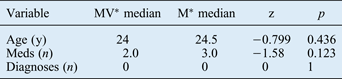
There were nine females and one male in both the migrainous vertigo group and the migraine without vertigo group. All participants were symptom free (no migraine and/or no vertigo) at the time of testing. Participant ages ranged from 18 to 53 years. The median age was 24.0 years (range 20–47 years) for the migrainous vertigo group and 24.5 years (range 18–53 years) for the migraine without vertigo group. Participants in both groups reported no history of neurological disorders, orthopaedic disorders or recent surgery. One participant in each group reported a history of hypotension due to unknown causes. The number of different medications taken by each participant ranged from 0 to 6 per day. Participants in the migrainous vertigo group took a median of 2.0 medications per day and participants in the migraine without vertigo group took a median of 3.0 medications per day. There were no statistically significantly differences between the two migraine groups for the above demographic variables (see Table II).
Demographic and clinical results
*n = 10. MV = migrainous vertigo group; M = migraine without vertigo group; y = years; meds = medications
The results revealed no statistically significant differences between the two groups in terms of the left and right gaze stabilisation test results (p = 0.305 and 0.222 respectively). The mean left gaze stabilisation test results were: 153.50 degrees per second (standard deviation (SD) = 33.54) for the migrainous vertigo group and 145.90 degrees per second (SD = 32.13) for the migraine without vertigo group. The mean right gaze stabilisation test results were: 139.40 degrees per second (SD = 51.18) for the migrainous vertigo group and 156.20 degrees per second (SD = 44.55) for the migraine without vertigo group (see Table III).
Independent t-test results
MV = migrainous vertigo group; M = migraine without vertigo group; df = degrees of freedom; GS = gaze stability; degree/sec = degrees per second; DVA = dynamic visual acuity loss; LogMAR = logarithm of the minimum angle of resolution; SOT-C = sensory organisation test composite score; HS-SOT = head shake sensory organisation test score
The mean left dynamic visual acuity loss was 0.19 (logarithm of the minimum angle of resolution; SD = 0.11) for the migrainous vertigo group and 0.14 (SD = 0.08) for the migraine without vertigo group. This difference was not significant (p = 0.101). The mean right dynamic visual acuity loss was 0.17 (logarithm of the minimum angle of resolution; SD = 0.17) for the migrainous vertigo group and 0.14 (SD = 0.08) for the migraine without vertigo group. Again, this difference was not statistically significant (p = 0.266) (see Table III).
The sensory organisation test and head shake sensory organisation test (fixed and sway) results are shown in Tables III and IV. There was no statistically significant difference (p = 0.192) in the sensory organisation test mean composite score between the migrainous vertigo group (mean = 79.30 per cent, SD = 4.00 per cent) and the migraine without vertigo group (mean = 77.00 per cent, SD = 7.11 per cent). In addition, there were no significant differences between the two groups for the fixed or sway head shake sensory organisation test scores (p = 0.094 and p = 0.466, respectively).
Mann–Whitney U test results
*p < 0.05. MV = migrainous vertigo group; M = migraine without vertigo group; HS-SOT = head shake sensory organisation test; FGA = functional gait assessment
The functional gait assessment results (Table IV) showed a statistically significant difference between the two groups (p = 0.006). Six of the 10 participants in the migrainous vertigo group scored below 30, which is the maximum score on this assessment (mean group score = 28.8, standard error = 0.3266). Only one participant in the migraine without vertigo group scored below 30 (mean group score = 29.90, standard error = 0.1000). The effect size for the functional gait assessment was large (r = 0.649).
Discussion
In this study, the only statistically significant difference in vestibular functioning found between the groups during a non-migrainous period was in the functional gait assessment, wherein the migrainous vertigo group scored lower on average than the migraine without vertigo group. Measures of the vestibular ocular reflex, specifically gaze stability and dynamic visual acuity, showed no significant differences between these two groups.
The gaze stability findings for both groups in the current study were similar to the normative data reported by Pritcher et al. Reference Pritcher, Whitney, Marchetti and Furman19 However, these authors found that gaze stabilisation was slower in participants with abnormal vestibular systems, especially for movements in a pitch (nodding head yes) direction. We only examined gaze stabilisation during yaw (shaking head no) movements. This may be why no group difference was observed in the current study. This lack of a difference could also be due to the low power in terms of the effect sizes, which were 0.19 on the right and 0.23 on the left.
The combined dynamic visual acuity loss of both groups in the current study (the logarithm of the minimum angle of resolution was 0.159) was higher than the established norm of a slightly older age group (for which the value was 0.094) (see Figure 3).Reference Schubert, Migliaccio, Clendaniel, Allak and Carey21 Schubert et al. also found that the dynamic visual acuity loss of a vestibular disorder group was significantly higher than that of a group with no vestibular disorder.Reference Schubert, Migliaccio, Clendaniel, Allak and Carey21 There was no difference between the two groups in the current study; however, both scores were above published norms (see Figure 3), suggesting that both groups struggled with the dynamic visual acuity test. Another reason why there was no group difference in this test might be because the power was extremely low, with effect sizes of 0.15 for the right and 0.37 for the left movement.
(a) Left and (b) right dynamic visual acuity loss of migrainous vertigo and migraine without vertigo groups compared with norms (below blue line). DVA = dynamic visual acuity loss; LogMAR = logarithm of the minimum angle of resolution
In the current study, the sensory organisation test results revealed no significant differences between the migrainous vertigo group and the migraine without vertigo group. This finding is different from that of Ishizaki et al., who reported a difference in this test between individuals with migraine and those with tension headaches.Reference Ishizaki, Mori, Takeshima, Fukuhara, Ijiri and Kusumi22 He found that migraine sufferers had more difficulty with conditions that required the eyes to be closed. The computerised dynamic posturography equipment used in the Ishizaki et al. study was different to the NeuroCom system used in the present study. In addition, the tasks that the participants were asked to do in that study were more difficult than the sensory organisation test used in the current study. These differences may help to explain the inconsistent finding. Furman et al. also examined individuals with migrainous vertigo using the NeuroCom system.Reference Furman, Sparto, Soso and Marcus8 The authors found that those participants had more difficulty than individuals in a non-migraine group. Again, the tasks performed were more difficult than those in the sensory organisation test. In agreement with the current findings, von Brevern et al. found that vestibular spinal reflexes were normal when assessed during a non-migrainous period. The findings suggest that the sensory organisation test may be too easy to distinguish between migrainous vertigo and migraine without vertigo. If the computerised dynamic posturography tasks were more difficult, a difference between the two groups might have been found. This hypothesis is in agreement with Shepard et al., who stated that the sensory organisation test may not be sensitive enough to pick up differences in those with well-compensated vestibular lesions.Reference Shepard, Cole, Bradshaw, Hyder and Parent24
The head shake sensory organisation test was developed partly because of the insensitivity of the sensory organisation test for examining vestibular lesions.Reference Shepard, Cole, Bradshaw, Hyder and Parent24, Reference Mirsha, Davis, Speers and Shepard25, Reference Paloski, Wood, Feiveson, Black, Hwang and Reschke29, Reference Honaker, Converse and Shepard30 The current study revealed no statistically significant difference between the migrainous vertigo group and the migraine without vertigo group on the fixed head shake sensory organisation test. In condition 2 of the sensory organisation test, participants are required to stand on a firm surface with their eyes closed. The results were compared with head-still and head-moving data. Neither group in the present study had low scores for the fixed head shake sensory organisation test, indicating no somatosensory-related loss.Reference Pang, Lam, Wong, Au and Chow26 This finding was as expected. Difficulty performing the sway head shake sensory organisation test is indicative of vestibular problems. Unexpectedly, the sway test also revealed no significant difference between groups in the current study. However, both groups' sway test scores were well below normal means (see Figure 4).Reference Pang, Lam, Wong, Au and Chow26 This suggests that both groups may have had difficulty performing this higher-level vestibular task.
• Migrainous vertigo is a common but under-diagnosed condition
• Functional, clinical testing of migrainous vertigo has not been performed
• More information about migrainous vertigo is needed to guide vestibular rehabilitation
• Dynamic visual acuity loss was greater in migrainous vertigo and migraine without vertigo groups compared with norms
• Head shake sensory organisation sway (yaw) scores of both migraine groups were below normal
• Functional gait results showed differences between migrainous vertigo and migraine without vertigo groups
Head shake sensory organisation test results (sway-referenced) of migrainous vertigo and migraine without vertigo groups compared with norms (above blue line).
Gait is a functional activity that requires vestibular ocular reflexes, vestibular spinal reflexes and balance.Reference Whitney, Marchetti, Pritcher and Furman20 The functional gait assessment was developed specifically to assess gait in those with vestibular abnormalities.Reference Wrisley, Marchetti, Kuharsky and Whitney27 However, we found no studies that compared migrainous vertigo with migraine without vertigo using this assessment. In the current study, the migrainous vertigo group scored lower than the migraine without vertigo group (Figure 5). The minimal clinical difference for the functional gait assessment has not been established; however, a large effect size was recorded in the current study. Walker et al. determined the normative means for this assessment based on community dwelling adults between the ages of 40 and 89 years.Reference Walker, Austin, Banke, Foxx, Gaetano and Gardner28 He found an inverse relationship between age and functional gait assessment score, in which the mean score decreased every 10 years. For the 40–49 year old age group, the average score was 29 in the Walker et al. study. In the current study, only 3 subjects out of the 20 were in this age group and their average functional gait assessment score was 30. Normative values for the 20–29 year old group and 30–39 year old group were not determined, and may therefore be higher than that reported by Walker et al. for the 40–49 year old group.Reference Walker, Austin, Banke, Foxx, Gaetano and Gardner28
Functional gait assessment results of migrainous vertigo and migraine without vertigo groups.
Limitations and future directions
Limitations of the present study include the fact that the sample was small and non-randomised. The power for the gaze stabilisation test, dynamic visual acuity test, sensory organisation test and head shake sensory organisation test ranged from 0.06 to 0.37, indicating that the sample size was too small to show a significant difference. Therefore, a similar study with a larger sample size is indicated. The sensory organisation test, a test used in this study to measure balance, may have been too easy for both groups of participants. In addition, self-reports of a physician's diagnosis of migraine may be inadequate. Further studies should include a larger sample, a non-migrainous control group, more difficult testing with the sensory organisation test, pitch testing in both the dynamic visual acuity test and in the head shake sensory organisation test, and physician-documented migraine diagnosis. The functional gait assessment findings should also be verified with a larger sample size.
Conclusion
The only statistically significant vestibular-related difference between the migrainous vertigo group and migraine without vertigo group was in the functional gait assessment scores, which were lower in the migrainous vertigo group. This may be because the functional gait assessment requires both vestibular ocular reflexes and vestibular spinal reflexes (and balance), and is therefore a more complicated task. It is also important to note that both groups' scores for the dynamic visual acuity test and the sway head shake sensory organisation test were well below published norms. This raises the question of whether there are some underlying abnormalities in the vestibular systems of individuals who suffer from migraine in general.
In conclusion, we found that there was a functional difference between the migrainous vertigo group and the migraine without vertigo group during a non-migrainous period. Further research is needed to determine whether there are specific differences in vestibular ocular reflexes and vestibular spinal reflexes in these populations, during both a non-migrainous period and a migrainous period.