Introduction
A key focus of the transformation of the higher education agenda in South Africa has been to improve access and participation (Ramrathan, Reference Ramrathan2016). Related to this is the need to ensure that students make successful educational transitions. Although participation rates during the teenage years are relatively high in South Africa, there is concern that most young people do not progress to higher school grades, and even fewer to tertiary education (Spaull, Reference Spaull2015). The average number of years of education received by young people in South African is estimated to be 10 years, a status quo that has been attributed primarily to poor schooling and socioeconomic inequality (Spaull, Reference Spaull2015). In this study, an argument is made that the trajectory through schooling is more complex than this and that young people in South Africa face many risks along the life course. Among the many transitions from adolescence to adulthood, sexual debut and/or the establishment of sexually based relationships are the most important dimensions, which also present many dangers (McCarthy & Grodsky, Reference McCarthy and Grodsky2011; Clark & Mathur, Reference Clark and Mathur2012; Egondi et al., Reference Egondi, Kabiru, Beguy, Kanyiva and Jessor2013).
Statistics from South Africa reveal that in 2011 approximately 68,000 teenagers fell pregnant (Statistics South Africa, 2013). These numbers do not seem to abate, as the statistics in 2013 showed that more than 99,000 schoolgirls fell pregnant – a rate of about 271 for every day of that year (Statistics South Africa, 2013). Regarding HIV and AIDS, the research base shows that there is a higher prevalence amongst young people aged 15–24 years (Shisana et al., Reference Shisana, Rehle, Simbayi, Zuma and Jooste2009). In other words, HIV and AIDS affects young people on the verge of completing high school and making the transition to post-secondary education; that is, education after high school, including diploma, certificate and degree programmes. By extension, the HIV and AIDS pandemic, together with teenage pregnancy, mean that only a few individuals will make it beyond high school. Clearly, and in the context of Education for All and Sustainable Development Goal 5, adolescent sexual behaviour is one of the biggest threats to access to education and equality of educational outcomes in South Africa.
In line with the growing interest in teenage sexuality, this study sought to explore the association between sexual behaviours initiated in adolescence and one academic milestone: the initiation of post-secondary education (PSE). The specific question that this study sought to answer was: What is the association between the timing of sexual debut and the transition to post-secondary education in South Africa? There are several reasons why PSE is an important focus of research. Firstly, it is a barometer of the skill level of the future workforce of a society (Cutler et al., Reference Cutler, Huang and Lleras-Muney2015). Secondly, the available research on the benefits of education has established higher returns to post-secondary education (May, Reference May2014). Individuals who have some form of PSE are also likely to have better career opportunities and monetary independence (Shaw & Dukes, Reference Shaw and Dukes2013).
Prior research, both locally and internationally, has identified several predictors of early sexual debut amongst adolescents (Parkes et al., Reference Parkes, Wight, Henderson and West2010; Marston et al., Reference Marston, Beguy, Kabiru and Cleland2013). Recurrent themes have focused on gender and economic opportunities, social class, race and level of education. For instance, studies from southern Africa have linked poverty to reported risky sexual behaviours (Madise et al., Reference Madise, Zulu and Ciera2007; Shisana et al., Reference Shisana, Rehle, Simbayi, Zuma and Jooste2009; Wamoyi et al., Reference Wamoyi, Wight and Remes2014) such as casual sex (Tadesse & Yakob, Reference Tadesse and Yakob2015; Lyons et al. Reference Lyons, Manning, Longmore and Giordano2015) and transactional sex (Udingwe et al., Reference Posel and Rudwick2014; Ranganathan et al., Reference Ranganathan, Heise, Pettifor, Silverwood, Selin and MacPhail2016). Thus, in the case of transactional sex, the need to survive becomes the motivation behind the sexual activity of adolescent girls. Research has also established the protective effects of family socioeconomic status against early sexual debut (Stephenson et al., Reference Stephenson, Calleen and Finneran2014).
Family structure is another factor that is commonly associated with both sexual debut and educational attainment (Frantz et al., Reference Frantz, Sixaba and Smith2015). Growing up with one or no parent has been shown to be related to early sexual debut, teenage pregnancy and low educational attainment (Mhele & Ayiga, Reference Mhele and Ayiga2014). This is largely because children who grow up in broken families are more likely to have weak attachments and a propensity to engage in risky behaviours (Reichert et al., Reference Reichert, Atkins, Ituah and Atkins2016). In South Africa, as in many developing countries, family structure also presents an emerging social complexity (Posel & Rudwick, Reference Posel and Rudwick2014). There is a growing prevalence of non-traditional families, characterized by single parenthood or child household heads – a situation that has been attributed primarily to the HIV epidemic (Monasch & Boerma, Reference Monasch and Boerma2004; Makiwane et al., Reference Makiwane, Makoae, Botsis and Vawda2012). In addition to family background factors, a negative correlation between early sexual debut and schooling has been documented (Frisco, Reference Frisco2008; Doyle et al., Reference Doyle, Mavedzenge, Plummer and Ross2012). There is evidence suggesting that while keeping young people in school might not deter them from having sex, it enables them to make better sexual decisions (Marteleto et al., Reference Marteleto, Lam and Ranchhod2008). Similarly, Zuilkowski and Jukes (Reference Zuilkowski and Jukes2012) found that being enrolled in school had protective effects against early sexual debut for girls, although there was mixed evidence for boys. Apart from the key issues highlighted above, there are other emerging social complexities that have compounded the issue of adolescent sexual debut. For instance, in South Africa, non-marital fertility has become more acceptable and has influenced sexual behaviours (Madhavan et al., Reference Madhavan, Harrison and Sennott2013; De Wet & Gumbo, Reference De Wet and Gumbo2016).
What is clear from all these studies is that early sexual debut during the adolescent years is a common phenomenon. Further, it is a well established fact that early sexual debut is associated with negative outcomes. However, in this study, an argument is made that the research base has been limited, particularly in South Africa where the focus has been on short follow-up times and the negative associations between sexual activity and immediate outcomes. For instance, South African based studies have explored the association between sexual behaviours and immediate educational outcomes such as school enrolment and drop-out (Marteleto et al. Reference Marteleto, Lam and Ranchhod2008), or the role of peer effects on sexual behaviours and school attainment (Lam et al., Reference Lam, Ardington, Branson, Case, Leibbrandt and Maughan-Brown2012). Other studies have also documented the negative effects of teenage pregnancy on educational outcomes (Mchunu et al., Reference Mchunu, Peltzer, Tutshana and Seutlwadi2012; Timæus & Moultrie, Reference Timæus and Moultrie2015). However, little is known in South Africa regarding whether these effects continue into young adulthood. Even internationally, research on the associations between teenage sexual debut and subsequent academic underachievement has been modest (Spriggs & Halpern, Reference Spriggs and Halpern2008; Frisco, Reference Frisco2008; Parkes et al., Reference Parkes, Wight, Henderson and West2010). Bengesai et al. (Reference Bengesai, Khan and Dube2017) attempted to expand on this work by exploring the effect of early sexual debut on the completion of high school in South Africa, measured at age 21. Their study revealed a negative correlation between early sexual debut and high school completion – with individuals who had initiated sex between the ages of 9 and 14 displaying the worst outcomes. The current study sought to take this work a step further and interrogate the long-term effects of early sexual debut on the initiation of post-secondary education (PSE) in South Africa.
The theoretical considerations are drawn from Problem Behaviour Theory (Jessor, Reference Jessor1991), which is premised on the belief that failure to effectively negotiate maturational transitions can lead to a constellation of problem behaviours (Spriggs & Halpern, Reference Spriggs and Halpern2008). Such behaviours might include sexual initiation, substance use, crime and avoidance of studying. Further, individuals who initiate sex early are more likely to lack social bonds with their families and schools – factors that can lead to depressed academic aspirations (Parkes et al., Reference Parkes, Wight, Henderson and West2010). The theory further posits that it is the balance between the risk and protective factors that determines the outcomes. In this study, the risky behaviour studied was sexual debut, which was expected to co-vary with other risky behaviours such as illegal substance use, cigarette smoking and drinking alcohol and neglect of school homework, while factors such as family background and aspirations were used as protective factors.
Methods
Data set
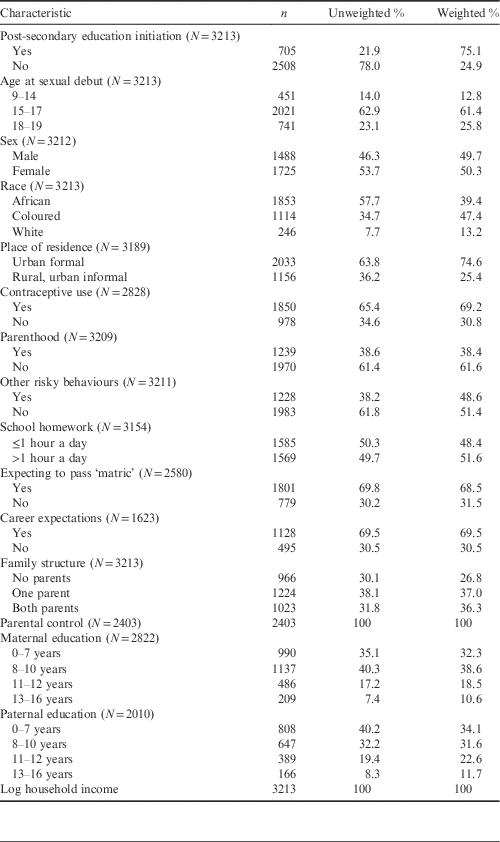
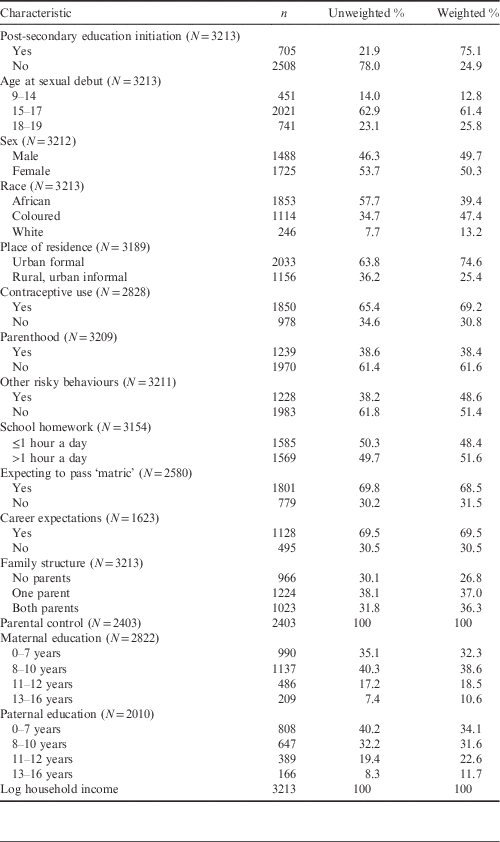
The study data were from Waves 1–5 (2002–2009) of the Cape Area Panel Study (CAPS) – a longitudinal survey that was designed to understand the sexual behaviours and educational outcomes of young adults in Cape Town, South Africa. The data were collected through face-to-face interviews and the target population were young people aged 14–22 years. The baseline study (Wave 1) was conducted in 2002 and 4752 young people between the ages of 14 and 22 from 3304 households were successfully interviewed. Further details about the sample and design are provided by Lam et al. (Reference Lam, Ardington, Branson, Case, Leibbrandt and Maughan-Brown2012). The total attrition rate between Waves 1 and 5 was estimated to be 32%. To account for the attrition, non-response weights as recommended by Lam et al. (Reference Lam, Ardington, Branson, Case, Leibbrandt and Maughan-Brown2012) were applied. Mindful that the focus was on individuals who reported initiating sex during adolescence, a restricted sample of 3213 young people was used and the analysis was undertaken when the youngest cohort was aged 21 years. The selected characteristics used in the analysis are presented in Table 1. The CAPS survey also obtained information about educational attainment, household characteristics and sexual behaviour. This makes it an appropriate data set to investigate the effect of sexual debut on participation in tertiary education.
Characteristics of the study sample of young people in Cape Town aged 14–22 who had their sexual debut in adolescence, Cape Area Panel Study, 2002–2009
Dependent variable
The dependent variable, post-secondary education (PSE) initiation (0=no, 1=yes), indicated whether an individual had received some post-secondary education or not. Table 1 shows that approximately 25% of the individuals who had initiated sex in their adolescent years had initiated post-secondary education by age 21. In South Africa, children generally start school in the year they turn 6 (before the 30th of June) (Education Laws Amendment Bill, Section 5 of Act 50, 2002). Therefore, an individual should finish high school (secondary education) by age 18 or 19. Thus, an assumption was made that by age 21 an individual should have initiated post-secondary education if they completed high school on time.
Key independent variable
The key independent variable was age at sexual debut (ASD) and was derived from the question that asked respondents about their age at first sex. This variable was coded as a three-level categorical variable: early debut (9–14 years), normative debut (15–17) and late debut (18–19 years, reference group). These categories reflect the general trends in ASD, which have also been used in previous studies (Sandfort et al., Reference Sandfort, Orr, Hirsch and Santelli2008; Khothari et al., Reference Kothari, Shanxiao, Head and Abderrahim2012).
Other independent variables
The most intuitive explanation of the relationship between ASD and educational attainment is the probability of pregnancy, which is mediated by contraceptive usage (Frisco, Reference Frisco2008). Hence, both parenthood and contraceptive non-use at first sex were considered as related factors that influence academic achievement. Other risky behaviours examined included smoking cigarettes, using marijuana or other drugs (illegal substance use) and drinking alcohol.
Expecting to pass the school leaving examination (called matriculation or ‘matric’) and having career expectations were used as proxy indicators for ‘aspirations’. Such aspirations have been referred to in the literature as ‘aligned ambitions’ (see Frisco, Reference Frisco2008; McCarthy & Grodsky, Reference McCarthy and Grodsky2011), and it has been suggested that students with aligned ambitions know the type of career they want to pursue and are likely to be strategic academically and put in the effort to realize their ambitions. Thus, time spent on school homework per day was included and coded as a dummy to represent either neglect of homework (≤1 hour spent on homework a day) or homework commitment (>1 hour spent on homework a day).
The household characteristics included in the study were: family structure, parental control, parental education and household income. These variables were carefully chosen in line with previous research (Frisco, Reference Frisco2008; Monserud & Elder, Reference Monserud and Elder2011), as well as the theoretical framework adopted. Parental education and household income were used as proxies for family socioeconomic status, while family structure and parental control were proxies for attachment and transmission of social capital. In line with previous research, the ‘parental control’ variable was created from a set of questions that asked about parental investment in the child (Monserud & Elder, Reference Monserud and Elder2011). This included questions about the frequency of family meals, parents spending time with their children and discussing personal matters, among other things.
In the data set, both the respondent’s mother’s and father’s education were reported in terms of number of years of schooling. For the analysis, the variables were re-coded as a four-level categorical variables: 0–7 years=no schooling; 8–10 years=lower secondary education; 11–12 years=upper secondary education; and 13–16 years=post-secondary/tertiary education. Family structure was coded to represent residence with parents and was coded as i) both parents were non-resident (No parents); ii) one parent was resident (One parent) and iii) both parents were resident (Both parents). The parental control variable was a summed indicator, which was constructed from the questions asking whether the mother or father shared dinner with the child, spent time and or discussed personal matters, as well as whether the parents bought gifts for their children. Household income was logged for skewness.
Control variables
The study also considered the demographic variables ‘population group’ and ‘place of residence’. In the data set, population group was recorded as a three-level categorical variable: African (reference category), Coloured and Indian (merged into one category) and White. Place of residence was transformed into a dummy variable: 1=urban formal; 2=rural/urban informal.
Analytical strategy
From a conceptual point of view, the present study was interested in the ultimate outcome (initiation of PSE) and the association with sexual debut and other explanatory variables. The dependent variable, PSE initiation, was treated as a dichotomous variable that took the value of either 0 (No PSE) or 1 (initiated PSE). Therefore, a binary logistic regression model was used.
For both males and females, two models were estimated. Model 1 estimated the independent effects of each of the selected variables on the initiation of PSE while controlling for age at sexual debut. Model 2 was adjusted for individual aspirations and family background.
Results
Characteristics of study sample
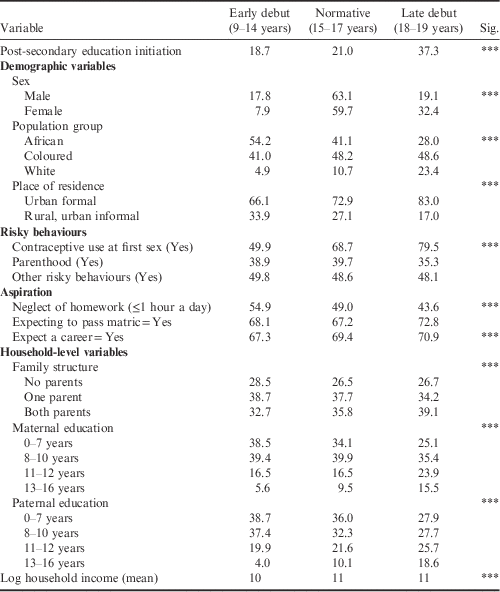
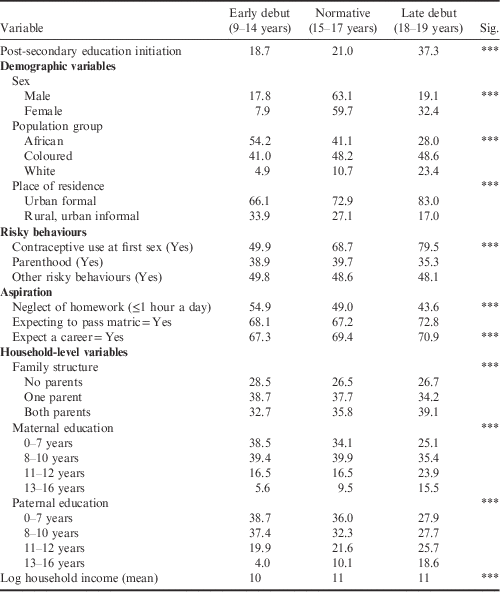
The normative age at sexual debut (ASD) rate of the study sample was 61.4%, while 25.8% had their sexual debut at ages 18–19 (Table 1). Only 12.8% had an early sexual debut (9–14 years). More than two-thirds of the young people in the survey reported using some form of contraceptive at first sex. Approximately 49% of the young people had engaged in other risky behaviours such as smoking cigarettes, drinking alcohol or using illegal drugs. Table 2 reports the means and percentages for all the variables used in the analysis by the key explanatory variable, ASD. There was a higher likelihood of initiating PSE if sexual debut was delayed. Urban youths were more likely to engage in sexual activity in general (66.1% of youths in formal urban areas had an early sexual debut vs 33.9% in rural/informal urban areas). Young people who delayed sexual debut were more likely to use contraceptives at first sex compared with those who initiated sex in early adolescences. There was no significant difference, however, in the rate of teenage parenthood between different ASD categories.
Bivariate association (means and percentages) between age at sexual debut and selected variables (weighted), Cape Area Panel Study, 2002–2009
***p<0.005.
Youth who delayed sexual activity also had greater ambitions such as studying for more than one hour a day or aspiring to pass ‘matric’, while the offspring of parents who had some post-secondary education were less likely to have an early sexual debut. Regarding race, Africans and Coloureds were more likely to engage in early sex. The descriptive statistics in Table 2 also demonstrate a strong association between ASD and all selected variables (p-value <0.001 for all variables).
Regression analysis results
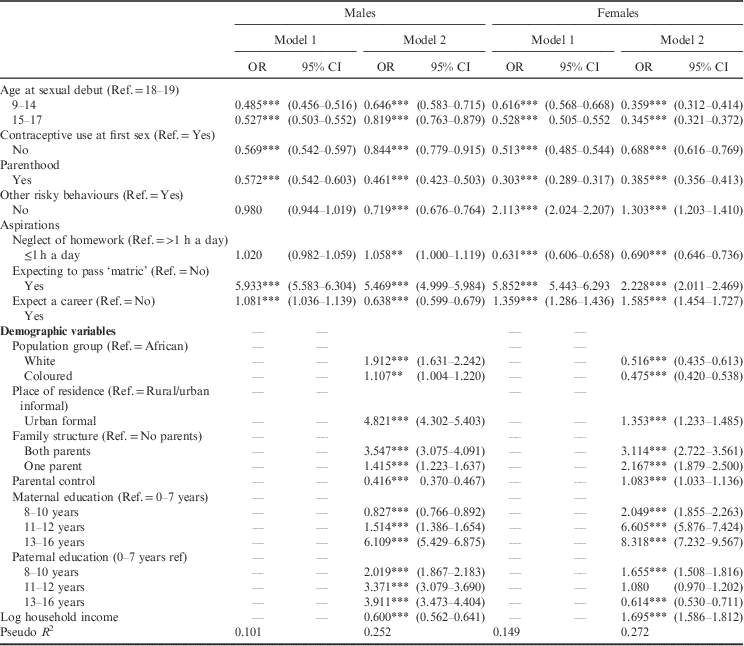
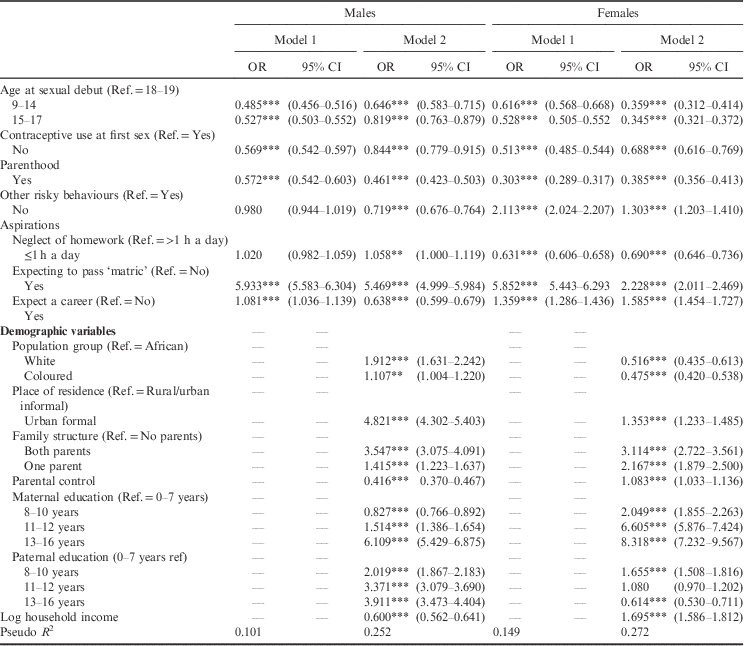
Table 3 presents the logistic regression models for post-secondary education enrolment for males and females separately. Model 1 examines the relationship between sexual behaviours, aspirations and PSE initiation. Model 2 addresses the question of whether the relationship between sexual debut and PSE initiation is attributable to demographic and background factors. In Model 1, the probability of initiating PSE was found to be negatively associated with early sexual debut.
Odds of initiating post-secondary education for young people in Cape Town aged 14–22 who had their sexual debut during adolescence, Cape Area Panel Study 2002–2009
***p<0.005.
Males
For males, the odds of initiating PSE were 52% less if sexual debut occurred in pre- and early adolescence (9–14 years) and 47% less if it occurred in the mid-teenage years, relative to those who initiated sex in late adolescence (18–19 years). Teenage parenthood and contraceptive non-use were also negatively associated with PSE initiation in both models for males. Engaging in other risky behaviours had a borderline negative effect (2%) on PSE enrolment in Model 1, which was not statistically significant. In Model 2, males who engaged in other risky behaviours in addition to early sexual debut had reduced odds (28% less) of PSE initiation relative to those who did not engage in such behaviours. Spending less time on school homework increased the odds of PSE initiation by about 6% in Model 2, although this effect was not significant in the first model. Expecting to pass ‘matric’ increased the odds by a factor of up to 6 in Models 1 and 2, while having career aspirations increased the odds by about 8% in Model 1, although this effect attenuated to negative in Model 2 (OR=0.638) when demographic and household characteristics were adjusted for. In Model 2, being White increased the odds of PSE enrolment by 91%, while being Coloured increased the odds by about 11% compared with being African. Urban dwellers were up to 4.8 times more likely to have better outcomes than their counterparts in rural/informal urban areas. Looking at family structure, the analysis demonstrated that children from both two-parent (OR=3.547) and lone-parent (OR=1.415) families were more likely to be in PSE relative to their counterparts who did not reside with either parent. Despite the importance of parental control on educational outcomes, as highlighted in the literature, the parental control measure in this study was negatively correlated with PSE initiation for the male population. As expected, levels of parental education had different effects on educational outcomes, with parental PSE (both maternal and paternal) exhibiting the strongest effect on PSE enrolment. Household income was negatively associated with PSE initiation (OR=0.600).
Females
The general pattern for the female population was similar to that for males, with a few exceptions. Both early (9–14 years, OR=0.616) and typical sexual initiators (15–17 years, OR=0.528) had significantly lower odds of making the transition to PSE compared with late initiators. However, this effect seemed to decrease in Model 2 (9–14 years, OR=0.359; 15–17 years, OR=0.345) when family background characteristics were factored in. Likewise, teenage parenthood and contraceptive non-use were negatively associated with PSE transition. However, there was a significant difference in the size of the coefficient between male teenage parents (OR=0.572, Model 1; OR=0.461, Model 2) and female teenage parents (OR=0.303, Model 1; OR=0.385, Model 2). This demonstrates that the difference in PSE enrolment between males and females is attributable to parenthood. Unlike in the male models, spending less time on school homework resulted in negative outcomes for the females, while aspirations such as expecting to pass ‘matric’ or aspiring to have a career increased the odds by a factor of 5.4 (pass matric=yes, Model 1) and 1.5 (career aspirations=yes, Model 2). It is important to note, however, that the addition of the family background factors reduced the size of the effect for the female population from OR=5.822 (Model 1) to OR=2.228 (Model 2). Contrary to expectations, both White and Coloured females were less likely to make the transition to PSE relative to their African counterparts. Residence in urban areas had a positive effect (1.353) and just as in the male model, both dual- and lone-parent families were positively associated with PSE enrolment. Parental control increased the odds by about 8.3% while maternal PSE had the strongest effect on female PSE enrolment. Interestingly, paternal PSE was negatively associated with females making the transition to PSE. The effect of paternal high school education was positive but not statistically significant. Female individuals in better-off households were significantly more likely to complete matric (70% more) than those in poorer households.
Discussion
In line with the theoretical framework adopted in this study, several factors were found to act either as hindrances or as protective factors to post-secondary education enrolment in this sample of young people in South Africa. Early sexual debut (by age 17) was negatively associated with initiation of PSE for both males and females. Other variables that had a negative effect included non-contraceptive use at first sex, parenthood, illegal substance use and studying for less than an hour a day. Higher levels of parental education (except for paternal education in the female model), urban residence and higher aspirations and analogous behaviours (studying) acted as protective factors and were positively associated with PSE initiation.
While the negative relationship between early sexual debut and educational outcomes has been well researched, there is little consensus as to why this is the case. Some studies from South Africa (Marteleto et al., Reference Marteleto, Lam and Ranchhod2008; Timæus & Moultrie, Reference Timæus and Moultrie2015), as well as internationally (Frisco, Reference Frisco2008), have suggested that the negative correlation between sexual debut and educational outcomes can be explained by the risk it confers to unplanned pregnancies/parenthood. However, a UK study by Parkes et al. (Reference Parkes, Wight, Henderson and West2010) found that while early sexual debut reduced participation in tertiary education, pregnancy did not explain all the gaps between males and females in PSE initiation. This discrepancy in the findings could be attributed to differences in the levels of education studied as well as the differing contexts. Both Timæus and Moultrie’s (Reference Timæus and Moultrie2015) and Marteleto et al.’s (2008) studies focused on high school levels while Frisco’s (Reference Frisco2008) study was conducted in the United States. There are also scholars who have argued that young people who become preoccupied with sex are less likely to concentrate in class and more likely to engage in other risky behaviours (Spriggs & Halpern, Reference Spriggs and Halpern2008; Pham et al., Reference Pham, Keenan and Han2013). This is particularly so when sexual behaviours occur in the context of romantic relationships (Clark & Mathur, Reference Clark and Mathur2012; Pham et al., Reference Pham, Keenan and Han2013). The evidence from the current study seems to mirror this prior research and demonstrates a significant negative relationship between sexual behaviour, contraceptive non-use, pregnancy and educational outcomes. Further, individuals who initiated sex in early adolescence (9–14 years) were likely to spend less time studying relative to those who initiated sex later in adolescence (Table 2). Additionally, the difference in effect size between males and females suggests that pregnancy accounted for a significant amount of the gap in PSE initiation between males and females. Despite the diverse explanations in the literature, the current study, taken together with prior research, suggests that early sexual debut is a major and consequential transition in the life course of a young person, with negative implications for first birth/parenthood and academic achievement in emerging adulthood.
It may be noted that the association between enrolling in PSE and sexual debut is not as automatic as it may at first appear (Parkes et al., Reference Parkes, Wight, Henderson and West2010). Educational attainment has been conceptualized as both a consequence of sexual risky behaviour, as well as an antecedent (Marteleto et al., Reference Marteleto, Lam and Ranchhod2008; Zuilkowski & Jukes, Reference Zuilkowski and Jukes2012). For instance, school drop-out has been seen as a causal effect of teenage pregnancy (Rosenberg et al., Reference Rosenberg, Pettifor, Miller, Thirumurthy, Emch and Afolabi2015). At the same time, a higher prevalence of pregnancy has been reported amongst girls who are out of school than those who are in school (Marteleto et al., Reference Marteleto, Lam and Ranchhod2008). Furthermore, evidence emanating from South Africa has indicated that drop-out after Grade 10 is a characteristic phenomenon of the education system (Spaull, Reference Spaull2015). While the present study found that sexual debut and pregnancy or parenthood were negatively associated with PSE, the possibility that pregnancy and sexual behaviour may have followed school-leaving cannot be ignored. However, in this study drop-out was not examined as the main outcome, yet the findings suggest that high academic aspirations are beneficial for PSE enrolment. Hence, it can be inferred that young people with high aspirations are likely to persist in school. The analysis undertaken in this study does not, however, allow for casual inferences to be made, thus future studies should prioritize this.
Perhaps there is need to explore why young people with ‘aligned ambitions’, such as spending more time on school homework, expecting to pass ‘matric’ and having a career, are more likely to have better educational outcomes, despite having have initiated sex early. This finding reinforces the notion that young people with aligned ambitions are more likely to be strategic academically (Frisco, Reference Frisco2008) and that these aspirations may extend to other domains. Spriggs and Halpern (Reference Spriggs and Halpern2008) also argued that young people with aligned ambitions are more likely to postpone sexual activity as a way of safeguarding their future goals. Table 2 illustrates that young people with expectations to pass ‘matric’, or who had career expectations, were more likely to be late initiators, although the percentage difference between early and late initiators was not very great. There is a possibility, therefore, that although sexual activity was initiated early, their personal ambitions might have influenced them to abstain later on. This is only a speculative point given that the study did not examine consistency of sexual behaviour over the period of investigation. Alternatively, the small percentage difference suggests that aspirations account for much of the variation and perhaps have a more direct effect on PSE enrolment.
In South Africa, socioeconomic status is more prominent due to the history of racial disparity that was legislated under the apartheid system (Seekings, Reference Seekings2011; Mhlauli et al., Reference Mhlauli, Salani and Mokotedi2015). These racial disparities have affected every aspect of life, leaving South Africa with immense income disparities, which rank amongst the highest in the world. In this study, both sexual debut and the initiation of PSE among young people differed significantly by race and family socioeconomic status. For instance, there was high rate of early sexual debut among Africans, and a high PSE enrolment rate among White males and the children of parents with post-secondary education. Regarding parental education, there is a consensus that scholarly behaviours are passed down within families from one generation to another (Bernadi & Requena, Reference Bernardi and Requena2010; Monserud & Elder, Reference Monserud and Elder2011). The findings of this study seem to reinforce this view as parental PSE (except for parental education in the female model) was found to be the strongest predictor of enrolment in PSE. There are many explanations as to why parental education has a positive effect on educational outcomes. First, parental education is an index of socioeconomic status, which potentially leads to better educational outcomes for children (Martin, Reference Martin2012; Lundborg et al., Reference Lundborg, Nilsson and Rooth2014; Mutodi & Ngirande, Reference Mutodi and Ngirande2014). This is because parental education can generate higher incomes, which can be used to invest in children. Put simply, more educated and richer parents can provide a better environment for their children’s educational achievement (Chevalier et al., Reference Chevalier, Harmon, O’ Sullivan and Walker2013). Additionally, educated parents might have learnt positive skills and habits during their schooling that they can transfer to their children through modelling behaviour (Martin, Reference Martin2012). Recall that Table 2 shows that children of better-educated parents had later sexual debuts. By extension, these children are at a lesser risk of sexually transmitted diseases and/or teenage parenthood. Similarly, and as Lundborg et al. (Reference Lundborg, Nilsson and Rooth2014) noted, education improves productive efficiency so the more educated parents can choose a more favourable mix of inputs in the production of their children’s human capital.
One of the assumptions made in this study, in accordance with Problem Behaviour Theory, is that quality of parenting matters for children’s outcomes (Jessor, Reference Jessor1991; McCarthy & Grodsky, Reference McCarthy and Grodsky2011). Yet, unlike family structure and parental education, the parental control variable used in this study did not account for much of the variation in educational attainment. The study results suggest that parental control only accounted for 8% of the gap in PSE attainment for the females, while for the males the effect was negative. However, this finding is consistent with several prior studies, which found weak associations between parental control and educational outcomes (Crosnoe, Reference Crosnoe2001; Monserud & Elder, Reference Monserud and Elder2011). For instance, Crosnoe (Reference Crosnoe2001) found that although important, the effect of parental quality tends to decline as children transition to high school. It can be inferred from the current study that the effect of parenting quality is even weaker at post-secondary level, since at this level children are generally significantly more independent and their behaviour is influenced by diverse institutions.
Another important determinant of children’s educational outcomes is family income. This study found that family income had no effect on PSE enrolment for males, while it increased the odds for females. This was an unexpected finding given the relevance of socioeconomic and finance discrepancies in South Africa. There are several possible reasons as to why the family income variable behaved in this manner. In South Africa, children from disadvantaged families are supported through the National Student Financial Aid Scheme (NSFAS), which makes it possible for them to access higher education (Letseka & Maile, Reference Letseka and Maile2008). In addition, male children are more likely than female children to work while studying to supplement their income. Hence, at PSE level, the effect of parental income might be different. Perhaps it is important to explore deeper sociological reasons as to why family income behaved differently for males and females in this study. In patriarchal societies such as South Africa, girls and young women are often not seen as worthy of investment or protection by their families (Rarieya et al., Reference Rarieya, Sanger and Moolman2014). Recall that in Table 3 (Model 2, Females), the magnitude of the ASD coefficient decreased when family background variables were added to the model. Supplementary analyses (available upon request) also showed that family income decreased the odds for post-secondary education enrolment for early and typical sexual initiators, suggesting that the gaps in PSE enrolment are to a greater extent attributable to family income. Thus, while female children might still benefit from NSFAS, there are other constraints that might hinder their participation in education.
Overall, the findings of this study suggest that sexual debut is associated with post-secondary education enrolment and that the effect varies depending on individual aspirations and family background. Nevertheless, the results should be interpreted in light of the study’s limitations. The study population was limited to the Cape Town area of South Africa, and the socioeconomic dynamics in this province are different from those in other South African provinces. Thus, the findings, although reflective of a South African dynamic, cannot be generalized to all provinces. Second, the study did not make causal attributions to the relationship between sexual debut and enrolment in PSE. As such, the findings should be read as observed associations.
From a policy perspective, the results of this study have several implications. Given the negative effect of early sexual debut on academic outcomes, suggesting that late initiators have better outcomes, sexual education must emphasize abstinence, especially in the early teenage years. This should also be accompanied by the inclusion of research-based evidence (such as provided in this study) in the curriculum to encourage abstinence and goal-setting. For instance, the findings could be incorporated under the topic Health, Social and Environmental Responsibility in the Life Orientation Curriculum at the Intermediate Phase (Grades 7–9). Furthermore, expectations and career aspirations should form the basis of sexual education programmes in schools. Adolescence is an ideal time to focus on career development since it is during adolescence that young people face many changes and make decisions that have the potential to impact on their career aspirations.
Acknowledgments
The authors are grateful to the University of Cape Town’s Southern African Labour and Development’s Research Unit for giving access to data from the Cape Area Panel Study. The views presented in this paper are those of the authors.
Ethical Approval. Ethical approval for the study was given by the University of KwaZulu-Natal’s research office.
Conflicts of Interest. The authors have no conflicts of interest to declare.
Funding. This research received no specific grant from any funding agency, commercial entity or not-for-profit organization.