Septic arthritis is an uncommon but life-threatening condition; it occurs when microorganisms infect the joint space by direct inoculation or by hematogenous spread. Direct introduction of microorganisms into the joint space can result from procedures including joint surgery, joint aspiration, or intra-articular injection. Various microorganisms, most commonly bacteria have caused septic arthritis. However, viruses, mycobacteria, and fungi have also been implicated. Risk factors for septic arthritis include prosthetic joints, preexisting arthritis, and immunodeficiency.Reference Klein 1 , Reference Zeller, Lynm and Glass 2
Approximately 20,000 cases of septic arthritis occur in the United States each year (7.8 cases per 100,000 person years), with a similar incidence in Europe.Reference Gray and Gottlieb 3 – Reference Goldenberg and Cohen 6 The risk of septic arthritis resulting from intra-articular injection is thought to be low, with an estimated prevalence of 10–40 persons per 100,000 injections.Reference Archer, Arduino and Arnold 7 Outbreaks associated with injection safety and other infection prevention breaches have been reported at pain management, oncology, radiology, and primary care clinics. Examples of infection prevention breaches that have resulted in transmission of pathogens include using the same syringe to administer medication to >1 patient, using medications packaged as single-dose or single-use for >1 patient, and failing to use aseptic technique when preparing and administering injections.Reference Goodman and Solomon 8 – 10
On March 6, 2017, the Monmouth County Regional Health Commission No. 1 and the New Jersey Department of Health (NJDOH) were notified by a New Jersey hospital of a suspected healthcare-associated outbreak when 3 patients were admitted for septic arthritis during March 3–4 after receiving intra-articular knee injections for osteoarthritis pain relief at the same private outpatient facility in New Jersey.Reference Ross, Mehr and Carothers 11
On March 7, without consulting public health authorities, the facility voluntarily stopped performing procedures in response to receiving numerous calls from patients reporting severe knee pain and swelling after receiving injections. The facility sent notification letters to inform patients of unexpected reactions following procedures. The letter attributed these reactions to intrinsic contamination of the manufactured injectable agents and advised patients to seek medical attention if they were symptomatic. The staff notified manufacturers and distributors of the potential contamination of these products and sequestered containers of their injectable contrast material and local anesthetics. The NJDOH contacted the Centers for Disease Control and Prevention (CDC) to determine whether there had been additional reports of intrinsic contamination in products implicated by the investigation; none had been reported.
On March 8, the NJDOH contacted the New Jersey Board of Medical Examiners, which oversees physician licensure, to facilitate and coordinate a joint investigation of the suspected outbreak. The purpose of this article is to report the results of that investigation.
Methods
Case definition and case finding
A case of septic arthritis was defined as any 1 of the following criteria in a patient who received intra-articular injections at the implicated facility from March 1–6, 2017: (1) isolation of any microorganism from synovial fluid or tissue collected from the injected joint, (2) Gram stain of synovial fluid demonstrating bacteria, (3) synovial fluid white blood cell count of >20,000/mm3, or (4) clinical diagnosis of septic arthritis including receipt of intravenous antibiotics or undergoing surgical debridement.
To identify cases, a call for cases was issued by e-mail to public health partners through the New Jersey Local Information Network and Communication System Health Alert Network and the CDC’s Epidemic Information Exchange requesting reports of suspected septic arthritis associated with intra-articular injections administered at the implicated facility.
News media outlets reported on the investigation and urged patients diagnosed with septic arthritis following injections to contact the NJDOH. In response, the NJDOH requested help from the New Jersey Poison Information and Education System (NJPIES) to assist with managing the calls from the public. The NJPIES established an emergency hotline and received more than 200 calls.
Data collection
Medical records from the implicated facility and treating healthcare facilities for all case patients were reviewed. Specific information regarding frequency of visits and types of medications administered were extracted from the implicated facility’s medical records. Specific information regarding symptoms, diagnoses, and treatment were extracted from the treating healthcare facilities’ medical records.
Medicare claims detailed data history (claims types A and B and durable medical equipment) was requested from the Centers for Medicare and Medicaid Services for the period March 1, 2017, to August 31, 2017, for case patients who were Medicare beneficiaries; Medicaid and private health insurance data were unavailable. The Medicare data included services rendered to the case patient and associated costs. Services rendered to the case patient were categorized by how likely they were to be associated with infections stemming from intra-articular injections (initial encounter and primary, secondary, and tertiary services, or unrelated).
Infection prevention assessment
On March 13, an investigative team comprised of medical and public health professionals from NJDOH, Monmouth County Regional Health Commission No. 1, and the New Jersey Division of Consumer Affairs (NJDCA) on behalf of the New Jersey Board of Medical Examiners conducted an unannounced visit to the facility. The site visit included staff interviews concerning infection prevention practices, review of medical records and documents, and evaluation of regulated medical waste handling. No direct patient care was observed during this visit because the facility remained closed to patients. Staff described and performed mock procedures for the investigative team. Infection prevention practices were assessed by observing staff perform medication preparation in a medication preparation room that also served as a storage room and mock injection procedures in 1 of 2 exam rooms where injections are administered.
Results
Case-patient characteristics
The investigation identified 41 cases of septic arthritis among 250 patient visits involving intra-articular knee injections at the implicated facility during March 1–6. Case patients had been scheduled over 3 consecutive clinic days (March 1, March 2, and March 6) with no clustering by appointment time.
Overall, 28 case patients (68%) were male. The median age at time of procedure was 70 years (range, 52–86). Information on time from injection to symptom onset was available for 38 of 41 case patients (93%) and ranged from <1 to 65 days; 35 (92%) of the 38 case patients developed symptoms within 48 hours of the procedure.
No deaths associated with the outbreak were reported to the NJDOH. Of the 41 case patients, 33 (81%) required surgical debridement of the infected joints. Moreover, 30 case patients had available discharge location data; 25 (93%) were transferred to an inpatient rehabilitation facility or skilled nursing facility. Also, 11 case patients (37%) required home care services. Costs associated with services rendered to the case patients who were Medicare beneficiaries (n = 31), derived from Centers for Medicare and Medicaid Services claims data, are summarized in Table 1.
Average and Total Costs Associated With Services Rendered to Case Patients who are Medicare Beneficiaries (N = 31), March 1–August 31, 2017

a Costs of initial injection and services provided by the implicated facility.
b Costs of services provided during initial hospitalization for septic arthritis (determined by diagnosis and admission date).
c Costs of services that were likely associated with the patients’ septic arthritis diagnoses, but unable to link by hospitalization date (eg, outpatient visits).
d Costs of services that may be related to initial infection (eg, treatment of C. difficile infection due to antibiotic use).
Bacteriology
All 41 case patients had synovial fluid or knee tissue obtained for culture during their procedures (eg, joint aspiration or surgery). Organisms were isolated from 15 case patients (37%); bacteria included Streptococcus mitis-oralis (n = 10), Abiotrophia defectiva (n = 2), Staphylococcus aureus (n = 2), Actinomyces odontolyticus (n = 1), alpha-hemolytic Streptococcus (n = 1), Eikenella corrodens (n = 1), Haemophilus parainfluenzae (n = 1), Neisseria oralis (n = 1), Streptococcus gordonii (n = 1), S. intermedius-milleri (n = 1), S. sanguinis (n = 1), and Veillonella (n = 1). Also, 5 case patients had polymicrobial infections. All recovered organisms are common oral flora.Reference Aas, Paster, Stokes, Olsen and Dewhirst 12 , Reference Bosch, Biesbroek, Trzcinski, Sanders and Bogaert 13
Infection prevention assessment
Injections were administered in 2 exam rooms. Each exam room contained a patient treatment chair, fluoroscopy unit, storage cabinet for medications and supplies, medication cart, and desk. No handwashing sinks or alcohol-based hand rub was available in either exam room. Staff reported seeing 70 patients for injections per day, although scheduling records showed evidence that the number could have been as high as 85 patients receiving injections per day. Some patients received injection in >1 joint during a single visit (eg, bilateral injections). Injections were administered by 2 licensed physicians, and occasionally 1 physician assistant, with the aid of either of 2 medical assistants, a licensed x-ray technician or a certified medical assistant. Physician A, a physiatrist, administered injections on Mondays, Wednesdays, and Thursdays; physician B, a family medicine physician, administered injections on Tuesdays; and no injections were given on Fridays. Physician A administered all injections on March 1, March 2, and March 6. The physician assistant was responsible for initial patient consultations; it was unclear when and how often the physician assistant administered injections. The owner and medical director of the practice was a physician licensed in New Jersey but who resided and practiced out of state; the owner did not have direct daily oversight of the practice. The administrator of the practice, a licensed chiropractor, was responsible for the daily operations of the practice, including employee oversight and ordering of medical supplies and medication. The New Jersey Board of Chiropractors was notified after it was noted that a chiropractor was involved in the administration of the facility.
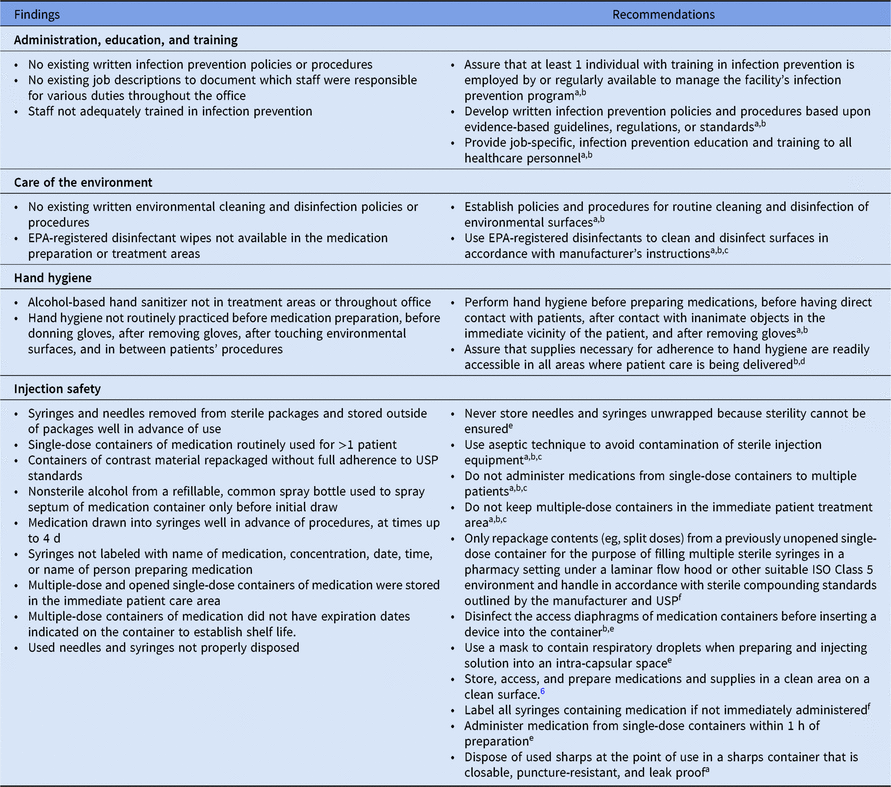
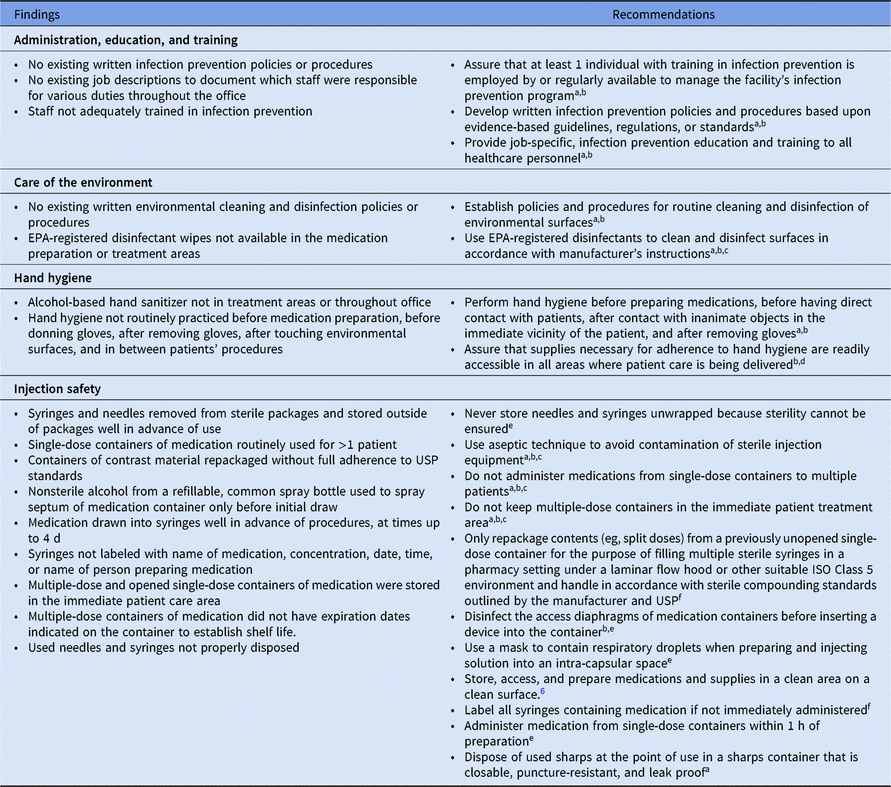
The infection prevention assessment revealed multiple breaches of infection prevention practices. Detailed explanations of these infection prevention deficiencies are provided in Table 2.
Deviations From Infection Prevention Recommendations at the Private Outpatient Facility on March 13, 2017
a Guide to Infection Prevention for Outpatient Settings: Minimum Expectations for Safe Care. 16
b Core Infection Prevention and Control Practices for Safe Healthcare Delivery in All Settings— Recommendations of the Healthcare Infection Control Practices Advisory Committee.
c Guideline for Isolation Precautions: Preventing Transmission of Infectious Agents in Healthcare Settings.Reference Siegel, Rhinehart, Jackson and Chiarello 14
d Guideline for Hand Hygiene in Healthcare Settings—Recommendations of the Healthcare Infection Control Practices Advisory Committee and the HICPAC/SHEA/APIC/IDSA Hand Hygiene Task Force.
e APIC Position Paper: Safe Injection, Infusion, and Medication Vial Practices in Health Care.Reference Dolan, Arias and Felizardo 15
f USP General Chapter 797: Pharmaceutical Compounding. 18
Syringes of contrast material from a single-dose container and local anesthetic from a multiple-dose container were prepared in a batch at the start of the day in the medication preparation room by the medical assistants. An exam table was used as a surface for preparation and was cleaned at most once daily. Environmental surfaces were cleaned using a product that was not registered by the Environmental Protection Agency for use in healthcare settings.Reference Siegel, Rhinehart, Jackson and Chiarello 14 Staff did not have access to a handwashing sink, and alcohol-based hand rub was not available in the room. Alcohol from a refillable spray bottle was used to disinfect the septum of injectable product containers. Staff indicated that the alcohol spray bottle would last several weeks and was not cleaned before being refilled. Staff members accessed a 50-mL single-dose container of contrast material up to 50 times to prepare syringes for multiple patients, with the septum of the container cleaned with the nonsterile alcohol only before the initial draw. Staff would not wait for the alcohol to dry before accessing the container with a needle. Syringes were stored outside of their sterile packaging. Injectable medications were drawn into syringes up to 4 days in advance of procedures.
Staff interviews and mock injection procedures found that physician A used a new pair of nonsterile gloves for each patient but did not perform hand hygiene before or after glove use. Injections were initiated using a needle and syringe filled with local anesthetic. After injecting the anesthetic, the physician removed the syringe, leaving the needle within the intra-articular space and the hub exposed. A second syringe containing ∼1 cm3 of contrast material was then attached to the needle hub and injected to facilitate fluoroscopic needle placement. This was followed by a third syringe containing a glucocorticoid or hyaluronic acid-based product. Syringes containing a glucocorticoid product were prepared using multiple-dose containers stored in the immediate patient care area. Hyaluronic acid-based products were available in pre-filled syringes. The physician did not wear a face mask during joint injection procedures and manipulated the exposed needle hub during procedures while wearing nonsterile gloves.Reference Dolan, Arias and Felizardo 15
Infection prevention recommendations were provided to the designated facility representative orally during the visit and subsequently in writing. These recommendations, from the CDC’s 2016 Guide to Infection Prevention for Outpatient Settings: Minimum Expectations for Safe Care, 16 are outlined in Table 2. The guide combines existing infection prevention guidance from the CDC and the Healthcare Infection Control Practices Advisory Committee (HICPAC).Reference Siegel, Rhinehart, Jackson and Chiarello 14 Additionally, the NJDOH recommended that the facility hire a consultant infection preventionist to review practices and assist with remediation.
On March 21, an announced follow-up site visit was conducted by the investigative team. The owner reported that physician A and physician B were no longer employed by the practice. The medical director rehired physician C, a family medicine physician who had previously been employed by the practice. The practice had made changes to infection prevention policies and procedures based on recommendations. Examples of these changes included providing hand sanitizer in the medication preparation and treatment areas; performing appropriate hand hygiene before medication preparation and administration; and cleaning medication preparation and treatment areas with an EPA-registered product appropriate for healthcare settings. However, the investigative team noted that the staff replaced the 50-mL single-dose container of contrast material with a 500-mL pharmacy bulk package (PBP) container of contrast material. However, the facility did not have a suitable work area needed to transfer the contents of PBP containers, in accordance with standards in the United States Pharmacopeia (USP).Reference Grissinger 17 , 18 Staff were immediately advised to stop the use of the 500-mL PBP containers. The investigative team observed direct patient care after the facility reopened to patients later that day. Infection prevention recommendations were reiterated to the medical director orally and in writing.
The investigative team conducted additional announced and unannounced site visits, on April 24 and July 26, respectively. During the third and fourth site visits, it was observed that the medical assistant responsible for medication preparation would draw 1–5 cm3 of contrast material into a syringe from a 50-mL single-dose container and discard the remainder.
The facility retained the 1-time service of an infection prevention consultant. The NJDOH recommended that the facility continue to retain the ongoing services of an infection preventionist to oversee infection prevention practices. No additional septic arthritis cases were identified after infection prevention recommendations were implemented by the facility and the facility resumed patient care on March 21.
Discussion
This report describes an investigation that identified 41 cases of septic arthritis associated with intra-articular injections at a private outpatient facility in New Jersey. All case patients received injections at the implicated facility during March 1–6, 2017. In total, 4 site visits occurred at the implicated facility between March and July 2017. Although suspected or confirmed outbreaks of any organism are reportable in New Jersey, single cases of infections with certain organisms are not. Therefore, we might not have identified all cases of septic arthritis associated with breaches of infection prevention practices at this facility.
Infection prevention and injection safety
Aseptic technique is an infection prevention method to maximize and maintain asepsis, the absence of pathogen organisms, in clinical settings. The goals of aseptic technique are to improve patient safety and prevent healthcare-associated infections. Breaches in aseptic technique can lead to the spread of pathogens.Reference Iwamoto and Post 19 The Centers for Disease Control and Prevention and the Healthcare Infection Control Practices Advisory Committee (HICPAC) 2007 Guidelines for Isolation Precautions: Preventing Transmission of Infectious Agents in Healthcare Settings provides recommendations for standard precautions that apply to all patient care, regardless of suspected or confirmed infection status of the patient, in any setting where healthcare is delivered. Standard precautions include (1) hand hygiene, (2) use of personal protective equipment (eg, gloves, gowns, masks), (3) safe injection practices, (4) safe handling of potentially contaminated equipment or surfaces in the patient environment, and (5) respiratory hygiene/cough etiquette.Reference Siegel, Rhinehart, Jackson and Chiarello 14 , 20
Adherence to injection safety guidelines is imperative, as product contamination and patient harm can occur when repackaging is not done properly. Qualified healthcare personnel shall only repackage contents (eg, split doses) from a previously unopened single-dose container for the purpose of filling multiple sterile syringes in a pharmacy setting under a laminar flow hood or other suitable ISO class 5 environment and handle in accordance with sterile compounding standards outlined by the manufacturer and USP.Reference Grissinger 17 , 18 Single-dose containers of contrast media do not contain the antimicrobial preservations found in most multiple-dose containers of medication and the inappropriate use of single-dose containers may lead to microbial contamination and growth, serving as a source of microorganisms.Reference Siegel, Rhinehart, Jackson and Chiarello 14 , 21
In addition, staff did not properly disinfect the septum of the container with sterile alcohol, and syringes were prepared in a batch of injectable medications up to 4 days in advance of procedures, contrary to the recommended practice of administering medication from single-dose containers within 1 hour of preparation.Reference Dolan, Arias and Felizardo 15 Because the facility used 1 single-dose container of contrast material for up to 50 patients, contamination of only a single container could account for the large number of cases identified in this outbreak.
Single-dose containers of contrast material are available in varying volumes (10–200 mL). Lower cost was the reported reason why the facility continued to order 50-mL containers of contrast material, instead of the smaller-volume 10-mL container, to draw up 1–5 mL per patient. Any potential savings that result from inappropriately subdividing the contents of single-dose containers by healthcare providers can be quickly offset by the costs associated with infections and subsequent complications. These costs include direct, indirect, and intangible costs; these costs are primarily borne by the patients and their families. In addition, healthcare providers can face serious legal consequences if a patient is harmed due to lapses of infection prevention practices. 22
Outbreaks of bacterial infections following spinal procedures have been associated with a common healthcare provider who did not wear a mask while performing the procedures.Reference de Fijter, DiOrio and Carmean 23 Evidence suggests that these outbreaks resulted from droplet transmission of oral flora from the healthcare provider. The CDC recommends that healthcare personnel wear face masks for spinal injection procedures that require injection of material or insertion of a catheter into epidural or subdural spaces (eg, myelogram, administration of spinal or epidural anesthesia, or intrathecal chemotherapy).Reference Siegel, Rhinehart, Jackson and Chiarello 14 Furthermore, the Association for Professionals in Infection Control and Epidemiology recommends the use of a face mask to contain respiratory droplets when preparing and injecting material into any intra-articular space.Reference Dolan, Arias and Felizardo 15 A needle placed into the intra-articular space can serve as a direct portal of entry for organisms into the joint, particularly when the needle’s hub is exposed during multiple syringe exchanges.
In conclusion, nationally recommended infection prevention and control practices are applicable to all settings in which health care is provided; however, outpatient settings sometimes fail to provide the infrastructure and resources needed to support infection prevention activities, and often lack regulatory oversight. 16 This large, costly outbreak highlights the serious consequences that can occur when healthcare providers do not follow infection prevention recommendations. Outbreaks related to unsafe injection practices indicate that certain healthcare personnel are either unaware, do not understand, or do not adhere to basic principles of infection prevention and aseptic techniques, confirming a need for education and thorough implementation of infection prevention recommendations.
Author ORCIDs
Kathleen M Ross, 0000-0002-9389-1548
Acknowledgments
The authors thank Joseph Perz and Nadine Shehab of CDC for their critical review of the manuscript for intellectual content, as well as Diane Calello and Bruce Ruck of the New Jersey Poison Information and Education System for responding to the calls from the public, and the New Jersey Board of Medical Examiners and the New Jersey Department of Environmental Protection for their involvement in the public health response. The findings and conclusions in this report are those of the authors and do not necessarily represent the official position of the Centers for Disease Control and Prevention or the New Jersey Department of Health.
Financial support
No financial support was provided relevant to this article.
Conflicts of interest
All authors report no conflicts of interest relevant to this article.