1. Introduction
The occurrence of pre-Variscan deformations in the Pyrenees has been a matter of debate since the early work of Llopis Lladó (Reference Llopis Lladó1965). The existence of Ordovician deformation in the Pyrenees has been proposed from indirect evidence such as the pre-Caradoc regional unconformity (Llopis Lladó, Reference Llopis Lladó1965; Santanach, Reference Santanach1972b; García-Sansegundo, Gavaldà & Alonso, Reference García-Sansegundo, Gavaldà and Alonso2004) or the Upper Ordovician magmatism (Ravier, Thiébaut & Chevenoy, Reference Ravier, Thiébaut and Chevenoy1975; Robert & Thiebaut, Reference Robert and Thiebaut1976; Martí, Muñoz & Vaquer, Reference Martí, Muñoz and Vaquer1986). In this regard, Llopis Lladó (Reference Llopis Lladó1965) invokes ‘Caledonian movements’ to account for the regional angular unconformity between the Upper Ordovician succession and the underlying Cambro-Ordovician metasediments. Santanach (Reference Santanach1972b) and García-Sansegundo, Gavaldà & Alonso (Reference García-Sansegundo, Gavaldà and Alonso2004) attribute the angular unconformity to basement tilting and subsequent erosion to a Late Ordovician fracture episode. However, although the existence of the Upper Ordovician unconformity has been confirmed (Santanach, Reference Santanach1972b; García-Sansegundo, Gavaldà & Alonso, Reference García-Sansegundo, Gavaldà and Alonso2004; Casas & Fernández, Reference Casas and Fernandez2007), no evidence of Late Ordovician deformational structures responsible for the unconformity has been found.
In this paper, we present new data on two Ordovician deformation episodes in the Pyrenees. A system of folds which affected the pre-Upper Ordovician materials and which developed prior to the main Variscan structures was recognized. Moreover, a set of normal faults affecting the lower part of the Upper Ordovician series, the unconformity and the underlying Cambro-Ordovician metasediments was also documented. These data provide a valuable insight into the pre-Variscan tectonic evolution of the Palaeozoic succession of the Pyrenees.
2. Geological setting
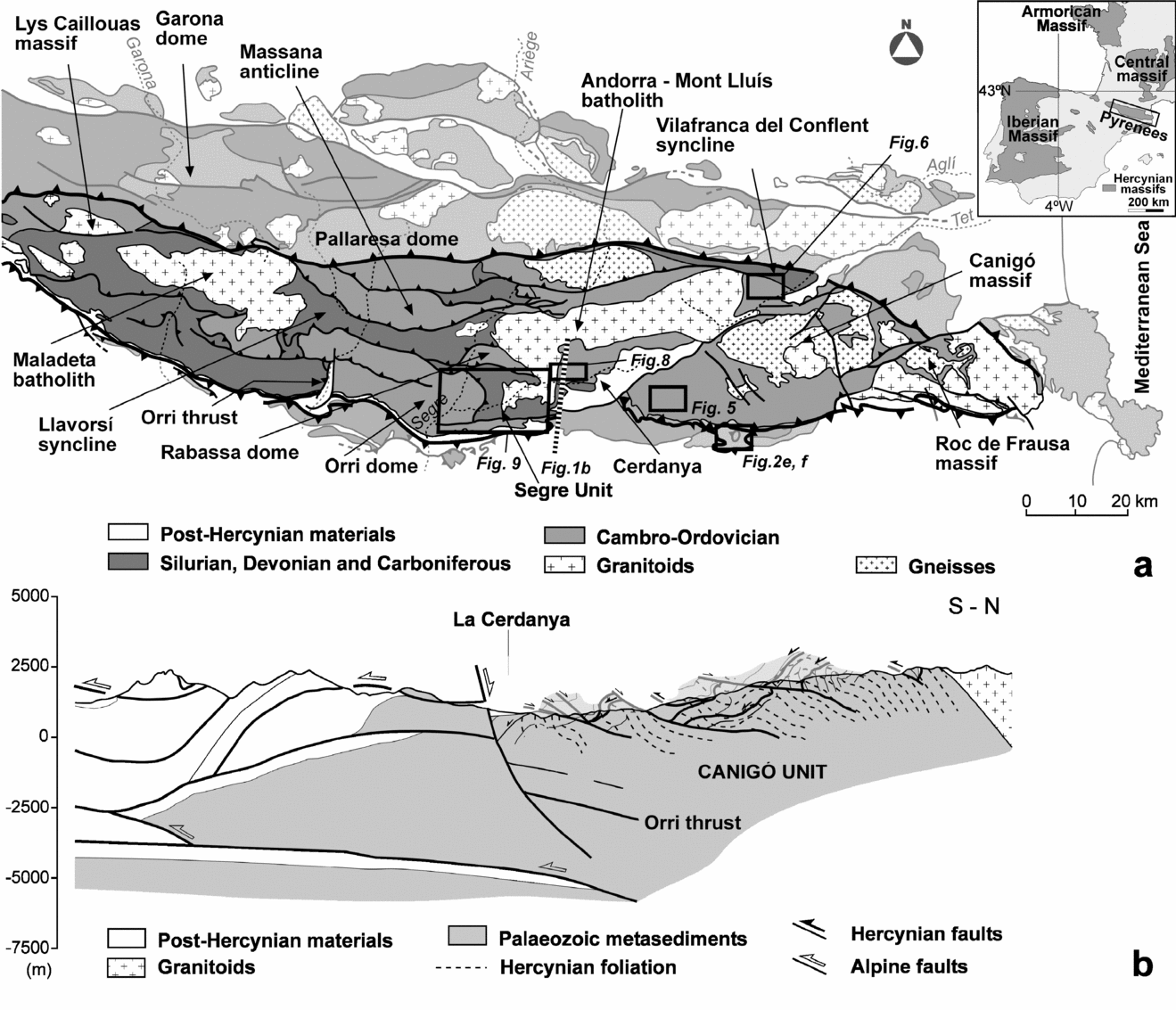
As a result of the Alpine tectonics, a complete pre-Variscan succession crops out in the central part of the Pyrenees forming an E–W-oriented zone (Fig. 1a). Pre-Variscan rocks belong to the lowermost Alpine units, which exhibit a general antiformal disposition (Muñoz, Reference Muñoz and McClay1992b) (Fig. 1b). The Canigó unit, or the Orri thrust sheet of Muñoz (Reference Muñoz and McClay1992b), constitutes the Alpine unit, which presents one of the most complete pre-Variscan sequences. Rocks range in age from Late Neoproterozoic to Carboniferous. A number of massifs roughly oriented E–W can be distinguished: the Roc de Frausa and Canigó massifs, Andorra–Mont Lluís batholith, Rabassa and Orri domes, Segre unit, Llavorsí syncline Massana anticline and Maladeta batholith (Fig. 1a). The floor thrust of this unit is the Orri thrust.

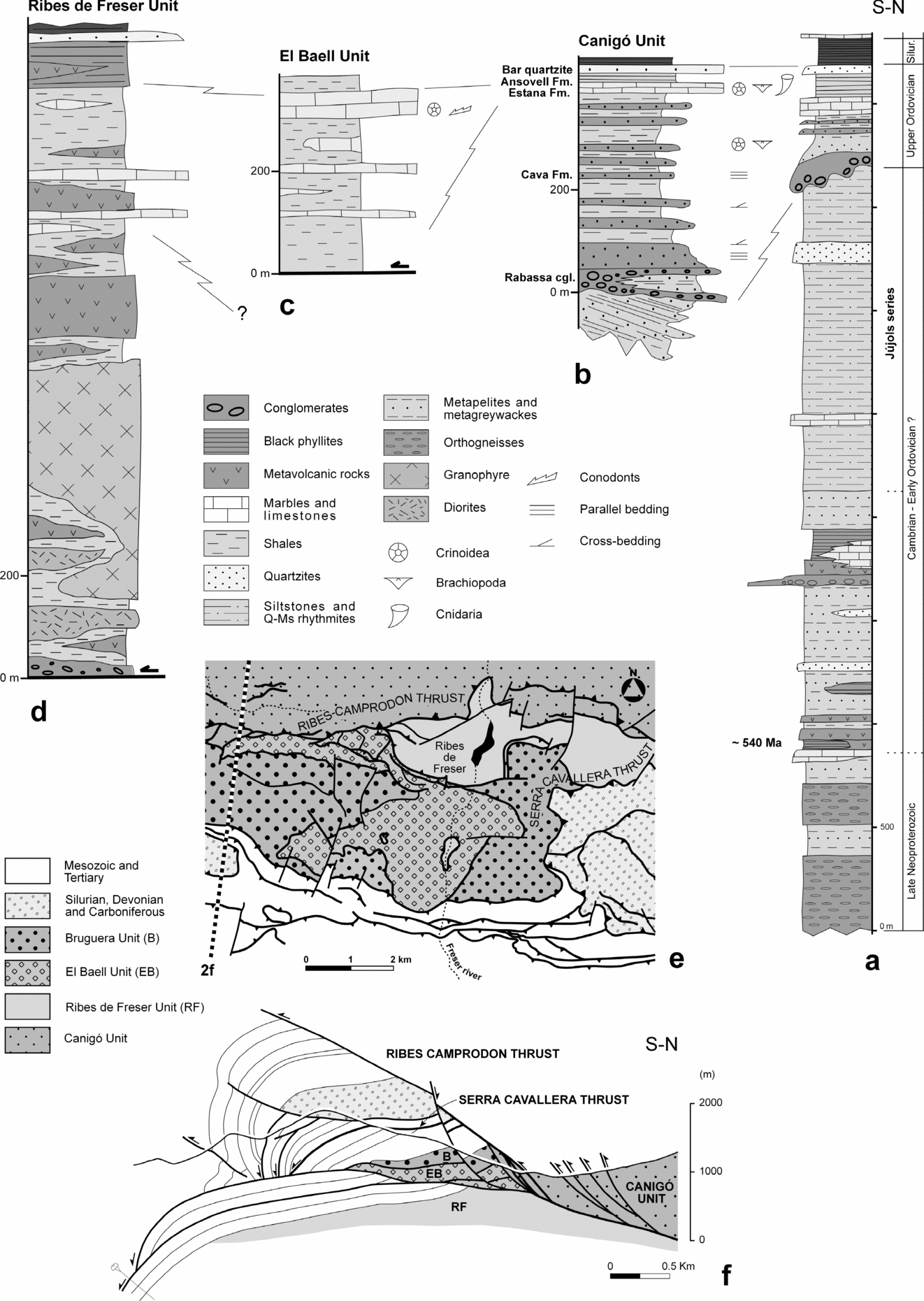
The lower part of the pre-Variscan succession of the Canigó unit is made up of a thick (3000 m) unfossiliferous metasedimentary sequence (Fig. 2a), pre-Late Ordovician in age (Cavet, Reference Cavet1957; Guitard, Reference Guitard1970). At the base is a heterogeneous sequence composed of metapelite and metagreywacke beds with orthogneiss sheets and interbedded metavolcanic rocks. At the top, the sequence consists of a monotonous succession of shales and sandstones. The age of this lowermost succession is unknown owing to its largely unfossiliferous character, although some trace fossils have been found (work in progress), and it is classically known as Cambro-Ordovician (Cavet, Reference Cavet1957). Recent radiometric dating of interlayered volcanic rocks gives a Late Neoproterozoic–Early Cambrian age to the lower part of the succession (581 ± 10 Ma: Cocherie et al. Reference Cocherie, Baudin, Autran, Guerra, Fanning and Laumonier2005; 540 Ma: Castiñeiras et al. Reference Castiñeiras, Navidad, Liesa, Carreras and Casas2008). An Upper Ordovician succession (Cavet, Reference Cavet1957; Hartevelt, Reference Hartevelt1970) lies unconformably over the former series (Santanach, Reference Santanach1972b; García-Sansegundo, Gavaldà & Alonso, Reference García-Sansegundo, Gavaldà and Alonso2004; Casas & Fernández, Reference Casas and Fernandez2007) (Fig. 2a, b). The absence of a biostratigraphic control in the pre-Upper Ordovician sequence makes it difficult to evaluate the magnitude of this unconformity. Nevertheless, it has been suggested that at least the Lower and Middle Ordovician sediments were removed before deposition of the Upper Ordovician succession (Muñoz & Casas, Reference Muñoz, Casas, Barnolas and Chiron1996). The Silurian series is mainly constituted by black shales which grade upwards to an alternation of black limestones and shales. The Devonian series consists of a limestone sequence, and the Carboniferous series is made up of a detrital sequence (Culm facies) composed of slates with sandstone, conglomerate and olistostrome intercalations in the lower part, which unconformably overlies the aforementioned sequence. Its age varies along the Pyrenees, and in the Eastern Pyrenees a Late Visean to Serpukhovian/Bashkirian (Namurian) age synchronous with the development of the main Variscan shortening event has been proposed (Cygan, Perret & Raymond, Reference Cygan, Perret and Raymond1981; Delvolvé et al. Reference Delvolvé, Souquet, Vachard, Perret and Aguirre1993; Delvolvé, Vachard & Souquet, Reference Delvolvé, Vachard and Souquet1998 among others).
(a) Synthetic stratigraphic column of the pre-Variscan succession of the Canigó unit. (b–d) Stratigraphic columns of the Upper Ordovician series of the Canigó, Baell and Ribes de Freser units. (e) Geological map of the Ribes de Freser area. (f) Cross-section illustrating the relationship between these units. (a, b) Data from Guitard (Reference Guitard1970), Hartevelt (Reference Hartevelt1970), Santanach (Reference Santanach1972a) and Ayora & Casas (Reference Ayora and Casas1986). (c, d) Data from J. F. Robert, unpub. Ph.D. thesis, Univ. de Besançon (1980) and Muñoz (Reference Muñoz1992a). (e, f) After Muñoz (Reference Muñoz1992a).

Variscan deformation (Late Visean to Serpukhovian) affects the whole succession, accompanied by high temperature–low pressure metamorphism (Guitard, Reference Guitard1970; Zwart, Reference Zwart1979). Syn- to late orogenic (Moscovian–Kasimovian: Romer & Soler, Reference Romer and Soler1995) granitoids are intruded mainly into the upper levels of the succession, producing local contact metamorphism (Autran, Fonteilles & Guitard, Reference Autran, Fonteilles and Guitard1970). The Variscan deformation exhibits different signatures in the pre-Silurian and post-Silurian rocks. A pervasive crenulation cleavage is the main deformational Variscan structure in the pre-Silurian rocks (Guitard, Reference Guitard1967; Hartevelt, Reference Hartevelt1970; Santanach, Reference Santanach1972a), whereas south-directed thrust sheets are well developed in the overlying Silurian, Devonian and Carboniferous successions (Hartevelt, Reference Hartevelt1970; Domingo, Muñoz & Santanach, Reference Domingo, Muñoz and Santanach1988; Casas et al. Reference Casas, Domingo, Poblet and Soler1989; J. Poblet, unpub. Ph.D. thesis, Univ. de Barcelona, 1991 and references therein). The thrust sheets involve mainly Devonian rocks, although some climb up into the Carboniferous ‘Culm’ sediments and in this case, their displacement sharply diminishes and tapers off in the Carboniferous rocks, confirming the syn-orogenic character of the rocks (Cirés et al. in press). The lowest thrust sheets are mainly made up of Silurian rocks with their basal detachment located at the base of the Silurian black shales. Although scarce, some thrusts affecting infra-Silurian rocks have been recognized. Thrusts cut fold-related cleavage, and in turn the thrusts and the lower detachment are folded by south-verging cleavage-related folds. Thus, thrust development and fold development are broadly synchronous.
3. The Cambro-Ordovician and the Upper Ordovician successions
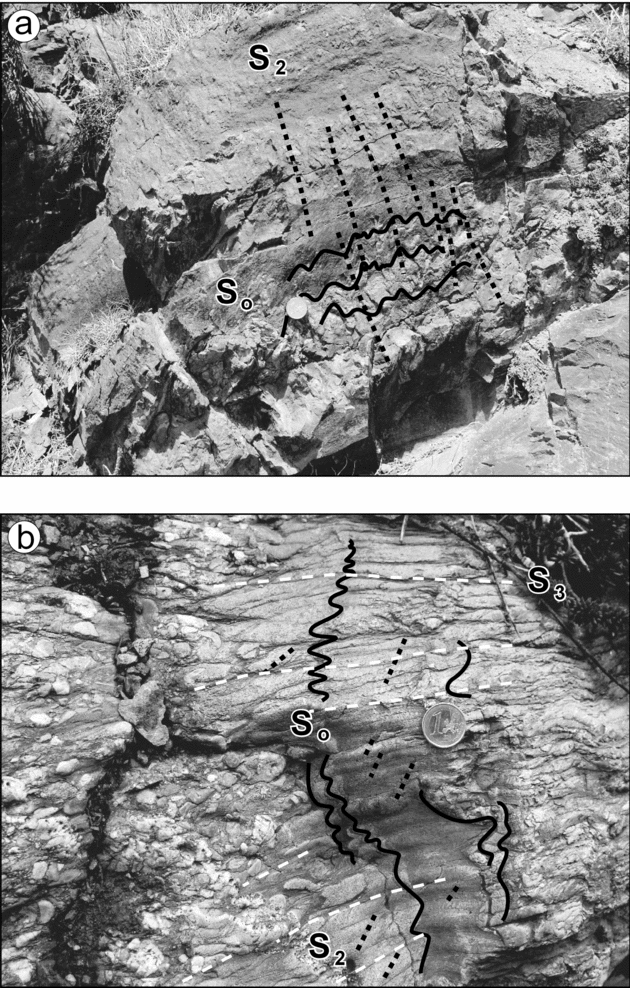
The upper part of the pre-Late Ordovician series, roughly 1500 m thick, consists of an azoic rhythmic alternation of sandstones, siltstones and argillite layers, 1 mm to several centimetres thick (Fig. 2a). Layers range in colour from grey to characteristic light green or light brown (Fig. 3a). Sandstones up to 1 m in thickness occur at the top of the series, exhibiting graded bedding, load casts, cross-bedding and fluid escapement structures. In contrast to the lowermost pre-Late Ordovician sequence, no metavolcanic intercalations have been found. The pre-Late Ordovician series is unconformably overlain by Late Ordovician conglomerates, whereas its lower limit is unknown due to its monotonous character and lack of a mappable key level. A discontinuous intercalation of carbonate and black phyllites can be considered as the contact with the lower part of the succession. This succession corresponds to the Jújols Series established by Cavet (Reference Cavet1957) in the Canigó massif, or to the Seo Formation defined by Hartevelt (Reference Hartevelt1970) in the Orri Dome, and forms part of the Jújols Formation or the Jújols Group (Laumonier, Reference Laumonier1988, Reference Laumonier, Barnolas and Chiron1996). Using stratigraphic correlation criteria, a Middle/Late Cambrian (Llopis Lladó, Reference Llopis Lladó1965; Abad, Reference Abad1987) or Late Cambrian/Early Ordovician age has been proposed for this series (Guitard et al. Reference Guitard, Laumonier, Autran, Bandet and Berger1998). Recently, a Middle Cambrian to Early Ordovician age has been proposed, based on geochronological data from the underlying metavolcanic rocks (Castiñeiras et al. Reference Castiñeiras, Navidad, Liesa, Carreras and Casas2008).
(a) D2 folds affecting the rhythmic alternation of sandstones and siltstones from the upper part of the pre-Upper Ordovician series. Note the high angle between bedding (S0) dipping towards the NW and S2 sub-vertical cleavage, giving rise to an elevated plunge of the L2 intersection lineation and D2 fold axes. La Molina area. (b) Upper Ordovician microconglomerates and sandstones exhibiting S0 sub-vertical planes, S2 and S3 cleavage surfaces. La Molina area.

The Upper Ordovician succession of the Canigó unit, well known after the works of Cavet (Reference Cavet1957) and Hartevelt (Reference Hartevelt1970), constitutes a fining-upwards sequence with an interlayered limestone key level and marked thickness variations between 100 and 1000 metres. Hartevelt (Reference Hartevelt1970) defined five stratigraphic formations, which can be recognized with some lithological variations all across the unit (Fig. 2b). The Rabassa Conglomerate Formation is made up of red-purple, unfossiliferous conglomerates and microconglomerates with lateral thickness variations from a few to 200 metres. Conglomerates are composed of sub-rounded to well-rounded clasts of slates, quartzites and quartz veins that can attain 50 cm in diameter in a green-purple granule-sized matrix. Hartevelt (Reference Hartevelt1970) attributed the Rabassa conglomerates to the Caradoc. The Rabassa conglomerates unconformably overlie the Cambro-Ordovician metasediments and are overlain by the sandstones of the Cava Formation. The Cava Formation is made up of microconglomerates and feldspathic sandstones in the lower part, followed upwards by shales, siltstones and fine-grained sandstones, green or purple in colour, with strongly bioturbated quartzites in the uppermost part. Thickness changes from 100 to 800 metres and sometimes passes laterally to the Rabassa conglomerates. Volcanic influence is present in the southeastern part of the unit, where ash levels, andesites and metavolcanic rocks are well recorded east of Ribes de Freser (Muñoz, Reference Muñoz1992a). Brachiopods and bryozoans are locally abundant, concentrated in fine-grained sandstones in the middle part of the formation. Gil Peña et al. (Reference Gil-Peña, Barnolas, Villas, Sanz-López and Vera2004) attributed a Late Caradoc–Early Ashgill age to this formation, which is Middle Late Ordovician, according to Finney (Reference Finney2005). The Estana Formation lies above the Cava Formation and consists of limestones and marly limestones, up to 10 m in thickness, which constitutes a good stratigraphic key level, the ‘schistes troués’ or ‘Grauwacke à Orthis’ and the ‘Caradoc limestones’ of French and Dutch geologists. Conodonts and brachiopods are abundant, yielding a Middle Ashgillian age (Gil Peña et al. Reference Gil-Peña, Barnolas, Villas, Sanz-López and Vera2004). The Ansovell Formation overlies the Estana limestone and is made up of dark shales and siltstones with minor interbedded quartzite layers in the uppermost part. In cases where the Estana Formation dwindles away, the shales of the Ansovell Formation overlie the sandstones of the Cava Formation. The Bar Quartzite Formation, located at the top of the Upper Ordovician succession, consists of a 5 to 10 m thick quartzite layer. An Ashgillian age is proposed for the Ansovell and Bar formations by Hartevelt (Reference Hartevelt1970), although Gil-Peña et al. (Reference Gil-Peña, Barnolas, Villas, Sanz-López and Vera2004) suggest that the Ordovician–Silurian boundary can be located within the Bar quartzite. More to the west, in the Orri, Pallaresa and Garona domes, Gil-Peña et al. (Reference Gil Peña, Sanz Lopez, Barnolas and Clariana2000, Reference Gil-Peña, Barnolas, Villas, Sanz-López and Vera2004) described an unconformity over the Estana and Ansovell formations overlain by a calcareous conglomerate unit up to 8 m thick. These authors proposed that the unconformity was a result of the glacial Hirnantian event.
It should be noted that two minor Alpine units (Ribes de Freser and Baell) located south of the Canigó unit exhibit different Upper Ordovician successions. The Ribes de Freser unit is predominantly made up of volcanic and volcano-sedimentary rocks (Fig. 2d) (Robert & Thiebaut, Reference Robert and Thiebaut1976; C. Ayora, unpub. Ph.D. thesis, Univ. de Barcelona, 1980; J. F. Robert, unpub. Ph.D. thesis, Univ. de Besançon, 1980; Muñoz, Reference Muñoz1992a; Martí, Muñoz & Vaquer, Reference Martí, Muñoz and Vaquer1986). This unit was initially located to the south and structurally below the Baell and Canigó units and occupies its present position because of the Ribes–Camprodon thrust (Fig. 2e). Its apparent thickness ranges from 600 to 1200 m. Its lower part is made up of diorite bodies and volcaniclastic rocks, whereas rhyolitic lava flows and ignimbrites predominate in the central part, and ash levels, ignimbrites and volcaniclastic rocks constitute its upper part. A granophyric body, recently dated as 458.1 ± 2.5 Ma (Martínez, Capdevila & Reche, Reference Martínez, Capdevila, Reche, Gutiérrez-Alonso, Weil, Fernández-Suárez, Johnston, González-Clavijo, Díaz-Montes, Alonso, Rubio and Merino2009), intrudes into the lower part of the series. The volcanic activity was mainly explosive and had a calc-alkaline affinity despite an alkaline character (Martí, Muñoz & Vaquer, Reference Martí, Muñoz and Vaquer1986).
The Baell unit is located between the Canigó and the Ribes de Freser units (Fig. 2c, e, f). Its apparent thickness is about 300 m and it is entirely made up of ‘schistes troués’ passing to a limestone/shale intercalation and finally to a 50 m thick carbonate member with abundant conodonts and crinoids (J. F. Robert, unpub. Ph.D. thesis, Univ. de Besançon, 1980; Muñoz, Reference Muñoz1992a), which allows these authors to attribute a Caradocian age to the beds forming this unit.
4. Ordovician deformations
4.a. The Middle Ordovician folding event
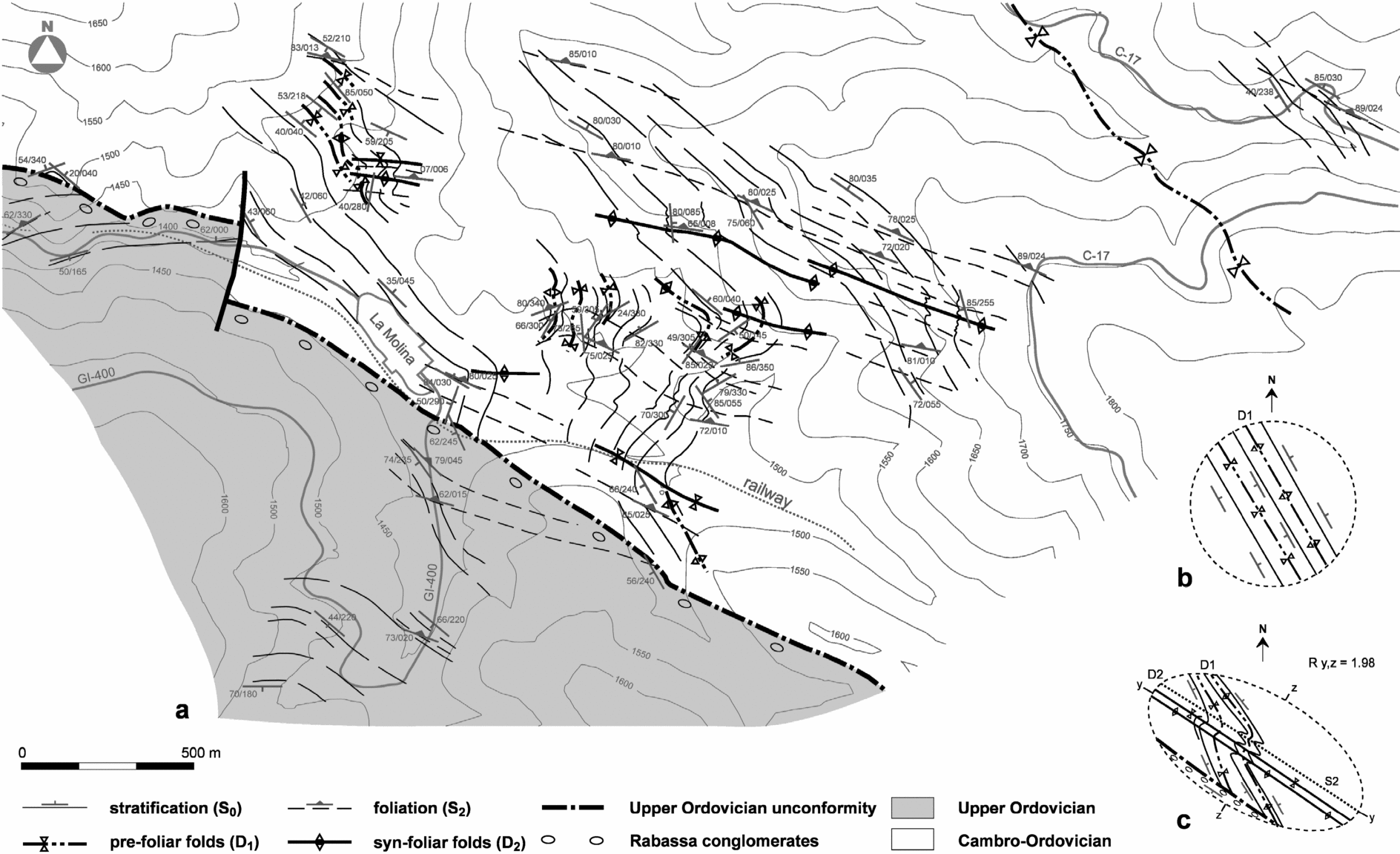
Areas around the contact between the Upper Ordovician and the Cambro-Ordovician metasediments affected only by weak or very weak Variscan metamorphism were chosen to compare the structures of both series in the La Molina (Fig. 5a) and El Conflent (Fig. 6a) regions.
Santanach (Reference Santanach1972b) described the Upper Ordovician unconformity on the basis of cartographic and structural data in the La Molina area on the southern slope of the Canigó massif (Fig. 1a). This author reports different attitudes of the bedding planes in both the Upper Ordovician and the underlying Cambro-Ordovician series and attributes this difference to a pre-Upper Ordovician tilting affecting only the Cambro-Ordovician series. This disposition of bedding planes gave rise to a different arrangement of the Variscan minor structures in both sequences. According to this author, this tilting was probably related to fracture development, and together with subsequent erosion, gave rise to the formation of the unconformity. However, a closer examination of the published data suggests that the bedding disposition of the Cambro-Ordovician series near the unconformity cannot be explained only by the bedding rotation related to tilting (fig. 1b of Santanach, Reference Santanach1972b). Selected outcrops in the La Molina area on both sides of the unconformity were chosen to provide further insight into this subject.
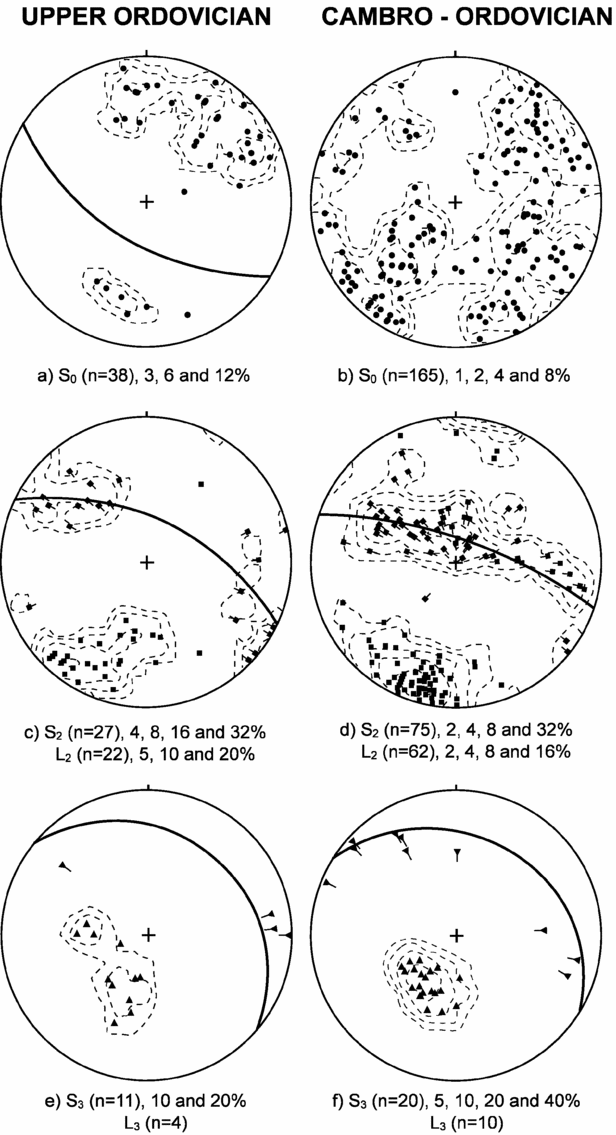
Detailed geological mapping (1/5000) and structural analysis reveal that in this area, the bedding planes in both series present different dispositions. In the Upper Ordovician sequence, bedding is regularly oriented NW–SE and dips to the SW with minor variations in strike (Figs 4a, 5a), while the bedding of the Cambro-Ordovician succession presents a marked dispersion (Figs 4b, 5a). This different bedding attitude is due to the presence of D1 folds that do not affect the Upper Ordovician series. In contrast, the disposition of the Cambro-Ordovician succession mainly results from the presence of these D1 folds, which constitute a series of anticlines and synclines oriented NW–SE with sub-vertical axial trace and sub-horizontal axes trending 140°. D1 folds are of hectometric wavelength and are responsible for the NE and SW dipping of the Cambro-Ordovician bedding. The folds are open to tight and probably symmetrical because the beds dip with comparable values, between 40° to 80°, towards the NE or the SW.
Equal-area lower hemisphere stereoplots of bedding (S0), D2 (S2 and L2) and D3 (S3 and L3) mesostructures from the Upper Ordovician (a, c, e) and Cambro-Ordovician sucessions (b, d, f) in the La Molina area (‘n’ indicates the number of measurements).

(a) Geological map of the contact between the Upper Ordovician and the Cambro-Ordovician successions in the La Molina area (see Fig. 1a for location). (b, c) Reconstruction of the initial D1 fold orientation and the main characteristics of the D2 structures. See text for explanation.

Apart from D1 folds, the same deformational mesostructures can be recognized in both the Cambro-Ordovician and the Upper Ordovician successions: two pervasive crenulation cleavages, S2 and S3, irregularly developed, are the main deformational structures. S2 crenulation cleavage is the predominant deformational mesostructure and exhibits a similar disposition in both series: S2 surfaces are sub-vertical or strongly dip (66° to 80°) to the N or NE and are irregularly developed, not being well expressed in sandstone and quartzite levels. S2 is parallel to the axial surface of D2 folds, recognizable from millimetric to hectometric scale and especially well developed in the Cambro-Ordovician rhythmites (Fig. 3a). The S3 crenulation cleavage is more locally developed and dips moderately to the N or NE in contrast to S2 (Fig. 3b). S3 is associated with D3 open south-verging folds with axial surfaces dipping moderately to the N or NE. D3 folds cause variations in the S2 dipping, and in the limbs of D3 folds it could be difficult to discriminate between S2 and S3. In this case, the dominant cleavage can be referred to as S2–3.
The presence of D1 folds causes the D2 and D3 linear mesostructures to exhibit different dispositions in both series. In the Cambro-Ordovician sequence the orientation of the D2 minor folds and bedding/S2 intersection lineation is strongly dependent on the previous bedding disposition. In the NE-dipping limbs of the D1 folds, the D2 minor folds plunge to the NE, whereas in the SW-dipping limbs, the D2 folds plunge towards the WNW. In the D2 map-scale hinge zones, the D2 minor folds plunge alternatively towards the WNW or the ESE, depending on the limbs of previous D1 folds at which they developed. Thus, L2 structures exhibit a wide dispersion on a S2 medium plane with L2 plunges ranging from sub-horizontal to sub-vertical (Fig. 4d). The interference of D1 and D2 folds also leads to a wide range of values in the L2/S2 pitch angle. Although theoretically possible (Santanach, Reference Santanach1972b; Speksnijder, Reference Speksnijder1986), it was not feasible to establish the D1 orientations in the studied case from only the map-scale distribution of the L2 pitch angle or the L2 trend.
In the Upper Ordovician sequence, L2 axes and intersection lineations are grouped forming two maxima with a moderate plunge to the NW or SE (15/302°) (Fig. 4c).
As in the case of D2, D3 axes and bedding/S3 intersection lineations display different dispositions in both series, being sub-horizontal, E–W-oriented, in the Upper Ordovician succession and displaying a more marked dispersion in the Cambro-Ordovician ones (Fig. 4e, f).
In order to determine the initial D1 fold orientation, we restored the effect of D2 and D3 deformations. Two strain determinations, made in the Upper Ordovician sandstones by Capellà (Reference Capellà1995), are available and furnish strain ellipsoids with axial ratios Rxy 1.2 and 1.52, Rxz 2.38 and 2.85 and Ryz 1.98 and 1.87 (Alp 4 and Alp6 samples: Capellà, Reference Capellà1995). In the Alp4 sample, the Y axis is sub-horizontal, whereas in the Alp6 sample the sub-horizontal axis is X. For the sake of simplicity, we consider S2 as a sub-vertical plane oriented 110° containing the X and Y axes, and the D1 axis as a 140° trending line lying in a horizontal plane, the YZ or XZ sections of the strain ellipsoid. Strain restoration (Ramsay & Huber, Reference Ramsay and Huber1983, p. 128) shows that initial orientation of the D1 folds varies to 160° or 170°, depending on the chosen strain ellipsoid (Fig. 5b, c). From the foregoing discussion, it follows that a pre-Late Ordovician age can be proposed for the D1 fold formation, as these folds were not recognized in the pre-Upper Ordovician succession and are responsible for the oblique disposition of the Cambro-Ordovician metasediments under the unconformity.
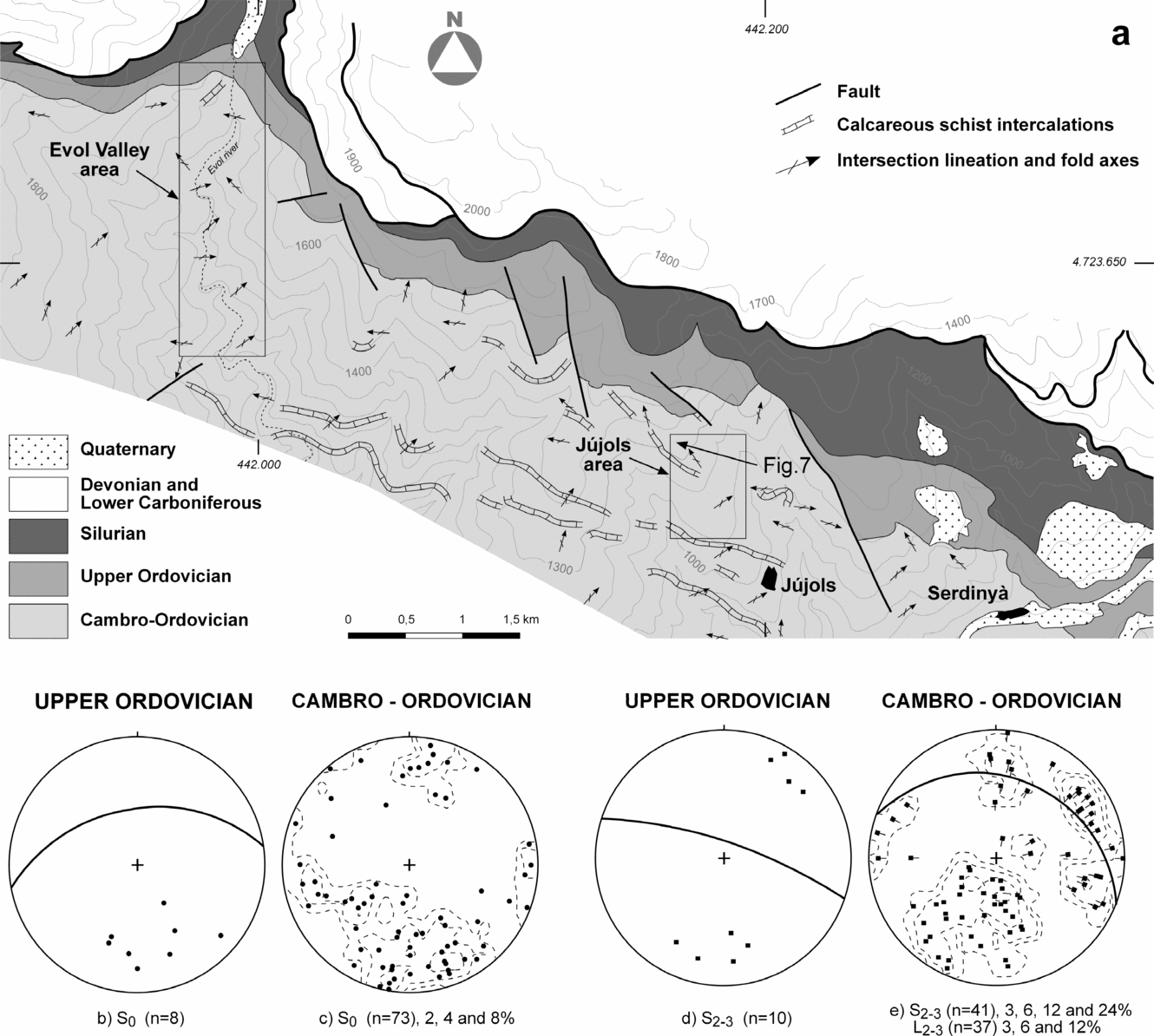
Laumonier & Guitard (Reference Laumonier and Guitard1978) focused on the structure of the Cambro-Ordovician metasediments of the El Conflent area, on the northern side of the Canigó massif south of the Vilafranca del Conflent syncline (Fig. 1a). These authors postulated the existence of two systems of Variscan pre-foliar folds to account for the variable disposition of the linear deformational mesostructures which exhibit variations in direction of more than 100°. We re-examined the published data, and acquired new data in the Cambro-Ordovician and the Upper Ordovician metasediments in selected outcrops located in two areas, one in the northern part of the Evol valley and the other north of the village of Jújols (Fig. 6a). As in the La Molina area, the bedding of the Upper Ordovician metasediments dips regularly in this zone towards the north (Fig. 6b), whereas the bedding of the Cambro-Ordovician sequence displays a wider range of orientations (Fig. 6c). This different disposition together with the map-scale cross-cutting relationship strongly suggests the existence of the Upper Ordovician unconformity in this area (Fig. 6a). The Upper Ordovician and the Cambro-Ordovician metasediments exhibit a regional crenulation cleavage dipping strongly or sub-horizontally, but always dipping to the north (Fig. 6d, e). Cleavage is related to open south-verging decametric folds with gently dipping axial surfaces, or to tight sub-vertical centimetric folds. Although only one cleavage was recognized in the outcrops studied, variation in style of folding and in dip attitude suggest that two folding episodes related to cleavage formation could exist. Thus, we propose to designate the main cleavage S2–3.
(a) Geological map of the El Conflent area showing the location of the studied areas in the Evol valley and Jújols and the location of Figure 7 (redrawn from the geological map of France 1/50 000, sheet 1095 Prades: Guitard et al. Reference Guitard, Geyssant, Laumonier, Autran, Fonteilles, Dalmayrach, Vidal and Bandet1992). See Figure 1a for location. UTM coordinates. (b–e) Equal-area lower hemisphere stereoplots of the bedding (S0) and D2 (S2–3 and L2–3) mesostructures from the Upper Ordovician and Cambro-Ordovician rocks (‘n’ indicates the number of measurements).

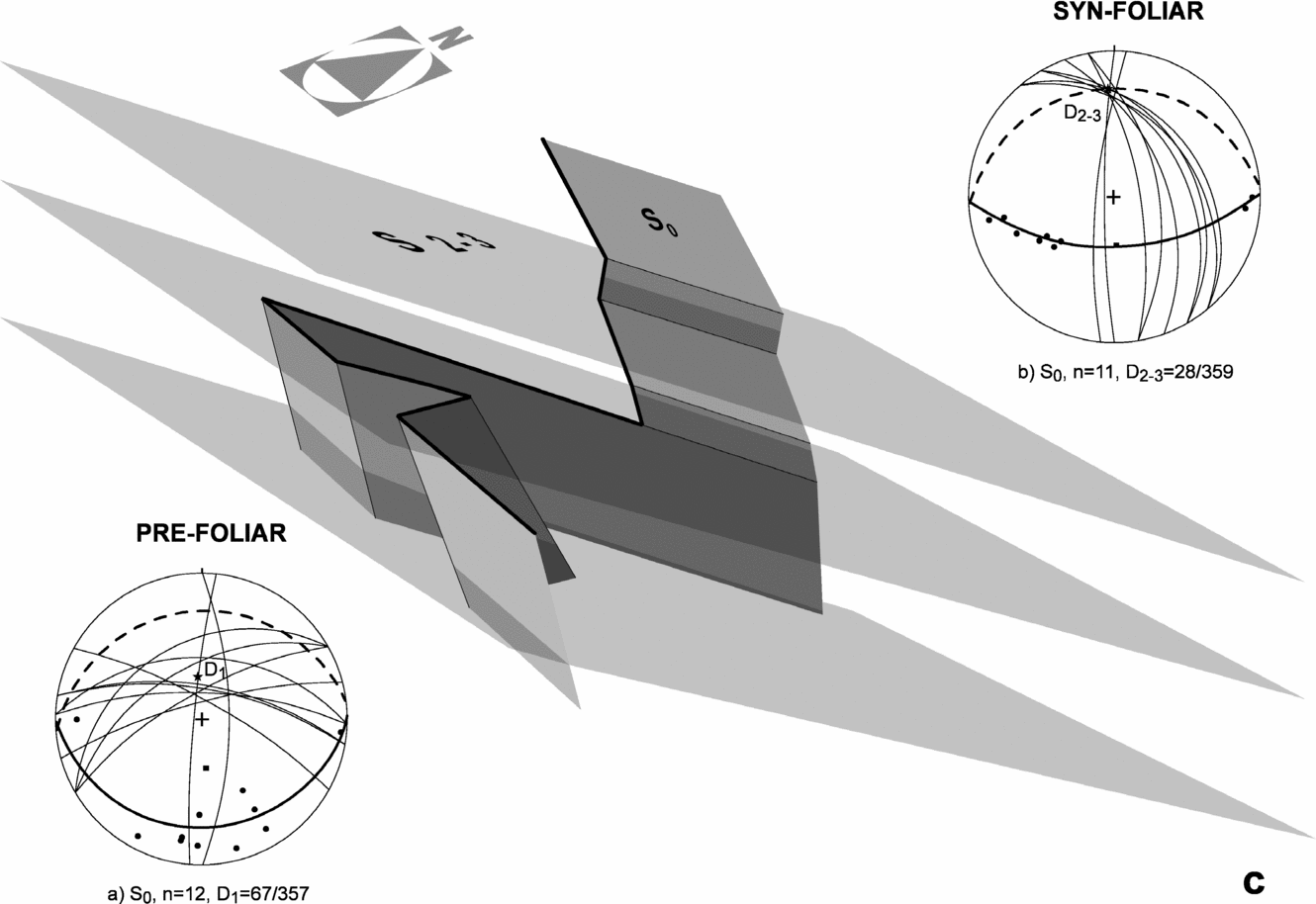
However, the most striking feature of this area is the presence of mesoscale pre-main cleavage folds. We recall the Bergerie de la Font de l'Abeurador outcrop (Figs 6a, 7), in which pre-main cleavage folds cut by the regional cleavage and syn-foliar folds are present (Laumonier & Guitard, Reference Laumonier and Guitard1978; Fig. 7a, b). In this outcrop, pre-main cleavage folds (D1), decametric in size, present fold axes strongly plunging to the north (67/357°) with a strong dip towards the NW axial surfaces (87/300°). The D1 folds are cut by gently dipping S2–3 regional cleavage (Fig. 7a). Smaller metric-sized D2–3 folds developed in their limbs, with folds axes trending N–S and gently plunging (28/359°) in the N–S-oriented limb (Fig. 7b) or exhibiting a wide range of orientation in the flanks oriented NE–SW to E–W (Fig. 7a). The combination of both D1 pre-main cleavage folds with strongly plunging axes and the D2–3 syn-foliar sub-horizontal folds with variable orientation gives rise to a complex disposition of the bedding planes (Fig. 7c). As a result, the L2–3 intersection lineations form a mesoscale reduced example of the pattern recognizable at map scale (Fig. 6a; Laumonier & Guitard, Reference Laumonier and Guitard1978; Guitard et al. Reference Guitard, Geyssant, Laumonier, Autran, Fonteilles, Dalmayrach, Vidal and Bandet1992). In this way, as in the La Molina area, the D1 folds can account for the different dispositions of the bedding and linear deformational mesostructures in both the Cambro-Ordovician and Upper Ordovician series. Although these D1 pre-main folds have been termed pre-main Variscan folds by Laumonier & Guitard (Reference Laumonier and Guitard1978), the fact that they were not recognized in the Upper Ordovician metasediments indicates that they could be pre-Variscan in age, probably Ordovician.
(a, b) Equal-area lower hemisphere stereoplots of the bedding (S0) arrangement of pre-foliar and syn-foliar folds from the Bergerie de la Font de l'Abeurador outcrop, X 441464, Y 4714564, Z 1323 m (‘n’ indicates the number of measurements, and the dashed line the main cleavage plane S2–3 in this outcrop). (c) 3D reconstruction using GoCad© of the syn-foliar and pre-foliar folds of this outcrop. See location in Figure 6.

4.b. The Late Ordovician fracture episode
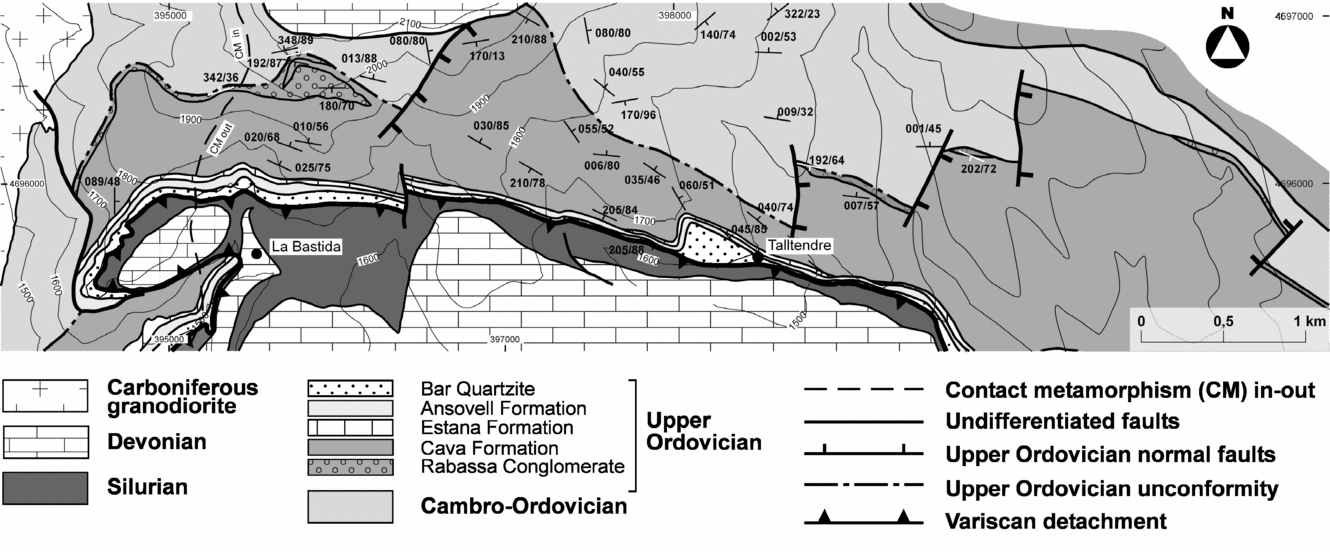
The presence of Late Ordovician extensional faults affecting the Upper Ordovician and Cambro-Ordovician successions can be postulated on the basis of cartographic, stratigraphic and structural evidence. Detailed geological mapping of the La Cerdanya area reveals a set of normal faults affecting the rocks of the Cava and Rabassa Conglomerate formations, the Upper Ordovician unconformity and the Cambro-Ordovician rocks (Fig. 8). The faults are steep and currently exhibit a broadly N–S to NNE–SSW map-scale trace. In most cases, their hanging-wall block is the eastern block despite the presence of some antithetic faults. The Upper Ordovician unconformity is the key marker used to establish the offset across the faults and, from this reference, maximum throws of about 0.2 to 0.9 km can be recognized. Displacement progressively diminishes upwards and tapers off in the Cava rocks (Fig. 8), although the monotonous character of the Cambro-Ordovician sediments and subsequent deformations masks the lower continuity of these faults. Thus, the position of a lower detachment of these normal faults has not been documented to date. An extension in the E–W direction, in present-day coordinates, can be proposed. Faults limit asymmetric basins that are 2 to 3 km wide, and the thickness of the Rabassa conglomerates and the Cava sandstones increases up to 1000 metres close to the faults, whereas the thickness of both formations is around 50 to 100 metres in the hinge zones between adjacent basins. Some sandstone layers of the Cava formation exhibit a wedge-shaped disposition, tapering away from the faults. By contrast, the uppermost part of the Cava Formation and the Estana, Ansovell and Bar formations overlie the basin-bounding normal faults and exhibit no variations in thickness in the vicinity of the faults. The original orientation of the faults cannot be pinpointed, owing to subsequent deformation events, although an original N–S orientation can be proposed. This orientation probably prevented the faults from being inverted during subsequent Variscan or Alpine contractional events, although the faults probably underwent rotations on a horizontal E–W axis during these subsequent deformations. From the foregoing data, it follows that the Rabassa conglomerates and most of the Cava sandstones can be interpreted as syn-rift sediments related to a Middle–Late Ordovician (Caradocian–Ashgillian) extensional event. The rest of the Upper Ordovician successions, which constitute the uppermost part of the Cava Formation and the Estana, Ansovell and Bar formations, can be regarded as post-tectonic.
Geological map of La Cerdanya area showing normal faults affecting the Upper Ordovician and the Cambro-Ordovician successions and the Upper Ordovician unconformity. See Figure 1a for location. UTM coordinates. Numbers refer to dip direction/dip.

It should be noted that similar structures can be recognized in other areas of the Pyrenees. In the El Conflent area, a set of hectometric–kilometric-sized steep faults cut the Upper Ordovician succession, the Upper Ordovician unconformity and the Cambro-Ordovician metasediments. Faults give rise to hectometric–kilometric cartographic displacements and are oriented mainly N–S. As in the La Cerdanya area, the hanging-wall block of these faults is the eastern one in most cases. The faults undergo marked thickness variations in the Upper Ordovician rocks and dwindle completely in the upper part of the succession below the Silurian rocks (Fig. 6a).
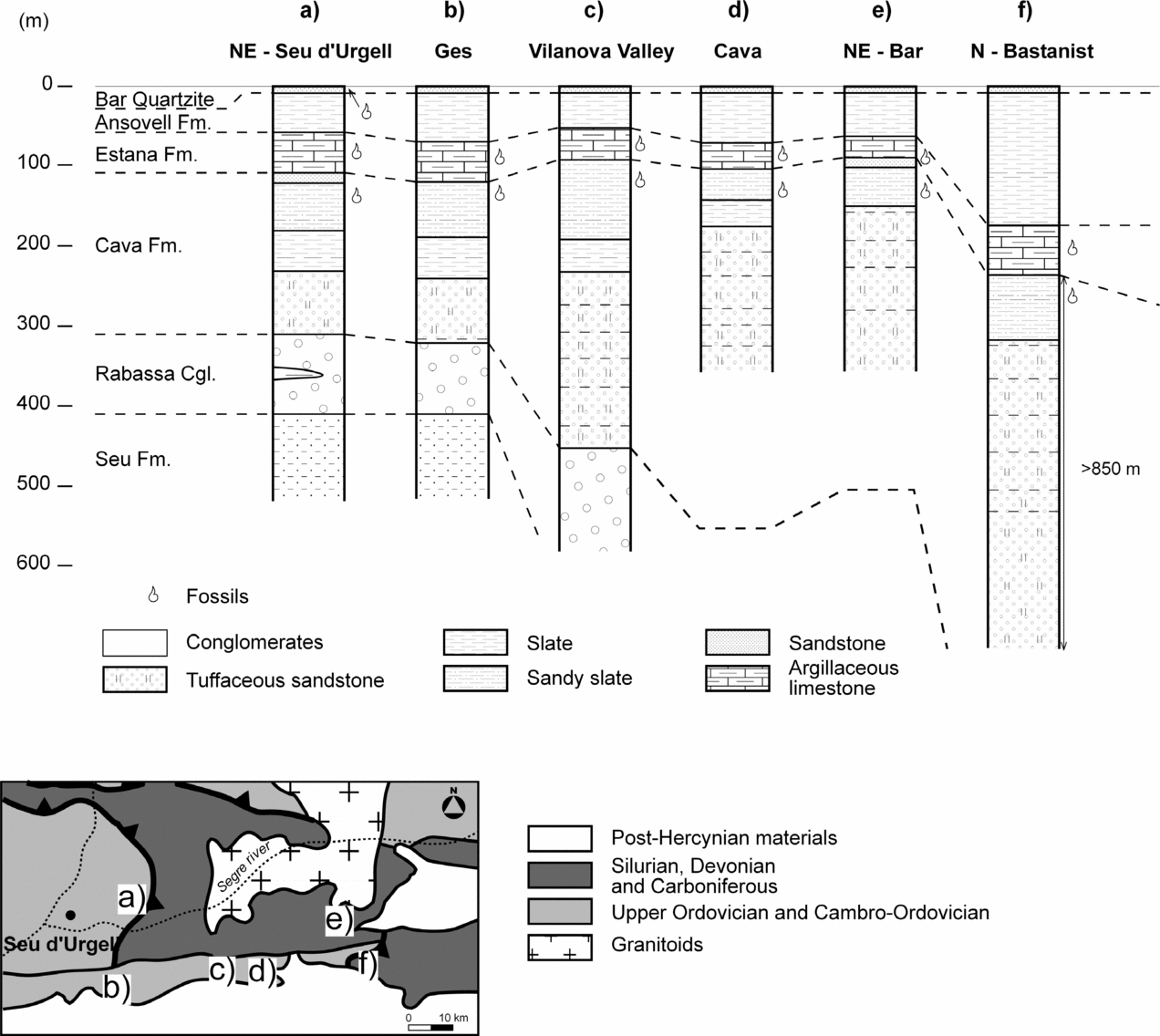
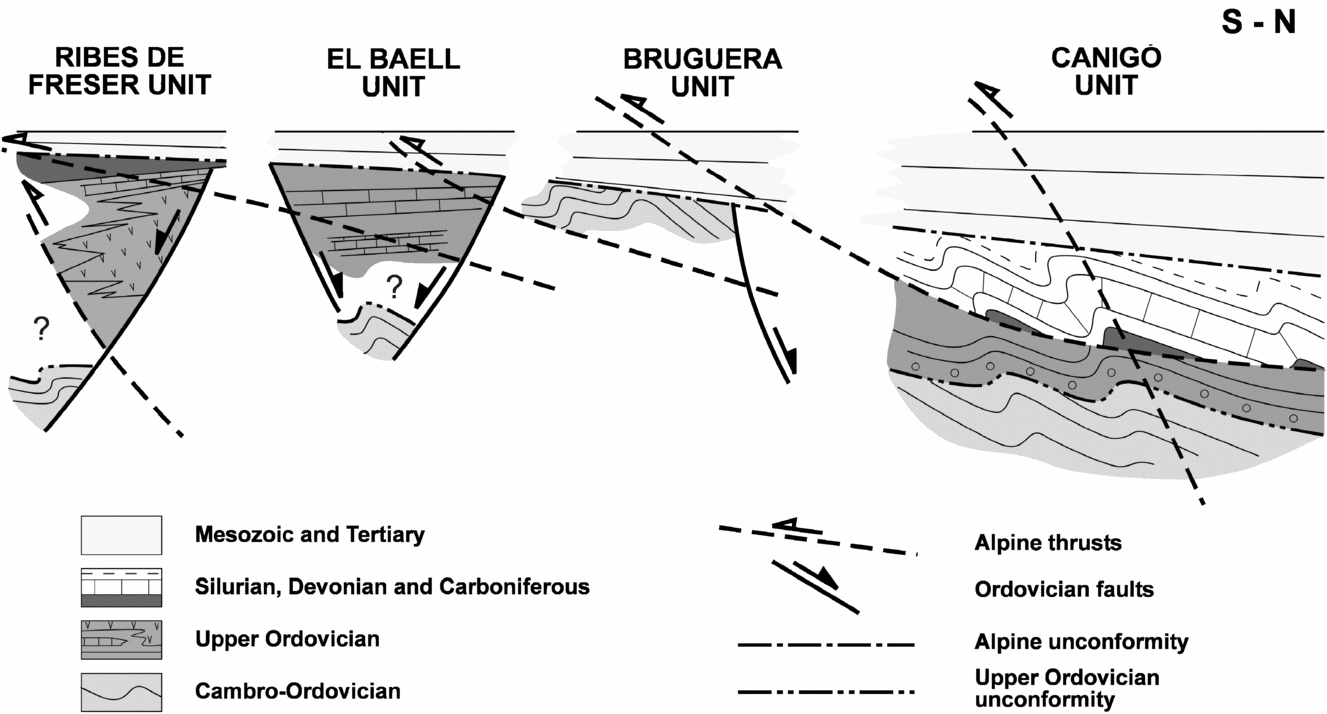
On the other hand, marked variations in the thickness of the Upper Ordovician succession have been reported by several authors (Llopis Lladó, Reference Llopis Lladó1965; Hartevelt, Reference Hartevelt1970; Speksnijder, Reference Speksnijder1986). Hartevelt (Reference Hartevelt1970) documented variations from 200 to more than 850 m in the thickness of the Cava Formation (Fig. 9). In the east of la Seu d'Urgell, for instance, the thickness of the Rabassa Conglomerate Formation and that of the Cava Formation attain more than 800 m before sharply diminishing to some tens of metres within a few kilometres (Casas & Fernández, Reference Casas and Fernández2008). In this zone, the maximum observed thickness occurs together with the maximum grain size of the conglomerates, and pebbles exceeding 50 cm in diameter are present. Variations in thickness and grain size can be attributed to relief formation controlled by fault activity and by subsequent erosion and alluvial fan sedimentation. As stated above, despite the marked lithological variations, the Upper Ordovician succession exhibits similar characteristics across the Canigó unit. These N–S-oriented normal faults can account for these variations, providing evidence of Caradocian–Ashgillian extensional tectonics in the Canigó unit. However, this is not the case for the Upper Ordovician succession forming the Ribes de Freser and Baell units, which exhibit a very different composition. The Ribes de Freser unit is practically made up of volcanic, subvolcanic and volcaniclastic rocks, with marked lithological variations, indicating a continuous intermediate to acidic volcanism during Caradocian and Ashgillian times. This unit constitutes the lowermost Alpine structural unit cropping out in this area, currently separated from the Baell unit by an out-of-sequence thrust, but according to Muñoz (Reference Muñoz1992a) initially located in a southernmost position. The Baell unit, in turn, is entirely formed by limestones, marly limestones and shales and is covered by another minor unit, the Bruguera unit, made up of Cambro-Ordovician metasediments. According to the restoration of the Alpine deformation (Muñoz, Reference Muñoz1992a), the Ribes de Freser was the unit located further south, followed by the Baell unit and the Bruguera unit. The Bruguera unit separates these units from the Canigó unit. Although the absolute positions of these units cannot be established owing to the uncertainty of the Variscan and Alpine displacements, a qualitative reconstruction can be proposed. A set of roughly E–W-oriented normal faults can limit these units, and control the active volcanism and the carbonatic sedimentation of the Baell unit in an unstable continental margin (Fig. 10). These E–W-oriented faults can coexist with the aforementioned N–S normal faults. The former faults had probably been inverted during subsequent Variscan and Alpine tectonics, whereas the latter faults, because of their unfavourable orientation, are preserved and currently recognizable.
Synthetic lithostratigraphic sections of the Upper Ordovician succession of La Cerdanya and Segre river areas after Hartevelt (Reference Hartevelt1970). See location in Figure 1a.

Reconstruction of the relations between the units involving Upper Ordovician metasediments before the Alpine deformations. Modified after Muñoz (Reference Muñoz1992a). Absolute positions cannot be established owing to the uncertainty about the Variscan and Alpine displacements.

5. Discussion
It should be noted that other Pyrenean massifs made up of a Cambro-Ordovician succession exhibit a structural arrangement similar to that described in the studied areas: a regional crenulation cleavage, regularly oriented and moderately to steeply dipping to the north, is associated with intersection lineations and minor fold axes with a marked dispersion. This disposition, described for the Rabassa dome (J. Poblet, unpub. Ph.D. thesis, Univ. de Barcelona, 1991; Capellà & Bou, Reference Capellà and Bou1997), the Massana anticline (Hartevelt, Reference Hartevelt1970; J. Poblet, unpub. Ph.D. thesis, Univ. de Barcelona, 1991; Casas, Parés & Megías, Reference Casas, Parés and Megías1998), the Orri dome (Hartevelt, Reference Hartevelt1970; Speksnijder, Reference Speksnijder1986; J. Poblet, unpub. Ph.D. thesis, Univ. de Barcelona, 1991) and the Lys-Caillouas massif (Den Brok, Reference Den Brok1989), among others, has been attributed to the presence of pre-foliar deformations. However, the authors disagree on the number, orientation and age of these pre-main Variscan folds. For instance, Speksnijder (Reference Speksnijder1986) proposes the existence of two orthogonal systems, NNW–SSE- and ENE–WSW-oriented, in the Orri dome, inferred only from the geometry and orientation of the intersection lineations. Given that no related mesostructures have been recognized in the outcrop and that no detailed maps of bedding attitude have been furnished, other pre-main fold orientations can account for a similar distribution of the intersection lineations. Most authors agree that folds can be open to tight, with sub-vertical axial surfaces and without penetrative axial plane foliations. Given the difficulty of determining the precise age of this pre-main deformation, most authors assign a Carboniferous age to the fold formation except in the Lys-Caillouas area (Den Brok, Reference Den Brok1989) and the southern slope of the Canigó massif (Muñoz & Casas, Reference Muñoz, Casas, Barnolas and Chiron1996), where a pre-Upper Ordovician age has been proposed. Despite the scarcity of detailed studies on the Massana anticline and the Orri and Rabassa domes comparing the structure of the Cambro-Ordovician and the Upper Ordovician series, these areas display characteristics so similar to those of the La Molina or El Conflent areas that an Ordovician age for the described pre-main Variscan deformations can be proposed.
The Iglesiente and Sarrabus regions in the south of Sardinia are the classic zones where an Upper Ordovician (Sardic) angular and erosional unconformity has been described (Teichmüller, Reference Teichmüller1931; Naud, Reference Naud1981). The Sardic Unconformity separates Cambrian and Ordovician series from a Late Ordovician sequence and has been attributed to the ‘Sardic Phase’ (Stille, Reference Stille1939), reflecting ‘Caledonian’ (Barca et al. Reference Barca, Carmignani, Cocozza, Franceschelli, Ghezzo, Memmi, Minzoni, Pertusati, Ricci, Gee and Sturt1985) or Taconic events (Leone et al. Reference Leone, Ferretti, Hammann, Loi, Pillola and Serpagli2002). In Sardinia, the younger upper part of the sequence under the unconformity is dated as Tremadocian (Barca et al. Reference Barca, Cocozza, Del Rio, Pillola and Pittau Demalia1987), and as a result, the age of the Sardic deformation is between Tremadocian and Caradocian. The Pyrenees closely resemble the most external part of the Sardinian fragment of the Variscan orogen: Upper Ordovician sequence, starting with conglomerates (‘Puddinga’), present similar lithologies (see discussion in Leone et al. Reference Leone, Ferretti, Hammann, Loi, Pillola and Serpagli2002). The Ordovician deformation is moderate without cleavage formation or related metamorphism, and normal fault activity is synchronous with Late Ordovician sedimentation (Carmignani et al. Reference Carmignani, Cocozza, Gandin, Pertusati, Carmignani, Pertusati, Cocozza, Ghezzo and Ricci1986a; Martini et al. Reference Martini, Tongiorgi, Oggiano and Cocoza1991). These similarities allow us to correlate the Upper Ordovician unconformity described in the Pyrenees with the Sardic Unconformity. It should be noted that this unconformity is not so well dated in the Pyrenees (see discussion in Gutiérrez-Marco et al. Reference Gutierrez-Marco, Robardet, Rabano, Sarmiento, San Jose Lancha, Herranz, Pieren Pidal, Gibbons and Moreno2002), but in contrast, in Sardinia the structures resulting from this Ordovician deformation are not so well characterized. For most authors, the Ordovician deformation is responsible for E–W-oriented large folds unconformably overlain by the Upper Ordovician conglomerates. E–W folds were subsequently deformed by N–S-oriented main Variscan ones (Arthaud, Reference Arthaud1963; Carmignani et al. Reference Carmignani, Cocozza, Ghezzo, Pertusati, Ricci, Carmignani, Pertusati, Cocozza, Ghezzo and Ricci1986b; Carmignani et al. Reference Carmignani, Oggiano, Barca, Conti, Salvadori, Eltrudis, Funedda and Pasci2001 and references therein). However, given that in some localities the Upper Ordovician succession is also affected by E–W folds, the Sardic phase seems to be homoaxial with subsequent E–W Variscan folds. This leads to considerable uncertainty when distinguishing the effects of both the Variscan and Ordovician deformations, and some authors discuss the existence of E–W Ordovician folds in the Iglesiente region (Lüneburg & Lebit, Reference Lüneburg and Lebit1998; Conti, Carmignani & Funedda, Reference Conti, Carmignani and Funedda2001). Thus, although the existence of the Upper Ordovician unconformity is well established in Sardinia, the structures responsible for their formation are not well characterized, and the comparison with the Ordovician folds described in the Pyrenees is not feasible.
In the Iberian massif, evidence of Ordovician tectonic activity is scarce. Concerning the fracture tectonics, Late Ordovician–Early Silurian normal faults and transverse folds related to a wrench component have been described in the Central Iberian Zone, at the limit with the West Asturian–Leonese Zone (Martínez-Catalán et al. Reference Martínez Catalán, Rodríguez, Alonso, Pérez Estaún and González Lodeiro1992). Faults control the thickness variation (0–300 m) of the Agüeira and La Aquiana formations, dated as Ashgillian and equivalent to the Estana Formation (Gutiérrez-Marco et al. Reference Gutierrez-Marco, Robardet, Rabano, Sarmiento, San Jose Lancha, Herranz, Pieren Pidal, Gibbons and Moreno2002) which rests unconformably over the Middle Ordovician (Martínez-Catalán et al. Reference Martínez Catalán, Rodríguez, Alonso, Pérez Estaún and González Lodeiro1992). In the proximity of this area, Díaz García (Reference Díaz García2001) described an Upper Ordovician subtractive contact between Lower Ordovician metasediments and the Ollo de Sapo gneiss. Further south in the Central Iberian zone, Oen (Reference Oen1970) and Roda (Reference Roda1986) described NE–SW-oriented folds that formed prior to the main Variscan deformation. In the same area, Silva & Ribeiro (Reference Silva and Ribeiro1985), Romão & Ribeiro (Reference Romão and Ribeiro1992) and Romão et al. (Reference Romão, Coke, Dias and Ribeiro2005) described a folding episode affecting the pre-Armorican quartzite sequence and giving rise to two unconformities, one at the base of the Armorican quartzite and the other at the base of the Volcano-Sedimentary Complex. These deformations are probably older than those described in Sardinia and in the Pyrenees, as they could have developed between post-Middle Cambrian and Early Arenig times. Migration of a major geodynamic regime is invoked by Romão et al. (Reference Romão, Coke, Dias and Ribeiro2005) in order to explain the diachronism between these events in Sardinia/Pyrenees and Iberia.
Whatever the case, and according to Gutiérrez-Marco et al. (Reference Gutierrez-Marco, Robardet, Rabano, Sarmiento, San Jose Lancha, Herranz, Pieren Pidal, Gibbons and Moreno2002), the term ‘Sardic unconformity’ must be restricted to an intra-Ordovician unconformity when well-dated Upper Ordovician metasediments overlie Cambrian or Ordovician series. Otherwise, when comparing the pre-Variscan deformations in the different areas, confusion arises due to the misleading correlation between the Sardic Unconformity and the pre-Ordovician unconformities (Díez Balda, Vegas & González Lodeiro, Reference Díez Balda, Vegas, González Lodeiro, Dallmeyer and García1990; Valverde-Vaquero & Dunning, Reference Valverde-Vaquero and Dunning2000).
Although this is a difficult task, because of the moderate character of the pre-main Variscan deformations and the imprint of the Variscan tectonics, it is of paramount importance to characterize accurately the geometry and age of the structures formed during these deformations. The evolution documented in the Pyrenees, with the occurrence of a Middle Ordovician contractional event, prevents us from considering a continuous extensional regime during Ordovician and Silurian times, related to the opening of the Rheic ocean or the Rheic and Palaeotethys oceans, depending on whether the chosen models involve one (Martínez-Catalán, Reference Martínez-Catalán1990; Robardet, Reference Robardet, Catalán, Hatcher, Arenas and García2002) or two peri-Gondwanan oceans (Matte, Reference Matte1986; Ribeiro et al. Reference Ribeiro, Munhà, Dias, Mateus, Pereira, Ribeiro, Fonseca, Araújo, Oliveira, Romão, Chaminé, Coke and Pedro2007). Some authors invoke a transient inversion of this extensional regime in order to explain the Ordovician deformations (Ribeiro et al. Reference Ribeiro, Munhà, Dias, Mateus, Pereira, Ribeiro, Fonseca, Araújo, Oliveira, Romão, Chaminé, Coke and Pedro2007), whereas Stampfli, Von Raumer & Borel (Reference Stampfli, Von Raumer, Borel, Catalán, Hatcher, Arenas and García2002) and von Raumer et al. (Reference Von Raumer, Stampfli, Borel and Bussy2002) proposed that the amalgamation of volcanic arcs and continental ribbons led to a short-lived cordillera formation in the Middle Ordovician. This cordillera started to collapse during the Late Ordovician in a context dominated by a Gondwana-directed subduction of a former (Prototethys or Iapetus?) peri-Gondwana ocean. This mechanism may explain a transient Middle Ordovician orogenic pulse formed in an environment dominated by extension.
6. Conclusions
In the Palaeozoic succession of the Pyrenees, two deformational events can be characterized prior to the formation of the Variscan structures. A Middle Ordovician (?) folding event affects only the pre-Upper Ordovician sequence and is responsible for the NW–SE- to N–S-trending folds. Folds gave rise to the Upper Ordovician unconformity and were responsible for the wide dispersion of the main Variscan linear structures in the Cambro-Ordovician metasediments. This folding event can be correlated with the ‘Sardic’ deformations described in Sardinia and is clearly unrelated to a later fracture episode which is Late Ordovician in age. This fracture episode originated N–S normal faults synchronous with Upper Ordovician sedimentation that affected the unconformity. The normal faults constitute the first direct evidence of Late Ordovician extensional tectonics in the Pyrenees and caused marked variations in the thickness and grain size of the Upper Ordovician succession of the Canigó unit. Moreover, the presence of E–W-oriented faults can also be postulated, controlling the active volcanism and the carbonatic sedimentation of minor units located in a southernmost position in an unstable continental margin. The later faults were probably inverted during subsequent Variscan and/or Alpine tectonics, while the N–S ones are still recognizable.
Thus, the ‘Sardic’ designation should be restricted to the intra-Ordovician deformations prior to the Late Ordovician. However, in the absence of detailed characterization of Lower Palaeozoic structural evolution, the use of this term should be avoided, given that it results in misleading correlations between deformational events of different ages in different areas.
This evolution prevents us from considering a continuous extensional regime during Ordovician and Silurian times in the Pyrenees, indicating a more complex evolution of this segment of the northern Gondwana margin during the Ordovician, as proposed by some reconstructions.
Acknowledgements
This work has been partly funded by geological mapping projects from the ‘Institut Cartogràfic de Catalunya’ and by the projects BTE2003-08653-CO2-O2, CGL-2007-66857CO2-02 and Consolider-Ingenio 2010 programme, under CSD2006-00041 ‘Topoiberia’. The author is indebted to O. Gratacós for the 3D reconstructions using GOCAD© and to colleagues from the Università degli Studi di Cagliari, especially C. Marini, for their kind hospitality during a sabbatical. Equal area plots were made using GEOrient 9.2 (R. J. Holcombe, University of Queensland). Detailed comments of two referees greatly improved a first version of the manuscript.