Cervical cancer (CC) is the leading cause of cancer death for women in sub-Saharan Africa. Madagascar ranks 11th among countries worldwide with the highest CC incidence (Reference Ferlay, Soerjomataram and Dikshit1). In high-income countries, cytology-based screening programs has allowed to drastically reduce CC incidence (2).
In low- and middle-income countries (LMIC), a cytology-based screening program is difficult to implement because of the lack of material resources and qualified physicians.
To overcome this difficulty, the options recommended by the World Health Organization (WHO) include human papillomavirus (HPV) testing followed by visual inspection with acetic acid (VIA) as a triage test (3). Integrating HPV-based screening with VIA/VILI (visual inspection after application of acetic acid/lugol's iodine) offers the dual benefit of optimizing both HPV detection and VIA/VILI for triage of HPV-positive women. However, VIA/VILI is healthcare provider-dependent and lacks a reliable quality assurance system. Given the concerns about the suboptimal sensitivity of the VIA/VILI approach, an improvement of quality assurance is required. Colposcopies of HPV-positive women followed by immediate treatment of pathological cases with or without guided biopsy might be considered as one of the best options. However, colposcopes are expensive, difficult to transport, and require specialized technicians for maintenance, as well as electric supply. Therefore, the implementation of colposcopes in LMIC is difficult and alternative system is required. Recent innovative technologies, such as the acquisition of consecutive cervical images including native, VIA and VILI with a smartphone, are a promising option for LMICs. The smartphone-based approach offers easy accessibility, user-friendly interfaces, high-definition cameras, minimal maintenance requirement and strong and focalized illumination; it allows both an optimal capture of the cervical status and to compare native with VIA and VILI by sliding through the picture.
The aim of this study was to assess the performance of smartphone-based digital images for the detection of cervical intraepithelial neoplasia of grade 2 or worse (CIN2+) in a low-resource context.
MATERIALS AND METHODS
This study took place in the Saint Damien Healthcare Centre in Ambanja, Madagascar, and in five dispensaries in the surrounding rural areas between February and October 2015. The town of Ambanja, which counts more than 33,000 inhabitants, is located in the northern region of Madagascar. Since 2010, the Saint-Damien Healthcare center in collaboration with Geneva University periodically runs routine HPV-based CC screening campaigns recruiting 1,000 women each year.
The study protocol has already been reported in a previous study (Reference Catarino, Vassilakos and Jinoro4). Briefly, women aged between 30 and 69 years, nonpregnant, were invited to perform HPV self-sampling (self-HPV). The samples were then analyzed by a point-of-care HPV test machine (GeneXpert®IV; Cepheid, Sunnyvale, CA) and HPV-positive women were invited for a VIA/VILI assessment. The study was approved by the Malagasy National Commission for the Ethics of Science and Technology and the Ethical Cantonal Board of Geneva, Switzerland (CER: 14–071). The trial has been registered on clinicaltrials.gov (registration number NCT02693379).
During the VIA/VILI procedure, images were captured using a smartphone (Samsung Galaxy S4 or S5, Seoul, South Korea): one of the digital-native cervix (D-NATIVE), one after application of acetic acid (1 min after application, D-VIA), and one after application of Lugol's iodine (D-VILI). Consecutive images were captured for consecutive patients, without selection or exclusion. At the end of the examination, a cervical smear and an endocervical sample were collected for each woman, followed by a biopsy of the pathological area, when present, or of the cervix at 6 o'clock when no lesion was visible. The gold standard for the disease was the histological evaluation, interpreted according to the WHO 2014 classification as grade CIN 1, 2, or 3.
Throughout the pelvic examination, photographs were obtained at a distance of 10–15 cm of the cervix, with 3.3–3.8× optical zoom and in flash mode. The two smartphones, Samsung Galaxy S4 and S5, were chosen for their high-quality cameras (13 and 16 megapixels, respectively, both with auto-focus and flash functions). The tutorial on how to perform the cervical capture is reported on the following Web site (https://www.gfmer.ch/ccdc/pdf/module5.pdf). Smartphone allows highly precise and detailed visualization of the cervix after zooming and focusing on the target. To improve the stability and quality of the images, the smartphone was fixed to the ground with a tripod and a support. Training could generally be done in 1 day and required 10 or 15 cases. Two gynecologists were trained to take the totality of the pictures contained in the database.
The Images of 125 consecutive women participating to the study were uploaded onto an online database (Google form). These included the D-native, D-VIA, and D-VILI images. The disease prevalence corresponded to that of real-life conditions (10–15 percent CIN2+). Questionnaires were broadly sent to: the European Network of Trainees in Gynecology and Obstetrics (ENTOG), the French Association of Trainees in Gynecology and Obstetrics (AGOF), members of the French Society of Colposcopy and Cervical Pathologies, doctors and trainees from different hospitals in France and Switzerland. The participants were blind to the histological results and were asked to determine if the images captured a nonpathological (normal or CIN1) or a pathological (CIN2+) cervix, and whether they were sufficiently or insufficiently useful for the diagnosis of CIN2+ . The Supplementary Figure 1 represents a case of normal cervix, and a case of CIN3, as presented in the online questionnaire. Completing the whole assessment required approximately 1 hour.
Readers were considered as novices or experts if they performed ≤ 50 or more than 50 colposcopies in their career, respectively.
This was a fully crossed multiple-reader multiple-case design because each cervicography was rated by the same set of readers (Reference Wagner, Metz and Campbell5). The sensitivity (specificity) for the detection of CIN2+ was assessed for each reader and reported with the 95 percent confidence interval (95 percent CI, Clopper-Pearson method). The reader-averaged sensitivity (specificity) was assessed by the mean of the reader-specific sensitivities (specificities). The 95 percent confidence interval around the reader-averaged sensitivities and specificities were calculated with a multireader multicase variance analysis (Reference Gallas, Pennello and Myers6). The reader-averaged sensitivity (specificity) was also assessed in the sub-groups of expert and novice readers. Both sub-groups were compared using a permutation test (Reference LaFleur and Greevy7). The distribution of the difference in reader-averaged sensitivities (specificity) between sub-groups under the null hypothesis of a null difference was simulated by shuffling the groups and by calculating, for each permutation, the difference in reader-averaged sensitivities.
The two-sided p-value was the proportion of absolute differences higher than the difference obtained in the original sample. Logistic regression analysis with mixed effects was performed to model the association between the quality of images rated by readers and sensitivity/specificity. The two-sided risk of type 1 error was 0.05 for all tests. Statistical analyses were performed with a statistical analysis software package (Stata13 IC software. College Station, TX).
RESULTS
The distribution of cervical disease among the 125 women was nineteen (15.2 percent) pathological cases (CIN2+) that included five (4.0 percent) cases of invasive cancer, eight (6.4 percent) cases of CIN3, six (4.8 percent) cases of CIN2. There were five (4.0 percent) cases of CIN1 and the remaining cases were negative for any cervical lesion.
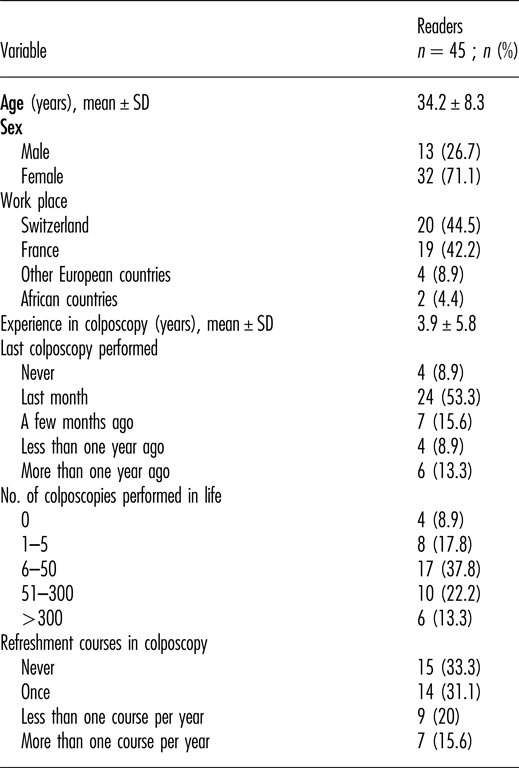
A total of forty-five gynecologists participated in the study and answered the questionnaire. Most of them were women, with a mean ± standard deviation age of 34.2 ± 8.3 years, coming from Europe, especially France and Switzerland. One-third of them were experts in colposcopy, and two-thirds of them were considered as novices. The characteristics of the readers are summarized in Table 1.
Characteristics of the Readers (n = 45)

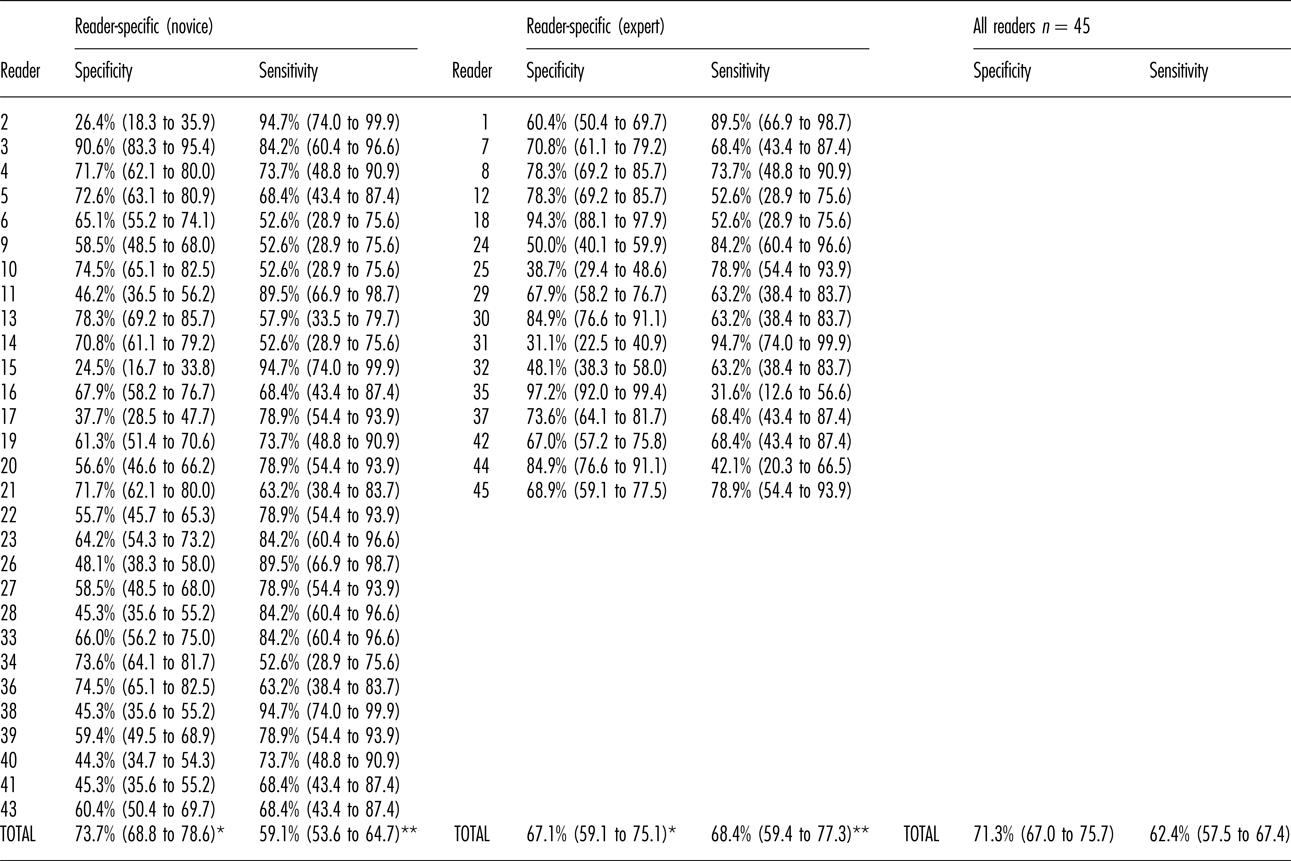
The diagnostic performance of digital images, reported in Table 2, varied broadly among readers: the readers-averaged sensitivity for CIN2+ detection was 71.3 percent (67.0–75.7 percent) and specificity was 62.4 percent (57.5–67.4 percent).
Performance of Novice and Expert Readers

Note. Comparison between the two-subgroups using a permutation test.
*Specificity did not differ between novices and experts (p = 0.1741).
** Sensitivity did not differ between novices and experts (p = 0.0838).
The specificity was higher for experts than novices (68.4 percent [59.4–77.3] and 59.1 percent [53.6 –64.7], respectively), although it was not statistically significant (p = .08). Sensitivity was not significantly different neither between the two groups of readers (p = .17) (Table 2).
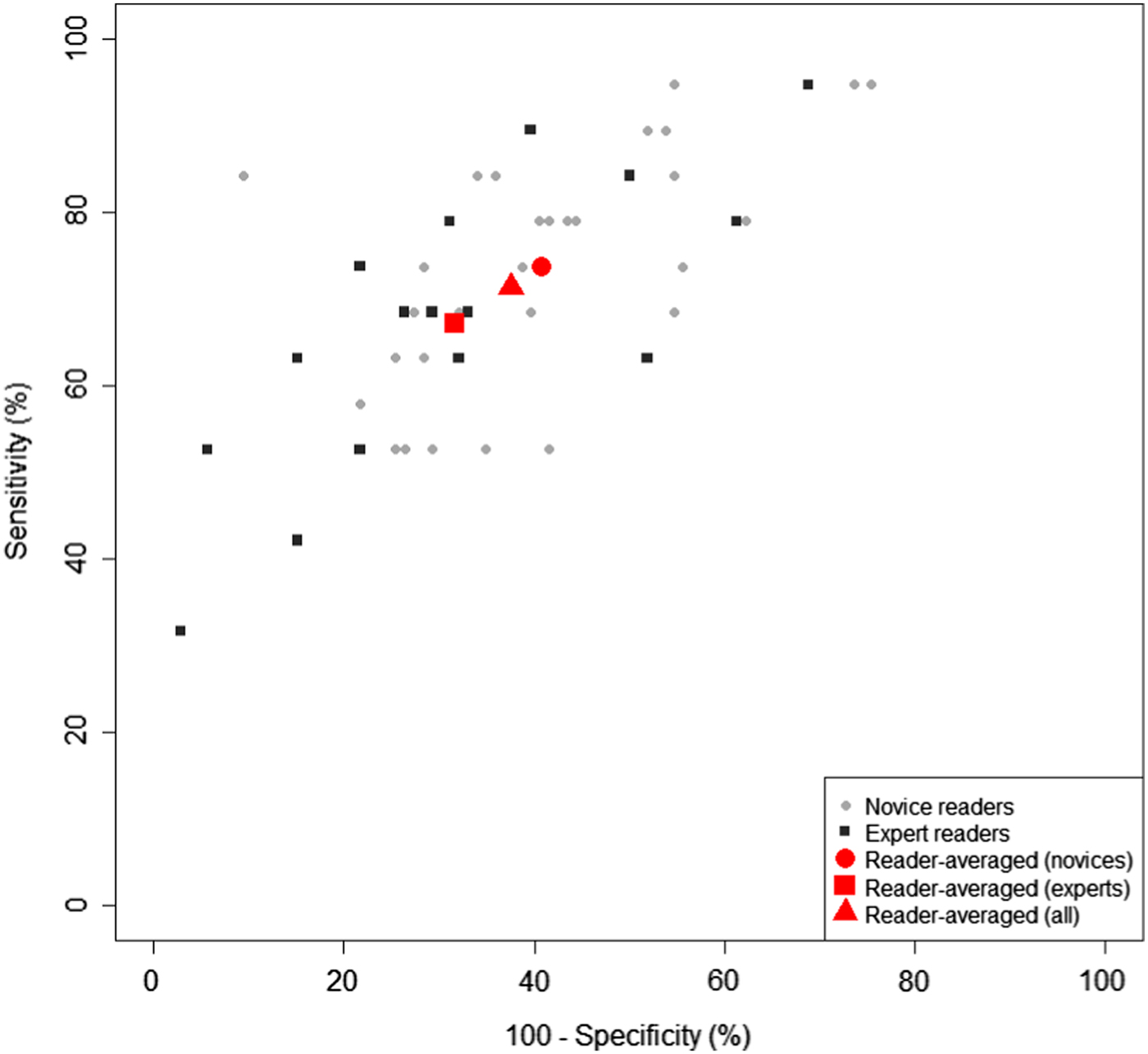
The sensitivity and specificity were negatively correlated across readers, as the specificity decreased as the sensitivity increased (Spearman's coefficient of correlation ρ = −0.67), in a comparable way among expert and novice readers (Spearman's coefficient of correlation ρ = −0.76 and ρ = −0.60, respectively) (Figure 1).
Sensitivity and specificity of digital images for novices (circle-shaped), experts (square), and overall readers (triangle).

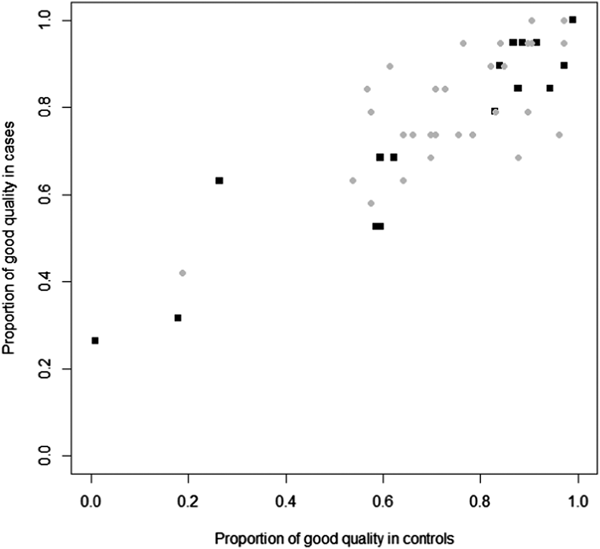
The proportion of images rated as of “sufficient quality” was 73.1 percent (66.9–79.2). There was no statistically significant difference between expert or novice (p = .39); there was no difference neither among cases (CIN2+) and controls (negative or CIN1) (Supplementary Table 1). The readers-averaged proportion of images rated as “sufficient quality” in cases and in controls was positively correlated across readers, with Spearman's correlation coefficient ρ = 0.77 (Figure 2). Quality evaluation was subjective and very-much individual-dependent. An example of images rated as “insufficient” by 100 percent of the readers is displayed in Supplementary Figure 2. The main reason for insufficient images was the lack of focus, inducing blurred pictures.
Reader-specific proportion of images rated of good quality in cases (CIN2+) and in controls (negative and CIN1), among novices (circle-shaped), experts (square).

When the images were rated as of “sufficient quality” by the readers, as compared with images of “insufficient quality,” the sensitivity was slightly although not significantly better (odds ratio OR 1.59 [95 percent CI 0.98–2.58]; p = .059) and the specificity was significantly higher (OR 1.29 [95 percent CI 1.06–1.57]; p = .013). The specificity among experts was higher when the latter rated the images as being of sufficient quality, compared with novices (p = .045).
DISCUSSION
The objective of VIA/VILI triage in HPV positive women is to maximize the early detection of CIN2+ lesion while minimizing the number of biopsies of benign lesions. This study was designed to assess the performance of smartphone-based digital images using close to real-life conditions, with pictures of 125 consecutive patients without image selection. The readers-averaged sensitivity was 71.3 percent (95 percent CI 67.0–75.7 percent) and specificity was 62.4 percent (95 percent CI 57.5–67.4 percent). Similarly, the agreement between cervical examination using digital store-and-forward colposcopic system compared with conventional binocular colposcopy in presence of the patient was judged as good in Schädel's study (Reference Schadel, Coumbos and Ey8). However, other studies have reported that colposcopic impressions were more likely rated high grade among women referred with high-grade cytology (odds ratio = 3.3; 95 percent CI = 1.8–6.4), significantly improving the sensitivity for CIN 2+ compared with static images (Reference Ferris and Litaker9;Reference Liu, Gold and Schiffman10).
A potential improvement of smartphone-based digital image can be obtained in real-life conditions, as Google Form does not allow to zoom in on the images. In addition, the readers were blind to the women's medical history, which could add a potential bias to the interpretation of some lesions.
If we compare our results with colposcopy including women referred for high-grade cytology, the risk of finding a high-grade lesion CIN2+ is 70–75 percent (Reference Apgar, Kittendorf and Bettcher11), so the physician is careful not to miss the lesion, thus optimizing the sensitivity. In our case, VIA/VILI assessment was performed in HPV-positive women, whereas prevalence of CIN2+ range between 12 and 15 percent. In the literature, colposcopy referral after HPV triage yielded sensitivity close to our rates (64.1 percent [95 percent CI: 51.1–75.7]) (Reference Isidean, Mayrand and Ramanakumar12).
VIA assessment with naked eye has been reported to be very sensitive and specific (Se 82.4 [95 percent CI 76.3–87.3], Sp 87.4 [95 percent CI 77.1–93.4]), similarly to naked-eye VILI assessment (Se 95.1 [95 percent CI 90.1–97.7], Sp 87.2 [95 percent CI 78.1–92.8]) (Reference Fokom-Domgue, Combescure and Fokom-Defo13). However, one weakness of these reports is that the gold standard was based on colposcopy without systematic histological assessment, which potentially overestimates the accuracy of visual methods (VIA and VILI). When biopsy was used as the standard reference, sensitivity decreased (VIA Se 59.7 [95 percent CI 45.8–72.4] and VILI Se 75.4 [95 percent CI 62.2–85.9]) and was closer to that obtained with digital images (Reference Shastri, Dinshaw and Amin14).
Our experience teaches that when healthcare providers use both the naked eye technique and the smartphone image-based one, they generally prefer to base their clinical decision on the smartphone. Although this issue was not formally evaluated in the present study, smartphone-based image may potentially improve diagnostic accuracy compared with naked-eye clinical examination.
The smartphone's image quality is probably not as good as those obtained with colposcopy, but this approach offers significant advantages, such as a lower price, an easier-to-use device, the possibility to save the pictures and to classify them in the patient's file, making them available for comparison at follow-up visits. The pictures can also be shown to patients to sensitize them on their anatomy and to obtain their informed consent before performing cervical biopsy or treatment. Once VILI is performed, it is possible to look back at the VIA or native picture for treatment decision making, something which is not possible in real-life conditions. Moreover, in case of doubt, it is possible to ask for a colleague's opinion either on- or off-site for quality control of the diagnosis (Reference Ferris and Litaker9). Finally, all these recorded images constitute a solid database for the medical staff's education.
The proportion of digital images judged as being of sufficient quality was high (73.1 percent), and the reader's sensation of sufficient quality improved specificity for the detection of CIN2+ lesions.
One strength of this study is the use of histological diagnosis (biopsy) as the reference for all patients, allowing correct assessment of disease prevalence and the absence of selection bias for lesions difficult to diagnose clinically. Moreover, these results represent the interpretation of multiple readers. Limitation is the low number of positive cases, however, interpretation of 125 images takes a significant time and it would be difficult to organize a larger trial.
In conclusion, the smartphone-based D-VIA and D-VILI assessment was primarily designed to help making a precise clinical diagnosis and ensure that CIN2+ lesions are not missed. Our results demonstrate that smartphone-based VIA/VILI has a good sensitivity and specificity for the detection of CIN2+ in HPV positive women. The accuracy of this approach supports its uses for HPV-positive triage in LMIC.
SUPPLEMENTARY MATERIAL
Supplementary Figure 1: https://doi.org/10.1017/S0266462318000260
Supplementary Table 1: https://doi.org/10.1017/S0266462318000260
Supplementary Figure 2: https://doi.org/10.1017/S0266462318000260
CONFLICTS OF INTEREST
The authors declare no potential conflicts of interest.