Introduction
When any new procedure is adopted by a speciality, it is important to assess and audit the new technique's effectiveness, compared with previous treatments used for the same condition. In the current economic environment, it is also important to consider the cost-effectiveness of an intervention, in order to ensure best use of available resources. Indeed, this is part of the remit of the UK National Institute for Clinical Excellence when considering whether to approve new drugs or procedures.
Dacryocystorhinostomy (DCR) is an operation to relieve obstruction in the nasolacrimal system by creating a nasolacrimal fistula proximal to the obstruction. Traditionally, DCR has been performed by ophthalmologists as an external procedure. However, over the past two decades, endonasal endoscopic DCR has become the surgical treatment of choice for acquired nasolacrimal duct obstruction in many centres. Usually, the endoscopic method is undertaken as a joint operation between ophthalmologists and otolaryngologists. The addition of an extra surgeon, the use of endoscopic equipment and the relatively lower success rate of the endoscopic procedure made us compare these two methods of DCR with regards to their financial costs and income generated for our National Health Service (NHS) hospital trust.
Methods
All primary endoscopic DCR procedures performed in our centre between 2001 and 2003 were retrospectively studied. Patients' age, sex, type of anaesthesia, duration of stay (day case or overnight), failure rate and the follow-up period were retrieved from the hospital records (unpublished data). The same data for external DCR procedures performed in our centre between 1993 and 2000 were extracted from a previously published paper.Reference Mirza, Al-Barmani, Douglas, Bearn and Robson1 The procedure was performed using ‘cold steel’ dissection without the use of a light probe or laser, and all patients had been intubated at the end of the procedure.
The trust reference cost for DCR was obtained from the hospital finance department and was used to calculate the cost for each DCR case. The income per case was obtained from the national tariffs based on the Health Resources Group's ‘payment by result’ system HRG B21 = dacryocystorhinostomy. The average number of cases per session was used to calculate the income gained per session for each method of DCR.
Results
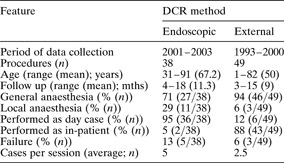
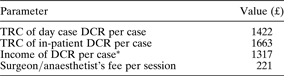
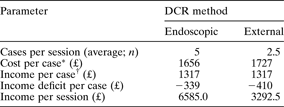
The retrospective data collected for endoscopic DCR over a two-year period are shown in Table I and compared with similar data for external dacryocystorhinostomy, collected in a previous study in our centre.Reference Mirza, Al-Barmani, Douglas, Bearn and Robson1 The fees and costs per item are presented in Table II. The cost of each DCR method (endoscopic or external) was calculated as shown in Appendix 1. The costs and income for each method are compared in Table III (financial data were based on figures provided by our NHS finance department in 2006).
Comparison of endoscopic and external DCR

DCR = dacryocystorhinostomy; mths = months
Fees and costs

*Based on Health Resources Group B21. TRC = trust reference cost; DCR = dacryocystorhinostomy
Cost and income comparison for DCR methods

*See Appendix 1. †Based on National Health Service national tariff (Health Resources Group B21). DCR = dacryocystorhinostomy
Discussion
Our data show that endoscopic DCR was less costly and produced more income compared with external DCR. To enable cost comparison, the two methods of DCR were broken down into their component financial elements (for the surgical procedure) in order to calculate the actual cost. The revision rate, type of anaesthesia and the rate of day case surgery have cost implications, and these were taken into account in our calculations. Income calculations were based on the national tariff, which is the same for day case and in-patient DCR. The endoscopic equipment for endonasal surgery was relatively expensive, but the purchase cost was not included in our calculations as the equipment is part of an established otolaryngology theatre. Our study evaluated the procedural costs of the two methods of DCR, but it did not take into consideration any pre- or post-operative costs, as these are entirely the same for both methods in our hospital. Epiphora patients, having been selected by the ophthalmologist, undergo similar pre- and post-operative management regardless of the type of DCR operation. This is achieved in regular joint ENT-ophthalmology clinics.
Endoscopic DCR is more cost-effective as it is performed faster; therefore, more cases can be done in one theatre session. Endoscopic DCR also has the obvious advantages of no skin scar, less bleeding or orbital haemorrhage, intact medial palpebral ligament, intact lacrimal pump mechanism, and intact horizontal apparatus, in comparison with external DCR.Reference Dietrich, Mewes, Kuhnemund, Hashemi, Mann and Amedee2 Endoscopic DCR can also address abnormalities that may potentially interfere with creation of the intranasal ostium (e.g. deflected nasal septum or hypertrophy of middle turbinate) via the same approach.Reference Woog, Kennedy, Custer, Kaltreider, Meyer and Camara3 Endoscopic DCR may also be useful in the management of acute dacryocystitis with abscess formation, when external DCR is a less favourable option.Reference Lee and Woog4
Despite all the above advantages of endoscopic DCR, it has been considered the inferior procedure owing to its lower success rate. However, this can be challenged.
Firstly, although external DCR has a high success rate of 85–100 per cent, longer follow-up times have given lower figures.Reference Dietrich, Mewes, Kuhnemund, Hashemi, Mann and Amedee2
Secondly, although most earlier studies of endoscopic DCR showed lower success rates compared with external DCR, higher success rates (approaching those of external DCR) have been reported in later studies.Reference Woog, Kennedy, Custer, Kaltreider, Meyer and Camara3, Reference Ben Simon, Joseph, Lee, Schwarcz, McCann and Goldberg5, Reference Durvasula and Gatland6
Thirdly, endoscopic DCR has been popularised in the past two decades. Over this time, it has been difficult to extract a universal success rate from the literature, owing to diversity in surgical methods; surgical tools (e.g. knife, laser and mechanical drill); type of operation (new case or revision); application of topical mitomycin C; length of follow up; definition of success; and the effect of the learning curve.Reference Mirza, Al-Barmani, Douglas, Bearn and Robson1, Reference Woog, Kennedy, Custer, Kaltreider, Meyer and Camara3, Reference Erdol, Akyol, Imamoglu and Sozen7, Reference Tsirbas, Davis and Wormald8
The higher costs of external DCR have been noted in previous studies.Reference Gerbaud, Chiambaretta, Desrumeaux, Privat, Doz and Menerath9 Our data show that endoscopic DCR was a financially better option in comparison with external DCR. This is due to several factors, as follows.
Higher number of cases per session
In our study, twice as many endoscopic DCR cases as external DCR cases could be done in each theatre session. Obviously, this statistic might differ between individual centres. Similar figures have been produced by Hartikainen et al. Reference Hartikainen, Antila, Varpula, Puukka, Seppa and Grenman10, Reference Hartkainen, Grenman, Puukka and Seppa11 However, Malhotra and colleagues found that equal time was required for both external and endoscopic DCR procedures (approximately 40 mintues).Reference Malhotra, Wright and Olver12
Higher number of day case operations
A significant difference in the rate of day case surgery was noted in our series. Day case surgery has great implications on surgical costs and income. For DCR, the nationally agreed income is the same for day case and in-patient procedures. However, in-patient DCR is more expensive for the hospital, as we have shown.
Higher number of cases performed under local anaesthesia
One of the factors in the cost reduction associated with endoscopic DCR is the number of cases that can be performed under local anaesthesia. Durvasula et al. performed 85 per cent of their endoscopic DCR under local anaesthesia.Reference Durvasula and Gatland6 However, it must be noted that this will be a cost-saving measure only if all cases within that theatre session are performed under local anaesthetic, in order to avoid allocation of an anaesthetic session fee. Use of local anaesthesia also expands the patient population eligible for the procedure, as it allows older and less fit patients to safely undergo surgery.
Our data also demonstrate that the cost of one DCR is higher than the income generated (Table III). This begs the question of how the trust reference cost is calculated, and whether this could partly explain the current financial shortcomings within NHS trusts. This is an issue that requires more attention, but we did not investigate it further as it was not the objective of our study.
Limitations of the study
Children require general anaesthesia regardless of DCR type. In our study, there were a small number of children in the external DCR group, and this could potentially have skewed the results in favour of endoscopic DCR. This is a potential bias and needs to be taken into account.
• In most UK centres, endoscopic dacryocystorhinostomy (DCR) is currently undertaken as a joint operation between ophthalmologists and otolaryngologists
• Endoscopic DCR is more cost-effective than external DCR, despite a lower success rate and greater use of resources, as it generates more income in the current UK National Health Service system
• The favourable cost-effectiveness of endoscopic procedures is mainly due to a higher number of cases per session and higher rates of local anaesthesia and day case surgery
The rate of readmission due to complications (e.g. epistaxis) was not calculated in our study. However, the previous study from our centre comparing the two methods showed their respective rates of post-operative epistaxis to be equal (i.e. 4 per cent).Reference Mirza, Al-Barmani, Douglas, Bearn and Robson1
Our study compared our current endoscopic DCR data with results from a relatively dated external DCR study. This may have affected outcomes, as some influential factors (i.e. anaesthetic techniques and day case rates) change with time. Currently, there is a campaign to increase the use of day case surgery in UK hospitals; this may improve future rates of day case external DCR surgery.
Conclusion
Endoscopic dacryocystorhinostomy is more cost-effective than external DCR, in spite of the former procedure's requirement for an extra surgeon allocated to the theatre session, and its reported lower success rate (although this can be challenged). Such favourable cost-efficiency is possible because endoscopic DCR produces more income, owing to the higher number of cases per theatre session, higher number of cases performed under local anaesthesia and higher number of cases done as day case surgery.
Appendix 1. Cost calculations per single case
Endoscopic dacryocystorhinostomy


External dacryocystorhinostomy