“The greatest discovery of my generation is that human beings can alter their lives by altering their attitudes of mind” (William James).
Implicit theories (also referred as self-theories) represent a cognitive conceptualization about a matter, generally raised as a belief about the nature of attributes or mindsets to be fixed or changeable. Beliefs are in actual considered as an individual’s recognitions or conventions (Richardson, Reference Richardson, Raths and McAninch2003) being held and strengthen by the individual's experiences effecting their overall behavior and attitude towards others (Mansour, Reference Mansour2009). Also, these are the elements of cognitive processing which can determine the way an individual feels, deals and respond to an individual, situation or a thing. Beliefs are usually regarded as accurate perceptions having no ambiguity at all (Deryakulu, Reference Deryakulu, Kuzgun and Deryakulu2006). On the whole, it represents a deterministic influence and powerful hold of certain kind of mindsets or beliefs over the whole life of living beings demanding researchers to devote their attempts for exploring this domain as well as directing the promising direction of practicing and holding such beliefs.
Dweck (Reference Dweck1986) at first presented the concept of implicit beliefs/theories with respect to intelligence. The construct was comprised of two opposite kinds of belief including entity beliefs and incremental beliefs. Entity beliefs were about the nature of intelligence to be assumed as genetically driven, fixed tendency of individuals (Cadwallader, Reference Cadwallader2009) which can never change or grow. Whereas, the incremental beliefs of intelligence were presented as growth-oriented ideas where it is believed that it can be developed and enhanced with effort, time and potential (Blackwell et al., Reference Blackwell, Trzesniewski and Dweck2007). According to the theory, these implicit conceptions are individual differences—which are quite stable over the period of time, and people are found to be either having an incremental or an entity mindset.
Furthermore, it is considered that these beliefs are influencing all aspects of cognitive, affective, and behavioral reactions of individuals to respective environments. It is added that incremental theorists are holding believe that the attributes of individuals like intelligence and moral character etc., are changeable, can be developed, cultivated and shaped with efforts and time. On the other hand, an entity theorist holds the view that the attributes of people are unchangeable and are quite stable over the period of time such as the belief of having fixed intelligence or moral character, etc. An individual who is having incremental mindset believes that people are able to change their attributes by shaping them up with environmental or contextual impacts or through personal growth and effort, whereas the entity believer will go to the hereditary or innate tendencies of individuals to be the basics of their attributes recognizing them as fixed and stable (Dweck, Reference Dweck2012).
Currently the trend is shifted towards the study of these beliefs with respect to different attributes other than intelligence, in field-oriented fashion (Ilhan & Cetin, Reference Ilhan and Cetin2013). Implicit beliefs are regarded as a bit more distinct than other variables reflecting individual differences, as these beliefs are both changeable and stable (Dweck et al., Reference Dweck, Chiu and Hong1995). Although these beliefs are contradictory in nature but people can hold them both simultaneously. Additionally, it is considered that implicit beliefs can vary chronically as well as from moment to moment. Certain attributes of individuals like intelligence and morality are the kind of domains being investigated extensively under this paradigm. It is depicted in these domains that a qualitatively different kind of patterns are produced by implicit beliefs in terms of behaviors and cognitions.
Literature depicts that entity belief orient and directs an individual’s attempts towards negative, harsh and hostile behaviors. Such individuals usually go for punishing others, showing aggression and making disruptions. Whereas, incremental processing is being evident for positive, flourishing and forgiving tendencies (Yeager et al., Reference Yeager, Trzesniewski, Tirri, Nokelainen and Dweck2011). It turns an individual’s attempts to the awarding and inspiring stance. Also, Molden and Dweck (Reference Molden and Dweck2006) presented that knowing an individual’s implicit beliefs will make it easy to understand and predict the possible reaction or function of that individual, handling of setbacks, regulation of self-esteem, their view and interaction with others, etc.
The most pertinent specification of such beliefs for this study seems to be addressed under implicit beliefs/ theories of empathy incorporating the ideas about empathy to be fixed or developed with efforts. The entity beliefs of empathy present that it is a tendency which can never be changed but its incremental beliefs present it to be developed with efforts and concern and respective behaviors would be expected (Schumann et al., Reference Schumann, Zaki and Dweck2014). Thus, the present study is designed to consider implicit beliefs, the way these are being conceptualized and influencing the behavior of individuals.
Demographic/Sociocultural Factors and Implicit Theories/Beliefs
Following are the demographic variables presented in literature to be explored in relation to implicit theories.
Gender. Previous studies suggested that gender is quite influential variable while working with forgiveness, empathy, and implicit beliefs. It is found as a common perception and most of the popular cultures maintain that females have a greater tendency of understanding others and affiliating with them as compared to males (Klein & Hodges, Reference Klein and Hodges2001). Most of the empirical evidences presented similar gender differences in empathy (Macaskill et al., Reference Macaskill, Maltby and Day2002; Schieman & van Gundy, Reference Schieman and van Gundy2000). Few theoretical notions also suggest that females are higher in empathy than males (Baron-Cohen et al., Reference Baron‐Cohen, Wheelwright, Hill, Raste and Plumb2001). Further, research indicated that it might be the outcome of motivation which allows females to be more empathic than males rather than ability (Klein & Hodges, Reference Klein and Hodges2001). This literature does not specify categorization of gender. Also, it is open for all kind of individuals to participate in current study as the variable needs to be explored for having a vivid kind of understanding for implicit beliefs of empathy.
Level of Education. Previous studies presented that the level or year of education is a quite influential contributor variable found to be an expression for greater precision of the phenomenon under investigation. It is also suggested in previous studies that higher studies or those students who were having higher level of education among the whole sample displayed more positive tendencies and dispositional optimism (Mattis et al., Reference Mattis, Fontenot, Hatcher-Kay, Grayman and Beale2004), so education was measured (You et al., Reference You, Fung and Isaacowitz2009).
Family Structure. There are certain research evidences available for the influence of family structure on forgiveness and empathy directing that there is a need to consider the role of nuclear and joint family systems while going for the exploration of implicit beliefs of empathy. For instance, it is presented that individualists are less likely to live with their nuclear families and were found to be more stressed. It is also suggested that with changing trends towards nuclear family systems than joint ones where people use to be closer and connected with multiple individuals, a need is to reflect over this element (Schumann et al., Reference Schumann, Zaki and Dweck2014).
No. of friends. Research evidences were also available for the variable of number of friends with some kind of specification. It is suggested that cultures and peer groups are the social factors which are found to be having an influence and pressure on individuals to express different kind of positive or negative attitudes and beliefs (Hepler & Albarracín, Reference Hepler and Albarracín2013). Also, Yang et al. (Reference Yang, Wu, Lei and Yang2009) mentioned that the increase likelihood of adolescents and young adults is depicted for having rich peer relations. Researchers worked for exploring the influence and selection of peer group among individuals. But few of them studied the variability of friendship structures. Few studies presented dyads, triads and gang kind of grouping. But others worked on fluidity and reliability of social networks with the consideration of interrelations among individuals by letting them free to nominate any number of friends.
Comprehensively accounting for this variable, it is presented that no friend or up to two friends is observed as unstable structure. Whereas three names are found to be the minimum number for getting more stable network structure in terms of friendship with having strong bonds.
Also, five or more names were found to be required for possible links between boys and girls, however more than that seem to be redundancy as in this case the selective friendship bracket get lost and people use to include most of their common associates as friends but without having true friendship (Yang et al., Reference Yang, Wu, Lei and Yang2009). Thus, the present study categorizes that 1–3 is the minimum no of friends, 4–7 as moderate no of friends (the desired friendship range) and 8 or more as maximum no of friends.
Pakistani Perspective
There are multiple studies available on positive constructs like forgiveness (Shoaib & Rafique, Reference Shoaib and Rafique2015) and agreeableness etc., as well as negative outcomes like punishment and vengeance (Bajwa & Khalid, Reference Bajwa and Khalid2015) in Pakistan but the construct of implicit theories is a comparatively fresh domain in this region. Only few studies are available which are limited to implicit theories of intelligence (Noureen, Reference Noureen2016). Therefore, the above-mentioned need of studying this construct made it promising to consider construct validity, reliability of the measure and establish psychometric properties for future usage in indigenous context.
Also, the current political situation of Pakistan is pertinently demanding something to mild the tendencies, change the conceptualization and reduce the harshness of individual’s attitudes. The way different political parties are blaming, teasing and disrespecting the rights of each other as well as common people, is distressing. Scholars are addressing these facts as a sad reality that not only government and military are presenting things without clarity and evidence, overriding good judgments in terms of personal as well as institutional interests. All political talk shows reflect the highest levels of exaggeration, conspiracy and suspiciousness. In short, a paranoid style is being declared to be prevalent in Pakistani politics (Hoodbhoy, Reference Hoodbhoy2016).
Further, one of the political leaders slapped his opponent recently during a TV show reflecting his anger, hostility and lack of self-control. Gun attack on former interior minister by a person while corner meeting in his own constituency-Narowal is another case. Also, a shoe was thrown at some political members including former prime minister of Pakistan, ink was thrown on former defense minister and many more shameful attempts are here to account for entity/hostile mindsets depiction. It is thus considered that the general attitude of political members is quite intolerant. They are not able to tolerate even genuine criticism and resort to violence. This is not the only case, such examples are increasing in same as well as slightly different manners (Chaudhry, Reference Chaudhry2018).
Therefore, the present exploration could prime one of the sound tendencies to have mild, tolerant and optimistic stance in general, particularly a food of thought for politicians inculcating the betterment of living beings.
Method
Objective of the Study
The purpose of conducting present study is to address the indigenous perspective of implicit theories and validate its measure. It included (i) construct validity with confirmatory factor analysis (ii) criterion-related validity by correlating it with the behavioral measure (iii) reliability of the scale as internal consistency and test-retest reliability (iv) identifying the role of demographic variables.
Measures
Implicit Beliefs Measure . The present study utilized the scale designed for measuring implicit beliefs of Empathy (Schumann et al., Reference Schumann, Zaki and Dweck2014). It was comprised of six items having two subscales usually treated as two variables for entity and incremental beliefs. First three items were measuring entity beliefs and next three was used to measure incremental mindsets. The measure was first given to the 15 bilingual graduate students from a public university of Islamabad, Pakistan, to assess the understanding and comprehensive aspects of the measure for Pakistani population. As the individuals responded that it is easy to understand and respond so, it reflected that there was no need to go for translation and the scale was used as it is. Further, although the country has several native languages, English is Pakistan's official language and it is widely used in education, commerce, and government; strengthening the fact that the instrument can be used within the context of the country. Specifically, the respondents were bilingual and their medium of instruction was ‘English’ in the educational institution, statements were very simple and it was ensured with a mini try out session that there is no need to go for translation of the scale. Therefore, the attempt was made to establish the psychometrics of the scale in our native context only. It was a Likert-typed rating scale having a range from 1 being strongly disagree to 7 being strongly agree. The alpha coefficient of reliability of the measure was reported to be (α = .90). Whereas, Omega coefficient was found to be .79 for the complete IBM, with .80 for Entity Theory and .74 for the Incremental theory subscales.
Behavioral Measure. The study included a behavioral measure from Robinson et al. (Reference Robinson, Jackowitz and Bartels2012) for measuring the outcomes of participant’s processing. It was comprised of five situations of misconducts requiring the participants to reflect their behavior towards them that either they will punish or forgive those misconducts. They need to rate their behavior from positive outcome as no punishment/forgiveness to a negative outcome as extreme punishment.
Sample of the Study
The present study included 355 Pakistani young adults with an age range of 20–30 years (M = 23.08, SD = 1.99). There were 175 males and 180 females (as they reported their gender) from Islamabad. They were all studying at undergraduate level with 164 individuals from first two semesters and around 191 individuals from last two semesters where 210 belonged to nuclear and 145 to joint family system. No. of friends were also asked and 82 participants reported of having 1–3 friends, 111 of them reported 4–7 friends and 162 of them reported 8 or more friends.
Procedure of the Study
The conventional procedure of conducting research was followed with all ethical and moral considerations. Data was collected by taking the permission from the head of institutes situated in Islamabad. Informed consent was taken from participants affirming their contribution on voluntary basis and they were ensured about confidentiality. Participants were seated in a comfortable and conducive environment. The instruments were provided with desired instructions and data was collected. Then the analysis was performed for establishing psychometric properties and demographic characteristics of the participants.
Further, a test-retest reliably was established through two times administration of measure on same sample. The participants were approached and their consents were taken for two sessions with the gap of around three weeks. There were 78 young adults, they were properly instructed and the measure was presented to them at first time. After three weeks they were again asked to gather and were provided with the same measure for data collection.
Results
The descriptive statistics of the measure were analyzed and the findings for mean, standard deviation, skewness and multivariate kurtosis are given in the Table 1 for the sample of 355 individuals. The appropriate dispersion of the scores was depicted from the values of mean, standard deviation and with the results of skewness and multivariate kurtosis
Descriptive Statistics of the Scale and Subscales of Implicit Beliefs Measure (N = 247)

Note. M = Mean; SD = Standard Deviation; SE = Standard Error; IMP = Implicit Theories/Beliefs; ENT = Entity Beliefs; INC = Incremental Beliefs subscale.
Construct Validity of the Measure
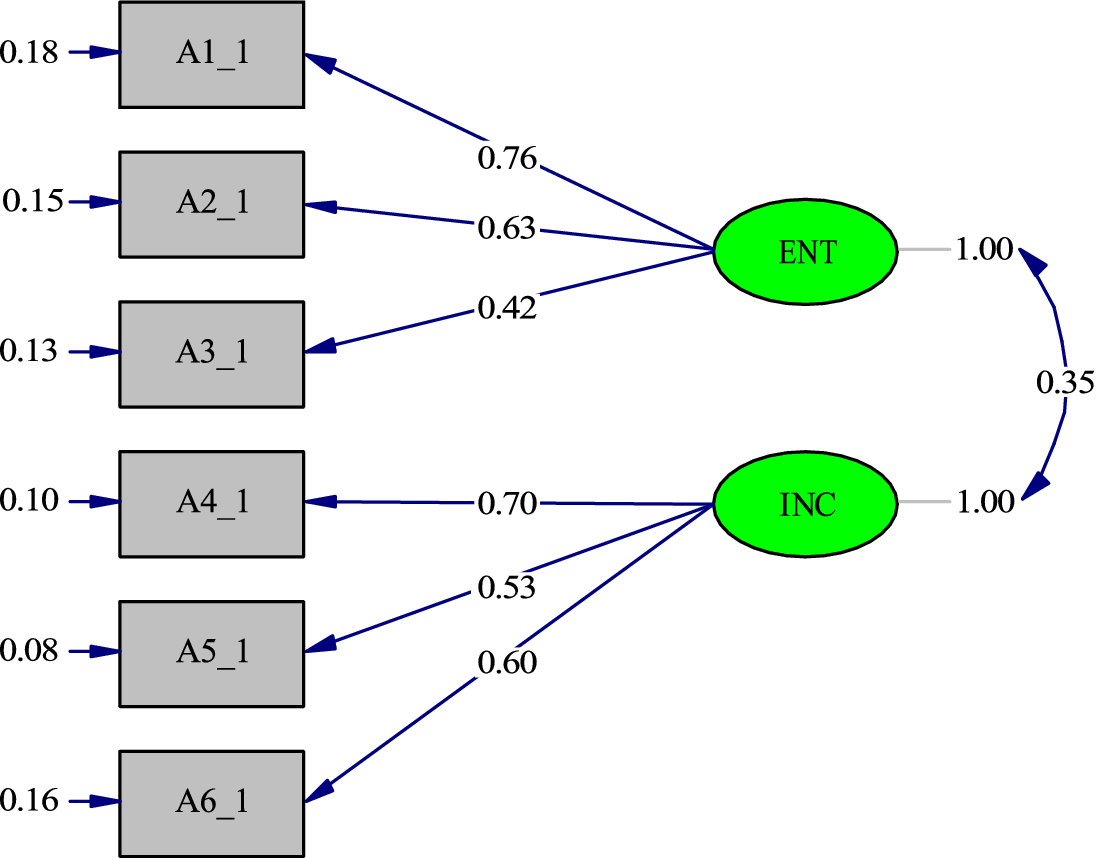
Confirmatory Factor Analysis (CFA) was performed to assess the construct validity of the measure with the help of LISREL 8.80 (student). CFA is recognized as a commonly practiced method for analyzing the construct validity of the measures (Boelen et al., Reference Boelen, van den Hout and van den Bout2008). It was performed to assess that whether six items and two-factor measure of implicit theories possess satisfactory or desired goodness of fit indices. The model provided adequate fit to the data, where Comparative Fit Index came to be χ2/df = 1.45, CFI = .99; Goodness of Fit Index, GFI = .97; Incremental Fit Index, IFI = .99; Tucker Lewis Index, TLI = .98; and Root Mean Square Error of Approximation, RMSEA = .04 Figure 1.
Path Diagram for two-factor (ENT= Entity Beliefs & INC= Incremental Beliefs) Measure of Implicit Theories.
Note. Chi-Square = 12.67; df = 8; P-value = .12370; RMSEA = .04.

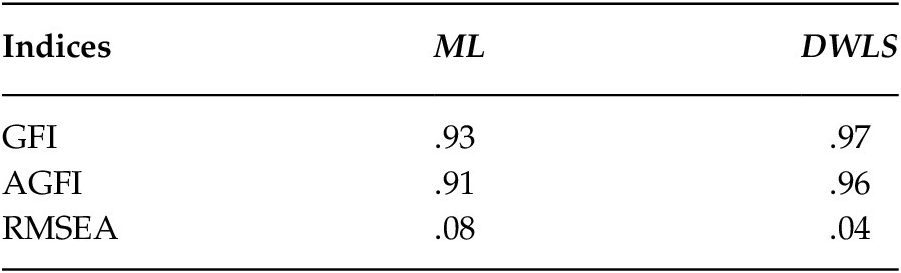
Generally, there are several considerations for the indices to evaluate factor analysis models but some of the repeatedly suggested are maximum likelihood to estimate the model and then diagonally weighted least squares, were examined and utilized for the comparison of two methods of fitness in terms of confirmatory factor analysis Table 2.
Indices of Bi- factor Structure for Implicit Beliefs Measure in Two Method of Fitting (N = 355)

Note. ML = Maximum Likelihood; DWLS = Diagonally Weighted Least Squares; GFI = Goodness of Fit Index, AGFI = Adjusted Goodness of Fit Index, RMSEA = Root Mean Square Error of Approximation.
The values of Goodness of Fit Index (GFI), Adjusted Goodness of Fit Index (AGFI), and Root Mean Square Error of Approximation (RMSEA) in Table 1 reflects that the fitness indices for the second model by DWLS techniques are comparatively better than the other as the optimal values of GFI and AGFI ranges between 0–1 so more closer to 1, means greater fit whereas, the values for RMSEA needs to be less than .05 for a perfect fit (Baghdarnia et al., Reference Baghdarnia, Soreh and Gorji2014).
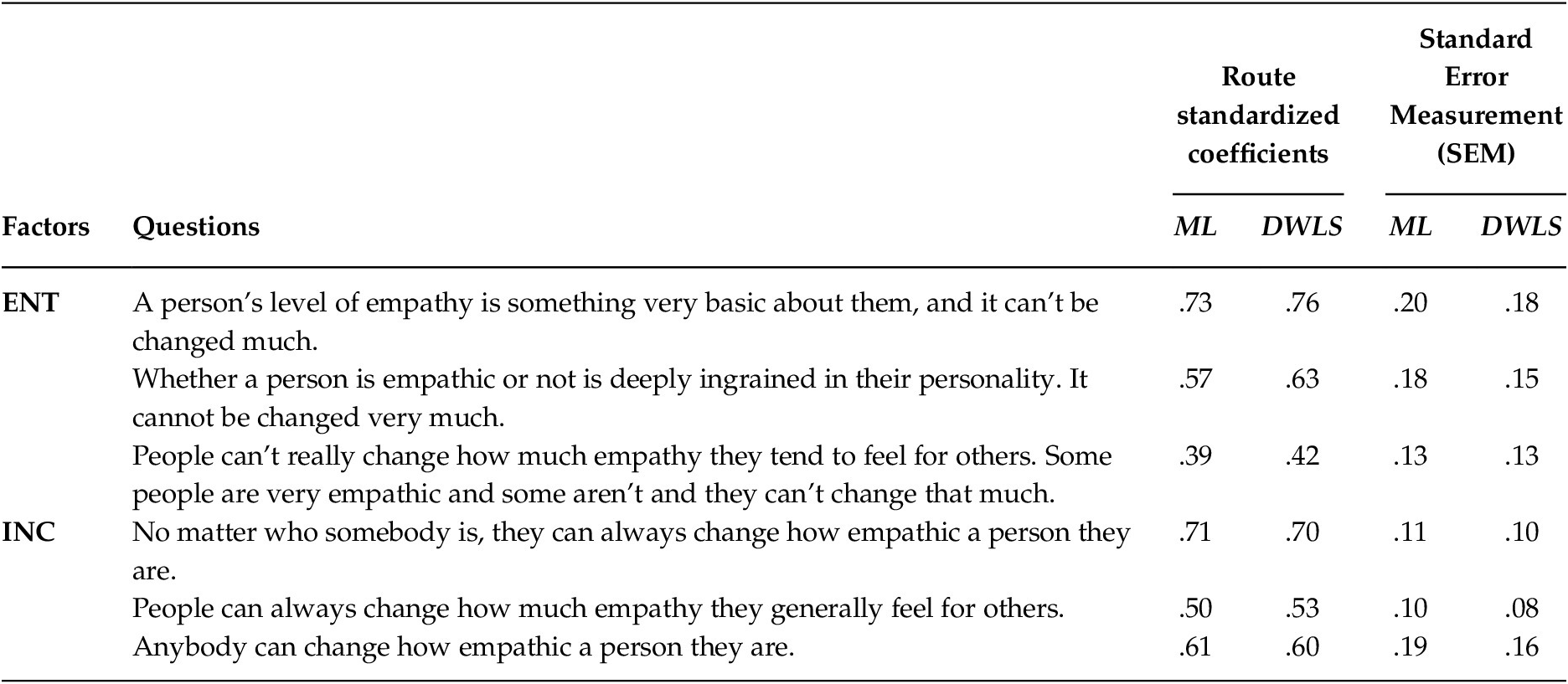
Moreover, Table 3 presents the detail of the significance of each question of the measure with factorial load in terms of the existing coefficients above the route between measurement indices and factors. It depicts that the range of standardized coefficients came to be from .39 to .76 with all significant routes.
Standardized Coefficients, and Measurement Error, for Any Question (N = 335)

Note. ML = Maximum Likelihood; DWLS = Diagonally Weighted Least Squares; ENT = Entity Beliefs, INC = Incremental Beliefs subscale.
Another attempt was made for the measurement of invariance across gender to address that whether the participants has ascribed same meanings to the items of the scale or had same interpretation of the statements irrespective of gender difference. As per the findings, IBM was found to be invariant across gender, the results were like 23.78 chi-square value, and p-value = .123. Therefore, the statistically insignificant findings of this test are supporting the assumption of invariance across gender, means males and females both have interpreted the items of implicit beliefs measure and constructs in a similar manner.
Criterion-Related Validity of the Measure
Literature presented that there is a negative relationship between entity beliefs and positive outcomes or forgiving tendencies whereas a positive relationship between incremental beliefs and such tendencies is evident (Yeager et al., Reference Yeager, Trzesniewski, Tirri, Nokelainen and Dweck2011). Thus, a correlation was computed to establish criterion-related validity for the measure. The hypothesis of positive relationship between incremental beliefs and forgiving behavior (n = 355, r = .17, p < .001) and negative relation between entity beliefs and forgiving behavior (n = 355, r = –.20, p < .001) was accepted. These results could be considered for the evidence of criterion-related validity of the measure.
Reliability of the Measure
Internal consistency and test-retest methods were used to assess the reliability of the measure. Alpha coefficients for internal consistency came to be .72 for the measure as a whole, .81 for Entity Theory and .70 for Incremental Theory subscales of the measure. Whereas, Omega coefficient was computed with free statistical software being available from the University of Amsterdam, called JASP, and it was found to be .79 for the complete scale, with .80 for Entity Theory and .74 for the Incremental theory subscales. The instrument was first given to 15 bilingual graduate students to consider their language concerns. They responded that it is an easy and understandable measure so, we did not go for translation. But still may be during the main study people had to face language issues, though the items are quite simple and easy. Also, as the measure contain two different constructs with only three items each, it could be the reason as well for comparatively low reliability.
Also, test-retest reliability of the measure was assessed in two intervals having a gap of around two weeks with the sample of 78 individuals. For calculating test-retest reliability of the measure correlation was computed between the scores of two administrations. Thus, for Entity Theory test-retest reliability coefficient was .95 and for Incremental Theory it was .98 and .92 was the coefficient for the measure as a whole. This all ensures the reliability of the scale with a fact that the value of .70 and above is recognized as an indication of a reliable measure (Fraenkel et al., Reference Fraenkel, Wallend and Hyun2012). All in all, it presents that Implicit Theories Scale is a reliable measure for measuring self-beliefs.
Findings of Demographic Variables
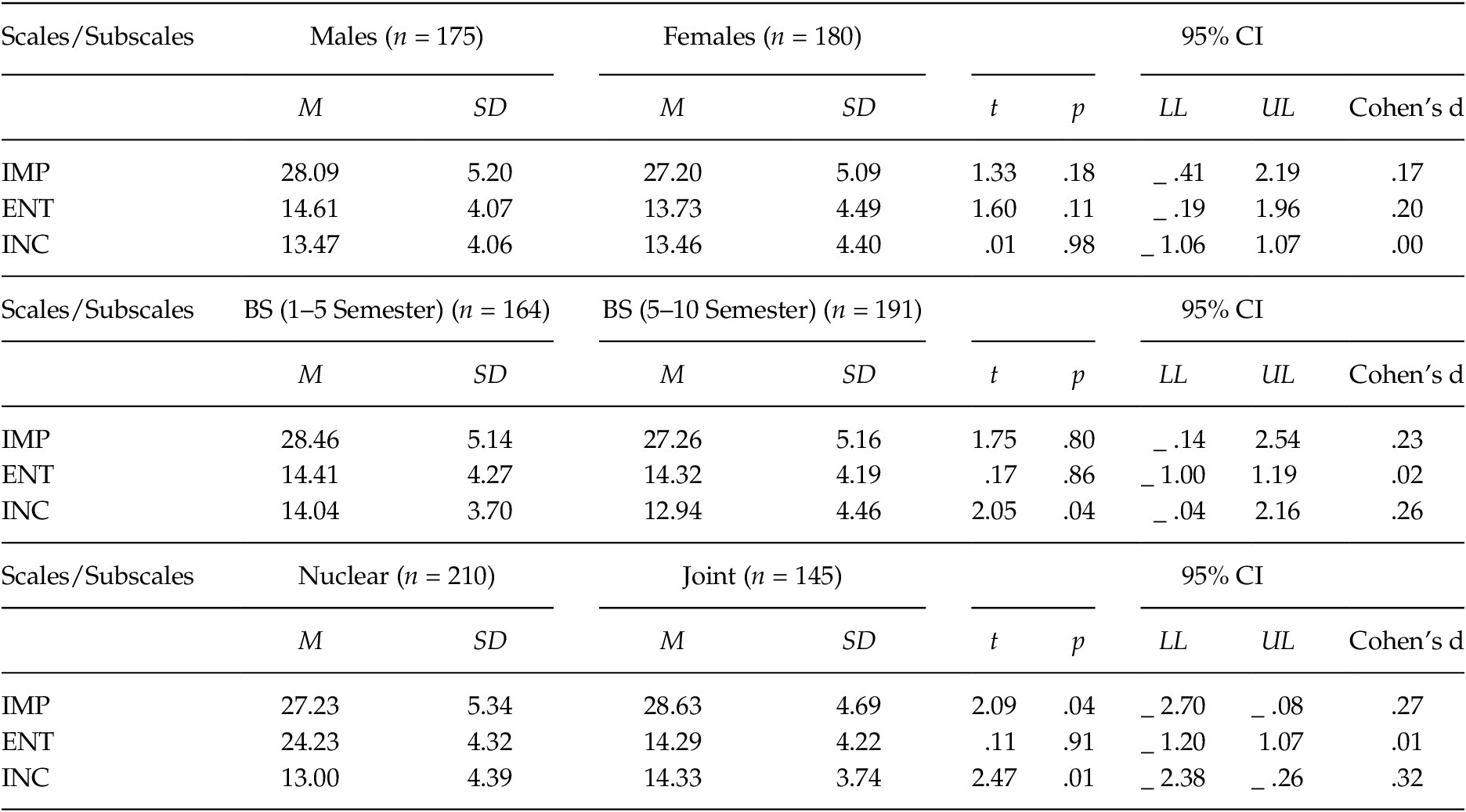
Independent sample t-test and ANOVA were computed to find out the differences between demographic groups and Implicit Theories measure. Results revealed that there is non-significant gender difference across entity and incremental processing. Whereas, a significant difference is evident for incremental theory processing with respect to level of education and family system reflecting that participants from higher level of education scored low on incremental processing that younger group and participants from joint family system score high on implicit theories processing particularly an incremental theory processing than those who belonged to nuclear setting. Results are presented in Table 4.
Mean, Standard Deviation and t Values for Gender, Level of Education, and Family System on Implicit Theories/Beliefs Scale (N = 355)

Note: M = Mean; SD = Standard Deviation; CI = Confidence Interval; LL = Lower Limit; UL = Upper Limit; IMP = Implicit Theories/Beliefs Measure; ENT = Entity Beliefs; INC = Incremental Beliefs
Further, one-way ANOVA was computed for the three groups of No. of friends and the results presented that only significant differences are available for incremental theory processing where the group two of having moderate No. of friends depicted comparatively high score but when post-hoc was applied no significant difference was found. Results are shown in Table 5.
One-way ANOVA to find Difference on Implicit Theories/Beliefs Scale and subscales Entity Beliefs, Incremental Beliefs Cross No. of Friends (N = 355)

Note. M = Mean; SD = Standard Deviation; IMP = Implicit Theories/Beliefs, ENT = Entity Beliefs, INC = Incremental Beliefs.
* p < .05
Also, further analysis was conducted for model testing with these variables but nothing was significant to be included. As the findings with demographic variables were not that much promising thus probably it resulted in non-significant results. Also, participants are not serious while participating in researches over here, though it was a voluntary involvement, this could be the reason for such kind of non-significant findings.
Discussion
The present study attempted to have an indigenous perspective to the rich and currently flourishing construct of implicit processing. Literature presented that an individual’s beliefs usually influence the behavioral outcomes thus the need is to direct the processing and beliefs of individuals towards peace and growth-oriented activities in this highly charged and aggressively controlled time period. Further, the measure of implicit theories was considered for validation and appropriateness of the construct in Pakistani context as it is a comparatively fresh variable in this region. Also, the role of potential demographic variables was explored to enhance the understanding of the phenomenon among Pakistani individuals.
Importantly, as it is presented earlier that the current political realm of Pakistan is depicting a bit more hostile, harsh and intolerant attitude towards others. Thus, the need of time was to bring into sight a more functional, applied and workable stance of cognitive processing. Therefore, it is an attempt to reflect that incremental processing is oriented to positive outcomes, mild tendencies and endorsement of tolerance as well as forgiveness.
To meet these objectives certain kind of analyses were performed. Confirmatory factor analysis was computed to assess construct validity and it confirmed the two-factor structure of the measure with appropriate goodness of fit indices. The range of standardized coefficients came to be from 0.39 to 0.76 with all significant routes. However, it is established in a few studies that there are no hard and fast rules in factor analysis regarding the value of factor loadings. It is further assumed that a few items are theoretically found to be distant from a particular factor, thus, might have low factor loadings but even then, it could be one of the significant contributors of the scale. So, still if the items do not match the required level of factor loadings, the researcher has a power to include it on the basis of the theoretical importance of the item, or can retain an item even with low factor loadings (Bandalos & Finney, Reference Bandalos, Finney, Hancock and Mueller2010).
Correlation of implicit theories measure with behavioral measure presented criterion-related validity (convergent and divergent validity evidence), as entity beliefs reflects positive correlation with negative tendencies or punishing behaviors and incremental beliefs had a negative correlation with punishment but positive association with forgiving behavior was evident, complementing literature (Yeager et al., Reference Yeager, Trzesniewski, Tirri, Nokelainen and Dweck2011). Reliability estimates including Cronbach’s Alpha coefficient, Omega coefficient, and test-retest reliability coefficient reflected satisfactory values presenting that the Implicit Theories Scale is a valid and reliable measure to assess Entity and Incremental Beliefs of Pakistani population.
Furthermore, to explore the differences across demographic variables having two groups, an independent sample t-test was computed. There were no significant differences found for gender but only few differences were there for education and family system. No gender difference could be considered with similar findings in literature. Macaskill et al. (Reference Macaskill, Maltby and Day2002) also documented no significant gender differences in the level of positive behavior like forgiveness which is found here to be strongly correlated with incremental mindsets of individuals. It is further asserted that the magnitude of the difference ever found in gender is not sufficient to be considered statistically significant (Toussaint & Webb, Reference Toussaint and Webb2005). As current conditions are advocating the stance that gander differences are progressively declining due to similar involvements, interests and treatments.
An incremental mindset was evident to be significantly high in the lower educational group having participants from first two years of BS. You et al. (Reference You, Fung and Isaacowitz2009) stated that culture is having an influential role in predicting the positive attitude among individuals with evidence that in collectivistic cultures older people scored low on this attribute whereas younger ones scored high on this positive feature. As asserted that collectivistic cultures have less focus on optimism thus with time and age, they use to get less positive. This argument could be considered to be supportive for the earlier mentioned differences as well because literature supported the notion that collectivistic cultures processed more incremental mind sets (Rosati et al., Reference Rosati, Knowles, Kalish, Gopnik, Ames, Morris, Malle, Moses and Baldwin2001).
Additionally, participants from joint family system were found to be high on processing implicit theories particularly a significant high incremental processing is observed. Joint family is a system of collectivistic cultures so this result could be strengthened with a study presented that incremental processing is observed in collectivistic cultures where people use to infer others mental states rather than traits (Miller, Reference Miller1986).
One-Way ANOVA reflected significant results for number of friends. It was evident from the findings of the study that an incremental mindset is found to be prevalent among those who were having greater number of friends. As greater No. of friends depicts more sociable and positive personality of an individual thus, such individuals use to process more incremental theory as incremental theorist are generally more positive and growth oriented (Maruna & King, Reference Maruna and King2009) also friends are recognized to be extremely important for the positive development of individuals (Selfhout et al., Reference Selfhout, Burk, Branje, Denissen, van Aken and Meeus2010).
It is clearly presented that individualistic cultures usually inculcate entity processing where people use to consider the traits, attributes and intentions of individuals for explaining their behaviors. Whereas collectivistic cultures instill a bit more context specific, situationally demanded and others-oriented opinion during decision making thus, such individuals reflect positive, mild and productive behaviors in general (Miller, Reference Miller1986). This explanation could account better for current findings in this collectivistic context as well.
No. of friends is a crud measure of the influence such variable has on implicit beliefs and forgiveness. There must be a reflective consideration for quality of friendship for addressing its impact on studied variables.
Present study is having theoretical enrichment for the domains of socio-cognitive as well as positive psychology. Thus, enabling researchers to have insightful consideration for working on and developing this growth-oriented phenomenon. Further, in terms of practical strengths, this exploration will enhance the functioning of individuals in all domains of life with imminent kind of knowledge and destined intellectual processing for the betterment of humanity.
The present study attempted to have an indigenous stance to the concept of implicit theories along with the validation of the measure. Findings of the study revealed that implicit theories scale is a valid and reliable measure to assess the entity and incremental beliefs processing of Pakistani individuals for controlling and directing their behaviors towards positivity and growth. Flourishing incremental mindsets will result in positive outcomes. Thus, a need for political context was also addressed. These findings will be an additive feature in literature to consider the cultural specification which definitely have an impact upon the beliefs, attitudes and behaviors, enabling individuals to align their mindsets in desired direction of peace growth and achievement.