Introduction
In 2015, then-European Commission Chairman Jean-Claude Juncker launched the “New Start for Social Dialogue”, which was aimed at “further strengthening social dialogue at the EU and national levels” (European Commission 2016). The re-launch of the European Social Dialogue (henceforth, ESD)Footnote 1 responded to a period beginning around the turn of the millennium with increasing difficulties in reaching (binding) agreements culminating in the breakdown of the negotiations concerning the revision of the Working Time Directive in 2012 and subsequent deadlock (Prosser Reference Prosser2016). However, the story of the ESD is not simply one of consecutive failures. The process of ESD was initiated in 1985 and finally institutionalised in the Maastricht Treaty of 1992 as part of European Commission Chairman Jacques Delors’ attempt to strengthen the “social dimension” (along with completing the internal market) of the European Community by involving social partners, represented by the European Trade Union Confederation (ETUC) and the Union of Industries of the European Community (UNICE, since 2007, BusinessEurope). The treaty gave the social partners unprecedented rights of participation European social policy-making, importantly, through the possibility of settling the European Commission’s (EC) proposals between themselves at the national level or by asking the Council to adopt a decision (Streeck Reference Streeck1994: 151–152). Hence, in the following years, the ESD was in fact one of the main drivers giving momentum and hope to Jacques Delors’ “Social Europe” project.
The social partners reached a number of binding agreements on parental leave (1995), part-time work (1997) and fixed-term work (1999), all of which were ratified as directives (Smismans Reference Smismans2008; Lapeyre Reference Lapeyre2017). The Amsterdam Treaty (1999) marks the peak of this “golden age of the ESD” (Pochet and Degryse Reference Pochet, Degryse, Vandenbroucke, Barnard and De Baere2017) by requiring all member states to participate. But the treaty, together with the European Employment Strategy, also marks the beginning of a new phase-shifting from “hard” legislation, such as directives, towards “softer”, less binding forms of governing of benchmarking in the field of labour market and social policy (Smismans Reference Smismans2008; Prosser Reference Prosser2016). Concurrent with the formalisation of the European Employment Strategy in the so-called Open Method of Coordination, the social partners were failing to reach an agreement on posted workers in 2001 (Ahlberg Reference Ahlberg, Ahlberg, Bercusson, Bruun, Kontouros, Vigneau and Zappalà2008). Henceforth, ESD has only led to non-binding agreements at the cross-sectoral level.
The ESD literature has thus been confronted with explaining successes as well as failures leading to both optimistic and, increasingly, pessimistic accounts of the prospects of ESD. Inspired by neo-functionalist theories, several scholars in the 1990s saw ESD as a prime example of potential “spill-over effects” (Teague Reference Teague1993; Falkner Reference Falkner1998; Dølvik Reference Dølvik1999). The ESD had managed to break with decades of political deadlock (Kim Reference Kim1999) and would develop into a solid, institutionalised Euro-corporatist framework for policy-making (Falkner Reference Falkner1998: 195). Others were more sceptical regarding the possibilities for ongoing spill-over effects. Some argued that the subsidiarity principle would uphold national autonomy (Teague Reference Teague1993; Streeck Reference Streeck1994) and therefore never develop into a proper corporatist framework (Streeck and Schmitter Reference Streeck and Schmitter1991), while others pointed to how the diverse European welfare states (accentuated by the enlargement) would block any further integration in social and labour market affairs (Keller and Sörries Reference Keller and Sörries1999; Scharpf Reference Scharpf2002).
Along with the absent binding agreements in the 00s, the neo-functionalist thesis of an increasingly stronger ESD was losing its explanatory power (Prosser Reference Prosser2016). Rather than corporatist, the ESD was seen as pluralist (Prosser and Perin Reference Prosser and Perin2015) or a case of “double voluntarism”; that is, voluntary negotiations between the social partners and voluntary implementation by the member states (Schäfer and Leiber Reference Schäfer and Leiber2009). This has led to several studies examining the implementation of the ESD agreements pointing to substantial variation across member states (Larsen and Andersen Reference Larsen and Andersen2007; Prosser Reference Prosser2016; Weber Reference Weber2010). Other studies have seen the ESD as an expression of neoliberal hegemony in and through EU institutions, resulting in an “asymmetrical” relation between economic and social concerns (Tsarouhas Reference Tsarouhas2006; Scharpf Reference Scharpf2010). ESD is, thus, nothing but “symbolic Euro-corporatism” (Bieler and Schulten Reference Bieler and Schulten2008: 239) or a “non-binding social partnership” (Horn Reference Horn2012: 583) through which trade unions can only achieve moderate concessions. Despite the tendency towards non-binding and fewer agreements, other scholars have maintained an optimistic view on ESD. Drawing on multi-level governance literature, the ESD is seen to circumvent collective action problems by making actors (mainly employers) more inclined to reach agreements due to their non-binding character, hereby potentially leading to harmonisation between member states (Marginson and Sisson Reference Marginson and Sisson2004; Keune and Marginson Reference Keune and Marginson2013).
While the studies described above provide structural explanations to be more or less optimistic of ESD, another group of studies focuses on the role of agency as an explanatory variable. For instance, various studies point out how internal divides within trade unions, such as those between the Nordic unions and Eastern, Central and Southern unions (Adamczyk Reference Adamczyk2018) on issues such as minimum wage, have made it more difficult to reach agreements (Furåker and Bengtsson Reference Furåker and Bengtsson2013; Schulten et al. Reference Schulten, Müller, Eldring, Gyes and Schulten2015). However, the reluctance of employers to engage in the ESD is a more consistent explanation of deadlock in the literature. In the unions’ lack of traditional means to bring employers to negotiations (mainly strikes), several studies have pointed out the importance of threats from EC to intervene if negotiations fail (Héritier and Lehmkuhl Reference Héritier and Lehmkuhl2008; Smismans Reference Smismans2008; Faro Reference Faro2012). According to this literature, it was thus the “shadow of hierarchy” (SoH) cast by the EC that made employers willing to enter into ESD negotiations in the 1990s and the lack of same in the 2000s that resulted in the absence of binding agreements which turned the non-binding agreements in favour of employer interests (Faro Reference Faro2012). Looking further into the reasons for the cessation of the SoH, Schömann (Reference Schömann2011) points to a shift from regulation to deregulation in the EC policy aims, while Schäfer and Leiber (Reference Schäfer and Leiber2009) tie it to the general shift among member states, and thus in the European Council, from centre–left towards conservative and liberal-leaning governments in the 2000s. Similar to this latter group of studies, we focus on the EC’s “SoH potential”. However, while existing studies have shown how the SoH can make employers willing to enter negotiations, we adopt a more dynamic perspective that takes into account how changes to the SoH affect the social partner asymmetry as well as how it affects the social partners’ preferences during negotiations. The aim is to evaluate and nuance the following hypothesis: The presence of SoH increases employer willingness to compromise and make concessions, thereby increasing the likelihood of a binding agreement.
In order to do so, we, following Janusch (Reference Janusch2018), develop a framework of semi-veto actors in the SoH combining the theories of “veto players” and “asymmetrical dependency” that contribute to the existing literature in two important ways. First, our analysis provides a more nuanced explanation of the outcome of key ESD negotiations that shows the complex role of SoH in reaching an agreement. We show the importance of previously neglected factors affecting the role of SoH, that is the degree of SoH, the fact that SoH can change in the course of negotiations, the complexity of the topic being negotiated, and, finally the reputations cost of actors involved. In this way, our analysis also sheds light on the likelihood of breaking the current deadlock. Second, we develop a novel framework of analysis based on game theoretical insights that may be used to study negotiations in other arenas with the presence of SoH.
The article is structured as follows. The first section presents our theoretical framework based on game theoretical concepts. In the second section, we present the research design, inspired by process tracing and argue for our selection of cases, the negotiations around the agreements on Fixed-Term Work (1999) and Temporary Agency Work (2001). In the third section, we apply the framework to the two cases. In the final section, we return to the hypothesis and discuss the implications in light of the EC initiative to “re-launch” the ESD.
Semi-veto actors in the shadow of hierarchy
For decades, the likelihood of cooperation and the distribution of gains in collective agreements have been important themes in international relations theory and negotiation theory. Two of the most prominent concepts to explain negotiator behaviour and the outcome of negotiations are veto player and asymmetric dependency (Janusch Reference Janusch2018). According to veto player theory, each actor has an indifference curve encompassing all acceptable outcomes. The curve is circular, implying that an actor is indifferent between alternatives with the same distance from the ideal point, and that she will always choose the solution closest to her ideal point. Thus, changing status quo (SQ) requires a new policy to be closer to the ideal point of all actors involved compared to the current SQ. Tsebelis (Reference Tsebelis2002: 21) defines this as the winset, expressing all possible outcomes.
While veto player theory relies on how the SQ cannot be changed without the consent of all veto players (Tsebelis Reference Tsebelis2002), the concept of asymmetric interdependence is based on the idea that an actor can more credibly threaten to end cooperation when that action would hurt the other actor more (Keohane and Nye Reference Keohane and Nye2001: 10; Moravscik Reference Moravcsik1998: 60). Contrary to veto player theory, negotiations will not necessarily be beneficial for all actors compared to the SQ. This is due to the assumption that the actors will distribute the benefits of a given agreement relative to their respective alternatives to the agreement. In so doing, the “value” of the actors’ alternative agreements define the credibility of each actor to veto specific proposals or threats to end the cooperation (Moravcsik Reference Moravcsik1998: 63). While both theoretical concepts appear to be mutually exclusive, Janusch (Reference Janusch2018) has shown how they can complement each other in studies of actors’ behaviour in negotiations: While veto player theory can explain the preferential distance between the actors involved and the likelihood of a deal (Tsebelis Reference Tsebelis2002), the theory of asymmetric dependence can explain the power relationship between actors, including why one is more willing to compromise and make concessions than another (Mohl Reference Mohl1997).
By introducing the theoretical framework of semi-veto players, Janusch (Reference Janusch2018) argues that, under certain circumstances, veto players are only semi-veto players whose opportunities to veto or threaten to leave negotiations are contingent on their best alternative to a negotiated agreement (BATNA). The BATNA is defined by the actors’ opportunities and benefits from acting independently or cooperating with other actors. Unlike veto player theory, the BATNA is not statically associated with the SQ. An actor may threaten to leave the collaboration or terminate an agreement whereby the actors’ BATNA is changed from the SQ to the expected outcome of the realisation of the threat. Semi-veto player theory thereby assumes that the actors are able and, in certain situations, willing to degrade the existing SQ by leaving the cooperation. This conflicts with veto player theory, where any threat of leaving a mutually profitable cooperation would be considered untrustworthy (Tsebelis Reference Tsebelis2002). To solve this theoretical problem, Janusch (Reference Janusch2018: 228f) incorporates reputational theory in his framework. The premise of these theories is that the past behaviour of the individual actor is used by other actors to predict their future behaviour (Miller Reference Miller2003: 42), implying that an actor withdrawing threats or claims will suffer an internal and external loss of reputation, reducing their credibility in future threats (Janusch Reference Janusch2018: 224). Actors will therefore abstain from withdrawing claims or threats to avoid a reputation loss, even though this would be the best choice in the short term (Sartori Reference Sartori2002: 140). According to Janusch (Reference Janusch2018: 229), the loss of reputation is thus greater than the costs associated with implementing the threat to the detriment of the SQ.
Turning to the ESD, the social partners have limited opportunity to degrade the SQ independently, as they lack the legal authority to terminate existing directives or to threaten action (e.g. strike, lockout) that could alter the BATNA for the negotiations (Streeck and Schmitter Reference Streeck and Schmitter1991; Schömann Reference Schömann2011). Rather, the negotiations are shrouded in the SoH, as the EC may threaten to implement legislation if negotiations should fail (Héritier and Lehmkuhl Reference Héritier and Lehmkuhl2008; Smismans Reference Smismans2008). Such threats alter the actors’ BATNA, since those who benefit less from a potential intervention “have a stronger incentive to negotiate than the social partner, who sees its interest better safeguarded by the Commission proposal” (Welz Reference Welz2008: 298f). Thus, the asymmetric dependence and therefore the power relationship between the social partners can be assumed to be proportionate to the value that each actor attributes to the EC proposal.
The social partners’ reputations can also be expected to influence the ESD negotiations. First, the social partners can be assumed to be willing to compromise or concede on issues where the loss of reputation exceeds the cost of executing a threat or by insisting on content requirements (Ibid.: 229). Second, it can be assumed that both social partners may have an interest in concluding agreements that enhance or maintain the legitimacy of the ESD, as it serves to mutually legitimise the social partners in the political sphere (Benson Reference Benson2007: 10).
Methods
To investigate whether and under what circumstances the SoH increases the likelihood of a binding agreement, we use process tracing. According to Collier (Reference Collier2011: 824), process tracing is a method for evaluating and nuancing hypotheses through detailed, within-case empirical analysis. This approach not only seeks explanations that can predict the outcome of a phenomenon but also explain its emergence. Thus, this research approach not only allows us to investigate whether the presence of any SoH is a necessary condition for the social partners to reach an agreement, but also why that is the case (Ibid.: 586).
In process tracing, the case study is a prerequisite for testing hypotheses by acquiring access to comprehensive information on the participants’ thought patterns and behaviour together with adequate descriptions of critical moments of the phenomena or process under study (Blatter and Haverland Reference Blatter and Haverland2012: 25).
We adopt a research design of two cases selected based on a sequential logic; that is, the cases must be similar but diverge in outcome (Ibid.: 104). This implies a positive case (e.g. the negotiations result in a binding agreement) followed by a possible case, which is a similar case but with a negative outcome (e.g. negotiation breakdown). Based on this premise, we choose the negotiations on Fixed-Term Work (1999) as the positive case and the negotiations on Temporary Agency Work (2001) as the first forthcoming possible case. Both cases involve the negotiation of non-standard employment in the cross-sectoral ESD in the SoH – but while the former case resulted in (the last) binding agreement, the latter resulted in a breakdown. In this way, the cases are suitable for the investigation of the conditions needed for the social partners to agree on binding agreements way, even though certain conditions, in particular the number of member states, have changed since the two negotiations (we discuss these in the conclusion). The analysis of the positive case allows us to identify the necessary condition(s) that determine whether the social partners are able to agree on binding agreements in the ESD whereas the possible case allows us to assess whether the identified condition(s) constitutes an adequate explanation of the outcome. In order to do so, we investigate whether the presence of SoH (X) increases the employer willingness to compromise and make concessions (M), thereby increasing the likelihood of a binding agreement (Y).
For this purpose, we make sure that the case studies constitute a comprehensive storyline that identifies and describes the most determining moments and turning points leading to the outcome of the negotiations (Blatter & Haverland Reference Blatter and Haverland2012: 111). By the use of hoop tests, we assess whether SoH (X) was a necessary condition for the compromise or concession (M) in the given situation. If one of the social partners is willing to compromise or make concessions that, compared to their ideal positions, is a devaluation of the SQ one can conclude that the partners preferences are under the influence of SoH. The hypothesis then passes the hoop test although it does not necessarily affirm the hypothesis.
To investigate whether SoH (X) is not only a necessary criterion in order to make binding agreements in the ESD (Y) but also a sufficient criterion for accepting the explanation, we look for a smoking gun evidence, meaning a determining moment were “an initial cause was essential to put the overall sequence in motion, culminating in the outcome” (Mahoney 2012: 582). As we will see in the analysis of the negotiations on temporary agency work, the EC Legal department made an announcement which sheds light on the EC’s positions on several unresolved issues resulting in a change in the social partners’ expectations for an EC-initiated directive. The announcement thereby changed the social partners’ BATNA causing a shift in the indifference curves and affecting the likelihood of an agreement. As this shift would not have appeared without the presence of SoH, the announcement constitutes a smoking gun evidence.
We study the negotiation processes through the analysis of internal documents, including meeting minutes and position papers produced by The Danish Confederation of Trade Unions (LO, now FH). In addition, we include existing studies of the negotiation processes, consultation papers, agreements and treaties. Finally, in order to triangulate information from collected sources, we conducted four qualitative interviews with former or current senior officials from Danish Confederation of Trade Unions (LO), Confederation of Danish employers, ETUC and Business Europe. As the meeting minutes are confidential, we will be referring to them by the date the meeting minute was conducted, for example (Minutes, March 31, 1998). The complete list of data is available in the online appendix.
Based on the theoretical framework, we now present the two case studies. We outline the mandate positions and the indifference curves of the social partners before analysing the negotiation processes and, finally, discuss how and to what extent the theory can explain the outcome.
Positive case: fixed-term work
The use of non-standard employment in European countries increased in the 1980s, leading several to introduce regulations aimed at social security and equal treatment. The 1982–95 period was therefore marked by multiple attempts to harmonise European legislation, followed by the agreement on part-time work (1997) and fixed-term work (1999) as well as negotiations on temporary agency work (2001). The agreement on part-time work included a number of conditions for using part-time work as well as a non-discrimination clause to ensure that part-time employees are not treated less favourably than full-time staff unless the treatment can be justified by objective reasons, such as seniority.
The agreement on part-time work formed the basis for negotiating our positive case: the agreement on fixed-term work in 1999. The fact that there was already a directive in this area together with the draft proposal on fixed-term work presented by the German Council Presidency in 1994 gave a sense of SoH. The proposed directive contained, amongst other things, a non-discrimination clause and a number of conditions for the use of fixed-term employment contracts, including 1) that the contracts should be limited to a maximum period of time set by the Member States, 2) a ceiling for the number of renewals of fixed-term employment contracts and 3) an extension of the fixed-term employment contracts should be based on objective reasons. Member States then had to implement at least one of the conditions in national regulation (Falkner Reference Falkner1998: 131). While the proposal was rejected by a majority in the European Council back in 1994, the political landscape changed afterwards, and in 1998 the European Council had a majority of Social Democratically led governments leading to the presumption that German proposal could become a reality. At the same time, the EC announced that they would legislate regardless of whether the social partners could reach an agreement forcing the employers to enter into negotiations even though they had expressed aversion to a directive: The employers simply feared that the 1994 proposal would become a reality if the EC interfered. These circumstances provided a high degree of SoH.
Mandate positions and indifference curves
The ETUC’s overall objectives in the negotiations were to ensure better conditions for the use of fixed-term contracts, avoid the abuse of fixed-term workers and improve the working conditions for this employee category. The mandate therefore stated that the agreement should 1) contain objective reasons for the use and renewal of fixed-term contracts, 2) limit fixed-term contracts to a 3-year maximum, 3) only allow fixed-term contracts to be renewed twice and 4) a non-discrimination clause should ensure equal treatment in relation to individual and collective rights as well as working conditions (Minutes, March 31, 1998; May 27, 1998). The first three criteria were more restrictive than the directive proposal from 1994 as well as the demand that member states should commit to implementing all three criteria. Thus, by demanding restrictive regulations in the form of a binding agreement, the ideal position of ETUC is relatively distant from the SQ.
The employers’ objective, on the other hand, was to promote a flexible labour market and reduce obstacles to the use of fixed-term work. They also opposed negotiating issues related to Article 137 (i.e. related to social protection). Their mandate included an agreement that should 1) recognise fixed-term work as a positive contribution to the European labour market, 2) promote flexibility in the labour market, that is, ease the use and termination of fixed-term contracts, 3) contain principles for non-discrimination and 4) strongly emphasise the subsidiarity principle (Minutes, April 22, 1998; May 27, 1998). Overall, the employers were advocating a less restrictive agreement compared to the 1994 proposal by demanding regulation to be carried out only by member states and rejecting conditions for the use of fixed-term contracts (Ahlberg 2000: 19f). The employers’ ideal position is thus placed relatively close but not equal to the SQ, as they opposed regulation while agreeing to negotiate a non-binding agreement (different from SQ).
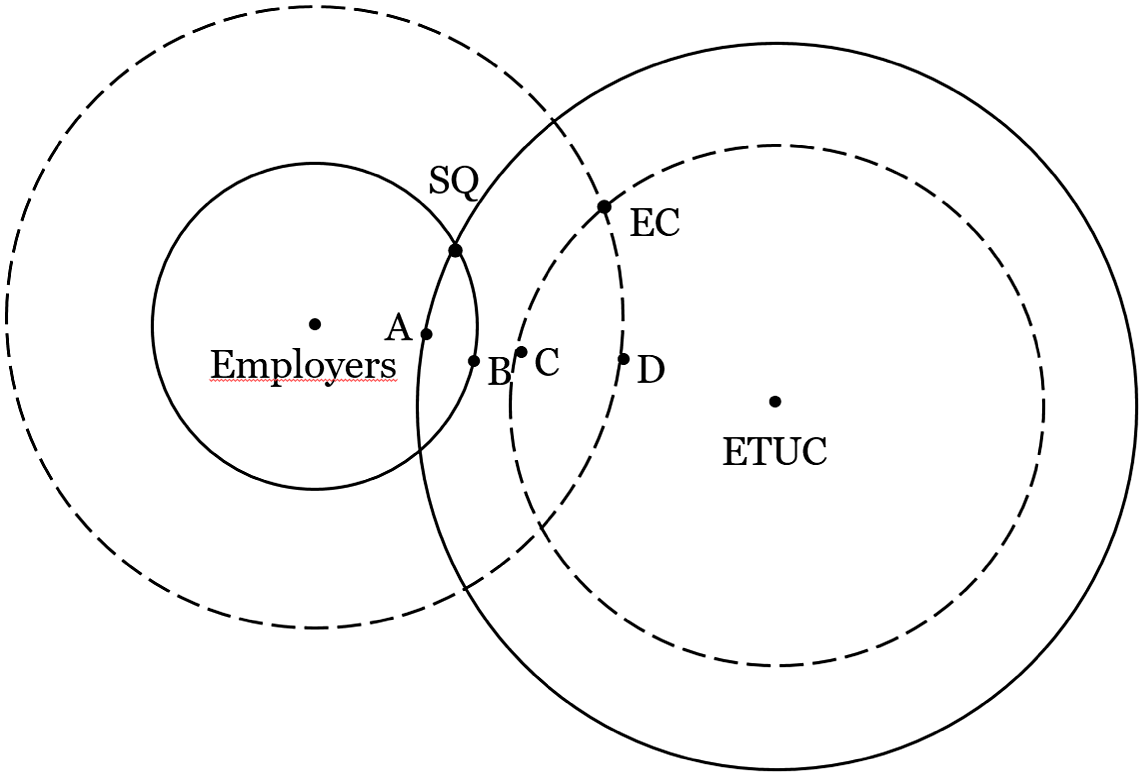
Figure 1 combines the two indifference curves (the solid line circles A and B) and shows how the winset (intersection of A and B) appears relatively narrow, and thus the probability of the social partners reaching an agreement equivalent small (Tsebelis Reference Tsebelis2002: 20).
The social partners’ indifference curve with (A and B) and without the influence of SoH (C and D) in the negotiations on fixed-term work.Footnote 2

By introducing SoH to the model, the expectations of an EC-initiated directive now replace the SQ. Since the EC wanted to introduce some degree of regulation, its ideal position is closer to the ideal ETUC position compared to the SQ. The employers’ indifference curve expands (dotted line circle C) while ETUC’s indifference curve shrinks (dotted line circle D), which changes and extends the winset (intersections of C and D). The social partners thereby become semi-veto players since they cannot effectively veto changes to the SQ. Due to the expectation of a regulatory directive, we can assume that the employers will benefit less from the EC-initiated directive than the employees, which leaves them more dependent on the negotiations. We therefore expect the employers to be more willing to compromise and make concessions with the employees than vice versa and that the employees would rather accept the EC-initiated directive than to make an agreement located between intersections A and C (Janusch 218: 231). As shown in Figure 1, it is the presence of SoH that enables the final agreement within the C–D intersection. We will now review the negotiation process and analyse why the agreement ended up at this intersection.
Negotiations
The negotiations were initiated with internal meetings succeeded by plenary meetings where the social partners presented and discussed their mandates (Minutes, March 23, 1998). Early in the negotiations, it was clear that the conditions for the use of fixed-term contracts and the non-discrimination clause would constitute the main points of contention in the negotiations. The employers could not accept ETUC’s demands for quantitative restrictions on the use of fixed-term work (Minutes, April 21, 1998). They argued that the restrictions were superfluous if they agreed to a non-discrimination clause (Minutes, May 22, 1998). ETUC strongly disagreed.
Subsequently, the social partners began showing some willingness to compromise. ETUC presented a draft proposal suggesting how conditions for the use of fixed-term contracts could, to a greater degree, be set by the member states and their national social partners (Minutes, May 26, 1998). With these concessions, the employees approached the expectations of an EC-initiated directive. The employers accommodated ETUC’s demands by acknowledging permanent employment contracts as the normal labour market standard (Ibid.). Thus, the social partners were willing to compromise on issues where the reputation lost from withdrawing from demands was less than the cost of maintaining them.
At the fourth meeting, ETUC emphasised the need of a non-discrimination clause, withdrew the demand of a maximum duration of successive fixed-term contracts and suggested that member states could choose whether to impose one or several conditions for the use of fixed-term contracts (Minutes, June 30, 1998). Thereby, ETUC maintained a more restrictive approach to fixed-term contracts than the EC proposal from 1994. The employers responded by referring to their own previous drafts and thereby made no further concessions (Minutes, July 9, 1998). This caused ETUC to doubt the employer willingness to reach an agreement, leading to a temporary deadlock in the negotiations. Given the asymmetric employer–employee dependency, it may seem illogical that the ETUC was more willing to make concessions than the employers. The explanation can be found in reputational theory: The social partners needed to prove their ability to produce results and legitimise their relevance in European policymaking (Welz Reference Welz2008: 408). The cost of sticking to their demands had at worst resulted in the negotiations collapsing, and the ETUC would have suffered an external loss of reputation that could potentially delegitimise the ESD as an institution (Benson Reference Benson2007: 13). Therefore, it can be assumed that the ETUC considered the external loss of reputation to be greater than the possible gains associated with sticking to their demands.
In the following months, ETUC made some concessions in an attempt at continuing the negotiations, such as allowing member states to derogate not only from the restrictions on the duration of fixed-term work but also from the number of contract renewals (Minutes, September 10, 1998). However, derogations should only be possible through national and/or sectoral collective agreements (Minutes, September 22, 1998). As stated in their mandates, ETUC argued for objective reasons for both the use and renewal of fixed-term contracts, but the employers would only accept the requirement in terms of renewals (Minutes, November 13, 1998). Simultaneously, the employers demanded that derogations should also be possible at the company level (Ibid.). As a result of these discrepancies, the negotiations were interrupted indefinitely.
The deadlock was broken when ETUC presented a proposal with a number of concessions making it quite similar to the German proposal in 1994 (Minutes, November 26, 1998). The objective reasons for using fixed-term contracts applying only to renewals and the specific quantitative restrictions could be set by the member states (Minutes, November 27, 1998). ETUC hereby went to the limit of their indifference curve (Janusch Reference Janusch2018: 231). Based on this draft proposal, the social partners finally reached an agreement. On one point, the agreement is less restrictive than the 1994 proposal: The member states must consider that different sectors have specific needs when implementing the conditions, which potentially allows for derogations (Minutes, January 11.-15., 1998). In relation to the non-discrimination clause, the social partners agreed to introduce a proportionality principle inspired by the agreement on part-time work: Fixed-term workers shall not be treated unequally compared to permanent workers unless the treatment is justified based on objective reasons; although in this case, the proportionality principle was slightly more restrictive (Minutes, January 11, 1998). The part-time agreement states that member states or national social partners may restrict the equal treatment of part-time workers according to seniority, working hours or earnings. The agreement on fixed-term work only included seniority.
Explaining the outcome
As the analysis has shown, the presence of SoH and the expectations of an EC-initiated directive greatly affected the negotiations. In accordance with the theory of asymmetric dependence, the employers were particularly affected by SoH: First, the employer willingness to negotiate a binding agreement was contingent on the presence of SoH as the employers had explicitly opposed legislation on fixed-term work. Second, the employers’ preferences changed during the negotiations, from wanting to preserve the SQ and remove any barriers to using fixed-term contracts to limiting the scope of regulation in the final agreement. If the negotiations had taken place without the presence of SOH, the employers could have vetoed any regulation on the use of fixed-term employment. However, it was not only the employers but also the employees who were affected by SoH. ETUC’s preference changed during the negotiations from wanting more restrictive conditions on the use of fixed-term employment to presenting a proposal that was almost identical with the expectations of an EC-initiated directive. Thus, the relatively clear expectations of an EC-initiated directive meant that the employers – and for that matter the employees – were not willing to compromise on everything. During the negotiations, the costs and benefits of making compromises were compared to the 1994 proposal for a directive and the agreement on part-time work pressuring the social partners to concessions and compromises that, however, never extended beyond their respective indifference curves. Finally, the resulting agreement ended up in the winset of the social partners with a negative impact on the SQ for the employers.
The possible case: temporary agency work
In the second (possible) case, SoH was present to a lesser extent. Although the prelude to the negotiations was quite similar, the context was different as the member states strongly disagreed on the policy to be pursued, questioning whether the EC would gain the support to implement a directive at all (Ahlberg Reference Ahlberg, Ahlberg, Bercusson, Bruun, Kontouros, Vigneau and Zappalà2008: 194). At the same time, there was no previous directive or proposal on this subject to clarify the EC’s priorities for an EC-initiated directive. However, the EC emphasised that maintaining the SQ was unattainable. The social partners thus presumed that the EC would seek inspiration in the agreement on fixed-term work and an International Labour Organisation (ILO) convention from 1997 that recognises the positive occupational effects of temporary agency work (Ahlberg Reference Ahlberg, Ahlberg, Bercusson, Bruun, Kontouros, Vigneau and Zappalà2008: 196; Hartzén Reference Hartzén2017: 214). These circumstances provided some degree of SoH.
Mandate positions and indifference curves
Contrary to the negotiations on fixed-term work, ETUC found it difficult to formulate a comprehensive mandate for the negotiations on temporary agency work as the member organizations disagreed on how to protect the interests of temporary workers (Welz Reference Welz2008: 447). Eventually, they agreed to recognise the presence of temporary agency work in the European labour market, given that certain conditions for using it were improved (Minutes, June 27, 2000). They also recognised that the agreement should include a non-discrimination clause, as was the case with the agreement on fixed-term work (Ibid.). The mandate stated that the agreement should 1) apply for both fixed-term contracts and indefinite duration contracts and 2) include conditions for using temporary agency work, including a maximum contract duration, 3) ensure equal treatment between temporary and regular employees and 4) put strong emphasis on the subsidiarity principle (Minutes, June 27, 2000; September 12, 2000).
The mandate echoed the negotiations on fixed-term work, although ETUC no longer specified the duration provision and included the subsidiarity principle in order to accommodate the internal disagreements between the member organisations and their divergent national policies: While some member organisations argued that temporary agency workers should be entitled to an unlimited contract, others would not accept such restrictions, as they would lead to a de facto normalisation of temporary agency work (Welz Reference Welz2008: 447). The ETUC mandate was more restrictive than the ILO convention from 1997, both in relation to the requirement for a maximum duration provision and the non-discrimination clause stating that temporary agency workers should have the same working conditions and wages as ordinary employees (Minutes, September 12, 2000). The ideal position of ETUC is thus placed relatively far from the SQ, albeit closer than the previous case due to the more divergent positions of the member organisations.
The employers also struggled to establish a mandate, as the organisation representing temporary agency workers (CIETT) was keen to improve the reputation, and thus also the working conditions, of this type of employment. Therefore, they were more willing than UNICE to ease some of the restrictions on temporary agency work by introducing a number of measures inspired by the ILO convention to secure a balance between corporate flexibility and the workers’ need for security (Ahlberg Reference Ahlberg, Ahlberg, Bercusson, Bruun, Kontouros, Vigneau and Zappalà2008: 197). UNICE argued that the agreement should recognise temporary agency work as a positive contribution to the European labour market and that any obstacles to using this type of employment should be removed (Ibid.: 200). CIETT and UNICE compromised and agreed to a mandate which stated that the agreement should 1) only apply to fixed-term contracts, 2) balance both the need for flexibility and security, 3) ensure equal treatment between temporary agency workers and a comparable employee in the company or other workers in the temporary agency, 4) put strong emphasis on the subsidiarity principle and 5) remove obstacles to the development of temporary agency work (Minutes, June 27, 2000; September 12, 2000). The employers had also learned from the negotiations on fixed-term work, as they accepted the premises for discussing the non-discrimination clause (Minutes, October 11.-12., 2000). Overall, the mandate was less restrictive than the ILO convention given the importance of the subsidiarity principle and the focus on removing obstacles to the development of this type of employment. By adding paragraphs 2 and 3, however, they went closer to the ILO convention compared to the previous case.
The social partners’ indifference curves are similar to the ones in the former case illustrated in Figure 1. The ideal position of the employers was relatively close to the SQ, as the existing policy gave the member states great autonomy in defining the political framework of temporary agency work, which was consistent with the employer interest. But as they did agree to negotiate the flexibility–security balance for the workers with the proviso that the agreement should be non-binding, their ideal position departs slightly from the SQ. Thus, the original winset appears relatively narrow, as illustrated by the intersections of the indifference curves of A and B. As in the former case, this indicates a small probability that the social partners will reach an agreement.
Taking into account, SoH changes the conditions for negotiations. Unlike the negotiations on fixed-term work, the EC did not present an actual proposal for a directive. The social partners expected the EC-initiated directive to be inspired by the ILO convention and the agreement on fixed-term work, which several member states had already implemented (Ahlberg Reference Ahlberg, Ahlberg, Bercusson, Bruun, Kontouros, Vigneau and Zappalà2008: 220; Hartzén Reference Hartzén2017: 230). Thus, we are placing the directive closer to the ideal position of ETUC than the employer position. The SoH turns the social partners into semi-veto actors, as their BATNA is now affected by expectations regarding an EC-initiated directive. Due to the SoH, the employers can no longer block a deterioration of the SQ and become more dependent on the collaboration than ETUC. Conversely, the ETUC mandate is expected to be closer to their ideal position than if the negotiations took their starting point in the SQ. As in the negotiations on fixed-term work, the employers’ indifference curve expands while the ETUC indifference curve is reduced, which extends the winset and increases the likelihood of a deal. The question then becomes: What explains why the social partners did not manage to reach an agreement on temporary agency work when both the theory and previous negotiations indicated this as a likely outcome? We now turn to this question by analysing the negotiation process.
Negotiations
The negotiations on temporary agency work were initiated with internal meetings followed by meetings between the social partners in plenary and, thus, organised similarly to the previous negotiations (Minutes, June 27, 2000). As in the previous negotiations, it quickly became clear that the conditions for using temporary agency contracts and the non-discrimination clause as well as the scope of the agreement would constitute the main points of contention in the negotiations. In the first two meetings, the social partners presented and discussed their mandates (Ibid.; September 11–12., 2000). The parties acknowledged certain similarities in their respective approaches to the negotiations, including an interest in turning the agreement into a directive and the shared recognition of the subsidiarity principle (September 11–12, 2000). However, the social partners strongly disagreed on the wording of the non-discrimination clause. While the employees wanted to counteract the abuse of temporary agency workers, the employers replied that they could not accept an agreement aimed at “preventing abuse” of temporary agency workers, as it would de facto categorise this type of employment as a form of abuse (Ibid.; Ahlberg Reference Ahlberg, Ahlberg, Bercusson, Bruun, Kontouros, Vigneau and Zappalà2008: 201).
At the third meeting, both parties presented their draft proposals, illustrating the main points of conflict in the negotiations: The employers yet again opposed discussion of issues related to article 137, while ETUC wanted to introduce minimum standards for the use of temporary agency contracts similar to the conditions in the fixed-term work agreement (Minutes October 11–12, 2000). Parallel to this, the employers wanted the agreement to apply only to fixed-term workers, whereas the employees argued that it should also apply to indefinite contracts (Ibid.). The ETUC position was thus closer to the expected EC-initiated directive in relation to the minimum standards while the scope of the directive remained unclear. The non-discrimination clause also caused disagreements: ETUC wanted to introduce specified working conditions for temporary agency workers equivalent to regular employees, while the employers wanted the member states to formulate the specific conditions (Minutes, October 11–12, 2000). Due to these discussions, the social partners doubted whether they would reach an agreement: unlike the previous negotiations, there was no EC-initiated directive proposal upon which the social partners could lean when trying to deal with their disagreements and compromise.
In the following meeting, the employers presented a draft proposal to the agreement largely consisting of earlier demands (Minutes, November 16–17, 2000). In that context, ETUC experienced noticeable internal conflicts regarding whether to discontinue the negotiations. Those arguing to continue expressed fear that failure to negotiate would hurt their reputation with the EC and result in a more employer-favourable directive (Ibid.). At the end of the fourth meeting, it was clear that the social partners were still experiencing major disputes as they stood firm on their demands and, as opposed to the former case, no concessions were yet given at this point in the negotiation process.
One month later, ETUC presented their first draft proposal for an agreement, which consisted of earlier requirements together with numerous repetitions from the agreement on fixed-term work and the ILO convention (Minutes, December 11–12, 2000). For the subsequent meeting, the employers had drafted a compromise proposal in which they accommodated the employees by including parts of the fixed-term work agreement in line with expectations of an EC-initiated directive (Minutes, January 11–12, 2001). These were minor concessions, and the employers did not give in to the major disputes, leading ETUC to propose a compromise. They were willing to give up the maximum provision on the duration of the contracts if the employers agreed to the ETUC non-discrimination clause (Ibid.). However, ETUC emphasised that the conditions for the use of temporary agency work should at minimum contain 1) the option to prohibit or restrict the use of temporary agency work in certain sectors and/or for certain categories of employees and 2) a ban on using temporary agency workers to replace ordinary employees during strikes (Minutes, January 11–12, 2001; Ahlberg Reference Ahlberg, Ahlberg, Bercusson, Bruun, Kontouros, Vigneau and Zappalà2008: 207).
The ETUC concession can partly be explained by the theoretical expectation that the reputation lost by giving up the claim was less than the reputation lost from not agreeing to the non-discrimination clause and partly that the proposal thereby more closely resembled the expectations of an EC-initiated directive, as they gave up a more restrictive provision by using the wording from the ILO convention and recommendation instead. The employers were positive about the ETUC proposal but uncertain whether it was in accordance with Article 137 to refer directly to strike and/or pay in the agreement, as “remuneration” appeared in the clause. The social partners therefore decided that the neutral negotiator should contact the EC legal service to clarify their doubts.
Prior to the seventh meeting, the employers once again experienced internal conflicts when it became clear that CIETT was more willing to give in to several of ETUC requirements in order to improve their reputation and to secure a number of their own requirements in the agreement that they expected the EC would include in their directive: Among other things, CIETT was willing to accept that the agreement should include both fixed-term and indefinite contracts and agreed that temporary agency work should not be used to replace workers during strikes (Ahlberg Reference Ahlberg, Ahlberg, Bercusson, Bruun, Kontouros, Vigneau and Zappalà2008: 208). Theoretically, the reputation lost from withdrawing from their demands was less than the costs of maintaining them – thereby possibly contributing to the breakdown.
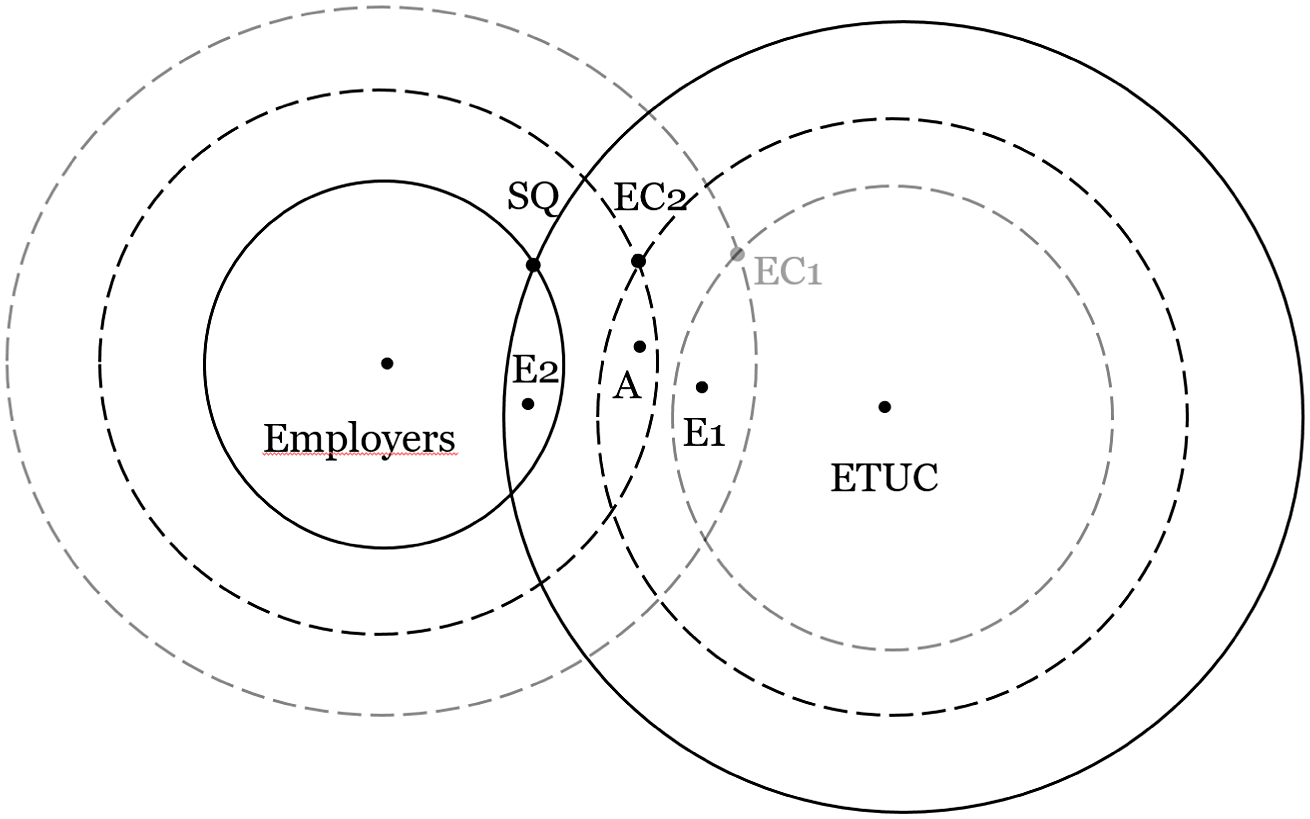
Due to CIETT’s intention to improve their reputation in the ESD and the internal disagreements on the employer side, the negotiations were expected to finally begin in the seventh meeting. The EC legal service entered at that time, however, stating that the social partners could not refer directly to strike or pay conditions in the agreement (Minutes, February 13, 2001). The legal service also stated that a temporary agency worker’s salary could not be determined on the basis of the salary of an ordinary employee (Ahlberg Reference Ahlberg, Ahlberg, Bercusson, Bruun, Kontouros, Vigneau and Zappalà2008: 209). This announcement was in line with the employer interest in a directive, which led them to withdraw their concessions (Minutes, February 13, 2001). At the same time, ETUC rephrased several claims so as to be more in line with the employers (Ibid.). The changes made by both the employers and ETUC show that the statement issued by the EC legal service had changed the social partners’ expectations for an EC-initiated directive, as it caused a shift in the social partners’ indifference curves: ETUC’s indifference curve expands while the employers’ indifference curve is reduced which is illustrated by the movement from EC1 to EC2 in Figure 2.
The social partners’ indifference curve before (EC1) after the EC announcement (EC2) and positioning points of agreement and disagreement within the social partners’ indifference curve (E1 and E2).

The shift in the social partners’ indifference curves narrowed the winset and reduced the prospects for an agreement. In the wake of the announcement, both the employers and employees presented multiple ultimate claims that were impossible for their counterpart to accept (Minutes, February 26–28, 2001). From this point, the negotiation process was characterised by a few and small concessions and some willingness to compromise, especially from ETUC, which tried to approximate the new expectations to the EC-directive. Among other things, ETUC suggested an exemption to the non-discrimination clause, allowing the national social partners to make a collective agreement determining who the comparable worker should be (Ibid.). However, the employers’ improved position in the negotiations resulting from the EC legal service announcements left them reluctant to agree to the compromises right away. As a last attempt to make an agreement, ETUC drafted a proposal both acknowledging temporary agency work as a positive contribution to the European labour market and easing the conditions for the use of this type of workforce (Ahlberg Reference Ahlberg, Ahlberg, Bercusson, Bruun, Kontouros, Vigneau and Zappalà2008: 211). With these concessions, ETUC theoretically went to the edge of their indifference curve, as the formulation was similar to provisions in the ILO convention (Ibid.). This final attempt at compromise was never presented to the employers, however, as the latter had already opposed the ETUC non-discrimination clause. ETUC then suspended the negotiations. The employers still feared that the EC-directive would be in ETUC’s favour, leading them to make a final attempt at compromise (Minutes, March 15, 2001). The employers were willing to accept the non-discrimination clause and the fact that specific sectors could prohibit the use of temporary agency contracts if ETUC accepted that the agreement should only apply to fixed-term contracts (Ibid.; Ahlberg Reference Ahlberg, Ahlberg, Bercusson, Bruun, Kontouros, Vigneau and Zappalà2008: 212). Despite these concessions also taking the employers to the edge of their indifference curve, ETUC did not accept the offer. This caused the negotiations to break down conclusively.
Explaining the outcome
Even though the social partners did not reach an agreement, the analysis shows that the SoH was of great importance to the social partners’ (lack of) willingness to compromise and make concessions. Firstly, the employers agreed to negotiate a binding agreement even though doing so did not correspond to their original needs and, secondly, the notice from the EC legal service left ETUC willing to compromise on major disputes. Furthermore, the expectations of an EC-initiated directive affected the negotiations, as the social partners ended up largely agreeing to the wording of the specific provisions in a non-discrimination clause and the conditions for the use of this type of employment, which was almost identical to the respective provisions in the agreement on fixed-term work and the ILO convention.
Any agreement reached by the social partners would be placed in the winset and relatively close to the EC position. The agreement would also be placed slightly closer to the employers’ indifference curve (A in Figure 2) since the basis of comparison in the non-discrimination clause would have been a comparable employee.
The social partners’ disagreements on the non-discrimination clause, the conditions for the use of temporary agency work, and, especially, the scope of the agreement were clearly insuperable and caused the breakdown. In Figure 2, the outer positions are illustrated by E1 = ETUC and E2 = Employers. Three particular factors can be seen as having had an impact on the social partners’ difficulties in agreeing on the scope. Firstly, it was unclear whether an EC-initiated directive would include temporary agency workers with limited and/or indefinite contracts. The conflict on the scope also ended up breaking the negotiations in the council after the breakdown in ESD (Ahlberg Reference Ahlberg, Ahlberg, Bercusson, Bruun, Kontouros, Vigneau and Zappalà2008: 247). Secondly, the social partners were restrained by tight mandates regarding the scope of the agreement, as the member states’ policies on temporary agency work differed extensively. Thirdly, the social partners needed to show that they would not agree to anything.
Conclusion
In the previous section, we have evaluated the hypothesis that SoH increases employer willingness to compromise and make concessions, thereby increasing the likelihood of a binding agreement. Based on the two case studies, we can conclude that the presence of SoH 1) affects the social partners’ preferences by making employers more willing to enter into negotiations on binding agreements, 2) that social partners adjust their mandates, concessions and compromises to the expectations of an EC-initiated directive and 3) that employers become willing to enter into agreements that, based on their ideal position, constitute a deterioration of the existing SQ. Thus, it can be concluded that the presence of SoH is a necessary condition but insufficient explanation for the social partners being able to reach agreement on binding, cross-sectoral agreements. The comparison of the two case studies reveals how at least four other contextual conditions also influence the outcome.
Firstly, the degree of SoH is of great importance to the ability of the social partners to define their BATNA and thereby their ability to overcome major discrepancies. The negotiations on fixed-term employment and temporary work made clear that expectations of an EC-initiated directive affected the social partners to the extent that they managed to overcome disagreement. At the same time, the social partners ended up agreeing on provisions very similar to the expectations of an EC-initiated directive. Conversely, the temporary work negotiations ultimately collapsed because the EC had not taken a clear position whether an EC-initiated directive should include temporary agency workers in a fixed-term employment relationship and/or temporary agency workers in a more permanent employment relationship. The degree of SoH must therefore be understood in relation to how clear and specific the expectations are for an EC-initiated directive. Secondly, SoH is not static but dynamic, as the degree and direction of the social partners’ BATNA can shift in the course of negotiations. In the negotiations for temporary work, this became evident when the social partners received the message from the EC Legal Service. Here, the social partners’ BATNA changed from the provisions of the ILO Convention and Recommendation to the new expectations of an EC-initiated directive. Thirdly, the complexity of the topic being negotiated seems to have a bearing on the willingness of the social partners to compromise and make concessions. One significant difference between the negotiations on fixed-term employment and temporary agency work was that the target group was undetermined in the latter case. Consequently, the mandates were significantly more locked, due to each member organisation having different strategies and opinions on how ETUC and the employers’ organisations should represent the interests of temporary agency workers and temporary employment agencies. Eventually, several member states were sceptical of European regulation in the area and it was uncertain whether there would be a majority for a directive complicating negotiations further. At the same time, it was unclear whether the EC-initiated directive would include temporary agency workers with limited and/or indefinite contracts. All in all, the negotiations were made more complex by these factors.
Finally, the reputations of the social partners constitute an important incentive for them to reach binding agreements. In the negotiations on fixed-term employment, the social partners needed to prove that they could reach an agreement and demonstrate their relevance in the European decision-making process. Conversely, this driving force had waned in the negotiations for temporary work and was instead replaced by a need to show both internally and externally that they were also able to say no to agreements.
By introducing a game-theoretical model on semi-veto players in the SoH, this article has shown how these conditions affect not only the incentives of the employers to enter into negotiations with the employees, which is widely acknowledged in the existing literature (Faro Reference Faro2012; Smismans Reference Smismans2008), but also the content of the agreements. The article hereby contributes to solving the theoretical puzzle of how external factors such as SoH influence the collective agreements reached by the European social partners in the ESD and why rational actors are willing to make agreements that possibly constitute a deterioration of the SQ for the one part. However, using game theory to explain and predict the outcome of negotiations in the ESD also includes some limitations. The game theory cannot sufficiently account for actors’ long-term strategic interests or explain how collective actors construct their immediate interests (Seeliger Reference Seeliger2019). Likewise, some researchers have pointed out that game theory fails to generate determinate predictions of what rational agents would, or should, do in important social interactions (see for example, Varoufakis Reference Varoufakis2008). Bearing in mind the limitation of the theory introduced in this article, there is still a need for further research on how employers and trade unions construct their interest, and how their internal organisational features may explain why social partners dismantle the legitimacy of ESD even though both sides desire the continued existence of the institution.
Apart from contributing theoretically, the findings may also have implications for the debate on the future of ESD and, in particular, whether the EC relaunch of the social dialogue brings the negotiations out of deadlock. While the answer is certainly not given, the most plausible scenario is that the ESD will continue in its present form, with the agreements being non-binding and only realised to a modest extent. This is mainly due to two reasons. First, despite the desire for an effective ESD, the EC cannot make use of a credible presence of SoH in the ESD negotiations. SoH is itself the result of squaring various national interests in the Council and unlike the 1990s, the member states tend to emphasise their own autonomy over the harmonisation of social and labour market policies (Adamczyk Reference Adamczyk2018). In so doing, they block new European initiatives. Therefore, it would be considered untrustworthy if the EC threatens the social partners with a directive without the necessary support from the Council. This dynamic was accentuated by the enlargement of the EU but may be reduced due to Brexit. Secondly, it is doubtful whether new initiatives, such as the preparation of an implementation report to expose the degree of implementation of the non-binding agreements concluded in the ESD, will have any impact on those member states that are currently failing to implement the agreements. Experience from similar “soft” monitoring measures, such as OMC and the “Single Market Scoreboard”, has shown that the effects are often limited (Berlingher Reference Berlingher2018: 31; Kröger Reference Kröger2009: 4). Conversely, one might argue that the continuation of the SQ will threaten the legitimacy of the ESD leading a new phase where the agreements remain non-binding, but better implemented. This will require, however, that the EC will provide the necessary assistance and support to the social partners in the implementation of non-binding agreement. If EC fails to support the implementation of the non-binding agreements in the ESD, there is a substantial risk that the ESD as an institution will disappear altogether.
Data availability statement
This study does not employ statistical methods, and no replication materials are available.