Strictly implemented public health measures are likely to control Ebola virus outbreaks locally should Ebola emerge in industrialized countries. Where such measures are insufficient, as recently in West Africa, virus-specific antiviral compounds and vaccines become essential to complement these measures. These medical interventions, however, are hard to develop in a timely fashion during “wartime,” ie, at the heart of an emerging epidemic.
Some of the barriers to developing such countermeasures during “peace time” relate to motivational drivers. For industrial stakeholders, a major barrier to the development of medical interventions has been the industry paradox: the largely self-limiting nature of filovirus outbreaks seems prohibitive for return on private sector investments.Reference Reperant, Van de Burgwal and Claassen 1 Public health officials prioritize diseases with higher current unmet medical needs over diseases with limited current health impact, even though the latter may emerge to pandemic proportions with large impacts on society.Reference Osterholm, Moore and Gostin 2 A final barrier appears related to the slow start of international aid campaigns implementing public health measures to contain recent outbreaks.Reference Siedner, Gostin, Cranmer and Kraemer 3 This last barrier may at least in part be due to the self-centric focus of some states in terms of biological threat response mechanisms.Reference Philips and Markham 4
Although differences in motivational drivers clearly pose barriers to international outbreak preparedness, and speculations on these differences exist,Reference Philips and Markham 4 no systematic research has been conducted on how these drivers actually differ between institutions and geographic regions. This is problematic because strategies attuned to pre-outbreak motivations could be the key to effective stakeholder alignment during “peace time,” which is necessary for medical preparedness. In turn, this may also improve stakeholder engagement for international aid during the initial phases of outbreaks. To address this knowledge gap, the current research examined the primary patent literature to analyze documented motivations from stakeholders who have invested in developing countermeasures in a pre-outbreak stage.
Methods
Measures
All patent documents (215) published until the end of 2014 with the term “Ebol*” or “filovir*” in the title or abstract were retrieved from the Espacenet database (European Patent Office, Munich, Germany). This database includes more than 90 million patents from 92 patent-issuing organizations worldwide and is considered by experts to be all-inclusive (D. Van Harte, Dutch RVO, personal communication, January 22, 2015). Priority numbers were used to identify the primary patent document (with the oldest application date) for each family (ie, related documents that differed only by limited alterations to the same invention). This resulted in 150 primary patent documents, constituting the complete population of patent families that were applied for before July 1, 2013 (during “peace time”), as well as 7 patent documents published between July 1, 2013, and December 31, 2014 (ie, before the end of the 18-month confidentiality period).
Primary patent documents were subjected to full-text analysis with a specific focus on the “background” and “field of invention” sections to identify unmet needs. During this analysis, 26 primary patent documents were excluded for not involving Ebola or filoviruses as a target (see the online data supplement for the exclusion criteria). On the basis of grounded theory coding and inductive text analysis, 5 categories of unmet need were identified: (1) the medical unmet need for vaccines and disease-specific therapies; the societal unmet needs for (2) detection and control of outbreaks in nonendemic areas, (3) control of outbreaks in endemic areas, and (4) protection against bioterrorism; and (5) the technical unmet need for better understanding of filoviruses. Using these 5 categories, the text from all patents was categorized by blinded review (see the online data supplement for the classification criteria).
Applicants that were also mentioned as inventor (ie, noninstitutional applicants) were removed. The remaining institutional applicants were classified as industry, academia, or government. The country code indicated for these applicants was used to define the geographic region(s) from which the patent originated.
A total of 16 patent documents did not mention an institutional applicant. For 13 of these patent documents an institutional applicant was found in another patent document belonging to the same patent family or via an online search identifying the affiliation of the inventors at the time of patent application. Geographic origin for this latter group was derived from the inventors’ country codes. Three patent documents for which no institutional applicant could be found or derived were excluded from the institutional analysis. Countries with less than 10 patent families each (Australia, Canada, and South Africa) were excluded from the geographic analysis. This included 7 patent families in total.
Statistical Methods
The geographic analysis included 117 patents. The institutional analysis included 121 patents. Patents that mentioned multiple unmet needs were counted once for each unmet need. Patents with applicants from multiple geographic regions or from multiple organization types were counted once for each region or organization type, respectively. Pearson’s chi-square test and Fisher’s exact test (FET) were used to determine statistical significance (P<0.05) on 2x2 contingency tables.
Results
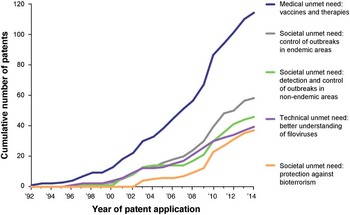
Medical unmet needs were described in nearly all patent families (92%). Three societal unmet needs were mentioned: the need for control of outbreaks in endemic areas (47%), for detection and control of outbreaks in nonendemic areas (37%), and for protection against the threat of bioterrorism (30%). Bioterrorism was first mentioned in 2002 (after 9/11) and subsequently as frequently as other societal unmet needs. Technical unmet needs were mentioned in 31% of the patents (Figure 1).
Cumulative Number of Patents on Ebola That Mentioned the Respective Unmet Needs at the End of Each Year.

While Russian applicants were the first to patent an Ebola-related invention in 1992, currently the United States are overrepresented in the patent literature with 68% of all patent families having US applicants. Other patenting regions included Europe (13%), Asia (10%), and Russia (9%). Institutional applicants were either academic (64%), industrial (44%), or governmental (29%).
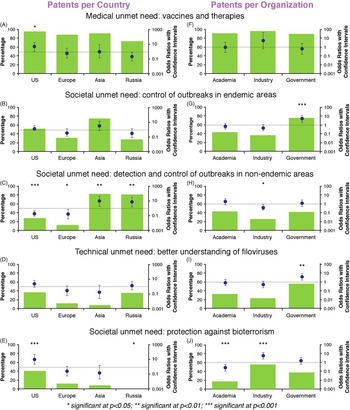
The unmet need profiles of applicants from different regions showed statistically significant heterogeneities (Figure 2). US applicants had 2 unmet needs of primary interest. More than applicants from other regions, they focused on the altruistic medical unmet need for vaccines and therapies (95% of patents from US applicants; odds ratio [OR]=4.44; P=0.029 [FET]) and furthermore showed a highly significant (P<0.001) and strong (OR=10.54) interest in the self-centric need for protection against bioterrorism (40%; χ2(1)=13.17). This latter unmet need was fully absent in Russian-based patents (P=0.017, FET). In contrast, Russian and Asian applicants mentioned the more self-centric need for detection and control of nonendemic outbreaks in the vast majority of patents, resulting in statistically significant ORs (OR=9.58; P=0.001 [FET], and OR=8.39; p=0.006 [FET], respectively). In turn, this unmet need was of far less importance for US and European applicants (29%; OR=0.20; χ2(1)=14.41; P<0.001, and 13%; OR=0.19; χ2(1)=5.59; p=0.018, respectively). Although Asian applicants also seemed to show relatively much interest in control of endemic outbreaks, these differences were statistically nonsignificant (OR=3.56, χ2(1)=3.70; P=0.070).
Percentage of Patents Per Country (A-E) and Per Type of Organization (F-J) That Addressed the Specified Unmet Needs (With Odds Ratios and 95% Confidence Intervals).

Further statistically significant heterogeneities in unmet need profiles were found between different institution types. Industrial applicants emphasized the need for protection against bioterrorism (55%; OR=5.91; χ2(1)=18.71; P<0.001), an unmet need that was scarcely mentioned by academic applicants (17%; OR=0.25; χ2(1)=11.48; P<0.001). In contrast, industrial applicants were less interested in detection and control of outbreaks in nonendemic areas (25%; OR=0.42; χ2(1)=4.40; P=0.036) than were their academic and governmental counterparts (44% and 41%, respectively). Governmental applicants demonstrated a stronger interest in the control of outbreaks in endemic areas (76%; OR=4.89; χ2(1)=11,92; P<0.001) than did industrial and academic applicants (36% and 44%, respectively). Surprisingly, governmental applicants also demonstrated a stronger interest in technical unmet needs for a better understanding of filoviruses (55%; OR=3.92; χ2(1)=10.00; P=0.002) than did academic and industrial applicants (30% and 23%, respectively).
Discussion
This study revealed heterogeneities in motivational drivers to invest in Ebola-related medical preparedness between different geographic regions and institution types. These identified heterogeneities may form the basis for tailored actions to improve medical preparedness and outbreak response.
US applicants were overrepresented in the patent literature and primarily mentioned the medical unmet need for vaccines and therapies and the societal unmet need for protection against bioterrorism. This is consistent with the United States being ranked as the largest donor of international support for the current Ebola outbreakReference Grepin 5 and may indicate that US stakeholders combine self-centric arguments with a global-oriented perspective on Ebola-related unmet needs. In contrast, Russian and Asian applicants showed a less altruistic and more self-centric profile, with a relatively large focus on diagnostics and the prevention of outbreaks in nonendemic areas. China’s efforts to prevent an outbreak of Ebola in their regionReference Larson 6 may be associated with this more self-centric perspective.
Differences in unmet need articulation between geographic regions impact international coordination. A recent example is the Global Health Security Agenda (GHSA), a partnership launched to complement the World Health Organization (WHO) International Health Regulations (IHR) treaty in capacity building for detection and response to public health threats.Reference Burkle 7 The strong focus on health security by the US-led GHSA has been a point of concern for other countries within both the GHSA and the IHR.Reference Burkle 7 The current study underlines that bioterrorism indeed has been a major point of focus for the United States and that this unmet need is not shared by all regions.
From an opposite perspective, in the recent Ebola crisis, the United States took 6 weeks to allocate budget and resources to contain the epidemic after the Public Health Emergency of International Concern declaration from the WHO.Reference Siedner, Gostin, Cranmer and Kraemer 3 A tailored call to action that triggered intrinsic US motivational drivers, as explicated in the current study, might have reduced this delay in response.
Heterogeneities between different institution types seem to be of particular importance for medical preparedness. Industrial applicants tended to articulate Ebola-related unmet needs in terms of bioterrorism protection, which, as has been suggested in the nonscientific literature, relates to a possibility for a return on investment.Reference Strauss 8 Interestingly, industrial stakeholders rarely mentioned the need for detection and control of outbreaks in nonendemic areas, thus indicating that they hardly considered this as a potential market. In comparison with academic applicants, a clear mismatch in unmet need articulation was found. Whereas industry focused on bioterrorism and neglected the need for detection and control of outbreaks in nonendemic areas, academic applicants did the opposite: 17% of their patents mentioned bioterrorism, whereas almost half of their patents mentioned detection and control in nonendemic areas.
Because interactions between public and private institutions are essential to effective product development,Reference Reperant, Van de Burgwal and Claassen 1 mismatches in the demand articulation between public and private institutions can hamper the translation of research findings into new products and services. Agenda-setting is an often overlooked—but essential—step in addressing unmet needs via research and innovation.Reference van den Nieuwboer, van de Burgwal and Claassen 9 A neglect of specific medical, societal, or technical unmet needs may therefore hinder innovative progress, a case which has been exemplified by the increased budget the US Congress allocated for GHSA initiatives and the simultaneous decrease in budgets for research on pathogenesis and epidemiology.Reference Burkle 7 Heterogeneities in unmet need profiles of different institution types likely resulted in such articulation mismatch in the field of Ebola, contributing to the lack of medical preparedness.
Eventually, the amount of funds allocated by private companies to respond to the current epidemic crisis have reached relatively high values,Reference Grepin 5 which may indicate an industrial change in perspective on societal unmet needs. Considering the huge impact that societal demand articulation has on stock prices of private companies,Reference Huggett 10 this is of great importance. Such changes may provide the incentives for industrial actors to invest in medical preparedness for a broader range of unmet needs than solely those related to the threat of bioterrorism and thereby improve the alignment with other stakeholders.
Conclusion
This research provides a first systematic overview of geographic and institutional differences in motivational drivers for engaging in Ebola-specific medical preparedness. During the early stages of outbreaks, stakeholder engagement strategies attuned to geographic unmet need profiles may aid in timely outbreak response efforts. A clear understanding of mismatches in this unmet need articulation may furthermore assist in overcoming some of the barriers to the development of new medical interventions against emerging infectious diseases, well ahead of “war times” and epidemic crises. Unmet medical, societal, and technical needs are inadequately addressed when political and funding priorities of governments, academia, and industry across geographic regions are not connected to unmet-need-driven development. Structural thinking in which these unmet needs are articulated will contribute to progression across the demand-driven value chain. International and institutional concordance will be a vital part of this.
Supplementary Material
To view supplementary material for this article, please visit http://dx.doi.org/10.1017/dmp.2016.64