Introduction
In recent times, researchers have been interested in measuring the phonological production skills of bilingual children, comparing them to monolingual children, and addressing why systematic differences exist between the two populations. Some researchers have focused on language-internal effects, namely the influence of the phonological properties of one language onto the other, a phenomenon referred to as ‘cross-linguistic interaction’ (Almeida, Rose, & Freitas, Reference Almeida, Rose, Freitas, Biller, Chung and Kimball2012; Keffala, Barlow, & Rose, Reference Keffala, Barlow and Rose2018; Lleó, Kuchenbrandt, Kehoe, & Trujillo, Reference Lleó, Kuchenbrandt, Kehoe, Trujillo and Müller2003; Paradis & Genesee, Reference Paradis and Genesee1996; Tamburelli, Sanoudaki, Jones, & Sowinska, Reference Tamburelli, Sanoudaki, Jones and Sowinska2015, among others). Other researchers have considered language-external effects, such as the influence of language exposure or dominance on phonological production (Ball, Müller, & Munro, Reference Ball, Müller and Munro2001; Goldstein, Bunta, Lange, Rodriguez, & Burrows, Reference Goldstein, Bunta, Lange, Rodriguez and Burrows2010; Goldstein, Fabiano, & Washington, Reference Goldstein, Fabiano and Washington2005; Law & So, Reference Law and So2006). Yet other researchers have integrated both sets of factors and included others such as lexical knowledge in order to determine which factors influence bilingual phonology the most (Kehoe & Havy, Reference Kehoe and Havy2019; Sorenson Duncan & Paradis, Reference Sorenson Duncan and Paradis2016). This study adopts the latter approach. Specifically, it examines the influence of language-internal, language-external, and lexical factors as well as bilingual status on the phonological development of monolingual and bilingual French-speaking children, aged three to six years. We test the French of the bilingual children only. We extend the findings of Kehoe and Havy (Reference Kehoe and Havy2019), who investigated the same set of factors on the phonological development of monolingual and bilingual French-speaking children aged 2;6.
In this ‘Introduction’, we first define cross-linguistic interaction. We then go on to describe language-internal, language-external, lexical factors, and bilingual status in more detail, and focus on studies which have examined the influence of these factors at different age-groups.
Cross-linguistic interaction
Paradis and Genesee (Reference Paradis and Genesee1996) define cross-linguistic interaction as “the systemic influence of the grammar of one language on the grammar of the other language during acquisition, causing differences in a bilingual's patterns and rates of development in comparison with a monolingual's” (p. 3). They consider three potential manifestations of cross-linguistic interaction, which are summarized below:
1. transfer: the incorporation of a grammatical property into one language from the other;
2. acceleration: the situation in which a certain property emerges in the grammar earlier than would be the norm in monolingual acquisition;
3. delay: when the acquisition process is slowed down due to the burden of acquiring two languages. We prefer to characterize ‘delay’ as the opposite of acceleration, that is, a certain property emerges in the grammar later than would be the norm in monolingual acquisition.
Recent work by Kehoe (Reference Kehoe, Babatsouli and Ingram2015) and Lleó (Reference Lleó, Babatsouli and Ingram2015) recommends an enlargement of this set to include patterns such as merging (or fusion) and deflecting (similar to perceptual assimilation and dissimilation in second language acquisition; Flege, Reference Flege and Strange1995), and change of order (order of developmental stages differs in a bilingual compared to monolingual). Due to the methodology of the study, which focuses on one language of the child, we consider acceleration and delay only; patterns such as merging and deflection would require comparison of the two languages of the bilingual which is not possible in the current study.
Language-internal, language-external, lexical factors, and bilingual status
Language-internal factors
Two principal language-internal effects, frequency and complexity, are implicated in understanding cross-linguistic interaction. Frequency refers to the low or high presence of a segment or phonological structure as determined by phoneme or syllable-type counts, whereas complexity refers to typological markedness (Gierut, Reference Gierut2001). A phonetic/phonological property that contains more elements and more structure is more complex than a phonetic/phonological property that contains fewer elements and less structure.
Several studies show that high frequency and complexity of structures in the L1 (i.e., language spoken at home which is not the majority language) may lead to accelerated production of these same structures in the L2 (i.e., the majority language) or vice versa. This has been found for word-final consonants in the Spanish of bilingual Spanish–German (Lleó et al., Reference Lleó, Kuchenbrandt, Kehoe, Trujillo and Müller2003) and bilingual Spanish–English children (Keffala et al., Reference Keffala, Barlow and Rose2018), and for initial clusters in both the Spanish and English of bilingual Spanish–English children (Keffala et al., Reference Keffala, Barlow and Rose2018), and in the English of bilingual Polish–English children (Tamburelli et al., Reference Tamburelli, Sanoudaki, Jones and Sowinska2015).
One problem when making claims about cross-linguistic interaction is that it is not always possible to separate out the independent effects of frequency and complexity. For example, codas in German are more frequent than in Spanish, but they are also more complex. Lleó et al. (Reference Lleó, Kuchenbrandt, Kehoe, Trujillo and Müller2003) argue that the high frequency of codas in German is responsible for the acceleration effects observed in the Spanish of bilingual German–Spanish children; however, Keffala et al. (Reference Keffala, Barlow and Rose2018) conclude that the findings on coda acceleration may well be due to the effects of complexity rather than frequency. Kehoe and Havy (Reference Kehoe and Havy2019) found similar effects on word-final consonant production irrespective of whether frequency or complexity was coded. For the sake of simplicity, we focus only on the parameter of complexity in our analyses of language-internal effects. We calculate complexity precisely for each of the languages and phonological features under consideration (see Supplementary materials, available at <https://doi.org/10.1017/S0305000919000874>).
Language-external factors
The main language-external factor that has been studied in research on young bilinguals is quantity of language input, which is often analyzed in terms of the single notion of language dominance. The language that the child hears and uses the most frequently is typically his dominant language. Many studies show that the dominant language of a bilingual is associated with faster phonological acquisition (Ball et al., Reference Ball, Müller and Munro2001; Law & So, Reference Law and So2006). Other studies have not found dominance to be useful in accounting for results. For example, Almeida et al. (Reference Almeida, Rose, Freitas, Biller, Chung and Kimball2012) observed an influence of French on Portuguese in the development of word-initial clusters, and an influence of Portuguese on French in the development of codas. Both effects occurred during the same developmental period, making it impossible to consider dominance as the source of both patterns.
More differentiated measures of language dominance, such as parent-reported estimates of language experience (frequency of language input and output, and language proficiency) have also been included in studies of bilingual phonology (Goldstein et al., Reference Goldstein, Fabiano and Washington2005, Reference Goldstein, Bunta, Lange, Rodriguez and Burrows2010; Ruiz-Felter, Cooperson, Bedore, & Peña, Reference Ruiz-Felter, Cooperson, Bedore and Peña2016). Some studies have found only modest effects of language experience (Cooperson, Bedore, & Peña, Reference Cooperson, Bedore and Peña2013; Goldstein et al., Reference Goldstein, Fabiano and Washington2005, Reference Goldstein, Bunta, Lange, Rodriguez and Burrows2010; Meziane & MacLeod, Reference Meziane and MacLeod2017), whereas others have found it to be a significant predictor of phonological accuracy (Morrow, Goldstein, Gilhool, & Paradis, Reference Morrow, Goldstein, Gilhool and Paradis2014; Ruiz-Felter et al., Reference Ruiz-Felter, Cooperson, Bedore and Peña2016). Studies underscore the importance of qualitative aspects of the input in children's language development. These aspects include presence of non-native input and code-switching (Byers-Heinlein, Reference Byers-Heinlein2013; Hoff & Core, Reference Hoff and Core2013). They also distinguish between input and intake, the latter referring to children's selection or processing of the input. Although acknowledging the relevance of these aspects of input, we focus only on quantitative aspects of input in this study.
Lexical factors
An abundance of studies in monolingual acquisition document a close relationship between phonological and lexical ability. Children with large vocabularies have superior phonological production relative to children with small vocabularies (Kehoe, Chaplin, Mudry, & Friend, Reference Kehoe, Chaplin, Mudry and Friend2015; Petinou & Okalidou, Reference Petinou and Okalidou2006; Rescorla & Ratner, Reference Rescorla and Ratner1996; Smith, McGregor, & Demille, Reference Smith, McGregor and Demille2006; Stoel-Gammon, Reference Stoel-Gammon2011). To date, the relationship between phonology and the lexicon has not been extensively studied in bilingual children. This is surprising given the close relationship between phonological production and vocabulary, and the fact that bilinguals often obtain poorer vocabulary scores than monolinguals when compared in one language only (Hoff, Core, Place, Rumiche, Señor, & Parra, Reference Hoff, Core, Place, Rumiche, Señor and Parra2012). Some apparent monolingual–bilingual differences in phonological production may reflect vocabulary effects.
Scarpino (Reference Scarpino2011) examined which factors were the best predictors of phonological production in a large group of Spanish–English bilingual children (n = 199), aged 3;0 to 6;4. She found that language-specific vocabulary scores were highly predictive of phonological proficiency in both the English and Spanish of the bilingual children. Other authors also report positive relations between language-specific vocabulary or semantic scores and phonology in bilingual children (Cooperson et al., Reference Cooperson, Bedore and Peña2013; Meziane & MacLeod, Reference Meziane and MacLeod2017).
Bilingual status
We are also interested in determining whether bilinguals as a group differ from monolinguals in their phonological production. Studies which have compared bilinguals on global phonological measures such as percent consonants correct (PCC) and percent vowels correct (PVC) have found varied results (Hambly, Wren, McLeod, & Roulstone, Reference Hambly, Wren, McLeod and Roulstone2013). Bilinguals may do better (Goldstein & Bunta, Reference Goldstein and Bunta2012; Grech & Dodd, Reference Grech and Dodd2008), less well (Gildersleeve-Neumann, Kester, Davis, & Pena, Reference Gildersleeve-Neumann, Kester, Davis and Peña2008; Law & So, Reference Law and So2006), or behave similarly to monolinguals (MacLeod, Laukys, & Rvachew, Reference MacLeod, Laukys and Rvachew2011). Variable findings may arise because language-internal, language-external, and lexical effects have not been well controlled. In this study we assume that these factors exert an influence on some but not all bilinguals. If we take language-internal effects as an example, we may observe that bilinguals who speak languages which are characterized by greater phonological complexity may have an advantage in their L2, but not necessarily bilinguals who speak languages with lesser phonological complexity.
Some findings in the literature are also consistent with a ‘general bilingual advantage’. A bilingual, by virtue of being exposed to different types of linguistic complexity across both languages, may have superior phonological perception and production than a monolingual (Grech & Dodd, Reference Grech and Dodd2008; Kehoe & Havy, Reference Kehoe and Havy2019). Other studies suggest a ‘general disadvantage’ for bilinguals (Gildersleeve-Neumann et al., Reference Gildersleeve-Neumann, Kester, Davis and Peña2008; Gildersleeve-Neumann & Wright, Reference Gildersleeve-Neumann and Wright2010), although it is not clear whether the poorer results reflect reduced exposure to the target language, poorer vocabulary levels, or other factors. We intend to separate out a ‘general bilingual’ effect from language-internal, language-external, and lexical influences by comparing a single group of bilinguals versus comparing subgroups of bilinguals to monolinguals. Only if bilinguals as a single group differ from monolinguals do we have evidence for a ‘general bilingual’ effect.
Studies examining the influence of language-internal, language-external, and lexical factors on phonological production
Kehoe and Havy (Reference Kehoe and Havy2019) investigated the influence of language-internal, language-external, and lexical factors on the phonological production skills of monolingual and bilingual French-speaking two-and-a-half-year-olds. The bilinguals had differing first languages (L1s) (e.g., Spanish, Portuguese, English, etc.) and variable exposure to French, which was the language of the environment. They coded the L1s of the bilinguals in terms of the complexity (and in some cases frequency) of three phonological structures – word-final consonants, initial clusters, and alveo-palatal fricatives (/ʃ, ʒ/) (henceforth referred to as ‘palatal fricatives’) – and from this they formulated precise predictions about the nature and direction of cross-linguistic interaction. They also included global measures such as PCC and PVC as outcome variables. In addition to language-internal factors, they determined percent exposure to French, socioeconomic status (SES), and total (i.e., vocabulary in French and L1 combined) as well as French vocabulary levels for the monolingual and bilingual children. These constituted the language-external and lexical factors.
Results indicated that all factors influenced phonological production to some degree. The influence of language-internal factors was suggested by graded effects in the outcome measures of coda and cluster accuracy, with higher scores being obtained by children speaking high-frequency/high-complexity languages and lower scores being obtained by children speaking low-frequency/low-complexity languages. Percent exposure to French, SES, and total vocabulary also influenced phonological performance. Children who received greater exposure to French, had higher SES, and had superior total vocabularies, obtained better PCC, final consonant, and initial cluster accuracy scores. French vocabulary was not a significant variable in any of the models.
Two other findings from this study were noteworthy. First, in several analyses bilinguals as a group scored higher than monolinguals, suggesting a general advantage in phonological production for bilinguals at age 2;6. Second, not all phonological measures were susceptible to language-internal (and -external) influence. Statistical models which tested vowels and palatal fricatives did not yield any significant findings. Kehoe and Havy (Reference Kehoe and Havy2019) query whether the general ease of vowels and the articulatory complexity of palatal fricatives may have obscured language-internal and -external effects. Nevertheless, they also propose that an analysis of vowel complexity, which takes into consideration vowel inventory size, and the inclusion of older children who have had greater exposure to palatal fricatives in their home language, may provide evidence of cross-linguistic interaction in these measures.
Sorenson Duncan and Paradis (Reference Sorenson Duncan and Paradis2016) also examined the influence of multiple factors (age, English vocabulary size, language exposure, and L1 typology) on the nonword repetition (NWR) accuracy of English L2 language learners, aged 5;8. Using linear mixed regression modeling, they found that all factors – age, receptive vocabulary level, amount of English exposure, and L1 – were significant predictors of bilingual children's NWR performance. Concerning L1 influence, they found that children acquiring a high-complexity coda language (Hindi, Punjabi, or Urdu) were more accurate in their production of coda consonants than children acquiring a low-complexity coda language (Cantonese or Mandarin). Thus, they obtained comparable findings to Kehoe and Havy (Reference Kehoe and Havy2019), but with older English L2 language learners and using a NWR task.
Meziane and MacLeod (Reference Meziane and MacLeod2017) examined variables influencing the phonology of French L2 language learners, aged approximately six years. They did not examine language-internal effects but they did examine lexical and language-external influences on children's PCC scores. They found correlations between expressive (but not receptive) vocabulary and phonology, but little influence of language-external effects, such as age of onset of French acquisition or usage of French in the home, on PCC scores.
This research adopts similar methodology to Kehoe and Havy (Reference Kehoe and Havy2019), Sorenson Duncan and Paradis (Reference Sorenson Duncan and Paradis2016), and Meziane and MacLeod (Reference Meziane and MacLeod2017). Like Sorenson Duncan and Paradis (Reference Sorenson Duncan and Paradis2016) and Meziane and MacLeod (Reference Meziane and MacLeod2017), we test older French-speaking children but we retain the use of real words as employed by Kehoe and Havy (Reference Kehoe and Havy2019) and Meziane and MacLeod (Reference Meziane and MacLeod2017) to control for possible confounds resulting from immediate perceptual experience. Real words may also give a more accurate estimation of children's phonological production capacities than nonwords, which test other phonological capacities such as memory. The study aims to determine whether the effects observed by Kehoe and Havy (Reference Kehoe and Havy2019) in French-speaking children aged 2;6 are also observed in older children, aged three to six years.
Before we present the research questions, we consider factors which affect bilingual phonological production at different ages.
Influence of language-internal, language-external, and lexical factors across different age-ranges
In this study, we are interested in determining whether monolingual–bilingual differences and the influence of language-internal, language-external, and lexical factors are similar across age. Several studies have compared monolingual and bilingual children on phonological measures at different age-ranges. Grech and Dodd (Reference Grech and Dodd2008) documented superior PCCs in Maltese–English learners in comparison to Maltese-only learners, and the differences in the two groups decreased with age (age 2;0–2;11: 8% difference vs. 5;6–6;0: 3.7% difference). Gildersleeve-Neumann and Wright (Reference Gildersleeve-Neumann and Wright2010), in contrast, observed superior PCCs and PVCs in English monolingual learners in comparison to Russian–English bilinguals, and differences were present in both the under and over five-year-old group. In another study, Gildersleeve-Neumann et al. (Reference Gildersleeve-Neumann, Kester, Davis and Peña2008) compared the phonological performance of monolingual English and bilingual English–Spanish children at two time periods, at ages 3;0 and 4;0. Monolingual children had higher PCCs and PVCs and fewer phonological processes than the bilingual children, and these differences were maintained across both time-points. We cannot be sure, however, whether the monolingual–bilingual differences reported in these studies reflect language typology, language exposure, or lexical influences.
Montanari, Mayr, and Subrahmanyam (Reference Montanari, Mayr and Subrahmanyam2018) predict that cross-linguistic interaction (referred to as ‘negative transfer’ in their study) should be particularly evident at the early stages of bilingual development when one language is dominant over the other. It should decrease as exposure to and practice with the non-dominant language increases. They examined speech sound development in 35 bilingual Spanish–English children at two time-points, when the children were aged 3;7 and 4;7. Indeed, they found that speech sound accuracy increased over time in both languages, although most consistently in English, which was the language of schooling. They did not include monolingual controls in their study so it cannot be determined if monolingual–bilingual differences decreased accordingly.
More recently, Sorenson Duncan and Paradis (Reference Sorenson Duncan and Paradis2016) took language typology, language exposure, and lexical factors into consideration (see above) and found a significant interaction between amount of English exposure and L1 typology in their population of English language learners, suggesting that cross-linguistic interaction was more pronounced with lower levels of English exposure, consistent with the predictions of Montanari et al. (Reference Montanari, Mayr and Subrahmanyam2018). Although the latter finding is based on degrees of English exposure and not age per se, it still attests to the declining influence of cross-linguistic interaction over time.
Concerning the influence of language exposure, Morrow et al. (Reference Morrow, Goldstein, Gilhool and Paradis2014) documented significant correlations between language exposure variables (e.g., age of arrival, age of exposure, English use, and months of exposure) and phonological production at five time-points which spanned on average 9 to 33 months of English language exposure. The children tested were English-language learners, aged 4;2 to 6;9 at the first time-point. ‘English use’, which is closest to the measure of dominance employed in this study, was significantly correlated with phonological measures at the first three time-points only.
We are unaware of studies which have examined lexical influences on phonological production in bilingual children across multiple time-points. Studies which have examined lexical development in bilingual children indicate variability in outcomes, with some studies showing that monolingual–bilingual differences decrease (Golberg, Paradis, & Crago, Reference Golberg, Paradis and Crago2008) and others showing that they are maintained (Cobo-Lewis, Pearson, Eiler, & Umbel, Reference Cobo-Lewis, Pearson, Eiler, Umbel, Oller and Eilers2002) over time, at least in children aged five to seven years. Montanari et al. (Reference Montanari, Mayr and Subrahmanyam2018) did not look at lexical influences on phonology, rather morphosyntactic influences, and found significant moderate correlations between mean length of utterance (MLU) and PCC in Spanish–English bilinguals. These correlations were of similar magnitude across two time-points (3;7 and 4;7), although only in English and not in Spanish.
To conclude this section, findings are varied as to whether the influence of language-internal, language-external, and lexical effects remains steady or declines with age.
Research predictions
Predictions based on language-internal factors
First, we examine whether language-internal factors influence phonological production. In our investigation of language-internal factors, we concentrate on PVCFootnote 1 and on four specific phonological properties: word-final consonants, word-final clusters, obstruent–liquid (OL) initial clusters, and palatal fricatives (/ʃ, ʒ/). We focus on three areas of syllable structure because they have been shown to evidence cross-linguistic interaction in studies on bilingual phonological acquisition (word-final consonants: Keffala et al., Reference Keffala, Barlow and Rose2018, Lleó et al., Reference Lleó, Kuchenbrandt, Kehoe, Trujillo and Müller2003; initial clusters: Almeida et al., Reference Almeida, Rose, Freitas, Biller, Chung and Kimball2012, Keffala et al., Reference Keffala, Barlow and Rose2018; final clusters: Mayr, Howells, & Lewis, Reference Mayr, Howells and Lewis2015). We are interested in vowels and palatal fricatives due to the findings of Kehoe and Havy (Reference Kehoe and Havy2019), which did not find evidence of monolingual–bilingual differences in these measures for younger children. The authors queried whether an analysis which took into consideration vowel inventory size for vowels and which tested older children for palatal fricatives may yield different results. We intend to address their queries in this study.
The basis of our predictions of cross-linguistic interaction is that a structure which has a higher complexity in the L1 compared to the L2 should facilitate acquisition in the L2, whereas a structure which has lower complexity in the L1 should inhibit acquisition. Facilitation effects result in acceleration, which we define as significantly higher correct performance for a target structure in the bilinguals’ L2 in comparison to monolinguals. Inhibition effects lead to delay, which is significantly lower correct performance for a target structure in the bilinguals’ L2 in comparison to monolinguals.
To group languages according to complexity criteria, we have pooled information from multiple sources, including the World's Atlas of Language Structures Online (Dryer & Haspelmath, Reference Dryer and Haspelmath2013). In Supplementary Materials A through D, we discuss the sources of information that have led to these groupings and the predictions of cross-linguistic interaction based on these groupings. The L1s of the bilingual children in this study are Spanish, Italian, Portuguese, Catalan, Mandarin, Japanese, Tagalog, Arabic, Farsi, Romanian, Russian, Polish, Albanian, Bosnian/Serbo-Croatian, Czech, English, (Swiss) German, Dutch, Norwegian, Swedish, Fons, and Mandinka. We did not use L1 as an inclusionary criterion; hence this set of languages reflects the L1s of bilinguals whose parents agreed to take part in the study. A summary of the predictions based on the linguistic characteristics of the L1s of the bilingual children is given in Table 1.
Predictions based on language-internal characteristics

Predictions based on language-external factors
Second, we examine whether language-external factors such as dominance influence phonological production. We predict that children who are rated as dominant in French should obtain superior results on all phonological measures in comparison to children who are rated as non-dominant. This is consistent with findings which reveal that the dominant language of the bilingual is characterized by superior phonological abilities (Ball et al., Reference Ball, Müller and Munro2001; Law & So, Reference Law and So2006).
Predictions based on the influence of the lexicon
Third, we examine whether vocabulary predicts phonological production. We predict that children with higher scores on a French expressive vocabulary test should have superior phonological results than children with lower vocabulary scores. This is consistent with studies demonstrating moderate to strong correlations between vocabulary size and phonological production in monolingual children. Nevertheless, Kehoe and Havy (Reference Kehoe and Havy2019) found that it was total rather than French vocabulary which predicted phonological production in the French of monolingual and bilingual children aged 2;6. Thus, we entertain the possibility that language-specific vocabulary is not a good predictor of phonological accuracy in bilingual children. Unfortunately, we were not able to test L1 vocabulary due to the variety of languages spoken by the bilingual children in the study.
Predictions based on bilingual status
Fourth, we examine whether bilinguals as a group differ from monolinguals in phonological production. Kehoe and Havy (Reference Kehoe and Havy2019) observed a bilingual advantage in children aged 2;6, whereas others have reported poorer results in bilinguals (Gildersleeve-Neumann et al., Reference Gildersleeve-Neumann, Kester, Davis and Peña2008). Thus, we make no firm predictions as to whether monolingual–bilingual differences will be present in the data given the diverse findings in the literature.
Predictions based on age-range
Finally, we examine the influence of bilingual status, language-internal, language-external, and lexical factors across age. We do this by examining whether there are significant interactions of the predictor variables with age. As mentioned, findings are varied concerning the influence of these factors across age. We consider that the most likely scenario, nevertheless, is that the influence of these effects will be reduced over time as children have greater contact with their L2. This would be consistent with Sorenson Duncan and Paradis’ (2016) finding that cross-linguistic interaction was more evident with lower than higher levels of English exposure.
In sum, this study investigates the effects of language-internal (complexity of phonological features in the L1), language-external (dominance), and lexical factors (French expressive vocabulary), as well as bilingual status (monolingual vs. bilingual), on global (PCC, PVC) and specific phonological measures (word-final consonants, initial and final clusters, and palatal fricatives) in the French of monolingual and bilingual children, aged three to six years.
Method
Participants
Participants included 101 French-speaking children (49 boys; 52 girls), aged 2;11 to 6;10, who attended crèche or public schools in Geneva. The original sample tested was 108 children, but four children were excluded due to having received speech therapy, two children were excluded due to not participating in the test procedure, and one child for having missing vocabulary information. The mean age of the monolinguals was 5;0 and the mean age of the bilinguals was 5;2. There was no significant difference in age between the monolinguals and the bilinguals on the basis of a two-tailed t-test (t(99) = –1.0, p = .32).
Bilingual status was determined on the basis of a parent questionnaire in which parents indicated whether their child spoke another language at least 30% of the time in addition to French. They were required to indicate which language the child spoke at home and with whom, and at what age the child had acquired French. They were also required to indicate whether they had any concerns about their child's speech and language development. The questionnaire was created for the purposes of the study but it was loosely based on the PABIQ (Tuller, Reference Tuller, Armon-Lotem, de Jong and Meir2015). It was distributed to the parents by the teachers along with the consent form. The parents completed the questionnaire at home and returned it to the crèche or school. Information provided in the questionnaire revealed that 64 of the 101 children were bilingual. They had all acquired French before the age of three years with the exception of one child who started learning French at 3;4.Footnote 2 Thus, the group could be essentially classified as simultaneous bilinguals (Genesee & Nicoladis, Reference Genesee, Nicoladis, Hoff and Shatz2006).
Parents were also required to judge the language usage of French and the other language on a scale from 1 to 5 (1: speaks only ‘other’ language; 2: speaks other language more than French; 3: speaks other language the same amount as French; 4: speaks French more than the other language; 5: speaks only French). The majority of children were dominant in French (n = 36, scale 4). The remaining children were balanced bilinguals (n = 20; scale 3) or were dominant in the other language (n = 7; scale 2). In one case, parents did not complete the question on language usage. This child was still included in the study; the absence of information on language usage was treated as a missing datapoint. Because of the small number of children who were dominant in the home language, we formed two dominance groupings: those who were dominant in French (n = 36) and those who were not (n = 27). Please note that there was a greater number of younger compared to older children who were dominant in French. If we divide the database into two groups (ages three to four, and ages five to six), we observe that there were twice as many children dominant than non-dominant in French in the younger age group (age three to four: 14 dominant; 7 non-dominant, 1 missing data). The number of dominant and non-dominant bilinguals was more even in the older age group (age five to six: 22 dominant, 20 non-dominant). We have no explanation for why this was the case given that the most likely scenario is that the older group would be made up of more children dominant in French. It must be noted that the younger and older groups reflect two different populations of bilinguals: one attending crèches and the other public schools.
Of the 64 Genevan bilinguals, 10 were actually trilingual, speaking two languages at home. There were 22 home languages represented in the bilingual sample, the most common being Portuguese, Spanish, Italian, Albanian, and English. SES information was not obtained for each child, the reason being that the parent questionnaires were distributed by the teachers at the crèches or schools and this information was considered of too sensitive a nature to be included in the questionnaire. However, the crèches and schools the children attended were in middle-class areas in Geneva.
Appendices A and B provide a description of the monolingual and bilingual participants, including information on gender, age, vocabulary score, dominance grouping, and languages spoken.
Test material
Phonological stimuli
The stimuli included 78 real words: 65 of the 78 words (83%) can be found in the l'Inventaire Français du Développement Communicatif (IFDC; Kern & Gayraud, Reference Kern and Gayraud2010) and/or in the Developpement du langage de production en français (DLPF) version 3 (31–36 mois) (Bassano, Labrell, Champaud, Lemétayer, & Bonnet, Reference Bassano, Labrell, Champaud, Lemétayer and Bonnet2005). The remaining words were considered to be familiar to children as young as 3;0. The stimulus set served three separate studies. Twenty words were selected for the purposes of developing a phonological screening test for French-speaking children (Kehoe, Niederberger, & Bouchut, Reference Kehoe, Niederberger and Bouchut2020) and another 16 words were selected for a study on voice onset time (VOT). Following this, additional words were added to fulfil phonological criteria relating to the presence of word-final consonants, initial and final clusters, and palatal fricatives (tested in both syllable-initial and -final position). Words containing medial codas, /s/C sequences, and rhotics were also targeted but are not the focus of the current study. These, along with the words for the VOT study (i.e., words with initial stop consonants), are included, however, in the analyses of global phonological measures (PCC and PVC). In addition, any words spontaneously produced during the session (i.e., not included in the stimulus list) which fulfilled the phonological criteria of the study could be included in the final dataset, with the condition that they were produced by multiple children. Examples of additional words include dragon ‘dragon’, bleu ‘blue’, fenêtre ‘window’, and chapeau ‘hat’. The global measures of PCC and PVC were based on all words produced in the recording session, whereas the specific phonological measures were based only on target words containing word-final consonants, clusters, or palatal fricatives. The stimulus words are shown in Appendix C along with a checklist of the relevant phonological criteria that they fulfilled.
French vocabulary test
Expressive vocabulary in French was tested using the subtest ‘Dénomination Phonologie/Lexique’ of the test battery EVALO2-6 (Coquet, Ferrand, & Roustit, Reference Coquet, Ferrand and Roustit2009). Children were required to name a series of 27 pictures. We used a restricted set (minus the body parts). If the children spontaneously named the picture, they received a score of 2. If the children named the picture after having received a phonological cue (the first phoneme of the word), they received a score of 1. We employ the initial test score (without phonological cue) as we considered it to be a more valid measure of the children's vocabulary knowledge. Since the test is normed on children only through to 6;3 and we tested children older than this, i.e., through to 6;10, we employ the raw rather than the standardized score.
Procedure
Children took part in a production task of approximately 20 to 30 minutes. Testing took place in a quiet room in the children's crèche or school. The screening and vocabulary tasks were picture naming tasks. The VOT test was a memory game, which also involved children naming pictures while searching for matching pairs. The additional phonological stimuli were elicited in the form of an object naming task (children selected toys/objects from a cloth bag) to vary the procedure and maintain interest. The children interacted with two native French-speaking experimenters. The average number of words produced by the monolingual children was 132 (sd = 17; range = 80–178), and by the bilingual children, 133 (sd = 16; range = 97–187). Children produced on average 67 words containing word-final consonants (sd = 10; range = 41–104), 18 words containing initial clusters (sd = 3.5; range = 9–29), 14 words containing final clusters (sd = 3; range = 8–23), and 24 words containing palatal fricatives (sd = 5; range = 14–39).
Data transcription
Children's speech was recorded with a portable digital tape-recorder (MARANTZ, TASCAM DR-2d) and unidirectional condenser microphone placed on a table in front of the children with the assistance of a tripod. Using Phon, a software program designed for the analysis of phonological data (Rose & MacWhinney, Reference Rose, MacWhinney, Durand, Gut and Kristoffersen2014; Rose et al., Reference Rose, MacWhinney, Byrne, Hedlund, Maddocks, O'Brien, Wareham, Bamman, Magnitskaia and Zaller2006), each child's wave file was segmented, and stimulus words were identified and transcribed. Two French-speaking graduate students, who had experience in phonetic transcription including training in the speech laboratory, performed the analyses. They transcribed each child's productions in broad phonetic transcription. The transcribed data were transferred to Excel and coded according to the phonological criteria under consideration. Calculations of PCC and PVC were computed automatically for each child in Phon.
Reliability
Twelve participants (approximately 12% of the data) were re-transcribed by a second transcriber (one of the two graduate students) using the Blind Transcription function of the Phon program. Point-to-point phoneme agreement was moderate to good (87.5%).
Data coding
Analyses were conducted on six dependent variables: PCC, PVC, word-final consonant accuracy, initial cluster accuracy, final cluster accuracy, and palatal fricative accuracy. In the case of PCC and PVC, the response variable was a proportion score for each word production: number of consonants correct / number of total consonants and number of vowels correct / number of total vowels. For example, escargot /ɛskaʁɡo/ ‘snail’ produced as [ekaɡo] was coded as 2/4 for PCC and 2/3 for PVC. We also included a ‘weights’ argument in the model set to the number of total consonants/vowels to take into account that a proportion (e.g., 0.5) could refer to different numerators and denominators (e.g., 1/2, 2/4, 3/6, etc.).
In the case of the response variables related to final consonants, clusters, and palatals, each individual word production was coded as either correct (1) or incorrect (0). For example, productions containing target word-final consonants were coded as correct for coda accuracy when the final consonant was segmentally correct (e.g., flèche as [flɛʃ]) and as incorrect when the consonant was absent or was not segmentally accurate (e.g., flèche as [fle] or [flɛs]). Productions containing target initial clusters were coded as correct for cluster accuracy when a cluster was structurally and segmentally correct (e.g., grenouille as [ɡʁənuj] ‘frog’) and as incorrect when a cluster was absent or segmentally incorrect (e.g., grenouille [dənuj] or [dʁənuj]). A similar coding system was applied to the other dependent variables.
Statistical analyses
Data were analyzed using mixed effect logistic regression, which allowed us to model production accuracy on the basis of binomial data. The analyses were performed using R statistical software (R Development Core Team, 2015) and the lme4 package (Bates, Maechler, Bolker, & Walker, Reference Bates, Maechler, Bolker and Walker2015) for mixed effects models.
The variables were coded as follows: Complexity ratings included: vowel complexity, which was coded as having two levels: mid- and large-sized vowel inventory; final consonant complexity, which was coded as having two levels: low and high; cluster complexity, which was coded as having three levels: low, mid, and high; and palatal complexity, which was coded as having three levels: low, mid, and high. The final consonant complexity rating was used in the analyses of both word-final consonants and clusters. In the case of participants who were exposed to two languages apart from French (trilinguals), the language with the greatest complexity was coded. This changed according to the phonological property. In the case of DL B3;4, who spoke Italian and Dutch, Dutch was the language coded for vowel inventory size and final consonants and clusters because Dutch has a larger vowel inventory and more complex final consonants and clusters than Italian. In the case of palatal fricatives, Italian was coded because Italian has more palatal fricatives than Dutch. Language dominance was coded as having three levels: 1 for ‘not dominant’ in French; 2 for ‘dominant’ in French; and 3 for monolingual. Since bilingual status (monolinguals vs. bilinguals) was nested within dominance, we did not include a separate variable for bilingual status but recoded the dominance variable (monolinguals = 1) in order to determine whether monolinguals differed from bilinguals who were both dominant and non-dominant in French. The presence of significant effects for both groups of bilinguals would indicate a significant effect for bilingual status. Vocabulary was the number of words named in a French vocabulary test (range: 2 to 54). There were two control variables: age (in months) and gender (male and female).
To determine what factors influenced phonological performance, we first entered the control variables: age and gender. Gender was not found to be significant in any of the analyses and was subsequently excluded to avoid over-parametrization. We then entered the predictor variables, vocabulary, dominance, and complexity, along with the interaction of these three variables with age (i.e., vocab*age, dominance*age, complexity*age). We conducted the analysis twice, recoding the values for dominance (monolinguals = 1) in order to determine whether bilingual status was significant. The random part of the model included random intercepts for participants and items. Random slopes on fixed effects were initially included but subsequently removed due to lack of convergence. The model was fitted using maximum likelihood estimation.
Results
Before we proceed to presenting the results of the statistical models, we examine the correlations between age, vocabulary, and the phonological outcome measures.
Correlations between age, vocabulary, and phonological outcome variables
Table 2 shows the Pearson product–moment correlations between age and vocabulary on the one hand and the six phonological outcome variables on the other. We also show the correlation coefficients between vocabulary and the phonological outcome variables with age partialled out. As can be seen, there were low to moderate correlations between age and phonological measures; there were moderate to high moderate correlations between vocabulary and phonological measures, with the exception of palatal fricatives. Even when age was partialled out, vocabulary was moderately correlated with phonological measures with the exception of palatal fricatives where no correlation was observed between vocabulary and this outcome measure.
Correlations between age, vocabulary, and phonological outcome measures

Notes. a: * p < .05, ** p < .01, *** p < .001; b: correlation between vocabulary and phonological outcome measures with age partialled out.
We also examined vocabulary scores according to bilingual status and dominance. Bilinguals had lower vocabulary scores than monolinguals (monolinguals: mean = 43.19 sd = 10.50; bilinguals: mean = 30.97 sd = 13.60). Independent two-tailed t-tests indicated that the differences between monolinguals and bilinguals were significant (t(99) = –4.71, p < .001). There were also differences in vocabulary according to the dominance ratings. A one-way analysis of variance indicated that the influence of dominance on vocabulary scores was significant (F(2,97) = 18.18, p < .001). Tukey multiple comparisons revealed that monolinguals had superior vocabulary scores to bilinguals who were dominant (p = .008) and not dominant in French (p < .001). In addition, bilinguals who were dominant in French had superior vocabulary scores to those who were non-dominant in French (p = .006). These findings are relevant to the analyses of our statistical models since the effects of bilingualism and dominance can be largely accounted for by vocabulary scores.
PCC
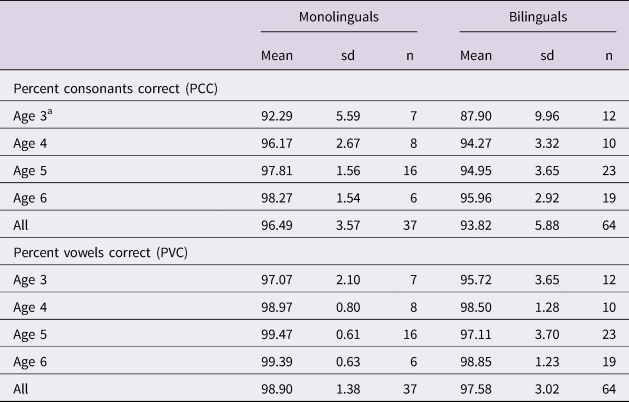
Table 3 presents the means and standard deviations for the PCC data for the monolingual and bilingual children according to age-group in years. Monolinguals produced 92–98% of consonants correctly and bilinguals produced 88–96% of consonants correctly. Monolinguals obtained slightly higher percent scores than bilinguals at all ages.
Means and standard deviations of PCC and PVC for monolingual and bilingual children according to age group

Notes. a: the age-groups were as follows: 3 (2;11–3;11), 4 (4;0–4;11), 5 (5;0–5;11), and 6 (6;0–6;10).
To determine what factors influenced children's consonant accuracy, we ran mixed effects logistic regression models entering the control variable age, the predictor variables dominance and vocabulary, and variables testing the interaction of predictor variables with age (dominance*age, vocabulary*age). The significance of bilingual status was determined by recoding the values for dominance. To remind the reader, there was no analysis of language-internal variables for PCC. There were 13,316 individual items spoken by the monolingual and bilingual children. The proportion score (number of consonants correct / number of total consonants) served as the dependent variable.
Analyses indicated that only one main effect was significant, namely vocabulary (β = .557, z = 5.88, p < .001). Children who had high vocabulary scores obtained superior PCCs to children who had low vocabulary scores. A scatterplot of the relation between PCC and vocabulary is shown in Figure 1. Bilinguals are color-coded differently to monolinguals to show the reader that a greater number of bilinguals received lower vocabulary scores than monolinguals, thus explaining the lower PCCs observed in Table 3. There was no main effect of dominance but the interaction between dominance and age was significant (dom-non dom*age: β = .354, z = 2.02, p = .043). Bilingual status was not significant. The interaction effect could be explained by the fact that children who were not dominant in French obtained better PCC scores at younger ages than children who were dominant in French. At the older age groups, the results were as expected: children who were not dominant in French obtained lower PCC scores than children who were dominant in French. We hypothesize that this interaction effect is largely due to the reduced sampling of younger children who were not dominant in French. See Supplementary Materials E for a summary of the statistical models.
A scatterplot of the relation between percent consonants correct (PCC) and raw vocabulary score. Bilinguals are coded differently from monolinguals.

PVC
Table 3 also displays the PVC scores for the monolingual and bilingual children. Overall, children made few errors in vowel production. They obtained percent scores of 96 to 99%. Monolinguals obtained slightly higher percent scores than bilinguals.
To determine what factors influenced children's vowel accuracy, we ran mixed logistic regression entering the control variable age, the predictor variables complexity, dominance, and vocabulary, and variables testing the interaction of the predictor variables with age. The significance of bilingual status was determined by recoding the values for dominance. The same number of items used in the PCC analyses was also used in the vowel analyses. The proportion score (number of vowels correct / number of total vowels) served as the dependent variable.
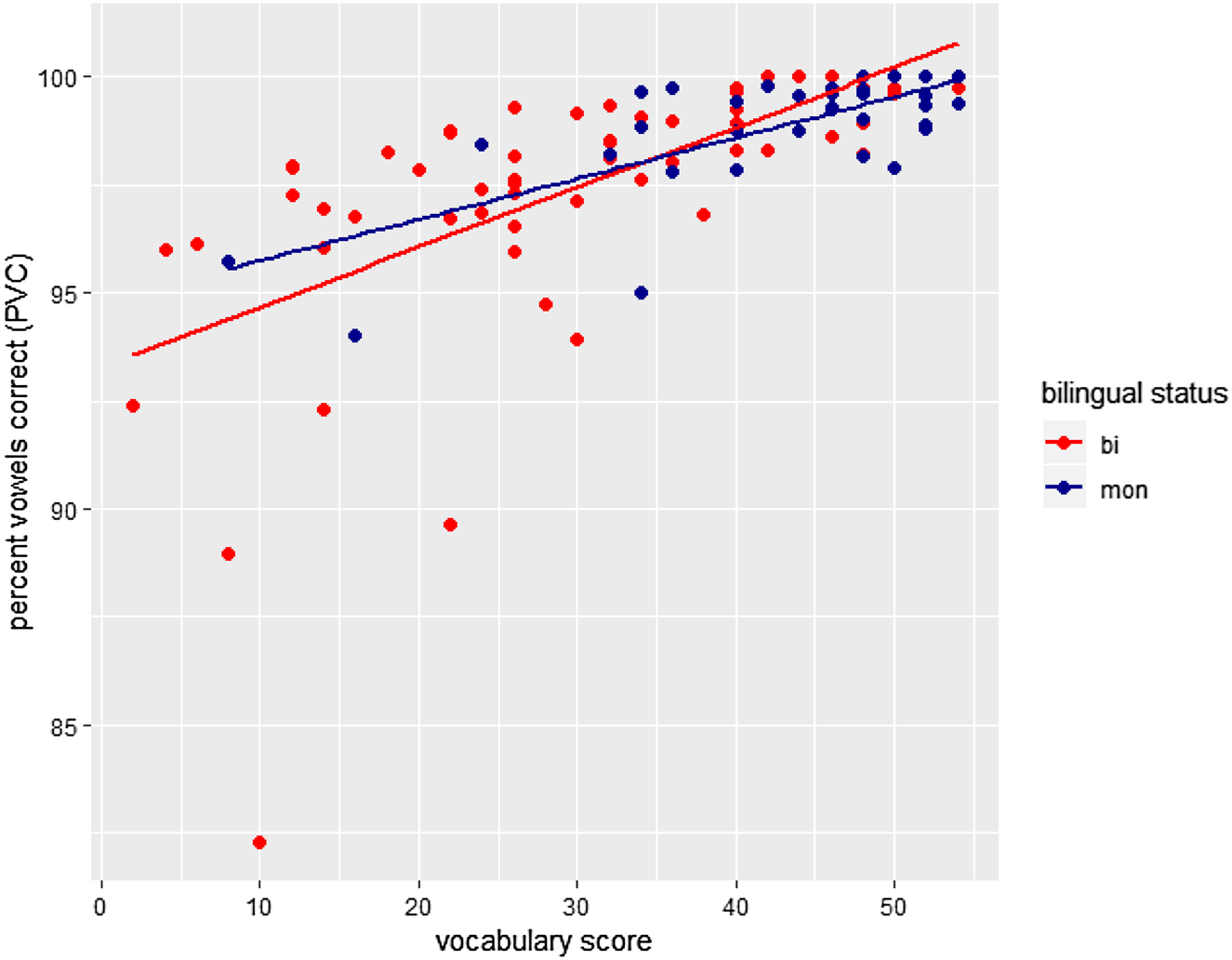
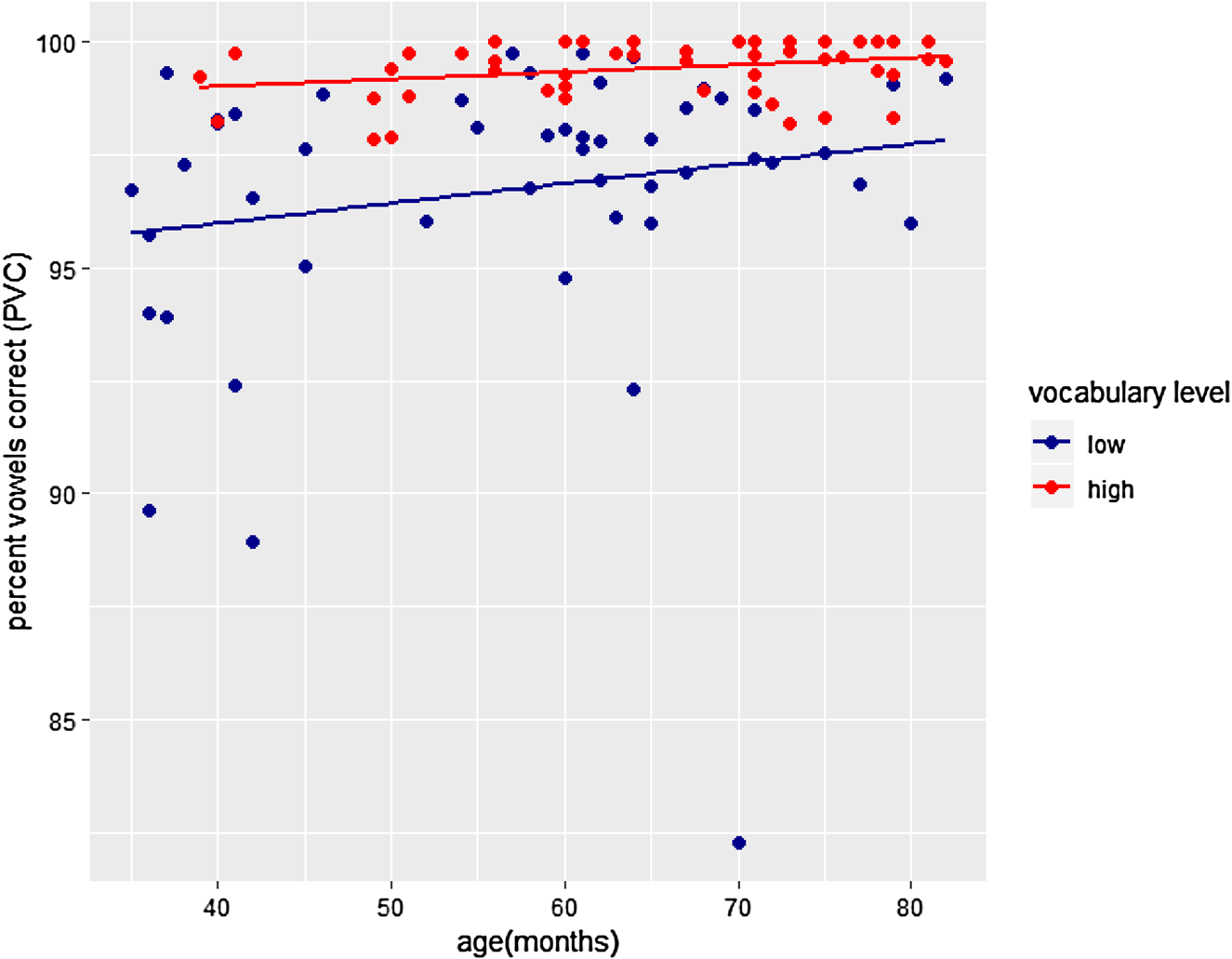
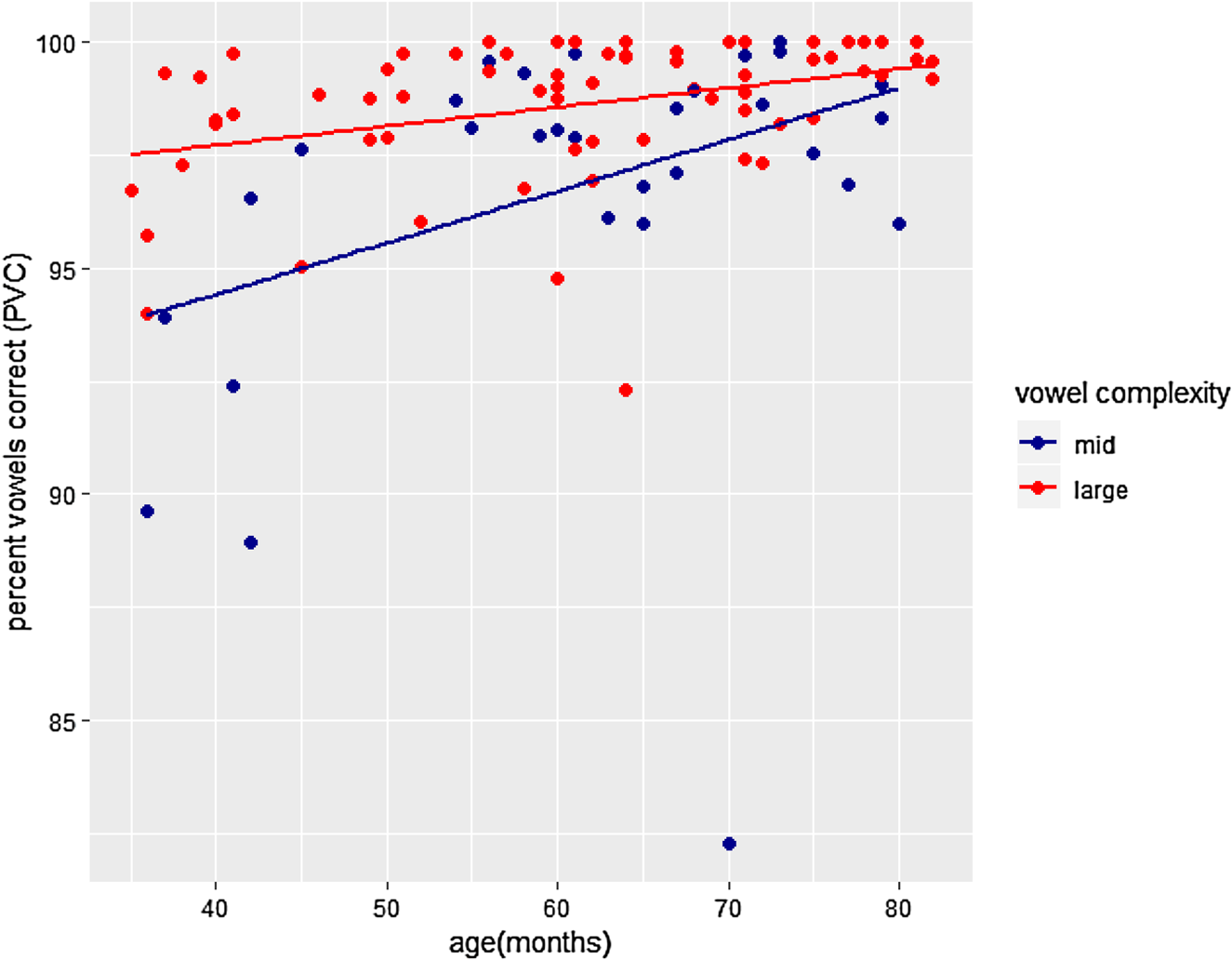
Analyses indicated that one main effect was significant: vocabulary (β = .824, z = 7.38, p < .001). Children who had high vocabulary scores obtained superior PVC scores to children who had low vocabulary scores. A scatterplot of the relation between PVC and vocabulary is shown in Figure 2. Monolingual and bilingual children are shown separately. There was also a significant interaction between vocabulary and age (β = .186, z = 2.09, p = .04). To display this interaction effect, vocabulary level was divided into low (range = 2–38) and high (range = 40–54) scores. As Figure 3 indicates, vocabulary had a stronger influence on PVC in the younger compared to the older children. Finally, there was a marginally significant main effect of vowel complexity (β = .318, z = –1.67, p = .096) and a marginally significant interaction between vowel complexity and age (β = .323, z = –1.75, p = .08). Since this was the only analysis in the entire database in which language-internal effects had some influence, albeit minor, we take the liberty of displaying this effect. Figure 4 indicates that children who spoke languages with mid-sized vowel inventories displayed a tendency to have lower PVC scores than children who spoke languages with large-sized vowel inventories. The influence of vowel complexity on PVC scores was stronger in the younger compared to the older children.Footnote 3
A scatterplot of the relation between percent vowels correct (PVC) and raw vocabulary score. Bilinguals are coded differently from monolinguals.

A scatterplot of the relation between percent vowels correct (PVC) and age (months) for children having high and low vocabulary levels. There was a significant interaction between vocabulary and age for PVC.

A scatterplot of the relation between percent vowels correct (PVC) and age (months) for children speaking languages with mid- and large-sized vowel inventories. There was a marginally significant main effect of vowel complexity and a marginally significant interaction between vowel complexity and age for PVC.

Word-final consonants
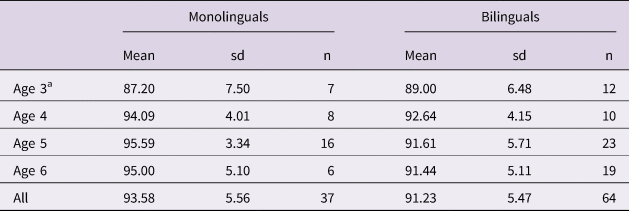
Table 4 presents the means and standard deviations of word-final consonant accuracy for the monolingual and bilingual children. Monolinguals produced 87–95% of word-final consonants correctly and bilinguals produced 89–91% of final consonants correctly. At the older ages, monolinguals obtained slightly higher percent scores than bilinguals.
Means and standard deviations of percent final consonants correct according to bilingual status and age

Notes. a: the age-groups were as follows: 3 (2;11–3;11), 4 (4;0–4;11), 5 (5;0–5;11), and 6 (6;0–6;10).
To determine what factors influenced children's word-final consonant accuracy, we ran mixed effects logistic regression models entering the control variable age, the predictor variables, and their interactions. There were 6721 individual items spoken by the monolingual and bilingual children. The dependent variable was whether the word-final consonant was produced accurately or not.
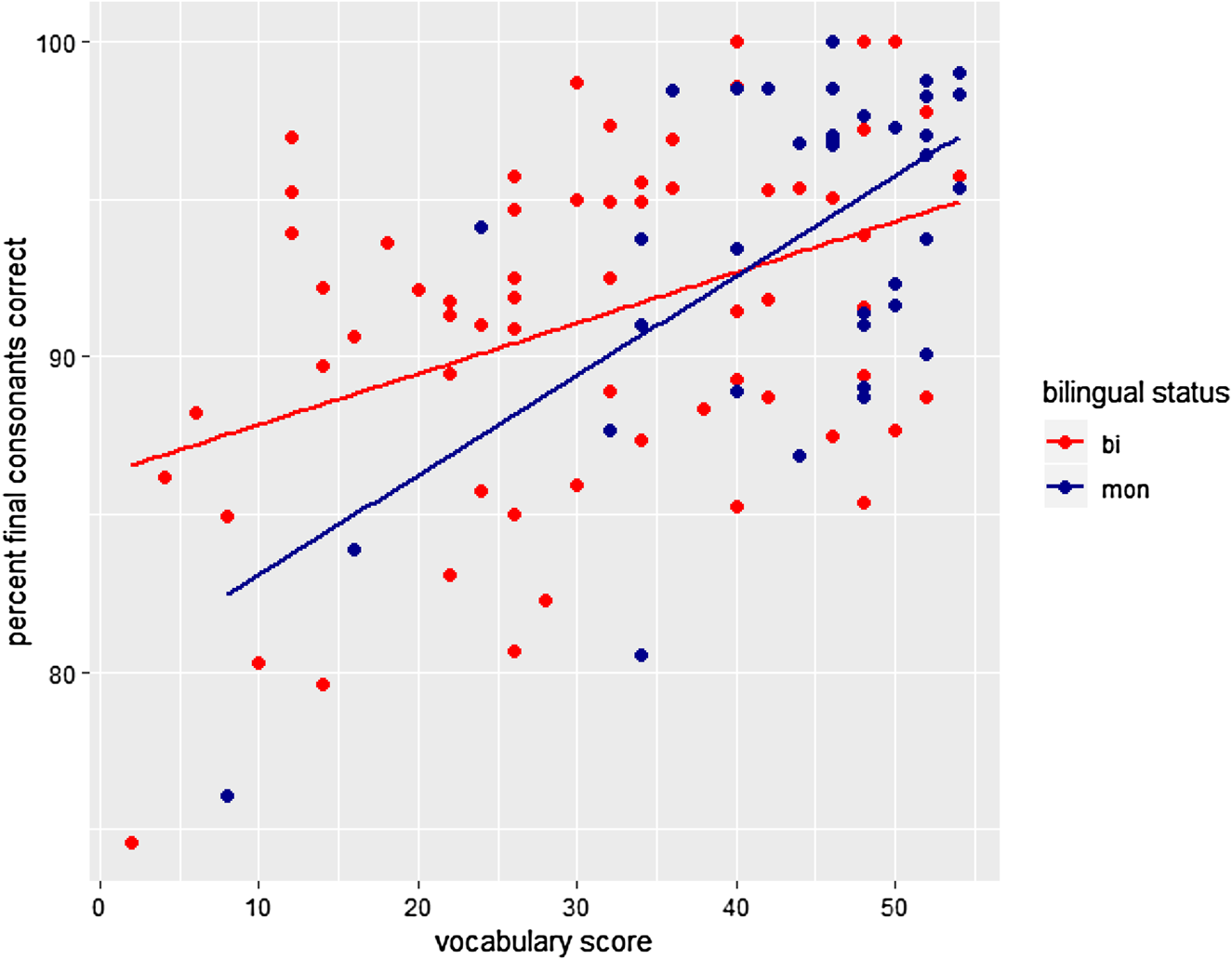
Results indicated that one single main effect was significant: vocabulary (β = .326, z = –2.72, p = .006). Children who had high vocabulary scores had superior word-final consonant production to children who had low vocabulary scores. The relation between vocabulary and percent final consonant production is shown in Figure 5. In addition, the interaction between dominance and age was significant (non dom-dom*age:β = .529, z = –2.40, p = .02; non dom-mon*age: β = .712, z = –2.72, p = .006). The findings were similar to those seen with PCC. Bilingual children who were not dominant in French obtained better final consonant production scores at the younger age ranges than monolingual children and bilingual children who were dominant in French. At the older age groups, the results were as expected: bilingual children who were not dominant in French obtained lower final consonant production scores than monolingual children and bilingual children who were dominant in French.
A scatterplot of the relation between percent final consonants correct and raw vocabulary score. Bilinguals are coded differently from monolinguals.

Onset and coda clusters
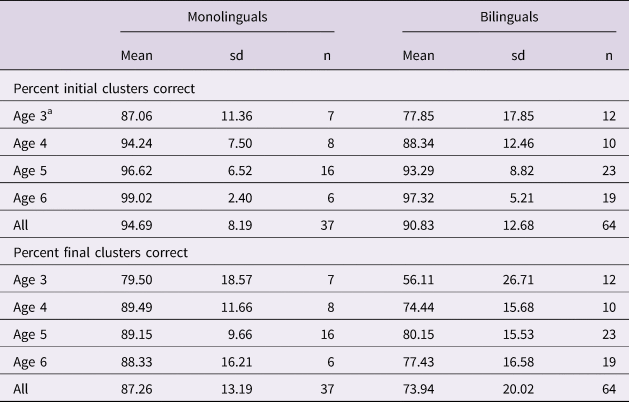
Table 5 presents the means and standard deviations of initial and final cluster accuracy for the monolingual and bilingual children. Monolingual children produced 87 to 99% initial clusters correctly and 80 to 88% final clusters correctly. Bilingual children produced 78 to 97% initial clusters correctly and 56 to 77% final clusters correctly. Monolinguals obtained higher percent correct scores than bilinguals.
Means and standard deviations of scores of percent initial and final clusters correct according to bilingual status and age

Notes. a: the age-groups were as follows: 3 (2;11–3;11), 4 (4;0–4;11), 5 (5;0–5;11), and 6 (6;0–6;10).
To determine what factors influenced children's initial and final cluster accuracy, we ran mixed logistic regression models entering the control variable age, the predictor variables, and their interactions. In the analysis of initial clusters, there were 1840 individual items spoken by the monolingual and bilingual children; in the analysis of final clusters, there were 1450 individual items spoken by the monolingual and bilingual children. The dependent variable was whether the cluster was produced accurately or not.
Analyses indicated similar results for both initial and final clusters. Only one factor was significant, vocabulary (initial: β = .755, z = 3.46, p < .001; final: β = .596, z = 3.73, p < .001). Children who performed well on a French vocabulary test had superior production of initial and final clusters. The relationship between vocabulary and percent production of initial and final clusters is shown in Figures 6 and 7. Monolinguals and bilinguals are coded separately. Figure 7 suggests that, for a given vocabulary level, monolinguals obtained superior final cluster accuracy scores to bilinguals. However, bilingual status did not emerge as significant in the statistical models when controlling for other main effects such as cluster complexity.
A scatterplot of the relation between percent initial clusters correct and raw vocabulary score. Bilinguals are coded differently from monolinguals.

A scatterplot of the relation between percent final clusters correct and raw vocabulary score. Bilinguals are coded differently from monolinguals.

Palatals
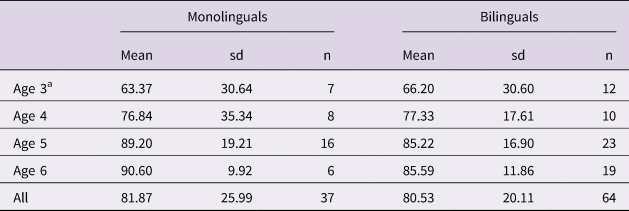
Table 6 presents the means and standard deviations of palatal fricative accuracy for the monolingual and bilingual children according to age-group. Monolingual children produced 63 to 91% of palatal fricatives correctly across the age range three to six years; bilingual children produced 66 to 86% correctly. The standard deviations of the groups were very large and there appeared to be minimal differences between the monolingual and bilingual children.
Means and standard deviations of percent palatal fricatives correct for monolingual and bilingual children according to bilingual status and age

Notes. a: the age-groups were as follows: 3 (2;11–3;11), 4 (4;0–4;11), 5 (5;0–5;11), and 6 (6;0–6;10).
To determine what factors influenced children's palatal fricative accuracy, we ran mixed effects logistic regression models. There were 2398 individual items spoken by the monolingual and bilingual children. The dependent variable was whether the palatal fricative was produced accurately or not.
Initial analyses indicated that no factor was significant. We subsequently simplified the model by eliminating all interaction effects. A final model which included all predictor variables (complexity, dominance, vocabulary) and the control variable age indicated that only age significantly improved model fit to data (β = .528, z = –2.26, p = .02). Older children produced palatal fricatives better than younger children. The relation between palatal fricatives and age is shown in Figure 8. Monolingual and bilingual children are coded separately.
A scatterplot of the relation between percent palatal fricatives correct (PCC) and age (in months). Bilinguals are coded differently from monolinguals.

Discussion
In this study we examined language-internal, language-external, and lexical influences on phonological production in monolingual and bilingual French-speaking children, aged three to six years. We extended the findings of Kehoe and Havy (Reference Kehoe and Havy2019), who examined the effects of a similar set of variables on the phonological production skills of monolingual and bilingual children aged 2;6. In contrast to Kehoe and Havy, who found that all factors influenced phonological production to some extent, we found that a single variable, vocabulary, best explained phonological performance across age. The influence of language-internal effects was minimal and only marginally present for vowel accuracy scores. Monolingual–bilingual differences and effects of dominance did not emerge as significant in the statistical models once vocabulary was taken into account. In the following sections of the discussion, we consider the findings in more detail and discuss the role of lexical factors in explaining phonological performance.
Language-internal effects
We predicted that complexity of the target structure in the L1 would influence acquisition of that same target structure in the L2. Our predictions were marginally borne out in the analysis of vowels only. Here, we observed that bilingual children who spoke languages with mid-sized vowel inventories displayed a tendency to have lower PVC scores than children who spoke languages with large vowel inventories (see Figure 4). Thus, it seems that speaking a language with a large number of vowels is beneficial for acquiring a language with an equally high number of vowels. Otherwise, the impact of L1 phonology on L2 phonological production was small. These findings contrast with those of other studies which have found complexity effects on word-final codas and onset clusters (Keffala et al., Reference Keffala, Barlow and Rose2018; Kehoe & Havy, Reference Kehoe and Havy2019; Sorenson-Duncan & Paradis, Reference Sorenson Duncan and Paradis2016; Tamburelli et al., Reference Tamburelli, Sanoudaki, Jones and Sowinska2015). We therefore ask why we documented cross-linguistic interaction to such a small degree in the current study.
We should point out that phonological accsuracy was high for most of the measures in the current study, whereas the phonological accuracy reported in other studies has been less. In our study, the younger set of monolingual and bilingual children (aged three to four years) produced word-final consonants with 87 to 94% accuracy (see Table 4), whereas the monolingual and bilingual Spanish–English children in Keffala et al.'s (Reference Keffala, Barlow and Rose2018) study, who ranged in age from 2;01 to 4;10, produced word-final consonants with accuracy scores from 55 to 80%. These scores are more similar to the ones obtained by the children aged 2;6 in Kehoe and Havy's (Reference Kehoe and Havy2019) study (in the vicinity of 76 to 82%) than the ones obtained in this study. Based on these trends, we hypothesize that L1 influence on the L2 is stronger in the developing system when accuracy levels are low, and weaker when accuracy levels are high. Increased complexity in the L1 may facilitate acquisition of the L2 phonetic and syllabic inventory at the early stages while the articulatory system is still developing. This may arise because the phonologies of both languages share a common speech-motor base as well as having many segments and structures in common. Scarpino (Reference Scarpino2011) found that phonological proficiency in one language was highly predictive of phonological proficiency in the other language in English–Spanish bilingual children. At later stages of development, complexity effects may play less of a role once children have acquired most of their phonetic and syllabic inventory. Other factors (e.g., language-specific vocabulary) may play a stronger role in the refinement of the phonological system. We cannot exclude, however, that the reduced L1 influence was also due to ceiling effects which prevented L1 influence to manifest.
We should also acknowledge that the methodology of the study might have compromised the chances of finding language-internal effects. Cross-linguistic interaction may have been obscured by grouping different languages together and by focusing on specific aspects of complexity. Stronger language-internal effects may have been evident if we had studied a more homogeneous population of bilinguals and had focused on alternative aspects of complexity. Furthermore, our understanding of cross-linguistic interaction in early bilingualism is strongly hindered by the lack of an appropriate research model to explain interaction (Hambly et al., Reference Hambly, Wren, McLeod and Roulstone2013; Kehoe, Reference Kehoe, Babatsouli and Ingram2015). It is possible that our notions of acceleration and delay are too simplistic to explain the subtle processes which underlie cross-linguistic interaction. Both the methodological limitations and absence of an elaborate research model should be taken into account when considering the scarce findings on cross-linguistic interaction in this study.
Language-external effects
Language-external effects were tested by the single measure of dominance. Parents indicated whether their bilingual children used their L1 more than, less than, or to a similar degree as French. Such a rating scale has been employed in a variety of studies with bilingual children (Goldstein et al., Reference Goldstein, Fabiano and Washington2005, Reference Goldstein, Bunta, Lange, Rodriguez and Burrows2010; Morrow et al., Reference Morrow, Goldstein, Gilhool and Paradis2014; Scarpino, Reference Scarpino2011) and has been found to be a reliable measure of language dominance. Dominance was not found to be a unique predictor of phonological accuracy once vocabulary was included in our statistical models. Our analyses indicated that children who used French the most (i.e., who were dominant in French) had superior vocabulary scores in French compared to children who used French less (i.e., who were not dominant in French). Both groups had lower vocabulary scores than monolingual French children. This finding is consistent with studies which report a relationship between language experience and L2 oral language skills (Pearson, Fernandez, Lewedeg, & Oller, Reference Pearson, Fernandez, Lewedeg and Oller1997; Thordardottir, Reference Thordardottir2011, Reference Thordardottir2015).
In two of our analyses (PCC, word-final consonants), there was a significant interaction between age and dominance. At younger ages, children who were non-dominant in French obtained superior PCCs and final consonant percent scores than children who were dominant in French, whereas at the older ages the results were as expected: children who were non-dominant in French obtained poorer PCCs and final consonant percent scores than children who were dominant in French. We believe this effect comes about from the reduced sampling of bilingual children who were non-dominant in French at the younger ages. As mentioned in the ‘Method’ section, there was an imbalance in the number of children who were non-dominant in French across the age range.
A more exact measure which calculates the percentage of time bilinguals hear or use each of their languages might have led to stronger effects for language experience. Indeed, Kehoe and Havy (Reference Kehoe and Havy2019) employed percent language exposure as a variable and observed separate effects for language exposure and vocabulary, as did Sorenson Duncan and Paradis (Reference Sorenson Duncan and Paradis2016) when examining factors which influence NWR. However, other authors using more exact measures (e.g., percent combined English input/output; age of onset) have not found strong effects of language experience on phonological performance in children aged five to six years (Cooperson et al., Reference Cooperson, Bedore and Peña2013; Meziane & MacLeod, Reference Meziane and MacLeod2017). Goldstein et al. (Reference Goldstein, Bunta, Lange, Rodriguez and Burrows2010) did not find that frequency of language output was a significant predictor of phonological segmental accuracy in children aged 5;9, whereas a five-point scale of language use was. They queried whether parents were able to reliably estimate percentages of language output given the variety of daily activities and communicative partners children have in the early school-age years. Thus, even if we had procured more in-depth information on percentages of language input and output, we may not have obtained different findings on language experience in this age-group of children.
Lexical factors
This study revealed moderate to moderately high correlations between French vocabulary scores and phonological accuracy. Vocabulary was the principal predictor of phonological accuracy in most of the phonological measures. This finding is intriguing given the results of Kehoe and Havy (Reference Kehoe and Havy2019), which indicated that total vocabulary was a better predictor of phonological production in children aged 2;6 than French vocabulary. We did not test the L1 vocabularies of children in this study, but we can assume, based on previous studies, that the bilingual children had similar sized or larger total vocabularies than the monolingual children (Hoff et al., Reference Hoff, Core, Place, Rumiche, Señor and Parra2012; Junker & Stockman, Reference Junker and Stockman2002; Pearson, Fernandez, & Oller, Reference Pearson, Fernandez and Oller1993). If the relationship between phonology and the lexicon had remained similar to what Kehoe and Havy (Reference Kehoe and Havy2019) had observed, we should have documented similar or superior phonological scores in bilinguals as compared to monolinguals. That this was not the case suggests that total vocabulary does not have the same importance at later ages as it does at earlier ages; rather language-specific vocabulary appears to play the major role. At age 2;6, children are still in the process of acquiring many sounds and syllable structures, whereas by ages three to six, children's phonetic and syllabic inventories are largely complete. Knowing many words across both languages may be important at the initial stages for building up the phonological system and acquiring shared phonological structures; knowing many words in the target language may be important for refining the phonology and acquiring language-specific structures. For example, acquisition of the unique phonological features of French, such as nasal and front rounded vowels, and initial and final clusters may depend upon familiarity with French vocabulary.
Our results support those of Montanari et al. (Reference Montanari, Mayr and Subrahmanyam2018), which query whether oral language proficiency may account for many of the so-called monolingual–bilingual differences in speech sound production documented in previous studies. Although we did not look at broader aspects of oral proficiency such as MLU, our findings based on vocabulary indicate that there was no major effect of bilingualism per se on phonological production. Similarly, Sorenson Duncan and Paradis (Reference Sorenson Duncan and Paradis2016) found a significant effect of English vocabulary size on English language learners’ NWR scores. They suggest that smaller vocabulary scores could be one of the main reasons why some studies find that bilingual children obtain lower NWR scores. Goldstein and Bunta (Reference Goldstein and Bunta2012) also found that, when monolingual and bilingual children were matched on language use and proficiency, their phonological production skills were commensurate.
Vocabulary did not influence phonological outcomes for one measure: palatal fricatives. We hypothesized that children speaking languages like Russian, Polish, or Romanian, which have a wide array of palatal fricatives in their phonetic inventories, should be at an advantage for producing these fricatives in French. Similar to Kehoe and Havy (Reference Kehoe and Havy2019) for children aged 2;6, we did not find any variable which predicted children's productions of palatal fricatives. In a simple model (removing interaction effects), age was the only factor found to be significant. Older children produced palatal fricatives more accurately than younger children (see Figure 8). Alveo-palatal fricatives are known to pose difficulty for French-speaking children (Aicart-De Falco & Vion, Reference Aicart-De Falco and Vion1987). They are also listed among the late sounds for English (Shriberg, Reference Shriberg1993). We conclude that factors related to articulatory and speech motor control may play a stronger role in accounting for their production than the factors tested in this study. Palatal fricatives require motor differentiation of the tongue tip versus blade and the ability to retract the tongue towards the front of the palate rather than the alveolar ridge. These skills may still not be well developed in children aged three to six years. It is telling that palatal fricatives were the only phonological feature immune to vocabulary influence, suggesting that knowing many words in French does not help in the production of these sounds. This supports the notion that articulatory rather than phonological factors may be important in the development of these structures.
Bilingual status
Kehoe and Havy (Reference Kehoe and Havy2019) found a facilitative effect of bilingualism on phonological performance at age 2;6, whereas the current results found no separate influence of bilingualism. Hambly et al.'s (Reference Hambly, Wren, McLeod and Roulstone2013) review paper on the influence of bilingualism on speech production underscores the variability of findings on phonological production in bilinguals: some studies show bilinguals to have superior results compared to monolinguals (Goldstein & Bunta, Reference Goldstein and Bunta2012; Grech & Dodd, Reference Grech and Dodd2008); others show them to have inferior results (Gildersleeve-Neumann et al., Reference Gildersleeve-Neumann, Kester, Davis and Peña2008; Law & So, Reference Law and So2006). Some of this variability may have arisen because researchers have not taken oral proficiency such as vocabulary scores into account. As discussed above, the findings of several researchers support the fact that oral language proficiency may underlie so-called monolingual–bilingual differences in phonology (Goldstein & Bunta, Reference Goldstein and Bunta2012; Montanari et al., Reference Montanari, Mayr and Subrahmanyam2018).
Differences across age-group
Our study did not reveal major differences in the influence of predictor factors across age-range. There were some minor interactions between age and dominance (for PCC and word-final consonants), between age and vocabulary (for PVC), and a marginal effect between age and vowel complexity (for PVC). However, the main finding was that vocabulary was a strong predictor of phonological accuracy across all ages. This ties in with diverse observations in the literature indicating that monolingual–bilingual differences in phonology are equally present in younger and older age-groups (Gildersleeve-Neumann et al., Reference Gildersleeve-Neumann, Kester, Davis and Peña2008: Gildersleeve-Neumann & Wright, Reference Gildersleeve-Neumann and Wright2010), and that MLU (which may exert a similar influence as expressive vocabulary) is correlated with phonology to an equal degree in younger and older groups (Montanari et al., Reference Montanari, Mayr and Subrahmanyam2018). We do not know until what age vocabulary influences phonology; however, as Figure 3 shows, our data attest to vocabulary effects on some phonological measures (e.g., PVCs) through to six years.
Limitations of the study
The study has several limitations, the main one being that the data are cross-sectional and not longitudinal; longitudinal data would be needed to confirm the trends observed across different ages. The bilingual children in Kehoe and Havy's (Reference Kehoe and Havy2019) study and in the present one were similar in many respects, all having acquired French in Geneva before the age of three years. However, there were differences in the groups as well. The children in Kehoe and Havy's study were tested in the university laboratory; the younger children in the present study were tested in crèches and the older children were tested at public schools. It cannot be excluded that there were subtle differences between the groups of children at the different test sites which influenced their phonological outcomes. A longitudinal study which follows monolingual and bilingual children from 2;6 through to 6;11 would allow a clearer understanding of what factors influence phonological performance over time.Footnote 4
Another methodological limitation was that we did not have an individual measure of SES for each child. Such a measure would be needed to determine if the strong vocabulary effects present in this study were influenced by SES. As mentioned above, use of a continuous rather than a discrete variable to tap language exposure or dominance may have led to stronger effects for language dominance than the ones measured in this study. Finally, we acknowledge that lack of statistical findings for some of our predictor variables may have come about by small group sizes. This was a particular handicap for the analyses of language-internal effects whereby the numbers of children in certain complexity groups were very small. A study which carefully controls L1 language typology and complexity group sizes may yield stronger effects for L1 influence on L2.
Conclusion
This study investigated the influence of language-internal, language-external, and lexical factors, as well as bilingual status, on phonological production in monolingual and bilingual French-speaking children, aged three to six years. Results indicated that bilingual status and dominance did not have direct effects on phonological production, once vocabulary was taken into account. Language-internal effects exerted a marginal influence on vowel accuracy only. Overall, vocabulary was the factor which most strongly accounted for the phonological outcome measures in the bilingual children, confirming previous findings in the monolingual literature that lexical and phonological systems are related (Petinou & Okalidou, Reference Petinou and Okalidou2006; Rescorla & Ratner, Reference Rescorla and Ratner1996; Smith et al., Reference Smith, McGregor and Demille2006; Stoel-Gammon, Reference Stoel-Gammon2011). Further studies of a longitudinal nature are needed to understand the nature of the lexical–phonological relation in bilingual children, particularly focusing on whether there are between-language influences and whether these influences change over time.
Supplementary materials
For Supplementary materials for this paper, please visit <https://doi.org/10.1017/S0305000919000874>.
Acknowledgments
We would like to thank Kopika Kannathasan, Audrey Burkhardt, Constance Terrail, and Tanya Bella Bancaleiro for their help in testing the children, and Anne-Laure Bouchut for her help in testing the children and in transcribing the data. In addition, we would like to thank the personnel and teachers at “EVE Espèces de vie enfantine du secteur université” and in the Genevan public school system for their collaboration in the recruitment of children.
Appendix A
Description of the monolingual participants including information on gender, age, and vocabulary.

Appendix B
Description of the bilingual participants including information on gender, age, languages spoken, dominance grouping, and vocabulary.

Appendix C
List of stimulus items.