Introduction
Cognitive difficulties are often experienced in individuals with schizophrenia and executive dysfunction is a robust and central deficit (Fioravanti, Carlone, Vitale, Cinti, & Clare, Reference Fioravanti, Carlone, Vitale, Cinti and Clare2005; Martin, Mowry, Reutens, & Robinson, Reference Martin, Mowry, Reutens and Robinson2015). Executive dysfunction is associated with a negative symptom profile, although relationships differ depending on the specific executive process measured (Clark, Warman, & Lysaker, Reference Clark, Warman and Lysaker2010; Simon, Giacomini, Ferrero, & Mohr, Reference Simon, Giacomini, Ferrero and Mohr2003). By contrast, associations with positive symptoms are less robust and possibly more complex (Guillem, Rinaldi, Pampoulova, & Stip, Reference Guillem, Rinaldi, Pampoulova and Stip2008). As the relationship between symptoms and executive processes is dependent on the measure, tasks with separable executive components are vital in understanding the nature of executive dysfunction in schizophrenia and the relationship with symptom profiles. Understanding this relationship will aid both our understanding of the heterogeneity of schizophrenia and our ability to clinically manage individuals based on their specific needs.
The Hayling Sentence Completion Test (HSCT) was developed to measure verbal initiation and inhibition within the same task, but it also measures strategy use (Burgess & Shallice, Reference Burgess and Shallice1996). In Section 1, the initiation condition, subjects must provide a word that completes a sentence meaningfully (e.g., London is a very busy . . . CITY). In the suppression Section 2, subjects must provide a completion word that is unconnected to the sentence (e.g., . . . FORWARD), which also necessitates suppression of the natural completion. A strategy score can be calculated for correct unconnected responses, which has not previously been investigated in schizophrenia. For example, the original HSCT study found that healthy subjects typically name visible items or produce a response compatible with the previous sentence (Burgess & Shallice, Reference Burgess and Shallice1996). Therefore, within one task there are three executive measures: initiation, suppression, and strategy.
The original HSCT study that compared performance between patients with frontal and posterior lesions, implicated the frontal lobes in all three aspects, with a response suppression deficit associated with diminished strategic-based responding (Burgess & Shallice, Reference Burgess and Shallice1996). In several subsequent lesion studies with focal frontal patients, verbal suppression has been associated with the right ventrolateral region (Robinson et al., Reference Robinson, Cipolotti, Walker, Biggs, Bozzali and Shallice2015) and the orbitoventral cortex (Volle et al., Reference Volle, de Lacy Costello, Coates, McGuire, Towgood, Gilbert and Burgess2012), although recent evidence suggests a critical right lateral rather than orbitofrontal role in response suppression (Cipolotti et al., Reference Cipolotti, Healy, Spano, Lecce, Biondo, Robinson and Bozzali2016). Right lateral frontal involvement is consistent with response inhibition on stop signal and go–no go tasks (for review, see Aron, Robbins, & Poldrack, Reference Aron, Robbins and Poldrack2014). Response initiation has been associated with the medial rostral (Volle et al., Reference Volle, de Lacy Costello, Coates, McGuire, Towgood, Gilbert and Burgess2012) and the left lateral (Robinson et al., Reference Robinson, Cipolotti, Walker, Biggs, Bozzali and Shallice2015) frontal cortex. Neuroimaging studies have also identified regions specific to the HSCT initiation and suppression components. Using positron emission tomography, Collette and colleagues (Reference Collette, Van der Linden, Delfiore, Degueldre, Luxen and Salmon2001) identified initiation associated activation in a small region of the left inferior frontal gyrus and response suppression associated activation in a large cluster containing left inferior/middle frontal gyrus and left orbitofrontal cortex (the latter also shown by Nathaniel-James, Fletcher, & Frith, Reference Nathaniel-James, Fletcher and Frith1997).
Studies using the HSCT have also revealed differences in individuals with schizophrenia, consistent with the frontal dysfunction characteristic of the disorder (Mathalon & Ford, Reference Mathalon and Ford2008). Deficits in both initiation and suppression have been identified (Joshua, Gogos, & Rossell, Reference Joshua, Gogos and Rossell2009), suggesting widespread dysfunction across frontopolar regions. This is corroborated in functional magnetic resonance imaging (fMRI) studies that identify activation differences in individuals with schizophrenia when performing the HSCT. In a review of 13 sentence-level language comprehension fMRI studies, including five with the HSCT, with a total of 226 individuals with schizophrenia and 211 healthy controls, a pattern of left frontotemporal language network dysfunction was revealed in the clinical group. This suggests dysfunctional language pathways may underpin several hallmark symptoms such as auditory verbal hallucinations and formal thought disorder (FTD) (Rapp & Steinhauser, Reference Rapp and Steinhauser2013). Specific studies using the HSCT have returned mixed results. One study identified hypoactivation in the left dorsolateral prefrontal cortex in individuals with schizophrenia during the initiation component (McIntosh et al., Reference McIntosh, Whalley, McKirdy, Hall, Sussmann, Shankar and Lawrie2008), whereas another smaller study identified hyperactivation of the right posterior parietal cortex attributable to the suppression component of the HSCT (Royer et al., Reference Royer, Schneider, Grosselin, Pellet, Barral, Laurent and Lang2009). However, a thorough examination of the HSCT performance in schizophrenia is yet to be undertaken using fMRI.
There are several aspects of the HSCT that have not been investigated in schizophrenia. One is strategy generation/use in the suppression section and another aspect is the analysis of the type of errors produced in both the initiation and suppression sections. Two studies have revealed that an inability to generate/use a strategy at least partly explained the suppression errors in frontal lesion patients (Burgess & Shallice, Reference Burgess and Shallice1996; Robinson et al., Reference Robinson, Cipolotti, Walker, Biggs, Bozzali and Shallice2015) and could potentially explain the suppression deficit in schizophrenia. In regards to types of errors, in the initiation section, although each sentence has a high probability for the dominant response, subjects may produce uncommon (e.g., He crept into the room without a ….peep), bizarre (e.g., He crept into the room without a ….knife), or incorrect responses (e.g., He crept into the room without a ….elevator).
Individuals with schizophrenia may produce more initiation errors or low probability responses possibly reflecting left fronto-temporal network dysfunction (Nathaniel-James et al., Reference Nathaniel-James, Fletcher and Frith1997). Suppression errors may be sensible connected responses (e.g., The dough was put in the hot ….oven) (category A errors) or semantically connected responses (category B errors). For category B errors, responses may be semantically related to the correct response (e.g., The dough was put in the hot ….sink) or sentence frame (e.g., The dough was put in the hot ….bread), or complete the sentence in a bizarre manner (e.g., The whole town came to hear the mayor ….cry). Recently, patients with right lateral prefrontal lesions produced more category B errors that were ‘subtly’ connected compared to healthy controls, suggesting strategy attainment and implementation is reliant on right lateral prefrontal regions (Robinson et al., Reference Robinson, Cipolotti, Walker, Biggs, Bozzali and Shallice2015). Individuals with schizophrenia have been documented to make a greater number of category A and B errors (Joshua et al., Reference Joshua, Gogos and Rossell2009) but a more refined analysis of the errors has not been conducted.
Due to the significant heterogeneity of symptom profiles in individuals with schizophrenia, it is important to investigate any correlations between aspects of cognition and specific symptoms. One clinical characteristic of schizophrenia is FTD, which reflects disorganized thinking and is often indexed by disorganized speech. There is strong evidence for an association between FTD and executive dysfunction, specifically impaired planning and response inhibition (Kerns & Berenbaum, Reference Kerns and Berenbaum2002). A meta-analysis comparing the association between cognition, FTD, and reality distortion (hallucinations and delusions) identified a stronger relationship for FTD symptoms across all cognitive domains included (speed of processing, reasoning and problem solving, working memory, visual memory, verbal memory, and attention) (Ventura, Thames, Wood, Guzik, & Hellemann, Reference Ventura, Thames, Wood, Guzik and Hellemann2010).
FTD is also associated with language deficits with involvement of the left and right inferior frontal cortex (Arcuri et al., Reference Arcuri, Broome, Giampietro, Amaro, Kircher, Williams and McGuire2012; Borofsky et al., Reference Borofsky, McNealy, Siddarth, Wu, Dapretto and Caplan2010; Kircher et al., Reference Kircher, Liddle, Brammer, Williams, Murray and McGuire2001; Rapp & Steinhauser, Reference Rapp and Steinhauser2013; Weinstein, Werker, Vouloumanos, Woodward, & Ngan, Reference Weinstein, Werker, Vouloumanos, Woodward and Ngan2006). Communication deficits in individuals with schizophrenia, especially those with FTD, reflects higher order dysfunction at the discourse or sentence level rather than single word level (Hoffman, Stopek, & Andreasen, Reference Hoffman, Stopek and Andreasen1986), suggesting contextual aspects of language impairment are important for understanding communication difficulties in schizophrenia.
Overall, the current study aims to investigate performance on the HSCT by replicating previous standard approaches (Burgess & Shallice, Reference Burgess and Shallice1996; Joshua et al., Reference Joshua, Gogos and Rossell2009; Robinson et al., Reference Robinson, Cipolotti, Walker, Biggs, Bozzali and Shallice2015) as well as introducing novel analyses in individuals with schizophrenia based on initiation errors and strategy use in the suppression section. Moreover, correlations with lifetime measures of clinical symptoms will further our understanding of the specificity of cognitive deficits relevant to subtypes of psychosis. The specific hypotheses are that individuals with schizophrenia will: (A) perform worse than age and sex matched healthy controls on the standard HSCT outcome measures and these differences will remain significant following correction for premorbid IQ, abstract verbal reasoning, naming ability, and fluid intelligence; (B) produce more initiation errors than matched healthy controls; (C) be less likely to generate/implement a strategy in the suppression section of the HSCT; and (D) performance on the HSCT will be associated with FTD, as indexed by lifetime disorganized speech symptoms.
Methods
Participants
Individuals with schizophrenia (N=77) and age and sex matched healthy controls with no history of psychiatric or neurological disorder (N=45) were recruited through the Queensland Centre for Mental Health Research. Diagnosis was carried out in accordance with the DSM-IV (American Psychiatric Association, 2004) by a psychiatrist (B.M.). All patients were chronic and medicated at the time of assessment. Medication was stable over the month before testing. Patients were excluded if history of neurological illness or head injuries, psychosis was considered secondary to substance abuse or neurological illness (e.g., epilepsy), if the patient could not give informed consent, or had severe intellectual impairment (IQ < 60). All data were obtained in compliance within ethical regulations detailed by the University of Queensland and Queensland Health.
Clinical Ascertainment
Individuals were comprehensively ascertained by trained clinicians using: (i) the Diagnostic Interview for Genetic Studies (DIGS) (Nurnberger et al., Reference Nurnberger, Blehar, Kaufmann, York-Cooler, Simpson, Harkavy-Friedman and Reich1994); (ii) Family Interview for Genetic Studies (FIGS) (Gershon et al., Reference Gershon, DeLisi, Hamovit, Nurnberger, Maxwell, Schreiber and Guroff1988; Maxwell, Reference Maxwell1992); (iii) information extracted from all available medical records; and (iv) Narrative summary prepared by the interviewer and based on all information obtained from the DIGS, FIGS, and medical records.
Coding of Clinical Variables
Positive, negative and FTD symptoms were scored using the Lifetime Dimensions of Psychosis Scale (LDPS) (Levinson, Mowry, Escamilla, & Faraone, Reference Levinson, Mowry, Escamilla and Faraone2002). Positive symptom scale comprised the total duration and severity of symptoms such as delusions and hallucinations with a maximum score of 56. Negative symptom scale was comprised of duration and severity of blunted affect and poverty of speech with a maximum score of 16. Formal thought disorder was indexed by duration and severity of disorganized speech with a maximum score of eight.
Baseline Cognitive Tests
Participants completed the following well-known standard clinical tests: the National Adult Reading Test (NART-R, Nelson & Willison, Reference Nelson and Willison1991), to provide an estimate of pre-morbid intellectual functioning; the Matrix Reasoning subtest from the Wechsler Abbreviated Scale of Intelligence (WASI; Wechsler, Reference Weschler1999) test to assess current “fluid” intelligence; naming ability was measured using the SYDBAT Naming test (Savage, Hsieh, Piguet, & Hodges, Reference Savage, Hsieh, Piguet and Hodges2009) and abstract verbal reasoning was measured with the Similarities subtest from the WASI (Wechsler, 1999).
Hayling Sentence Completion Test: Procedure and Response Scoring Criteria
The HSCT comprises 30 sentence frames with the last word omitted, and examines response initiation (Section 1) and suppression (Section 1). The test was administered in accordance with the published manual (Burgess & Shallice, Reference Burgess and Shallice1997) Therefore, in Section 1, participants were required to generate one word that completed the sentence meaningfully (e.g., He posted a letter without a…. stamp; n=15). Section 2 required the participant to instead provide one word that was unrelated to any natural completion, which also requires suppression of the correct response (e.g., … banana; n=15). For Sections 1 and 2, the number of sentences completed and total response time (RT) to produce a word was recorded. As detailed by Burgess and Shallice (Reference Burgess and Shallice1996), the responses to Section 2, were coded as correct (unconnected), incorrect and connected (Category A), or incorrect and somewhat connected (Category B). The raw scores for each section (Sections 1 and 2 RTs, Section 2 Errors), were scaled, and then combined to provide an overall scaled score.
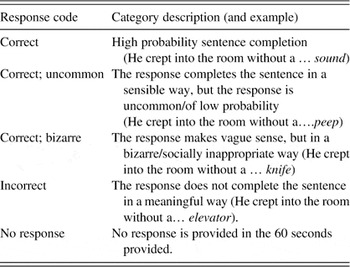
For this study, several additional outcome measures were included. Section 1 initiation responses were coded into one of five categories (see Table 1), with the frequency each participant produced a response in each category recorded. Specifically, correct but low probability responses were scored as one, a bizarre response was scored as two, incorrect or no responses were coded as three, and then these were added together to form the initiation Global Error Score - initiation (see Table 1 for examples).
Description of the Hayling Test initiation section response type classification system

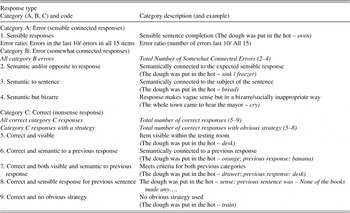
To analyze strategic-based responses, correct responses in the suppression section were coded into one of five categories. Categorization was based on Burgess and Shallice (Reference Burgess and Shallice1996) and adapted as detailed in Robinson et al. (Reference Robinson, Cipolotti, Walker, Biggs, Bozzali and Shallice2015) (see Table 2). For each participant, the frequency of each response category (1–5) was recorded.
Description of the Hayling Test suppression section response type classification system

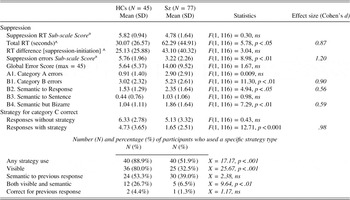
Additional measures included the Global Error Score that was computed using the Burgess and Shallice (Reference Burgess and Shallice1996) formula. That is, Category A errors (3 points each) and Category B errors (1 point each) were combined to index the Global Error Score - suppression (maximum=45). The following measures were also calculated based on Robinson et al. (Reference Robinson, Cipolotti, Walker, Biggs, Bozzali and Shallice2015): RT Difference (Suppression RT - Initiation RT); Category C (correct) responses with a strategy; percentage of total Category A, B, and C responses (see Table 2).
Statistical Analyses
All statistical analyses were performed using the Statistical Package for the Social Sciences (SPSS) for Windows (Version 20.0). For the background demographic and cognitive characteristics of the clinical and non-clinical groups, independent t tests were used to compare the two groups, with the exception of gender distribution, which was compared using a χ2 test. For the main analyses of the HSCT scaled scores and other measures, pre-morbid intelligence (NART IQ), matrix reasoning (WASI), SYDBAT naming score, and similarities (WASI) scores were included as covariates, and a series of univariate analysis of covariance were run. Log transformations were used for the total RT and error score of the initiation section, the RT of the suppression task, and the difference in RT between the initiation and suppression conditions. Partial correlations correcting for pre-morbid IQ, matrix reasoning, naming, and similarities were calculated between the clinical symptom profile scores and global errors on the initiation and suppression sections, respectively, and strategy use in the suppression section.
Results
Descriptive Characteristics and Baseline Cognitive Tests
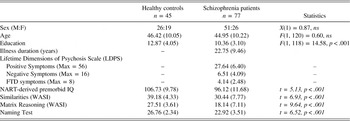
Descriptive characteristics and baseline cognitive test scores for the clinical group (schizophrenia) and non-clinical healthy control sample are depicted in Table 3. The mean positive, negative and FTD symptom severity scores, as measured by the LDPS, are provided in Table 3. The average duration of illness was 22.75 years. Participants were matched on age and gender. Healthy controls, on average, had a higher number of years of formal schooling and performed significantly better on measures of pre-morbid IQ, similarities, naming, and matrix reasoning.
Descriptive characteristics and cognitive baseline scores for healthy controls and participants with schizophrenia

NART=National Adult Reading Test; FTD=formal thought disorder; WASI=Weschler Abbreviated Scale of Intelligence; ns=not significant.
Initiation (Section 1 of HSCT)
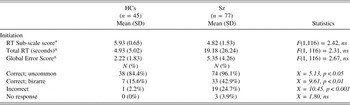
Patients with schizophrenia were slower at the initiation section and produced a greater number of errors. However, after correcting for the baseline measures these composite measures were no longer significantly different between the groups. The clinical group were, however, significantly more likely to produce a correct but uncommon or bizarre response, or incorrect response for at least one sentence (see Table 4).
Performance on the initiation section for individuals with schizophrenia and healthy controls

HC=healthy control; Sz=schizophrenia; RT=response time; ^=analysis based on Log transformation.
a Scaled Score is 1–7.
Suppression (Section 2 of HSCT)
Suppression RTs
The two groups did not significantly differ for the Suppression RT Sub-scale Score, but healthy controls were faster for the total RT score (see Table 5). Regarding the difference in RT between the HSCT initiation and suppression sections (RT Difference), the groups did not significantly differ.
Performance on the suppression section, including strategy use, for individuals with schizophrenia and healthy controls

HC=healthy control; Sz=schizophrenia; ns=not significant; RT=response time; ^=analysis based on Log transformation.
a =Scaled Score is 1–7.
Suppression errors (category A and B)
In regards to the Suppression Error Sub-Scale Score, the clinical group were significantly impaired in comparison to healthy controls (see Table 5). Although the groups did not differ for blatant suppression failures (category A errors), after controlling for baseline cognitive measures, the clinical group produced a significantly higher percentage of subtle category B errors. When each type of B error was investigated separately, although each type was more prevalent in the clinical group, only semantic to response (B2) and bizarre responses (B4) remained significant (see Table 5).
Category C responses and strategy use
The clinical group produced a significantly lower number of correct unconnected responses (category C) than healthy controls (see Table 5). Furthermore, analysis of category C responses revealed that healthy controls used strategies to produce an unconnected response to a greater extent than the clinical group. Individuals with schizophrenia did not differ from healthy controls in the number of correct responses that did not use an obvious strategy (see Table 5). Of the strategies used, healthy controls were more likely to report an object visible in the room or both visible and semantic to the previous response (see Table 5).
Correlation with Schizophrenia Symptoms
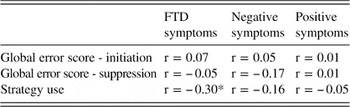
Correlations were performed between lifetime ratings of positive, negative, and FTD symptoms and the HSCT Global Error Score - initiation, Global Error Score - suppression, and responses with strategy (Table 6). Responses with a strategy evident and FTD were negatively correlated, r=−0.30, p=.01. All other correlations were non-significant.
Correlation between clinical symptoms and error and strategy scores after controlling for fluid intelligence, naming, and premorbid IQ

FTD=formal thought disorder.
*p=.01
Discussion
To our knowledge, this is the first study to investigate strategy use and conduct an error analysis of both the initiation and suppression sections of the HSCT in individuals with schizophrenia. In addition to deficits on the standard HSCT measures, individuals with schizophrenia were more likely to produce a low probability response in the initiation section and a semantically connected word in the suppression section. The schizophrenia group were significantly less likely to use a recognizable strategy compared with the healthy controls. The predominant strategy used by the healthy group was to name items visible in their surroundings, similar to the findings reported by Burgess and Shallice (Reference Burgess and Shallice1996). However, in the current study, this strategy was significantly less frequent in the schizophrenia group. The deficits in these measures could not be explained by deficits in fluid intelligence, abstract verbal reasoning ability, naming ability, or as a result of lower premorbid IQ, as the differences remained significant after controlling for these four cognitive measures. Although the clinical group produced a considerably higher number of blatant suppression errors, where the word completed the sentence sensibly, this difference did not remain significant after taking into account performance on baseline cognitive measures (i.e., premorbid IQ, fluid intelligence, abstract verbal reasoning, naming), in contrast to patients with frontal lesions (Robinson et al., Reference Robinson, Cipolotti, Walker, Biggs, Bozzali and Shallice2015). However, the schizophrenia group’s impairment in suppressing subtly incorrect responses (Category B error) remained significant even after controlling for performance on baseline cognitive measures, reflecting a similar pattern to that observed in patients with right lateral frontal lesions (Robinson et al., Reference Robinson, Cipolotti, Walker, Biggs, Bozzali and Shallice2015).
The failure to attain an effective strategy has been argued to be the prime cause of completion and semantically connected errors (Burgess & Shallice, Reference Burgess and Shallice1996). In accordance with the frontal lesion patients in Burgess and Shallice’s (Reference Burgess and Shallice1996) study, individuals with schizophrenia produced a higher number of semantically connected words in the suppression task coupled with fewer strategic-based responses. The factor analysis carried out by Burgess and Shallice (Reference Burgess and Shallice1996) found that both semantically related errors and strategy use loaded onto one principal component and this separated frontal patients from other lesion and control groups. This provides evidence that a deficit in strategy-attainment explains suppression errors and is indicative of frontal dysfunction characteristic of schizophrenia (Mathalon & Ford, Reference Mathalon and Ford2008).
Recently, a lesion study (Robinson et al., Reference Robinson, Cipolotti, Walker, Biggs, Bozzali and Shallice2015) identified a greater number of subtle semantic errors in right lateral frontal patients that was not observed in left lateral frontal patients. The current results suggest that a blatant failure to inhibit the correct response reflects more general cognitive process captured by standard cognitive measures, whereas subtle response errors may reflect specific processes involving right lateral frontal cortex. Strong evidence exists for right prefrontal cortex dysfunction in the pathogenesis of schizophrenia and associated cognitive deficits (Kaladjian et al., Reference Kaladjian, Jeanningros, Azorin, Grimault, Anton and Mazzola-Pomietto2007; Kim et al., Reference Kim, Kwon, Park, Youn, Kang, Kim and Lee2003; Martin, Robinson, Reutens, & Mowry, Reference Martin, Robinson, Reutens and Mowry2014; Salgado-Pineda et al., Reference Salgado-Pineda, Caclin, Baeza, Junque, Bernardo, Blin and Fonlupt2007). The exact nature of these processes is unknown but a failure to adopt a strategy on the HSCT in individuals with schizophrenia is similar to that observed in right lateral frontal patients, further implicating this region in schizophrenia pathology. However, although the right lateral frontal region is implicated in strategy use (Miller & Tippett, Reference Miller and Tippett1996; Robinson et al., Reference Robinson, Cipolotti, Walker, Biggs, Bozzali and Shallice2015; Roca et al., Reference Roca, Parr, Thompson, Woolgar, Torralva, Antoun and Duncan2010) and inhibition (Aron, Fletcher, Bullmore, Sahakian, & Robbins, Reference Aron, Fletcher, Bullmore, Sahakian and Robbins2003; Aron et al., Reference Aron, Robbins and Poldrack2014), another possibility is monitoring of responses (e.g., see Fleck, Daselaar, Dobbins, & Cabeza, Reference Fleck, Daselaar, Dobbins and Cabeza2006; Stuss et al., Reference Stuss, Alexander, Shallice, Picton, Binns, Macdonald and Katz2005).
The current study, to the authors’ knowledge, is the first to address the nature of completions and errors on the initiation section of the HSCT. The patients with schizophrenia produced a greater number of uncommon, bizarre, or incorrect responses, although the composite measures were no longer significant after controlling for the baseline cognitive measures. Verbal initiation may be disturbed in schizophrenia due to disorganized semantic storage or retrieval (Goldberg et al., Reference Goldberg, Aloia, Gourovitch, Missar, Pickar and Weinberger1998), resulting in the increased uncommon, bizarre, or incorrect responses. Specifically, individuals with schizophrenia were significantly more likely to produce a bizarre or incorrect completion with 44% producing at least one bizarre response and 25.3% producing an incorrect response compared with 15.6% and 2.2% of healthy controls, respectively. Uncommon but correct responses were also more prevalent in the schizophrenia group with 96% producing at least one compared to 84.4% of healthy controls.
In Robinson and colleagues’ (Reference Robinson, Cipolotti, Walker, Biggs, Bozzali and Shallice2015) study, initiation omissions were almost exclusively produced by patients with left frontal lesions, consistent with patients with specific verbal generation deficits like dynamic aphasia (Robinson, Shallice, & Cipolotti, Reference Robinson, Shallice and Cipolotti2005). Although not significantly different, three individuals with schizophrenia made at least one omission error, whereas no healthy controls omitted a response. However, the significant differences across the other types of initiation errors suggest that individuals with schizophrenia have greater difficulty finding the word that is connected to the sentence and instead are more likely to provide an incorrect response or produce a bizarre or uncommon response. These findings may reflect greater dysfunction of the dorsolateral prefrontal cortex as identified in a previous fMRI study using a modified HSCT paradigm (McIntosh et al., Reference McIntosh, Whalley, McKirdy, Hall, Sussmann, Shankar and Lawrie2008).
Specific clinical symptom profiles were not associated with the global response/error scores on either the initiation or suppression section of the HSCT, but strategy use was negatively correlated with FTD. As the correlation was not explained by baseline cognitive measures, it suggests a specific relationship between strategy use and disorganized speech not captured by measures of general cognition such as fluid intelligence. These results support previous suggestions for a greater association between FTD and executive functions (Stirling, Hellewell, Blakey, & Deakin, Reference Stirling, Hellewell, Blakey and Deakin2006; Ventura et al., Reference Ventura, Thames, Wood, Guzik and Hellemann2010), specifically planning and inhibition (Kerns & Berenbaum, Reference Kerns and Berenbaum2002) and strategic-based responding.
Future studies should aim to advance these findings using more specific clinical measures of FTD to assess the specific impact measures of verbal initiation and suppression and the use of strategies not inherent in the task. Moreover, acute symptom state may affect performance in addition to the lifetime effects observed in the current study and larger studies, with more refined clinical measures, may uncover further associations of interest. Medication history, both current and lifetime, may affect performance on the specific aspects of the HSCT and may be considered in future larger studies better able to disentangle the specific effects of specific antipsychotic medications. Likewise, substance abuse is prevalent in schizophrenia (Swofford, Scheller-Gilkey, Miller, Woolwne, & Mance, Reference Swofford, Scheller-Gilkey, Miller, Woolwne and Mance2000) and could affect specific components of HSCT performance, presenting further avenues for future research. Finally, to conceptualize the results in individuals with schizophrenia with those with lesions or neurodegenerative disorders, associations with structural and functional imaging data will be vital and may provide further clues as to the neural substrates involved.
Overall, the current study provides further evidence for deficits in the initiation and suppression of verbal responses in individuals with schizophrenia. Moreover, an inability to attain a strategy at least partly contributes to increased semantically connected errors when attempting to suppress responses. The association between strategy use and FTD points to the involvement of executive deficits in disorganized speech in schizophrenia. Understanding the cognitive correlates of specific symptom profiles increases both our understanding of schizophrenia and our ability to clinically manage patients based on individual needs.
Acknowledgments
We thank all participants and their families for their time and effort in completing the neuropsychological assessment. Also, Andrea Baker, Deb Nertney, and Duncan McLean for their assistance with clinical recruitment and assessment. The authors report no conflicts of interest. Financial Support: This work was supported by the Australian National Health and Medical Research Council (grant number 631671) and the United States National Institute of Mental Health (grant number RO1 MH59588). G.R. was the recipient of an Australian Research Council Discovery Early Career Researcher Award (DE120101119). Author Contributions: A.M., E.G., G.R. conceptualized the study. A.M. and E.G. performed the analyses and A.M. wrote the manuscript. G.R. supervised the project and contributed to the interpretation of results. B.M. supervised the project and facilitated the clinical population and symptom measures. All authors contributed to and approved the final manuscript.