Reading disability is characterized by difficulties with accuracy and fluency in decoding and word recognition and often also by poor spelling skills. These difficulties typically involve a phonological core deficit (Lyon, Shaywitz, & Shaywitz, Reference Lyon, Shaywitz and Shaywitz2003). The development of methods that have an effect on reading and writing performance continues to pose a challenge in research and practice. Intervention programs often involve the explicit instruction of rules, such as the relations between graphemes and phonemes, spelling rules, or the explicit instruction of strategies for reading comprehension (e.g., Roberts, Torgesen, Boardman, & Scammacca, Reference Roberts, Torgesen, Boardman and Scammacca2008). Practice of these rules or strategies follows thereafter, while assuming that these would transfer into everyday reading and writing routines.
Computerized training programs offer the opportunity to examine whether efficient reading or writing routines could be directly imposed on trainees using different computerized manipulations. One example for such a manipulation is the Reading Acceleration Program (Breznitz et al., Reference Breznitz, Shaul, Horowitz-Kraus, Sela, Nevat and Karni2013) in which a demand of fast processing of the printed information is imposed by manipulating the duration of text presentation. This manipulation has been found to have positive effects on fluency in reading following a period of training (Breznitz et al., Reference Breznitz, Shaul, Horowitz-Kraus, Sela, Nevat and Karni2013; Nagler, Lonnemann, Linkersdörfer, Hasselhorn, & Lindberg, Reference Nagler, Lonnemann, Linkersdörfer, Hasselhorn and Lindberg2014). The positive effects on reading ability extended to untrained material and were sustained in a six-month posttraining examination (Breznitz et al., Reference Breznitz, Shaul, Horowitz-Kraus, Sela, Nevat and Karni2013), thereby suggesting that a routine of reading has been enhanced.
In this study, we further develop the use of a computerized manipulation on the presentation of printed information while attempting to train a specific reading and writing related cognitive–language process. The process we focus on is the fast morphological analysis of written words (e.g., the analysis of the word “darkness” into the morpheme “dark” and the suffix “–ness”), which has been shown to be a core lexical process. We next explain why the training of morphological skills is expected to lead to positive effects on literacy skills. We also refer to the type of addition that the current examination would bring to previous research on morphological interventions and lastly present the rationale underlying the design of the computerized manipulation applied in the current training.
Literacy skills, lexical processing and morphological analysis
Efficient lexical processing is a core component of skilled reading and writing. Lexical processing of novice readers has been characterized as involving mainly the phonological decoding of small orthographic units (such as single letters) until a word is recognized in reading or is produced in spelling (e.g., Ehri, Reference Ehri2005). With print exposure and successful decoding attempts, orthographic word representations are acquired and stored in memory, which in turn allow fast processing of larger orthographic units, such as morphemes or whole words (Ehri, Reference Ehri2005; Share, Reference Share1995). Consequently, the basic skills of word recognition and spelling can be carried out with few efforts, and cognitive resources become available for the higher order processes of reading comprehension and text composition.
However, reading disabled students have been shown to struggle with the very basic skill of phonological decoding (Shaywitz & Shaywitz, Reference Shaywitz and Shaywitz2005). Such deficits were even found in high functioning university students with a childhood diagnosis of a reading disability (Bar-Kochva & Amiel, Reference Bar-Kochva and Amiel2016; Bruck, Reference Bruck1990), thereby suggesting that a phonological decoding deficit is persistent and difficult to compensate, even after substantial print exposure. As precise phonological decoding provides the infrastructure for the acquisition of precise orthographic representations (Share, Reference Share1995), a phonological decoding deficit may hinder efficient orthographic–lexical processing in reading and spelling. Indeed, inaccurate decoding has been linked to imprecise and inconsistent formation of word representations (Bar-Kochva, Gilor & Breznitz, Reference Bar-Kochva, Gilor and Breznitz2016; Share & Shalev, Reference Share and Shalev2004).
The improvement of morphological skills has previously been suggested as a method of enhancing lexical processing and consequently also reading and writing skills (e.g., Kirby & Bowers, Reference Kirby, Bowers, Cain, Compton and Parrila2017). A large body of evidence indicates that morphological skills play a central role in lexical processing in typical readers when different measures addressing morphological processes are used (e.g., Beyersmann, Coltheart, & Castles, Reference Beyersmann, Coltheart and Castles2012; Clahsen, Reference Clahsen1999; Diependaele, Sandra, & Grainger, Reference Diependaele, Sandra and Grainger2005; Drews & Zwitserlood, Reference Drews and Zwitserlood1995; Frost, Kugler, Deutsch, & Forster, Reference Frost, Kugler, Deutsch and Forster2005; Penke, Reference Penke and Wünderlich2006; Smolka, Zwitserlood, & Rösler, Reference Smolka, Zwitserlood and Rösler2007). One task commonly used to examine the role of morphology in lexical processing is the priming task, in which prime words are presented (either auditory or visually) for a limited duration, while followed by a visually presented target word in a lexical decision task (e.g., Smolka et al., Reference Smolka, Zwitserlood and Rösler2007; Sonnenstuhl, Eisenbeiss, & Clahsen Reference Sonnenstuhl, Eisenbeiss and Clahsen1999). Results indicate faster response times for target words that share a word stem (or root) with their primes. Such an effect was also obtained when the primes were presented for a very brief duration (40–60 ms), a duration thought to address unconscious processes (e.g., Frost et al., Reference Frost, Kugler, Deutsch and Forster2005; Marslen-Wilson, Bozic, & Randall, Reference Marslen-Wilson, Bozic and Randall2008). This accelerating effect was taken to suggest that part of the target word’s processing had already taken place when the morphological prime was presented, while leading the reader closer to its representation in the mental lexicon. Consequently, it has been suggested that morphology is an organizing principle of the mental lexicon, and that morphological analysis of words occurs fast, automatically, and at an initial stage of lexical processing (e.g., Frost et al., Reference Frost, Kugler, Deutsch and Forster2005; Marslen-Wilson et al., Reference Marslen-Wilson, Bozic and Randall2008; Rastle, Davis, Marslen-Wilson, & Tyler, Reference Rastle, Davis, Marslen-Wilson and Tyler2000; Rueckl, Reference Rueckl2010).
Additional research on typical readers suggests that morphological effects, which occur early in the process of word recognition, could be attributed to orthographic relations between morphologically related words, while effects attributed to the semantic relations between such words appear later on (Lavric, Elchlepp, & Rastle, Reference Lavric, Elchlepp and Rastle2012). Morris, Grainger, and Holcomb (Reference Morris, Grainger and Holcomb2008) for example, found that words with semantically transparent morphological relations (such as farmer–farm) and words with semantically opaque relations (corner–corn) are analyzed similarly in the early stages of word processing (see Marelli, Amenta, Morone, & Crepaldi, Reference Marelli, Amenta, Morone and Crepaldi2013 for varying effects when different tasks are used). Of note, the processing of the orthographic properties of morphemes as well as the separable processing of their semantic properties have also been reported in developing readers (third-grade French readers and fourth-grade Hebrew readers, see Quémart, Casalis, & Colé, Reference Quémart, Casalis and Colé2011; Schiff, Raveh, & Fighel, Reference Schiff, Raveh and Fighel2012, respectively).
Considering that words sharing the same morphemes also share phonemes, graphemes, and often related semantics (Kirby & Bowers, Reference Kirby, Bowers, Cain, Compton and Parrila2017), morphological skills provide linguistic regularity in reading and writing. Such regularity may contribute to the establishment of efficient lexical processes when decoding skills are deficient. However, the scientific literature does not provide a clear answer to the question whether reading disabled participants apply morphological analysis during written word processing. Some studies obtained effects of morphological priming (using brief durations of the primes) in children (Quémart & Casalis, Reference Quémart and Casalis2015) and adults (Leikin & Even Zur, Reference Leikin and Even Zur2006) with a reading disability. At the same time, effects related to morphological processing were found to be explained mainly by semantic properties of the words (Quémart & Casalis, Reference Quémart and Casalis2015). Using other methods addressing morphological processing in word recognition, Burani, Marcolini, De Luca, and Zoccolotti (Reference Burani, Marcolini, De Luca and Zoccolotti2008) found that both skilled as well as reading disabled participants read pseudowords structured according to morphological principles more accurately and more quickly than pseudowords that were not structured according to such principles. Additionally, in contrast to skilled readers, children with a reading disability benefited from morphological structure in the oral reading of words. Verhoeven and Schreuder (Reference Verhoeven and Schreuder2011) also found that root frequency had an effect on performance in a lexical decision task in typically developing children and in children with a reading disability.
Other studies, however, did not replicate these morphological effects in reading disabled participants. Schiff and Raveh (Reference Schiff and Raveh2007) and Raveh and Schiff (Reference Raveh and Schiff2008) obtained morphological effects in an auditory but not in a visual word processing task in adults with a reading disability (using a primed word fragment completion test and a long-term primed lexical decision task). Deacon, Parrila and Kirby (Reference Deacon, Parrila and Kirby2006) also did not obtain morphological effects in a lexical decision task in adults with a reading disability, while obtaining such effects in typical readers, who showed varying response times to words constructed according to different levels of morphological complexity.
It should also be mentioned, that some studies addressing morphosyntactic processing in the spoken language indicate subtle differences between participants with a reading disability and typical readers. Cantiani, Lorusso, Guasti, Sabisch, and Männel (Reference Cantiani, Lorusso, Guasti, Sabisch and Männel2013; see also Cantiani, Lorusso, Perego, Molteni, & Guasti, Reference Cantiani, Lorusso, Perego, Molteni and Guasti2013) reported differences between adults who are typical readers and adults with a reading disability in behavioral and electrophysiological measures during auditory morphosyntactic judgment tasks. Rispens, Been, and Zwarts (Reference Rispens, Been and Zwarts2006), however, found such differences only at an electrophysiological level. As far as children were concerned, Cantiani, Lorusso, Perego, Molteni, and Guasti (Reference Cantiani, Lorusso, Perego, Molteni and Guasti2015) did not find differences in behavioral measures in such a judgment task between children with or without a reading disability (but see Rispens, Roeleven, & Koster, Reference Rispens, Roeleven and Koster2004). At the same time, some electrophysiological variation between the groups was observed in the study by Cantiani et al. (Reference Cantiani, Lorusso, Perego, Molteni and Guasti2015). Behavioral differences were, however, found in a production task of inflectional and derivational morphology when nonwords were used as stimuli.
In conclusion, these results suggest that morphological skills are available to readers with a reading disability. They, however, may not apply morphological processing as consistently as typical readers do. Consequently, results could vary when different methods are used to address morphological processing. Reading disabled participants may then benefit from the training of morphological skills.
The suggested computerized morphological manipulation
Studies report positive effects on literacy skills following a period of morphological instruction (Bowers, Kirby, & Deacon, Reference Bowers, Kirby and Deacon2010; Carlisle, Reference Carlisle2010; Elbro & Arnbak, Reference Elbro and Arnbak1996; Good, Lance, & Rainey, Reference Good, Lance and Rainey2015; Goodwin & Ahn, Reference Goodwin and Ahn2013; Gray, Ehri, & Locke, Reference Gray, Ehri and Locke2018; Kirby & Bowers, Reference Kirby, Bowers, Cain, Compton and Parrila2017, Reference Kirby, Bowers, Berthiaume, Daigle and Desrochers2018; Nunes, Bryant, & Olsson, Reference Nunes, Bryant and Olsson2003; Reed, Reference Reed2008; Tsesmeli, Douvalis, & Kyrou, Reference Tsesmeli, Douvalis, Kyrou and Fabini2011; Tsesmeli & Seymour, Reference Tsesmeli and Seymour2009). A meta-analysis of morphological intervention studies has shown a medium effect size of such interventions on morphological knowledge, phonological awareness, vocabulary, decoding, and spelling but not on reading fluency and comprehension in a general population of English-speaking children (Goodwin & Ahn, Reference Goodwin and Ahn2013). These researchers also reported a medium effect size on phonological awareness, morphological awareness, and vocabulary, with smaller effects on spelling and comprehension in children (including speakers of languages other than English) with difficulties in acquiring literacy skills (Goodwin & Ahn, Reference Goodwin and Ahn2010). One aspect, which is common to the reported morphological interventions, is the focus on the explicit instruction of morphological rules and regularities while providing explicit strategies for morphological analysis in reading or writing. As is the case with many interventions addressing other reading- and writing- related skills, the assumption underlying these morphological interventions is that explicit morphological knowledge would transfer into everyday reading or spelling routines. It should also be noted that in some cases morphological instruction was given as part of a comprehensive literacy intervention (see a review in Goodwin & Ahn, Reference Goodwin and Ahn2013), which makes the effect of the morphological component of the program difficult to disentangle.
In the present study, we examined a different approach to a morphological training. First, we attempted to directly train the implicit routine of fast morphological analysis in word processing. This was done by using a computerized manipulation designed to impose a demand of executing this routine. Second, in order to isolate the effects of different factors of intervention, we focused solely on the training of morphological analysis in word processing. Third, in order to reduce resources often involved in explicit instruction, a computerized training procedure was programmed, which allowed independent individual training. As the program could adapt the progress in the training to the individual word recognition skills of each trainee, very little involvement of a tutor was required.
More specifically, the training consisted of a lexical decision task, designed to encourage the fast morphological analysis of morphologically complex words. In an attempt to automatize the fast processing of the core morphological unit of a word, the duration of the word-stem’s presentation within each word was restricted, while the presentation of the remaining parts of the word (prefixes and/or suffixes) was terminated upon response. As aforementioned, a time constraint in itself has been found to have positive effects on processes involved in reading (Bar-Kochva & Hasselhorn, Reference Bar-Kochva and Hasselhorn2015; Breznitz et al., Reference Breznitz, Shaul, Horowitz-Kraus, Sela, Nevat and Karni2013; Breznitz, Reference Breznitz2006; Nagler et al., Reference Nagler, Lonnemann, Linkersdörfer, Hasselhorn and Lindberg2014). As the manipulation applied in the training involved two factors, a morphological manipulation and a limitation imposed on the duration of presentation, these two factors had to be disentangled. For this purpose, a control training program was designed, comprising the same task and items. However, instead of limiting the presentation of a morpheme, the duration of a nonmorphological unit’s presentation was manipulated.
These two programs were contrasted in a recent study of German-speaking children who struggle with reading and who speak German as a second language due to a migration background (Bar-Kochva & Hasselhorn, Reference Bar-Kochva and Hasselhorn2017). Participants received 12 sessions of training, each lasting 15–20 min. Results suggested a unique contribution of the morpheme-based training procedure to spelling but not to reading. In this study, however, it could not be determined whether the children tested had a reading disability, as a migratory background has been linked to difficulties in acquiring reading and writing skills (OECD 2001, 2003). One aspect that has been suggested to explain this risk factor is the use of a language at home, which is not the language of instruction, however, only in combination with limited opportunities to acquire literacy skills in both languages (Marx & Stanat, Reference Marx and Stanat2012). With this background in mind, an intervention focusing on a central language component, such as morphology, was hypothesized to be a relevant intervention method for this group.
However, as a reading disability involves core difficulties in executing specific cognitive-language processes, the training of such processes may be more resistant to change in this population. The examination of whether the suggested morpheme-based training has an effect in this group, therefore requires a separate examination. Hence in this study, we focused on children with a reading disability who attend the regular educational system and speak the language of instruction at home.
RESEARCH QUESTIONS AND HYPOTHESES
We examined the following question: what effect does a computerized morpheme-based training program, designed to demand a fast morphological analysis in word processing, have on the reading and spelling skills of reading disabled participants? Based on the central role suggested for morphology in lexical processing, we generally hypothesized that the morpheme-based training would lead to improved lexical access and retrieval and consequently to improved performance in word reading and word spelling tasks. Considering that the intervention was restricted to only one aspect involved in reading, no significant gains were expected in the highly complex task of reading comprehension.
Method
Participants
Results of 30 children in the 5th-6th grade (mean age = 11.23 years, SD = 0.935) were analyzed in this study. The children were recruited from two schools, belonging to the regular educational system. Pupils in these schools came from lower-middle to middle socioeconomic neighborhoods. All participants were born in Germany and were speakers of German as a first language.
The process of screening was as follows. A reading diagnostic test was administered to 275 pupils (ELFE 1–6; Lenhard & Schneider, Reference Lenhard and Schneider2006). This test examines reading comprehension at the level of words, sentences and short texts. Participants presenting overall low performance in this test (80 participants), that is, below the 30th percentile were directed to further individual testing. Of note, according to the ELFE 1–6 test’s manual, children achieving below the 25th percentile should be directed to further diagnosis. While taking into account that additional tests were applied, which were more sensitive to the diagnosis of a reading disability (including the testing of word and pseudoword reading), a somewhat higher percentile was used as a cutoff criterion in this initial step of screening.
The definition of a reading disability has been the subject of an ongoing debate. At the same time, there appears to be a consensus regarding the core difficulty in single word recognition and/or phonological decoding (American Psychiatric Association, 1994, 2013; Lyon et al., Reference Lyon, Shaywitz and Shaywitz2003; World Health Organization, 1993). Performance in standardized word and pseudoword reading tests (Moll & Landerl, Reference Moll and Landerl2010) was therefore used as an inclusion criterion: all participants had a word reading efficiency score and/or a phonological decoding score (represented by the items correctly read in one minute) at the lowest 25th percentile. In addition, participants who did not speak German at home (as a first language) were excluded from analysis.
Finally, a processing speed test was administered (the “Zahlen-Verbindung Test” [ZVT], a number-connecting test; Oswald & Roth, Reference Oswald and Roth1997; see the Materials section). Based on reports of high correlations between performance in this test and performance in comprehensive intelligence tests (Test Manual; Oswald & Roth, Reference Oswald and Roth1997), the test is used in Germany for a rough IQ estimation. The cutoff point used as an inclusion criterion in the sample was an IQ estimation score of above 85 (four children showing scores between 73 and 80 were excluded in this step). Of note, the main test with which correlations of the ZVT test were calculated is the German PSB intelligence test (“Prüfsystem für Schul- und Bildungsberatung”; Horn, Reference Horn1969). These correlations were calculated based on random representative samples ranging from 45 to 126 participants, while the mean age was around 14 years (SD was between 0.3 and 0.4). Correlations ranged from r = .69 to r = .81. In another sample of 40 participants with a mean age of 20 (SD = 3.69), a correlation of r = .69 between the ZVT test and an additional comprehensive intelligence test (Intelligence Structure Test; Amthauer, Reference Amthauer1973) has been reported. Nevertheless, as a comprehensive IQ assessment was not carried out in this study, the IQ conversion scores may only provide a rough screening indicator and should hence be treated with caution.
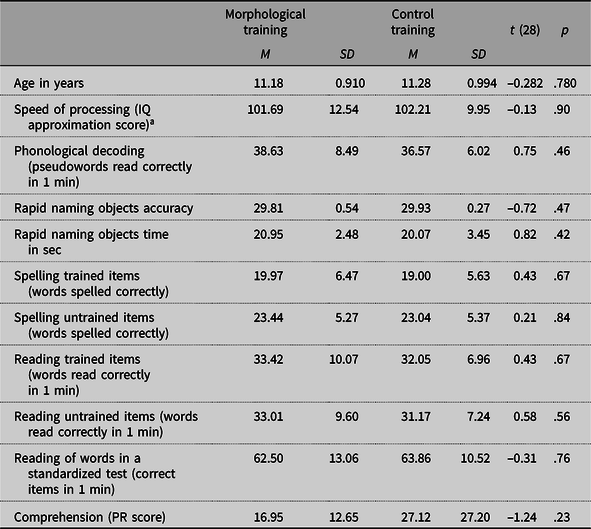
This screening procedure resulted in the above mentioned 30 participants who were analyzed in this study. Participants were randomly assigned into one of two groups: one received the morpheme-based training (n = 16, 11 boys), and the other received a control training (n = 14, 6 boys). Descriptive statistics of the two groups are presented in Table 1. The study was approved by the local ethics committee of the DIPF | Leibniz Institute for Research and Information in Education, and the children’s parents provided written informed consent to take part in the study.
Mean background measures and mean performance in reading and spelling tests prior to training (in Time 1 testing, standard deviation in parentheses) by group and results of t tests comparing the two groups

a The IQ approximation score is based on high correlations found between the speed of processing test administered in this study and more comprehensive IQ tests (see the Method section). It should be taken into account, however that this measure provides only a rough estimation of IQ.
Materials
Reading comprehension
A standardized German reading comprehension test was administered (ELFE 1–6; Reading comprehension for first to sixth graders; Lenhard & Schneider, Reference Lenhard and Schneider2006). The test examines reading comprehension of words, sentences, and texts under time constraints. In its first part, children were given two minutes in order to match as many written words as possible to their corresponding pictures (this part includes 72 items altogether). In the second part, children were asked to match a written word (out of four possibilities) and a sentence according to its context (28 items). The working time on this task was also restricted to two minutes. In the third part, children had to read short paragraphs followed by comprehension questions of the multiple-choice type (20 paragraphs). Working time for this part was restricted to six minutes. Two examples were given for each part. The test was administered in groups, and the children were required to read silently. One point was given for each item correctly answered. Cronbach’s α reliability coefficients of the subtests are between α = .92 and α = .97.
Of note, in addition to a screening test, this test was used to estimate effects of training on reading comprehension across three testing times (before training, immediately after training, and one month following training; see the Procedure section). As the test has two parallel forms (A and B), different forms were administered in a counterbalanced manner to participants and across testing times (A, B, A or B, A, B).
Word reading and decoding
Two subtests from the Reading and Spelling Tests (Moll & Landerl, Reference Moll and Landerl2010) were used to determine the level of word recognition and phonological decoding: the word-reading test and the pseudoword-reading test. Participants were presented with a list of either printed words or pseudowords. In both subtests, the lists included eight example items as well as 156 test words or pseudowords. The items in the word reading test comprised nouns and verbs and the items in the pseudoword-reading test were created based on legal phonological combinations, but without any real morphemes in them. Both tests were administered individually, while the children were instructed to read out aloud each item, as fast and as accurately as they could, and were stopped after one minute. One point was given for each word or pseudoword correctly read. Parallel test reliability coefficients of these tests are above .90.
These tests were used for screening participants, while the word reading test was also used to estimate the effect of training. As this test has two parallel forms (A and B), the forms were administered in a counterbalanced manner to participants and across testing times (A, B, A or B, A, B).
Speed of processing
A standardized test of cognitive processing speed was used (ZVT; a number-connecting test; Oswald & Roth, Reference Oswald and Roth1997). The test was administered individually, while participants were presented with numbers printed on a sheet, and asked to quickly draw a line connecting the numbers according to their serial order (using a pencil). The internal consistency and the six-month test–retest reliability of this test were found to be between .84 and .98. The raw scores were converted to IQ estimations, provided by the test manual (as detailed under the Participants section, the conversion is based on high correlations found between this test and more comprehensive IQ tests; see Oswald & Roth, Reference Oswald and Roth1997).
Rapid Naming
Reading disability has been suggested to be linked to slow performance in rapid-naming (RAN) tasks (Wolf, Bowers, & Biddle, Reference Wolf, Bowers and Biddle2000). In order to verify similar RAN performance of the two groups, a test of rapid naming of objects from the ZLT-II test battery (“Züricher Lesetest II”, the Zurich reading test II; Petermann & Daseking, Reference Petermann and Daseking2012) was administered. The children were presented with a table of six rows and five columns, with five different objects appearing several times in the table. Participants were asked to name the objects as fast and as accurately as they could. Each correct naming earned one point and performance time was recorded.
Spelling of trained and of untrained words
The effects of training were tested at two levels: on trained words and on untrained word stems embedded in trained prefixes and/or suffixes. Tests addressing these two levels were developed for the purpose of this study. Three parallel versions were created for each level in order to be administered in the three testing points (i.e., three parallel versions for the testing of trained words and three for the testing of untrained word stems embedded in trained prefixes and/or suffixes). In each test, participants were required to spell 41 words spoken out loud by an experimenter. The spelling tests of trained words comprised a sample of words introduced during training. The tests of untrained words were composed of word-stems, which had not appeared in training, and prefixes or suffixes, which had appeared in training. All words in these tests could not be spelled based on phoneme–grapheme conversion alone and hence required orthographic knowledge.
Each of the three tests of trained words and each of the three tests of untrained words were matched for mean word frequency (according to dlexDB; Heister et al., Reference Heister, Wuerzner, Bubenzer, Pohl, Hanneforth, Geyken and Kliegl2011) and mean word length. One-way analysis of variance was carried out in order to examine possible differences despite the matching process, with either word frequency or word length as dependent variables. No significant differences were obtained between the three versions of the trained word lists and between the three versions of the untrained word lists. The mean frequencies of the three lists of trained words were: 612.73 (SD = 1155.18), 614.80 (SD = 1387.04), and 621.78 (SD = 1152.21) appearances. The mean frequencies of the lists of the untrained words were: 515.56 (SD = 801.30), 516.98 (SD = 905.28), and 518.34 (SD = 1118.54) appearances. Of note, the high SDs result from the representation of words of a wide frequency range in each list. The means of word length per list of the trained words were 7.76 (SD = 1.18), 7.76 (SD = 1.50) and 7.85 (SD = 1.39) letters in a word. The means of word length of the untrained words were: 7.56 (SD = 1.10), 7.85 (SD = 1.56) and 8.00 (SD = 1.32) letters per word.
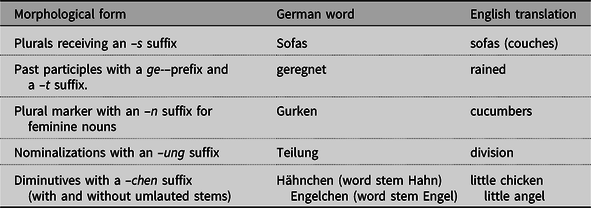
Furthermore, the tests included words of all morphological forms appearing in training (Table 2): (a) plurals receiving an –s suffix; (b) past participles with a ge– prefix and a –t suffix; (c) plural marker with an –n suffix for feminine nouns; (d) nominalizations with an –ung suffix; and (e) diminutives with a –chen suffix (with and without umlauted stems). Each of the three versions of spelling tests of trained words included three words of type (a), 19 words of type (b), seven words of type (c), seven words of type (d), and five words of type (e). Each of the three versions of the spelling tests of untrained words included the same proportion of items of each word type. The tests were administered individually. One point was given for each correctly spelled item. One version from each test was presented at each testing time in a counterbalanced manner to participants and across testing times.
Examples of morphological forms included in training and in the word reading and word spelling tasks

Reading of trained and of untrained words
The principles guiding the design of the word reading tests were the same as the ones guiding the design of the spelling tests: two word reading tests were developed for the purpose of this study, with three parallel versions for each test (to be administered in the three testing times). Each version of the test comprised 97 words. One test included a list of trained words sampled out from the words introduced in training, and the other included untrained words composed of word stems, which did not appear in training (embedded in prefixes and/or suffixes, which did appear in training). The three versions of each test were matched in terms of number of words from each morphological form. These included the same regularly inflected forms presented under the spelling task (see Table 2): (a) plurals receiving an –s suffix; (b) participles with a ge– prefix and a –t suffix; (c) plural marker with an –n suffix for feminine nouns; (d) nominalizations with an –ung suffix; and (e) diminutives with a –chen suffix (with and without umlauted stems). Each of the three test versions of trained words included 17 words of type (a), 26 words of type (b), 25 words of type (c), 12 words of type (d), and 17 words of type (e). Each of the three test versions of untrained words included similar proportions from each word type: 17 words of type (a), 25 words of type (b), 26 words of type (c), 12 words of type (d), and 17 words of type (e).
The lists were also matched in terms of mean word frequency (based on dlexDB; Heister et al., Reference Heister, Wuerzner, Bubenzer, Pohl, Hanneforth, Geyken and Kliegl2011) and word length. Mean word frequency of the lists of trained words were 549.25 (SD = 1647.96), 551.68 (SD = 1545.96), and 549.60 (SD = 1583.48). The mean word lengths were 7.43 (SD = 1.46), 7.43 (SD = 1.42), and 7.44 (SD = 1.43). The same criteria were used to match the three lists of untrained words: mean frequencies were 538.82 (SD = 1658.85), 532.91 (SD = 1566.08), and 539.37 (SD = 1649.76) appearances (dlexDB; Heister et al., Reference Heister, Wuerzner, Bubenzer, Pohl, Hanneforth, Geyken and Kliegl2011); and mean word length was 7.63 (SD = 1.55), 7.45 (SD = 1.51), and 7.52 (SD = 1.51) letters in a word. No significant differences between the three versions of each test were found in terms of word frequency and word length in a one-way analysis of variance.
One list of trained words and one list of untrained words were presented at each testing time in a counterbalanced manner across participants. This task was administered individually, while participants were required to read out loud as accurately and as fast as they could. Scores of reading accuracy and reading time were given separately for each list. These scores were later converted into a word reading efficiency scores by calculating the number of items correctly read within one minute.
Training
The training consisted of a lexical decision task, which was programmed using the E-Prime software (Schneider, Eschman, & Zuccolotto, Reference Schneider, Eschman and Zuccolotto2002). Words and pseudowords were presented at the center of a computer screen, one stimulus at a time. Participants were asked to read the stimuli silently and to then press one key on the keyboard if the stimulus was a real word and another key, if it was an “invented” word. The participant’s decision terminated the presentation of each item. A blank screen appeared thereafter for 1000 ms and was followed by a visual mask in the form of an asterisks line, which was presented for 500 ms. Participants were asked to work as fast and as accurately as they could.
The words included in the task were verbal inflections and noun derivations of varying frequencies (ranging from infrequent to highly frequent words according to dlexDB; Heister et al., Reference Heister, Wuerzner, Bubenzer, Pohl, Hanneforth, Geyken and Kliegl2011). Pseudowords were composed by replacing one to three letters within the real words included in training. Only letters from the words’ stems were replaced, thereby creating pseudowords, which include legal morphological structures in the language (pseudostems integrated into real prefixes and/or suffixes). Considering the debate regarding whether all complex words are morphologically decomposed while reading the German language (Clahsen, Reference Clahsen1999; Penke, Reference Penke and Wünderlich2006; Smolka et al., Reference Smolka, Zwitserlood and Rösler2007), we only included regular forms in this training, which were repeatedly found to be analyzed into their morphological components. These were: –s plurals, past participles with ge– prefix and –t suffix; plural marker –n for feminine nouns; –ung nominalizations and –chen diminutives (Table 2). Each word or pseudoword appeared only once in training.
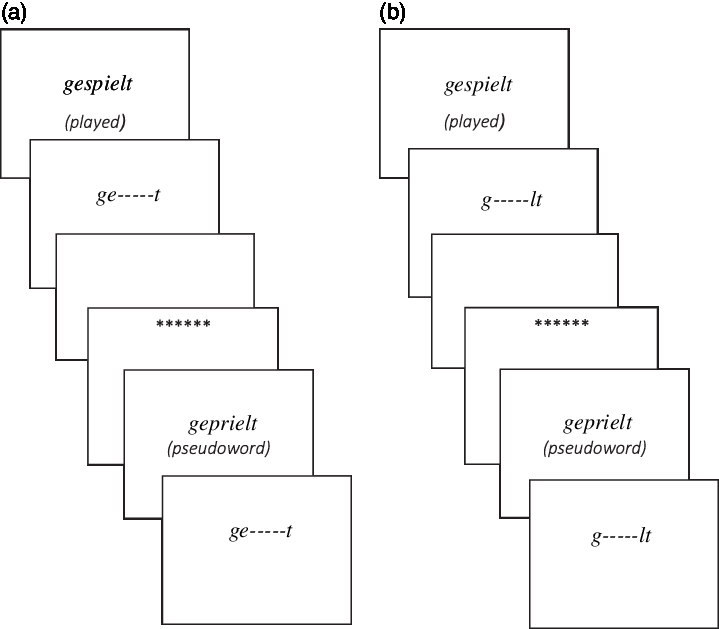
Two versions of training programs were created. These included the same stimuli but differed in the type of orthographic units’ presentation, that had been manipulated (Figure 1):
-
1. The morpheme-based training included a manipulation on the presentation of the word stems within morphological complex words or pseudowords. Each stimulus was presented on screen, while the stem of the word or pseudoword appeared for a limited duration and was then replaced by small dashes. The presentation of the dashes, as well as the words’ or pseudowords’ prefixes and suffixes, stayed on screen until the participant pressed a key signifying a decision (whether the stimulus was a real word or an invented word). For example, in the case of words: getanzt (meaning “danced”) appeared on screen, while the unit tanz appeared for a limited duration, and ge––––t remained on screen until a response occurred. In the case of pseudowords: geschanzt was presented, while the unit schanz appeared for a limited duration, and ge–––––t remained on screen until response.
-
2. The control training included a manipulation on the presentation duration of nonmorphological units within morphologically complex words or pseudowords. This manipulation was designed with the aim of disentangling the possible effects of time constraint on performance in literacy tasks (as previously shown by Breznitz, Reference Breznitz2006) from the possible effects of manipulating the presentation of morphological units. The same procedure was applied as described under the morphological manipulation, except that the duration of a nonmorphological unit’s presentation was restricted. In order to match the control training to the morpheme-based training as much as possible, the manipulation of the nonmorphological units comprised the same number of letters as the word stems. For example, the word getanzt (meaning “danced”) appeared on screen, while the nonmorphological unit etan appeared for a limited duration, and g––––zt remained on screen until response (in this example, tanz is the actual word stem). In the case of pseudowords: geschanzt was presented and the unit eschan was manipulated, while g–––––zt remained on screen until response.
Examples for items appearing in (a) the morpheme-based training procedure and (b) the control training procedure. In the morphological procedure, word stems appeared on screen for a limited duration, and in the control procedure, the presentation duration of nonmorphological units was restricted. The remaining letters of each item appeared on screen until response. A blank screen (appearing for 1000 ms) and a forward mask (appearing for 500 ms) separated the items.

The presentation duration of the manipulated orthographic units in the two training programs were set according to the performance of each individual in a lexical decision task preceding the training (following the individual base-line principle previously applied by Breznitz, Reference Breznitz2006). This task (which did not include any manipulation on the presentation duration) comprised words and pseudowords of the same morphological forms that appeared in the training. The presentation of each stimulus was terminated by response (by pressing one key for words and another key for pseudowords). The mean response time for accurately identified items was used to calculate a measure of individual per-letter reading rate. The baseline duration of the manipulated orthographic unit’s presentation (the word stem in the morpheme-based training program and the nonmorphological unit in the control training program) was set according to this measure, by multiplying the per-letter reading rate by the number of letters in each manipulated orthographic unit. For example, the presentation time of the word stem lern in the word gelernt (meaning “learned”) was the individual per-letter reading rate multiplied by four. This duration was then reduced by 5% per training block, providing that accuracy stayed at 80% and above. Each of the two training programs included 144 blocks, while 20 stimuli were presented per block (10 words and 10 pseudowords). Each block included words and pseudowords of only one morphological form (examples of such blocks are presented in Table S.1 in the online-only Supplemental materials). Each of the five forms included in training were repeated across the different blocks. The blocks were divided between 12 sessions of training (i.e., each session included 12 blocks).
Of note, short breaks were given in between the blocks, during which various questions (one to two questions) were presented to participants, such as different trivia questions and questions on the items, which had been presented (e.g., “did a word describing a working tool appear in the last block?”). The same questions were introduced in the two training programs. These short tasks were added in order to keep participants involved in the rather exhausting task of lexical decision.
Procedure
Each child completed 12 sessions of training, which were offered in the course of approximately four weeks. The children worked individually on computers, while experimenters supervised each session of training.
There were three testing times: before training, immediately after training, and one month following the last session of training. The tests were administered within one to three days during each testing time. One to two hours were required in order to complete a testing session (including a break), and a training session required between 15 and 20 minutes (including the short breaks between the blocks). The instruction to work accurately and quickly applied for all tasks. The parallel testing forms were administered in a counterbalanced manner to participants and across testing times.
Results
Performance in Time 1 testing
In order to verify similar base-line characteristics of the two groups, background measures and measures of performance in the reading and spelling tests administered prior to training (in Time 1 testing) were compared between the two groups using t tests for independent samples. No significant differences were found between the groups in age, speed of processing, RAN, phonological decoding, and in the different reading and spelling tests (Table 1).
Effects of training
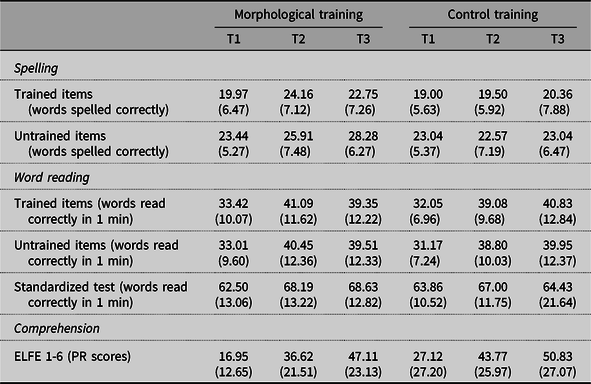
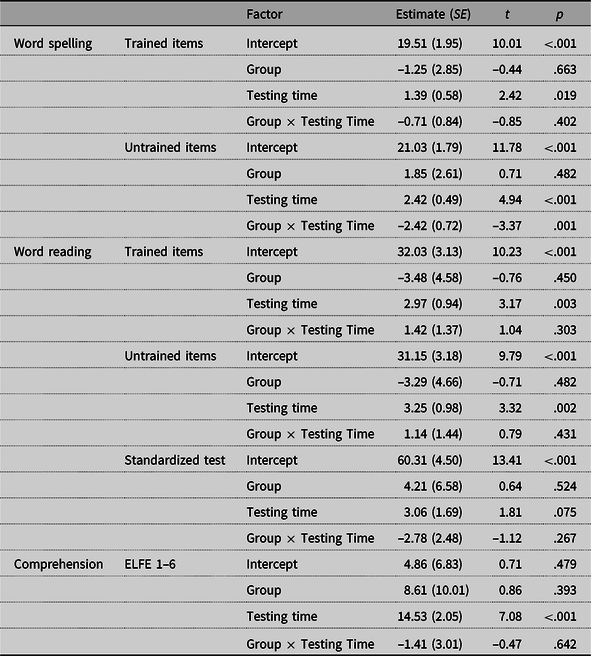
The mean performance per group in the different reading and spelling tests across the three testing times appear in Table 3. Using R (R Core Team, 2014) and the lme4 package (Bates, Mächler, Bolker, & Walker, Reference Bates, Mächler, Bolker and Walker2015), the effects of the two training programs were examined by applying linear mixed effects modeling. Performance in the reading and spelling tasks were the dependent variables; the models assumed random intercepts for participants and defined the training group, the testing time, and their interaction as fixed effects.
Mean performance in the spelling and reading tests across the three testing times by group

The meaningful calculation of the denominator degrees of freedom in mixed designs is a complex and highly debated issue (Bates, Reference Bates2006), which is why p values are not provided by the lme4 package (Bates et al., Reference Bates, Mächler, Bolker and Walker2015). An absolute t value larger than 2 is commonly used as a criterion to estimate significance (Baayen, Davidson, & Bates, Reference Baayen, Davidson and Bates2008; Kliegl, Masson, & Richter, Reference Kliegl, Masson and Richter2010). Nevertheless, we have also added p values obtained by using the lmerTest package (Kuznetsova, Brockhoff, & Christensen, Reference Kuznetsova, Brockhoff and Christensen2017).
The results appearing in Table 4 indicate an effect for testing time in the following measures: reading and spelling of trained and of untrained words and in reading comprehension. The means in Table 3 suggest an improved performance across the testing times of these measures in both groups. One exception was the case of spelling of untrained word stems embedded in trained prefixes and/or affixes. It was only in this measure that an interaction between testing time and group was obtained. The means in Table 3 suggest an improvement in this measure only for the group receiving the morpheme-based training.
Results of linear mixed effects modeling examining the effects of the training programs on the different measures of spelling and reading

Discussion
In the present study, we examined the effects of a computerized morpheme-based training program, designed to demand fast morphological analysis in word processing in children with a reading disability. The control training program was designed to isolate the morphological manipulation from other possible factors, which could have influenced performance in the literacy tasks. The morpheme-based training procedure had a positive effect beyond the control training procedure on the spelling of untrained word stems, which were embedded in trained prefixes and/or suffixes. Improvements in other measures of some of the reading tests and in the spelling of trained words could not, however, be ascribed to the morphological manipulation alone.
The advantage of the morpheme-based training program in comparison to the control procedure in spelling of untrained word stems (embedded in trained prefixes and/or affixes) has also been reported in our previous examination of the same programs in struggling readers, who speak German as a second language (Bar-Kochva & Hasselhorn, Reference Bar-Kochva and Hasselhorn2017). The morpheme-based program may have improved the sensitivity of the participants to the morphological structure of words. Considering the central role given to morphology in models of lexical processing (e.g., Frost et al., Reference Frost, Kugler, Deutsch and Forster2005; Smolka et al., Reference Smolka, Zwitserlood and Rösler2007), it is possible that this improved sensitivity contributed to the ability to retrieve orthographic representations from the mental lexicon. In other words, spelling may have become less arbitrary and increasingly guided by the words’ morphology. Another possibility, as previously suggested (Bar-Kochva & Hasselhorn, Reference Bar-Kochva and Hasselhorn2017), is that an improved sensitivity to the morphological structure of words, following the morpheme-based training procedure, contributed to the participants’ ability to deduce the spelling of words, which were unfamiliar to them in their written form, based on analogies to morphologically related words, which spelling was familiar to them. Considering that the morpheme-based training procedure did not have a unique effect on improvement in spelling of trained words but did show such an effect on spelling of untrained word stems, some effect of generalization may be concluded. However, further effects of generalization have to be explored by testing the spelling of morphological structures not included in training (i.e., of untrained stems embedded in untrained prefixes and/or suffixes).
These results from readers and spellers of the German orthography join several studies indicating a contribution of morphological instruction to spelling skills in struggling readers of different orthographies, for example Danish (Elbro & Arnbak, Reference Elbro and Arnbak1996), Arabic (Taha & Saiegh-Haddad, Reference Taha and Saiegh-Haddad2016) and English (Tsesmeli & Seymour, Reference Tsesmeli and Seymour2009). It should be mentioned, that in the previous pilot examination of this morpheme-based training procedure (of only 50 minutes), in which adult Hebrew readers with a reading disability had participated (Bar-Kochva, Reference Bar-Kochva2016), a direction of positive effect of the morpheme-based training program on spelling has also been found. Together, these results stress the role of morphological processing in the development of spelling skills for spellers of orthographies with different transparencies and morphological structures, be it via explicit instruction or via a computerized intervention program addressing an implicit morphological procedure in word processing. The phonological-orthographic and often semantic regularities provided by morphemes are common to different types of orthographies and morphological structures and may explain these results.
Finally, fluency in the reading of words and reading comprehension are discussed. Both groups improved in these measures (except in the case of word reading in a standardized test), with no interaction between group and testing time. As the morpheme-based training program focused on the speed with which morphological analysis is carried out in word recognition, a unique positive effect of the program was expected at least in the case of fluency in word reading. These results, however, replicate the results obtained in the previous study of the morpheme-based training program, in which children with reading difficulties, to whom German is a second language were examined (Bar-Kochva & Hasselhorn, Reference Bar-Kochva and Hasselhorn2017). These results are also in line with reports of small to no effects of morphological explicit instruction programs on these literacy measures (see the meta-analysis by Goodwin & Ahn, Reference Goodwin and Ahn2010, Reference Goodwin and Ahn2013). As indicated in the introduction, time constraint has been shown to improve fluency in reading and under certain conditions comprehension as well (Breznitz et al., Reference Breznitz, Shaul, Horowitz-Kraus, Sela, Nevat and Karni2013). It is possible, that some contribution of the morpheme-based training procedure to reading fluency may have been obscured by the factor of time constraint. As expected, however, an intervention restricted to a single morphological process in itself did not lead to significant improvements in the complex task of reading comprehension.
Several limitations of the study should be considered. The training programs were designed as an experimental task, with the goal of isolating the effect of the morphological manipulation as much as possible. The application of the method in fieldwork would naturally require the integration of the suggested morphological manipulation in a more game-oriented computerized intervention. With the aim of enhancing effects, the suggested program may also require the integration into more comprehensive programs, which address additional reading and writing related factors (Kirby & Bowers, Reference Kirby, Bowers, Cain, Compton and Parrila2017). In a similar vein, in this experiment we focused on the training of certain morphological structures, including a restricted number of prefixes and suffixes. In addition, as recently recommended by Kirby and Bowers (Reference Kirby, Bowers, Cain, Compton and Parrila2017), teaching morphology is part of acquiring vocabulary depth. The meanings of the word bases were, however, not addressed in the current morphological intervention. Finally, sustained effects were tested to a limited extent of one month following training.
Conclusions
To conclude, the results suggest that a morpheme-based training program, designed to demand fast morphological analysis of written words, can lead to improvements in the spelling of untrained word stems embedded in trained prefixes and/or suffixes. This suggests that a process of lexical access and retrieval was enhanced, rather than mere familiarity with specific word stems appearing in training. Generalization of this effect to the spelling of untrained word stems embedded in untrained prefixes and/or suffixes remains to be explored. The current results do not suggest that the morphological manipulation in itself leads to better reading fluency and comprehension beyond other possible factors of intervention (the imposing of time constraint, print exposure, or acquaintance with the setting of testing). The suggested computerized manipulation then appears to be more relevant to the training of spelling than to the training of reading ability.
Acknowledgments
The authors are greatly indebted to the schools and participants. We also wish to thank the anonymous reviewers for their constructive advice and Chantal Herrmann for the language corrections. The research was carried out while the first author was being supported by a Minerva Postdoctoral Fellowship of the Max Planck Society for a research stay at the DIPF | Leibniz Institute for Research and Information in Education
Supplementary material
To view supplementary material for this article, please visit https://doi.org/10.1017/S0142716420000120