Introduction
There are 12 cancer registries in the United Kingdom.1–12 These were established between 1945 and 1965 and cover all regions of the UK.3–6
Each cancer registry is responsible for the structured compilation, storage, analysis and interpretation of data on patients with cancer.13–15 The registries have a wide range of consumers, including the Office of National Statistics, health authorities and health boards, cancer clinicians, cancer researchers, and National Health Service executive regional offices.16
The Internet has become a key source of information on cancerReference Junghans, Sevin, Ionin and Seifried17, Reference Pal, Pandey, Kesari, Choudhuri and Mittal18 for both patients and the medical profession.Reference Ross, Chapman, Murray, Stevenson, Natin and Rogstad19 It is essential that this information is accurate, representative and easy to assimilate, especially for patients. Many clinicians will have used the data held by cancer registries; however, historically, such data would not have been accessed by individual patients. The Internet may be changing this.
Each cancer registry has its own website, which provides information and statistics relating to the various bodily cancer sites. A review of the web pages of these registries was undertaken to compare the relative value of data on head and neck cancers.
Objective
Our objective was to evaluate the presentation and relative value of data on head and neck cancer available on the websites of cancer registries in the UK.
Methods
The data presented on the websites of all the UK cancer registries were analysed in July 2004. The type of head and neck cancer information available and the mode of presentation were evaluated for each website.
Results
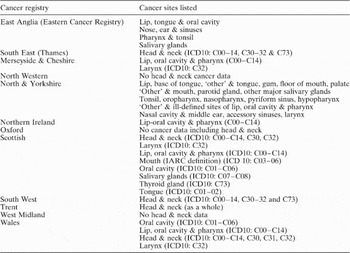
The type of data available at each website varied considerably. One website (8 per cent, 1/12) offered no cancer data at all. Sixteen per cent (2/11) had some cancer data but none relating to head and neck cancer. Seventy-five per cent (9/12) of the registries had selected data on head and neck cancer, but 33 per cent (3/9) of these pooled the various head and neck cancers into a single group. The remainder of those websites offering data [66 per cent (6/9)] had a variety of ways of grouping and presenting the various types of head and neck cancer (Table I).
Cancer registries presenting head and neck cancer data

ICD=International classification of diseases; IARC=International Agency for Research on Cancer
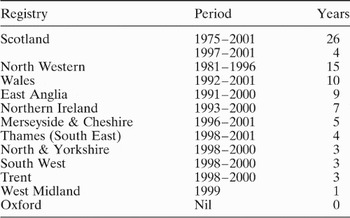
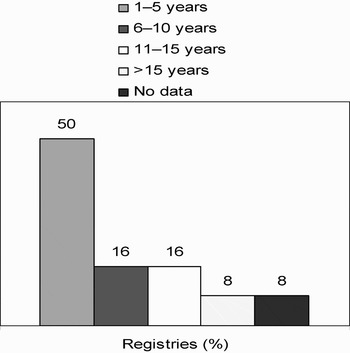
The number of years worth of cumulative data made available at each website also varied between sites (Table II and Figure 1).
Cumulative data period available on each cancer registry website

Cumulative data collection periods available on UK cancer registry websites.

Discussion
Medical professionals now use the Internet for many purposes.Reference Pal, Pandey, Kesari, Choudhuri and Mittal18 These include continuing medical education,Reference McColl20, Reference Mandikos21 access to the latest medical information,Reference McColl20–Reference Gorriz, Gonzalez, Trinidad, Garcia, Pinilla and Lopez Cortijo24 quick retrieval of diagnostic dataReference Liang and O'Grady25, Reference Bassignani, Dwyer, Ciambotti, Olazagasti, Moran and Moynihan26 and discussion of treatment strategies, to name but a few. Increasingly, members of the public also use the Internet as a source of medical information. Unfortunately, the quality and presentation of this information is variableReference Pal, Pandey, Kesari, Choudhuri and Mittal18, Reference Ziebland27 and it can prove difficult to understand, especially for the inexperienced or those who lack medical knowledge. Despite this, the Internet has the potential to be a cost-effective and easily accessible source of high quality information for cancer patientsReference Bazzoli28 and their relatives.
• This study evaluated the relative usefulness of data on head and neck cancer available on the websites of UK cancer registries
• The overall value and usefulness of head and neck cancer information on these websites were limited, especially when all the sites were considered together
• The cancer registries collectively possess an extremely important asset that would be of immense value to both the medical profession and, possibly, patients with cancer
Historically, the primary purpose of the cancer registries has not been the collation and presentation of data for the purpose of directly informing the wider medical community or the general public. However, the continued evolution and increasingly widespread availability of the Internet may change this expectation. Each cancer registry has a presence on the Internet and has made a serious attempt to make their data available. It is likely that cancer registry websites will be accessed by individuals searching the Internet for information on this subject.
We found that each cancer registry website had a unique way of presenting its data, and not all websites gave equal priority to each bodily cancer site. All but one registry presented statistical information on the various cancer sites. Conversely, of the twelve cancer registry, only 75%(9/12) included the data on head and neck cancer. However, where this information was available, in most cases it was not presented in a user friendly fashion.
We noted that there was no consistency between cancer registries regarding the data collection periods presented. The statistical data available had been gathered over time periods ranging from one to 26 years. Fifty per cent (6/12) of registries presented data collected over one to five years, 16 per cent (2/12) over six to 10 years, another 16 per cent (2/12) over 11 to 15 years and 8 per cent (1/12) up to 26 years (Figure 1, Table II).
Searching for information on the cancer registry websites was a difficult task. We found no set format for presentation of statistics, making comparison of data between registries difficult or impossible. For those with a detailed understanding of head and neck cancer, apparent inconsistencies in the use of International Union Against Cancer and American Joint Committee on Cancer classifications in subgroupings of various head and neck cancers further exacerbated the difficulties.
The Internet has given the public and the medical profession access to a wealth of information that was previously unavailable with such ease. It is clearly important that websites carrying medical information are accurate and understandable, especially if the intended target audience includes individuals without medical qualifications.Reference Chestnutt29
Each cancer registry has made a significant effort to make the data it holds more accessible through the Internet, and this should be applauded. In general, however, we found the overall value and usefulness of the head and neck cancer information on these websites to be very limited, especially when all the sites were considered together. It is possible that, in its current state, the information currently available serves more to confuse than to inform.
Conclusion
Each UK cancer registry website has its own unique and in some cases confusing way of presenting head and neck cancer data. The reasons for this are multiple. Improving the overall experience of those seeking information on head and neck cancer from these websites would require significant thought, collaboration and agreement between each registry, and it would certainly require significant extra resources. Whether this would be possible or even considered desirable is not known. However, we feel that, collectively, the cancer registries have an opportunity to make available, in an accessible and user-friendly fashion, an extremely important UK asset that would be of immense value to both the medical profession and, possibly, patients with cancer.