INTRODUCTION
The first well-documented benthic fauna studies on the northern, southern and eastern parts of the Persian Gulf were performed by the Danish Survey Expedition (1762), the Danish Fisheries Investigation (1937–1938), the German Oceanographic Vessel (1965) and the Japanese Training Ship of Tokyo University (1968) (cited in Hasan, Reference Hasan1996).
The following studies have been carried out on crustacean fauna of the Persian Gulf and Gulf of Oman: Heller (Reference Heller1861), Alcock (Reference Alcock1895, Reference Alcock1896, Reference Alcock1898, Reference Alcock1899a, Reference Alcockb, Reference Alcock1900), Bogoyavlensky (unpublished), MacGilchrist (Reference MacGilchrist1905), Nobili (Reference Nobili1905), Klunzinger (Reference Klunzinger1913), Chopra & Das (Reference Chopra and Das1937), Stephensen (Reference Stephensen1945), Haig (Reference Haig1966), Takeda & Miyake (Reference Takeda and Miyake1970a), Pretzmann (Reference Pretzmann1971), Evans et al. (Reference Evans, Murray, Biggs, Bate, Bush and Purser1973), Kuronuma (Reference Kuronuma1974), Motoh (Reference Motoh1975a, Reference Motohb), Basson et al. (Reference Basson, Burchard, Hardy and Price1977), Titgen (Reference Titgen1982), Jones & Clayton (Reference Jones and Clayton1983), Jones (Reference Jones1986), Hogarth (Reference Hogarth1988, Reference Hogarth1989), Hornby (Reference Hornby1997), Apel & Spiridonov (Reference Apel and Spiridonov1998), Apel & Türkay (Reference Apel and Türkay1999), (Apel, Reference Apel2001), Siddiqui & Kazmi (Reference Siddiqui and Kazmi2003), Kazmi et al. (Reference Kazmi, Siddiqui and Kazmi2007) and Ng et al. (Reference Ng, Rahayu and Naser2009).
Since the last decade, there is a new taxonomic and ecological interest in the Iranian side of the Persian Gulf crustacean assemblages, resulting in a number of new publications: Naderloo & Sari (Reference Naderloo and Sari2005, Reference Naderloo and Sari2007), Moradmand & Sari (Reference Moradmand and Sari2007), Kamrani et al. (Reference Kamrani, Ng, Mirzadeh and Nakhodai2009), Naderloo & Schubart (Reference Naderloo and Schubart2009, Reference Naderloo and Schubart2010), Naderloo & Türkay (Reference Naderloo and Türkay2009, Reference Naderloo and Türkay2010), Shih et al. (Reference Shih, Kamrani, Davie and Liu2009), Yazdani et al. (Reference Yazdani, Taheri, Sanjani and Seyfabadi2009), Anker et al. (Reference Anker, Naderloo and Marin2010), Khalaji-Pirbalouty & Wägele (Reference Khalaji-Pirbalouty and Wägele2010a, Reference Khalaji-Pirbalouty and Wägeleb, Reference Khalaji-Pirbalouty and Wägelec), Naderloo et al. (Reference Naderloo, Türkay and Chen2010, Reference Naderloo, Türkay and Apel2011), Saeedi & Ardalan, Reference Saeedi and Ardalan2010; Mokhlesi et al. (Reference Mokhlesi, Kamrani, Backwell and Sajjadi2011) and Shahdadi & Sari (Reference Shahdadi and Sari2011).
The offshore benthic gastropod species of the Persian Gulf and Gulf of Oman received noticeable attention by Melvill (Reference Melvill1898, Reference Melvill1928), Smythe (1972, Reference Smythe1975, 1979), Evans et al. (Reference Evans, Murray, Biggs, Bate, Bush and Purser1973), Bosch & Bosch (Reference Bosch and Bosch1982), and Glayzer et al. (Reference Glayzer, Glayzer and Smythe1984). Furthermore, Biggs & Grantier (Reference Biggs and Grantier1960), Basson et al. (Reference Basson, Burchard, Hardy and Price1977), Sharabati (Reference Sharabati1981), Smythe (Reference Smythe1982), MacCain (Reference MacCain1984), Jones (Reference Jones1986), Bosch et al. (Reference Bosch, Dance, Moolenbeek and Oliver1995) and Hasan (Reference Hasan1996) have reported some Saudi Arabian gastropod fauna of the Persian Gulf (cited in Hasan, Reference Hasan1996). Hosseinzadeh et al. (Reference Hosseinzadeh, Daghoghi and Rameshi2001) listed some mollusca of the Iranian coasts of the Persian Gulf in their atlas in 2001.
The invertebrate fauna along the Iranian coast of the Persian Gulf is still inadequately known and hence the possible human effects on the present fauna are difficult to establish. Despite its diverse macro-invertebrate assemblages, Qeshm Island is not an exception to this and it has been addressed by a few patchy and restricted studies with different targets only until now. This island is the largest island of the Persian Gulf, with 120 km length and up to 30 km width, situated in the western part of the Strait of Hormuz (Höpner et al., Reference Höpner, Ebrahimpour and Maraschi2000). By receiving more fresh and nutrient rich oceanic water through the Strait of Hormuz, it exhibits various substrates and ecosystems, including mangrove forests, rocky and sandy shores, mud flats and estuaries, which lead to a large biodiversity.
By support of the Persian Gulf Biotechnology Research Center, a collection of intertidal macrobenthic communities was obtained in order to prepare a checklist for the two most dominant groups (Crustacea and Gastropda) of the Qeshm Island. The present report provides a summary of the collected taxa with locality data.
MATERIALS AND METHODS
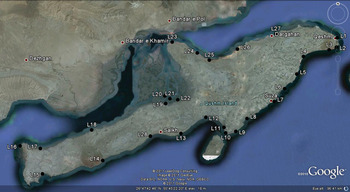
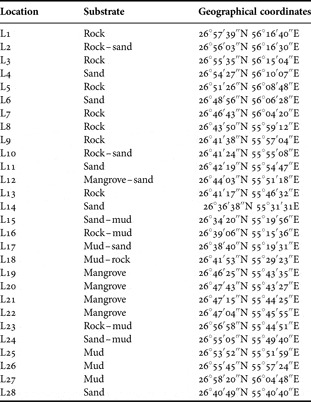
Twenty-eight intertidal locations of different habitats (rocky, sandy, mud flats and mangrove forests), all around the Qeshm Island were sampled during 2007–2010 (Figure 1; Table 1). Crustacean and gastropod specimens were collected at low tide of intertidal zones by time survey while three persons were walking in an area approximately 100 m wide at each locality. At rocky locations, samples were collected from the surface and from under the stones, in crevices and on rock walls, while bottom-dwelling species (infauna) were separated from sediment by sieving through 4.8 mm mesh at soft substrate locations. After transporting samples to the laboratory, specimens were fixed in 70% ethanol and identification of the specimens up to the possible level was attempted. Some gastropod and crustacean specimens were deposited in the Zoological Museum of Amsterdam (now being transferred to the NCB Naturalis, Leiden, The Netherlands) and the Crustacea section of the Senckenberg Natural History Museum, Frankfurt am Main, Germany, respectively. Most specimens were also deposited in the biological museum of Shahid Beheshti University, Tehran.
Qeshm Island and the sampling locations.

Sampling locations and their geographical coordinates.

Martin & Davis (Reference Martin and Davis2001) and Bouchet & Rocroi (Reference Bouchet and Rocroi2005) were used as references for crustacean and gastropod classifications respectively; genera and species came alphabetically within each family. Moreover, classification was updated based on the World Register of Marine Species (WoRMS: http://www.marinespecies.org/) where it was necessary.
The following references were used for identification of each crustacean's taxa: Tirmizi et al. (Reference Tirmizi, Yaqoob and Siddiqui1982), Collins et al (Reference Collins, Jones and Clayton1984), Serene (Reference Serene1984), Jones (Reference Jones1986), Galil & Clark (Reference Galil and Clark1994), Türkay et al. (Reference Türkay, Sakai and Apel1996), Apel & Spiridonov (Reference Apel and Spiridonov1998), Neumann & Spiridonov (Reference Neumann and Spiridonov1999), McLaughlin (Reference McLaughlin2003), Ng & Koh (Reference Ng and Koh2008), Galil (Reference Galil2009), Ng et al. (Reference Ng, Rahayu and Naser2009), Anker et al. (Reference Anker, Naderloo and Marin2010), Khalaji-Pirbalouty & Wägele (2010).
For the gastropod identification the following references were consulted: Melvill & Standen (Reference Melvill and Standen1893–1904, Reference Melvill1896, Reference Melvill1918), Bosch & Bosch (Reference Bosch and Bosch1982), Smythe (Reference Smythe1982), Houbrick (Reference Houbrick1985, Reference Houbrick1987, Reference Houbrick1991), Jones (Reference Jones1986), Bosch et al. (Reference Bosch, Dance, Moolenbeek and Oliver1995), Carpenter et al. (Reference Carpenter, Krupp, Jones and Zajonz1997) and Carpenter & Niem (Reference Carpenter and Niem1998).
RESULTS
Collected specimens’ taxonomic list with locations in square brackets:
DISCUSSION
About 88% of the collected specimens were identified up to species level and confirmed by national and international taxonomists.
Regarding subphylum Crustacea 56 species were identified to the species level, and 7 species remained unidentified. Nanosesarma sarii (Sesarmidae) was the most common and widespread species collected on 13 out of 28 studied sites.
Of the Gastropoda, 52 species are identified and 8 species are waiting for futher identification. The family Muricidae was the most diverse family found with 7 species. Osilinus kotschyi (Trochidae) was the most common gastropod species, which occurred in 17 out of 28 sampling sites.
Rocky substrate sites were the most diverse intertidal habitats of the island in terms of species number.
Despite several taxonomic studies on Iranian intertidal crustacean taxa, some groups require more attention (i.e. superfamilies Hippoidea and Alpheoidea, and order Stomatopoda) (Naderloo, personal communication). Also the sea slugs (Gastropoda: Nudibranchia, Sacoglossa, Anaspida and Systellommatophora) need more detailed study to be identified.
ACKNOWLEDGEMENTS
We thank Professor Michael Türkay and Dr Reza Naderloo from the Crustacea section of the Natural History Museum of Senckenberg, Dr Ali Reza Sari, Dr Adnan Shahdadi, Dr Valiallah Khalaji-Pirbalouty, Dr Majid Moradmand and Zahra Mirbagheri for verifying crustacean identifications. We are also grateful to Robert G. Moolenbeek from the Zoological Museum of Amsterdam for verification of gastropod species identification and Dr Henk Dekker for helpful comments and recommendation on new recorded gastropod species (C. isselii). Our special thanks are to the Persian Gulf Biotechnology Research Center and Biological Department of Shahid Beheshti University, Iran for their great support and co-operation.