Introduction
Lightning is a ubiquitous natural process, and an individual strike can produce a peak power of 1013 W and a peak temperature of >30000 K all within about a millisecond (Krider et al., Reference Krider, Dawson and Uman1968). When lightning strikes soil, sand, or rock, the resulting rapid change in temperature can lead to the formation of a natural glass known as a fulgurite. This temperature change consists of an extremely rapid temperature increase due to the formation of the plasma channel (<1 second), followed by a slower, but still relatively rapid decrease as the heat dissipates conductively (∼minutes). A fulgurite is a glassy and usually tubular structure that follows the path of the strike. Fulgurites can be natural or artificial in origin. Artificial fulgurites are formed when a downed electric power line discharges into soil, typically over periods of minutes to hours. In contrast natural fulgurites form under much shorter timescales (<1 second) with much higher power (megawatts to gigawatts) (Pasek and Pasek, Reference Pasek and Pasek2018).
Lightning strikes produce extremely high temperatures and through this rapid deposition of energy are capable of generating a highly reducing local environment (Sheffer, Reference Sheffer2007). Due to the reductive environment formed when lightning strikes a material, Hess et al. (Reference Hess, Piazolo and Harvey2021) argued that fulgurites could have played a role in supplying a source of reactive reduced phosphorus on the early Earth surface. Fulgurites were one of the first modern rock types in which reduced phosphorus was discovered (Pasek and Block, Reference Pasek and Block2009), probably present as both phosphides and phosphites, including solid CaHPO3 (Bindi et al., Reference Bindi, Feng and Pasek2023a). The process of fulgurite formation (high temperature, high energy and highly reducing) leads to the formation of rare materials such as iron silicides, phosphides, phosphites (Pasek et al., Reference Pasek, Block and Pasek2012), and even more complex alloys (Bindi et al., Reference Bindi, Pasek, Ma, Hu, Cheng, Yao, Asimow and Steinhardt2023b).
Iron silicides are a group of rare minerals that form under reducing conditions. Silicides have been invoked as a possible solution to the presence of a light element in the Earth’s core (Lin et al., Reference Lin, Heinz, Campbell, Devine and Shen2002; Kuwayama et al., Reference Kuwayama, Sawai, Hirose, Sata and Ohishi2009; Hsieh et al., Reference Hsieh, Goncharov, Labrosse, Holtgrewe, Lobanov, Chuvashova, Deschamps and Lin2020), and in general are rare in surficial rocks. Essene and Fisher (Reference Essene and Fisher1986) were the first to investigate iron silicides in fulgurites, specifically the Winans Lake fulgurite, Michigan, USA. The Winans Lake fulgurite contains metallic spherules inside a glassy matrix, consisting of intergrowths of phosphides, metals and silicides. The silicides included compositions such as Fe3Si7, FeSi and FeTiSi2. The Winans Lake fulgurite displays no signs of the spherules mixing with the matrix leading to the conclusion that that the spherules were contemporaneous with the formation of the fulgurite. The cause of silicate reduction within the fulgurite was attributed to concurrent carbon oxidation, probably produced by combustion of a nearby tree root, as evidenced by the presence of graphite within the fulgurite.
Since Essene and Fisher (Reference Essene and Fisher1986), there have been several more reports of iron silicides in fulgurites (see review by Feng et al., Reference Feng, Abbatiello, Omran, Mehta and Pasek2021). Iron silicide minerals include fersilicite/naquite (FeSi), ferdisilicite/linzhiite (FeSi2), gupeiite (Fe3Si), hapkeite (Fe2Si), luobusaite (Fe0.84Si2), xifengite (Fe5Si3) and suessite [(Fe, Ni)3Si]. Several of these have been found in fulgurites (Essene and Fisher, Reference Essene and Fisher1986; Sheffer and Dyar, Reference Sheffer and Dyar2004; Ramírez-Cardona et al., Reference Ramírez-Cardona, Flores-Castro, P.P and L.E2006; Block, Reference Block2011; Pasek et al., Reference Pasek, Block and Pasek2012; Roberts et al., Reference Roberts, Sheffer, McCanta, Dyar and Sklute2019; Bindi et al., Reference Bindi, Feng and Pasek2023a). The formation of iron silicides within fulgurites probably depends on the presence of reductants such as organic carbon to drive the removal of O from SiO2, though Sheffer (Sheffer, Reference Sheffer2007) argued that carbon oxidation alone could not provide enough of a reducing environment to form iron silicides in all observed instances.
Iron silicides have been produced industrially for over 125 years to remove oxides from melted steel during casting processes (Brack et al., Reference Brack, Dann, Wijayantha, Adcock and Foster2015; Chepkasov et al., Reference Chepkasov, Baidyshev, Sukhanova, Visotin, Süle and Popov2020; Rappenglück, Reference Rappenglück2022). Industrially, the production of FeSi2 follows the reaction:
 \begin{equation}\text{8}\text{SiO}_{2} + \text{11}\text{C} + \text{2}\text{Fe}_{2}\text{O}_{3} \to {\text{ }}\text{4}\text{FeSi}_{2} + \text{11}\text{CO}_{2}\end{equation}
An alternative route to production of iron silicides utilises a process called electrodeposition. (Hovestad et al., Reference Hovestad, Ansink and Janssen1997; Popovici et al., Reference Popovici, Savii, Enache, Niziiansky, Subrt and Vecemikova2005; Liang et al., Reference Liang, Islam, Smith, Bennett, O’brien and Taylor2006; Saidin et al., Reference Saidin, Ying and Khuan2011; Delekar, Reference Delekar2022).
Building on the generation of silicides from industry, and noting the formation of silicides within some rocks, here we present data on an iron silicide within a Type II (Pasek et al., Reference Pasek, Block and Pasek2012) fulgurite from Southwick, Massachusetts, USA. We investigate a particular occurrence of iron silicides in this fulgurite to better constrain how these materials form under geologic settings, and especially in a lightning strike.
Methods and materials
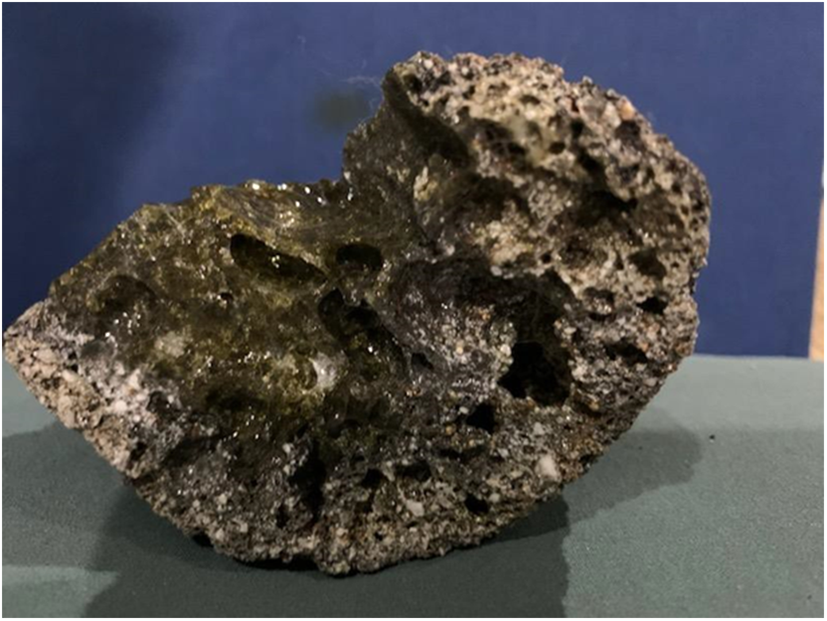
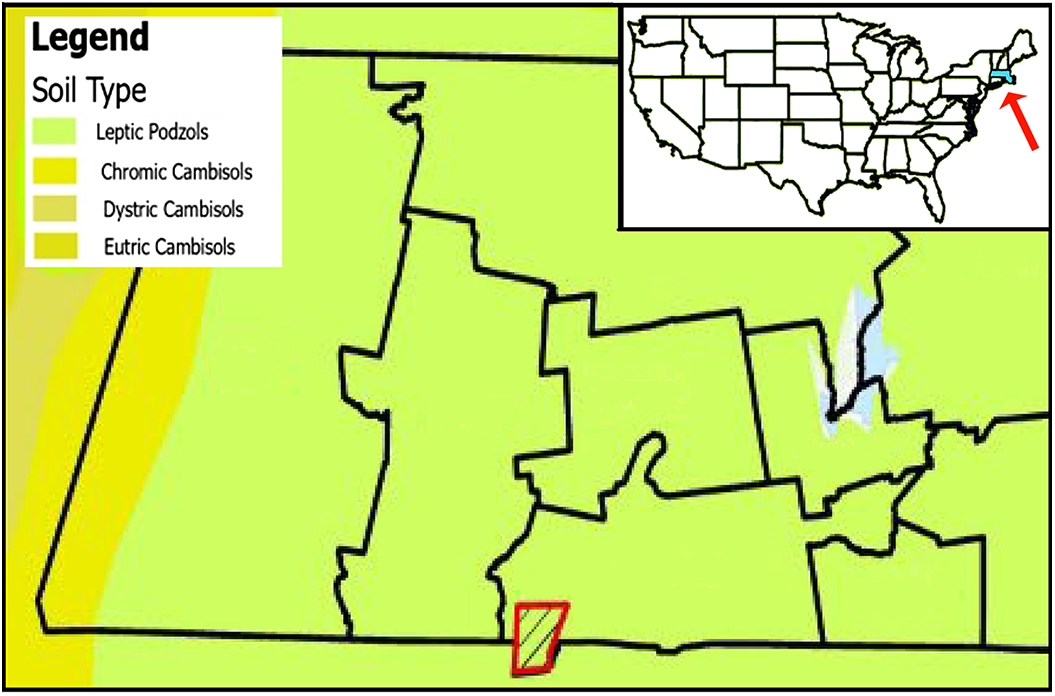
The Southwick Massachusetts fulgurite (Fig. 1) was obtained from the finders who sold the sample on eBay to one of the authors (M.A.P.) in 2015. The finders described the location only by the nearest town where it was found (See Fig. 2), hence we will discuss the general geology of the Southwick area of Massachusetts (Schnabel, Reference Schnabel1973), and contrast this sample with another nearby fulgurite to confirm its origin site. According to the Southwick geological quadrangle, the surficial area of Southwick is predominantly composed of reddish brown or light olive grey till forming on sediments dated to the Triassic (252–201 million years ago). The fulgurite was said to have formed in 2010 after a thunderstorm.
Image of the fulgurite from Southwick, Massachusetts, USA in cross section (specimen in private collection). Width is 7 cm.

Map of Massachusetts (located in blue on the inset map of the USA) with Southwick highlighted in red. The area of Southwick is comprised of leptic podzols which are typically found within 200 cm from the surface and comprised of appreciable clay mineralogy (Kitagawa, Reference Kitagawa2005).

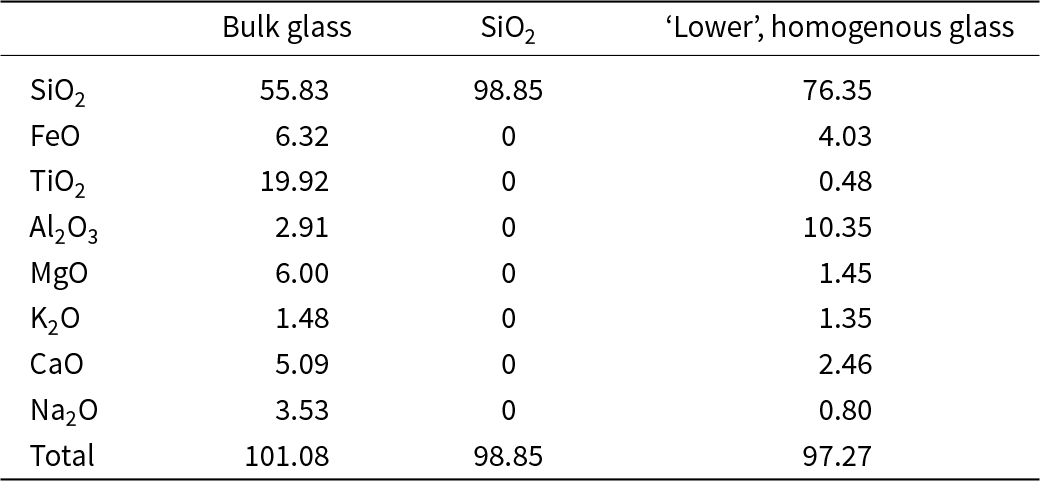
The proximity of the Southwick fulgurite to another fulgurite discussed by Sheffer et al. (Reference Sheffer, Melosh, Jarnot and Lauretta2003) in Farmington, Connecticut (30 km) is noted. The target material of the Farmington fulgurite was sand and basalt gravel berm with oxide compositions listed in Table 1 and may have had a portion of aluminium conductor melted into the fulgurite. We believe, in contrast, that the Southwick fulgurite is fully natural while the Farmington fulgurite is a mix of natural and anthropogenic target materials. We highlight the Farmington fulgurite here mainly to show that the similarities between the Southwick and Farmington bulk compositions shows that these fulgurites were formed from similar materials. As samples of the surrounding soil were not available for confirmation of the Southwick fulgurite’s formation site, such a comparison helps verify that the fulgurite was indeed found in its stated region.
Oxide weight percentages of Farmington Connecticut fulgurite as per Sheffer (Reference Sheffer2007), for contrast with the Southwick Massachusetts fulgurite in Table 2

Samples were analysed using a Zeiss-EVO MA15 Scanning Electron Microscope (SEM) with attached Oxford INCA250 Energy-Dispersive Spectrometer (EDS). The operating parameters were a probe current of 500 pA, counting time of 500 s, average count rate for the whole spectrum of 2500 cps, and operating accelerating potential of 25 kV. A 30 nm carbon film was sputter-coated onto the samples.
The Fe–Si phases were analysed with a Bruker D8 Venture equipped with a Photon II CCD detector single-crystal X-ray Diffractometer (XRD). The instrument utilised graphite-monochromatised MoKα radiation (λ = 0.71073 Å), a detector-to-sample distance of 7 cm, and an exposure time of 30 s per frame. Intensity data was integrated for adsorption and Lorentz-Polarization with software packages from Bruker. Both XRD and SEM were performed at the CRIST, Centro di Studi per la Cristallografia Strutturale, Department of Chemistry, Università di Firenze, Italy
We used thermodynamic data to investigate the formation of iron silicides within the Southwick fulgurite. Specifically, the Gibbs free energy (ΔG) and equilibrium constant (Keq) of three potential reactions investigating the transformation of one iron silicide into another were calculated using a range of temperatures from 298.15 – 1773.15 K increasing at increments of 25 K. The specific heat capacity (cP), ΔH (change in enthalpy) and ΔS (change in entropy) of Fe5Si3 were calculated using HSC chemistry workbench (a thermodynamic equilibrium modelling program from Outokompu Research Oy; for more details see Pasek and Greenberg, Reference Pasek and Greenberg2012). S 0, ΔH and cP values at 298.15 K for SiO2, O2, Fe, and Si were obtained from the NIST chemistry webbook (Linstorm, Reference Linstorm1998). For all subsequent values past 298.15 K, a midpoint formula was used where thermodynamic values of the enthalpy (H) and entropy (S) were estimated at the 25 K incremental steps.
 \begin{equation}H_T^0 = {\Delta }H_{298.15}^0 + \smallint \limits_{298.15}^T {\text{c}_\text{p}}dT\end{equation}
 \begin{equation}S_T^0 = {\Delta }S_{298.15}^0 + \smallint \limits_{298.15}^T \frac{{\text{c}_\text{p}}}{T}dT\end{equation}
Using the cP of Fe5Si3 the cP for Fe2Si was calculated by multiplying the cP Fe5Si3 by 3/8ths as cP follows the number of atoms for related species. The ΔcP of Fe2Si was calculated by obtaining a cP value by taking an average of cP at 298.15 K gathered from Cui and Jung (Reference Cui and Jung2017) for Fe5Si3 (Cui and Jung, Reference Cui and Jung2017) and subtracting the summation of iron and silicon cP and dividing the result by 2. The ΔH value for temperatures past 298.15 K for Fe2Si was calculated using equation 2. The ΔH of Fe2Si at 298.15 K was obtained through an averaging of values obtained from Cui and Jung (Reference Cui and Jung2017).
Using equation 3, the S 0 for Fe2Si were calculated for subsequent temperature past 298.15 K. ΔS of Fe2Si was calculated using the average S 0 value at 298.15 K obtained from Cui and Jung (Reference Cui and Jung2017) and subtracting the summation of iron and silicon S 0 values. The ΔG and Keq were then calculated using subsequent equations, below.
Results
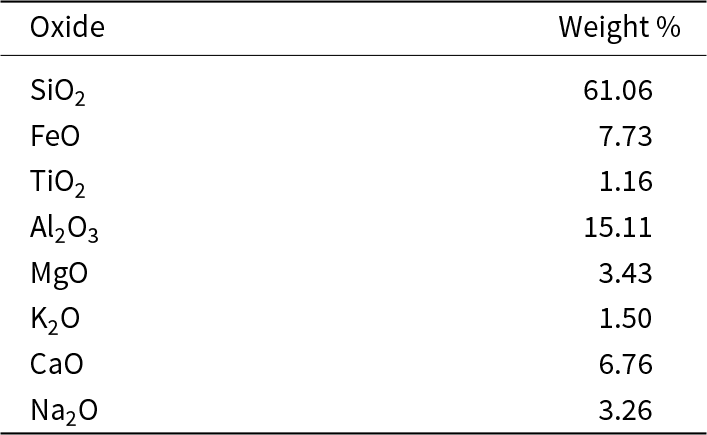
The Southwick Massachusetts fulgurite consists primarily of a groundmass of oxide glass (65%) with lechatelierite (200–400 μm in diameter, compositionally >99% SiO2) dispersed throughout (35%). Accessory phases include spinel and metal grains. The groundmass of the fulgurite was analysed by SEM to constrain its composition (Table 2) and investigate any unusual minerals within the glassy matrix. The general composition of the fulgurite seems to match with the information gathered from the Southwick quadrangle, but the composition is like the nearby Farmington fulgurite, specifically the ‘lower’ glass, albeit with more Al2O3 in the Southwick fulgurite (Table 1). The predominant composition of the protolith of the Southwick fulgurite is a clayey till which tracks with higher Al2O3 percentages in contrast to the Farmington fulgurite. The two fulgurites are compositionally similar if the SiO2 of the Farmington fulgurite is reduced from 75 to 61 wt.%, and all other oxides are increased by 50% by weight (Supplementary Figure S1).
Oxide weight percentage of Southwick Massachusetts fulgurite groundmass glass

Notably, in general the composition of the protolith for most fulgurites closely tracks the composition of the outer glass (a ‘baked’ material), especially for Type II fulgurites (see description below), as the temperature of this ‘baked’ zone does not exceed the temperature of vaporisation of the major rock-forming elements. However volatiles such as organic carbon and water are both depleted during the fulgurite-forming process (e.g. the Winans lake fulgurite, despite forming along a tree root, contained only trace quantities of graphite, see Essene and Fisher, Reference Essene and Fisher1986).
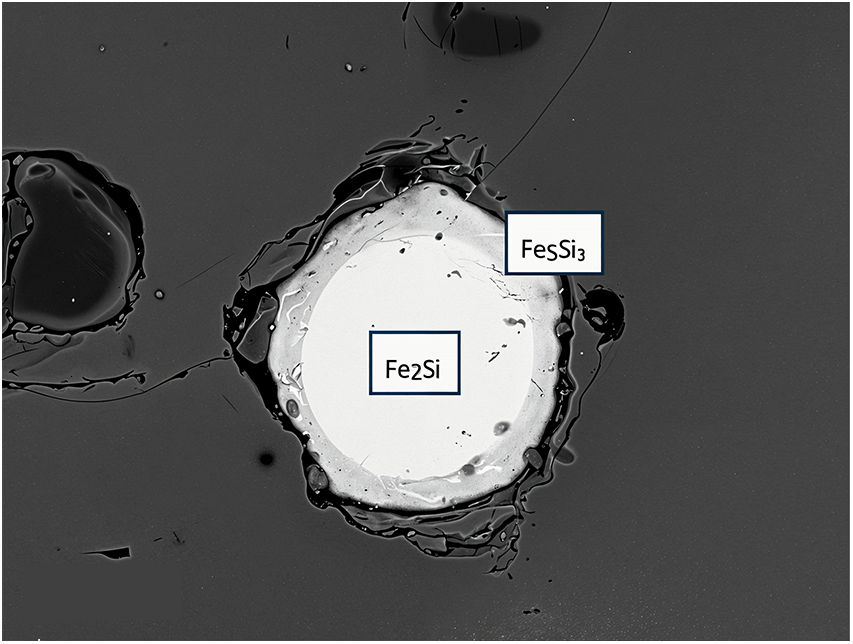
One spherical grain (∼95 μm in diameter) was found to exhibit a reaction rim (Fig. 3) with an outer rim of Fe5Si3 and a core of Fe2Si. This was the only metal spherical grain noted within this section of the fulgurite. Based on SEM EDS data of this grain, the outer rim has an iron atomic percentage of ∼62% whereas the core is close to 67%. For a correct identification, the two phases were handpicked from the polished section and analysed using single-crystal XRD. The outer rim turned out to exhibit a hexagonal symmetry, with a = 6.76(2) Å and c = 4.72(2) Å, closely resembling the mineral xifengite, Fe5Si3. In contrast, the core corresponds to the mineral hapkeite, Fe2Si, with cubic symmetry and cell value of a = 2.85 Å.
Back-scattered electron image of grain of Southwick Massachusetts fulgurite exhibiting a reaction rim. The outer rim is made up of Fe5Si3 and the core is Fe2Si. Sphere diameter is 95 μm, including rim.

Discussion
The iron silicide phases seen in the Southwick Massachusetts fulgurite include an external rind of Fe5Si3 and an internal core of Fe2Si. This section will discuss the potential routes of formation of iron silicides as well as the potential significance of this grain. Following the fulgurite classification system, this fulgurite best fits the Type II archetype of clayey soil being struck by lightning (Pasek et al., Reference Pasek, Block and Pasek2012). Iron silicide in fulgurites generally fall into two groups: iron rich and silicon rich, and most fulgurites bear silicon-rich silicides (Si>Fe by atomic fraction), if any are even present. Iron-rich silicides are more common in extraterrestrial material (Feng et al., Reference Feng, Abbatiello, Omran, Mehta and Pasek2021), but do occur in fulgurites. The fulgurite from Southwick, Massachusetts, falls within the iron-rich category, with iron metal potentially reacting with all reduced silicon prior to the formation of more Si-rich silicides or even elemental silicon.
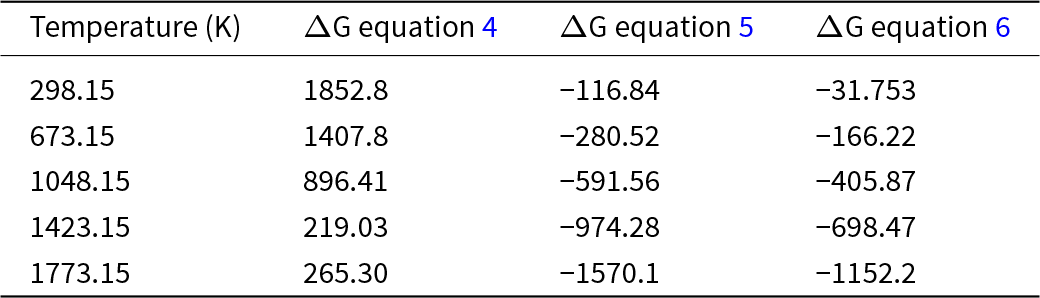
To further understand the mechanisms behind this reaction rim the thermodynamic data (ΔG in kJ/mol) for three possible equations were calculated (Table 3, with full range of values available in Supplementary material). Note that for these calculations we assume a pressure of 1 atm, and since some fulgurites may experience high pressure conditions, that is a limitation of the current model. We also acknowledge that applying thermodynamics to a system that may not have time to reach equilibrium necessarily means that the results predicted from thermodynamics are at best a prediction of reaction direction, and not a direct reflection of reality.
Selected ΔG values for equations 4, 5 and 6

We tested three potential routes for the formation of a Fe5Si3 rind from Fe2Si to see which may be the most plausible. In the first reaction, the internal Fe2Si core may be reacting with SiO2 melt (either as SiO2 melt that later formed lechatelierite that comprises 35% of the fulgurite by volume, or as a component of the groundmass melt), and expelling O2 to the environment.
 \begin{equation}5\text{Fe}_{2}\text{Si}{\text{ }} + {\text{ }}\text{SiO}_{2} \to {\text{ }}2\text{Fe}_{5}\text{Si}_{3} + {\text{ }}\text{O}_{2}\left( \text{g} \right)\end{equation}
The second potential route of formation would follow the reaction:
 \begin{equation}5\text{Fe}_{2}\text{Si}{\text{ }} + {\text{ }}\text{Si}\left( \text{g} \right){\text{ }} \to {\text{ }}2\text{Fe}_{5}\text{Si}_{3}\end{equation}
In this reaction, the Fe2Si core is reacting with silicon gas, through a silicidation reaction. This would parallel the known sulfidation of metals in meteorites (Imae, Reference Imae1994) and the phosphidation of metals, for example within Lunar impact rocks (Gooley et al., Reference Gooley, Brett and Warner1973; Pasek, Reference Pasek2015). Notably, this reaction requires the presence of Si(g), which must have originated from reduction of the soil (e.g. as per Essene and Fisher, Reference Essene and Fisher1986). In addition, equation 5 is similar to equation 4, in as much as SiO2 may break down to Si and O2 gases, through a thermodynamically unfavourable reaction. However, in the presence of organic carbon, the generation of CO and CO2 gas may push the reaction towards products.
The third potential route of formation would be by incongruent melting, but this seems to be the least likely option as a more reduced phase comes from an oxidised phase, and is inconsistent texturally with the sample. That said, such a disproportionation reaction is expected from some reducing environments, such as the formation of awaruite (Bird and Weathers, Reference Bird and Weathers1975, Reference Bird and Weathers1979). Incongruent melting of minerals within fulgurites has also been reported for zircons (Kenny and Pasek, Reference Kenny and Pasek2021).
 \begin{equation}3\text{Fe}_{2}\text{Si}{\text{ }} \to {\text{ }}\text{Fe}_{5}\text{Si}_{3} + {\text{ }}\text{Fe}\end{equation}
The rind we see is more appropriately termed a reaction rim. A reaction rim signifies a secondary mineral that forms a rim around a primary grain. Possible causes of formation of these reaction rims are: (1) early formed crystal reactions with a melt; (2) solid-state reactions with an intergranular fluid such as gas; (3) magmatic accretion from a different liquid; and (4) solid-state reactions between grains adjacent to primary during thermal or regional metamorphism (Spry, Reference Spry2013).
Reaction rims can be found as a simple single layer surrounding a grain. A prime example of this is the serpentinisation process where serpentine minerals form through water/rock interaction and begin encrusting olivine grains in peridotite (Cuthbert, Reference Cuthbert1990). Reaction rims can also form in a complex process with an assemblage of minerals. For example, one clearly defined rim from Griffin and Heier (Reference Griffin and Heier1973) showed an olivine grain (rimmed by accessory minerals such as orthopyroxene, clinopyroxene, garnet and spinel) next to a plagioclase grain. Following the initial growth structure, garnet began to propagate outwards and enveloped the previous rims (with previous grains becoming inclusions) with clinopyroxene forming. The final stages of this reaction rim combine the reactions of water, garnet and clinopyroxene to form a hornblende layer.
Seemingly, the closest mechanism that describes this fulgurite’s reaction rim is a reaction between adjacent grains during thermal metamorphism. The thermal aspect could be attributed to the intense heat from the lightning strike. As such, this lightning-induced melting may be similar to prior reports of lightning-struck rocks (Castro et al., Reference Castro, Keller, Feisel, Lanari, Helo, Mueller, Schipper and Thomas2020). It may also be possible that the lightning strike created a reducing environment further promoting the reduction from core to rim species. Based on thermodynamic data, the most likely reaction is the silicidation reaction in equation 5. This reaction requires a very low fO2 (Essene and Fisher, Reference Essene and Fisher1986 estimate an fO2 between 10–18 to 10–13 at 1700 K).
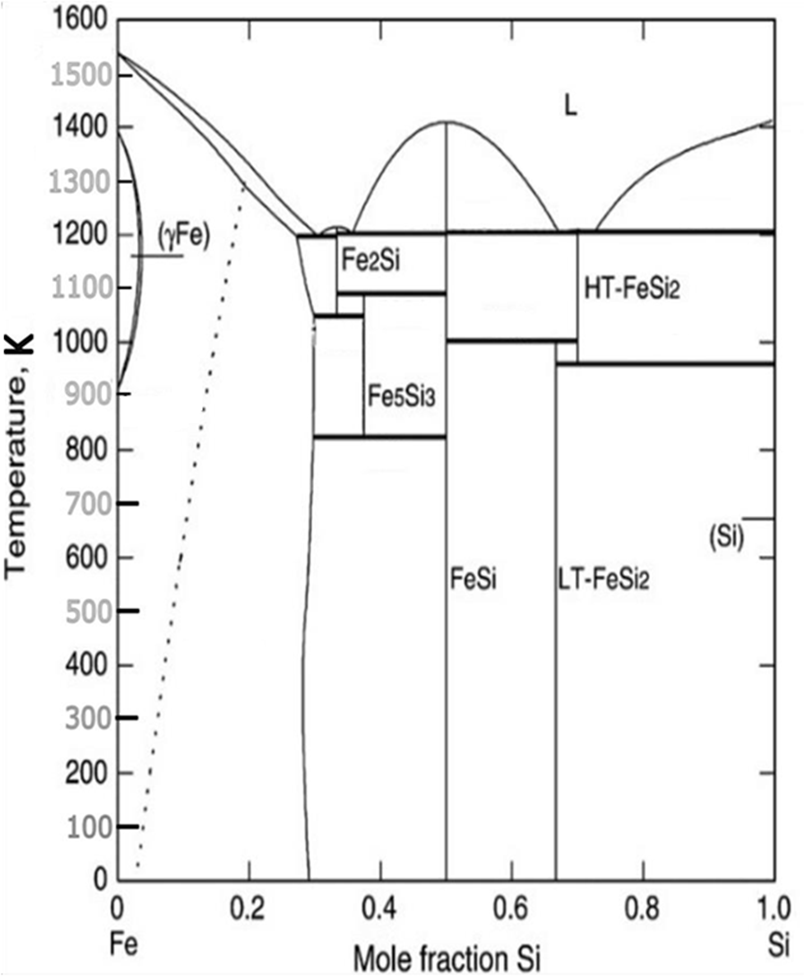
We favour equation 5, in which silicon gas reacts with iron silicides to generate new iron silicides. Equation 5 is an exergonic reaction (Table 3), and we also expect increasing silicidation with higher pressure as temperatures increase (which results in a favouring of the products because gas is a reactant in equation 5, vs. a product in equation 4). Pressure may also increase due to shock (Chen et al., Reference Chen, Elmi, Goldsby and Gieré2017). We base this on the Fe–Si phase diagram for these phases (Fig. 4). From this figure it is apparent that Fe2Si is a higher temperature phase than Fe5Si3, with Fe2Si being stable from 1317–1476 K, whereas Fe5Si3 is stable from 1093–1364 K. Given that the other major occurrence of rinds due to incongruent melting in fulgurites is on zircon with rinds of baddeleyite (ZrSiO4 = ZrO2 + SiO2) (e.g. Pasek et al., Reference Pasek, Block and Pasek2012; Kenny and Pasek, Reference Kenny and Pasek2021), these rinds form because of the high-temperature phase forming a rind on the low-temperature phase. The occurrence of Fe5Si3 as a rind on Fe2Si is the opposite.
Calculated Fe–Si phase diagram according to the modelling by Lacaze and Sundman (Lacaze and Sundman, Reference Lacaze and Sundman1991) and modified from Liang et al. (Reference Liang, Shang, Wang, Wang, Ye, Lin, Chen and Liu2011).

As a ‘sanity check’ we contrast the sphere in Fig. 3 to known metal gas–solid kinetics (e.g. oxidation, see Supplementary material). Metals generally follow a parabolic rate law during gas–solid reactions (Monceau and Pieraggi, Reference Monceau and Pieraggi1998), where the mass gained per surface area is proportional to the square root of the reaction time. If we assume a reaction time of one second, then for a sphere with a 100 μm diameter, we find a requirement of a parabolic rate constant of ∼5×10⁻⁶ kg2/m4s. This rate constant matches measurements of the parabolic rate constant for iron phosphidation (Sasaki, Reference Sasaki1985) at high temperature and, probably, under high pressure (see Supplementary Material), as unfortunately metal silicidation rates have not been measured as robustly. However, the silicidation of metal should be reasonable under these timescales.
Conclusions
Iron silicides have been known from fulgurites since their discovery by Essene and Fisher (Reference Essene and Fisher1986) in the Winans Lake fulgurite from Michigan, USA. These materials clearly indicate highly reducing conditions during the formation of a fulgurite from a lightning strike, usually from combusting organic matter. The likely driver of the reduction in the Southwick fulgurite is similarly combusting organic matter, which drives the oxidation state to extreme reduction, though no organic material was found within the Southwick fulgurite. Organic material has however been observed in other fulgurites, in the form of graphite (Essene and Fisher, Reference Essene and Fisher1986), fullerenes (Daly et al., Reference Daly, Buseck, Williams and Lewis1993), polycyclic aromatic hydrocarbons (Carter et al., Reference Carter, Pasek, Smith, Kee, Hines and Edwards2010; Elmi et al., Reference Elmi, Chen, Goldsby and Gieré2017) and partially graphitised carbon (Feng et al., Reference Feng, Lang and Pasek2019). It seems likely that a similar organic driver promoted reduction of the matrix to Fe2Si and Fe5Si3 in the Southwick fulgurite.
The fortuitous discovery of a Fe5Si3 rind on an Fe2Si core within the Southwick fulgurite may give clues as to how these minerals are generated during a lightning strike. We note that, as only one grain was observed within this fulgurite, silicides may form by an assortment of other processes, however for this grain, we propose that the most likely pathway for this grain’s formation is through silicidation of existing iron silicides. This sphere probably formed through gas–solid reactions in the cooling lightning plasma channel. Silicides are unstable at the peak temperatures of lightning forming a fulgurite (>1800K), and hence they had to form as the fulgurite cools. The initial Fe2Si phase probably formed under extremely reduced conditions somewhere between the iron–wüstite and the silicon–silica buffers, and probably favoured this composition due to the lower SiO2 abundance of the protolith. For example, Feng et al. (Reference Feng, Abbatiello, Omran, Mehta and Pasek2021) track Fe–Si composition in fulgurites compared to groundmass composition, finding that fulgurites with ∼60 wt.% or less SiO2 tend to have more Fe-enriched silicides (where Fe>Si by atomic fraction), whereas those with >70% SiO2 tend to have Si-enriched silicides.
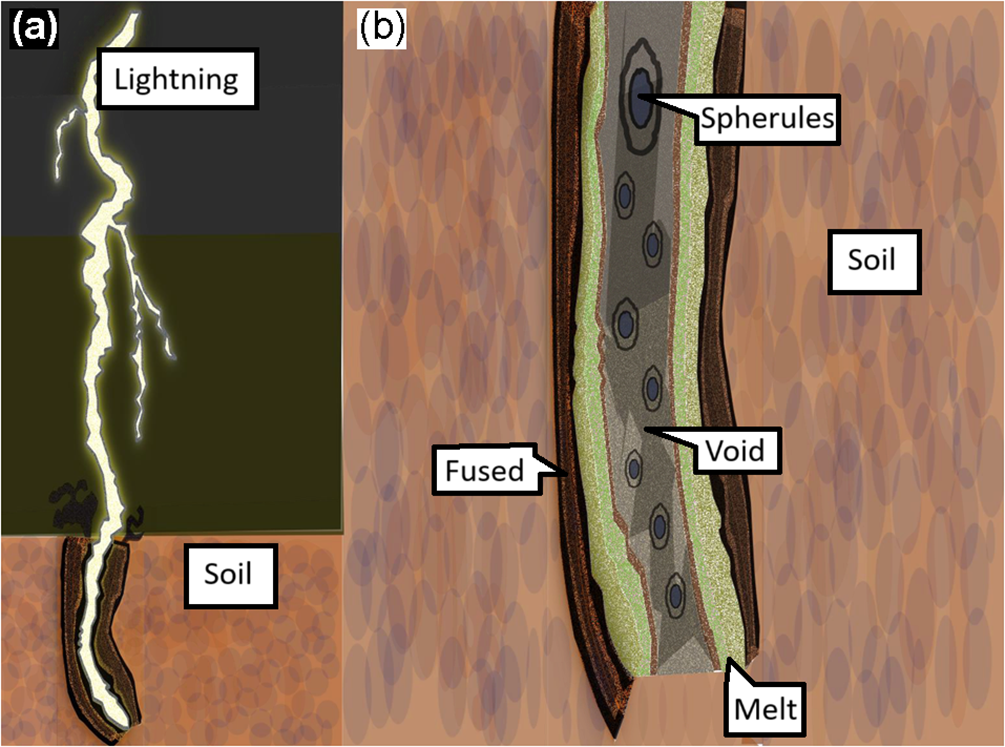
We present a simple illustration of the likely formation process for these grains (Fig. 5). In this process, lightning strikes and propagates through soil (Fig. 5a), vaporising a portion of the soil. As this gas cools, grains rich in iron metal, possibly solidify as Fe2Si or are formed as liquid droplets (Fig. 5b). These droplets then react with Si in the gas, forming the Fe5Si3 rind around the Fe2Si. After a few seconds the fulgurite cools and the gas condenses as a glass, entraining the silicides within the glassy matrix. This may also suggest that, as the fulgurite cools, the gas may have become more reducing, given that the silicon content of the grain increased in the formation of the reaction rim. This may have been due to separation of oxygen from the environment, perhaps as an expelling of CO2.
An illustration showing: (a) lightning striking and propagating through soil; the lightning vaporizes a portion of the soil leaving a void space and Si gas; (b) as this gas cools, iron-metal rich grains, possibly as Fe2Si solidify or are formed as liquid droplets, these droplets then react with Si in the gas, forming the Fe5Si3 rind around the Fe2Si; after a few seconds the fulgurite cools and a majority of the gas condenses as a glass, entraining the silicides within the glassy matrix.

This reaction sequence may explain at least some of the silicides found in fulgurites (but probably not all). Iron silicides in fulgurites can form by reaction of gas with a condensed phase (most likely solid iron metal), and the Southwick fulgurite seems to be capturing one grain in the process of this reaction. Notably, gas–solid reactions can be extremely fast, and similar rinds (∼10 μm in diameter) have been found in lunar impact rocks, suggesting a timescale of seconds, and reaction kinetics—at least for P reacting with Fe—would reasonably form rinds of the size observed in the Southwick fulgurite.
Supplementary material
The supplementary material for this article can be found at https://doi.org/10.1180/mgm.2024.108.
Acknowledgements
J.A. and M.A.P. were supported by NASA Emerging Worlds grant (80NSSC18K0598). The authors thank T. Feng for helpful discussion.
Competing interests
The authors declare no competing interests.