INTRODUCTION
Patients with advanced cancer often have numerous symptoms that are physical, psychosocial, and existential in nature (Strömgren et al., Reference Strömgren, Niemann and Tange2014; Kurita et al., Reference Kurita, Tange and Farholt2013; Holtan et al., Reference Holtan, Aass and Nordoy2007; van den Beuken-van Everdingen et al., Reference van den Beuken-van Everdingen, de Rijke and Kessels2007; Mercadante et al., Reference Mercadante, Roila and Berretto2008; Breivik et al., Reference Breivik, Cherny and Collett2009; Cleeland et al., Reference Cleeland, Gonin and Hatfield1994; Caraceni & Portenoy, Reference Caraceni and Portenoy1999; Klepstad et al., Reference Klepstad, Kaasa and Cherny2005; Caraceni et al., Reference Caraceni, Martini and Zecca2004; Lundorff et al., Reference Lundorff, Peuckmann and Sjøgren2008; Gotze et al., Reference Gotze, Brahler and Gansera2014; Boston et al., Reference Boston, Bruce and Schreiber2011). A high prevalence of unmet needs, symptom overload, and inadequate treatment in this population have been observed (Johnsen et al., Reference Johnsen, Petersen and Pedersen2009), which demonstrates an important demand for taking the many dimensions of suffering into account. In this context, specialized palliative care (SPC) is the current response to meet patients' needs utilizing a holistic approach to care.
The European Association for Palliative Care (EAPC), the World Health Organization (WHO), and the International Association for Hospice & Palliative Care (IAHPC) emphasize that SPC aims to support patients and relatives, to alleviate symptoms, and to attain the best possible quality of life (QoL) with a multi-professional and interdisciplinary approach (Radbruch et al., Reference Radbruch and Payne2009; World Health Organization, 2016; Sepulveda et al., Reference Sepulveda, Marlin and Yoshida2002; Doyle & Woodruff, Reference Doyle and Woodruff2013). An EAPC white paper described important factors for successful outcomes in home-based SPC and stressed that an SPC team should have expertise in pain management, symptom control, palliative care, and psychosocial support based on specialized training in palliative care (Radbruch et al., Reference Radbruch and Payne2009). Most often, home-based SPC is provided by nurses and/or physicians with or without connection to a hospital or hospice. The SPC team should also include a psychologist to provide psychosocial support to both patient and family members. Finally, informal caregivers, community help care, and insurance/financial status are in some cases important factors for achieving successful home-based SPC.
Home-based SPC seems to be a particularly advantageous approach for patients with different chronic diseases (e.g., advanced cancer, congestive heart failure, chronic obstructive pulmonary disease) according to a recent systematic review (Gomes et al., Reference Gomes, Calanzani and Curiale2013a ). Reduction of symptom burden and increased odds of dying at home were observed in patients who received home-based SPC in comparison with those who received the usual care regime (odds ratio = 2.21) (Gomes et al., Reference Gomes, Calanzani and Curiale2013a ). Studies including mixed populations and different settings have described the positive effects of SPC, such as increased patient satisfaction, enhanced QoL, symptom improvement, fewer hospitalizations, and a higher frequency of dying at home (Brumley et al., Reference Brumley, Enguidanos and Jamison2007; Rabow et al., Reference Rabow, Dibble and Pantilat2004; Hanks et al., Reference Hanks, Robbins and Sharp2002; Follwell et al., Reference Follwell, Burman and Le2009; Zimmer et al., Reference Zimmer, Groth-Juncker and McCusker1985; Groh et al., Reference Groh, Vyhnalek and Feddersen2013); however, heterogeneous outcomes challenge interpretation of the effectiveness of home-based SPC for patients with advanced cancer.
Most patients (50–90%) with advanced cancer in Europe prefer to be cared for and die in their own homes (OECD, 2010; Higginson & Sen-Gupta, Reference Higginson and Sen-Gupta2000). In contrast, the proportion of patients dying in their own homes is small (Gomes et al., Reference Gomes, Higginson and Calanzani2012; Cohen et al., Reference Cohen, Houttekier and Onwuteaka-Philipsen2010; Reference Cohen, Bilsen and Addington-Hall2008; Abel et al., Reference Abel, Pring and Rich2013; Gomes & Higginson, Reference Gomes and Higginson2008). A recent cross-national study showed that 18–46% of patients with cancer in 9 European countries died at home (Cohen et al., Reference Cohen, Pivodic and Miccinesi2015). Patients' preferences for care and dying at home were among the key factors associated with obtaining the opportunity to die at home (Gomes & Higginson, Reference Gomes and Higginson2006), and studies have indicated that home-based SPC can reduce the number of deaths at hospitals as well as the number of readmissions (Bruera et al., Reference Bruera, Neumann and Gagnon1999; Hughes et al., Reference Hughes, Weaver and Giobbie-Hurder2000; Costantini et al., Reference Costantini, Higginson and Boni2003; Miccinesi et al., Reference Miccinesi, Crocetti and Morino2003).
In the future, it is expected that patients with cancer will live longer (von Hoff et al., Reference von Hoff, Ervin and Arena2013; Office for National Statistics, 2014; Slattery et al., Reference Slattery, Herrick and Mullany2015) due to more effective treatment options; consequently, the number of patients referred to SPC will increase (Temel et al., Reference Temel, Greer and Muzikansky2010), and home-based SPC may probably be a significant resource with which to address this burgeoning population. The present systematic literature review aimed at providing an overview on the available information about the organization, on the composition of the staff, and on the outcomes of home-based SPC services for patients with advanced cancer. Outcomes as place of death, survival time, QoL, performance status (PS), and symptom management were assessed.
METHODS
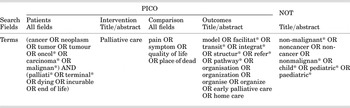
We followed the PICO process framework (patient, intervention, comparison, and outcome) for the search strategy and included both MeSH terms and free-text words (Table 1). Searches were performed in the PubMed and EMBASE electronic databases, as well as the Cochrane Central Register of Controlled Trials (CENTRAL), and encompassed the period from January 1, 2000, to January 27, 2015. Searches were limited to English-language articles and research on human subjects. The retrieved abstracts were transferred to EndNote version X5 (Thomson Reuters, New York), where duplicate abstracts were excluded. The reference lists of relevant articles were reviewed to identify any further studies.
Search strategy

Selection Procedure and Analysis
Retrieved abstracts were read, and then the inclusion and exclusion criteria were applied. Abstracts that were unclear were selected for full reading before inclusion/exclusion. The inclusion and exclusion criteria were rechecked during the reading of full articles.
Selected full articles were read and analyzed. Our analysis focused on study design, content of home-based SPC services, and patient outcomes.
Doubts regarding classification were discussed among the coauthors until a consensus was obtained. The reduced number of articles and design/methods differences precluded any attempt at a refined statistical analysis.
Selection Criteria
The studies included in the present review were meant to investigate home-based SPC provided to adult patients (≥18 years or a mean age of samples reflecting adults) with advanced cancer and to describe the healthcare professionals involved. Patients were considered to have advanced cancer if the cancer was metastatic or incurable, or if patients were judged to have a short life expectancy. SPC should primarily be home-based, and articles were excluded if the patients were described as outpatients and/or “home” was not mentioned as the primary setting for the treatment and care delivered by the SPC team. The composition of the SPC team had to include at least a doctor or a nurse.
Studies had to contain data on relevant patient outcomes (place of death, survival time, QoL, PS, and/or symptom management) and written in the English language. Studies were excluded if the sample size was less than 20 patients, or if they were retrospective studies, included mixed-disease populations without separate information regarding cancer diagnoses, or involved mixed-care places without separate information regarding home care. Further, duplicate publications and conference abstracts were excluded.
RESULTS
Search Numbers
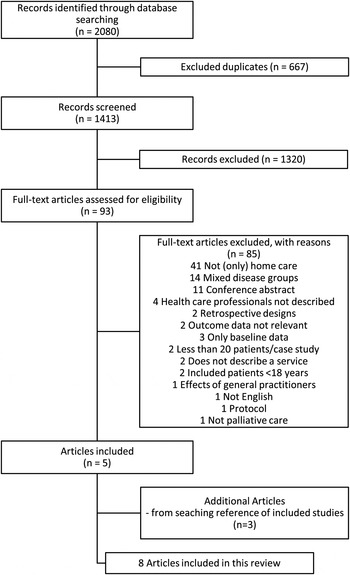
The number of abstracts screened was 1413. A total of 93 articles were selected for full reading, out of which 5 were selected for our analysis. Three additional articles were identified from the reference lists of the included studies, yielding a total of eight relevant articles/studies. The most frequent reasons for exclusion were: mixed places of care without separate information on home care, mixed cancer/noncancer populations, and/or missing information regarding the composition of the SPC team (Figure 1).
PRISMA flowchart.

Study Design
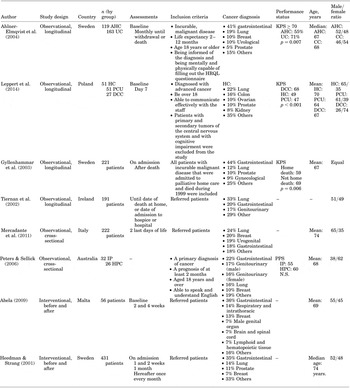
Six studies were observational (four longitudinal and two cross-sectional) and two interventional (before and after). The number of included patients varied from 56 to 431 (see Table 2). In one study, the number of included patients was guided by a power calculation (Ahlner-Elmqvist et al., Reference Ahlner-Elmqvist, Jordhoy and Jannert2004). First follow-up after enrollment varied from one week to a month, or death (Table 2). The majority of the studies were European, and one was Australian (Table 2).
Studies' and baseline characteristics

– = information not available; KPS = Karnofsky Performance Status (Karnofsky & Burchenal, Reference Karnofsky, Burchenal and MacLeod1949); PPS = Palliative Performance Scale (Anderson et al., Reference Anderson, Downing and Hill1996); AHC = advanced home care.; UC = usual care; HC = home care; PCU = palliative care unit; DCC = day care center; IP = inpatients; HPC = home-based palliative care patients; N.S. = no significant difference.
Patient Characteristics
The sample inclusion criteria were incurable/advanced cancer or a short life expectancy. Four studies did not report inclusion criteria; however, they included patients referred to SPC. The sociodemographics are described in Table 2. Gastrointestinal cancers were the most frequent diagnostic group (18–44%), followed by lung cancer (12–33%). The Karnofsky Performance Status (KPS) Scale (Karnofsky & Burchenal, Reference Karnofsky, Burchenal and MacLeod1949) and the Palliative Performance Scale (PPS) (Anderson et al., Reference Anderson, Downing and Hill1996) were employed to assess performance status. Two studies showed a difference in KPS scores across settings at baseline. The study using the PPS observed no between-group difference at baseline (Table 2).
Home-Based Specialized Palliative Care Team
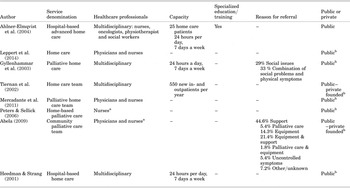
Multidisciplinary SPC teams were described in four studies. Only physicians and nurses comprised the teams in three studies. Team composition was unclear in one study. Only one study described the training of staff. The service was free of charge for patients in all studies. Two studies described the reasons for referral to SPC (Table 3).
Home-based SPC service

– = information not available; a = only team members mentioned in articles, there might be more healthcare professionals involved; b = judged public or private by the authors of the present review.
Outcomes
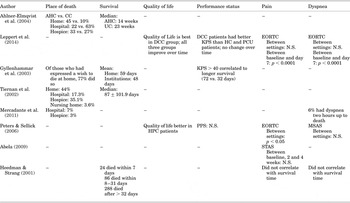
The studies had various outcomes, places of death, survival, QoL, and PS. Forty-four to 90% of the patients who received home-based SPC died at home. Regarding survival, the studies included patients at different phases in the disease trajectory. One study found that home-based SPC did not provide longer overall survival compared to standard care (Table 4).
Patient-related outcomes

– = information not available or not analyzed in the study; AHC = advanced home care; UC = usual care; HC = home care; PCU = palliative care unit; DCC = day care center; HPC = home-based palliative care patients; KPS = Karnofsky Performance Status (Karnofsky & Burchenal, Reference Karnofsky, Burchenal and MacLeod1949).; PPS = Palliative Performance Scale (Anderson et al., Reference Anderson, Downing and Hill1996); EORTC = EORTC QLQ–C15–PAL (Groenvold et al., Reference Groenvold, Petersen and Aaronson2006); MSAS = Memorial Symptom Assessment Scale (Portenoy et al., Reference Portenoy, Thaler and Kornblith1994); STAS = Support Team Assessment Schedule (Edmonds et al., Reference Edmonds, Stuttaford and Penny1998); settings = Leppert et al., Reference Leppert, Majkowicz and Forycka2014 = home, palliative care inpatient unit, and day care center; Peters & Sellick, Reference Peters and Sellick2006 = home and palliative care inpatient unit; – = information not available or not analyzed in the study; N.S. = no significant difference.
The level of QoL diverged among the patient populations of the included studies. One study showed better QoL in patients receiving home-based SPC compared to inpatients at a palliative care unit (p < 0.01, Global QoL, EORTC QLQ-C30 [Aaronson et al., Reference Aaronson, Ahmedzai and Bergman1993]). Another study showed better QoL in patients followed at a day care center compared to QoL for patients receiving home-based SPC and in inpatients at an SPC unit. Nevertheless, all groups improved over time (p < 0.0001, EORTC QLQ–C15–PAL [Groenvold et al., Reference Groenvold, Petersen and Aaronson2006]). Better KPS scores were also observed in patients at the day care center (p < 0.0001), and longer survival was related to higher KPS scores in one observational study. The PPS scores in one observational study did not show any difference between patients receiving home-based SPC and inpatients at an SPC unit (Table 4).
Half the studies assessed pain and dyspnea. Significant improvement in pain relief was observed in two studies. One described decreased pain intensity over time in favor of home-based SPC compared to inpatients on an SPC unit. However, no significant correlation between pain and survival time was observed in patients in home-based SPC (Table 4). Dyspnea improved over time, but no significant difference was observed between settings (Table 4).
DISCUSSION
Previous reviews have mainly attempted to gather information regarding symptom management and place of death as the primary outcomes of SPC interventions. However, they have included mixed populations composed of inpatients, outpatients, and home-based care patients suffering from several different diseases and with varied disease trajectories (Davis et al., Reference Davis, Temel and Balboni2015; Gomes et al., Reference Gomes, Calanzani and Curiale2013a ; Zimmermann et al., Reference Zimmermann, Riechelmann and Krzyzanowska2008; Luckett et al., Reference Luckett, Davidson and Lam2013; Mercadante et al., Reference Mercadante, Valle and Porzio2011). We therefore intended to review the literature with a sharp focus on patients with advanced cancer receiving home-based SPC.
For the present review, no randomized controlled trials were identified. In addition, an absence of information regarding service organization and the multidisciplinarity of home-based SPC was noted. In most studies, it was not clear whether or not the service was organized according to, for example, the recommendations of the EAPC and/or WHO (Sepulveda et al., Reference Sepulveda, Marlin and Yoshida2002; Radbruch et al., Reference Radbruch and Payne2009). Thus, the articles of the present review did not specify which kind of care was provided.
The inclusion criteria varied among the studies, as the patients had advanced/incurable cancer or a life expectancy below one year (Leppert et al., Reference Leppert, Majkowicz and Forycka2014; Gyllenhammar et al., Reference Gyllenhammar, Thoren-Todoulos and Strang2003; Peters & Sellick, Reference Peters and Sellick2006; Ahlner-Elmqvist et al., Reference Ahlner-Elmqvist, Jordhoy and Jannert2004). Not all studies used the term “advanced cancer” but described the cancer as metastatic or incurable or stated that the patients were judged to have a short life expectancy (Ahlner-Elmqvist et al., Reference Ahlner-Elmqvist, Jordhoy and Jannert2004; Gyllenhammar et al., Reference Gyllenhammar, Thoren-Todoulos and Strang2003; Peters & Sellick, Reference Peters and Sellick2006; Heedman & Strang, Reference Heedman and Strang2001). Other articles used the term “advanced cancer” without any definitions (Leppert et al., Reference Leppert, Majkowicz and Forycka2014; Tiernan et al., Reference Tiernan, O'Connor and O'Siorain2002; Mercadante et al., Reference Mercadante, Valle and Porzio2011) or just included patients referred to palliative care (Abela, Reference Abela2009), which implied that the patients had advanced cancer. None of the studies described what they considered “incurable” or how they assessed life expectancy. In other studies, patients had already been referred to SPC (Tiernan et al., Reference Tiernan, O'Connor and O'Siorain2002; Mercadante et al., Reference Mercadante, Valle and Porzio2011; Abela, Reference Abela2009; Heedman & Strang, Reference Heedman and Strang2001). Thus, in this respect, the characterizations of the population were vague. The mean/median age in all studies was above 60 years, and the effects of home-based SPC may have had a different effect on a younger population. Further, most patients had gastrointestinal or lung cancer. Consequently, the outcomes from these studies may have varied if other cancer diagnoses had been more numerously represented.
Home-based SPC seemed to have an impact on patient outcomes. Four studies reported place of death. Generally, home death is considered a proxy for high-quality home-based SPC (Gomes et al., Reference Gomes, Calanzani and Gysels2013b ). A review by Gomes et al. (Reference Gomes, Calanzani and Gysels2013b ) found that the majority of people with advanced/metastatic cancer prefer to die at home. Home was the most frequent place of death in all four studies that assessed place of death (range 44 to 90%) (Ahlner-Elmqvist et al., Reference Ahlner-Elmqvist, Jordhoy and Jannert2004; Mercadante et al., Reference Mercadante, Valle and Porzio2011; Gyllenhammar et al., Reference Gyllenhammar, Thoren-Todoulos and Strang2003; Tiernan et al., Reference Tiernan, O'Connor and O'Siorain2002). Interestingly, one of these four studies demonstrated that patients' wishes to die at home were a strong predictor for actually dying at home (Gyllenhammar et al., Reference Gyllenhammar, Thoren-Todoulos and Strang2003).
The studies analyzed were not designed to investigate the impact of home-based SPC on overall survival. Nevertheless, one study compared usual care with home-based SPC and found that patients receiving home-based SPC had shorter overall survival times (Ahlner-Elmqvist et al., Reference Ahlner-Elmqvist, Jordhoy and Jannert2004). However, the two patients groups had different KPS scores and times from diagnosis to inclusion (Ahlner-Elmqvist et al., Reference Ahlner-Elmqvist, Jordhoy and Bjordal2008) at baseline, making any comparison between the groups questionable. Thus, the patients in home-based SPC may have been of generally poorer health and with lower PS compared to patients in standard care, which may interfere with interpretation of outcomes. In three other studies, all the patients received home-based SPC, not allowing for a comparison between different interventions (Gyllenhammar et al., Reference Gyllenhammar, Thoren-Todoulos and Strang2003; Tiernan et al., Reference Tiernan, O'Connor and O'Siorain2002; Heedman & Strang, Reference Heedman and Strang2001). Finally, the patient populations were included at different timepoints along their disease trajectory (Ahlner-Elmqvist et al., Reference Ahlner-Elmqvist, Jordhoy and Jannert2004; Gyllenhammar et al., Reference Gyllenhammar, Thoren-Todoulos and Strang2003; Tiernan et al., Reference Tiernan, O'Connor and O'Siorain2002; Heedman & Strang, Reference Heedman and Strang2001), which made general conclusions about survival purely speculative.
QoL and PS diverged among the studies that analyzed these two parameters (Leppert et al., Reference Leppert, Majkowicz and Forycka2014; Gyllenhammar et al., Reference Gyllenhammar, Thoren-Todoulos and Strang2003; Peters & Sellick, Reference Peters and Sellick2006). Patients with better KPS scores and high QoL were in day care centers and not in home-based SPC (Leppert et al., Reference Leppert, Majkowicz and Forycka2014). In the study where PPS scores were the same in home-based and inpatients on an SPC unit, the patients in home-based SPC had better QoL compared to the inpatients (Peters & Sellick, Reference Peters and Sellick2006). It seems likely that receiving home-based SPC has a positive effect on QoL. Of course, this effect may not exclusively be due to the care service provided, but it could also be the result of the presence of supportive relatives, which is actually a key point in home-based SPC.
Symptom management was assessed in seven articles (Peters & Sellick, Reference Peters and Sellick2006; Leppert et al., Reference Leppert, Majkowicz and Forycka2014; Gyllenhammar et al., Reference Gyllenhammar, Thoren-Todoulos and Strang2003; Tiernan et al., Reference Tiernan, O'Connor and O'Siorain2002; Mercadante et al., Reference Mercadante, Valle and Porzio2011; Abela, Reference Abela2009; Heedman & Strang, Reference Heedman and Strang2001), where pain and dyspnea were the most frequently assessed symptoms (Peters & Sellick, Reference Peters and Sellick2006; Leppert et al., Reference Leppert, Majkowicz and Forycka2014; Heedman & Strang, Reference Heedman and Strang2001; Abela, Reference Abela2009; Mercadante et al., Reference Mercadante, Valle and Porzio2011). The assessment involving pain measurement had different aims and resulted in a mixture of diverse variables. Home-based SPC seemed to be capable of improving pain control over time (Leppert et al., Reference Leppert, Majkowicz and Forycka2014), while a comparison between groups with/without home-based SPC and correlation with survival yielded conflicting results or did not show any specific effect of home-based SPC (Leppert et al., Reference Leppert, Majkowicz and Forycka2014; Peters & Sellick, Reference Peters and Sellick2006; Heedman & Strang, Reference Heedman and Strang2001).
CONSIDERATIONS AND LIMITATIONS
In the present review, studies before the year of 2000 were not included as the state-of-the-art research should be done within a limited and recent time period since SPC is continuously developing. Despite the lack of knowledge regarding home-based SPC in noncancer patients, which can be considered a limitation of the present study, we decided only to focus on studies that included patients with advanced cancer in home-based SPC, as these patients maybe have other effects of home-based SPC than non-cancer patients. A mix of different diseases might result in an unproductive analysis due to the diversity of patient characteristics, disease trajectory, survival time, comorbidities, and treatment needs. Further, there is little information in the literature about home-based SPC in patients with cancer. Nevertheless, it is widely considered in oncology to be advantageous with regard to patients' and family members' satisfaction, to patients' QoL, and to the reduction of expenses associated with hospitalizations. Other settings or locations of care may also have an impact on the effect of SPC. It should be noted that none of the present researchers were authors of any of the included studies.
Unfortunately, the available evidence regarding home-based SPC is still nascent, and no strong conclusions can be drawn at this point in time. Further, there might be a publication bias, as studies with negative results may not have been published. Out of the eight studies found, only one was non-European, which may be due to the extensive focus and longer tradition of palliative care for cancer patients in Europe, thus encouraging the predominantly governmental healthcare systems in most European countries to find solutions to optimize treatment and reduce costs. However, the present review, even with small sample sizes and varied designs, still delivers some understanding of the complexity of home-based SPC.
FUTURE DIRECTIONS
There is a lack of information regarding home-based SPC, and more studies in this area (descriptive/observational, etc.) are needed. In addition, randomized controlled trials with validated outcome measures of different models are required to generate scientific evidence, including the impact of home-based SPC on patient and caregiver outcomes as well as cost-effectiveness data. The EAPC Task Force on Outcome Measurement recently recommended using multidimensional patient-reported outcome measures (PROMs) that have been validated in relevant populations in order to capture the holistic nature of SPC (Bausewein et al., Reference Bausewein, Daveson and Currow2016).
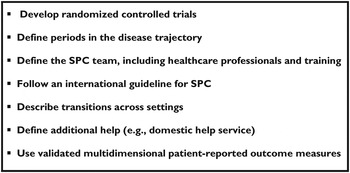
Another important aspect observed in our review was the lack of consistency of inclusion criteria. One solution for future studies could be to include patients with no or limited antineoplastic treatment options or patients who have resigned antineoplastic treatment (Nordly et al., Reference Nordly, Benthien and von der Maase2014; Benthien et al., Reference Benthien, Nordly and Videbaek2015). Additional inclusion criteria already used in clinical practice could be symptom load and palliative care needs. Also desirable would be a better description of the organization of home-based SPC, with more details about staff composition and the care strategy plan. These and other suggestions about how to improve the information gathered in future studies are listed in Figure 2.
Suggestions for further research in home-based specialized palliative care for patients with advanced cancer.

CONCLUSION
There is a lack of data on organizational practice and outcomes regarding home-based SPC for patients with advanced cancer, resulting in a lack of evidence for its effectiveness. There is also a lack of information related to a description of home-based SPC organization and characterization of the patient population at the time of inclusion or referral. The effects of home-based SPC on place of death, symptom control, QoL, and performance status were inconsistent. However, a majority of the patients who received home-based SPC died at home. Pain and dyspnea were the two most frequently reported symptoms, and home-based SPC seemed to be capable of improving pain control over time, but it only had positive effects on dyspnea in one study. The outcomes of home-based SPC might have looked different if age and cancer diagnosis had been distributed differently. Generally, home-based SPC seems to have a positive effect on pain and dyspnea, but more high-quality studies are certainly required.
CONFLICTS OF INTEREST
The authors hereby declare that they have no conflicts of interest to report.