Maintaining high hand hygiene compliance is particularly challenging in a healthcare setting. Although many evaluations have demonstrated success with short-term interventions,Reference Price, MacDonald, Gozdzielewska, Howe, Flowers, Shepherd, Watt and Reilly1,Reference Luangasanatip, Hongsuwan and Limmathurotsakul2 sustaining high levels of compliance over multiple years has proven to be much more difficult. In addition, hand hygiene compliance has long been plagued by concerns over measurement bias as well as a lack of a directly applied intervention that improves compliance in a sustainable fashion. We previously reported on a program that utilizes frontline healthcare personnel (HCP) across multiple disciplines to conduct observations and provide real-time feedback to each other.Reference Sickbert-Bennett, DiBiase, Willis, Wolak, Weber and Rutala3,Reference Sickbert-Bennett, DiBiase, Schade Willis, Wolak, Weber and Rutala4 Here, we describe the patterns of real-time feedback delivery among HCP as an improvement strategy that has been sustained over a nearly 3-year period.
Methods
At a 914-bed academic hospital, in September 2013 all frontline staff began conducting hand hygiene compliance observations of each other as they traveled “in” and “out” of patient-care areas to provide care to a patient or to interact with the patient’s environment. In 2014, staff also began reporting on their delivery of real-time feedback in the form of both compliments on performing hand hygiene and reminders, either just in time to prevent a missed opportunity or, if not possible, a reminder immediately after a missed opportunity to encourage a change in behavior. All data were collected using an electronic data collection tool, and all staff members were invited to participate. Data elements collected included job classification of the staff member conducting the observation, the job classification of the staff member who was observed, assessment of compliance of the opportunity, and the type of feedback that was delivered with the observation (none, reminder, or compliment).
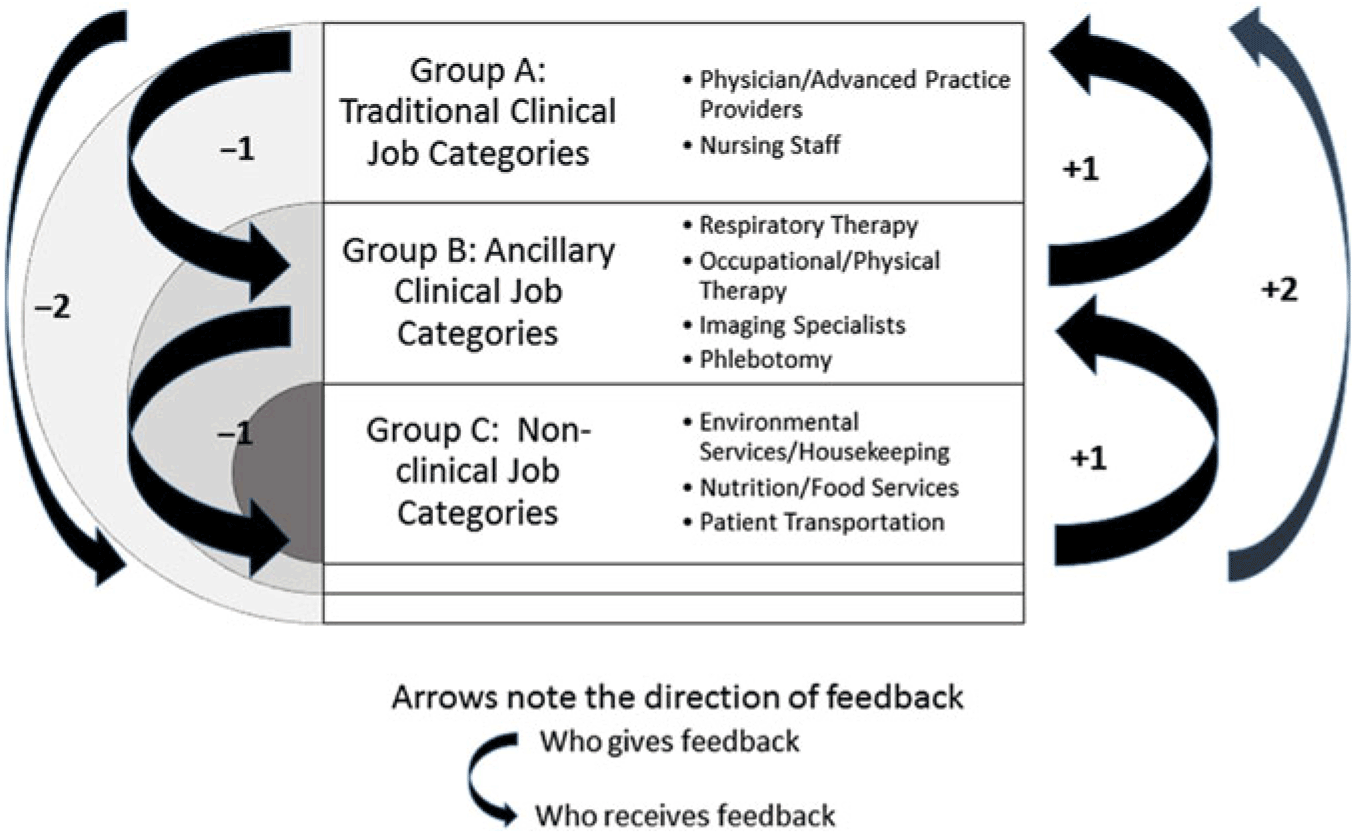
Over 35 months (October 2014–September 2017), we examined the delivery of feedback using the proportion of compliant and noncompliant observations with compliments and reminders provided with Fisher exact test 95% confidence intervals on each job classification’s proportion. Patterns between the delivery of feedback from one job classification to another were examined using a hierarchical job category model (Fig. 1). The distribution of job classes that provided observations with feedback that actually led to improved hand hygiene compliance (ie, compliant episode with reminder provided) was also described using the Fisher exact test with 95% confidence intervals.
Hierarchical job classifications in healthcare.

Results
Real-time feedback was delivered for 49% of the 394,471 hand hygiene compliance observations submitted over the 35-month period by ∼1,000 unique employees (10% of all employees) participating each year. Most of the feedback (47 of the 49%) was in the form of compliments and another 2% (N = 8,547) were reminders.
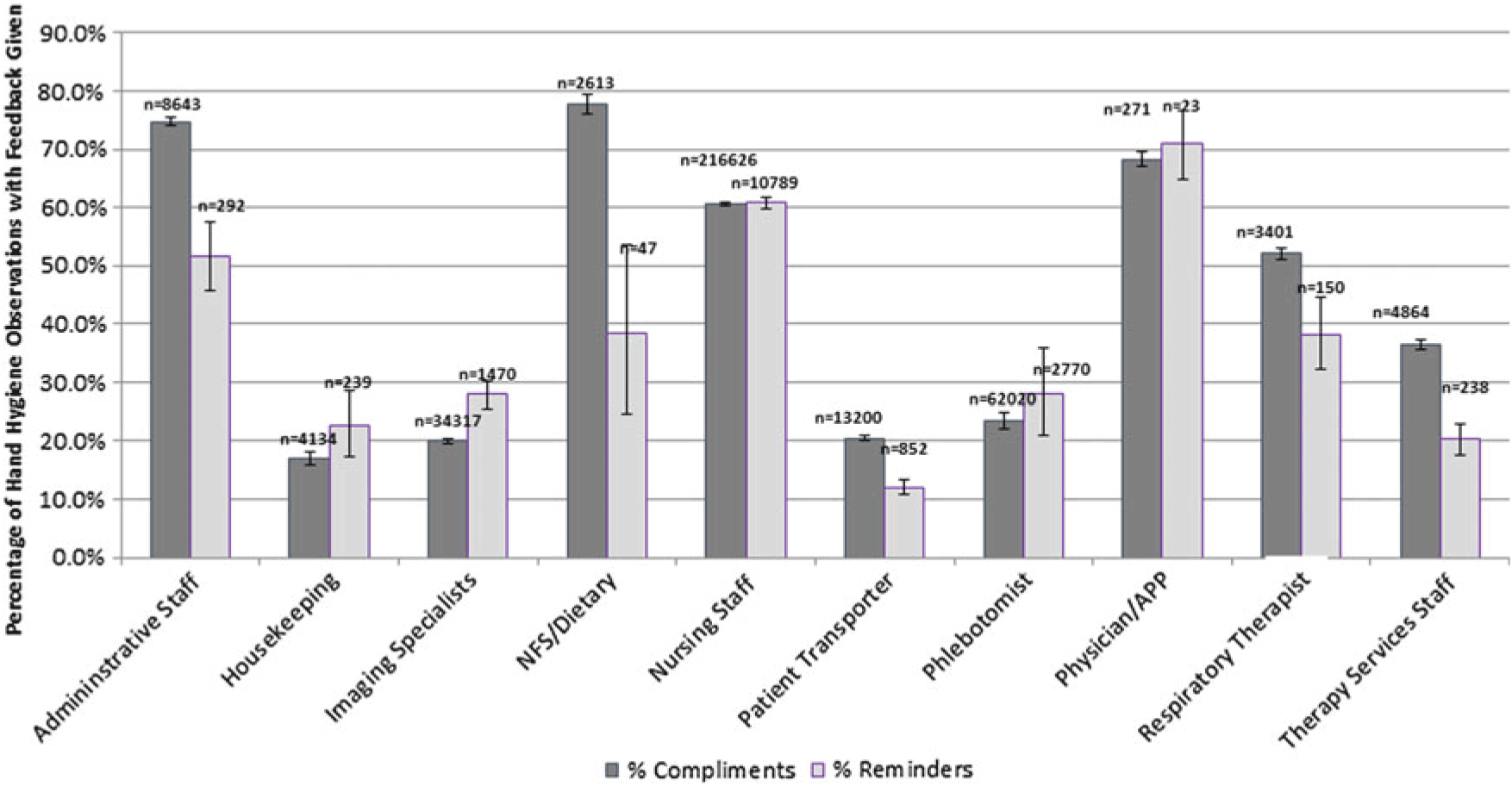
The percentage of noncompliant observations with reminders provided and percentage of compliant observations with compliments or reminders provided is displayed by job class in Figure 2. The highest proportion of feedback of either type (reminders or compliments) delivered with observations was by administrative staff (78%), food services staff (77%), and physicians or advanced practice providers (72%), while housekeeping staff (17%), patient transporters (20%), and imaging specialists (20%) delivered the lowest proportion of feedback on their observations. Commonly, most job categories (ie, administrative staff, food services staff, patient transporters, respiratory therapists, and therapy service staff) provided higher percentages of compliments than reminders. However, imaging specialists gave statistically higher percentages of reminders than compliments.
Delivery of compliments and reminders for hand hygiene by job category. Bars signify 95% confidence intervals.

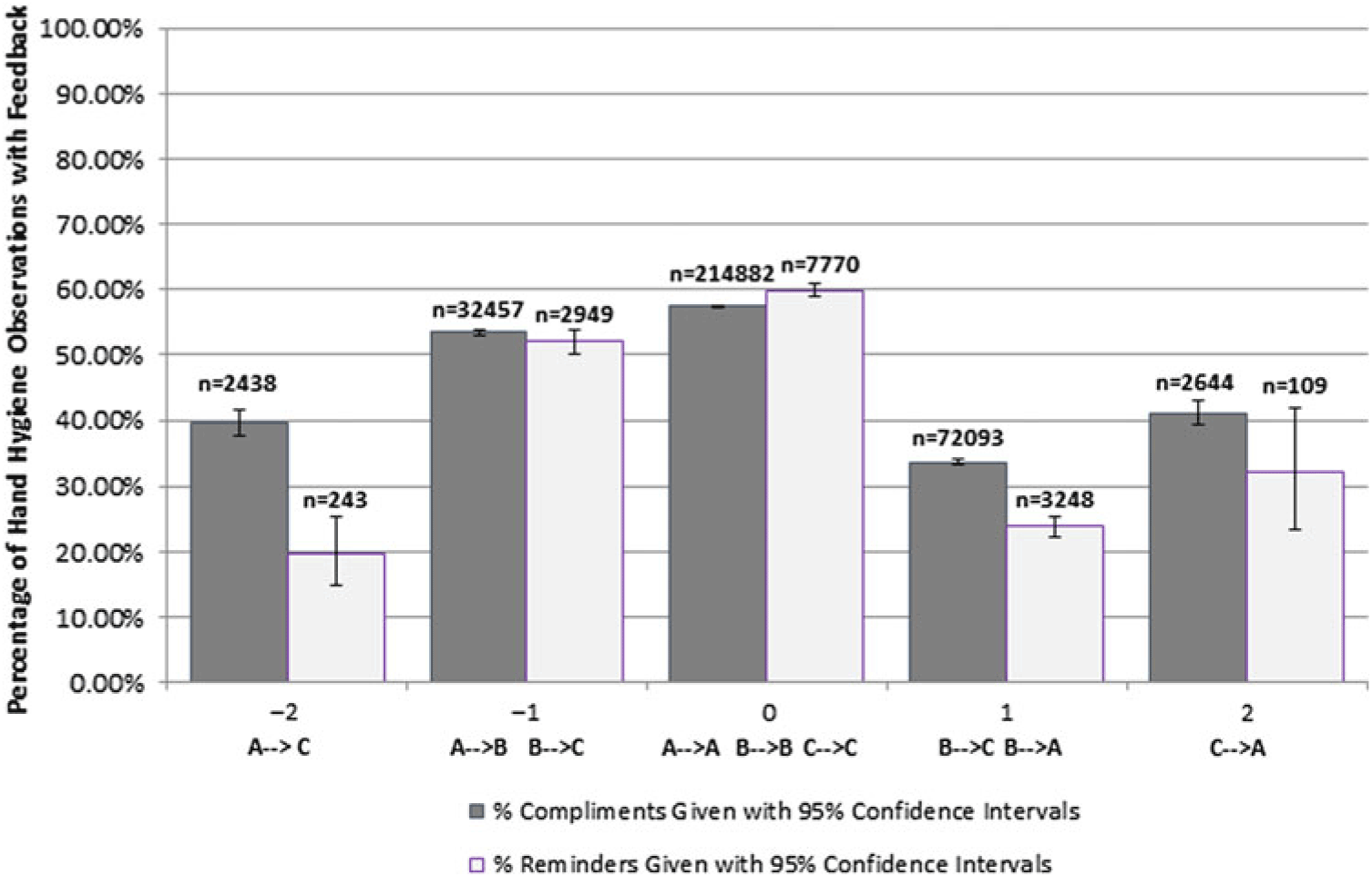
The direction of feedback was summarized between job categories using the hierarchical classification scheme (Fig. 1). Compliments and reminders were most commonly delivered (57% compliments, 59% reminders) within (0) a hierarchical job category (ie, to a colleague within the same job category), followed by down (−1) a hierarchical job category (52% reminders, 53% compliments). Delivering feedback (compliments/reminders) down 1 step (−1) was statistically more common than delivering feedback up 1 step (+1) in the hierarchical scheme (Fig. 3). The proportion of compliments and reminders provided was not statistically different when given up 2 steps (+2) compared to down 2 steps (−2).
Feedback given between hierarchical job classifications. Using the hierarchical model displayed in Fig. 1, −2 signifies a feedback step that is down 2 levels (eg, physician gives feedback to housekeeper); −1 signifies a feedback step that is down 1 level. (eg, respiratory therapist gives feedback to housekeeper); 0 signifies a feedback step that is within the same level (eg, nurse gives feedback to nurse); +1 signifies a feedback step that is up 1 level. (eg, housekeeper gives feedback to respiratory therapist); and +2 signifies a feedback step that is up 2 levels. (eg, housekeeper gives feedback to physician). Bars signify 95% confidence intervals.

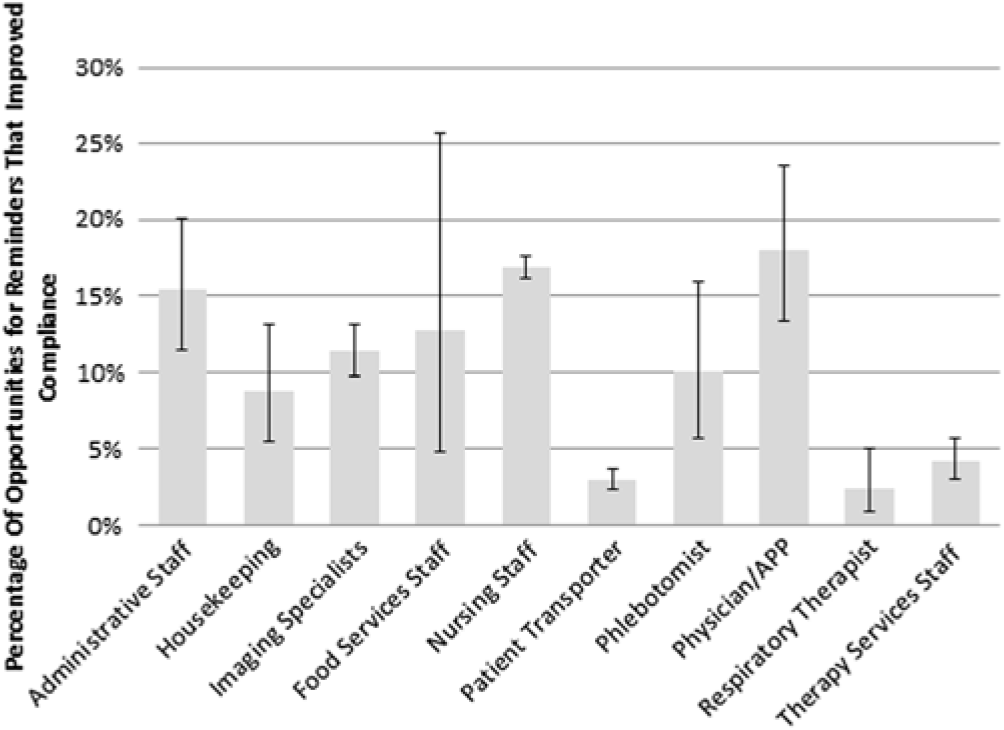
The percentage of opportunities where reminders improved hand hygiene compliance by job category is shown in Figure 4. Importantly, of the overall 171,171 noncompliant observations submitted, 2,247 observations (1.3%) had associated feedback that led to a behavior change, that is, a hand hygiene reminder was provided before the missed opportunity to impact an individual’s action to become a compliant episode. The job categories that had the highest percentage of opportunities where their reminders improved hand hygiene compliance were administrative staff (15%; 95% CI, 11–20), nursing staff (17%; 95% CI, 16–18), and physician or advanced practice providers (18%; 95% CI, 13–24) (Fig. 4).
Percentage of opportunities in which reminders improved hand hygiene compliance. Bars signify 95% confidence intervals.

Discussion
Achieving high hand hygiene compliance continues to be a challenge in all healthcare settings. Strategies that utilize shared accountability, incentives, and direct feedback have been previously shown to be effective.Reference Luangasanatip, Hongsuwan and Limmathurotsakul2,Reference Talbot, Johnson and Fergus5,Reference McGuckin, Storr, Longtin, Allegranzi and Pittet6 Some hospitals have adopted electronic hand hygiene systems designed to provide real-time feedback in the form of electronic reminders via badges.Reference Masroor, Doll, Stevens and Bearman7,Reference Meng, Sorber, Herzog, Igel and Kugler8 These systems have demonstrated mixed results and are not currently recommended as a replacement for in-person observation.Reference Ward, Schweizer, Polgreen, Gupta, Reisinger and Perencevich9 Our hospital has utilized a low-technology crowdsourcing solution that encourages all HCP to provide real-time feedback to each other on hand hygiene compliance as a mechanism to reinforce good hand hygiene habits, to respectfully intervene during moments of missed compliance, and to create a culture of shared accountability to promote safety.Reference Sickbert-Bennett, DiBiase, Willis, Wolak, Weber and Rutala3,Reference Sickbert-Bennett, DiBiase, Schade Willis, Wolak, Weber and Rutala4
Despite a widely adopted program across multiple hospital settings (ie, inpatient, outpatient, procedural, operating rooms), we found that feedback was not consistently delivered within and among all job classifications. In addition, feedback was much more frequently provided as reinforcing positive behavior via compliments. Although real-time interventions during moments of near-miss opportunities are critical for improving hand hygiene, promoting a program of shared accountability that encourages positive feedback can build a foundation for comfort with real-time reminders. Habits are made up of cues, routines, and rewards and hand hygiene programs that incorporate rewards in the form of real-time peer feedback can be successful for sustaining good habits.
The culture of feedback is often threatened by a real or perceived hierarchy between job categories even in a cooperative environment such as healthcare. This finding was reinforced in our results that feedback was most commonly delivered within the same job hierarchy, followed by feedback delivered down 1 job hierarchy (−1). However, outside of the hierarchical structure, we also observed that certain job classifications that are cohesive to a unit or departmental structure (ie, administrative staff who are a part of the nursing unit) may feel more empowered to speak up about patient safety issues and have an important role in behavior change. Administrative staff on the nursing units were among the most common groups to provide reminders that affected hand hygiene behavior. Job classifications were self-reported, so misclassification of job category was a possible limitation of this analysis. However, the misclassification is unlikely to have occurred more frequently for a certain job class and was likely random and nondifferential, leading to minimal misclassification that would not have affected the conclusions of this analysis.
Hand hygiene compliance metrics are fraught with concern including lack of validated metrics, observer or reporting bias, sampling bias, and the Hawthorne effect, so perhaps the time has come to reassess the goals of our metrics. A metric of feedback delivery achieved through a crowdsourcing web-based application, rather than observed compliance alone, could be a more meaningful metric for continuous improvement of hand hygiene and could simultaneously serve as an ongoing intervention strategy. Hospital epidemiologists and infection preventionists can use feedback delivery to examine the strengths and gaps of existing relationships within their organizations to continue to develop real-time feedback interventions for hand hygiene and promote a culture of safety.
Acknowledgments
None.
Financial support
No financial support was provided relevant to this article.
Conflicts of interest
All authors report no conflicts of interest relevant to this article.