

A burgeoning literature in the past two decades testifies to the expanded, intensified, and blurred relationships between heritage professionals and the public (e.g., Berliner and Nassaney Reference Berliner and Nassaney2015; Colwell-Chanthaphonh and Ferguson, ed. Reference Colwell-Chanthaphonh and Ferguson2008; Little Reference Little2002; Moshenska and Dhanjal Reference Moshenska and Dhanjal2012; Skeates et al. Reference Skeates, McDavid and Carman2012; Thomas and Lea Reference Thomas and Lea2014; Trelka and Beaulieu Reference Trelka and Beaulieu2020). Although various terms have emerged to characterize public involvement in archaeology (Bollwerk et al. Reference Bollwerk, Connolly and McDavid2015:179–180), most approaches share the premise that the archaeological interests of multiple constituencies intersect in a variety of ways that can lead to mutual benefits. Many community groups appreciate that the past matters, and consequently they are eager to participate in—and often aim to control—the archaeological process (see Ferguson Reference Ferguson, Sebastian and Lipe2009:188).
Due to heightened public interest in the past, practitioners have worked to define the parameters of public archaeology and its many offshoots, establish the scope of its study, identify effective methodologies, and measure its success (e.g., Atalay Reference Atalay2012; Gould Reference Gould2016; Moshenska Reference Moshenska2008; Silberman Reference Silberman2009; Simpson and Williams Reference Simpson and Williams2008; Wylie Reference Wylie2019). They have examined the conditions that contribute to increasing community involvement in heritage-related fields, highlighting some of the goals and best practices that have emerged in this millennium.
Even as practitioners strive to move toward genuine synergy in the collaborative process (see Colwell-Chanthaphonh and Ferguson Reference Colwell-Chanthaphonh, Ferguson, Colwell-Chanthaphonh and Ferguson2008:1), there remain gaps between prescription and practice in collaborative archaeology. Here, I examine these disparities and ask readers to consider the larger structural forces that impinge on practice and inhibit the formation of equitable relationships needed to fulfill the promise of authentic collaboration in hierarchical societies. By authenticity, I mean honest and transparent exchanges of goods, services, and information among partners and a willingness to be accountable (Nassaney Reference Nassaney2020).Footnote 1 Although much of my discussion has relevance for collaboration beyond the field of archaeology, I draw predominantly from the English-language archaeological literature produced in the United States and other settler societies. As González-Ruibal (Reference González-Ruibal2019:40–41) has recently noted, collaboration faces different challenges in the Andes, sub-Saharan Africa, and large parts of Asia where terra nullius colonialism and the large-scale invasion of white settlers did not triumph.
Much of the literature in collaborative archaeology employs the self-congratulatory case study—“the distinctive trope of publication in the field”—as justification for the method (Gould Reference Gould2016:5; Nassaney Reference Nassaney2020).Yet, critical examination of public involvement in archaeology notably provides some cautionary tales that reveal room for improvement. For example, the ideals of community archaeology programs—in the United States, United Kingdom, and Canada—often do not match expectations for the practical and perceived benefits envisioned by communities (La Salle and Hutchings Reference La Salle and Hutchings2016; Simpson Reference Simpson2008; Simpson and Williams Reference Simpson and Williams2008:86). Indeed, the benefits to individuals and communities are often abstract and very personal (Gould Reference Gould2016), making it difficult to measure the results and raising questions about the efficacy of the approach. The authentic collaborations that I advocate compel us to acknowledge the differences between the ethical and cultural values of archaeologists and those of our partners, particularly among the marginalized, racialized, and disempowered. Exposing these ruptures is the first step. We must then adopt and practice transformative values if we are to develop and live into authentic and accountable relationships with our community partners.
A COLLABORATIVE ARCHAEOLOGY PRIMER
Archaeology is a practice that aims to study the human past (and present) through a material lens. Because the archaeological record is underdetermined, significant social and political biases can creep into interpretations. “Heritage” is a broader term that encompasses the “objects, places, knowledge, customs, practices, plants, stories, songs, and designs that define or contribute to a person's or group's identity, history, worldview, and wellbeing” (Nicholas Reference Nicholas, Anderson and Geismar2017:214). Consequently, heritage has become attached to archaeology because material remains are imbued with meaning ascribed within a cultural context. Although individuals and communities may endeavor to control (physically, legally, and intellectually) this tangible record, it is typically the interpretations of the objects, their connections to heritage, the power they invoke, and the symbolic capital they represent that interest people in the present.
Until the late twentieth century, archaeology was generally the domain of white, middle-class men who used the past as a tool to legitimize their power and privilege (Kador Reference Kador, Thomas and Lea2014:42; McGuire Reference McGuire2008:104; Patterson Reference Patterson1995; Trigger Reference Trigger2007). Developments in the new social history as well as the study of ordinary people and everyday life in the 1960s opened the door for historical archaeology, a methodology that was best suited to address the histories of marginalized groups (Little Reference Little1994). With the maturation of post-processualism in the 1980s, archaeologists began to partner with communities just as some Indigenous groups began to assert control over their pasts (Lea and Thomas Reference Lea, Thomas, Thomas and Lea2014:1; Matsuda and Okamura Reference Matsuda, Okamura, Okamura and Matsuda2011:8; Trigger Reference Trigger2007:460).
Archaeologists welcomed community interest and support in the 1980s, when they were witnessing a decline in governmental funding, downsizings, and privatization of public resources that contributed to the promotion of volunteerism (Hofman and Rosing Reference Hofman and Rosing2007). This disciplinary shift was anticipated by important historic preservation legislation and broader social movements that threatened the status quo in Americanist archaeology. Advancements in the rights of minorities, women, and Indigenous peoples opened spaces for alternative voices, culminating in American archaeology with the so-called reburial issue, which was being debated just as the World Archaeological Congress was formed in Southampton, England (1986) in an increasingly politicized atmosphere (Layton et al. Reference Layton, Shennan and Stone2006; Ucko Reference Ucko1987). When African American descendants in New York City organized to seize control over the proper excavation and respect for their ancestors at the African burial ground in the early 1990s, the power of the people could no longer be ignored (LaRoche and Blakey Reference LaRoche and Blakey1997; Levin Reference Levin2011). Despite these developments, the norms that emanated from institutions that sanctioned this work (i.e., colleges and universities, professional organizations, governmental bodies, cultural resource management) still reflected white, dominant culture values that thwarted transformational change (Barndt Reference Barndt2007:143–183; Nassaney and LaRoche Reference Nassaney and LaRoche2011). This remains the case.
Archaeologists represent a narrow stratum of society, and to leave archaeological heritage interpretation in their hands skews our view of the past (Tripp Reference Tripp, Moshenska and Dhanjal2012:29). Moreover, archaeology as ideological production reproduces dominant narratives and associated values. Too many voices are silenced by the standard, positivist practice that produces an authorized heritage discourse (Smith Reference Smith2006; Smith and Waterton Reference Smith, Waterton, Skeates, McDavid and Carman2012). Communities become involved in archaeology to challenge the authority of archaeologists who mobilized white, dominant culture values in their quest to understand the past (Horning Reference Horning and Dalglish2013:95; LaRoche and Blakey Reference LaRoche and Blakey1997). Archaeologists, in turn, recognize that collaboration with communities can enrich the discipline by encouraging us to ask new questions of the past and reconsider the relationship between the past and the present (Marshall Reference Marshall2002:218). Collaboration became mandated by law and codes of ethics, which explains, in part, its popularity today (Ferguson Reference Ferguson, Sebastian and Lipe2009:169–170).
Collaborative archaeology is the practice of identifying, investigating, and interpreting heritage from material remains through partnerships between archaeologists and others. The latter are typically community groups that, by definition, have some common interest that unifies them (e.g., metal detector hobbyists, performative historiographers, veterans, neighbors). Communities are also known to sponsor their own archaeology, blurring the former distinction between archaeologists and other constituents. An authentic collaboration is an inclusive practice that recognizes the full range of contributions in an intellectual endeavor from conception through execution (see Atalay Reference Atalay2012:55) and aligns well with the “genuine synergy” of Colwell-Chanthaphonh and Ferguson's (Reference Colwell-Chanthaphonh and Ferguson2008) collaborative continuum. It moves us beyond the exclusionary values developed in institutions to benefit white hierarchies (Barndt Reference Barndt2007). I emphasize “authentic” to underscore the need to lift up interpretations from even the most marginalized populations lest archaeology be guilty of the tyranny of the majority, whereby the loudest and greatest number of voices predominate (see Guinier Reference Guinier1994). Indeed, the challenges to an authentic collaborative archaeology emanate from ontological and epistemological differences between the values of groups that are embedded in unequal power relations as expressed along lines of race, class, gender, and other identity vectors. Partners must mediate these differences to mitigate instability and hostilities and to live into the tensions that these conflicting views create. By embracing transformative anti-racist values (Dias Reference Dias2008), we can circumvent these fault lines and work to fulfill the promise of authentic collaboration.
Why Collaboration?
The benefits of collaboration for communities and archaeologists fill the literature and defy brief summation. Many of the sources present useful prescriptions for practice. Partnerships are formed, driven by, and sustained through the mutual benefits that collaboration provides at the individual and organizational levels (Nevell Reference Nevell and Dalglish2013:72). Benefits accrue when collaboration fosters greater inclusivity, increased relevance, ethical practice, fairness, and sustainable action (e.g., Atalay Reference Atalay2012; Colwell-Chanthaphonh and Ferguson Reference Colwell-Chanthaphonh, Ferguson, Colwell-Chanthaphonh and Ferguson2008:7).
Archaeologists have noted both the ways in which participation occurs and its varying levels of intensity. Colwell-Chanthaphonh and Ferguson (Reference Colwell-Chanthaphonh, Ferguson, Colwell-Chanthaphonh and Ferguson2008) developed a collaborative continuum that provides benchmarks that archaeologists can use to assess the degree of public participation and the forms it takes (see also Arnstein Reference Arnstein1969; Ferguson Reference Ferguson, Sebastian and Lipe2009; Kador Reference Kador, Thomas and Lea2014; Moussouri Reference Moussouri, Thomas and Lea2014; Nevell Reference Nevell and Dalglish2013). Genuine synergy in collaboration occurs when “the contributions of community members and scholars create a positive result that could not be achieved without joining efforts” (Colwell-Chanthaphonh and Ferguson Reference Colwell-Chanthaphonh, Ferguson, Colwell-Chanthaphonh and Ferguson2008:1). Although genuine collaboration between groups at all stages of a project is the ideal, in reality, many projects fall short of this lofty goal, but they can still provide meaningful results. For example, in the Fort St. Joseph Archaeological Project, we have been unable to build the capacity needed to involve the archaeology advisory committee in disseminating the results of our investigations through presentations and copublication, although it is supportive of the work and provides regular input into the research design (Nassaney Reference Nassaney2011, Reference Nassaney2020).
The motivations for engaged heritage management are as varied as its intensity and driven by practical, ethical, and ideological reasons. The aim of collaboration is to engender greater inclusion, the co-creation of knowledge, and power sharing in the interpretation of the past, leading to “positive change in the lives of participants” (Nicholas et al. Reference Nicholas2012:30). Because archaeologists have controlled many aspects of the interpretive process, they must recognize that segments of the population are marginalized by current modes of discourse and practice, invite broad participation, and ensure the redistribution of power. Otherwise, participation “is an empty and frustrating process for the powerless” (Arnstein Reference Arnstein1969:216 cited in Dalglish Reference Dalglish and Dalglish2013:8). As the public participates in heritage, archaeologists shift to being one of many participants (Gustafsson and Karlsson Reference Gustafsson, Karlsson, Skeates, McDavid and Carman2012; McDavid Reference McDavid2002), albeit ones with archaeological expertise.
Community involvement generally benefits archaeology through site preservation, heightened interest, increased public support, recruitment, insider knowledge, and access to local resources (Jeppson Reference Jeppson and Stottman2010:63; Watkins et al. Reference Watkins, Anne Pyburn, Cressey, Bender and Smith2000:73). Our efforts to engage with the public, however, are not merely self-serving. The benefits that accrue arguably stimulate—if not sustain—collaborative relationships. One would expect that the questions that interest archaeologists and the public would converge over time, even if archaeologists and nonarchaeologists begin with different agendas.
IMPEDIMENTS TO ACHIEVING AUTHENTIC COLLABORATION
There have been recent efforts to develop methodologies to evaluate the success of collaborative archaeology (e.g., Gould Reference Gould2016; Simpson Reference Simpson2008). These are useful exercises, even as the diversity of contexts makes it impossible to identify explicit procedures for public engagement because no general recipes for interaction with community groups exist (González-Ruibal Reference González-Ruibal2019:40; Nicholas et al. Reference Nicholas, Welch, Yellowhorn, Colwell-Chanthaphonh and Ferguson2008:274). Partners may aspire to work together to attain common goals (Ferguson Reference Ferguson, Sebastian and Lipe2009:191), yet often their values are fundamentally incompatible (see also González-Ruibal Reference González-Ruibal2019). In addition, both academic and compliance-driven archaeology face social structural constraints. For example, societal values dictate which sites to protect and how to manage them, often relegating entire classes of sites to the margins (e.g., African American tenant sites in some parts of the United States) and raising the question of significance for whom (Lipe Reference Lipe, Sebastian and Lipe2009:42).
Consequently, there are historical, practical, and structural barriers that inhibit archaeologists and communities from practicing an authentic collaborative archaeology. Given the history of colonial practice, some communities have rejected archaeology because it is seen as anathema to their mission and a threat to their cultural autonomy, particularly when it is used to undermine identity and misrepresent history. Perhaps the best-known examples relate to the distrust some Indigenous groups have of archaeologists, given the history of the discipline and its colonialist tropes (Trigger Reference Trigger1980).
Collaborative archaeology can also exacerbate social divisions if some communities—or members of a community—are excluded by archaeological practice and the esoteric knowledge it generates about heritage. Participation is embedded in privilege, and not all communities are organized to collaborate, especially those from underdeveloped countries and smaller tribal units that lack expendable wealth needed to support archaeology (Baram Reference Baram2011; Matsuda and Okamura Reference Matsuda, Okamura, Okamura and Matsuda2011:2). In cases in which archaeology may be considered a luxury, governments alone are left with the burden of managing archaeological sites (with very little community input; Carman and Keitumetse Reference Carman and Keitumetse2005:39). In contrast, European, Australian, and American practice favors the involvement of the wider community in heritage matters, albeit often a privileged few (cf. Schmidt and Pikirayi Reference Schmidt and Pikirayi2016).
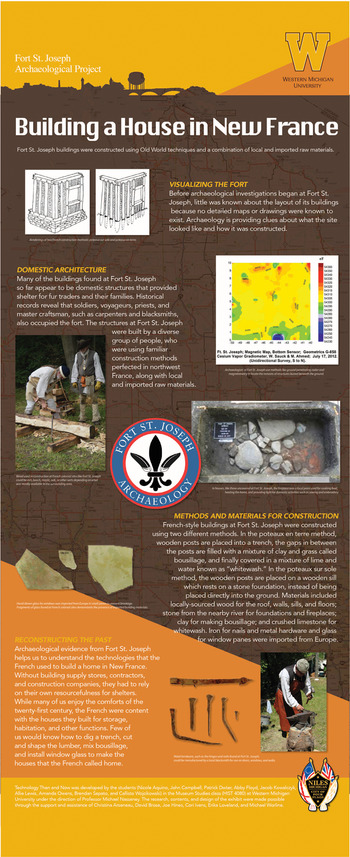
Individuals and community groups have varying degrees of knowledge about local history, collaboration, and archaeology. Some may not even care about such matters. Consequently, it is incumbent on archaeologists to develop effective channels of communication to make intellectually meaningful and emotionally personal connections to an audience (Derry Reference Derry2011; see also Supernant Reference Supernant2012). People become involved in archaeology when it becomes “relevant, meaningful and personal to their changing interests and daily lives” (Derry Reference Derry2011). Ideally, to achieve genuine synergy we should forge this link in all stages of the work—from initial introductions through dissemination of results—but this is seldom the case. Communication conveys transparency (Figure 1; see Watkins et al. Reference Watkins, Anne Pyburn, Cressey, Bender and Smith2000:75–79).
Informational panels and banners on themed topics are used to convey our findings in prose and images suitable for a general audience during the annual archaeology open house at Fort St. Joseph.

Collaboration is generally difficult, messy, time consuming, and resource intensive (Clark and Horning Reference Clark and Horning2019; Ferguson Reference Ferguson, Sebastian and Lipe2009:192). Many individuals, especially those socialized into a white racialized identity, may not have the temperament or motivation to enter into an authentic relationship. For example, archaeologists generally are oriented to the pursuit of knowledge within the framework of the humanities and historical sciences, and many subscribe to the Western value of academic freedom and voyeurism—any and all questions, places, and peoples’ histories are open to scholarly inquiry (Nicholas Reference Nicholas, Anderson and Geismar2017). In contrast, some community groups may believe that not all cultural knowledge is suitable for public consumption, and others may be attracted to heritage sites as a source of economic diversification and/or cultural revitalization (Jameson Reference Jameson, Jameson and Eogan2013:5). In this way, archaeologists find themselves “caught between a commitment to understanding the world, past and present, as fully as possible on the one hand, and respecting the customs, values, and customary laws of the living people with whom we work, on the other” (Nicholas Reference Nicholas, Anderson and Geismar2017:225).
Because collaboration rests on human interactions, it is precarious, and it requires deliberate nurturing and a shared vision of the potential short- and long-term benefits (Nicholas et al. Reference Nicholas, Welch, Yellowhorn, Colwell-Chanthaphonh and Ferguson2008:291). Collaborative projects operate amid the vulnerability of community relations and the conflicting interests of community partners. There may be multiple values at play that require one to mediate among conflicting demands made by various populations of resource users (Lipe Reference Lipe, Sebastian and Lipe2009:46). Problems arising from the fragility of community relations and the conflicting interests of collaborating partners can threaten to dismantle a partnership (e.g., Reckner et al. Reference Reckner, Duke, Miller, Valentino, Nassaney and Levine2009:203–205).
A cautionary tale comes from the Colorado Coalfield War Project, where archaeology revealed important information about the horrific events that led to the massacre of women and children in a western mining town in the early twentieth century (Saitta Reference Saitta2007). The project had the support of the United Mine Works of America, the Women's Auxiliary of the local union, the local labor community, and other local groups (Reckner et al. Reference Reckner, Duke, Miller, Valentino, Nassaney and Levine2009). All the participants were pleased with the outcomes that served their mutual interests, and there was an openness and free exchange of ideas and friendship at social gatherings, political events, and a memorial service—until 1999. That summer, archaeologists, in consultation with their partners, commissioned the installation of an interpretive kiosk—a collaborative design with content shaped by input from the community. Despite the best intentions, the project staff later learned that the carpenter who had been recommended by the Women's Auxiliary to construct the kiosk was a nonunion laborer—a serious oversight. Although the Auxiliary took the brunt of the blame for this faux pas, relationships soured and were never the same. A key factor underlying the conflict was the divergent perspectives of the local and regional unions on what it meant to be pro-union (Reckner et al. Reference Reckner, Duke, Miller, Valentino, Nassaney and Levine2009:204).
There is always the potential for different groups to come into conflict over archaeological heritage. For example, UNESCO World Heritage sites, which embody universal value, are often managed by state organizations. They may exclude local communities, which have connections to the resource, from benefiting economically (Ardren Reference Ardren2002). The ICOMOS “Charter for the Interpretation and Presentation of Cultural Heritage Sites” recognized the need for greater public participation, prompting the UNESCO Convention (1972) to establish “an appropriate plan to specify how a property should be preserved . . . preferably through participatory means” (Cleere Reference Cleere, Layton, Shennan and Stone2006:xxii; emphasis added). Even then, managers and local communities often have unrealistic expectations for the economic benefits of heritage sites, which are seldom realized (Hodder Reference Hodder, Okamura and Matsuda2011:24).
Tourists and descendants expect to have access to heritage sites, even if preservation is threatened. For example, at the rock-carving site of Tatum in Sweden, the interests of site protection and public accessibility collided when these fragile remains were literally buried to protect them from the elements (i.e., environmental pollution), consequently obscuring them from public view (Gustafsson and Karlsson Reference Gustafsson, Karlsson, Skeates, McDavid and Carman2012:490). In this case, access was restricted in the name of conservation. Descendants often want to connect to historic places in ways that may compromise the integrity of the resource demonstrating that “there are fundamental differences between Western and Indigenous conceptions of ‘property’” (Nicholas Reference Nicholas, Anderson and Geismar2017:220) and how it should be treated (Bridges Reference Bridges, Sebastian and Lipe2009:243). Because some objects are seen as animate, they must be nurtured in ways that may be inconsistent with Western ideas about long-term care. Objects are often imbued with messages that do not readily transcend cultural barriers and “material engagements with the world are filtered through society's collective knowledge, experiences, traditions, social obligations, and origin stories that shape and reflect what people do and why” (Nicholas Reference Nicholas, Anderson and Geismar2017:218).
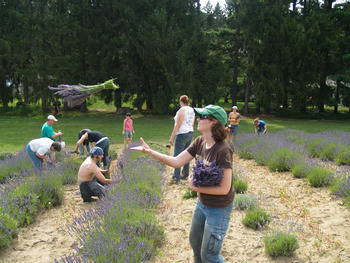
Places, people, and relationships are given priority in many traditional societies, whereas time and efficiency are highly valued in the Western world (Dias Reference Dias2008). Compliance-driven archaeologists have deadlines to meet, just as academics work against the tenure and promotion clock. Time constraints inhibit community interactions that are unrelated to archaeology and take place outside of the field season. Indeed, building relationships is part of the work and demonstrates a long-term commitment between the researchers and the community, and it may involve attending social (e.g., birthday parties, funerals), cultural (e.g., pow-wows), and civic (e.g., parades, festivals) events. We volunteered our field school students to pick lavender for a neighbor who is a commercial grower. Because the crop matures quickly in July, many hands are needed to harvest the flowers at their prime (Figure 2). Various activities that do not involve immediate archaeological practice require a personal commitment to engage with the community that many archaeologists are unable or unwilling to provide.
Community relationships are forged in various ways that may not include archaeology directly. Here, students and staff of the Fort St. Joseph Archaeological Project assist a neighbor in harvesting lavender. Photograph by Tori Hawley.

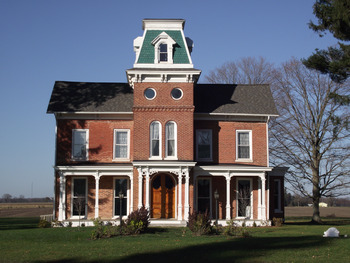
When archaeologists consult community partners, they may find that their interpretations contradict local understandings. Local preservationists in southwest Michigan prioritize the role of white Quakers in assisting freedom seekers of African descent who escaped bondage from the American South via the Underground Railroad. Consequently, the contributions of free Blacks and the agency of self-liberators were underrepresented in local narratives. Despite archaeological evidence to the contrary, the preservationists contend that a community of formerly enslaved African Americans settled exclusively on the property of a well-known Quaker, whom they memorialize in this clandestine network. This appears to be a self-serving interpretation because they own his house and have renovated it to become an interpretive center (Figure 3). No resolution is in sight, although I am content to live with the tension created by alternate and contradictory interpretations, even as we support their preservation and promotional efforts. Archaeologists and their partners have vested interests, and their understandings may be challenged by alternative narratives, which can lead to ill will and distrust if the differences are not mediated, diffused, and allowed to coexist peacefully.
The restored home of James Bonine, a conductor on the Underground Railroad, who assisted African American freedom seekers escaping from bondage in the American South. Photograph by Paul Bonenfant.

When our findings diverge from the needs and desires of community groups (Christensen Reference Christensen and Stottman2010:34), disinterest and disillusionment may occur. In the late 1990s, I was invited by members of the Historic Seventh-Day Adventist Village to conduct archaeological investigations at the home of James and Ellen White (20CA118) in Battle Creek, Michigan (Nassaney Reference Nassaney1999). While occupying the house in the 1850s, Ellen White had a series of divinely inspired visions that led her to promote abstinence from tobacco, alcohol, caffeine, and meat. Her prophesies became foundational teachings for many Seventh-Day Adventists. The Whites’ son, William C., recalled a well that provided a good source of drinking water that the Whites and their neighbors used and that the Seventh-Day Adventists, understandably, wanted to relocate. When we failed to find the well and artifacts that could be directly associated with their prophetess, the Seventh-Day Adventists lost faith in the project. We recovered a few white clay tobacco-pipe fragments and some animal bones, but these were likely associated with later site occupants. We wondered how we would have presented our results to the descendant community if we had discovered archaeological remains that suggested that Ellen White (and her husband and followers) did not literally practice what she preached.
Reconciling divergent interpretations of the past remains a challenge for collaborative archaeology. To resolve discrepancies, some researchers advocate a multivocal approach in which alternate interpretations are juxtaposed, allowing third parties to compare, contrast, and evaluate varying understandings and come to their own conclusions (see Colwell-Chanthaphonh et al. Reference Colwell-Chanthaphonh, Ferguson, Gann, Okamura and Matsuda2011; Gero Reference Gero, Rowan and Baram2004:293). The normative view from conventional science, however, is often given priority—multivocality is not necessarily empowering (Atalay Reference Atalay2012:77; González-Ruibal et al. Reference González-Ruibal, Alonso González and Criado-Boado2018) and can exacerbate social divisions. Archaeologists face an additional challenge when they have to mediate between two strongly opposed communities (Horning Reference Horning and Dalglish2013). Different interest groups may care for a place even though their ideologies are diametrically opposed, given that various groups see heritage in different ways (Derry Reference Derry2011; Shakour et al. Reference Shakour, Kuijt and Burke2019). More often, archaeologists have to contend with dominant and subordinate narratives and determine how archaeology might complement, contradict, or interrogate these perspectives on the past.
For many years the American Anthropological Association (1986 [1971]) Statement on Ethics compelled anthropologists to be responsible to the public at large and “speak out publicly, both individually and collectively, on what they know and what they believe as a result of their professional expertise gained in the study of human beings.” Yet, this statement failed to consider that there are multiple publics and that archaeologists cannot be neutral. Archaeologists often subscribe unconsciously to dominant culture values (Barndt Reference Barndt2007). The customs and mores of a local culture may also diverge from an archaeologist's ethical and moral stance, progressive as it may seem. For example, Hodder (Reference Hodder, Okamura and Matsuda2011:27) employed women in his work in the patriarchal villages surrounding Çatalhöyük in Turkey, despite efforts by male elders to carefully control and limit female involvement. These and other economic activities that empowered women were perceived as socially disruptive. Eventually, archaeologists were denied access to engage the local community in this project (Sonya Atalay, personal communication 2020). This incident, among others, led Hodder (Reference Hodder2018) to conclude that over 25 years of trying to implement a reflexive, decolonized archaeology enjoyed only limited success.
The ground rules for creating a dialogue among groups that hold disparate values are not universally agreed on (Hodder Reference Hodder, Okamura and Matsuda2011:19). If heritage is a relationship between the present and the past, then how we accord it significance, interpret its meaning, and present it to local and global audiences lie in the eyes of the beholder. Archaeologists and their partners cannot predict a priori what will interest the other. Hodder (Reference Hodder, Okamura and Matsuda2011:26) urges us to recognize all the stratigraphic layers of a community's past in the spirit of inclusivity at the risk of forgetting, denying, or ignoring critical elements. For example, local communities showed little regard for the Neolithic site of Çatalhöyük because it had not benefited them previously (Hodder Reference Hodder, Okamura and Matsuda2011:24). Yet, so-called Goddess groups from around the world visit the site regularly, organize tours for women, and engage with the project director about recent findings and their interpretation (Atalay Reference Atalay2012:95; Hodder Reference Hodder, Okamura and Matsuda2011:27). Despite some interest in this very ancient pre-Islamic site, many communities are often attracted to more immediate pasts, which hold greater meaning (Dalglish Reference Dalglish and Dalglish2013:3). In York, England, the excavation of demolished World War I housing was more evocative to some than nearby Viking remains (Isherwood Reference Isherwood and Dalglish2013:85). As more voices come to participate at the table and the number of perspectives multiplies, there is the danger of excluding certain groups. Consequently, we must constantly ask ourselves who is left out of the process of recovering history and commemorating heritage (Little Reference Little and Stottman2010:158; Nassaney Reference Nassaney2017). We may soon discover that some groups have not engaged with our practice because it is foreign to their way of thinking and being in the world. By ignoring them, we deny their participation. Not everyone is interested in heritage, and many do not see its benefits (González-Ruibal Reference González-Ruibal2019). We need to meet people where they are.
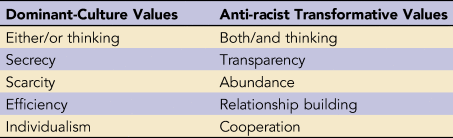
Multiethnic nation states encompass various constituencies that entertain heterogeneous and potentially conflictual value systems driven by identity politics. Indeed, capitalist, patriarchal, racist, and colonial systems engender inequities and power differentials that hinder authentic collaboration. Western-styled decision-making models are generally hierarchical with power and control vested in—and trickling down from—the upper echelons. This structure has fostered various dominant-culture values that are not shared by groups that seek alternate ways of being and aim to participate in authentic relationships (Table 1). The following discussion, which emerges from a transformative anti-racist dialogue that began in the 1980s in the United States (Barndt Reference Barndt2007:8; Dias Reference Dias2008), is broadly applicable wherever oppressed groups who attempt to participate in reclaiming their heritage confront Western-styled decision-making models.
Model of Dominant Culture and Anti-racist Transformative Values.

Source: Adapted from Dias Reference Dias2008.
In the dominant-culture model, either/or thinking prevails. There is only one right answer, and this is asserted by those in control. There is little space for competing world views. Hierarchical decision making is often conducted in relative secrecy by a small number of individuals who are in positions of power in an institution. It is often difficult to determine who makes these decisions and how. Dominant-culture values often assume a scarcity of resources, be it time, personnel, or money. Driven by the laws of supply and demand and a need to subject decisions to cost-benefit analyses, time is commoditized, and all activities have to be conducted efficiently. Full participation in collaborative work is limited by time and funding (Lipe Reference Lipe, Sebastian and Lipe2009:51–52). Finally, individual action and accomplishment is rewarded in capitalist society, with little recognition given to the collectivity. Individuals and groups are not expected to be responsible and accountable to others for their actions (Barndt Reference Barndt2007:152; cf. Watkins et al. Reference Watkins, Goldstein, Vitelli, Jenkins, Lynott and Wylie1995).
These dominant-culture values, which permeate capitalist societies marked by racial hierarchy, are not conducive to genuine synergy. Despite the enormous amount of attention that archaeologists have paid to collaboration, it is understandable that so little focus has been devoted to training students in collaborative archaeology because the academy is structured around—and students have been socialized into—a value system that, ironically, works against collaboration. Furthermore, the academy is slow to respond to the practical concerns of the discipline, as demonstrated by the delay in preparing archaeologists for the opportunities of cultural resource management (CRM; Schuldenrein Reference Schuldenrein, Bender and Smith2000). At present, there is hardly any incentive to train archaeologists to achieve collaborative outcomes because they do not fit within the reward system of both academic and compliance-driven work (Nassaney Reference Nassaney, Nassaney and Levine2009:23–24). Even ethical codes can be uselessly vague. The Register of Professional Archaeologists Code and Standards directs archaeologists to “be sensitive to and respect the legitimate concerns of the people whose culture histories are the subject of research,” but it does not specify how (Ferguson Reference Ferguson, Sebastian and Lipe2009:181). Fundamental changes in our value system are needed if we aim to fulfill the promise of authentic collaboration.
TRANSFORMATIVE VALUES AND AN AUTHENTIC COLLABORATIVE ARCHAEOLOGY
Archaeologists have repeatedly noted that successful collaboration requires professionals to create the conditions for genuine synergy by relinquishing power to community control and engaging with excluded communities (Nevell Reference Nevell and Dalglish2013:72). However, more specific guidelines and transformational changes are needed in our practice if we are to realize this goal.Footnote 2 Elsewhere, I have detailed some strategies for developing authentic and sustainable partnerships in the Fort St. Joseph Archaeological Project (Nassaney Reference Nassaney2020). Here, I argue that we must adopt transformative values if we are to achieve genuine synergy in our collaborative efforts.
In the spirit of inclusivity, we must be willing to abandon either/or thinking and entertain the multivocality implied by both/and (Table 1), even as we eschew epistemic popularism (González-Ruibal Reference González-Ruibal2019). Consider that two seemingly opposed viewpoints can be dialectically related. This should be familiar to archaeologists, who often draw abstractions from different sides of the same relationship when they describe the experiences of labor and capital, men and women, colonizers and colonized, and white people and people of color (Wurst Reference Wurst1999). Neither of these experiences negates the other. Instead, they provide a broader understanding of the phenomenon under investigation. When we take the perspectives of others into consideration, we are more likely to offer more inclusive interpretations of the past and respect the idea that two truths can be held simultaneously (Nassaney Reference Nassaney2020). For example, colonialism and all it entailed was both damaging to many Native cultures and resisted by Native peoples who struggled to maintain their cultures in the face of political, biological, and religious onslaught. By creating space for seemingly alternate interpretations through both/and thinking, we can empower people and acknowledge their control over the production of knowledge about the past and the way it shapes their identities in the present.
Transparency and trust in a relationship operate in tandem as partners maintain open communication networks about their goals, strategies, and motivations for the study of the past (Nassaney Reference Nassaney2020). Transparency in interactions between partners does not guarantee that both groups will always get what they want, but it will confer mutual respect that will make it more likely for them to achieve their ends in the future. Tensions arose several years ago over whether to continue excavating to collect architectural data or shift attention to identify site boundaries at colonial Fort St. Joseph in southwest Michigan. The archaeologists conceded to the community's focus on architectural reconstruction. The community later recognized the importance of expanding excavations and supported the idea of determining the horizontal extent of the deposits. True collaboration requires transparency in a process through which individuals communicate, work to achieve consensus, and make efforts to accommodate the needs of all participants. This often requires lengthy discussions that take time and that may or may not lead to immediate action. For example, we have learned that Native representatives on our advisory committee must consult with their tribal council before rendering a collective response to our invitations for engagement. We have come to respect this process for decision making and prioritize our relationship over speed and efficiency.
In a capitalist society marked by endless commodification, scarcity is a familiar refrain espoused by those who subscribe to dominant-culture values. Yet, if we aim to be our authentic selves, we often discover resource abundance even under austere economic conditions. For example, when we needed funding for some unanticipated expenses at Fort St. Joseph, we found previously unidentified support from our community partners with whom we had established positive relationships. This continues to take the form of various in-kind contributions, such as volunteer labor, professional engineering advice, installation of costly infrastructure, and the use of a backhoe and operator, among other critical assets that facilitate our shared goals.
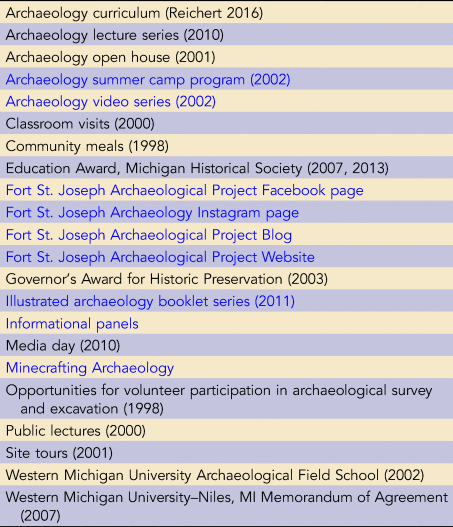
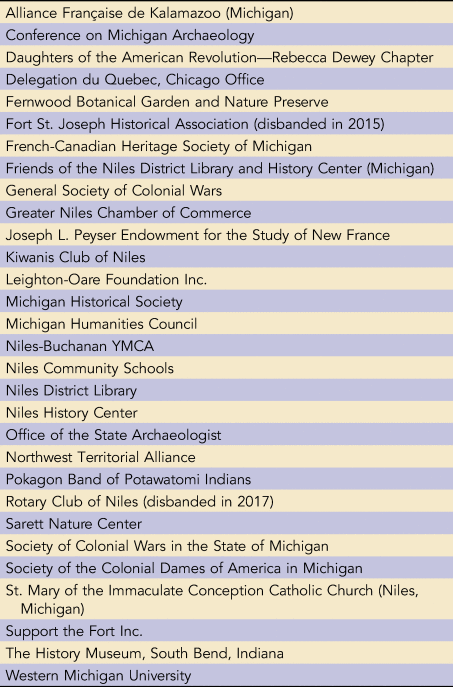
We attribute much of this generosity to the trust that we have cultivated over the past 20 years. Rather than insist on efficiency in excavation by maximizing the amount of time spent digging, we have devoted considerable time and effort to involving the public in various aspects of the project (Tables 2 and 3). Community participation and public outreach include partnerships with dozens of community groups (D'Elia et al. Reference D'Elia, Berliner, Reichert, Nassaney and Nassaney2019). These activities are organized and implemented by a rotating public-outreach coordinator (now a media coordinator); a Fort St. Joseph Museum student intern supported by the city of Niles, Michigan; the director of the Niles History Center; and the principal investigator under the direction of the Fort St. Joseph Archaeology Advisory Committee.
Public Outreach Activities, Outcomes, and Community Reciprocity in the Fort St. Joseph Archaeological Project, with Dates of Inception.

Community Partners in the Fort St. Joseph Archaeological Project.

From the outset of the Fort St. Joseph Archaeological Project—a long-term partnership between Western Michigan University and the city of Niles—it became clear that cooperation would be necessary for sustainability (Nassaney Reference Nassaney2020). We have tried to put the goals of the project ahead of personal aspirations (Watkins et al. Reference Watkins, Anne Pyburn, Cressey, Bender and Smith2000:75–79). As our relationship with the community has strengthened, we welcome our partners to “call out” our behavioral shortcomings, in the spirit of further deepening our relationship. We have come to realize that “developing community-collaborative [relationships] demands more than just being well versed in the scholarly literature . . .; it is about building trust, developing relationships, communicating, sharing authority, and being humble” and receptive to constructive criticism (Lonetree Reference Lonetree2012:170; see also Zimmerman Reference Zimmerman, Smith and Wobst2005). Conversations over discordant issues are less likely to become volatile once rapport is established (see Hodder Reference Hodder, Okamura and Matsuda2011:25).
Individualism must be replaced by cooperation to realize genuine synergy in an authentic collaborative relationship. Individuals are less likely to center themselves when groups are bound by relations of trust, which can only develop over time. They can celebrate collectively the accomplishments that accrue from consensus. Under these conditions, reciprocity is practiced without an expected immediate return (what González-Ruibal [Reference González-Ruibal2019:41] refers to as “hospitality”). Collaboration has taught us that individuals and groups are most likely to remain involved in a project if it has mutual, even if delayed, benefits.
SUMMARY AND CONCLUSIONS
Archaeologists are increasingly working together with local and descendant communities in the study, interpretation, and preservation of both tangible and intangible heritage. Numerous examples demonstrate that archaeologists and communities have much to benefit when they collaborate, although there are still many obstacles that hinder their authentic engagement. In societies marked by profound power imbalances along lines of race, gender, class, and other divisions, the values of varying groups are likely to come into conflict and create significant tensions over the control of the past. These tensions can take many forms, including land claims, reburial and repatriation, excavation priorities, research ethics, the protection of burial grounds and sacred places, and the authority to interpret the past, to name just a few examples (Nicholas Reference Nicholas, Anderson and Geismar2017:218).
When we examine critically how we are socialized in a hierarchical and racist culture, and when we choose to adopt and live out transformative values, we lay the foundation for an authentic collaborative archaeology (Barndt Reference Barndt2007). I propose that we must embrace new ways of thinking, acting, and being in the world to build healthy relationships that create the conditions for authenticity, sustainability, and a more equitable quest for knowledge. These changes must take place at deep, structural levels in the institutions in which we work if they are to be truly transformative and fulfill the promise that collaboration holds. Collaborative work in archaeology can provide lessons for fundamental shifts within our institutions, including academia (Atalay Reference Atalay2019). Transformational change will require us to reject “rigid adherence to professional principles” (Bridges Reference Bridges, Sebastian and Lipe2009:237) and a willingness to embrace new cultural values.Footnote 3
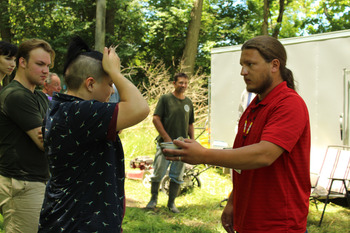
Moreover, the transformative values I advocate here often begin to inform the work we do even when we are not working directly with our partners. In other words, it is important to be accountable to the people who are most affected by archaeology, even if they are not full participants. For example, Native Americans have been represented on the Fort St. Joseph Archaeology Advisory Committee since its inception (Figure 4), but the local tribe members have been reticent to fully accept archaeology as a tool to help them pursue their own agendas for a variety of reasons (Low Reference Low, Walder and Yann2018). We respect their desire to leave Native sites in the region undisturbed (i.e., unexcavated) while we work to understand their position, and we remain ready to assist them in ways they deem appropriate. Sometimes the collaborative process involves standing on the sidelines and getting out of the way. This is what it means to be an accountable white ally/accomplice in the anti-racist work of transformative change, and it will serve us well as we seek to realize authentic and sustainable collaborative relationships in archaeology.
The Tribal Historic Preservation Officer of the Pokagon Band of Potawatomi and representative to the Fort St. Joseph Archaeology Advisory Committee (right) conducts a smudging ceremony involving students and staff before excavations begin at Fort St. Joseph. Photograph by Hannah Rucinski.

As the discipline is currently structured, collaboration may not be appropriate for all archaeological research (Bridges Reference Bridges, Sebastian and Lipe2009:244). Much of the archaeology in the United States is practiced as compliance-driven work. As long as market forces impinge on archaeology, there will be a need to balance cost, quality, and efficiency to be competitive in cultural resource management (Ferguson Reference Ferguson, Sebastian and Lipe2009:203–204), which can compromise and threaten genuine collaboration. Similar problems can emerge in academic archaeology when economic resources are at stake and heritage is commodified (Rowan and Baram Reference Rowan and Baram2004).
We must remain ever vigilant and reflexive in our practice. Even as we recover from dominant-culture values, we should acknowledge the limitations of sharing real power in any given context (Bollwerk et al. Reference Bollwerk, Connolly and McDavid2015:185). Furthermore, in exchange for public support, our responsibility is to provide benefits to a diverse set of publics in ways that optimize the use of nonrenewable archaeological resources over the long term. Consequently, our work will always be a compromise (Lipe Reference Lipe, Sebastian and Lipe2009:63) that fulfills the needs of the majority, even as we avoid epistemic popularism (González-Ruibal Reference González-Ruibal2019). If we neglect the needs of various minorities, however, we do so at considerable risk that negates genuine cooperation.
Finally, we cannot depend exclusively on our community partners to point out the shortcomings of white, Western, normative practice because many of these populations are already disempowered and often under siege (Nassaney Reference Nassaney2012). Moreover, we fail to be accountable if we do so. We must help each other develop the capacity to witness how we reproduce a dominant discourse. The ways in which white privilege should be interrogated provides an apt model for this work (Tochluk Reference Tochluk2008:130). Just as confronting racism entails a recognition of white supremacy among whites, so too collaborative archaeology requires archaeologists with and without sustained community involvement to examine their approach critically and work toward a broader reconciliation between their goals and their practice. We must also adjust our values to allow space for alternate ways of thinking, being, and acting in our combined roles as archaeologists and allies for social justice. Although we cannot expect archaeology to solve all the problems associated with global inequities, we can begin to adopt new value systems and implement them among our partners and in our institutions to have a positive impact not only on archaeology but in our wider worlds (Atalay Reference Atalay2019).
An authentic collaborative archaeology is an effort to bend the moral arc of the universe toward social justice. Consequently, there is a profoundly spiritual dimension to the work we do insofar as archaeology and heritage can bridge social capital and greater equity in a world marked by divisiveness, contestation, fear, and hopelessness—even as we maintain our intellectual rigor. Community participation in archaeological heritage can help us disengage from colonial domination and work toward building a wider, richer knowledge of many pasts. As we face the prospects and challenges of genuine collaboration, we should adopt new values to transform our practice and, ultimately, help us become our authentic selves.
Acknowledgments
I appreciate the constructive criticism on earlier drafts of this article from Mary Ann Levine, Barbara Little, Bob Paynter, the editors, and four anonymous reviewers. Crossroads Antiracism Organizing and Training provided permission to use its copyrighted framework for transformative values (Dias Reference Dias2008). This article represents a perspective that has emerged through the convergence of a decade of anti-racist training and more than three decades of collaborative archaeological practice. Thanks to all my partners and allies who challenged me when I needed it most and taught me about the importance of humility and compassion—most notably, Florie Bugarin, Chris Fennell, Maria Franklin, Nadine Godin-Nassaney, Carolyn Heineman, Lewis Jones, Liis Lahti, Cheryl LaRoche, Rev. Jill McAllister, Carol McDavid, Rev. Joann Mundy, and Lillie Wolf. Karen Hutchison and Nicole Haddow provided the demographic information on participants in the anti-racist workshops sponsored by the Society for Historical Archaeology. Irma Lopez provided the Spanish translations. I am privileged to use archaeology to work toward social justice and greater equity in a world marked by persistent racial and economic disparities.
Data Availability Statement
No original data were presented in this article.