


INTRODUCTION
Emotions are noninstrumental, subjective, evaluative experiences that are evoked by external or mental events and carry physiological changes and action tendencies (Frijda Reference Frijda1986). Emotions are not only corporeal but also social, cultural, and political, as they arise within interactions and are shaped by context (Kitayama and Markus Reference Kitayama and Markus1994). Challenging long-standing views that passions are antithetical to reason, political science research increasingly establishes the centrality of emotions in political life due to their influence on how people form preferences, assess information, make judgments, and behave (Damasio Reference Damasio1994; Elster Reference Elster1999; Marcus Reference Marcus2000; Marcus, Neuman, and MacKuen Reference Marcus, Neuman and MacKuen2000; McDermott Reference McDermott2004; Nussbaum Reference Nussbaum2001). Nevertheless, the emotions of research participants typically garner attention only when they are directly under study. This neglects a larger picture: emotions are pertinent even when not part of the research question because they are inherent in research that human researchers do with human participants.
Political science’s relative inattention to the role of emotions in research processes is conspicuous because many of the discipline’s core concerns, such as justice, freedom, and security, center values that people process in affective ways (Elster Reference Elster1999; Nussbaum Reference Nussbaum2001). It is also noteworthy due to robust scholarship on research participants’ emotions in other disciplines, such as health (Dickson-Swift et al. Reference Dickson-Swift, James, Kippen and Liamputtong2008; Ellis and Bochner Reference Ellis and Bochner1999; Lalor, Begley, and Devane Reference Lalor, Begley and Devane2006), anthropology (Davies and Spencer Reference Davies and Spencer2010; Milton and Svašek Reference Milton and Svašek2005), sociology (Blee Reference Blee1998; Clark Reference Clark2008; Holland Reference Holland2007; Sukarieh and Tannock Reference Sukarieh and Tannock2013), psychology (Buckle, Dwyer, and Jackson Reference Buckle, Dwyer and Jackson2010), organizational studies (Clarke, Broussine, and Watts Reference Clarke, Broussine and Watts2015; Mazzetti Reference Mazzetti, Ciesielska and Jemielniak2018), and qualitative and field research (Bergman Blix and Wettergren Reference Bergman Blix and Wettergren2015; Collins and Cooper Reference Collins and Cooper2014; Ezzy Reference Ezzy2010; Gilbert Reference Gilbert2001; Hubbard, Backett-Milburn, and Kemmer Reference Hubbard, Backett-Milburn and Kemmer2001; Kleinman Reference Kleinman, Shaffir and Stebbins1991; Kleinman and Copp Reference Kleinman and Copp1993).
Learning from those fields, as well as from interpretivist, feminist, reflexive, and embodied research traditions, I call for an “emotional sensibility” in political science. According to Schatz (Reference Schatz2009, 5), “ethnographic sensibility” is an approach to research that seeks to glean the meaning that people attribute to their reality. Building on that concept, I propose “emotional sensibility” as an approach to research that seeks to glean people’s emotional experiences. Just as ethnographic sensibility has an interest “not just in what people do, but also in why” (Zacka Reference Zacka2017, 255), emotional sensibility attends to not only research participants’ responses or behaviors but also the feelings that accompany and infuse them. Just as ethnographic sensibility is an openness to discover “more than we knew to ask” (McGranahan Reference McGranahan2018, 7), emotional sensibility is a readiness to consider the significance of emotions even when not investigating emotions, per se.
Emotional sensibility makes two contributions. First, it can improve data collection and analysis. Emotions influence what participants do or do not tell us, how they act when we observe them, and why. Emotions affect whether people enlist in our studies, influencing whom samples do or do not represent. When we do not take emotions seriously, we neglect important data or confounding factors that can bias inferences. In addition, participants’ emotional responses to research at one point can influence whether they or others cooperate with research subsequently. Emotions thus shape long-term access and knowledge production.
Second, emotional sensibility can make research more ethical. A growing scholarship explores research ethics in political science and cognate social sciences (Baele et al. Reference Baele, Lewis, Hoeffler, Sterck and Slingeneyer2018; Bernstein et al. Reference Bernstein, Levi, Magnus, Rajala, Satz and Waeiss2021; Campbell Reference Campbell2017; Desposato Reference Desposato2016; Fujii Reference Fujii2012; Reference Fujii2017; Guillemin and Gillam Reference Guillemin and Gillam2004; Krause Reference Krause2021; Mazurana, Jacobsen, and Gale Reference Mazurana, Jacobsen and Gale2013; McDermott and Hatemi Reference McDermott and Hatemi2020; Phillips Reference Phillips2021; Sriram et al. Reference Sriram, King, Mertus, Martin-Ortega and Herman2009; Thomson, Ansoms, and Murison Reference Thomson, Ansoms and Murison2013; Wood Reference Wood2006). In this context, the American Political Science Association (2020) launched a three-year deliberative process culminating in adoption of the landmark Principles and Guidance for Human Subjects Research. This multifaceted body of work has gone far in encouraging reflection, conversation, and responsibility about research ethics. When this work mentions research participants’ emotions, however, it is usually only in situations that Institutional Review Boards (IRBs) flag for special scrutiny—namely, when research subjects are vulnerable, marginal, or low power; when research engages sensitive topics; or when research takes place in threatening environments such as conflict zones. Extra care in these circumstances is essential. Framing ethical scrutiny in terms of particular categories, however, risks pathologizing emotions for some participants and ignoring emotions for others. This is misleading, as seemingly innocuous stimuli can cause harm, whereas talking about painful experiences may be rewarding. Emotional sensibility invites broader attention to these complexities under the umbrella that I call “emotional ethics”: researchers’ ethical responsibilities vis-à-vis the emotional dimensions of research for research participants.
Researchers can uphold emotional sensibility by attending to four dimensions of research that elicit participants’ emotions—namely the content of research questions and stimuli, the context in which research occurs, researchers’ positionality, and researchers’ conduct. Some of my recommendations regarding these dimensions will be familiar. Nevertheless, my conceptualization of emotional sensibility offers a new and interconnected way of understanding issues that often go unseen in the discipline or are addressed disjointedly. It thus seeks to shed fresh light on what some researchers are already doing, encourage others to invest in these practices, and stimulate continued innovation and discussion in this realm.
In developing these arguments, my intent is neither to infantilize the actors whom we study nor to raise obstacles to scholarship. Rather, I take up Fujii’s (Reference Fujii2012, 722) exhortation: “To enter another’s world as a researcher is a privilege, not a right. Wrestling with ethical dilemmas is the price we pay for the privileges we enjoy.” When we make sensitivity to emotions part of that price, we can make research more empirically valid and ethically sound. With that goal, this article proceeds in four parts. The first two sections, respectively, present the methodological and ethical cases for emotional sensibility. The third section outlines a typology for operationalizing and applying emotional sensibility. The final section concludes with implications for practice and questions for further research.
METHODOLOGICAL ARGUMENTS FOR EMOTIONAL SENSIBILITY
I consider three ways in which human subjects’ emotions affect data collection. Ignoring these effects can undermine data quality, validity, or reliability or even lead to mismeasurement.
Emotions Are Data
In seeking to gather information, political scientists often regard research participants’ emotions as irrelevant or as a problem to be neutralized (Davies and Spencer Reference Davies and Spencer2010; Olson Reference Olson2021). In contrast, emotional sensibility grounds data collection in recognition that participants are not merely “vessels of answers” but also “vessels of feelings” (Holstein and Gubrium Reference Holstein and Gubrium1995, 11–2). Existing scholarship illustrates the value of that approach. Studying social movements during the AIDS crisis, Gould (Reference Gould2009) was struck by the gap between activists’ anger at that time and her own sadness reading archival documents in retrospect. Attention to those emotions led to her main argument that emotions influence political action by shaping people’s sense of what is possible and necessary. Conducting interviews in Rwanda, Fujii (Reference Fujii2010) learned from not only answers to questions but also the feelings that interviewees conveyed in their denials, rumors, fabrications, and nonverbal communications. Her attentiveness to participants’ anxieties, for example, helped her distinguish deliberate silences about events from evidence that they had not occurred.
Although sensitive topics are especially “shrouded in emotionality” (Brannen Reference Brannen1988, 554), emotions offer data relevant for a large range of political topics. Brader (Reference Brader2006) shows how studies of campaign ads misunderstand their influence when they consider only how people process the information that ads convey and ignore their emotional appeals. Conover and Feldman (Reference Conover and Feldman1986) find that respondents’ personal financial circumstances scarcely affect their evaluations of politicians’ economic performance, whereas their emotional responses to economic conditions have significant effects. Models that ignore emotions therefore underestimate the influence of economic conditions and even suggest a gender gap that disappears when emotions are taken into account.
Researchers can thus go astray when they examine what people think but ignore what they feel. Building from this premise, emotional sensibility encourages researchers to go beyond the observation that emotions matter and instead investigate how they vary. For example, Phoenix (Reference Phoenix2019) finds that anger is a less powerful political motivator for Black Americans than for whites, whereas hope is more powerful. His conclusion—that one must feel secure and entitled to translate anger into political engagement—demonstrates how data about a range of respondents’ emotions can teach us about political structures and processes.
In experimental research, emotions might help explain puzzling findings. Driscoll and Hidalgo (Reference Driscoll and Hidalgo2014) conducted an experiment to test whether an informational campaign about electoral fraud increased filing of fraud complaints. The intervention yielded a surprising downstream effect when it lowered voter turnout in the upcoming election. Rerunning the experiment, they inferred that the campaign unintentionally provoked citizens’ fears of state surveillance, prompting voters to stay home. This experience illustrates how treatments intended to affect subjects’ rational assessments can prompt unforeseen emotions. When we ignore or do not anticipate emotions, we risk mismeasuring behaviors that we seek to explain.
Emotions Affect the Quality, Validity, and Reliability of Other Data
In addition to being themselves data, emotions affect other data collected from human subjects. Imbuing people’s recollections, judgments, and choices about what to share, emotional states are central to response biases. It is well known that respondents generally overreport socially desirable behaviors, underreport socially undesirable behaviors, or give untruthful answers to questions perceived to be threatening or intrusive (Berinsky Reference Berinsky2004; Tourangeau and Yan Reference Tourangeau and Yan2007). In addition to neutralizing incentives for bias through indirect questioning techniques (Corstange Reference Corstange2009; Rosenfeld, Imai, and Shapiro Reference Rosenfeld, Imai and Shapiro2016), scholars can learn more about the emotional dynamics that shape these biases. After all, when participants say what they think researchers want to hear, it is likely not due to the calculated utility of truthfulness as much as the felt desire for validation or fear of disapproval. Emotions are similarly at play when respondents respond negatively to questions intended to gauge political knowledge. Whether people worry about getting answers wrong or simply are unmotivated to exert effort (Lupia Reference Lupia2015), their emotional responses to these questions can lead them to look up correct answers, drop out, or respond with the nebulous “I don’t know.” The more we understand the emotions that underlie these undesirable tendencies, the more we can foresee and address them.
Emotions also affect research refusal (Berinsky Reference Berinsky, Donscbach and Traugott2008). Bosnjak, Metzger, and Gräf (Reference Bosnjak, Metzger and Gräf2010) find that the most important influences on cooperation with mobile surveys are trust, affective attitudes toward participation, and the perceived enjoyment of participation. These emotionally laden factors suggest that surveys overrepresent people who feel confident in research and researchers (Brehm Reference John1993) and underrepresent those for whom surveys elicit negative emotions. Alternatively, negative emotions such as bitterness toward information gathering can motivate respondents to participate, but in ways that undermine the reliability of the data that they provide (Parkinson Reference Parkinson2022).
Upon agreeing to participate, individuals usually need some degree of emotional enthusiasm in order to continue. In qualitative studies requiring sustained relationships, participants’ withdrawal due to feelings of apathy or alienation presents serious obstacles (Clark Reference Clark2008). For surveys, emotional sensibility suggests that the solution to respondent fatigue is not simply to make questionnaires shorter but to make the experience of participation worthwhile. Attending to the emotional dimensions of participation can help researchers design studies that inspire respondents’ motivation and thereby earn their engagement.
Emotions Condition Subsequent Data Collection
Research participants’ emotions carry long-term ramifications for access and knowledge production. Some populations report frustration or resentment with being “overresearched,” especially when research seems to have no effect and researchers do not fulfil pledges to stay in touch or share findings (Clark Reference Clark2008; Sukarieh and Tannock Reference Sukarieh and Tannock2013). Resulting feelings of being used, abandoned, or disappointed can lead to reluctance toward future research requests (McClendon Reference McClendon2012) or generate incentives to stymie future researchers’ agendas (Parkinson Reference Parkinson2022).
These enduring emotional effects are not limited to vulnerable populations. Some experiments have left political elites upset at being deceived or attacked (Paschall Reference Paschall2016) or annoyed that their time was wasted (Landgrave Reference Landgrave2020). This can lead them to refuse subsequent research invitations, impeding other scholars’ work (McClendon Reference McClendon2012; Nathan and White Reference Nathan, White, Druckman and Green2021). Attention to emotions in such cases is not a call to coddle the powerful but to consider the range of adverse consequences when researchers lack emotional sensibility.
ETHICAL ARGUMENTS FOR EMOTIONAL SENSIBILITY
The National Commission for the Protection of Human Subjects of Biomedical and Behavioral Research’s (1979) foundational “Belmont Report” centers on three principles. “Respect for persons” requires researchers to acknowledge the autonomy of research subjects and protect those with diminished autonomy by ensuring that consent is informed and voluntary. “Beneficence” requires researchers to design studies to maximize benefits and minimize harms. “Justice” obliges researchers to distribute research benefits and burdens fairly and equally.
This framework, as well as the IRBs and ethics committees developed to uphold and build on it, has helped prevent recurrence of egregious past violations. Still, many insist that its biomedical orientation is ill-fit for social science in general and field research in particular (Campbell Reference Campbell2017; van den Hoonaard Reference den Hoonaard, Iphofen and Tolich2019). Some charge that IRBs’ primary purpose is not even research ethics as much as safeguarding universities from liability (Sieber and Tolich Reference Sieber and Tolich2015; Yanow and Schwartz-Shea Reference Yanow and Schwartz-Shea2008). Others argue that IRBs neglect risks to people beyond immediate participants, including to society at large (Bernstein et al. Reference Bernstein, Levi, Magnus, Rajala, Satz and Waeiss2021; McDermott and Hatemi Reference McDermott and Hatemi2020).
Emotional sensibility contributes to these critiques, but from a different angle. I argue that the conventional ethics apparatus embodied by IRBs is deficient because it views research subjects through an excessively rationalist lens (see also Olson Reference Olson2021). For instance, the Belmont Report holds that human subjects are “capable of deliberation” and, on that premise, operationalizes respect for persons as a two-pronged consent process. First, researchers must provide subjects with clear, sufficient information, including a “systematic, nonarbitrary analysis of risks and benefits.” They must be attentive to how subjects’ comprehension of information “is a function of intelligence, rationality, maturity, and language.” Second, researchers must offer subjects the opportunity to ask questions and withdraw at any time.
This view of consent as calculation—informed individuals weigh pros and cons and then choose to initiate and sustain participation—is erroneously void of emotions. Affective judgments shape cognitive judgments and might even precede them (Zajonc Reference Zajonc1980). Accordingly, participants’ consent can reflect emotional responses as much as measured evaluations of information. Furthermore, informing participants that they may refuse questions or terminate participation is insufficient to prevent harm. Simply hearing a question can prompt distress. Timidity or eagerness to please can leave individuals feeling pressured to respond even when researchers assure them that they ought not. Given the power asymmetry inherent in research (APSA 2020; Fujii Reference Fujii2012; Kvale Reference Kvale2006), participants might feel embarrassed, afraid, or otherwise resistant to withdraw consent and thus continue when they prefer to stop.
These dynamics point to the inherent role of emotions in consent processes, as well as in the risks and benefits of research participation at large. This role is not adequately captured by IRB protocols’ focus on “principle-based” (Olson Reference Olson2021) or “procedural” ethics rules (Guillemin and Gillam Reference Guillemin and Gillam2004). Nor is it adequately addressed in what Guillemin and Gillam (Reference Guillemin and Gillam2004) dub “ethically important moments,” or the unpredictable judgment calls that arise in the everyday practice of research. Emotions are a constant, structural part of research participation, not a sporadic contingency. Emotional sensibility thus suggests the need for a new category of research ethics concerns, which I call “emotional ethics,” or researchers’ responsibilities vis-à-vis research participants’ emotional experiences. Emotional ethics invites thinking about how emotions intersect with ethics in six interconnected realms, outlined as follows.
Emotional Harm
I define research-induced emotional harm as harm that occurs when research prompts affective states that lead to participant distress. Emotional harm can be seen as a subset of psychological harm. The latter is a larger category that goes beyond emotions to encompass other kinds of mental processes, interpersonal behaviors, and cognitions, such as dampened self-esteem or decreased confidence in others (Labott and Johnson Reference Labott and Johnson2004). The APSA (2020, 8–9) and many IRB protocols emphasize researchers’ obligations to anticipate and avoid psychological harm, which they sometimes refer to as “psychological risk.” By focusing on “emotional harm” as a subcategory of psychological harm, I seek to call special attention to feelings and affects, per se. This includes attention to the ways that emotional harm and benefit do not strictly correspond to “negative” or “positive” emotions. Indeed, negative emotions such as anger and guilt might produce catharsis rather than distress, whereas positive emotions such as trust can enable other forms of harm, such as exploitation (Olson Reference Olson2021).
Trauma and Retraumatization
One grave psychological risk is trauma, defined as a state of disruption so severe that some life-enhancing processes become irretrievably lost (Valent Reference Valent and Figley2012). Although symptoms of trauma can resemble those of emotional harm, trauma goes beyond emotions to entail larger effects on brain functioning (Valent Reference Valent and Figley2012). The APSA (2020, 10) warns political scientists that exposing participants to sensitive topics might generate trauma. Asking participants to think about or discuss painful past experiences can also cause retraumatization when it prompts the return of symptoms associated with the original trauma or the onset of new symptoms (Leshner et al. Reference Leshner, Kelly, Schutz, Foy and Figley2012). The APSA (2020, 10) emphasizes that researchers should not intentionally induce (re)traumatization and should not expose participants to (re)traumatization without informed consent. They must “reasonably and realistically” foresee risks of trauma, disclose how they assessed and managed risks, report whether participants experienced trauma, and explain how they addressed any trauma that occurred.
Emotional Harms beyond Trauma
Beyond trauma, a much larger array of potential emotional harms demands attention. Some experimental research deliberately induces fear, anger, sadness, or other kinds of distress in order to study participants’ responses. Other affective distress might be unintentional. Research participants might feel guilt after disclosing sensitive information about themselves and others, humiliation upon learning that researchers deceived them, insulted when researchers disrespect their knowledge or personal boundaries, anger when researchers violate valued customs, fear that their responses will be used against them, jealousy when other research participants are treated more favorably, or frustration with inadequate compensation for their efforts, among other kinds of emotional distress.
Illustrative of several of these forms of harm is Nayel’s (Reference Nayel2013) searing description of being a fixer/interpreter for foreign researchers interviewing a refugee from Syria. He recounts a two-hour “tirade of questions” in which researchers press the interviewee to recall the minutiae of her displacement, undeterred as she grows “more vague and troubled” with each question. The interviewee repeatedly requests to speak about her injured son’s need for medical care, but the researchers ignore her and push forward with their questionnaire. Finally, the researchers instruct Nayel to give the agitated woman “five minutes to tell her son’s story quickly,” though they show no interest in what she says. Nayel eventually realizes that the entire encounter is only a training exercise for the team’s student researchers.
In this incident, it is researchers’ lack of emotional sensibility—not topic sensitivity or participant vulnerability—that is the source of harm. The interview does not cause emotional harm because it triggers recollections or a reexperiencing of trauma. On the contrary, the interviewee wants to discuss the trauma of her injured son. When the researchers ignore her, they prompt new feelings of being dismissed, misled, and silenced.
This is not an isolated story. Overresearched communities, in particular, have expressed dismay with some researchers’ self-interest, rudeness, lack of preparation, indiscretion, manipulation of relationships, or failure to deliver on promises (Sukarieh and Tannock Reference Sukarieh and Tannock2013). Indeed, the South African San Institute (2017) was so fed up that it drafted its own ethics codes to specify the care that it demands of researchers.
Emotional Harms beyond “Vulnerability”
Protocols generally regard as vulnerable those “categories of people [who] are presumed to be more likely than others to be misled, mistreated, or otherwise taken advantage of as participants in research” and are thus especially susceptible to suffering harm (Levine et al. Reference Levine, Faden, Grady, Hammerschmidt, Eckenwiler and Sugarman2004, 44). Van den Hoonaard (Reference den Hoonaard, Iphofen and Tolich2019) argues that this medically informed definition, viewing vulnerability as a fixed, personal trait, is inappropriate for the social sciences, where vulnerability is better understood as a dynamic relationship between participants and research processes. Levine et al. (Reference Levine, Faden, Grady, Hammerschmidt, Eckenwiler and Sugarman2004) add that equating vulnerability with classifications of people risks stereotyping or disempowering groups and diverts attention from the research design or researchers’ own behavior, which might be the real sources of harm. These points are pertinent for political scientists because there are specifically political forms of vulnerability—such as demographic characteristics that make one a likely target for state repression—that vary due to political, not biomedical, factors (Lake, Majic, and Maxwell Reference Lake, Majic and Maxwell2018).
Emotional sensibility augments these critiques. Subgroups that are not typically identified as vulnerable might experience emotional harm, whereas “vulnerable people” might not—not least because the latter have developed advanced coping mechanisms (Fujii Reference Fujii2012, 722). Rather than ruling some people to be off-limits and others trouble-free, emotional ethics advocates sensitivity across the board. This is especially helpful because writing on vulnerable populations often assumes that researchers sympathize with their participants and thus provides little guidance for those whose beliefs researchers deplore. Interviewing racist activists, Blee (Reference Blee1998, 396–7) notes that both she and her respondents caused each other fear. That her research “engage[d] the hearts as well as the minds of … informants” generated unique ethical responsibilities that existing scholarship did not address. Emotional ethics offers a way to understand these issues that slip through the cracks of standard human subject categorizations.
Downstream Harms Caused by Emotional Mechanisms
Emotions prompted by research can have ethical ramifications beyond feelings in the moment. Interventions intended to incite participants’ antigovernment anger could affect subsequent decisions to participate in risky dissent (Pan Reference Pan, Druckman and Green2021). Experiments that distribute resources unequally between treatment and control groups can trigger feelings of shame, jealousy, or resentment, which later foster conflict (Phillips Reference Phillips2021). Ethical scrutiny is needed to assess these and other mechanisms through which research influences participants’ emotions and, thereby, potentially causes downstream harms.
Emotions beyond Harms
Olson (Reference Olson2021) argues that, to the degree that ethics committee protocols address emotions, they overwhelmingly pathologize them as hazards to manage rather than appreciate them as inherent facets of human life. Emotional sensibility echoes Olson’s call for a broader approach. Accordingly, emotional sensibility highlights how participants can experience both emotional harms and emotional benefits and encourages researchers to think about their nonobvious trade-offs. For example, many argue that IRBs’ wariness of sensitive research overestimates the risks of discussing difficult topics and undervalues how talking can help people make sense of and extract meaning from experience and thus generate rewarding feelings of relief, self-awareness, or empowerment (Buckle, Dwyer, and Jackson Reference Buckle, Dwyer and Jackson2010; Corbin and Morse Reference Corbin and Morse2003; Finch Reference Finch, Bell and Roberts1984).
The potential for painful topics to yield emotional benefits can be heightened on political questions, where some may want to speak their truths as an act of agency, duty, or dignity. Examples from Northern Ireland (Lundy and McGovern Reference Lundy and McGovern2006) and the Balkans (Kostovicova and Knott Reference Kostovicova and Knott2020) find that research participants expressed emotional distress while discussing their experiences of political violence, yet they nevertheless wanted to document their perspectives. Under these circumstances, thwarting participants who wish to discuss past pains might itself be unethical (Kostovicova and Knott Reference Kostovicova and Knott2020, 12).
OPERATIONALIZATION
The APSA (2020, 13) exhorts political scientists to consider how their research affects the “experience of individuals directly engaged by the research.” One of the goals of this article is to demonstrate that these experiences have distinctly emotional dimensions and that researchers thus need emotional sensibility to detect, understand, and respond to them. In practice, researchers can implement emotional sensibility by attending to four interconnected dimensions of research that have consequences for participants’ emotions. Table 1 outlines these dimensions and their methodological and ethical implications. For interviews, all might be pertinent. For online surveys, only the content of research questions might be relevant. Nevertheless, all researchers can benefit by considering these issues in advance and tracking their salience over the course of a study.
Research Dimensions Affecting Emotions: Implications and Examples
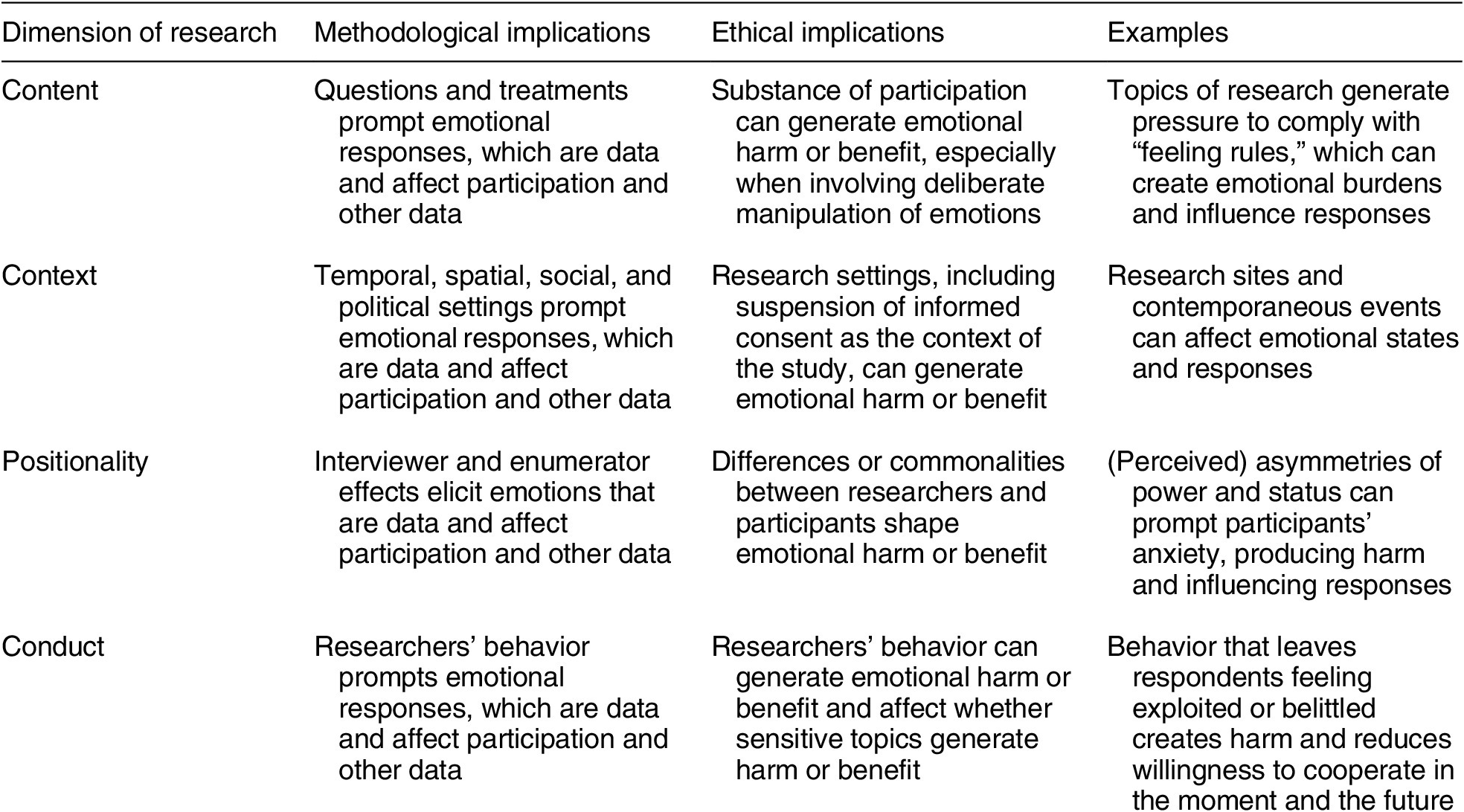
The value of this schema is that it shifts attention from the characteristics of research participants, as is conventional in thinking about vulnerable populations and past trauma, to participant emotions contingent on researchers themselves. This emphasis does not deny the importance of participants’ backgrounds. Rather, it asks researchers to think deeply about how their own choices constitute harm or benefit as well as how emotional sensibility can improve their work. In discussing each dimension, I echo others who seek not to specify requirements or prohibitions (APSA 2020) or cast blame (McDermott and Hatemi Reference McDermott and Hatemi2020) but instead encourage reflectiveness, openness, and discussion.
Content
The substance of researchers’ questions and interventions can have emotional consequences. This principle applies more broadly than political scientists typically recognize. Lee’s (Reference Lee1993, 4) classic book on sensitive research identifies three conditions that make research sensitive: when it is intrusive, is stigmatizing or incriminating, or relates to politics. In other words, all political science work is potentially sensitive and emotive. Furthermore, in Iphofen’s (Reference Iphofen2009, 54) words, “One can never anticipate the emotional effects an apparently innocent question can have.” For example, Guillemin and Gillam (Reference Guillemin and Gillam2004, 261) describe interviewing an interlocutor about heart disease when she suddenly broke down and began discussing sexual abuse. Hoffmann (Reference Hoffmann Elizabeth2007, 338) interviewed a homecare worker about her employment and was surprised when the interviewee described the distress of finding a client’s corpse. These and other illustrations remind us that even “ordinary” topics can prompt intense emotions among research participants.
Emotional responses to the content of research also come to the fore in experiments. The ethical standard for experiments is that they entail minimal risk, understood as no more than what one would experience in daily life. On that basis, Morton and Rogers (Reference Morton, Rogers and Desposato2016, 75) conclude that an experimental stimulus is acceptable if “the risk to subjects is not different from reading a newspaper or watching television … as long as subjects are allowed and able to leave the experiment and not participate.” When a stimulus generates distress, however, that distress does not necessarily disappear when participation ends, just as emotions do not evaporate when a television flicks off or newspaper is put aside.
Moreover, even if participants might come across similarly upsetting stimuli in everyday circumstances, a question remains about the ethics of purposefully subjecting them to it. This question is particularly salient in experiments that expose people to violence (Nair and Sambanis Reference Nair and Sambanis2019) or induce emotions such as fear (Young Reference Young2019), anger (Valentino et al. Reference Valentino, Brader, Groenendyk, Gregorowicz and Hutchings2011), anxiety (Albertson and Gadarian Reference Albertson and Gadarian2015), stress (Hassell and Settle Reference Hassell and Settle2017), or sadness (Small and Lerner Reference Small and Lerner2008). It is likewise pertinent in experiments that manipulate participants’ beliefs or violate norms in ways that cause unease (Morton and Rogers Reference Morton, Rogers and Desposato2016; Nielson Reference Nielson and Desposato2016). Experiments that target emotions are proliferating in political science (Brader Reference Brader2006; Groenendyk, Reference Groenendyk2011; Neuman et al. Reference Neuman, Marcus, Crigler and MacKuen2007; Redlawsk Reference Redlawsk2006), as are methodological tips for how to conduct them (Albertson and Gadarian Reference Albertson and Gadarian2016; Searles and Mattes Reference Searles and Mattes2015). Scrutiny of the ethical dimensions of this research should keep pace with conversations about its technical sophistication and theoretical value.
One recommendation for thinking about research content is that we, as a discipline, discourage approaching human subjects research as a “raid” in which researchers get in, get data, and get out (Horn et al. Reference Horn, Alba, Blom, Faure, Flack-Davison, Gopalakrishna and IJsselmuiden2022; Wadsworth Reference Wadsworth1984). Rather, we can value time that researchers spend acquiring nuanced knowledge about researched populations as relevant for understanding their emotional experiences. As emotions are unpredictable, contextual knowledge cannot guarantee that researchers will accurately interpret any participant’s responses or ensure that the content of research causes no distress. However, it can help researchers anticipate how populations relate emotionally to different topics and prepare researchers to recognize how participants communicate emotional states. Local knowledge also demonstrates to research participants that researchers have dedicated time and care to learning about them, reducing their likelihood of feeling reduced to mere data sources.
Context
The larger temporal, spatial, social, and political contexts in which research unfolds, in terms of both real-world field sites and specific study settings, have emotional implications. Lupu and Michelitch (Reference Lupu and Michelitch2018) note that settings that are nondemocratic, unstable, violent, low education, or high crime can render survey respondents uncomfortable in ways that yield untruthful answers. More generally, Cowles (Reference Cowles1988) suggests that the choice of when to initiate contact with participants, the time allotted for research sessions, the frequency of interviews or observations, and the time of day of research all affect participants’ emotional well-being. Salient developments in local, national, or international politics occurring around the time of data collection can also affect data due to the emotions that they trigger. For instance, questions about racism might provoke different emotional responses if asked before or after spikes in public attention to police violence against a person of color. Research about military interventions might carry different emotional consequences in the wake of a major humanitarian crisis.
The intersection between emotions and research context can influence what participants say, their susceptibility to emotional harm, and whether they choose to participate in research at all. Conducting a telephone survey in Mogadishu, Denny and Driscoll (Reference Denny and Driscoll2019) coincidentally placed calls both before and after a major attack on Somalia’s Parliament. That natural experiment supported the finding that reminders of violence decrease vulnerable persons’ willingness to provide sensitive information. Researchers, they conclude, should be attuned to how contextual circumstances prompt emotions such as stress and fear, which can cause nonresponse.
Like timing, the location of human subjects research has emotional effects. Liamputtong (Reference Liamputtong2007, 65) explains how places might have contradicting emotional pros and cons. For example, home might be where a participant feels most at ease but could preclude confidentiality from family members. Participants might not feel comfortable being alone in a site with a researcher (Lupu and Michelitch Reference Lupu and Michelitch2018) or might not want to be seen with researchers in public. Researchers should take those emotions into account in selecting a venue and perhaps also arrange for researchers and participants to arrive and depart separately (Liamputtong Reference Liamputtong2007).
These concerns draw attention to how the presence of others in research settings influences participants’ emotions and thus the data that they provide. Findings about third-party effects on surveys are mixed, suggesting the need for greater understanding about how such effects are conditioned by the third party’s identity and other factors (Diop, Le, and Traugott Reference Diop, Le and Traugott2015). Likewise in focus groups, participants’ interactions with and perceptions of each other affect them emotionally in ways that shape what they do or do not say. Cyr (Reference Cyr2019, 66–7) notes that homogenous groups more easily create comfortable spaces that encourage participants to speak openly and indeed cultivate feelings of solidarity that can make focus groups more fruitful than interviews. However, that emotional security comes at the expense of intragroup discord and disagreement and that emotional friction can also produce valuable data.
Randomized controlled trials are themselves a research context with emotional ramifications. Questions that garner little noteworthy response in normal situations might prompt sharp emotions under circumstances of deception. Many research subjects have become angry upon learning that they were enlisted in political science experiments without their awareness or consent (Desposato Reference Desposato2016). Alternatively, they might have become angry had they been debriefed, but they never were (McDermott and Hatemi Reference McDermott and Hatemi2020). Even when the treatment involves minimal risk according to objective calculations, subjectively felt harm can be formidable. As Desposato (Reference Desposato2016, 278–9) concludes, “If subjects are upset, it implies that our cost–benefit analysis was inaccurate.”
Other aspects of research context that shape participants’ emotions are more subtle. Hochschild (Reference Hochschild1983) coined the term “feeling rules” to refer to socially shared understandings about what people “ought” to feel in any situation. “Emotional labor” is the effort that people undertake to manage their feelings and respond to others’ feelings, in alignment with feeling rules. Many scholars analyze how researchers do emotional labor (Bergman Blix and Wettergren Reference Bergman Blix and Wettergren2015; Dickson-Swift et al. Reference Dickson-Swift, James, Kippen and Liamputtong2008; Reference Dickson-Swift, James, Kippen and Liamputtong2009; Hoffmann Reference Hoffmann Elizabeth2007; Hubbard, Backett-Milburn, and Kemmer Reference Hubbard, Backett-Milburn and Kemmer2001; Kleinman and Copp Reference Kleinman and Copp1993), if not cope with distress or trauma (Blee Reference Blee1998; Campbell Reference Campbell2017; Davies and Spencer Reference Davies and Spencer2010; Fujii Reference Fujii2017; Gilbert Reference Gilbert2001; Kleinman Reference Kleinman, Shaffir and Stebbins1991; Krause Reference Krause2021; Lalor, Begley, and Devane Reference Lalor, Begley and Devane2006; Loyle and Simoni Reference Loyle and Simoni2017; Mazurana, Jacobsen, and Gale Reference Mazurana, Jacobsen and Gale2013; Shesterinina Reference Shesterinina2018; Thomson, Ansoms, and Murison Reference Thomson, Ansoms and Murison2013; Wood Reference Wood2006). As humans, researchers naturally might feel disdain for some participants and closeness to others (Maier and Monahan Reference Maier and Monahan2010) or become overcome by sadness, anger, or other feelings. As professionals, however, they must control their emotions for the sake of the participant and study (Hoffmann Reference Hoffmann Elizabeth2007; Hubbard, Backett-Milburn, and Kemmer Reference Hubbard, Backett-Milburn and Kemmer2001).
Some works on researchers’ emotional labor imply that good researchers create a space in which participants freely feel and express feelings, whereas researchers must restrain their emotions in response. This underestimates the degree to which feeling rules affect participants, too. Unlike researchers, participants are not compelled to perform emotional labor due to a repeated social or professional role. Nevertheless, participants also operate in a world permeated by expectations about appropriate feelings. They might try to suppress emotions that they worry are inappropriate or, alternatively, conjure emotions that they believe a situation demands. They might sense that they are upsetting the researcher and alter responses to avoid doing so. They can also face the interpersonal dilemmas with respect to researchers—being polite to someone they do not like or becoming too intimate with someone whom they hardly know—that researchers face with participants. All of these emotions have methodological consequences for what participants do or do not tell researchers as well as ethical consequences for the pressures that participation generates.
Positionality
Participants respond emotionally to not only questions but also who asks them. Consequently, researchers’ positionality, referring to their social, cultural, economic, and political location in relation to research and participants, has emotional consequences. Positionality is pertinent in the constitution of vulnerable populations insofar as susceptibility to harm is a relational process rather than a biographical characteristic of participants (Levine et al. Reference Levine, Faden, Grady, Hammerschmidt, Eckenwiler and Sugarman2004; Van den Hoonaard Reference den Hoonaard, Iphofen and Tolich2019). More generally, the inherent power asymmetry between “researcher and researched” (Fujii Reference Fujii2012) can prompt emotions regardless of particular vulnerabilities. Kostovicova and Knott (Reference Kostovicova and Knott2020, 9) note that research participants sometimes experience “epistemic insecurity” when they perceive themselves to be subordinate or inferior to researchers who have more educational, material, or institutional resources. Such insecurity can lead to distress when participants feel shame about inadequate knowledge, frustration that they do not know more, or nervousness to “deliver” on what they are asked. On the other hand, gentle, charming researchers can purposefully or unwittingly coax participants into feeling so at ease that they share in ways that they later regret (Finch Reference Finch, Bell and Roberts1984; Kvale Reference Kvale2006). Though ethics committee protocols usually treat trust as an emotional good, Olson (Reference Olson2021, 6) warns that it is also a “space for manipulation.”
Various aspects of researchers and enumerators’ positionality can affect participants emotionally, including intersectional categories such as race (Hatchett and Schuman Reference Hatchett and Schuman1975), ethnicity (Adida et al. Reference Adida, Ferree, Posner and Robinson2016), gender (Benstead Reference Benstead Lindsay2014), and religiosity (Blaydes and Gillum Reference Blaydes and Gillum2013). Respondents might skew responses due to their emotional reactions to enumerators’ identities or skew responses in anticipation of enumerators’ own sentiments. Survey technologies also elicit emotional dynamics. Bush and Prather (Reference Bush and Prather2019) find that use of electronic devices can bring low-income respondents to feel shame vis-à-vis enumerators whom they perceive to be wealthier, leading respondents to hide or misreport their socioeconomic status. Such emotions can emerge even when researchers assume that positionality concerns are neutralized, such as when they hire firms to administer surveys using panels developed for nonpolitical purposes.
In light of such dynamics, “insider” researchers might best help respondents feel the emotional security that they need to be forthcoming. Cammett (Reference Cammett and Mosley2013) trained local proxies to interview respondents who shared the same religious background, finding that respondents’ greater comfort yielded more candid exchanges and insightful data. Cyr (Reference Cyr2019, 68–9) recommends that focus group moderators be “as similar to the participants as possible” because participants are more open when they see moderators as equals. One of moderators’ main tasks, Cyr adds, is to encourage participants to feel like peers and be attentive if they do not.
Local partners’ positionalities, however, can also generate emotional complications. Community leaders or nongovernmental organizations aid access, but their own power within the target population can cause potential participants to feel intimidated or obligated, undermining the voluntariness of participants’ consent. Those emotional dynamics might bias data when gatekeepers have stakes in research results (Pittaway, Bartolomei, and Hugman Reference Pittaway, Bartolomei and Hugman2010). Local fixers, translators, or research partners can also experience their own emotional distress (Mwambari Reference Mwambari2019), especially when inequitable collaborations leave researchers from the Global South feeling exploited or disrespected by researchers from the Global North (Horn et al. Reference Horn, Alba, Blom, Faure, Flack-Davison, Gopalakrishna and IJsselmuiden2022). This emotional harm has both ethical and methodological consequences. As Stys (Reference Stys2019, 10) writes, “More than anyone would care to admit, [local] researchers determine what one sees and how one sees it.” It is in part due to the effect of emotions on this facet of research collaborations that Horn et al. (Reference Horn, Alba, Blom, Faure, Flack-Davison, Gopalakrishna and IJsselmuiden2022, 5) conclude, “Fairer research leads to better quality research.”
Acting with emotional sensibility, researchers should be reflexive about how their identities and positions influence what participants feel and with what methodological and ethical consequences. They can employ this sensibility as they make careful decisions about how research team members work together and interface with research participants.
Conduct
How researchers act and treat participants has tremendous significance for participants’ emotions. With respect to sensitive topics, researchers’ conduct arguably drives emotional responses as much as does the content of questions themselves. Buckle, Dwyer, and Jackson (Reference Buckle, Dwyer and Jackson2010, 112, emphasis added) find that participants in bereavement research “frequently comment on the personal benefits they derived from the process of sharing their perspective … with an interested and engaged researcher.” Sieber and Tolich (Reference Sieber and Tolich2015, 28, emphasis added) agree that persons interviewed about past trauma or stress “typically report that they benefit emotionally from having a skilled interviewer listen to them.” The emphasized passages remind us that the difference between an emotionally rewarding or horrible research participation experience often lies with researchers themselves.
The emotional effects of researcher conduct have important methodological consequences. Our ability to recruit participants, sustain their engagement, and elicit useful data is conditional on whether participants believe studies are worth their time and effort. This is shaped by how researchers make them feel. Soss (Reference Soss, Yanow and Schwartz-Shea2014, 172) recounts a day of ethnographic fieldwork when, by chance, his interlocutor received a research survey in the mail, mocked it, and threw it away. When Soss asked why she gave time to his project but none to the other researcher, she explained that Soss “cared enough” to get to know her. “Participants’ perceptions of … the researcher and her or his project,” Soss concludes, “can have a major influence on what the researcher ‘finds’ in the field.” This does not mean that survey enumerators are expected to obtain the deep trust from respondents that ethnographers cultivate over months (Corstange Reference Corstange2009, 45). Nevertheless, both survey designers and enumerators can be attentive to respondents’ emotions; endeavor to document emotional cues as data; and conduct research in ways that allay feelings of disrespect, distress, or embarrassment.
More generally, scholars can integrate emotional sensibility into academic training, advising, and mentorship and thereby uphold the principle of “shared responsibility” for research ethics underscored by the APSA (2020, 20). Just as research requires methodological skills, research with human subjects demands emotional intelligence, in Collins and Cooper’s (Reference Collins and Cooper2014, 91) sense of a capacity to recognize one’s feelings and others’ feelings for the purpose of motivating and managing relationships. Although political science celebrates methodological prowess, it hardly recognizes emotional aptitude as an asset worth developing. This is symptomatic of the presumption that science is emotion-free (Stys Reference Stys2019). It also reflects the general lack of research ethics training in the discipline, which is conspicuous relative to some other social sciences such as psychology (Desposato Reference Desposato2016, 284–5).
Some argue that the ability to sense other people’s emotions and respond with care is innate and cannot be cultivated (Davis Reference Davis1990). However, fields such as prejudice reduction, health sciences, and social work have fine-tuned empathy trainings, and there is evidence that trainings can improve the cognitive and behavioral dimensions of empathy, if not its affective dimensions as well (Chiu et al. Reference Chiu, Lam, Kolomitro and Alamparambil2011; Levett-Jones et al. Reference Levett-Jones, Lapkin, Govind, Pich, Hoffman, Jeong and Norton2017; Teding van Berkhout and Malouff Reference Teding van Berkhout and Malouff2016). Trainings reveal a wide range of techniques including “didactic” approaches that teach about empathy, “stimulus” approaches that bolster empathy through observing others, “skills” approaches that hone particular abilities involved in acting empathetically, “experiential” approaches that practice those skills, and “mindfulness” approaches that develop nonjudgmental awareness toward others (Chiu et al. Reference Chiu, Lam, Kolomitro and Alamparambil2011). These techniques can be integrated into political science coursework or workshops related to human subjects research. Researchers can pilot surveys, experiments, or interviews with test respondents and practice inferring respondents’ emotional experiences (Barone et al. Reference Barone, Hutchings, Kimmel, Traub, Cooper and Marshall2005). Taking a cue from trauma-informed journalism, they can also develop manuals to guide work in settings where prospects for emotional harm are acute (Brayne Reference Brayne2007).
Beyond developing emotional sensibility as an asset and skill, researchers can address emotions as they plan particular studies. As a part of research design, they can ask themselves questions such as these: What might research participants feel during different phases of my research? How might this vary given the content or context of research, participants’ characteristics, or other factors? What methods will I employ to understand and register participants’ emotions during and after research? How will I judge between intense emotion and emotional harm? How ought I adjust research processes in response to indications of emotional harm? At what point might I alter, shift, or discontinue research? How will I follow up and support participants to address emotional effects, if appropriate?
Moving to the execution of a study, investing researcher conduct with emotional sensibility reminds us that participant consent is not a “one-off” box to check but requires ongoing care (Barker and Macleod Reference Barker, Macleod, Macleod, Marx, Mnyaka and Treharne2018; Knott Reference Knott2019; Miller and Bell Reference Miller, Bell, Miller, Birch, Mauthner and Jessop2012). As Lee (Reference Lee1993, 103) observes, “There is no guarantee that informants will realize before an interview begins what they might reveal, in what ways, or at what risk.” Before and after obtaining initial consent, researchers can be vigilant in attending to emotional cues to discern whether participants are experiencing discomfort and genuinely want to continue. Respondents should not be alone in bearing the burden of articulating their desire to stop participation because not all will feel empowered to do so. Researchers can thus bring emotional sensibility to a broader conceptualization of consent as a series of decision points as a study unfolds (Cox et al. Reference Cox, Drew, Guillemin, Howell, Warr and Waycott2014), a continuous negotiation between researcher and participant (Miller and Bell Reference Miller, Bell, Miller, Birch, Mauthner and Jessop2012), or a sustained understanding that might necessitate renewal even after fieldwork ends (Knott Reference Knott2019).
Throughout a study, researchers and enumerators can undertake “active listening” to what interviewees say; what they do not say; and the emotional cues in their facial expressions, body language, pauses, and silences. It is through active listening that researchers perceive the emotional work that research participants are performing, sense participants’ distress, and allow participants’ comfort levels to guide data collection (Dempsey et al. Reference Dempsey, Dowling, Larkin and Murphy2016; Thomson Reference Thomson2010). Driscoll (Reference Jesse2021, 111) notes that active listening, demanding both empathy and judgment about when to stop, is a skill that might come naturally to some researchers more than to others but all can work to train.
During the course of a study, there might be times when researchers ought to put aside their agendas and listen to what participants wish to discuss, even when not relevant to the research (Barker and Macleod Reference Barker, Macleod, Macleod, Marx, Mnyaka and Treharne2018; Collins and Cooper Reference Collins and Cooper2014; Thomson Reference Thomson2010). When participants grant us permission to investigate their thoughts and experiences, emotional ethics suggests an obligation not only to travel to our preferred destinations but also to make stops that are important to participants. Those journeys can sometimes lead back to where we wanted to go. Fujii (Reference Fujii2010, 236) discovered that allowing interlocutors to tell stories that did not fit her analytic categories sometimes directed them to precisely the information that she sought; to have impeded interviewees from discussing what they were eager to discuss would have resulted in “systematic holes in the data.” At the same time, emotional sensibility can help researchers recognize when probing might be inappropriate (Fujii Reference Fujii2010) and thus respect participants’ right not to reflect on or talk about their lives (Duncombe and Jessop Reference Duncombe, Jessop, Miller, Birch, Mauthner and Jessop2012).
The need for emotional sensibility in researcher conduct is most apparent when participants demonstrate intense emotion. Alty and Rodham (Reference Alty and Rodham1998, 280) note that participants might want to “talk about feelings stirred up” by the research and argue that “it is … unethical to fail to provide such an opportunity.” Responding to such emotions, researchers can be cognizant that an urge to say something to make participants “feel better” might be primarily motivated by the need to make researchers themselves feel better (Brannen Reference Brannen1988, 559–60). Rather than say something that interlocutors might perceive as dismissive, the best action might be the most difficult: simply to listen (Seidman Reference Seidman1991).
Many scholars emphasize the emotional significance of the conclusion of a research session. For surveys, researchers might include a final open question in which they invite respondents to describe how they felt as they completed the survey or to report anything else they wish. Responses can be useful for interpreting collected data and offer feedback for subsequent survey design. For interviews, and especially on sensitive topics, some advocate a postresearch debriefing in which researchers invite participants to discuss their feelings (Iphofen Reference Iphofen2009). If fitting, researchers might also offer referrals or information about opportunities for counseling (Alty and Rodham Reference Alty and Rodham1998; Baele et al. Reference Baele, Lewis, Hoeffler, Sterck and Slingeneyer2018; Corbin and Morse Reference Corbin and Morse2003; Hubbard, Backett-Milburn, and Kemmer Reference Hubbard, Backett-Milburn and Kemmer2001; Thomson Reference Thomson2010). Although postresearch mental health interventions are important responses to particular signs of distress, people can be upset without needing a psychologist. For example, when participants respond emotionally to political injustices that demand structural change it can be offensive to suggest that their distress is a personal pathology demanding therapy.Footnote 1 Bringing emotional sensibility to the conduct of research can help researchers make these distinctions and respond with care.
Finally, researchers should take emotions into account in reporting research. The APSA’s Principles (2020, 1, 9) calls for openness and discussion about research ethics including by encouraging editors, reviewers, authors, and the larger research community to uphold the norm of explaining ethics issues in publications and presentations. This norm applies to emotional ethics as well. Following the APSA’s lead, scholars can discuss potential and realized emotional harms and benefits as well as how researchers addressed them. Increased attention in written works and ongoing dialogue across disciplinary forums will increase awareness about the role of emotions in research processes and direct deliberation toward thorny issues. This can help the concept of emotional sensibility, like the APSA’s Principles (2020, 2) themselves, “evolve to become more representative …, more informative, and more useful.”
CONCLUSION
Writing in the 1980s, Elster (Reference Elster1989, 61) lamented, “The importance of emotions in human life is matched only by the neglect they have suffered at the hands of philosophers and social scientists.” Since that time, scholars have made strides in bringing emotions into political science as a variable. Still, emotions remain neglected in discussions about the process of doing political science research in general and human subjects research in particular.
With the goal of encouraging those neglected conversations, I propose that researchers strive to develop and apply an “emotional sensibility” by working to recognize, understand, and address the irreducibly emotional dimensions of research for research participants. Emotional sensibility can improve research methodologically by helping us appreciate how participants’ emotions are themselves data, influence the quality and validity of other data, and affect who does or does not participate in research, now or in the future. Neglecting these roles of emotions can introduce bias into analyses and also create long-term barriers for other researchers.
In addition, emotional sensibility improves research ethics. To that end, I introduce another term, “emotional ethics,” to capture researchers’ responsibilities vis-à-vis research participants’ emotional experiences. Standard bureaucratic approaches are implicitly rationalist, typically conceptualizing consent as a reasoned assessment of information and either ignoring participants’ emotions or viewing them through a narrow understanding of harm. As initial steps, emotional ethics calls for deeper thinking about both a wider range of emotional harms and emotions beyond harm.
Once political scientists recognize emotional sensibility as a principle worthy of attention and discussion, they can operationalize it by tracking four dimensions of research that prompt research participants’ emotional responses: research content, research context, researcher positionality, and researcher conduct. Each dimension suggests different recommendations for research praxis, such as building local knowledge to understand the cultural contexts shaping emotions or training emotional intelligence as a research skill. In planning and implementing any study, researchers can review Table 1 and reflect on the significance of each cell. Attending to each dimension’s relevance can help prepare researchers to catch emotional cues, avert emotional harm, cultivate emotional benefits, and take advantage of the methodological and ethical benefits that emotional sensibility can generate.
The concept of emotional sensibility suggests new avenues for research. Building on critiques of conventional conceptualizations of vulnerable populations, future work might develop alternative frameworks based on categories not of people but of experience. These might include experiences such as emotional harms (ranging from discomfort to distress or even trauma in a medical sense), emotional benefits (such as the satisfaction of expressing oneself, contributing to knowledge, etc.), and performance of emotional management in conformity with feeling rules. Such emotions might overlap in occurrence; vary in their effects; and differ across contexts, topics, and individuals. Researchers can collect data on verbal and nonverbal indications of various emotions and about the emotions that particular questions appear to elicit. This information can be useful both as data and for adjusting ethics protocols.
Future research can also explore how emotional ethics might apply differently to different research methods and track implications for surveys, experiments, or various kinds of interviews. In addition, it can debate how emotional sensibility might operate distinctly in investigations of political elites. One view of research as “speaking truth to power” implies, as does the APSA (2020, 3), that because “people who seek, hold, or wield power in the political sphere are accountable to the public in ways that are different from ordinary citizens, harms … may sometimes be permissible.” More scrutiny is needed about the circumstances under which specifically emotional harms are permissible—and, if permissible, are advisable.
Finally, researchers can apply emotional sensibility to deepen their understanding of their own emotional experiences as well as how their emotions interact with those of participants. Researchers’ emotional responses are data and can heighten alertness toward other data. They can also persist in ways that shape researchers’ perspectives and subsequent decisions. Appreciating that scholars feel as well as think does not negate the ability to produce scientific findings. Rather, it points to dimensions of knowledge that we seal off when we deny that emotions are ever-present and influential. Furthermore, it warns us of biases that might result when we fail to recognize how emotions shape our work.
Making research both rigorous and ethical entails difficult trade-offs between multiple and even contradicting priorities (Fujii Reference Fujii2012; Iphofen Reference Iphofen2009; Wood Reference Wood2006). The main point of this article is that the emotional experience of research participants should be among the considerations that we bring into the balance. In developing and employing emotional sensibility, political scientists can learn from conversations well underway in other disciplines about how to build and uphold a standard of care in human subjects research. Doing so will not only strengthen research methods and ethics but also encourage greater consideration of emotions in the study of politics at large.
ACKNOWLEDGMENTS
For invaluable input and feedback, I thank Lisa Anderson, Ted Brader, John Bullock, Jesse Driscoll, Daniel Galvin, Laurel Harbridge-Yong, Mary McGrath, Irfan Nooruddin, Sarah Parkinson, and Mark Tessler, as well as participants in the Advanced Workshop on Ethical Engagement in Conflict Research at Harvard University, Johns Hopkins University SNF Agora Institute seminar, University of Michigan Center for Political Studies workshop, and Research Ethics in the Middle East and North Africa initiative based at Columbia University. I also sincerely thank the editors and anonymous reviewers for their constructive critiques. For research assistance, I am indebted to Naomi Aisen, Felix Beilin, and Brianna Bilter.
CONFLICT OF INTEREST
The author declares no ethical issues or conflicts of interest in this research.
ETHICAL STANDARDS
The author affirms this research did not involve human subjects.



Comments
No Comments have been published for this article.