


Introduction
Response prevention is an intervention that refers to deliberately abstaining from or blocking a compulsion, which is typically performed in response to an obsession. It was first described by Vic Meyer (Reference Meyer1966) in conjunction with exposure. He described two in-patients who were successfully treated in the Cambridge Ward, St Luke’s Hospital in Muswell Hill, London (which was academically linked to the Middlesex Hospital Medical School) using a behavioural intervention based on learning theory. He attributed the success of response prevention to the patient discovering that it did not lead to overwhelming, unmanageable anxiety and that expectations of ‘disastrous consequences’ were not fulfilled (Meyer, Reference Meyer1966; p. 279). Rachman (Reference Rachman2015) described how Dr Vic Meyer and colleagues had the courage to go against the prevailing view and were warned that if they took away a patient’s defences (their compulsions), the patient could become psychotic (personal communication). However, this did not of course occur. After much research evidence, cognitive behavioural therapy (CBT) with exposure and response prevention (ERP) is now recommended as the main psychological intervention for treating obsessive-compulsive disorder (OCD) globally (e.g. National Institute for Health and Clinical Excellence, 2005) and has strong empirical support (Song et al., Reference Song, Li, Zhang, Jin, Zhen, Su and Li2022). Sixty years after the publication of Meyer’s seminal paper, it seems pertinent to review how the intervention has been refined and developed and to identify areas that still require research. We will discuss how response prevention can be applied to various types of compulsions. We first consider the phenomenology of compulsions.
Phenomenology of compulsions
Compulsions are defined as repetitive behaviours, including repetitive mental acts that the individual feels driven to perform in response to an obsession, according to rigid rules, or to achieve a sense of ‘completeness’ or to feel ‘just right’ (World Health Organization, 2022). Compulsions are either not realistically connected to the feared event (e.g. arranging items symmetrically to prevent harm to a loved one) or are clearly excessive (e.g. showering daily for hours). They are either time-consuming (e.g. taking more than 1 hour per day) or result in significant distress or impairment in personal, family, social, educational, occupational, or other important areas of functioning. Although compulsions are often conducted in highly specific, prescriptive ways, in general, we try to avoid using the term ‘rituals’ which does not convey the degree of distress and interference in one’s life. For example, we may have a ritual of making morning coffee, or a sports person may have a ritual before a big shot.
Some individuals may only have compulsions (and no avoidance), while others have very few compulsions because they are highly avoidant. Others use either compulsion or avoidance in different contexts. Thus, someone is more likely to escape or avoid a situation when there is an immediate threat and use a compulsion when the threat can be prevented or undone. An example of this is a mother’s obsessional fear of stabbing her baby. She might avoid being alone with her baby and put all knives or sharp objects out of sight, ‘just in case’ she has the urge to harm her baby. When avoidance is not possible, she may ensure that someone is always with her (a safety-seeking behaviour), check the location of knives, or use a mental compulsion to reassure herself that she will not stab her baby.
OCD can be considered to have four dimensions: contamination, harm, unacceptable thoughts, and order (Abramowitz et al., Reference Abramowitz, Franklin, Schwartz and Furr2003; Abramowitz et al., Reference Abramowitz, Deacon, Olatunji, Wheaton, Berman, Losardo, Timpano, McGrath, Riemann, Adams, Björgvinsson, Storch and Hale2010). While this is clinically useful, it is probably an over-simplification with limited evidence to support it.
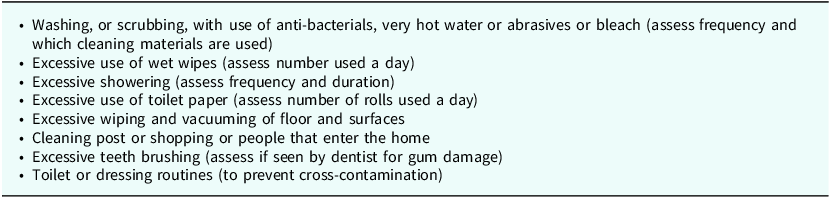
Table 1 lists the most common compulsions associated with the fear of contamination. Compulsions are commonly physical (e.g. handwashing) but can be mental (e.g. mental washing or counting to cleanse the thought). Sometimes, the handicap is created by the frequency or duration of the compulsion, the effect on others, and sometimes by the behaviour itself (e.g. washing with extremely hot water, bleach, or sodium peroxide). This may be misinterpreted as self-harm in the Accident and Emergency department (Thomson et al., Reference Thomson, McAllister and Veale2020). Avoidance and safety behaviours are designed to prevent an obsession from being triggered or to avoid performing a lengthy compulsion.
Typical compulsions association with contamination

Table 1. Long description
A table with one column and nine rows listing various compulsions related to the fear of contamination. The table does not have a header. Row 1: Washing, or scrubbing, with use of anti-bacterials, very hot water or abrasives or bleach (assess frequency and which cleaning materials are used). Row 2: Excessive use of wet wipes (assess number used a day). Row 3: Excessive showering (assess frequency and duration). Row 4: Excessive use of toilet paper (assess number of rolls used a day). Row 5: Excessive wiping and vacuuming of floor and surfaces. Row 6: Cleaning post or shopping or people that enter the home. Row 7: Excessive teeth brushing (assess if seen by dentist for gum damage). Row 8: Toilet or dressing routines (to prevent cross-contamination).
Clinical tip: Examine the client’s hands for damage caused by excessive cleaning and enquire in detail about the cleaning products used at home and for personal use.
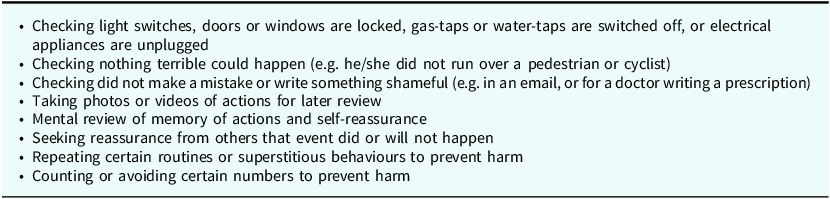
Table 2 lists the compulsions associated with the obsession of preventing harm (e.g. checking whether a cyclist has been run over). Avoidance behaviour occurs when the compulsions are too lengthy, such as when the individual asks someone else to check (because they are now housebound and do not open the door). Here, the handicap from compulsion is usually created by the time and distress of checking. New problems for people with OCD have arisen as the digital age brings a surfeit of information from multiple sources, which may be conflicting and give an illusion and expectation of control.
Typical compulsions associated with harm regarding safety of self, other people or objects in OCD

Table 2. Long description
A table listing typical compulsions associated with harm regarding safety of self, other people or objects in OCD. The table has one column and eight rows. Row 1: Checking light switches, doors or windows are locked, gas-taps or water-taps are switched off, or electrical appliances are unplugged. Row 2: Checking nothing terrible could happen (e.g. he/she did not run over a pedestrian or cyclist). Row 3: Checking did not make a mistake or write something shameful (e.g. in an email, or for a doctor writing a prescription). Row 4: Taking photos or videos of actions for later review. Row 5: Mental review of memory of actions and self-reassurance. Row 6: Seeking reassurance from others that event did or will not happen. Row 7: Repeating certain routines or superstitious behaviours to prevent harm. Row 8: Counting or avoiding certain numbers to prevent harm.
Clinical tip: Ask if their mobile phone has many photos taken for checking purposes.
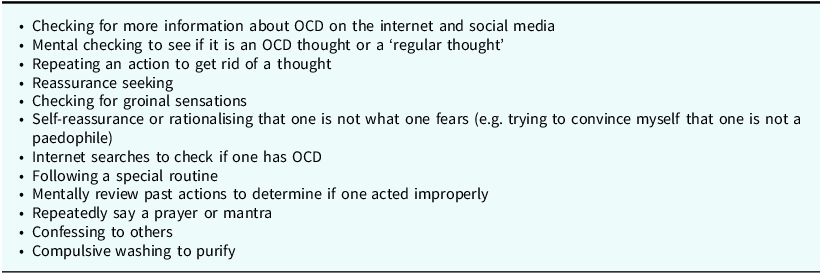
Table 3 lists the typical compulsions associated with obsessions with unacceptable thoughts and images (e.g. illegal or immoral sexual activity with a child; blasphemy or religious thoughts). Avoidance behaviours are usually used to prevent triggering obsessions. Handicaps are usually created by severe distress triggered by such thoughts and avoidance behaviours.
Typical compulsions associated with unacceptable thoughts, images or sensations in OCD

Table 3. Long description
A table listing typical compulsions associated with unacceptable thoughts, images, or sensations in OCD. The table has one column and ten rows. Row 1: Checking for more information about OCD on the internet and social media. Row 2: Mental checking to see if it is an OCD thought or a ‘regular thought’. Row 3: Repeating an action to get rid of a thought. Row 4: Reassurance seeking. Row 5: Checking for groinal sensations. Row 6: Self-reassurance or rationalising that one is not what one fears (e.g. trying to convince myself that one is not a paedophile). Row 7: Internet searches to check if one has OCD. Row 8: Following a special routine. Row 9: Mentally review past actions to determine if one acted improperly. Row 10: Repeatedly say a prayer or mantra. Row 11: Confessing to others. Row 12: Compulsive washing to purify.
Clinical tip: Ask your client about checking for thoughts, images, urges and sensations. If they do not report checking, ask about purposeful avoidance or suppression
Table 4 lists typical compulsions associated with the urge for order. These include compulsions to create order, symmetry, and completeness. This dimension may include ‘tic like compulsions’ which are more automatic or ‘just-right’ driven (like tics) and often lack a clear fear-based goal (unlike classic OCD compulsions). Examples include tapping, blinking, touching objects until it ‘feels right’.
Typical compulsions associated with order and symmetry in OCD

Table 4. Long description
A table listing typical compulsions associated with the urge for order. The table has one column and five rows. Row 1: Arranging objects in order (e.g. clothing in a cupboard). Row 2: Repeating a routine action (e.g. crossing a threshold, getting up and down from a chair, putting an object down). Row 3: Counting senseless things (e.g. ceiling tiles, words in a sentence). Row 4: Having to repeat a word or sentence over and over in the same way. Row 5: Having others to repeat a word or a sentence over and over.
Clinical tip: Such behaviours may be motivated by magical thinking to prevent harm or bad luck for oneself or for others. Equally, they are often done to feel ‘just right’ or ‘complete’ without any sense of preventing harm.
An existential subtype of OCD exists outside the four common dimensions of OCD. Here the individual ruminates and is very self-focused to find answers to questions such as ‘What if nothing is real?’, ‘What is the point of life?’, ‘How do I know I exist?’, ‘What happens after death?’, or ‘What if I am in a parallel world or the Matrix?’. This leads to mental reviews and physical checks.
Sensorimotor obsessions are another less common form of OCD in which one’s attention becomes excessively focused on normal automatic bodily sensations or processes, such as breathing, blinking, swallowing, or ‘floaters’ in one’s vision (Puranen, Reference Puranen2022; Wilson et al., Reference Wilson, Scarfo, Jones and Rehm2025). This is associated with significant anxiety, compulsive checking and monitoring of the sensation, seeking reassurance and Googling symptoms. There is a limited evidence base for treating sensorimotor OCD, but response prevention remains an important component.
Since the introduction of response prevention, our understanding of anxiety disorders has emphasised the importance of dropping safety-seeking behaviours (Salkovskis, Reference Salkovskis1991) and safety objects (Veale and Caplin, Reference Veale and Caplin2010) to test one’s expectations. It could be argued that compulsions are a form of safety seeking behaviour, as they both prevent the discovery of what happens. Examples of classic safety-seeking behaviours in OCD include wearing gloves to touch a perceived contaminant, breath-holding to prevent the entry of possible contaminants and averting one’s gaze away from a child in someone with intrusive sexual thoughts.
‘Neutralising’ is a distinct type of safety behaviour. It is a voluntary or effortful action performed to prevent or minimise harm and is often mental (Rachman, Reference Rachman1976). It often works as a one-off to ‘cancel out’ the potential harm of the obsession (although it may be performed regularly or is time-consuming, so it appears to be a mental compulsion). For example, if a person experiences an intrusive image of a family member dying in an accident, they tell themselves, ‘It’s me’ (i.e. they are dying) to save the family member. During this time, their eyes are shut, and they are very self-focused.
The next step is to understand the next layer of phenomenology and the functional analysis of compulsions. This includes (a) the context in which the compulsion occurs (or why it does not always occur), (b) the beliefs or motivation for the compulsion, and (c) the criteria used to terminate the compulsion and the elevated evidence requirements (Wahl et al., Reference Wahl, Salkovskis and Cotter2008). A good understanding of these factors will be used for the formulation and to guide therapy.
Washing compulsions
The context for washing compulsions is usually when a person feels that they are contaminated. This is commonly a physical contagion but can also be mental (Coughtrey et al., Reference Coughtrey, Shafran, Lee and Rachman2012). The motivation for compulsive washing is usually reparation; that is, restoring a clean state through washing. Another important motivation is to avoid feelings of disgust (Melli et al., Reference Melli, Chiorri, Carraresi, Stopani and Bulli2015). The termination criteria for washing and cleaning compulsions are usually internal when it ‘feels’ comfortable, clean, or ‘just right’.
Checking compulsions
The context for this dimension is when a person experiences a thought or detects a potential threat in the environment that they believe they have some influence or responsibility to prevent harm. The motivation for checking is to verify whether harm has occurred or could occur in the future. This may also be dominated by the desire to avoid visceral sensations and the feeling of uncertainty. The termination criteria of a check are usually when the person feels certain or ‘knows’ that harm is prevented or will not occur.
Reassurance seeking can be considered a specific type of interpersonal checking. Salkovskis (Reference Salkovskis1985) and Warwick and Salkovskis (Reference Warwick and Salkovskis1985) defined reassurance within the context of health anxiety and drew a parallel with OCD as the repetitive provision of old information. Rachman (Reference Rachman2002) noted that a person seeking reassurance typically knows the answer beforehand but still asks for reassurance to decrease their anxiety about the answer. Rachman (Reference Rachman2012) later revisited the concept and suggested that ‘the person is seeking some relief from distress and anxiety, not information as such. Without necessarily recognising it themselves, sufferers are seeking a response, not information as such’ (p. 507, Rachman, Reference Rachman2012). A more recent definition of reassurance seeking is ‘verbal and/or non-verbal interaction with someone, who you perceive has access to potentially threat relieving information, with the intention of increasing your perceived sense of certainty of safety from harm’ (p. 4; Halldorsson and Salkovskis, Reference Halldorsson and Salkovskis2023). The merits of response prevention for excessive reassurance seeking have been debated, given that it strains relationships and is difficult to sustain (Halldorsson et al., Reference Halldorsson, Salkovskis, Kobori and Pagdin2016).
Some people may reassure themselves by repeating phrases they have heard or read (‘It’s not a real thought, it’s just OCD’). They may take notes and read them to challenge their thoughts. Sometimes, people misuse what they have been taught (e.g. Theory A and Theory B) (Salkovskis, Reference Salkovskis1999). They reassure themselves that it cannot be Theory A for various rational reasons. In all these cases, a good functional analysis is required to understand the motivation for self-reassurance and its frequency of occurrence.
Unacceptable thoughts and images
The context for this dimension is usually an intrusive thought, image, or sensation, or if the person detects a potential threat in the environment that triggers such thoughts (e.g. a child). They are often associated with mental compulsion. The motivation may be to verify (mentally review actions or the motivation), restore a previous clean state of mind, or prevent harm. The termination criteria for a compulsion are therefore varied; for example, when a person feels certain or comfortable.
Order
The context for this dimension is usually an intrusive thought or potential threat in the environment that triggers such thoughts. The motivation may be to verify (mentally review actions or motivations), restore a previous clean state of mind, or to prevent harm. The termination criteria are typically until it feels ‘just right’, balanced, or complete.
Evidence for response prevention
The evidence for response prevention came from studies such as Foa et al. (Reference Foa, Steketee and Milby1980; Reference Foa, Steketee, Grayson, Turner and Latimer1984), who sought to disentangle the effects of exposure and response prevention. Participants with washing compulsions were randomised to receive either exposure alone, response prevention alone, or a combination of ERP. Treatment by exposure alone reduced anxiety about contamination but did not significantly reduce the washing compulsions. Response prevention alone reduced washing compulsions and the urge to ritualise, but not anxiety. The combined treatment yielded the best results. In other words, exposure alone was insufficient without response prevention. Later meta-analyses confirmed that ERP with complete response prevention was associated with better outcomes than ERP involving only partial prevention or exposure alone (Abramowitz, Reference Abramowitz1996).
In terms of non-responders, the weighted average drop-out rate in ERP for OCD is 15% (Ong et al., Reference Ong, Clyde, Bluett, Levin and Twohig2016). Non-response after ERP is 25–35%, although this depends on how ‘response’ is defined. In the largest study (n = 334) that received standard ERP, 25.4% showed little to no progress (Kim et al., Reference Kim, Wheaton, Foa and Blair Simpson2023). Poorer outcomes were predicted by more severe baseline avoidance and a broad tendency to internalising disorder symptoms such as anxiety and depression (Kim et al., Reference Kim, Wheaton, Foa and Blair Simpson2023). Subtypes do not generally predict prognosis (Kim et al., Reference Kim, Wheaton, Foa and Blair Simpson2023; Liu et al., Reference Liu, Yang, Wang and Li2022). However, Williams et al. (Reference Williams, Farris, Turkheimer, Franklin, Simpson, Liebowitz and Foa2014) found evidence that unacceptable thoughts have a poorer response to ERP.
Learning theory
The initial theory behind ERP is that prolonged exposure facilitates emotional processing through within-session habituation and decreases anxiety levels (Foa and Kozak, Reference Foa and Kozak1986). Furthermore, between sessions, there was a gradual extinction of the fear response. Response prevention was necessary to allow habituation because the compulsions interfered with this process. The goal was anxiety reduction, and response prevention served to prevent escape from the fear stimulus.
Inhibitory learning models (Arch and Abramowitz, Reference Arch and Abramowitz2015; Craske et al., Reference Craske, Kircanski, Zelikowsky, Mystkowski, Chowdhury and Baker2008; Craske et al., Reference Craske, Treanor, Conway, Zbozinek and Vervliet2014; Jacoby and Abramowitz, Reference Jacoby and Abramowitz2016) reframed the question of why and how ERP should be conducted. The theory is not based on habituation but rather on new learning. They proposed that exposure creates a new inhibitory memory that competes with the original excitatory (fear) memory. The fear memory remains but is inhibited by the new ‘nothing bad happened’ association. For response prevention, the goal is no longer simply to outlast anxiety until it decreases but to violate the expectancy that drives the compulsion. Response prevention allows for the maximum violation of the threat expectancy. Compulsions (and indeed all safety behaviours) prevent threat violation as they enable the continuation of the individual’s belief that the compulsion caused safety (‘nothing bad happened because I washed/checked’). They also prevent individuals from learning that the feared outcome will not occur. Therefore, response prevention helps create the conditions for disconfirmatory learning. Interestingly, even in 1966, Meyer was thinking about disconfirmatory learning and testing expectations. He noted, ‘Two aspects of the treatment are deemed as important: the realization by the patients that persistent non-performance of rituals did not lead to the immediate experience of unchecked arousal of anxiety; the patients’ expectations of “disastrous consequences” were not fulfilled’.
Some ERP tasks are not directly amenable to disconfirmation and do not violate threat expectations; for example, a client having blasphemous thoughts, meaning that she was sinful and deserved to be damned, leading to compulsive prayers (Berg et al., Reference Berg, Webler, Klein and Kushner2024). In this case, the ERP task was to read a narrative of their specific blasphemous thoughts and scenes of being damned without any compulsive prayers. After about five minutes of narration during which the patient’s fears are strongly activated (as indexed by subjective ratings), the therapist introduces new information meant to challenge and modify the individual’s interpretation of the upsetting thoughts (for example, that the thoughts are a sign of just how much she despises damnation and loves God). They argue that the mechanism is (1) non-associative habituation to aversive stimuli and (2) fear-memory elicitation and subsequent reconsolidation. As will be seen below, this overlaps with the cognitive approaches.
Cognitive theory
Cognitive theory focuses on understanding the appraisals that arise from the obsession that motivates the compulsion (e.g. ‘I could be responsible for harm – I need to repeat my action to prevent harm or death to my family’) (Rachman, Reference Rachman1997; Salkovskis, Reference Salkovskis1985). This alternative explanation can be tested in a behavioural experiment. Behavioural experiments often involve exposure and response prevention, but the goal is to gather evidence to test beliefs. In theory, the exposure is not prolonged or repeated and is not conducted within a graded ERP hierarchy (Whittal et al., Reference Whittal, Radomsky, Coughtrey and Shafran2027). This could be considered within both cognitive theory and inhibitory learning theory, which state that stopping compulsions allows one to test threat expectancies and learn that feared outcomes are less likely, less dangerous, or more tolerable than predicted.
Rachman (Reference Rachman2002) developed a cognitive theory of compulsive checking. He proposed that checking behaviour is maintained by beliefs, including inflated responsibility and reduced confidence in memory, for which there is experimental and preliminary clinical evidence (Radomsky et al., Reference Radomsky, Dugas, Alcolado and Lavoie2014; Radomsky et al., Reference Radomsky, Giraldo-O’Meara, Wong, Dugas, Gelfand, Rachman and Whittal2020).
Cognitive therapy has further identified that compulsions are maintained by problematic termination criteria and elevated evidence requirements (e.g. it feels comfortable or ‘just right’ (Wahl et al., Reference Wahl, Salkovskis and Cotter2008), potentially related to a deficit in the ability to access internal states (Liberman et al., Reference Liberman, Lazarov and Dar2023). These are highlighted in the section on descriptive psychopathology in this study.
Formulation
Meyer reportedly once told a colleague, ‘I sometimes regret ever inventing response prevention and exposure techniques for the treatment of obsessive compulsive disorder’ (Malatesta, Reference Malatesta1995). He was referring to the technological application of an intervention without adequate assessment and formulation (Meyer and Turkat, Reference Meyer and Turkat1979). Cognitive behavioural formulations mainly focus on maintenance factors (e.g. checking, seeking reassurance, and being self-focused). Rhéaume et al. (Reference Rhéaume, Freeston, Léger and Ladouceur1998) highlighted how particularly dramatic events or a succession of unlucky and improbable events may contribute to the over-importance given to the thought’s meaning. These may be part of the formulation of how bad luck may contribute to appraisals.
A developmental formulation may be important to hypothesise a function (e.g. loss, anger) or determine if any aversive experiences, such as bullying, especially in childhood or adolescence, may be emotionally linked to their compulsions. Sometimes, these require validation and making the emotional link. Others may benefit from emotional processing, such as imagery rescripting (Veale et al., Reference Veale, Page, Woodward and Salkovskis2015). Exposure and response prevention should not come at the cost of a detailed case conceptualisation, and both are necessary.
Therapy goals
It is important to agree on the goals of eliminating all compulsions and safety behaviours. Abramowitz (Reference Abramowitz1996) found that ERP protocols using strict ritual prevention produced better outcomes than gradual or partial ritual prevention. Partial reduction in the frequency or duration of compulsions is often an unintended outcome of homework and a common problem in treatment. Clients and even therapists may be happy with a functional improvement; for example, a reduction in compulsions may lead to the ability to get to work on time or perform other activities. This is helpful, but the compulsions or safety behaviours remain and maintain the problem, and the OCD can easily become worse again when stress increases. It is also important to aim to begin dropping safety behaviours and response prevention early in therapy, if possible.
Response prevention
We describe ten main approaches to response prevention that have been used by clinicians and described in the literature.
Psychoeducation
It begins with psychoeducation about the nature of compulsions and how response prevention ‘works’. The nature of psychoeducation on response prevention depends on the model used by therapists. Caution is required, as response prevention may be perceived by a client as being told to ‘just stop it’ which could impact the therapeutic alliance. Thus, it should always be delivered compassionately, collaboratively, and non-judgementally. A behavioural approach would highlight that compulsions ‘work’ by reducing anxiety and uncertainty in the short term. However, the compulsion is then strengthened, and the person is more likely to perform the compulsion again (using the principles of negative reinforcement). By performing a compulsion, the person is unable to learn to tolerate anxiety or uncertainty and continues to experience the unintended consequences of repeating the compulsion. Many people with OCD at one level ‘know’ these facts. Psychoeducation within a cognitive approach includes attempts to provide an alternative understanding of the problem as a catastrophic misinterpretation of normal, unwanted, intrusive thoughts (Rachman, Reference Rachman1997), with compulsions serving to prevent disconfirmation of the misinterpretation (Salkovskis, Reference Salkovskis1999).
Self-monitoring
When compulsions are extensive, it is often helpful to suggest self-monitoring to determine their frequency and context. Self-monitoring increases awareness of habitual behaviour. This is especially true when OCD becomes chronic over a prolonged period. The frequency can be monitored using a tally counter. Some individuals struggle with accurate self-monitoring, and it may be helpful to have a caregiver or a suitable professional observe them throughout the day. A therapist and client need to understand the context of their compulsion (and identify when they do not perform a compulsion), the motivation behind the compulsion, and the termination criteria used for the task. A suitable form for monitoring between sessions is provided in the Supplementary material.
Response blocking
Response blocking refers to the physical or procedural prevention of behavioural occurrence. It was first described in the original paper on response prevention (Meyer, Reference Meyer1966), in which the author described a patient for whom ‘the water-taps in her room were cut off and strict control over her cleansing agents was exerted. Persuasion, reassurance and encouragement were used to prevent the patient from unnecessary and excessive washing and cleaning’. Patients were initially placed under 24-hour nursing supervision, whose role was to block the compulsions. This was in the context of exposure to various objects that were perceived as contaminants.
Response blocking may be ‘effective’ in the short term, but behaviour can easily return once control is removed from the environment. If it is used nowadays, it is likely to be in a hospital or a residential setting. It needs to be with full consent and gradually reintroducing access to water taps or other triggers. Currently, health and safety regulations prevent the storage of bleach and other cleansing agents in patients’ rooms. There may be other practical problems to be negotiated in hospitals or family environments, such as the number of toilet rolls allowed, the number of wet wipes clogging toilets, or water flooding the environment. Here, response blocking must occur for practical reasons and compliance with regulations.
The most common consequence of response blocking is that the person develops a response that cannot be controlled by others (e.g. finding another toilet in the hospital). Another example of response blocking is when a family member is taught to stop providing repeated reassurance. This was described by Isaac Marks (Reference Marks2005) as ‘Hospital says no answer’ to requests for reassurance. However, seeking reassurance can be extremely subtle and nuanced, and difficult for both therapists and clients (Causier and Salkovskis, Reference Causier and Salkovskis2025; Halldorsson & Salkovskis, Reference Halldorsson and Salkovskis2023).
Thus, a person may believe that if their family member does not say anything, this will still reassure them, as they reason that their family member would have said something if there was danger. Instead of response blocking, it has been proposed that a more acceptable intervention may be for a loved one to provide emotional support (Causier and Salkovskis, Reference Causier and Salkovskis2025). Thus, a carer may be encouraged to not discuss the content of the obsessional fear but to say something like, ‘I understand, darling. This is really tough, but let’s just stick with the plan’ and offer to give them a hug. This can be done first in a role-play.
Alternatively, an individual may resort to reassuring themselves and mentally reviewing past events. Here, they would be encouraged to be self-compassionate, soothing, empathic, and non-judgemental (without discussing the content of their fear).
Response reduction
Response reduction refers to a gradual reduction in the frequency and/or duration of compulsive behaviour. In many ways, this mirrors graded exposure (e.g. graded response prevention). For example, a client might agree to reduce the frequency of compulsive handwashing from 100 times a day to 90 times a day, or the duration of checking a stove from 30 to 20 minutes per day. However, clients generally speed up their compulsions. This is often ineffective because they do not learn to tolerate anxiety or test their expectations. The goal is to stop compulsions, as opposed to only a partial reduction or speeding up the compulsion. One could argue that this may be a means to an end, but for many, this is not the case, and there are more effective approaches available. We are not saying that response reduction should never be used, but rather that its limitations should be recognised by both the client and therapist. Furthermore, response reduction may play a role where the compulsion is an exaggerated version of a necessary behaviour, such as personal hygiene, where complete prevention is undesirable (Freeston, Reference Freeston2001). It is essential to ensure that the treatment is formulation-driven and that there are clear agreements with the client regarding the targets of behaviour.
Response delay
Response delay as an intervention refers to increasingly postponing (delaying the compulsion). The therapist might encourage their client to resist the compulsion but delay it for a set period: ‘You can wash your hands/check the appliance, but only after 30 minutes has passed’. This may be a means towards an end (like graded exposure) but can distract from the goal of learning to tolerate anxiety and test out expectations. Response delay may also occur in an unplanned way; for example, a client engages in therapist-guided exposure in a clinic but then goes home to perform their compulsions. In summary, response delay may be helpful in some cases if it is a means towards an end, but in general, it is not a first-line intervention.
Exposure after a compulsion
Exposure after compulsion can be an effective response prevention strategy for OCD. For example, after compulsive washing, exposure to recontamination occurs. The term ‘spoiling’ the compulsion is sometimes used colloquially between a therapist and client (Gillihan, Reference Gillihan2016). Spoiling can occur at the time of the urge before a compulsion, during a compulsion by interrupting it, or after it has been completed. This may be repeated as many times as required. Examples are provided below.
-
• After compulsive washing, touching a contaminant (e.g. the floor), and then transferring the contagion to perceived safe areas.
-
• After compulsive ordering of one’s possessions, they would be encouraged to create the slightest disorder and incompleteness and ensure they finish feeling wrong.
-
• After repeating an action, such as going back and forth through a door and doing a mental compulsion to prevent harm from coming to their loved ones, they would be helped to ‘spoil’ the compulsion by trying to wish harm on their families.
In all these examples, the compulsion has been ‘undone’ so that the person is in a state of permanent contamination or disorder and learns to tolerate uncertainty and violate their expectations. When a client’s fears are strongly activated, the therapist may remind them of the alternative explanation (for example, ‘Theory B’) that challenges their appraisal. This may help to get around the problem of an alternative explanation as being too intellectual and done when the person is not anxious (Stott, Reference Stott2007).
Non-reactivity to a compulsion
Researchers have investigated mindfulness meditation, which involves not reacting to or identifying with intrusions or urges (Didonna, Reference Didonna2019). They learn to observe the contents in a non-judgemental manner and experience awareness of the present. Mindfulness is likely to require a great deal of training and is not relevant for those in acute distress. In a meta-analysis, mindfulness-based interventions for OCD were not found to be significantly different from other interventions (Perin et al., Reference Perin, Carvas Junior, Civile, Moreira and Melnik2025). The most recent study comparing CBT and mindfulness-based cognitive therapy (MBCT) found equivalent outcomes but suggested different mechanisms of action (Rector et al., Reference Rector, Hawley and McCabe2026). CBT was found to impact obsessive beliefs which in turn predicted improvement in symptoms. In contrast, MBCT found that the extent to which self-kindness improved and self-judgement reduced was related to symptom improvement. Although some may find that mindfulness interventions can increase rumination and uncertainty in some individuals, the study argued that MBCT reduced the focus on obsession, potentially reducing the frequency, distress, and duration. In addition, MBCT skills focused on ‘urge surfing’ which may have reduced engagement in compulsive rituals (Rector et al., Reference Rector, Hawley and McCabe2026).
Linked to mindfulness is ACT and the principle of defusion. This means a way of relating to their thoughts and urges for compulsions which do not need to be evaluated for their truth. Twohig et al. (Reference Twohig, Abramowitz, Smith, Fabricant, Jacoby, Morrison, Bluett, Reuman, Blakey and Ledermann2018) directly compared ERP alone with ACT+ERP. No significant differences were observed in exposure engagement, treatment acceptability, or drop-out rates between ACT + ERP and ERP groups. Therefore, adding ACT did not significantly improve ERP alone, nor did it detract from it. In conclusion, non-reactivity to the urge to perform a compulsion is fine in theory but very difficult to practise as an intervention.
We believe that clients do not have to learn mindfulness or ACT, but they should be encouraged to pay full attention to the world as it is. This can be best observed when accompanying clients. Thus, they should not be self-focused on how they feel or their urges and attempt to distance themselves. Increased awareness of urges may, in theory, allow the person to choose to either perform the compulsion (and see what effect it has) or stay in the real world and do the things they value. Being externally focused also discourages the use of unhelpful termination criteria. When clients are very distressed by compulsions, they may be taught to ground themselves or listen to a pre-recorded compassionate message if it helps disengage them from the compulsion.
Habit reversal
Compulsions have also been conceptualised as habitual behaviours. Gillan (Reference Gillan, Fineberg and Robbins2021) suggests there an imbalance between two systems of action control:
-
(a) Goal-directed system: flexible, based on understanding consequences (‘If I do X, I get Y’).
-
(b) Habit system: automatic stimulus–response (S–R) learning, triggered by cues, and is relatively insensitive to outcomes.
Habits develop through repetition and reinforcement, gradually shifting behaviour from deliberate to automatic. This shift is typically adaptive, but in the case of compulsions, it has been argued that the behaviour becomes overly habitual and is decoupled from the goals. Gillan (Reference Gillan, Fineberg and Robbins2021) further highlights that compulsions may not stem from overactive habit learning alone, but from deficits in goal-directed processing, e.g. poor use of action–outcome knowledge. According to this perspective, compulsions become more entrenched because repetition strengthens S–R associations (habit learning) and doubt.
According to this approach, because habits are cue-driven, habit reversal training rather than exposure and response prevention is warranted. The theory behind habit reversal training is to modify the environment to reduce triggers, introduce a competing response, and use variability to weaken rigid routines. It was originally developed for tics and body-focused repetitive behaviours (Azrin and Nunn, Reference Azrin and Nunn1973) and appears to be effective (Woods et al., Reference Woods, Himle, Stiede and Pitts2023). Competing response training first increases awareness of unwanted habits (e.g. hair pulling), a detailed functional analysis of the behaviour, and then adds an incompatible behaviour (the competing response). This is practised whenever an urge occurs or immediately after a habitual behaviour. Therefore, instead of raising one’s hand to pull a hair, it might involve extending one’s arm behind the chest. Moritz and Rufer (Reference Moritz and Rufer2011) developed a variation of decoupling, which is a counter-movement immediately triggered by habitual behaviour (e.g. as one’s hand approaches hair to be pulled, one’s hand is pushed away with a sudden and accelerated movement).
Could HRT or decoupling be developed for response prevention in individuals with OCD? The most relevant component of HRT is increasing awareness of when a compulsion occurs (as discussed above). If decoupling is used, one might teach a countermovement (e.g. as one’s hand approaches an electric switch to be checked, one’s hand is pushed away with a sudden and accelerated movement). Standard HRT for OCD has been evaluated through case studies (Dillenburger, Reference Dillenburger2006; Toffolo and Saxena, Reference Toffolo and Saxena2019) that showed a 30–50% improvement in OCD severity. Pereira de Souza et al. (Reference Pereira de Souza, Mpavaenda, Banca, Wellsted, Hopkins, Marzuki, Lee, Karafylli, Bardsley, Mazoruk, Skalecki, Boodhun, Mendoza-Wolfson, Crispin, Aloneftis, Monji-Patel, Cinosi, Pellegrini, Enara, Panjwani and Fineberg2026) have taken a different approach by developing a smartphone-induced habit, consisting of a learnt finger sequence. They were instructed to practise the new habit (before the compulsion took place). Their theory is to break the stop-signal association with a stop-change approach and learn a different habit that can be broken more easily. The authors demonstrated the feasibility and acceptability of the intervention; however, we are concerned that it will distract from the first-line intervention of exposure with response prevention. It may also distract clients from understanding their motivation and the termination criteria of the compulsion. Furthermore, compulsions can be differentiated from habits, such as body-focused repetitive behaviours. The latter are usually triggered by urges, boredom, or sensory discomfort. The goal is to bring relief, gratification, or stimulation. There is often no associated belief, and they may be automatic or outside of awareness. Sometimes, compulsions begin to resemble habitual behaviours, particularly when OCD is chronic, but their purpose is to reduce anxiety and/or threat, are in response to an obsession, and are executed according to specific rules.
Lifestyle
Various lifestyle factors (especially sleep and diet) may influence the ability to resist compulsions. Thus, people with severe OCD compulsions may experience delayed-phase sleep as they do not get to bed until the early hours of the morning because of their compulsion to perform certain behaviours (Paterson et al., Reference Paterson, Reynolds, Ferguson and Dawson2013; Santiago et al., Reference Santiago, Simbre and DelRosso2025). Sleep disruption and fatigue make it more difficult to resist compulsions. Good sleep hygiene is required, and getting up with the sun or bright light therapy in the morning can help reset the circadian rhythm. Better outcomes have been reported in residential units where stricter getting-up times were implemented (Coles and Stewart Reference Coles and Stewart2019).
When OCD compulsions become severe, there is often no time to prepare or eat food, or more junk food is consumed than usual. This, in turn, may increase a depressed mood and make it more difficult to resist compulsions. Eating a healthy diet can improve mood (Staudacher et al., Reference Staudacher, Teasdale, Cowan, Opie, Jacka and Rocks2025). Finally, when compulsions are severe, there is no time for previous activities, and the person becomes inactive and more depressed. It may be important to use behavioural activation concurrently in the treatment of OCD (Simkin et al., Reference Simkin, Hodsoll and Veale2022).
Family accommodation
Family members may assist in compulsions or be restricted from some activities (Hermida-Barros et al., Reference Hermida-Barros, Primé-Tous, García-Delgar, Forcadell, Lera-Miguel, Fernández de la Cruz, Vieta, Radua, Lázaro and Fullana2024). This may be motivated by a desire to reduce stress in their relatives, prevent aggression, or make family life possible. During therapy, it is often helpful to do a home assessment or see the family, perhaps role-play in choosing not to accommodate the person with OCD. Family helpers may be flexible in setting boundaries and being emotionally supportive without being accommodating. When a person with OCD is stuck in a compulsion for a long period, it may be helpful to discuss beforehand how the family member can best be compassionate in supporting the individual without accommodating. Cognitive behavioural therapy for OCD decreases family accommodation (Hermida-Barros et al., Reference Hermida-Barros, Primé-Tous, García-Delgar, Forcadell, Lera-Miguel, Fernández de la Cruz, Vieta, Radua, Lázaro and Fullana2024).
Special considerations for doubts
OCD was historically known as the ‘doubting disease’ (Berrios, Reference Berrios1989). Doubts and images about whether a feared consequence has occurred in the past (‘Did I run over that cyclist’, or ‘Could I have become aroused when I was playing with my daughter on my knee’, or ‘Could I have left the stove on?’) often leads to mental checking to review their actions. There may also be doubts about whether they could act on their urges in the future, leading to self-reassurance. Doubts cut across content domains and can be observed as (i) obsessional doubts, (ii) doubts in memory, senses, or cognitive processes, and (iii) doubts about whether a compulsion was performed correctly (Chiang and Purdon, Reference Chiang and Purdon2023). Many patients may engage in neutralising or compulsions to pre-empt doubt; for example, mental reviewing, as an attempt to gain certainty. Rachman (Reference Rachman1976) specifically described how, after provoking the obsession, the person is instructed to refrain from all attempts (internal or external) to neutralise the effect of the image, thought, or impulse.
There is no good evidence on how best to approach response prevention for mental compulsions in response to doubts. However, the same principles regarding response prevention for other forms of OCD apply to doubts (Chiang and Purdon, Reference Chiang and Purdon2023). Examples provided by Chiang and Purdon (Reference Chiang and Purdon2023) suggest that it may be helpful for people to perform a compulsion incompletely and then experience uncertainty while engaging in covert and overt response prevention. Clinicians sometimes encourage their clients to tell themselves that a doubt may or may not be true (‘Maybe I am, maybe I am not’) and to tolerate the uncertainty. Individuals with existential OCD who are trying to sort out death or whether their life is real are usually avoiding life. It is important to tolerate the ‘not knowing’ of the answer to the questions and to live life to the full now.
The field is divided, and unfortunately, there is no direct comparison of ERP and cognitive therapy for unacceptable sexual thoughts or whether one can use exposure to undo a mental compulsion. (There is one randomised controlled trial (RCT) for participants with unacceptable thoughts comparing cognitive therapy against a wait list by Whittal et al., Reference Whittal, Woody, McLean, Rachman and Robichaud2010.) There is no disagreement about all the other components, such as psychoeducation, good formulation, normalising the thoughts and images and putting them in the context of their values, trying to develop a different relationship to the thoughts and images; no avoidance of cues such as being near children and dropping safety-seeking behaviours to test expectations. However, what if distressing thoughts and images persist? Williams et al. (Reference Williams, Whittal and La Torre2022) use narrative exposure to target sexual obsessions and undo mental compulsion. They describe this approach for sexual thoughts, but some therapists may be uncomfortable with exposure to the worst fear. They might still use it for thoughts of violence or blasphemy, however. The client is encouraged to deliberately imagine exposing themselves to their fear through written narratives. They are guided to vividly depict in their imagination a catastrophic worst-case scenario based on the target image or thoughts. This may also involve listening to an audio recording of the script. Others may describe narrative exposure to the scene they are avoiding (e.g. changing a nappy and cleaning the genitalia but not their feared consequence of abusing the child). Others describe narrative exposure to the distal consequences of being prosecuted and shunned in court. The concerns are that this may lead to unintended consequences of reinforcing shame and guilt.
In one of the few RCTs on obsessive thoughts without overt compulsions, it should be noted that ERP was used for a range of thoughts, including harming obsessions (Freeston et al., Reference Freeston, Ladouceur, Gagnon, Thibodeau, Rhéaume, Letarte and Bujold1997), and a range of strategies were used by different individuals (Freeston and Ladouceur, Reference Freeston and Ladouceur1997).
Summary
The construct of ERP was first described nearly 60 years ago in case reports that emphasised both its cognitive and behavioural elements: learning through the testing of expectations alongside the deliberate prevention of compulsions (Meyer, Reference Meyer1966). It was a far cry from simplistic notions of ‘just stop it’. Over the following decade, this emphasis was reinforced through the recognition of the importance of individual formulation in the implementation of response prevention (for example, Meyer and Turkat, Reference Meyer and Turkat1979). However, during the 1980s, ERP often became associated with a more rigid, technique-driven approach, heavily influenced by habituation models that at times prioritised anxiety reduction over broader learning (Foa and Kozak, Reference Foa and Kozak1986). The development of cognitive theories of OCD in the 1990s shifted the focus back towards meaning, appraisal, and learning, including the use of behavioural experiments often incorporating the evaluation of the consequences of resisting compulsions. More recently, Craske’s inhibitory learning model has brought ERP full circle by placing expectancy violation and new learning at the centre of the treatment. Across decades, one conclusion has remained consistent: response prevention is beneficial to the treatment of OCD, but its effective implementation requires collaboration, individualised formulation, and clinical competence to apply ERP compassionately and flexibly across a wide range of OCD presentations. Further research is required to determine the most effective application of response prevention and the contexts in which it is effective.
Key practice points
-
(1) Response prevention remains just as relevant as Meyer’s original paper.
-
(2) When done properly, it is collaborative, derived from a formulation, and has multiple components.
-
(3) It must be applied flexibly, depending on the clinical presentation of OCD.
Supplementary material
To view supplementary material for this article, please visit https://doi.org/10.1017/S1754470X2610097X
Data availability statement
There are no research data in this paper.
Acknowledgements
We should like to thank Professor Mark Freeston’s helpful comments on an earlier version of this manuscript.
Author contributions
David M. Veale: Conceptualization-Lead, Writing - original draft-Lead, Writing - review & editing-Equal; Roz Shafran: Writing - original draft-Supporting, Writing - review & editing-Equal.
Financial support
This study presents independent research, part-funded by the National Institute for Health Research (NIHR) Biomedical Research Centre in South London, the Maudsley NHS Foundation Trust, and King’s College London. This work is supported by the NIHR GOSH BRC. The views expressed are those of the authors and not necessarily those of the NHS, the NIHR or the Department of Health.
Competing interests
The authors declare no competing interests.
Ethical standards
The authors have abided by the Ethical Principles of Psychologists and Code of Conduct as set out by the British Association for Behavioural and Cognitive Psychotherapies (BABCP) and the British Psychological Society (BPS). This article is an empirically grounded clinical guidance paper and does not report original research involving human participants, the collection of new participant data, or the use of identifiable clinical material. As such, formal research ethics approval was not required.



 Open access


Comments
No Comments have been published for this article.