

INTRODUCTION
East Asia was also affected by the tide of democratization during the so-called “Third Wave” that began in Portugal and Spain in 1973–1974. At the end of the 1970s, Japan was the only country in the region that could be categorized as democratic. During the 1980s and 1990s, however, six former authoritarian regimes—South Korea, Mongolia, the Philippines, Taiwan, Indonesia, and Thailand—became democracies.Footnote 1
Why did this “great transformation” occur? What accounts for democratization in these East Asian states? In previous studies on the history of democracy (Dunn Reference Dunn1992; Tilly Reference Tilly2007) and the comparative politics of democratization (O’Donnell, Schmitter, and Whitehead Reference O'Donnell, Schmitter and Whitehead1986b; Shain and Linz Reference Shain and Linz1995; Linz and Stepan Reference Linz and Stepan1996; Lijphart Reference Lijphart1999; Coleman and Lawson-Remer Reference Coleman and Lawson-Remer2013), the East Asian experiences are generally understudied. Instead, Latin American and post-communist Eastern European countries have received more sustained attention (O'Donnell, Schmitter, and Whitehead Reference O'Donnell, Schmitter and Whitehead1986a; Przeworski Reference Przeworski1991; Walker and Armony Reference Walker and Armony2000; Calhoun Reference Calhoun2004; Rizman Reference Rizman2006; Ramet and Matic Reference Ramet and Matic2007; Petrovic Reference Petrovic2013).
Moreover, the existing but limited research on the democratization of East Asian states has not clarified the distinct models of democratic transition visible in the region. Most of these studies treat the region as a whole and then try to explore a single “East Asian pathway” or a master causal variable. For example, democratic transitions in East Asia occurred in the context of “economic miracles,” and in line with modernization theory democratization was treated as a by-product of such miracles (Morley Reference Morley1992; Haggard and Kaufman Reference Haggard and Kaufman1995). In addition to economic factors, either culture—including the emergence of post-material values (Inglehart Reference Inglehart1997) and Confucian legacies (Moody Reference Moody1988)—or pacted transitions (Compton Reference Compton1998) have been identified as core features of democratic transitions in East Asia.
The above problem is related to another deficiency in the democratization literature. The literature on democratization in East Asia has largely been case-oriented (Huntington Reference Huntington1991; Diamond, Plattner, and Chu Reference Diamond, Plattner and Chu2013). Moreover, most of these studies (e.g., Friedman Reference Friedman1994) only focus on those cases that are classified as “democratic states” (or more generally, “positive cases”). As a result, the work is guilty of selection bias, in which cases are selected based on the values of dependent variables (Geddes Reference Geddes2003). Although Shin (Reference Shin2012) attempts to eliminate such bias by considering “negative cases” in his study on the role of culture, he only focuses on “Confucian East Asian states” with similar problems of selection bias. The failure to include “negative cases” or a sufficient number of “positive cases” has undermined real comparative analysis of democratization in the region.
This paper presents a more refined understanding of the various causal factors that have contributed to democratization in East Asia during the Third Wave. Unlike existing literature, we use qualitative comparative analysis (QCA) to determine the parallel models or pathways of democratic transition in the region. According to the logic of QCA, different combinations or configurations of certain causal factors result in a particular consequence. Since QCA is designed to deal with medium-N phenomenon (N = 10–30)—with too many samples for small-N case studies but too limited for large-N cross regional statistical analysis—it is ideally suited to studying democratization in one region. The QCA technique can also be used to address both positive and negative cases, which may prevent selection bias to some degree.
After a careful examination of fourteen cases by using QCA techniques, we find three pathways to democracy in Asia: (1) an overthrow model , which features successful mass mobilization against authoritarianism in the context of a deinstitutionalized authoritarian regime; (2) an urban pressure model that can generate democratization under institutionalized authoritarian regimes; and (3) an inside-out model , in which democratization is triggered by both international pressures and domestic conditions, and which can lead to transitions under both institutionalized and deinstitutionalized regimes. A central finding is that the initiation of democratization within East Asia during the Third Wave highly depends on the authoritarian status quo ante.
The rest of the article is organized as follows. The next section highlights the theoretical and practical significance of initial political conditions, namely, the correlation between types of authoritarian regimes and democratic transition. The third section presents the methodology used and briefly discusses the QCA approach. The fourth section explains case selection, the variables, and the scheme for calibrating them. The fifth section demonstrates the findings based on the QCA results. The sixth section discusses three “East Asian pathways” of democratization during the Third Wave and their implications. The seventh section concludes.
REGIME TYPE AND POTENTIAL OF DEMOCRATIZATION
The authoritarian starting point is important both for the course and likely the outcome of democratic transitions. When exploring the contributing factors to democratization, most political scientists have acknowledged the importance of the authoritarian status quo ante (Przeworski Reference Przeworski1991; Haggard and Kaufman Reference Haggard and Kaufman1995; O’Donnell, Schmitter, and Whitehead Reference O'Donnell, Schmitter and Whitehead1986a; Geddes Reference Geddes1999; McFaul Reference McFaul2002; Svolik Reference Svolik2012). Unlike previous studies in comparative politics that prefer to label all non-democratic regimes as “authoritarian,” research now has recognized that authoritarianism is not monolithic. Different forms of authoritarianism have distinct effects on the breakdown of authoritarianism or democratization (Huntington Reference Huntington1991; Linz and Stepan Reference Linz and Stepan1996). To be more specific, for example, Geddes contends that the single-party regime has a relatively higher survival rate than the regimes with military or personalist rule (Geddes Reference Geddes1999).
While the fact that different forms of authoritarian status quo ante vary in terms of their potential for democratization is widely known, no typology of “authoritarianisms” enjoys universal support, despite the fact that numerous conceptualizations of “authoritarianisms with adjectives” have been elaborated in the existing literature (O’Donnell Reference O'Donnell1979; Lieberthal and Oksenberg Reference Lieberthal and Oksenberg1988; Levitsky and Way Reference Levitsky and Way2002; Nathan Reference Nathan2003; Pei Reference Pei2009; Schedler Reference Schedler, Landman and Robinson2009).
In this paper, we focus on a somewhat different typology of authoritarian regimes that is relevant for the region based on degrees of institutionalization. Two types of East Asian authoritarian regimes are identified: what we call “deinstitutionalized” authoritarian regimes (DAR) and “institutionalized” authoritarian regimes (IAR). The most common form of IAR in East Asia is the single-party regime ruled by communist parties (i.e., China, Vietnam, Laos, and North Korea) and by other kinds of Leninist or dominant parties (i.e., Taiwan and Singapore) (Acemoglu and Robinson Reference Acemoglu and Robinson2006; Lee Reference Lee2000). DAR encompasses military regimes (e.g., South Korea after the 1961 military coup) and other types of hybrid or personalist regimes (e.g., the Philippines under Marcos).
As shown in Table 1, these two types of regime differ in three main dimensions, namely, intuitional constraints, penetration, and political succession. In an IAR, the behavior of authoritarian rulers is constrained by various institutions. In some single-party regimes, power sharing via authoritarian parties and to a lesser extent through legislatures and other institutions (Svolik Reference Svolik2012) may make these regimes more “resilient” (Nathan Reference Nathan2003; Gilley Reference Gilley2003) than their DAR counterparts. For example, Singapore is always recognized as a single-party regime with rule of law. Technocratic leaders in China in the post-Deng period are more restrained by the formal or informal rules governing the CCP than their revolutionary predecessors were. By contrast, the dictators in DARs are largely unchecked. In some military regimes, civilian institutions are largely marginalized and the generals are prone to govern at their will.
Typology of Authoritarian Regimes

Second, in general, an IAR permeates deeply in societies by means of hierarchical organizational structures and grassroots “cells.” For example, communist states, according to the Leninist doctrine, have established rigorous organizational networks that reach all corners of society from sub-national units to villages or communities. Even the mass media, schools, universities, and armies are strictly controlled by communist party. By contrast, a DAR usually lacks these complex organizational structures and exhibits weaker social penetration as a result. Compared with IARs, DARs not only have little knowledge about the society and its people but also lack the capacity to channel sociopolitical crises that can emerge from popular mobilization (Tilly and Tarrow Reference Tilly and Tarrow2006).
Third, political stability relies on regularized political succession. Unlike democracies with universal elections, some IARs have solved the problem of political succession by building oligarchical selectorates and even by unleashing intra-party elections to choose the successors. In the worst case scenario, political succession operates by following a hereditary principle. Contrary to their IAR counterparts, most DARs, namely the personalist and military regimes, lack regularized and clear-cut rules of succession. Therefore, life-long dictatorship and military juntas are commonplace in most DAR states, and the regime tends to cause rivalries between factions, political assassinations, internal disorder, or even civil wars when incumbent dictators fail to satisfy their own or others’ cliques or after the death of these dictators.
As our discussion makes clear, these two types of authoritarian status quo ante have different potential for democratization. Generally speaking, IARs usually perform better economically (Wright Reference Wright2008) and are more sustainable politically (Hibbs Reference Hibbs1973; Magaloni and Kricheli Reference Magaloni and Kricheli2010; Frantz and Kendall-Taylor Reference Frantz and Kendall-Taylor2014). Even in the face of protests from below, IARs are better positioned to channel pressures from below and to control them through institutional means. As a result, we expect greater “authoritarian resilience” in IARs. But “authoritarian resilience” is likely to be weaker or absent in most DARs because of the inherent vulnerabilities noted. When facing an internal or external crisis, DAR are more likely to dissolve into social disorder, turbulence, and even revolution (Wickham-Crowley Reference Wickham-Crowley1992) or to undertake repressive actions that have the opposite effect.
The argument outlined so far does not suggest that IARs cannot democratize. We merely assume that IAR and DAR are dissimilar in terms of their potential for democratization. That is to say, IAR and DAR need different sets of conditions or mechanisms to achieve democratization (see Figure 1). In a nutshell, they are likely to generate different pathways toward democracy.
Regime Type and Democratization: An Assumption

QUALITATIVE COMPARATIVE ANALYSIS
Simply put, the basic ideas of QCA are twofold. On the one hand, in contrast to traditional comparative methods such as Mill's method of agreement and difference, QCA aims at processing a number of causes simultaneously. On the other hand, the variables specifying the outcomes and causal conditions in QCA are not measured in an interval or ratio scale. Instead, they are essentially nominal (binary in crisp-set analysis) or ordinal (when using the fuzzy-set analysisFootnote 2 ). In the scoring or measuring process, all variables must be transferred (or “calibrated”) to ordinal- or nominal-scale measures.
Employing the QCA technique is appropriate in this paper for two reasons. First, QCA is suitable for analyzing ten to thirty cases; in other words, compared to statistics and case studies, this method is designed to deal with medium-N samples (Hicks, Misra, and Ng Reference Hicks, Misra and Ng1995; Mahoney Reference Mahoney2007; Katz, Hau, and Mahoney Reference Katz, Hau and Mahoney2005; Ragin Reference Ragin1987, Reference Ragin2000). As shown in the next section, fourteen cases are investigated in this study. Second, though it is embedded Boolean algebra, QCA helps determine different yet parallel causal combinations of one outcome or equifinality. Therefore, it can help identify the different paths toward democracy.
Boolean algebra is the core logic underlying QCA. The Boolean algebra uses the logical words “AND,” “OR,” and “NEGATION (or NON-)” to compose a more complicated expression of the interaction among different causes, as well as the relationship between the causes and outcome. A typical formula of Boolean algebra would read as follows:
 $${\bf C1} + \left( {{\bf C2}^{\ast} \sim {\bf C3}} \right) = {\bf O}$$
In this formula (here, “+” indicates logical “OR”; “*” indicates logical “AND”; and “~,” or sometimes lowercase letters such as “c3,” indicates “NON-” or “absence” of a causal condition), two parallel ways that lead to an outcome are specified. One of these ways indicates the presence or existence of the cause C1, while the other indicates the simultaneous presence of the cause C2 and the absence of the cause C3.
Similar to the way they would in quantitative studies, the variables (or causes and outcomes) serve as the starting point of a QCA project. More specifically, when conducting QCA, the possible effect of a single cause on the outcome is suspected or known in advance, but the effects of the combinations and the forms of interaction of these variables remain unknown because they are more complex and difficult to discern. Fortunately, QCA places more emphasis on the interactive effects between different variables, especially on the “conjuncture of necessary conditions” (Goertz and Mahoney Reference Goertz and Mahoney2005) when using the logical “AND” or the symbol “*.” That is, a single “pathway” toward a specific outcome comprises the interactive effects of different causal conditions, but the effects of different pathways are equal in leading to the same outcome (equifinality) as represented by the symbol “+.”
To sum up, QCA is able to determine the particular configurations of the causes by comparing several cases with the leverage of Boolean algebra (Ragin Reference Ragin2008, 37). As a result, it is particularly suitable for exploring the different parallel pathways toward democracy from different types of authoritarian regimes in East Asia.
CASES AND VARIABLES
CASE SELECTION
The case selection criteria must be set beforehand. To prevent selection bias, this study considers as many cases as possible, instead of merely investigating positive cases of transition. East Asia comprises two sub-regions: Northeast Asia and Southeast Asia. From Northeast Asia we draw eight cases, namely, North Korea, South Korea, Japan, Mongolia, and four Greater China entities: Mainland China, Hong Kong, Macau, and Taiwan. Southeast Asia includes eleven countries, namely, Vietnam, Laos, Cambodia, Myanmar, Thailand, Malaysia, Singapore, Indonesia, the Philippines, Brunei, and East Timor. But five cases are excluded here. First, given the availability of the Polity IV index, which serves as the measure of democracy in this article, one case that is not in the dataset (i.e., Brunei) is dropped. Second, Hong Kong and Macau are excluded because they are not sovereign states (also, neither of them is included in Polity IV). Third, Japan cannot be treated as a Third Wave democracy as it democratized in the 1950s. Finally, East Timor presents another special case, as it became democratic when it gained independence from Indonesia in 2002. After this screening process, fourteen cases remained for the analysis.
VARIABLES
Democracy
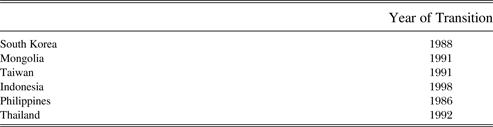
In terms of the dependent variable or using the QCA term “outcome,” we exploit the Polity IV index as the measurement of democracy. Those cases with Polity IV scores of 6 or above during the Third Wave (from 1980 to 2000) are defined as democracies.Footnote 3 In this study, six cases are classified as democracies. Table 2 presents the year of transition (the year when the polity IV scores reach 6) in these positive cases. Nine non-democratic or authoritarian states (China, North Korea, Vietnam, Laos, Cambodia, Myanmar, Thailand, Singapore, and Malaysia) have survived the tide of democratization in the region. In other words, the polity IV scores of these states remained under 6 until 2000.
“The Third Wave” Democracies in East Asia
Economic Development
Six possible causal conditions contributing to democratization have been identified drawing on the theoretical literature. It is widely argued that certain levels of economic development and urbanization are important to democracy both in terms of transition and consolidation. First, most modernization theorists argue that democracy is a result of level of development (Moore Reference Moore1967; Lipset Reference Lipset1963; Rueschemeyer, Stephens, and Stephens Reference Rueschemeyer, Stephens and Stephens1992). Almost all theorists and practitioners assert that the probability for the emergence of democracy will increase if some indicators of economic development exceed certain cutoff points. Most economists and political scientists generally agree that GDP per capita is a key indicator to measure the degree of development and we take a threshold of USD 3,000 (nominal) as our measure following Huntington and others (Huntington Reference Huntington1991).
Urbanization
Another socioeconomic condition that can lead to democracy (Lerner Reference Lerner1958; Lipset Reference Lipset1959; Przeworski and Limongi Reference Przeworski and Limongi1997) is urbanization. Urban residents are always perceived as the core of civil society and have crucial roles in resisting oppressive behavior of the state. In contrast to the traditional sociopolitical order that is based in rural areas, modernity is derived from urban areas or metropolis, and shapes a contractual order. More importantly, an urban public sphere offers a stage for people to engage in public affairs. Therefore, urban residents are more politically motivated, active, and conscious than their rural counterparts. Those states with a considerable level of urbanization may have a higher likelihood of being democratized. In this paper, we categorize a case with an urbanization rate higher than 50 percent as an urbanized country.
Mass contention
Sociopolitical conditions are as important as economic factors considering that democracy is ultimately a political phenomenon. Political condition refers to the types of authoritarian regimes —namely IAR and DAR, as discussed above—and sociopolitical mobilization that is indicated by mass contention. The emergence of contention against the authoritarian regime within a country reflects support of the people for democratic change (Shin Reference Shin1994). Contention symbolizes the birth of “powerful democrats” and therefore favors democratization (Tarrow Reference Tarrow1989; Diamond Reference Diamond2008). Empirical studies have demonstrated that democratic regimes that have experienced mass contestations will be more consolidated than those democracies that are derived from “pacted” transitions (McFaul Reference McFaul2002). However, only the presence of persistent and large-scale pro-democratic contention is considered in this study. In contrast, fragmented (or localized), intermittent or short-term (less than one year), ill-organized, or non-political (not directly against the authoritarian regime) contention or protest is less likely to stimulate democratization. For instance, although the 1989 student protest in China could be seen as a nationwide pro-democratic contention that greatly affected the communist regime, the CCP quickly suppressed this movement because of the latter's poor organization and, this type of protest has never occurred in the subsequent decades. So this protest is not the “mass contention” we talk about here. Instead, in this paper, “existence of mass contention” refers to persistent and large-scale pro-democratic movements.
Christianity
In addition to socioeconomic and political conditions, religion is the third possible driving force of democratization. Previous studies have shown that Christianity (European Christendom) is a key source of the modern political system, including democracy. Following Max Weber, Protestantism promoted individualism that helped unwind the authority of the state. Similarly, empirical studies have argued that protestant societies are more prone to democracy than others (Bollen Reference Bollen1979; Huntington 1993; Reference Huntington1996; Inglehart Reference Inglehart, Harrison and Huntington2000). Christianity could promote democracy via not only ideational (e.g., promotion of the idea of reciprocity by the diffusion of Christian, especially Protestant, doctrines) but also organizational (e.g., protests that are mobilized by the political leverage of churches) channels. Thus, in this study, we treat a society in which the largest religious group is Christian as “Christian society” and then assume that democratization is more likely to be seen in these societies.
Alliance with the United States
International conditions are also a possible source of democratization, particularly for “latecomers” like the East Asian states. In the Third Wave, external pressure from the United States is one of the most significant impetuses of democratization. Experiences from other regions demonstrate that states can democratize via “peaceful evolution” (Mullerson Reference Mullerson2013), under either official guidance or non-governmental influences from the United States (Whitehead Reference Whitehead, O'Donnell, Schmitter and Whitehead1986). During the Cold War when geopolitical interests outweighed the importance of building a democratic world, the United States supported dictatorships in Latin America and Africa (Dahl Reference Dahl1998; Davilia Reference Davilia2013). Since the 1980s, however, the United States has been more willing to build communities with a common identity in which democracy has become a more important element. Consequently, by the end of the cold war, the United States had committed itself to the promotion of democracy globally. In this article, we regard an alliance with the US, based on a common defense treaty, as a facilitator of democratization. We assume that the alliance brings a full-range of sustained interaction (e.g. frequent flow of people and ideas between US and its allies) between two sides as well as US influence on the internal affairs of its allies.
CALIBRATION
The coding process in QCA is called calibration, the major task of which is conversion of raw data into the degree of membership of a certain set (i.e., dichotomous values of 1 or 0 for crisp set analysis and continuous values from 0 to 1 for fuzzy set analysis). Nevertheless, clarifying the timing frame or period in this study is useful before setting the calibrating scheme. The time points for calibration are necessarily different for democracies and the authoritarian survivors in the Third Wave. For the former, the timing of calibration is the transition year (i.e., the year in which a country's Polity IV index reached 6). For example, South Korea's Polity IV score reached 6 in 1988. Thus, the calibration of the causal conditions is based on their values in 1988. For the latter, the timing of calibration is the year 2000 that is treated as the end of the Third Wave. This design aims to identify what had happened before the year of transition to stimulate democratization and what had happened before the end of the Third Wave to impede democratization.
Table 3 shows the calibrating scheme for the seven variables in which the outcome is democratization (demo) and the causal conditions are US ally (ally), deinstitutionalized authoritarian regime (deinst), mass contention (contention), developed economy (developed), urbanization (urban), and Christian society (christ). Given the qualitative nature of the QCA method, all variables are eventually transferred into qualitative data based on the lines of calibration highlighted in Table 3. Each variable may be treated as a set, and the value of a variable indicates membership or non-membership of a single case in this set. For example, the fact that Myanmar is coded “1” in the variable “deinst” represents the fact that Myanmar is a member of the set “deinstitutionalized authoritarian regime (DAR).”
Calibrating Scheme

The facts of all variables of all cases are presented in Table 4. Having been calibrated, Table 4 with uncalibrated variables becomes a data table (see Table A.1 in Appendix I) in the form of crisp sets (i.e., with binary variable of 1–0). The data table shows six positive cases (i.e., the outcome, or “demo,” is calibrated “1”) and eight negative cases (the outcome of them is calibrated “0”). This data table is analyzed in the next section by fs/QCA, a QCA software developed by Ragin and his colleagues and based on combinatorial logic (Ragin Reference Ragin1987).
The Facts of All Cases

a Estimated data from United Nations, Department of Economic and Social Affairs, Population Division (2014)
b cData from UN database
ANALYSIS AND RESULTS
NECESSARY CONDITIONS
The first step of QCA analysis is the examination of necessary conditions. A causal condition is treated as a necessary condition if it is present in all positive cases. Thus, necessary conditions should be put aside before conducting a truth table analysis. Here we use Schneider and Wagemann's standard (Reference Schneider and Wagemann2012) in which the threshold of consistencyFootnote 4 for a necessary condition is 0.9.
Table A.2 in the Appendix I implies that no necessary condition is identified prior to the subsequent steps of analysis. The causal condition with the highest consistency is mass contention (contention, consist = 0.83). Indeed, the score is relatively high, but it still does not meet the cut-off point of being a necessary condition.
RESULTS
The output of fs/QCA truth table analysis is composed of three kinds of solutions depending on the favored degree of complexity. While complex solutions always contain all causal conditions that lead to the outcome, parsimonious solutions are the simplest and only show which conditions are essential to distinguishing between positive and negative cases (Ragin Reference Ragin2008, 70). The intermediate solution that is used in this article (see result below) is most interpretable.Footnote 5 Theoretically, intermediate solution is the subset of parsimonious solutions and the superset of complex solutions. Technically, to obtain an intermediate solution, fs/QCA requires researchers, based on their theoretical and substantial knowledge, to specify how each causal condition should contribute to the outcome (Ragin Reference Ragin2008, 52). That is, one should confirm in the positive cases whether each specific cause is “present,” “absent,” or “present or absent.” In our study, all causal conditions are set “present” due to their assumed positive effects on democratization.
The results in Table 5 can also be presented as follows:
 $${\bf Demo} ={\bf deinst}^{\bf \ast}{\bf contention}\!+\!{\rm} {\bf ally}^{\bf \ast}{\bf contention}^{\bf \ast}{\bf developed}^{\bf \ast}{\bf urban}$$
Presentation of results

As shown in the formula, two parallel pathways that are connected by the symbol “+” (“or”) are identified by fs/QCA as pathways of democratization in East Asia during the Third Wave. The first pathway is the conjuncture of two factors: mass contention (contention) and DAR (deinst). The second pathway is the conjuncture of four causal conditions: mass contention (contention), US ally (ally), and considerable levels of economic development (developed), and urbanization (urban).
Before proceeding to the findings and implications, it is important to define coverage and consistency , two major indicators of the strength of any given QCA result. According to Ragin (Reference Ragin2008, 85), consistency “measures the degree to which solution terms and the solution as a whole are subsets of the outcome,” and coverage measures “how much of the outcome is covered (or explained) by each solution term and by the solution as a whole.”
First, the raw coverage of the first pathway is 0.67, which means 67% of all positive cases (i.e., cases in South Korea, the Philippines, Indonesia, and Thailand) could be classified as following this pathway. This pathway's unique coverage is 0.5, which means that 50% of the positive cases (i.e., cases in the Philippines, Indonesia, and Thailand) solely follow this pathway. Similarly, the raw coverage of the second pathway is 0.33, which means that 33% of all positive cases (i.e. South Korea and Taiwan) could be classified as following this pathway. The unique coverage of the second pathway is 0.17, which means that 17% of the positive cases (i.e. only Taiwan) solely follow this pathway. Therefore, the case of South Korea follows both pathways of democratization; the implication of this situation will be discussed in the next section. Secondly, both single solution terms (consistency = 1) and solutions as a whole (solution consistency = 1) show good consistency. This implies that each single pathway as well as the pathways as a whole are the subset of the outcome. Finally, the solution coverage (0.83) shows that these two pathways could not explain all positive cases. Rather, a deviant case (0.17 or 17%), namely Mongolia, has been identified. We include this case as a third but unique pathway of democratization in our discussion below.
In sum, three roads for East Asian states to democracy have been identified and are treated as exhibiting equifinality. We have labeled them, based on different authoritarian status quo ante, as an overthrow model (under DAR), an urban pressure model (under IAR) and an inside-out model (under both types of regimes).
FINDINGS AND IMPLICATIONS
THREE PATHWAYS OF DEMOCRATIZATION
Pathway I: Overthrow Model under DAR (South Korea, the Philippines, Indonesia, and Thailand)
This pathway features the positive effects of mass contention on democratization. As shown in the analysis above and in parsimonious solutions as well (see Appendix II), persistent and large-scale pro-democratic mobilization is more important, because this condition is present in almost all positive cases but absent in all negative cases. This suggests that democracy is not only an elite enterprise but a matter of the people.
QCA further reveals that mass mobilization plays a bigger role in DARs (deinst*contention). This model is reflected in the experiences of the Philippines, Thailand, Indonesia, and South Korea in the Third Wave. All four states were DARs. Thailand and South Korea represent military regimes, in which the top leaders are from the army or even in uniform. The Philippines and Indonesia, though with some characteristics of military rule, particularly in Indonesia, are personalist regimes ruled by a single dictator with the support from a small scale clique.
DAR always fails to effectively handle mass mobilization in the process of democratization. For example, the military government in South Korea repressed student protests in the city of Gwangju by force in the early 1980s. However, in subsequent years, pro-democratic organizations were established by survivors and family members of the victims in the name of memorializing the Gwangju Incident. Moreover, these organizations mobilized people to join new struggles against the dictatorship. The protests quickly spread to the capital, Seoul, and then caused another nation-wide protest in 1987, which finally subverted Chun Doo Hwan's rule and ignited the democratization process. This marked the first time for the South Korean state to be civilianized after Park Chung-hee's coup in 1961. In addition to South Korea, persistent large-scale mass contentions could be seen everywhere in DARs (whether it is military regimes like Thailand or personalist rules like the Philippines and Indonesia) and proved destructive to the authoritarian order.
Pathway II: Inside-out Model under Both Types of Regimes (Taiwan and South Korea)
The combination of mass contention and socioeconomic development (i.e., developed economy and urbanized society), together with external dynamics (i.e., alliance with US), appears to be another democratic transition pathway (ally*contention*developed*urban). Like the situation in the first pathway, the strength of mass mobilization has also been displayed in this pathway. But here, the regime type is not specified. Arguably, it is a pathway applicable for both types of regimes, or more formally:
 $$\eqalign{& {\bf ally}^{\bf \ast}{\bf contention}^{\bf \ast}{\bf developed}^{\bf \ast}{\bf urban} \cr & = \left( {{\bf deinst} \,+\!\!\sim\!\!{\bf deinst}} \right)^{\bf \ast}{\bf ally}^{\bf \ast}{\bf contention}^{\bf \ast}{\bf developed}^{\bf \ast}{\bf urban} \cr & = {\bf deinst}^{\bf \ast}{\bf ally}^{\bf \ast}{\bf contention}^{\bf \ast}{\bf developed}^{\bf \ast}{\bf urban} \cr & +\!\!\sim\!\!{\bf deinst}^{\bf \ast}{\bf ally}^{\bf \ast}{\bf contention}^{\bf \ast}{\bf developed}^{\bf \ast}{\bf urban}} $$
The inside-out model, represented by Taiwan (under IAR) as well as South Korea (under DAR), shows that, regardless of regime type, mass mobilization in an urbanized and economically developed state allied with the US is prone to democratization. It is clear that this model demonstrates the complex dynamics of democratization in East Asia in which domestic factors are closely linked with foreign ones.
Compared with South Korea, discussed above, Taiwan reveals the mechanisms of democratization in East Asian IAR as a party-state or single-party regime. The Kuomintang (KMT), also known as the Nationalist Party of China, reestablished its Leninist reign in Taiwan in 1949, although not in the name of communism (Cheng Reference Cheng1989). After retreat from the Mainland China to Taiwan, Chiang Kai-shek and his son (also his heir) Chiang Ching-kuo revitalized local elections and expanded political participation to enhance the legitimacy of KMT rule among indigenous Taiwanese. Indeed, this strategy of limited political inclusion eliminated the demand for democracy to some extent during the era of economic boom in Taiwan. But, on the other hand, with the development of the economy, the emerging urban professionals (most of them are lawyers) launched the Tang-wai (黨外 or ‘outside the KMT’) movement in the late 1970s and early 1980s to urge KMT ruling elites to further political openness. It is no doubt that this anti-authoritarian contention plays a role of political opposition and exerts pressures on the KMT's rule.
However domestic economic and political conditions are not enough. The United States also played a role in democratizing Taiwan. First and foremost, the Tang-wai movement and its members were supported by the United States (Chao and Myers Reference Chao and Myers2002). Second, after the opening of US relations with China under Nixon, KMT leaders in Taiwan found they were facing more pressures for political change precisely because they were a US ally.Footnote 6 In order to distinguish itself from communist China and make it more attractive to the US, including Congress and the public, Taiwan tried to make concessions to the domestic pro-democratic advocates and further undertake political reforms by enhancing the transparency and allowing the opposition party, namely the Democratic Progressive Party (DPP) that grew from the Tang-wai movement, to compete with KMT in the elections at all levels. In a word, under the pressures both from inside and outside, the party state in Taiwan became more tolerant of pro-democratic movements, and was ultimately replaced by a regime with universal elections and a multi-party system in the early 1990s. Although the KMT won the early elections, the transition ultimately brought the DPP to power in 2000.
Pathway III: Urban Pressure Model under IAR (Mongolia)
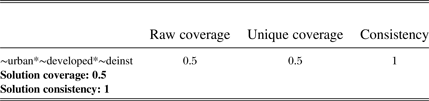
The last pathway toward democracy in East Asia is found in only one country, Mongolia. In contrast to Taiwan, this model suggests that urbanization has a positive impact on democratic transitions within an IAR even without other favorable requisites such as economic development, mass contention, ties with the United States, or a Christian society
 $$\left( {{\bi\!\sim\!deinst^{\bf \ast}urban^{\bf \ast}\!\sim\!developed^{\bf \ast}\!\sim\!contention^{\bf \ast}\!\sim\!christ^{\bf \ast}\!\sim\!ally}} \right){\bi.} $$
This argument is echoed by the literature that advocates the contribution of urbanization to democratization. Firstly, urbanization means that there was no rural conservative force able to block the process of democratization. Secondly, the spirit of compromise that contributed to the transition in Mongolia appears to have derived in part from a new urban class. The Mongolian IAR offered the opportunity for urban professionals to use peaceful means to argue the case for democratization (Doorenspleet and Mudde Reference Doorenspleet and Mudde2008; Diamond Reference Diamond2008).
It is no exaggeration to treat Mongolia as a “democratic miracle” or “deviate democracy” (Fritz Reference Fritz2008) in East Asia. Mongolia is an IAR without any other contributing factors that typically undermine authoritarian rule. Moreover, it is the only country in our set of cases that democratized without mass contention. This means that democratization in Mongolia was largely the result of negotiation among urban elites. Clearly, a more sustained analysis of this case is warranted.
REGIME MATTERS
The three pathways show that the authoritarian status quo ante matters in the Third Wave of democratization in East Asia. First, we find DARs are vulnerable to democratization when facing mass mobilization. Persistent and large-scale pro-democratic mass contention is the key or a quasi-necessary condition for East Asian democratization in the Third Wave. Such activity manifests the power of mass publics in the democratization process. As shown in our inquiry, all East Asian DARs where mass contentions occur have democratized during the Third Wave.
Democratization is the result of DARs’ inherent vulnerability, especially for those dictators who are military strongmen (Geddes, Frantz, and Wright Reference Geddes, Frantz and Wright2014). The mechanism of democratization under DAR follows two routes. On the one hand, mass contention tends to happen under a DAR because of the weakness of institutionalized social control. A DAR also lacks effective ways to resolve mass mobilization except suppression by force, which makes mass contention more confrontational (Kriesi et al. Reference Kriesi, Koopmans, Duyvendak and Giugni1992, Kitschelt Reference Kitschelt1986). On the other hand, in the face of contention, the ruling elite is also more prone to fracture, and the risk of defection from the dictator or general's clique increases the possibility of authoritarian collapse (Bueno de Mesquita et al. Reference Bueno de Mesquita, Smith, Siverson and Morrow2005).
By contrast, most IARs in East Asia have shown their resilience in and after the Third Wave. IARs, particularly communist regimes, increase their survival prospects through relatively effective ways of managing their relationships with both elites and mass publics (Magaloni and Kricheli Reference Magaloni and Kricheli2010). An additional QCA of negative cases shows that IAR (~deinst) is close to a necessary condition (consist = 0.88) for authoritarian survival (i.e., ~demo)Footnote 7 (see Table A.3 in Appendix I). Meanwhile, the truth table analysis based on negative cases (see Appendix II) suggests that IARs, especially in less developed countries, have advantages over DARs in political survival. Although both Mongolia and Taiwan's IARs have democratized, four communist regimes (i.e., China, Vietnam, North Korea, and Laos) have continued to rule for nearly two decades after the end of the Third Wave. All of them are underdeveloped or developing countries. This fact is in agreement with the prediction of Vanhanen (Reference Vanhanen1997) that democratization of the East Asian communist states is a difficult task. This is because most East Asian communist states, together with Singapore as a de facto single party regime, have launched a set of socioeconomic and restricted political reform projects after the collapse of the Soviet bloc. These projects have dispelled social discontents and weakened demands for democracy.
Some other implications of the analysis also deserve a brief discussion. First, South Korea may be seen as the ideal type of East Asian democratization because it followed two pathways (i.e., overthrow model and inside-out model). All causal conditions are calibrated as “1” in South Korea's case: socioeconomic, political, religious and international all helped push this particular DAR toward democracy.
Second, socioeconomic conditions are important for democratization in the East Asian states in the Third Wave, as modernization theorists argue. The negative case analysis shows that an underdeveloped economy serves to preserve authoritarian rule. However, Mongolia's case and the inside-out model show that urbanization may be more significant than economic development per se under certain conditions.
Last but not least, Christianity appears to have played a role in democratization in East Asia. Christianity has played a significant role in the process of democratization in several cases—including Korea—and so far most undemocratic states in the region are non-Christian. However, some non-Christian East Asian countries, including Islamic (i.e., Indonesia) and Buddhist (i.e., Thailand and Mongolia) states, also became democracies in the Third Wave. Given the fact that most East Asian democracies are US allies, it might be reasonable to hypothesize that Christianity might be one of the proxies of the alliance effect. But this hypothesis remains to be tested.
CONCLUSION
By applying QCA methods, this article conducts an analysis based on fourteen cases to figure out the East Asian pathways toward democracy. Without doubt, the study has several limitations. First, QCA offers a mid-range explanation of democratization, and the conclusions are more contextually sensitive. The findings of this paper reflect the experience of East Asia only, and their validity is strictly confined to a specific time frame, the Third Wave (from 1980 to 2000). Second, this study is ontologically more structural than agent-centered, although we do consider the role of mass contestation. However, the preferences, choices, and alignment of political elites or agents in the Third Wave are equally crucial and case studies are still needed to provide this information.
Nonetheless, the analysis reveals clearly that no single or general East Asian pathway of democratization exists. Instead, three East Asian pathways were found in the Third Wave, and they highlight different forms of democratization within the region. The first pathway, the overthrow model, is characterized by an interaction between mass contention or mobilization and a specific authoritarian regime type, DAR. It indicates the positive effect of DAR upon the emergence and intensification of mass contention and the effect of such mobilization on democratization of these weakly institutionalized systems. Similarly, the second pathway (i.e., inside-out model) also highlights the significance of mass contention. But it also finds another interactive relationship between contention, domestic socioeconomic factors, and external pressure. Moreover, this model works to undermine both IAR and DAR. The last pathway (i.e., urban pressure model) is relatively marginal and represented only by the case of Mongolia. This pathway reflects a path to democracy without mass contention under a poor authoritarian state with a considerable degree of institutionalization and a higher level of urbanization. It thus also shows the salience of urbanization in the process of democratization.
We conclude that the likelihood of becoming democratic for a regime in East Asia depends largely upon the authoritarian status quo ante. Whereas DARs are exposed to a variety of pressures for democratization in East Asia, most IARs in the region survived and have shown their resilience. As the inside-out model and Taiwan case implies, IARs are less likely to democratize, and they do so only under multiple pressures. Institutionalized authoritarian states need not only favorable domestic conditions but also external forces including pressure from actors such as the US, geopolitical crises, and internationalization of their economies (Keohane and Milner Reference Keohane and Milner1996).
APPENDIX I
Cases after Calibration

Examination of Necessary Conditions (Positive Cases)

Examination of Necessary Conditions (Negative Cases)

APPENDIX II
1. fs/QCA OUTPUT (COMPLEX AND PARSIMONIOUS SOLUTIONS) BASED ON POSITIVE CASES (demo = 1)
(a) Complex solutions

(b) Parsimonious solutions
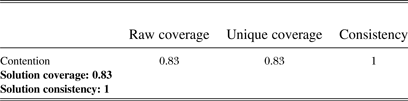
2. fs/QCA OUTPUT (INTERMEDIATE SOLUTIONS) BASED ON NEGATIVE CASES (demo = 0)
Assumptions:
~urban (absent)
~developed (absent)
~deinst (absent)