In the late nineteenth and early twentieth centuries, the Vatican positioned itself between promoting scholarly inquiry and controlling the vast material, literary and artistic resources of ecclesiastical history. Studies in archaeology and the early Christian and medieval history of the Church were facilitated by popes like Leo XIII who contributed to a critical investigation of the past through the opening of the Vatican Archives in 1881. Scholars affiliated with new centers for historical research in Rome not only utilized the vast wealth of documentation found in the archives but also explored the material sources for the Christian past found throughout the city. The papacy additionally encouraged archaeological research, such as the catacomb exploration of Giovanni de Rossi (1822–1894), as a means of documenting the origins of early Christianity. De Rossi's creation of the Bollettino di archeologia cristiana in 1863 and his foundation of a Società dei Cultori di Archeologia Cristiana in 1875 helped to disseminate new finds while at the same time increasing the profile of Christian archaeology outside of Rome.Footnote 1 De Rossi's pupils, Enrico Stevenson, Orazio Marucchi, and Josef Wilpert, continued the tradition of catacomb exploration with finds that reinforced the priority of Rome and the originality of early Christian art forms, points that were sometimes questioned, especially in the scholarly community in Germany.Footnote 2
At the turn of the century, the availability of research resources and the development of an institutional framework that supported academic inquiry were coupled with new methodological approaches that sometimes conflicted with the established Church hierarchy. Modernism, representing a more skeptical and critical examination of Catholic doctrine, underscored discrepancies between Christian theology and advances in science and philosophy.Footnote 3 Encyclicals like Leo XIII's Providentissimus Deus (1893) defended the infallibility of scripture at a time when “the thirst for novelty and unrestrained freedom of thought make the danger of error most real and proximate”; the Church was most concerned that contradictions based on the “peremptory pronouncements of a certain newly invented ‘free science’” might cause the “more ignorant masses” to lose confidence in the Bible and question the true meaning of scripture.Footnote 4 The field of history was similarly a potential threat:
It is a lamentable fact that there are many who with great labour carry out and publish investigations on the monuments of antiquity, the manners and institutions of nations and other illustrative subjects, and whose chief purpose in all this is too often to find mistakes in the sacred writings and so to shake and weaken their authority. Some of these writers display not only extreme hostility, but the greatest unfairness; in their eyes a profane book or ancient document is accepted without hesitation, whilst the Scripture, if they only find in it a suspicion of error, is set down with the slightest possible discussion as quite untrustworthy.Footnote 5
The rationalists could disseminate their “deadly poison” in various ways: “by means of books, pamphlets, and newspapers; they spread it by addresses and by conversation; and they are in possession of numerous schools, taken by violence from the Church.”Footnote 6 The Pontifical Biblical Commission, established in 1902, further promoted the proper interpretation of scripture by observing the guidelines developed in Providentissimus Deus.Footnote 7 Nonetheless, an unresolved, key question remained: how could truly independent scholarship be reconciled with a compliance with ecclesiastical authority?Footnote 8
As the modernists created an intellectual front that threatened to damage the credibility of Catholic doctrine, the formation of the Italian state endangered the overall political and temporal authority of the papacy. After Italian troops entered the city on September 20, 1870, Rome and its provinces were annexed to the Kingdom of Italy. Out of protest, the pope withdrew to the Vatican, remaining there as a type of prisoner in his own home from 1870 until 1929. The Law of Guarantees, issued by the Italian parliament in 1871, attempted to establish the status of the pope by declaring that he possessed diplomatic honors and privileges similar to those of the king of Italy.Footnote 9 The law further allowed the pope to maintain a private army, the Swiss and noble guards, and gave the pope control over the Vatican, Lateran, and Castel Gandolfo. Refusing to recognize the legitimacy of the Italian rule, Pope Pius IX rejected the Law of Guarantees through the encyclical Ubi nos arcano (1871). From 1870 until 1929, the rights of the papacy, therefore, remained uncertain. During this period, the true ownership of the cultural patrimony associated with churches, religious houses, and the pontifical collections was also a point of contention between Italy and the papacy. In 1879, for example, the Italian parliament questioned the sale of majolica from Castel Gandolfo, for it was believed that the Vatican had stolen national property.Footnote 10 While unresolved, cases such as this one reinforced the ambiguous ownership of artistic patrimony and demonstrated the power of the Italian courts to potentially intervene in the decision process.
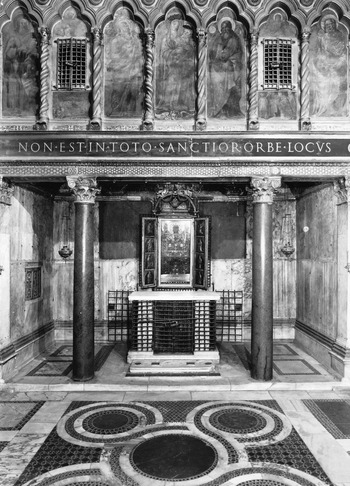
Continuing tension between the papacy and the Italian government certainly also played a strong role in the investigation of the Christian past, an investigation that was complemented by the holdings of the Vatican Archives and new archaeological discoveries. The early saints and martyrs helped to reinforce the venerable roots of Catholicism in Rome while the examination of periods like the Middle Ages explored the zenith of papal authority. In this context, it is not surprising that the Sancta Sanctorum, a medieval chapel that was once part of the papal palace at the Lateran, would generate great interest at the turn of the twentieth century. Containing precious relics within a well-secured altar as well as a miraculous icon of Christ attributed to the hand of St. Luke and an angel, the treasury of the Sancta Sanctorum included some of the most venerable relics in Christendom (fig. 1). Beginning in 1903 with the opening of the altar and the examination of its holy objects, the Sancta Sanctorum was the center of intense scholarly activity that resulted, by 1908, in a total of twenty books or articles that dealt in some way with the chapel or its contents. The present article will use the exploration of the Sancta Sanctorum to help understand the scholarly, political, and religious environment in Rome in the early 1900s—an environment that was characterized by a division of critical methods tempered by fears of modernism, by financial pressure on the papacy related to its captivity in the Vatican, by intense academic competition between the French and German scholarly communities, and by a changing attitude towards the role of relics.
Rome, Sancta Sanctorum, view of alter (photo: Istituto centrale per il Catalogo e la Documentazione, E111106).

Known as the Holy of Holies, the current chapel of the Sancta Sanctorum dates to the time of Nicholas III (1277–1280), who replaced an earlier structure on the site that had been damaged by an earthquake. In the Middle Ages, the Sancta Sanctorum served as the pope's private chapel and often functioned as a staging point for the stational liturgy.Footnote 11 The unique association between the Sancta Sanctorum and the medieval papal palace in the Lateran prevented access to the chapel's relics, for strict rules regulated the Sancta Sanctorum's liturgical function and limited those who could enter the space. Although the residence of the popes shifted across town to the Vatican in the fifteenth century, the venerable and exclusive nature of the Sancta Sanctorum was nonetheless maintained.Footnote 12 The sacredness of the relics and of the icon of Christ was certainly enhanced by the fact that the objects were so rarely viewed by the general Roman populace, who would have only seen them during special liturgical celebrations or on extraordinary occasions when they might be removed from the chapel. Otherwise, the pious would have an obscured view of the covered icon and altar through the grillwork at the top of the Scala Santa.Footnote 13
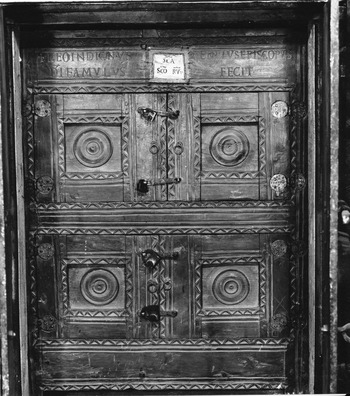
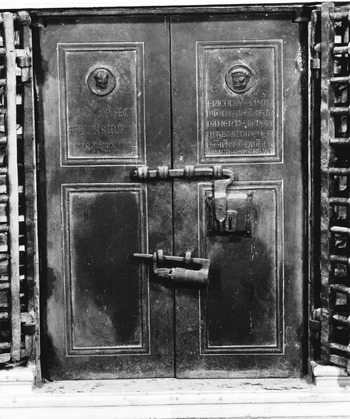
Because of this limited access, there are very few detailed descriptions of the Sancta Sanctorum's relics or icon before the early twentieth century.Footnote 14 The relics themselves were contained in reliquaries that were housed within a ninth-century cypress chest sponsored by Pope Leo III; this chest was inserted within the cavity of the altar and was secured by bronze doors and metal grating (figs. 2 and 3). A twelfth-century account of the Lateran Basilica by John the Deacon included a description of the Sancta Sanctorum relics, which became an important resource for subsequent writers.Footnote 15 In the fourteenth century, Urban V (1362–1370) opened the chapel's altar in order to extract the heads of Peter and Paul and transfer them to the high altar of the Lateran basilica.Footnote 16 Leo X (1513–1521) viewed the other precious objects in the altar in 1513 and created an index of the chapel's relics at that time; a sixteenth-century text by Onofrio Panvinio may reproduce portions of that inventory.Footnote 17 With the exception of possible looting during the Sack of Rome in 1527, the altar remained closed until 1903.Footnote 18 Access to the icon of Christ also decreased drastically in the sixteenth century, especially after 1565 when Pius V (1566–1572) cancelled the yearly procession that celebrated the Virgin's Assumption, one of the few occasions when the image left the Sancta Sanctorum. With the exception of an eighteenth-century text by Giovanni Marangoni that describes in detail the icon and its history, most accounts of the Christ image are brief and tend to focus on its earlier, processional use.Footnote 19 The series of investigations and resulting publications of the Sancta Sanctorum and its altar, relics, and icon that took place between 1903 and 1908 therefore demonstrate an important turning point in the Church's attitude toward the sacred objects and sanctified space of the medieval chapel.Footnote 20
Rome, Sancta Sanctorum, cypress chest in alter, ninth century (photo: Istituto Centrale per il Catalogo e le Documentazione, E59948).

Rome, Sancta Sanctorum, bronze doors of alter (photo: Istituto Centrale per il Catalogo e la Documentazione, E59945).

The French Jesuit Florian Jubaru, a professor in the Collegio Leoniano in Anagni, was the first scholar to receive permission to open the altar of the Sancta Sanctorum; his study of Saint Agnes necessitated an examination of the martyr's head, which was contained in a reliquary found within the chapel.Footnote 21 Jubaru intended to use a direct study of Agnes's remains to reconcile conflicting Greek and Roman sources to determine if the saint was martyred as an adult or as a child; in his publications, he underscores the critical and archaeological nature of his historical research as well as the importance of authenticity.Footnote 22 He furthermore wanted to investigate the common belief that many objects had been removed from the altar during the sack of 1527.Footnote 23 Jubaru was assisted by Cardinal Mariano Rampolla, who personally presented the Jesuit's request to Leo XIII in 1902.Footnote 24 Jubaru's connections and his teaching position in an institute founded by Leo XIII certainly must have influenced the consent.Footnote 25
With the support of Cardinal Francesco di Paola Satolli, the archpriest of the Lateran, Jubaru met with the Passionisti, who were the caretakers of the chapel. Unfortunately, they were unable to open the altar because the keys had been lost.Footnote 26 A year later, in April 1903, Jubaru renewed his attempt and, with Cardinal Satolli's intervention and the hiring of a blacksmith, successfully opened the altar.Footnote 27 Jubaru found the relics undisturbed and was able to examine the head of Saint Agnes; he was accompanied by Cardinal Satolli, Dr. Giuseppe Lapponi, who was the pope's physician, and Giuseppe Bonavenia, who was a member of the Pontifical Commission for Sacred Archaeology.Footnote 28 On April 20, 1903, Satolli wrote to Rampolla to alert him of the great quantity of reliquaries and relics that had been found and to request permission from the pope for a more accurate examination of the objects.Footnote 29 Two days later, Satolli received a response on behalf of Leo XIII that once Jubaru's authorized work was completed, the altar should be placed “in pristinum.”Footnote 30
Jubaru, primarily concerned with the remains of Saint Agnes, did not create an inventory of the other objects in the altar but his “rediscovery” of the relics led to future investigations. The passing of Pope Leo XIII in July 1903 and the election of Pope Pius X temporarily delayed work in the Sancta Sanctorum, but in 1905 Hartmann Grisar initiated what would become a long and difficult process of studying, photographing, and publishing the relics and reliquaries of the chapel.Footnote 31 Grisar, a German Jesuit and a specialist in religious archaeology, was well known in both the Italian and German scholarly communities for his work on medieval monuments in Rome and his planned publication of a multi-volume study on the popes of the Middle Ages. When Grisar first heard of Jubaru's research, he immediately wanted to examine the relics firsthand.Footnote 32 On May 29, 1905, Grisar received permission from Pius X to publish photographs and a description of the treasure of the Sancta Sanctorum in the Jesuit journal La Civiltà Cattolica.Footnote 33 With the assistance of the rector of the Passionisti and Cardinal Satolli, Grisar began work on June 6, 1905, when he opened the altar, removed the precious objects, and had them photographed; the archives of the Passionisti indicate that Grisar's work focused on the archaeological, artistic, and historical aspects of the reliquaries rather than the liturgical function of the relics.Footnote 34 Just under two weeks after the opening of the altar, on the evening of June 19, 1905, the Passionisti priests and brothers along with Grisar were called into the chapel by Monsignor Marzolini and were sworn to secrecy; information regarding the relics and reliquaries was protected by order of a “segreto” of the holy office of the pope. The relics and reliquaries were then placed in baskets and transferred by pontifical carriage from the Sancta Sanctorum to the Vatican; the Passionisti archives explain that the transfer was done to better secure the precious objects or to avoid a liturgical question prevailing over an artistic one.Footnote 35 The reliquaries and their contents were taken to the Museo Sacro of the Biblioteca Apostolica Vaticana, where they were examined, photographed, and catalogued by a Capuchin father, Louis-Antoine de Porrentruy.Footnote 36 The relics of the Sancta Sanctorum remained in the Vatican until September 13, 1907, when the majority of the relics was returned to the Sancta Sanctorum in simple, sealed containers; the reliquaries, on the other hand, remained in the Vatican collection where they can still be viewed today.Footnote 37
The “segreto” imposed by the pope necessitated that Grisar curtail his work on the Sancta Sanctorum reliquaries. He was not allowed to continue with his planned publication in La Civiltà Cattolica and could not give public presentations on his findings. In late August and early September 1905, the Cardinal Secretary of State Rafael Merry del Val received letters from the Apostolic Nunciature in Bavaria, from Grisar, and from Giorgio Haeffer, the president of the Görres Society, a German group that cultivated scientific inquiry based on Christian principles.Footnote 38 The purpose of this correspondence was to determine whether or not Grisar would be able to present his work on the Sancta Sanctorum at the general meeting of the Görres Society in Munich.Footnote 39 This talk, which would have attracted the attention of leading scholars in Germany as well as correspondents from the nation's newspapers, was prohibited by the Vatican.
With the required discretion surrounding the treasure of the Sancta Sanctorum, it was likely very surprising for Grisar to discover a publication by Florian Jubaru issued on September 20, 1905, that essentially summarized the contents of the altar and gave up the secret; apparently, the French Jesuit did not have the same restrictions as those imposed on Grisar.Footnote 40 Jubaru mentioned at the end of his article that Grisar had photographed the objects in the Sancta Sanctorum and was planning a larger study on the altar's treasure. This statement caused great concern for Grisar, who immediately wrote to the Vatican to clarify that he had not authorized in any way Jubaru's suggestion of a future publication.Footnote 41 Although Jubaru had disclosed the exploration of the altar to the academic community, it was only seven months later, on April 8, 1906, that Grisar was contacted by Father Carlo Bricarelli, a writer for the La Civiltà Cattolica, that his own publication could proceed.Footnote 42
On May 1, 1906, Grisar received a communication from Cardinal Merry del Val stating that Pius X had conceded permission to the French scholar Philippe Lauer to view the objects of the Sancta Sanctorum, but that Grisar had a position of primacy for a publication; Grisar was further urged not to postpone this work.Footnote 43 Lauer had been interested in the Sancta Sanctorum for some time, for he was preparing a history of the medieval palace of the Lateran and had attempted, unsuccessfully, to enter the chapel in 1899 and 1900.Footnote 44 During that time, Lauer was a member of the École Française de Rome, which was under the directorship of the medieval church historian Louis Duchesne.Footnote 45 While unable to gain access to the Sancta Sanctorum, Lauer did investigate the subterranean environment below the Scala Santa.Footnote 46 After his time at the École Française, Lauer returned to Paris where he assumed a position in the Department of Manuscripts in the Bibliothèque nationale. He may have learned details of the treasure of the Sancta Sanctorum from Léopold Victor Delisle, the Administrator General of the Bibliothèque nationale until 1905; Louis-Antoine de Porrentruy, who was responsible for cataloguing the relics and reliquaries once they reached the Vatican, likely shared information with Delisle, who then would have passed it on to Lauer.Footnote 47 Lauer's association with the French scholarly community in Rome and his previous experience researching the Lateran complex would have provided important connections that must have helped him to receive permission to investigate the Sancta Sanctorum's treasure.Footnote 48
On May 23, 1906, with the assistance of the Académie des Inscriptions et Belles-Lettres and the Société des Antiquaires de France, Lauer was able to examine and photograph the chapel's reliquaries, which were then contained in the Vatican, and was also able to enter and photograph the Sancta Sanctorum and its icon. On June 1, 1906, he presented photographs of all of the reliquaries to a meeting of the Académie des Inscriptions et Belles-Lettres; because neither Jubaru nor Grisar had published drawings or a detailed description of the works, this was the first time that the reliquaries were revealed to the general public.Footnote 49 Lauer's intention was to publish, as quickly as possible, his findings.
Thus, both Grisar and Lauer rapidly completed their work. In the remaining months of 1906, Lauer published two articles and a monograph in French on the treasure of the Sancta Sanctorum.Footnote 50 During the same time, Grisar published seven articles—six in Italian in La Civiltà Cattolica and one in German; these texts dealt with the chapel and its relics and reliquaries.Footnote 51 In 1907, Grisar continued his scholarship on the Sancta Sanctorum with two additional articles and a monograph in Italian as well as the publication of a conference paper that he had presented at the meeting of the Görres Society in the previous year.Footnote 52 In 1908, he published a monograph on the Sancta Sanctorum in German.Footnote 53 Josef Wilpert, a specialist in early Christian and medieval art in Rome, joined this publishing frenzy with two articles, published in Italian and German in 1907, that focused on the icon of Christ found in the Sancta Sanctorum.Footnote 54 One should further keep in mind that Florian Jubaru's work on Saint Agnes, published in 1905 and 1907, also detailed his early exploration of the Sancta Sanctorum and its relics.Footnote 55 Therefore, from 1905 to 1908, after nearly four hundred years of the altar being closed and extraordinarily limited access to the chapel in general, a total of twenty articles and books were published by Jubaru, Lauer, Grisar, and Wilpert that dealt in some way with the Sancta Sanctorum or its contents.
The initial permission given to Jubaru and the rapid succession of investigations and publications marked especially by the scholars Grisar and Lauer raise several important questions. Why were the chapel and its treasure the focus of such intense scrutiny in the early twentieth century? What were the reasons for the rapid, almost clandestine, transfer of the relics from the Sancta Sanctorum to the Vatican? Why was Grisar forced to keep his findings secret? And what does the competitive relationship of Grisar and Lauer tell us about the German and French scholarly communities in Rome? I will respond briefly to these issues.
The initial permission to open the altar that was given to Jubaru in 1902 by Leo XIII must, first of all, be viewed within the context of the adversarial relationship between the Vatican and the Italian state that characterized late nineteenth- and early twentieth-century Rome. Under the Law of Guarantees of 1871, the Vatican, Lateran, and Castel Gandolfo came under the control of the papacy and were given the right of extraterritoriality, such that no one could visit or inspect those properties without proper authorization of the pope; however, while the territories remained in the jurisdiction of the papacy, the art and archives formed part of the property of the Italian state.Footnote 56 Although the Law of Guarantees was never accepted by any pope, the fear that the Italian state might try to take what remained of the property of the Church may have influenced the initial opening of the Sancta Sanctorum and may have led to the hasty transfer of the chapel's relics to the Vatican just thirteen days after Grisar was allowed to view them. The Roman question, dealing with the political relationship between the pope and Italy, remained a central issue that shaped the pontificates of the late nineteenth and early twentieth centuries and was only resolved with the Lateran Treaty of 1929.
The unification of Italy did not bring an immediate, consistent approach to dealing with cultural patrimony but it did raise concerns at the Vatican over the potential liquidation of the property of bishoprics, cathedral chapters, and religious orders. Already prior to the unification, rules relating to the protection of artistic heritage brought into question the legal standing of the Church in relation to its patrimony. On July 7, 1866, law number 3036 suppressed religious orders and established that the books, manuscripts, scientific documents, archives, monuments and art works found in religious structures were to be transferred to public libraries or provincial museums; on June 19, 1873, this law was expanded to include also Rome and its provinces.Footnote 57 In 1875, a centralized directorship for excavations and museums in Italy was established (law number 2440); regulations for the excavations of antiquities were developed in 1877 (law number 3660); and attempts were made to prevent the export of Italy's artistic patrimony (laws number 286 in 1871 and number 31 in 1892).Footnote 58 Although the preservation of Italy's artistic heritage was clearly an important priority, by the early 1900s there was not a consistent, national law that dealt with safeguarding cultural patrimony; instead, many regions still relied upon laws and decrees that had been formulated prior to unification. On June 12, 1902, a more comprehensive law (number 185) for the preservation of art and antiquities and for the limitation of their export was passed.Footnote 59 Law number 185 was further modified in 1904, with the development of three branches of superintendencies dedicated to monuments, to excavations and antiquities, and to museums and medieval and modern art works; these superintendencies were officially established on June 27, 1907, with law number 386.Footnote 60
With these various laws, which were often revised and amended, the Vatican had reason to be concerned about maintaining its property. In 1884, for example, the curial office of the Congregation of Propaganda Fide was sequestered and sold off even though it clearly was financed by the Catholic faithful.Footnote 61 As suggested by John Pollard in his analysis of the financial situation of the Vatican, Leo XIII “feared that the government would lay its hands on what remained of the property of the Italian Church, and especially the religious orders.”Footnote 62 While Pius X had a slightly better relationship with the Italian state, he still was uncertain about the legal status of the Holy See. Incidents during his pontificate reinforced the precarious position of the Vatican and its holdings; for example, in 1904, when Cardinal Merry del Val moved into the Borgia apartment of the apostolic palace to facilitate the renovation of the secretary of state's apartment, newspapers questioned the renovations by proclaiming that the Vatican should be recognized as Italian property and therefore a national monument.Footnote 63
As an extraterritorial property controlled by the Vatican that was closely linked to history of the papacy, the Lateran would have held important symbolic significance at a time when papal authority was in question. Although Leo XIII never visited the Lateran during his pontificate, he initiated a restoration of the Basilica of San Giovanni in 1881 that included an extension of the apse of the church and the development of pontifical offices.Footnote 64 Beyond the structural changes, Leo XIII's choice to focus on the Lateran basilica helped to emphasize the supremacy of the papacy and the centrality of the Catholic Church in the history of Rome, for the basilica was the cathedral of the city and was the first church founded by Constantine.
In 1892, Leo XIII had the remains of the medieval pope, Innocent III, transferred from Perugia to the Lateran basilica.Footnote 65 The movement of Innocent III's remains honored the thirteenth-century pope, who Leo XIII held as a model for his own pontificate.Footnote 66 Leo XIII was likely well aware of Innocent III's goal to raise the papacy to a sacerdotal-royal position, with the pope at the head of the populus christianus.Footnote 67 Innocent III's clear emphasis on the primacy of the papacy would have been specifically relevant to the Roman question and Leo XIII's own desired temporal sovereignty.Footnote 68 The decision to bury Innocent III in San Giovanni also underscored the special place that the Lateran held in the pontificate of the medieval pope, for Innocent III had convened the Fourth Lateran Council there in 1215 and had been a patron of the Sancta Sanctorum; Innocent III commissioned the bronze doors that protected the cypress chest containing the Sancta Sanctorum's relics (fig. 3) and likely played a role in sponsoring the silver revetment covering the icon of Christ, as indicated in an accompanying inscription. Upon his death in 1903, Leo XIII joined Innocent III in the Lateran in a tomb opposite that of the medieval pope.Footnote 69 The initial exploration of the Sancta Sanctorum, authorized by Leo XIII in 1902, therefore complimented his restoration of the Lateran basilica, the pope's church, with an investigation of the private papal chapel of the Middle Ages.
The investigation of the holy objects found within the Sancta Sanctorum moreover marks a shift in attitude toward the relics of the chapel and the precious reliquaries that contained them. While the desire for a firsthand exploration of early Christian remains propelled Jubaru's critical and archaeological examination of the head of Agnes found within the chapel's altar, subsequent scholars like Grisar and Lauer focused primarily on the relics' silver, gold, or enamel reliquaries. Significantly, when the holy objects were transferred to the Vatican for examination and cataloguing, the reliquaries remained in the Museo Sacro while the relics were returned to the Sancta Sanctorum. The reliquaries, removed from their original context and function, were therefore inserted into the historical continuum of objects associated with the Church that were contained in the museum.Footnote 70 The reliquaries would have clearly supported the ideals associated with Benedict XIV's foundation of the Museo Sacro in 1756; an inscription at the entrance to the museum explains the pope's intention to “increase the splendor of the City and bear witness to the truth of religion through sacred Christian monuments.”Footnote 71 Additionally, and perhaps most importantly, in the Museo Sacro the reliquaries were secure within an environment controlled by the papacy.
The return of the relics to the Sancta Sanctorum, on the other hand, continued to support the efficacy of the papal chapel as a holy destination for pilgrims. With its storehouse of some of the most precious relics in Rome, the Sancta Sanctorum would have reinforced the city's historic sanctity at a time when pilgrimage had strong economic ramifications for the papacy. While not prescribed as a necessary part of Jubilee observances, a visit to the Sancta Sanctorum was often an important part of a pilgrim's stop at the Lateran. In his discussion of the history and ceremonial of the Jubilee published initially in 1900, Herbert Thurston dedicated an extensive description to the Scala Santa and the chapel of the Sancta Sanctorum, where “Rome's most famous sanctuary of relics” and an image of Christ known as the acheropsita were found.Footnote 72 While Thurston focuses on the icon of Christ, which was only partially visible behind an elaborate silver cover, he does note the “multitude of other relics enshrined there.”Footnote 73 Pilgrims would have had limited direct access to the Sancta Sanctorum due to the private nature of the chapel but would have been able to view the altar containing the relics and the icon of Christ through the grillwork located at the top of the Scala Santa.Footnote 74 The mention of the chapel's relics in pilgrims' guides and texts like that of Thurston would have reconfirmed the holiness of the site, the historic nature of the chapel, and the veracity of the inscription found in the Sancta Sanctorum: non est in toto sanctior orbe locvs.Footnote 75
Pilgrimage to Rome and the potential financial benefits that it assured were of central importance in the late nineteenth and early twentieth centuries. As a means of celebrating the Church and emphasizing the centrality of Rome, Leo XIII established special indulgences in the years 1879, 1881, and 1886, jubilees in 1887, 1893, and 1898, the anno santo in 1900, and a silver jubilee in 1903 to celebrate the pope's twenty-fifth year in office.Footnote 76 The series of jubilees and celebrations was important not only for inflaming the religious zeal of Catholics but also for raising Peter's Pence, which financially supported the Holy See with funds that were sent directly to Rome.Footnote 77 Clearly, the number of pilgrims to the city also drastically increased during Jubilee celebrations. For example, during the Holy Year of 1900, 1,300,000 pilgrims went to Rome; this extraordinarily high number may have been due in part to the cancellation of the ordinary jubilees in 1850 and 1875.Footnote 78 Leo XIII's decision to approve Jubaru's request to open the altar of the Sancta Sanctorum the year before the Jubilee of 1903 that celebrated the twenty-fifth anniversary of his pontificate may have therefore had an economic relevance to the contemporary financial situation of the papacy as well as a connection to Leo XIII's general interest in the Lateran and in projects related to the pontificate of Innocent III.
Money was certainly an issue for the papacy during this period. Having lost the revenues of the papal states after 1870, the Vatican refused the annual compensation offered in the Law of Papal Guarantees in 1871 and instead came to depend on the alms of the Catholic world for its sustenance.Footnote 79 While these funds initially provided higher yearly revenues than would have been received through the Law of Guarantees, by the early 1890s poor investments led to a loss of about one-third of the capital fund.Footnote 80 The jubilee years helped to provide a framework for the financial mobilization of Catholics and also served to reinforce a more direct emotional and physical connection between the faithful and the “imprisoned” pope. A New York Times article describes the opening ceremony for the jubilee of 1903, in which crowds greeted Leo XIII with the words “Long live the Pope-King.”Footnote 81 In conjunction with this jubilee, $40,000 was received specifically for the restoration of the Lateran basilica of San Giovanni, which desperately needed additional repairs for its roof threatened to collapse.Footnote 82
In addition to the economic situation of the papacy, the investigation of the Sancta Sanctorum must also be viewed against the backdrop of the intense division of critical methods that characterized late nineteenth- and early twentieth-century scholarship. The founding of historical institutes in Rome, coupled with the opening of the Vatican Archives in 1881 under Leo XIII, provided unprecedented resources for ecclesiastical and historical research.Footnote 83 The Ècole Française de Rome, established in 1873 and supported by the French government, focused on archaeological, philological, and historical studies with much research related to the holdings of the Vatican Archives and the publication of papal registers. Shortly thereafter, the Germans founded the Görres Society Historical Institute in 1876 with a seat in Rome in 1887; a department devoted to the study of Christian archaeology and art was created in 1900 under the directorship of Josef Wilpert.Footnote 84 These institutions, along with others established with British, Austrian, Prussian, Hungarian, Belgian, and Dutch sponsorship, developed an environment of intense scholarly inquiry into sources that had hitherto been inaccessible. Leo XIII underscored the significance of using these documents to promote impartial and critical research; in an address given to the Görres Society in 1884, Leo XIII stated: “Go to the sources. That is why I have opened the archives to you. We are not afraid of people publishing documents out of them.”Footnote 85 As Owen Chadwick has noted, across Europe and especially in liberal newspapers, Leo XIII's opening of the archives was applauded and the pope was associated with “abandoning the era of attack upon the modern world which was the era of Pope Pius IX, and turning to the era of enquiry and discussion.”Footnote 86 The free access to, and publishing of, the Vatican documents also helped to delineate the papacy's historical position in Roman and European culture and establish the pope's temporal and spiritual power at a time when the papacy's contemporary position was increasingly uncertain.
The death of Leo XIII and the election of Pius X ushered in a more openly conservative scholarly environment. In the early years of his pontificate, Pius X warned bishops to be aware of more radical interpretations of the past and urged them to take action against seminarians who, “animated by a critical spirit without limits, . . . lose all respect for the science derived from our great teachers, Church Fathers, and interpreters of revealed doctrine.”Footnote 87 In the E supremi apostolatus of October 4, 1903, Pius X expressed the necessity to “use the greatest diligence to prevent the members of the clergy from being drawn to the snares of a certain new and fallacious science, which savoureth not of Christ, but with masked and cunning arguments strives to open the door to the errors of rationalism and semi-rationalism.”Footnote 88 In 1907, Pius X's campaign against modernism was crystallized in the papal encyclical, Pascendi dominici gregis.Footnote 89 Pius X described the various facets of a modernist's personality: he could be a philosopher, a believer, a theologian, a historian, a critic, an apologist, or a reformer. Modernists neglected scholasticism and instead favored a rationalist approach to the Bible, secularism, and modern philosophical systems. Pius X cautioned specifically against theologians whose false, modernist beliefs would potentially lead to agnosticism and then to the “annihilation of all religion—atheism.”Footnote 90
To prevent the spreading of modernist thought and the potential corruption of seminarians or university students, Pius X described the necessity for both episcopal vigilance over publications and censorship. He specified the
writings of some Catholics, who, though not badly disposed themselves but ill-instructed in theological studies and imbued with modern philosophy, strive to make this harmonize with the faith, and, as they say, to turn it to the account of the faith. The name and reputation of these authors caused them to be read without suspicion, and they were, therefore, all the more dangerous in preparing the way for Modernism.Footnote 91
Official censors were to examine already published books as well as papers or periodicals for any text that might be “infected with Modernism.”Footnote 92 Congresses and public gatherings were also considered potential locations where modernists could congregate and disseminate their ideas; the risks were especially great when the presenter was a priest, leading to the rule that “in the future Bishops shall not permit Congresses of priests except on very rare occasions” and only dealing with subjects that made no mention of modernism, presbyterianism, or laicism.Footnote 93
The effects of Pascendi dominici gregis and the papal campaign against modernism were widespread in Catholic Europe. In June 1908, the publication of a pamphlet by a professor of Canon Law at the University of Innsbruck was considered offensive to Catholic authorities and led to the removal of the professor; rioting students who refused to attend classes forced the closure of the Universities of Vienna, Innsbruck and Gratz.Footnote 94 By 1910, both clerics facing ordination and teachers of philosophy and theology at Catholic colleges, universities, and seminaries were required to swear an oath against modernism.Footnote 95 One should remember, in this context, that Grisar, as a Jesuit priest, came under the direct potential censorship from ecclesiastical authorities; from 1895, Grisar was furthermore affiliated with the University of Innsbruck as a professor of church history.
By the time of the exploration of the Sancta Sanctorum, Grisar had already had problems with ecclesiastical authorities in relation to his scholarship, for his publications and presentations on early Christian and medieval art were, at times, criticized by the Church hierarchy. As observed by Father Martín García, the superior general of the Jesuit Order from 1892 to 1906, “although not exaggerated in his views . . . [Grisar] frequently spoke against many Roman traditions on saints and relics, calling them—often with reason—legends of ignorant sacristans and unfounded fables invented in the Middle Ages and transmitted by credulous people and later by pious writers with no sense of history.”Footnote 96 Such was the case with Grisar's article of 1895 on the crib of Jesus in Santa Maria Maggiore, a publication that was negatively received by the Vatican but was defended by the Archaeological Society of Rome.Footnote 97 In 1900, Grisar gave a talk at a Catholic Congress in Munich that questioned the House of Loreto, the Roman Martyrology, and stories in the Breviary. His speech, widely reported in both Catholic and non-Catholic sources, caused great concern in part because of the potential for “dangerous interpretations.”Footnote 98 A Jesuit historian in attendance noted that “a certain sarcasm and flippancy with which the veneration of some relics was treated threw all their cult into a certain ridiculous situation, to the great joy of the Protestants, who already begin to crow in their newspapers.”Footnote 99 The planned publication of this speech in La Civiltá Cattolica was denied by Cardinal Rampolla and Pope Leo XIII.Footnote 100 Grisar's conflict with the Vatican may have led to the economic cutbacks that curtailed the funding that he had been promised by the Vatican for a four-volume publication on the popes of the Middle Ages.Footnote 101 One should note that Grisar's request to view the Sancta Sanctorum was related to this very study.
Grisar was therefore known for having a “very liberal criticism.”Footnote 102 Perhaps not surprisingly, he continued to question the reliability of specific relics in his discussion of the treasury of the Sancta Sanctorum. In relation to his examination of a gemmed cross reliquary that supposedly once contained the circumcised foreskin of Christ, Grisar noted that relics are not infallible and errors relating to the accuracy of specific objects can occur and be repeated over time; such involuntary mistakes should not, however, discredit the general authority of the Church.Footnote 103 Rather than allow errors to be perpetuated, Grisar stressed the importance of expressing the truth, for it is better for those within the Church to correct the inaccuracies of the past than to risk potential adversaries using the same information for evil purposes. In his analysis of the gemmed cross, Grisar noted that the reliquary was associated with the circumcised foreskin of Christ from the time of John the Deacon in the twelfth century, an association that was both perpetuated and questioned in subsequent centuries. Following an examination of contradictory historical sources and theological inconsistencies relating to the resurrection of Christ, Grisar concluded that evidence of the relic's cult activities in Rome was limited to the twelfth century, which raised doubt over the relic's general authenticity.
Notably, Grisar put forth these questions dealing with the accuracy of holy objects like the foreskin of Christ in the Jesuit journal, La Civiltá Cattolica, a periodical dedicated primarily to articles dealing with Christian theological and philosophical thought as well as texts of general cultural interest.Footnote 104 Founded by the Jesuits with papal funding in 1850, the bi-monthly journal increasingly came under the control of the pope. When Pius X took office, he ordered the superior general of the Jesuits, Martín, to change the directorship of the periodical; in this way, the editor was appointed or at least approved by the papacy.Footnote 105 Proposed articles also had to be accepted by the cardinal secretary of state and sometimes, as was the case with Grisar, were denied publication. Prior to being released to the general public, the journal proofs furthermore had to be approved by the cardinal secretary of state to guarantee that all articles were in conformity with the official teachings of the Church.Footnote 106
In contrast to Grisar, Lauer published his findings on the Sancta Sanctorum in venues that did not have such a strong tie with the Vatican but rather were linked more closely with the French scholarly community. His initial articles appeared in Le Moyen Age, a journal founded in 1888 that served as a bulletin of information and critical recensions for medievalists of the French language, and in the Revue de l'art ancien et moderne, a periodical founded in 1897 that was dedicated to the publishing of modern erudition relating to all artistic epochs.Footnote 107 His monograph was published as part of the series Monuments et Mémoires by the Académie des Inscriptions et Belles-Lettres, the same institution that had assisted Lauer in his initial endeavor to explore the Sancta Sanctorum.Footnote 108
The delays imposed by the Church on Grisar and the ensuing competitive publishing environment that developed between the German Jesuit and Lauer were clearly referenced and described in their resulting publications; each author attempted to establish his precedence and the significance of his discoveries. Grisar's lecture at the Görres Society, subsequently published in the journal of the society in 1907, underscores the novelty of the Jesuit's findings by clearly stating that his talk marked the first time that the general public could witness the treasure of the Sancta Sanctorum and by emphasizing that Lauer's investigation took place long after his own.Footnote 109 Grisar further describes to his audience his original intention to speak at the Munich meeting of the Görres Society in 1905 and his inability to do so because the Vatican wanted to first catalogue and secure the objects.Footnote 110 In Grisar's initial series of articles appearing in La Civiltà Cattolica, however, he limits his discussion to an explanation of the special concession that he received from Pius X to enter the medieval chapel and a mention of Jubaru's preliminary investigation of the relic of Saint Agnes.Footnote 111 By the time of the publication of Grisar's monograph on the Sancta Sanctorum in 1907, Lauer's work had come out and it was necessary for Grisar to establish his position of priority. In a long introduction, Grisar clarifies that already in 1894 he had entered the Sancta Sanctorum with the permission of Leo XIII and that he immediately resumed an attempt to view the contents of the altar following news of Jubaru's 1903 examination of the relics of Agnes.Footnote 112 Grisar outlines his request to Pius X, explains his desire to publish his findings in La Civiltà Cattolica, and establishes a connection between the exploration of the Sancta Sanctorum and his other scholarly endeavors on the medieval papacy. To prove his precedence, he notes that both Italian and foreign newspapers announced and publicized his discoveries in the Sancta Sanctorum.Footnote 113 In almost painful detail, Grisar recounts the difficulties he encountered in publishing his materials and the papal “veto” that blocked even the presentation of his findings. He expresses his surprise over Jubaru's 1905 publication and greater dismay after learning that Lauer had arrived in Rome with the intention of publishing the treasure of the Sancta Sanctorum.Footnote 114 Grisar underscores that Lauer was well aware of Grisar's relationship with the treasure and the restrictions that had been placed on his publication. Grisar then proceeds to describe in detail his articles and their dates of publication as well as his presentation in Germany of his findings, always emphasizing the public and scholarly recognition that he received and the novelty of his scientific inquiry.Footnote 115 He concludes his introduction with a comparison of his work with that of Lauer.
Lauer's texts instead express concern that the treasure of the Sancta Sanctorum might remain in obscurity if he did not publish his conclusions.Footnote 116 Although Lauer recognizes that Grisar had been authorized to view the treasure of the Sancta Sanctorum, he suggests that the publication of the Jesuit's findings would be delayed, if not indefinitely postponed. Working out of the “general interest,” Lauer chose “an energetic intervention” and quickly published his work. Notably, Lauer's publications on the treasures of the chapel resemble and compliment those of Grisar; both scholars are, more often than not, in agreement on dates and in their common focus on the historical and archaeological context for the reliquaries.
In the environment of the dynamically developing scholarly community in Rome, it is not surprising that competition existed between different groups or scholars. The exploration of the Sancta Sanctorum and the sheer quantity of publications dedicated to its contents was, nonetheless, exceptional. Although it might be tempting to suggest a general, nationalistic competition based on the German and French heritage of Grisar and Lauer, it seems that the numerous publications were centered more on individual, scholarly rivalry.
Grisar and Lauer were, however, both favored by the particular historical circumstances that characterized the Vatican in the early twentieth century, for the decision to open the “Holy of Holies” reinforced the spiritual and temporal primacy of the papacy in Rome at a time when the political relationship between the pope and Italy was in question. The scholarship generated by Grisar and Lauer as well as by Jubaru and Wilpert unquestionably provided new focus on the treasures of the medieval Church while firmly rooting the history of those treasures in the Roman context. As demonstrated in this article, the exploration of the holy objects found within the Sancta Sanctorum illustrates some of the complexities of early twentieth-century Rome—an environment that was characterized by new research methods combined with the ensuing threat of modernism, by academic competition within the energetic scholarly community of the city, by the changing economic circumstances of the papacy, and by the related conflict with the Italian state.