INTRODUCTION
Breast cancer is the most common cancer among women across the world. Overall breast cancer burden reports 1·2 million new diagnosed cases every year internationally.Reference Forman, Ferlay, Stewart and Wild 1 Primary treatment of breast cancer consists of surgery followed by adjuvant radiotherapy for improvement on the overall survival and decrement in the recurrence rate.Reference Overgaard, Hansen and Overgaard 2 , 3 However, radiotherapy treatment is associated with cardiac toxicity in terms of ischaemic heart diseases, lung toxicities like pneumonitis and other long-term side effect including the possibility of the secondary cancer.Reference Darby, Ewertz and McGale 4 , Reference Henson, McGale, Taylor and Darby 5
Retrospective analysis of treatment plans shows mean heart dose for right-sided breast treatment is 1–2 Gy whereas for left-sided treatment it varies widely and can be as high as 10 Gy for women receiving internal mammary chain irradiation or if the distance between the heart and thoracic wall is small.Reference Darby, Ewertz and McGale 4 However this data was estimated over time period of 1958 up to 2001. Radiotherapy dose and delivery techniques have changed considerably for breast radiotherapy during that time.Reference Munshi, Pai and Phurailatpam 6
Nevertheless, in most women receiving advanced radiotherapy delivery techniques like volumetric modulated arc therapy (VMAT) or gated therapy delivery, heart still receives doses of 1–5 Gy.Reference Aznar, Korreman, Pedersen, Persson, Josipovic and Specht 7 Only a few studies have established that this dose is sufficient to cause ischaemic heart disease.Reference Azizova, Muirhead and Druzhinina 8
It is a well-known fact that breast radiotherapy has seen several techniques ranging from a simple parallel-opposed wedged tangential pair technique to advanced techniques such intensity modulated radiotherapy (IMRT), VMAT and tomotherapy techniques. Several authors have attempted to compare the various techniques, but none of these comparisons has brought out any conclusive result establishing the superiority of one technique over the others. However, it is well-proven that any beam arrangement other than the classical wedged tangential pair technique would result in a higher dose to both heart and ipsilateral lung.Reference Zhao, He and Cheng 9 , Reference Virén, Heikkilä, Myllyoja, Koskela, Lahtinen and Seppälä 10
One of the important reasons for higher cardiac and ipsilateral lung doses in IMRT and VMAT techniques is the selection of beams and gantry angles. Authors have attempted 180° VMAT arcs or multiple IMRT beams spanning 180°Reference Zhao, He and Cheng 9 resulting in inferior treatment plans in terms of cardiac and ipsilateral lung doses. Instead of spanning beams over such large angles, we found that limiting them to small spans would result in better sparing of these critical structures. Our beam arrangement of VMAT arcs bear a resemblance to classical tangential beam geometry and the arcs were limited only to 30°. Based on our experience, it can be stated that the cardiac and ipsilateral lung doses are significantly lower with this setup.
Quasi-continuous couch motion or trajectory modulated arc therapy (TMAT) technique is a proven technique for improving dose-volume parameters. The technique has been successfully tried in treating lesions in liver, lung, brain, prostate and in accelerated partial breast irradiation (APBI).Reference Liang, Atwood and von Eyben 11 – Reference Smyth, Bamber, Evans and Bedford 17 However, given the complexity of the technique, including manual interventions and increased possibilities for patient–gantry collisions, the technique never gained popularity other than in brain cases.
In our efforts to further reduce doses to critical structures, we explored the option of using this quasi-continuous couch motion technique for breast radiotherapy. We added TMAT fields with minimal couch rotation of ±30° as supplementary fields over and above the coplanar VMAT fields and studied the impact on dose-volume histogram (DVH) parameters in patients treated for left-sided chest wall (LCW) and left whole breast (LWB).
MATERIAL AND METHODS
A total of 47 patients treated for left breast and left chest wall between December 2014 and February 2016 were included in this study. All patients were evaluated for the gantry–patient–couch collision possibility. Four patients were eliminated due to collision possibility, leading to a total number of feasible patients for this study as 43. All these patients were treated by partial tangential arc VMAT technique. The patients were positioned supine on the computed tomographic (CT) simulator using an inclined all-in-one base plate. Both arms were kept in abducted position, each arm holding a rod near the head rest of the patient.
After aligning the patient on CT simulator (Philips Truflight Brilliance CT, Philips healthcare, Amsterdam, The Netherlands) under laser guidance, thin copper wires were placed over breast to facilitate easy delineation of breast boundary during contouring. Axial scans of thickness 3 mm were taken from hyoid to 8 cm below the ipsilateral (in case of breast conservation) or 5 cm below the infra-mammary fold of contralateral side of breast (in case of mastectomy). Contouring was done in the Monaco Sim (V5.00.04; CMS Elekta, Sunnyvale, CA, USA) workstation and the entire data were transferred to Monaco treatment planning system (TPS) using a DICOM protocol for partial tangential arc VMAT treatment planning.
All patients were treated by VMAT technique with 6 MV beams from an Elekta Synergy (Elekta, Crawley, UK) linear accelerator equipped with 40 pairs of 1 cm width at isocentre, multileaf collimator (MLC). Prescription doses were 40 Gy in 15 fractions (13 patients), 45 Gy in 20 fractions (11 patients) and 50 Gy in 25 fractions (19 patients). In all treatment plans we used two opposing partial tangential arcs of 30° arc length. The VMAT arcs were coplanar. VMAT were planned in such a way that the gantry traversed the same locus twice (called as dual arc), once in clockwise direction and then in anticlockwise direction. These treatment plans were referred as reference plans.
For every patient, in addition to the delivered treatment plan, a TMAT plan was also generated. Each TMAT plan had two primary coplanar partial tangential arcs and two supplementary non-coplanar partial tangential arcs. Each supplementary arc had a length of 30° like the primary arc, but the first 10° was delivered with a couch rotation of ±10°, the second 10° was delivered with a couch rotation of ±20° and the third and last arc length of 10° was delivered with a couch rotation of ±30°. The other supplementary arc was also delivered in the same way. Complete field sequencing is tabulated in Table 1. Using the beam’s eye view in the TPS, couch rotation was chosen in such a way that patient’s feet pointed away from gantry to avoid the possibility of any collision. Except for the additional supplementary arcs, all other treatment parameters including the optimisation constraints were kept unchanged from that of the reference coplanar VMAT plan.
Medial and lateral tangential arc length for all the plans in this study were 30°*

From the DVHs, dose coverage to percentage volume receiving (PTV) 95% of prescription dose (V95%), PTV receiving more than 105% of prescription dose (V105%) was compared between reference and TMAT plans. The mean doses to PTV, right breast, heart and left lung, dose to 1% of volume (D1%) for right breast and heart, volumes receiving 20 and 5% doses (V20% and V5%) of left lung and number of monitoring units (MUs) were scored for both plans and compared. Volumes receiving 50 and 20% of the prescription doses (I50% and I20%) in the entire patient volume were considered as indicative of spillage doses and were calculated. Statistical characteristic of the PTV and organ at risk (OAR) doses were evaluated using paired sample t-test, statistically significant correlation was defined at 95% confidence interval (p<0·05).
The arc arrangement for reference and TMAT plans are presented in Table 1. Both plans took a similar amount of time to produce the treatment planning calculations.
RESULT
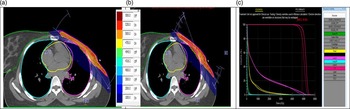
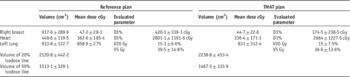
Figure 1a shows the dose distribution for a typical coplanar VMAT plan and 1b shows that of the non-coplanar TMAT plan for the same patient. Patient and plan characteristics in terms of age, target volumes, start angles for the tangential arc fields are given in Table 2. Table 3 lists the dose-volume characteristics for the PTV chest wall (LCW) cases, whole breast (LWB) cases and also for all patients together, grouped according to the prescription doses. As the evaluated patients in this study do not have a uniform prescription different prescription groups were formed. Further all doses reported in the present paper are normalised to their respective prescription dose (relative dose), termed as prescription dose normalised percentage gain or loss. Dose coverage to PTV was better in TMAT plans for all cases and in all groups. In the 40 Gy in 15 fractions group, prescription dose normalised percentage gain in V95% was 5·0±2·1% for the LCW cases, was 4·2±2·5% for the LWB cases and was 4·9±0·2% for all the cases considered together. In the 45 Gy in 20 fractions group the corresponding figures were 4·2±1·3, 5·0±2·1 and 4·7±1·6% while in the 50 Gy in 25 fractions group these were 3·8±1·3, 4·7±2·2 and 4·5±1·9%. The gain in PTV coverage (V95%) between TMAT and reference plans were found to be statistically significant (p=0·043) using paired t-test. Hot spots were identified by measuring V105%. Mean V105% for TMAT and reference plans were 6·7±4·8 and 7·2±5·2%, respectively, and there was no significant difference between the two values (p=0·85). Mean MUs, averaged overall prescription dose levels, for reference and TMAT plans were 537·5±123·6 and 682·9±74·8, respectively, and the difference was statistically significant (p=0·03). Table 4 enlists the dose-volume parameters to the three OARs namely right breast, heart and left lung. Mean dose to heart was 362·6±185·4 and 336·4±171·3 cGy in the reference and TMAT plans, respectively (p=0·68). However D1% showed significant reduction (p=0·046) in TMAT plans with a mean difference between TMAT and reference plan of 137·1 cGy. For the contralateral breast and ipsilateral lung, none of the evaluated dose-volume parameters showed any statistical difference between the two plans.
(a) Reference plan: coplanar tangential arc for left chest wall irradiation. A 30° medial and lateral tangential arc placed at table angle zero. (b) Trajectory modulated arc therapy plan (TMAT): three non-coplanar arc of 10° placed at a couch angle of ±10°, ±20°, ±30°, respectively, layered on top of coplanar beam. (c) Dose-volume histogram comparison between reference (dotted) and TMAT (solid) plans. Increase in PTV dose and reduction in left lung dose is clearly visible.

Patient detail and Physical characteristic and parameters used in the reference plan

LCW, left chest wall; LWB, left whole breast.
PTV dose characteristic as a function of prescription dose

LCW, left chest wall; LWB, left whole breast.
Organ at risk dose-volume parameters, 20% and 50% isodose volume representing the spillage dose

D1%=dose received by 1% of volume; V20 Gy=volume receiving 20 Gy dose; V5 Gy=volume receiving 5 Gy dose.
Further, volumes of 50% isodose line and 20% isodose line, which are indicative of spillage dose, were calculated for both the plans. Although TMAT plan showed a slightly reduced I50% and a slightly increased I20% with respect to reference plan, the differences were not significant.
Although we have not delivered the TMAT plans to patients, the feasibility of delivering TMAT plans was tested for gantry–couch collision. Out of all tested plans, we found four patients having a risk of single or multiple collisions, therefore it would not have been possible to deliver TMAT for these patients.
DISCUSSION
The last decade saw medical linear accelerators acquiring several additional capabilities like integrated finer MLC leaves, high speed MLC (up to 6 cm/second) for dynamic dose delivery, flattening-filter free beam, etc., and improvements in treatment delivery techniques like VMAT. These developments, mainly in the gantry inside the linac head and a significant has taken place for couch by enabling the six-dimensional positional correction. Nevertheless, couch movement during treatment delivery (dynamic couch movement) remains an unexplored option. This may have more to do with the concern for patient safety and the risk of patient–gantry collisions during treatment delivery.
Isocentric couch rotation limited to small angles and in the direction opposite to gantry movement is a safe proposition to exploit for improving dose-volume parameters. In the absence of such feature in the machine and in the TPS, we used a quasi-continuous motion to simulate the dynamic couch delivery. It is well-known that a non-coplanar beam approach through couch rotation gives better results than with a coplanar approach in terms of sharp dose falloff outside target volume while treating lesions, for example, brain tumours. However for treating large tumours like cervix, oesophagus, etc.; non-coplanar technique is not that effective as radiological depth traverse by a non-coplanar beam is higher than the coplanar beam.
However, some authors have tried couch modulated arc therapy for treating breast tumours. Liang et al. have described a TMAT technique for treating breast using horizontal arcs. They showed that in APBI it can significantly reduce tissue volume receiving 100, 80, 50 and 20% of the prescription dose compared with six fixed fields non-coplanar IMRT beam.Reference Liang, Atwood and von Eyben 11 Shaitelmen et al. compared continuous couch rotated therapy delivery with fixed beam IMRT and VMAT for APBI in 12 patients, and predicted a good cosmetic result with lesser risk of secondary cancer.Reference Shaitelman, Kim, Yan, Martinez, Vicini and Grills 12 The same authors have described a continuous couch rotation, however they used control points separation of 10°; this technique, by delivery mechanism same that of our described technique and can consider as quasicontinuous only.Reference Shaitelman, Kim, Yan, Martinez, Vicini and Grills 12 Some other investigators have also used similar couch positions with 10° separations and used static IMRT or three-dimensional (3D) CRT beams to describe a TMAT.Reference Liang, Atwood and von Eyben 11 , Reference Popescu, Beckham, Patenaude, Olivotto and Vlachaki 13 All of these studies exclusively describe APBI only with patients lying down in either prone or supine position. APBI offers much higher flexibility to the treatment planner in trying out different gantry–couch rotations. APBI is more advantageous when treating patients in a prone position and in the case of pendulous breast.
Our study describes the use of TMAT technique in treating patients in supine position for both post-breast conservative surgery and modified radical mastectomy cases, which are much more complex than simple APBI cases in terms of treatment delivery considering the stringent requirements on OAR doses, especially heart dose. This study reveals a significant improvement (≈5%) in the PTV dose coverage for couch TMAT plans. In addition, the mean heart dose can be reduced by 1·3 Gy though it was found to be not significant. Dose reductions were observed in doses to contralateral breast and ipsilateral lung as well.
One of the drawbacks of the trajectory modulated VMAT plans is increased spillage dose in the form of increase in I20% even though I50% was found to be marginally reduced. The other significant drawback is the increase in MUs. TMAT plans consistently required more MUs than simple coplanar VMAT plans.
Except for heart D1%, TMAT plans did not result in significantly improved OAR doses. This is because of typical dose buildup characteristic in the surface. During planning it was observed that, for the given arc lengths, PTV dose (V95%) coverage saturates and did not improve further even with relaxation in OAR constraints. Instead such relaxation leads to increase in OAR doses. Intact whole breast and chest wall treatments allow for a limited range of gantry angles for arc therapy, nearly replicating classical tangential wedge pair fields leading to saturation in dose coverage to PTV. Introduction of couch trajectory modulated partial arcs brings in a new degree of freedom that can at least improve the dose coverage to PTV, even if it cannot reduce OAR doses significantly.
This article demonstrates the use of TMAT in only chest wall or whole breast planning, involving no supraclavicular field or axillary field. It is pertinent to note here that in cases requiring supraclavicular or axillary irradiation, simple manual calculation cannot be adopted when using TMAT for breast or chest wall irradiation. In such situation, the nodal volumes should be delineated on the CT scan and a separate conformal plan created for nodal PTV. Plan evaluation is undertaken on the composite summed plan taking into consideration dose contributions to the volumes from all treatment fields used.
CONCLUSION
A new radiotherapy treatment technique, a first of its kind, which incorporates quasi-continuous couch motion for treating left breast or left chest wall is described. Couch trajectory modulated plans are found to be useful in improving PTV dose coverage. TMAT plans could also result in marginally improved doses to OARs. These improvements come at the cost of an increase in the MUs. Couch angles employed should not be large to rule out the possibility of patient-gantry collision. Every treatment plan must be evaluated for collision possibilities with the patient in treatment position before proceeding with treatment execution.
Acknowledgement
Authors sincerely acknowledge the comment and suggestion from Dr T. Ganesh (Chief Medical Physicist) and Dr Anusheel Munshi (Additional Director) Fortis Memorial Research Institute, Gurgaon.
Conflict of Interest
None.