




No CrossRef data available.
Article contents
The differential clinical and neurocognitive profiles of COMT SNP rs165599 genotypes in schizophrenia
Published online by Cambridge University Press: 11 April 2005
Extract
Schizophrenia is characterized by profound disturbances in cognition, emotion, and social functioning. Catechol-O-methyl transferase (COMT) is the important enzyme for the metabolism of monoamines, which play important part in the pathogenesis of schizophrenia. COMT exists in high and low activity forms. The low activity form was found to be an amino acid substitution (Val-108-Met), which reduces the thermostability of the enzyme. This genetic polymorphism has been reported to be associated with schizophrenia and its associated clinical features (Li et al., 1996).
Information
- Type
- RAPID COMMUNICATION
- Information
- Journal of the International Neuropsychological Society , Volume 11 , Issue 2 , March 2005 , pp. 202 - 204
- Copyright
- © 2005 The International Neuropsychological Society
INTRODUCTION
Schizophrenia is characterized by profound disturbances in cognition, emotion, and social functioning. Catechol-O-methyl transferase (COMT) is the important enzyme for the metabolism of monoamines, which play important part in the pathogenesis of schizophrenia. COMT exists in high and low activity forms. The low activity form was found to be an amino acid substitution (Val-108-Met), which reduces the thermostability of the enzyme. This genetic polymorphism has been reported to be associated with schizophrenia and its associated clinical features (Li et al., 1996).
Shifman et al. (2002) reported a highly significant association between schizophrenia and a COMT haplotype in a large case–control sample. This haplotype included two noncoding single-nucleotide polymorphisms (SNPs) at either end of the COMT gene in addition to the valine-methionine (Val/Met) polymorphism. Bray et al. (2003) showed that COMT variants other than the Val/Met change are of functional importance to the human brain and that the haplotype implicated in schizophrenia susceptibility is likely to exert its effect, either directly or indirectly, by down-regulating COMT gene expression. However, little is known about the impact of such COMT variants upon the clinical manifestations and neurocognitive functions in patients with schizophrenia. Given the role of COMT alleles in physiology of prefrontal cognition and that the COMT gene variants are susceptible to schizophrenia (Egan et al., 2001), we examined the specific clinical manifestations and neurocognitive profile of the patients with the identified COMT SNP rs165599 genotypes in a group of Chinese patients with schizophrenia.
MATERIALS AND METHODS
All patients met the DSM–IV (American Psychiatric Association, 1994) criteria of schizophrenia. Consensus diagnosis was made independently by two authors of the present study (EFCC, RYLC) by face-to-face interview using the Structured Clinical Interview for DSM–IV. All patients were taking conventional antipsychotic medication together with, in some cases, anticholinergic medication (benzhexol in all subjects). Patients with a history of physical illness involving the central nervous system, substance and/or alcohol abuse were excluded.
Patients genomic DNA was collected by standard method. The primers were designed by Primer3 program basic on the human genomic sequence from the public databases (National Institute of Health, 2004). The sequences were: 5′-CATTCAAAGCTCCCCTTGAC-3′ and 5′GGGAGTAGGGAAGGAGATGC-3′. PCR was performed by using 100ng genomic DNA, 1x buffer, 1.5mM MgCl2, 0.2mM dNTPs, 0.25μM of each primer and 1U Taq (ABgene). Running conditions consists 35 cycles of 94°C denaturing for 1 min, 56°C annealing for 1 min and 72°C extension for another 1 min. The PCR product (301bp) was then digested by the restriction enzyme MspI (New England BioLab). The A allele gives fragment of 301bp, while the G allele gives fragments of 166 and 135bp. The DNA fragments were detected by standard electrophoresis method. Perfect agreement (100%) on the genotyping processing was established between two laboratory technicians on the same sample.
Clinical symptoms were assessed using the Positive and Negative Syndrome Scale (PANSS; Kay et al., 1987). The details of the complete procedure for each test are reported elsewhere (Chan et al., 2004; Halperin et al., 1991). Background cognition was assessed with the Wechsler Adult Intelligence Test–III Scale (WAIS–III; Wechsler, 1997a). Sustained attention was assessed by the Continuous Performance Test (Halperin et al., 1991). Verbal and visual memory was assessed by the Logical Memory Test and Visual Reproduction Test from the Wechsler Memory Scale–III (WMS–III; Wechsler, 1997b). Working memory was assessed by the Letter-Number Span Test (Gold et al., 1997) and 2-back test (Callicott et al., 1998). Executive function was assessed by verbal fluency and the Stroop Test.
The university and the corresponding hospital ethics committees approved the research plan and the recruitment procedure of the subjects with schizophrenia. Informed consent was obtained from all the subjects prior to the testing session and blood taking in accordance with the Declaration of Helsinki.
SPSS for window version 11.0 was used for statistical analysis. We computed a standardized score (z score) with the normative data from our laboratory. Multiple univariate analysis of covariance (ANCOVA) controlling for age, intellectual functioning, medication and duration of illness would be made whenever appropriate. Another set of non-parametric test of Kruskal-Wallis H Test would also be conducted to check with the consistency of the results. Statistical significance was considered to be attained at p < .05.
RESULTS
A total of 36 patients (31 men, 5 women) were recruited and completed the full set of neurocognitive tests. The demographics of the sample are summarized in Table 1. No significant differences were found among the groups in terms of education level, gender proportion, and diagnosis.
Demographics of the three COMT SNP genotype subgroups

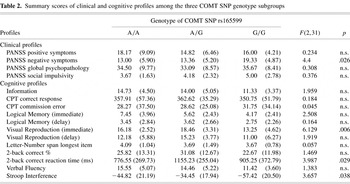
Multiple univariate ANCOVA controlling for age, duration of illness and medication dosage was conducted. Significant difference was found in negative symptoms [F(2,33) = 4.4, p = 0.026; Table 2]. Post-hoc analysis showed that the patients with G/G genotype exhibited the most severe negative symptoms. Patients with A/A tended to demonstrate lesser negative symptoms. No other significant differences were found between the subgroups in other clinical symptoms as well as neurological signs. Non-parametric Kruskal-Wallis H tests demonstrated the same pattern.
Summary scores of clinical and cognitive profiles among the three COMT SNP genotype subgroups

Significant differences were also found in Visual Reproduction [F(2,31) = 6.129, p = .006], Stroop Test [F(2,31) = 3.657, p = .038], and 2-back reaction time for correct response [F(2,31) = 3.987, p = .029]. Post-hoc analyses showed that patients with G/G genotype performed significantly worse than patients with A/G in Visual Reproduction (t = 3.462, p = .002), 2-Back reaction time for correct response (t = 1.962, p = .05), and exhibited significantly more interference in Stroop Test (t = 2.679, p = .012). Similar findings were replicated by Kruskal-Wallis H tests.
DISCUSSION
The present study identified a differential pattern of clinical and neurocognitive profiles in patients with different COMT SNP rs165599 genotypes. The findings are summarized as follows:
- Patients with COMT SNP G/G genotype exhibited the most severe negative symptoms as compared with those with COMT SNP A/A.
- General impairments were observed in different subgroups of COMT SNP genotypes. Memory impairments and prefrontal executive function impairments were more pronounced in patients with COMT SNP G/G genotype.
COMT SNP rs165599 is a SNP with recent interest. It has not been widely studied. From the molecular point of view, it is at the downstream position of the COMT gene. There was evidence of the presence of this SNP transcript in human brain. This SNP (G/G) was found to be over-represented in schizophrenia and also demonstrated to have reduction in COMT expression (Bray et al., 2003). Thus it is speculated that this SNP polymorphism (or other nearby polymorphism in linkage disequilibrium) may involve in COMT gene regulation rendering susceptibility of schizophrenia and its associated clinical and neurocognitive impairment. The present study provides the first preliminary data on the impact of the COMT SNP rs165599 genotypes upon the clinical manifestations and neurocognitive performance in a group of Chinese patients with schizophrenia. Further studies recruiting a larger sample and different ethnic groups are indicated to validate the present findings.
ACKNOWLEDGMENTS
This project was supported in part by the Research Initiation Fund from the University of Hong Kong and the 100-scholar Plan from Sun Yat-Sen University to Raymond Chan; and a Biological Research Collaboration Grant from the Welcome Trust to Ronald Chen. The authors would also like to thank patients and staff at the Castle Peak Hospital for their participation and assistance in the study.
References
REFERENCES
American Psychiatric Association.
(1994).
Diagnostic and statistical manual of mental disorders
(4th ed.).
Washington, DC:
American Psychiatric Association.
Bray, N.J.,
Buckland, P.R.,
Williams, N.M.,
Williams, H.J.,
Norton, N.,
Owen, M.J., &
O'Donovan, M.C.
(2003).
A haplotype implicated in schizophrenia susceptibility is associated
with reduced COMT expression in human brain.
American Journal of Human Genetics,
73,
152–161.CrossRefGoogle Scholar
Callicott, J.H.,
Ramsey, N.F.,
Tallent, K.,
Bertolino, A.,
Knable, M.B.,
Coppola, R., &
Weinberger, D.R.
(1998).
Functional magnetic resonance imaging brain mapping in psychiatry:
Methodological issues illustrated in a study of working memory in
schizophrenia.
Neuropsychopharmacology,
18,
186–196.CrossRefGoogle Scholar
Chan, R.C.K.,
Chen, E.Y.H.,
Cheung, E.F.C., &
Cheung, H.K.
(2004).
Executive dysfunctions in schizophrenia: Relationships to clinical
manifestations.
European Archives of Psychiatry and Clinical Neuroscience,
254,
256–262CrossRefGoogle Scholar
Egan, M.F.,
Goldberg, T.E.,
Kolachana, B.S.,
Callicott, J.H.,
Maz-zanti, C.M.,
Straub, R.E.,
Goldman, D., &
Weinberger, D.R.
(2001).
Effect of COMPT Val108/158 Met genotype on frontal
lobe function and risk for schizophrenia.
Proceedings of the National Academy of Science,
98,
6917–6922.CrossRefGoogle Scholar
Glatt, S.J.,
Faraone, S.V., &
Tsuang, M.T.
(2003).
Association between a functional catechol O-methyltransferase gene
polymorphism and schizophrenia: Meta-analysis of case-control and
family-based studies.
American Journal of Psychiatry,
160,
469–476.CrossRefGoogle Scholar
Gold, J.M.,
Carpenter, C.,
Randolph, C.,
Goldberg, T.E., &
Weinberger, D.R.
(1997).
Auditory working memory and Wisconsin Card Sorting Test performance
in schizophrenia.
Archives of General Psychiatry,
54,
159–165.CrossRefGoogle Scholar
Halperin, J.M.,
Sharma, V.,
Greenblatt, E., &
Schwartz, S.T.
(1991).
Assessment of the Continuous Performance Test: Reliability and
validity in a nonreferred Sample.
Psychological Assessment,
3,
603–608.CrossRefGoogle Scholar
Kay, S.R.,
Fiszbein, A., &
Opler, L.A.
(1987).
The Positive and Negative Syndrome Scale (PANSS) for
schizophrenia.
Schizophrenia Bulletin,
13,
261–276.CrossRefGoogle Scholar
Li, T.,
Sham, P.C.,
Vallada, H.,
Xie, T.,
Tang, X.,
Murray, R.M.,
Liu, X., &
Collier, D.A.
(1996).
Preferential transmission of the high activity allele of COMT in
schizophrenia.
Psychiatry Genetics,
6,
131–133.CrossRefGoogle Scholar
National Institute of Health.
(2004).
SNP: Single nucleotide polymorphism.
Retrieved from
http:www.ncbi.nlm.nih.gov/entrez/query.fegi?db=snp
Shifman, S.,
Bronstein, M.,
Sternfeld, M.,
Pisante-Shalom, A.,
Lev-Lehman, E.,
Weizman, A.,
Reznik, I.,
Spivak, B.,
Grisaru, N.,
Karp, L.,
Schiffer, R.,
Kotler, M.,
Strous, R.D.,
Swartz-Vanetik, M.,
Knobler, H.Y.,
Shinar, E.,
Beckmann, J.S.,
Yakir, B.,
Risch, N.,
Zak, N.B., &
Darvasi, A.
(2002).
A highly significant association between a COMT haplotype and
schizophrenia.
American Journal of Human Genetics,
71,
1296–1302.CrossRefGoogle Scholar
Wechsler, D.
(1997a).
WAIS–III administration and scoring manual.
San Antonio, TX:
The Psychological Corporation.
Wechsler, D.
(1997b).
WMS–III administration and scoring manual.
San Antonio, TX:
The Psychological Corporation.

Demographics of the three COMT SNP genotype subgroups
Summary scores of clinical and cognitive profiles among the three COMT SNP genotype subgroups
 You have
Access
- 15
- Cited by