





Introduction
Virtual care has undergone immense changes in its adoption and use in recent years. While a range of synchronous (telephone and video) and asynchronous (email and messaging) healthcare modalities have been adopted in many countries since its conceptualisation (De Vera et al., Reference De Vera, Challa, Liu, Fuller, Feroz, Gamble, Leung and Seto2022; Mohammed et al., Reference Mohammed, Hyseni, Bui, Gerritsen, Fuller, Sung and Alarakhia2021; Smith and Raskin, Reference Smith and Raskin2021), Canada has traditionally lagged behind in virtual care implementation across the healthcare system (Vogel, Reference Wosik, Fudim, Cameron, Gellad, Cho, Phinney, Curtis, Roman, Poon and Ferranti2020), particularly in primary care settings (Canadian Medical Association, 2019; Madigan et al., Reference Madigan, Racine, Cooke and Korczak2021). One report estimated virtual care utilisation taking ‘decades’ to increase within Canada (Canadian Medical Association, 2019).
The Canadian health care system is a federally and provincially funded system that provides patients universal access to insured services that have been deemed medically necessary by the provincial government (Iglehart, Reference iglehart2000). Primary care providers (i.e., family physicians and nurse practitioners) are the first point of contact and are typically remunerated through fee-for-service payments or alternative payments such as salary or blended payment models (Wranik and Durier-Copp, Reference Wranik and Durier-Copp2010). Within Canadian health systems, virtual care was scarcely used before the COVID-19 pandemic as concerns about remuneration, patient/provider rapport, and privacy and confidentiality made jurisdictions hesitant (Madigan et al., Reference Madigan, Racine, Cooke and Korczak2021).
Study setting and context
Nova Scotia has approximately 1,076,347 residents with approximately over 1,160 FPs licensed to practise in the province. Nova Scotia currently has approximately 60,000 people registered on the Need a Family Practice Registry (NAFPR), which is the centralised waitlist used to match unattached patients with primary care providers, but this number had historically exceeded 100,000 (Nova Scotia Health, 2024; Nova Scotia Health, 2025).
Virtual care is provided provincially through Virtual Care Nova Scotia (VCNS). VCNS was introduced in 2021 to help provide access to primary care for unattached patients on the NAFPR. VCNS is conducted in real time by phone or video-based consultations conducted through the digital healthcare platform, Maple. VCNS offers both full care, which is accessible only to unattached patients, and basic care, available to all Nova Scotians. (Murphy et al., Reference Murphy, Sampalli, Anderson, Stackhouse, Pauls, Ferris, King, Koto, Devereaux, Abbood, Macinnis and Guk2025; Nova Scotia Health, 2026). Full care is only available to unattached patients who are registered on the NAFPR with patients able to receive prescriptions, healthcare advice, medical tests, and referrals for in-person care or specialists care from providers while basic care is available to unattached patients, on a need basis, and with attached patients with a maximum of two free basic care visits. Services offered include healthcare advice or prescription renewals (Nova Scotia Health, 2026).
The use of virtual care fee codes was particularly restricted before COVID-19. Fee codes allowing primary care providers to be compensated for using virtual care in their practice could only be used for a patient with whom the provider had an existing relationship, who had one or more chronic/mental health conditions, or who was over the age of 65 (Medical Service Insurance, 2018). Providers were not remunerated at the same rate as an equivalent in-person visit, and the administrative burden and lower payment of virtual care billing codes reduced physicians’ use of virtual care modalities (Medical Service Insurance, 2018).
The COVID-19 pandemic stimulated rapid shifts to a larger and, in some cases, predominant use of virtual care within primary care (Wosik et al., Reference Wosik, Fudim, Cameron, Gellad, Cho, Phinney, Curtis, Roman, Poon and Ferranti2020). Across North America, existing virtual care billing policies were expanded so that virtual care could be remunerated in broader circumstances, with fewer documentation barriers, and often for the same compensation rates as in-person visits (Smith and Raskin, Reference Smith and Raskin2021). The shift to virtual care allowed patients to access their primary care providers without further spread of the virus while preventing disruption to the compensation of fee-for-service providers who might otherwise be unable to see many of their patients. This shift to providing virtual care resulted from rapid policy development and implementation and rapid uptake of virtual care platforms and practice changes by primary care providers.
Given the widespread change incurred by expanding virtual care within primary care settings, it is critical to gain a clearer understanding of the outcomes of virtual care implementation. The rapid implementation on virtual care created sometimes conflicting perceptions of the benefits and challenges of virtual care. The objective of the study was to explore and uncover areas of concordance and discordance between the perceptions and experiences of family physicians and policymakers regarding the implementation and use of virtual care within the Nova Scotian primary care system. Understanding these perceptions and experiences will help lead the foundation for policy reforms in virtual care.
Methods
We conducted an analysis of qualitative interview data collected as part of the Canadian Institutes of Health Research-funded Study (Marshall et al., Reference Marshall, Breton, Cossette, Isenor, Mathews, Ayn, Smithman, Stock, Frymire, Edwards and Green2021). The Nova Scotia Health Ethics Board granted grants ethical approval (#1024979). The study team consisted of academic researchers, health practitioners, health authority, and department of health staff.
We recruited provincial policymakers and family physicians to take part in semi-structured interviews. We used purposive sampling to ensure key health policy organisations within Nova Scotia were represented among the policymakers recruited (e.g., provincial government, provincial health authority, provider organisations). Purposive and snowball sampling of family physicians ensured representation reflective of Nova Scotia’s physician population in terms of demographics such as gender, rurality, care for dependents, years in practice, and practice characteristics (including payment models, hospital privileges, and additional roles). Potential participants were identified by the research team’s network of primary care stakeholders and policymakers. The study team had developed pre-existing strong relationships through our Department of Family Medicine and allied healthcare providers, which included policy and decision makers from the Nova Scotia Health Authority. Invitations to participate were distributed to potential participants via partner organisations (e.g., physician and nursing professional associations, relevant university departments, primary care clinics) and social media (e.g., Physician Facebook group, Twitter). Interested participants were directed to contact a research team by e-mail or phone. Informed consent was obtained from each participant prior to their participation.
The interview guides were developed as part of a larger study on the impacts of the pandemic on access to primary care for patients with and without a regular primary care provider (see Supplemental material A). The interview guides were developed by a multidisciplinary team using findings from a policy scan and analysis and input from members of the study team, which included representatives from various stakeholder groups (e.g., clinicians, policymakers).
We interviewed participants via Zoom (Zoom Video Communications, Inc.) or telephone to comply with public health physical distancing requirements. Two interviewers conducted the interviews, one with each group (i.e., physicians and policymakers). Interviews were conducted by overseen by the PhD-trained nominated principal investigator (EGM) of the study. We conducted semi-structured interviews to elicit participant lived experiences regarding changes in response to the COVID-19 pandemic, including the implementation and use of virtual care. After each interview, we summarised emerging topics. We used the summaries, with preliminary coding of transcripts, to identify the point at which we reached data saturation. Data saturation was achieved when no new themes emerged, with additional data only confirming the emergent themes. At this point, the themes, and sub-themes, were well-developed, established, and validated by all the team members.
We transcribed interview recordings verbatim. We utilised a qualitative descriptive approach through inductive framework analysis to sort and code the data in this study (Gale et al., Reference Gale, Heath, Cameron, Rashid and Redwood2013; Sandelowski, Reference Sandelowski2000). The qualitative descriptive approach is a commonly used approach in analysis of qualitative data in health research that allows us to develop our themes from the bottom up while staying anchored to the experiences and accounts participants shared with us. Framework analysis is a 7-step process that includes transcription, familiarisation, coding, developing an analytical framework, applying the framework, charting data into the framework matrix, and interpreting the data (Gale et al., Reference Gale, Heath, Cameron, Rashid and Redwood2013). We identified and coded all passages pertinent to virtual care implementation using NVivo (QSR International 2022). To analyse content, two members of the research team reviewed and coded passages inductively. We compared codes and passages to ensure consistency in data coding and summarisation. We then categorised codes for policymakers and family physicians to compare perceptions and identify areas of concordance and discordance between these groups. In the context of this study, ‘concordance’ refers to perspectives that were shared by both family physician and policymaker groups, thus emphasising their agreement or concordant views. The ‘discordance’ theme encompasses sub-themes or perspectives that were emphasised by only one group (i.e., either the family physicians or the policymakers), demonstrating that each group had some different perspectives or a lack of awareness regarding certain topics on virtual care, thus representing that both groups were ‘discordant’ in some of their beliefs’. ‘Mixed Concordance’ refers to themes that were emphasised by both groups however, differences remained between the two groups, sharing different perspectives on the themes emphasised.
Results
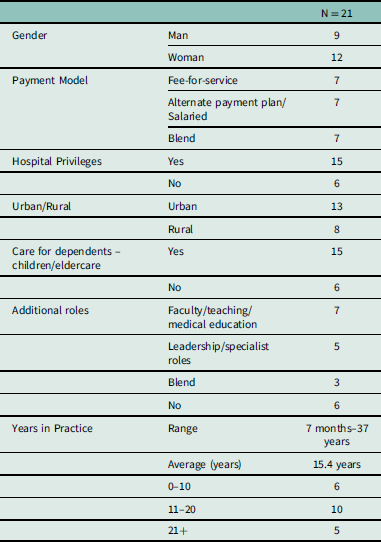
Interviews took place between October 2020 and July 2021 with 9 policymakers, 20 family physicians, and one participant who was both a policymaker and family physician. For confidentiality, we did not collect additional demographic information for participants in the policymaker roles. Table 1 displays family physicians’ demographic information.
Participant demographic summary

Table 1. Long description
A table summarizing demographic information of family physicians. The table has 10 rows and 3 columns. The columns are labeled Gender, Payment Model, Hospital Privileges, Urban/Rural, Care for dependents – children/eldercare, Additional roles, and Years in Practice. The rows provide the following information: Row 1: Gender, Man, 9; Woman, 12. Row 2: Payment Model, Fee-for-service, 7; Alternate payment plan/Salaried, 7; Blend, 7. Row 3: Hospital Privileges, Yes, 15; No, 6. Row 4: Urban/Rural, Urban, 13; Rural, 8. Row 5: Care for dependents – children/eldercare, Yes, 15; No, 6. Row 6: Additional roles, Faculty/teaching/medical education, 7; Leadership/specialist roles, 5; Blend, 3; No, 6. Row 7: Years in Practice, Range, 7 months–37 years; Average (years), 15.4 years. Row 8: 0–10, 6. Row 9: 11–20, 10. Row 10: 21+, 5.
We found several areas of concordance and discordance between provider and policymaker perspectives. Figure 1 illustrates these, and Table 2 highlights participants’ quotes regarding concordance, mixed concordance, and discordance.
Summary of areas of concordance, mixed concordance, and discordance between family physician and policymaker perspectives regarding virtual care.

Summary of quotes in topics of concordance, mixed concordance, and discordance among physicians and policymakers

Table 2. Long description
The table compares quotes on concordance, mixed concordance, and discordance among physicians and policymakers. It has three main columns: Concordance, Mixed Concordance, and Discordance, each with subcategories. The Concordance column includes Virtual Care, Overutilization, Barriers of Access, and Waste. The Mixed Concordance column includes Physician Workload, Confidentiality, Prescribing Authority, and Efficiency and Use. The Discordance column includes Family Physicians and Policymakers. Each subcategory contains quotes from family physicians and policymakers. The table highlights the perspectives and opinions of both groups on various topics related to healthcare.
Areas of concordance
This theme encompasses sub-themes and perspectives that were shared by both the family physician and policymaker groups, thereby highlighting their agreement or concordance.
Virtual care should continue
Both policymaker and family physician participants agreed that virtual care is a significant addition to primary care services. Both groups expressed a desire to maintain virtual care to some extent following the pandemic, and both felt that virtual care uptake was a silver lining of the pandemic.
Overreliance concerns
Another area of high concordance between both groups was concern regarding the potential for overreliance on virtual care, and the possibility of providing care virtually when an in-person visit is more suitable.
Recognition of technological barriers
Both groups also raised the issue of technological infrastructure and the lack of internet or phone access for both patients and providers.
Mixed concordance
This theme encompasses sub-themes or perspectives that were shared by both the family physician and policymaker groups. Despite agreement on themes, each group (i.e., either the family physicians or the policymakers) emphasised different perspectives on the specific theme. This added element demonstrated the differences in knowledge and experiences between both groups regarding the same sub-theme.
Confidentiality
Patient confidentiality was voiced as a concern by both groups. Although both groups discussed issues of patient confidentiality and privacy, physicians also discussed challenges associated with their own privacy when working from home. For example, physicians with children experienced significant difficulty maintaining confidentiality with patients because of the lack of privacy in their own homes.
Promoting access and attachment
Policymakers and family physicians both argued that virtual care has the potential to support or enable access to primary care and improve care efficiency. Both emphasised virtual care as convenient for patients and for reducing opportunity costs such as time off work, travel costs, and childcare costs.
Policymakers were more inclined to discuss the potential for virtual care modalities to improve capacity and to attach patients to providers, describing how virtual care could be used to create virtual clinics for unattached patients.
Efficiency and burnout
Policymakers and family physicians shared similar views in terms of how virtual care may or may not be patient-centred. For instance, both argued that virtual care has the potential to support or enable access to primary care and improve care efficiency.
Physicians also discussed challenges associated with providing virtual care, namely how exhausting providing virtual care can be. While working with virtual care can improve access for many patients, physicians working with synchronous and asynchronous virtual care could experience technology fatigue and difficulty moderating when to log off.
Appropriate and inappropriate use of virtual care
Both groups discussed when virtual care should be used and the types of patients/encounters best suited for virtual care.
Only physicians, however, discussed types of situations to avoid using virtual care, and several physicians expressed the opinion that virtual care is not ideally suited for visits requiring an in-person examination.
Using and evaluating virtual care fee codes
Policymakers and family physicians were in agreement about billing codes used in Nova Scotia. Both were concerned about the inability of walk-in clinics to use virtual care billing codes and the impact of this on unattached patients and both argued that the virtual care fee codes in Nova Scotia were much more user-friendly during COVID-19 than the codes that existed previously.
Policymakers alone discussed the challenges associated with evaluating how virtual care was used due to the set-up of the billing codes, and one policymaker emphasised the difficulty in evaluating virtual care use versus in-person care.
Discordance
The ‘discordance’ theme encompasses sub-themes or perspectives that were emphasised by only one group (i.e., either the family physicians or the policymakers), demonstrating that each group had some different perspectives or a lack of awareness regarding certain topics on virtual care, thus representing that both groups were ‘discordant’ in some of their beliefs’.
Triaging in-person versus virtual visits
Physicians also discussed the challenges associated with triaging patients for virtual versus in-person care. Some physicians found triaging to be something their staff did well. Other physicians found staff less able to accurately triage patients for in-person care.
Patient understanding
Family physicians alone discussed the virtual care challenges associated with patient understanding. Some physicians found that patients were not always prepared for their appointment or did not view the visit as a formal medical appointment. For example, one physician described a patient encounter wherein the patient perceived the virtual visit (i.e., a phone consultation) as something that was not part of care work. Another physician described patient encounters where the patient was not prepared for the virtual visit.
Virtual care modalities
The rapid introduction of virtual care options has been largely lauded by both policymaker and family physician participants. Physicians, however, were more likely than policymakers to discuss the value of using asynchronous modalities of virtual care such as email and messaging platforms. For instance, one physician mentioned the existence of an asynchronous platform pre-COVID-19 and the value of bringing that system back.
Provider-patient connection
One aspect of patient-centred care that family physicians alone discussed was the loss of personal connection with the patient over virtual care. One physician providing palliative care found phone care to be challenging, and some physicians found that the lack of personal connection over the phone impacted patient-centred care.
Virtual care remuneration
The consideration of whether virtual care should be remunerated more than in-person care was considered only among policymakers.
Discussion
The rapid shift to virtual care was catalysed by the COVID-19 pandemic public health emergency. when barriers to adoption may have been circumvented due to the multiple stressors faced by healthcare providers, patients, and healthcare policymakers. Providers and policymakers raised important issues surrounding virtual care, including the ethics of its use, perceptions regarding its impact on provider and system capacity, and ideas regarding continued implementation. There is agreement between policymakers and family physicians regarding the benefits and challenges of virtual care. For instance, agreement that virtual care can promote access and should continue, but that there continue to be technological barriers for providers and patients. Discordance in the data suggests that it is important to explore the separate experiences of both groups. The discordance between the groups’ perspectives may result from the type of work each group performs and the pressures from their different roles in the healthcare system. For example, family physicians work ‘on-the-ground’, interacting with patients directly, hence they provided greater insight into the operationalising of virtual care. Providers also identified challenges like provider burnout and subsequent impacts on provider-patient rapport. Conversely, policymakers work on systemic and structural issues of the healthcare system. They provided insight on systems-level aspects of virtual care, including the potential for virtual care to promote attachment and the challenges with evaluation. Policymakers also make recommendations that balance costs to the system with appropriate access to fiscally responsible care. Both perspectives are vital for the sustainability of virtual care but have not previously been reported in the literature.
Our findings demonstrate the need for further guidance and standards regarding ethical considerations and appropriate uses of virtual care. Although there is the perception that virtual care will improve safe access to primary care (Herzer and Pronovost, Reference Herzer and Pronovost2021), the reality of virtual care has demonstrated issues of inequity in access and challenges of confidentiality for both patients and providers (Hedden et al., Reference Hedden, Spencer, Mathews, Marshall, Lukewich, Asghari, Brown, Gill, Freeman and Mccracken2023; Hedden et al., Reference Hedden, Spencer, Mathews, Gard Marshall, Lukewich, Asghari, Gill, Mccracken, Vaughan and Wong2024). The challenges and benefits of virtual care for both providers and patients require further attention to understand how virtual care should be utilised and renumerated, and what modalities are most useful. Accessible primary care is essential for sustaining the Canadian publicly funded healthcare system, as there is currently a rise in for-profit primary healthcare access (Hedden et al., Reference Hedden, Spencer, Mathews, Marshall, Lukewich, Asghari, Brown, Gill, Freeman and Mccracken2023). Virtual care can improve primary care access, and our findings indicate that both asynchronous and synchronous options should be considered. Moving forward, virtual care training about when and how to use virtual care would also be of benefit for providers, trainees, and patients.
This study also provides insight into the relationship between virtual care and patient attachment to primary care. While both this study and others suggest that virtual care may generate efficiencies within care (Bokolo Anthony, Reference Bokolo Anthony2020), our results indicate that expectations around whether these efficiencies are sufficient to allow providers to adopt virtual care requires further clarification. To support addressing this issue, we suggest that future billing infrastructure remain easy to access and utilise, with mechanisms added to improve the ability to evaluate virtual care’s impacts on costs, patient visits, provider capacity, and patient health outcomes. Alternatively, moving towards salaried models of primary care with team-based approaches could support patients and make best use of provider skills and time, with the right provider for the right patient (e.g., family physicians, nurse practitioners, nurses, social workers, pharmacists, physiotherapists, counsellors).
Furthermore, to facilitate understanding and the contextual opportunities and challenges faced by both physicians and policymakers in the implementation of virtual care, strategies such as deliberative dialogues could be employed both before and after policy and practice enactments. The continued evaluation of the use of virtual care on health outcomes at the provider, patient, and health system level, cannot be understated.
Limitations
Our qualitative study included family physicians and policy and decision makers in Nova Scotia, with a participant sample (n = 30). Interviews were conducted within the province of Nova Scotia to ensure demographic and institutional representation capturing the contextual practice and policy landscape with respect to virtual care. While the results of our study may be transferable, there may be contextual variation in the practices and policies that shape the uptake and use of virtual care in different jurisdictions.
Future directions
The importance of virtual care has been demonstrated in the current study of provider and policymaker concordant and discordant perspectives. An integral next step in the exploration of virtual care experiences is the inclusion of patient perspectives regarding the accessibility and use of virtual care modalities.
Conclusions
Policymakers and providers’ perspectives were largely concordant in this study regarding some of the concerns and benefits of virtual care. However, some perspectives were discordant, revealing areas that may require reconciliation via communication and policy. In general, family physicians provided greater insight into operationalising virtual care and challenges such as provider burnout and the impact on provider-patient rapport. Policymakers provided insight into the systems-level aspects of virtual care, including the potential for virtual care to promote attachment and the challenges with evaluation. Provider, patient, and policymaker perspectives are vital for the sustainability of virtual care.
Supplementary material
The supplementary material for this article can be found at https://doi.org/10.1017/S146342362610200X.
Data availability statement
The data that support the findings of this study may be available on request from the corresponding author EGM. The data are not publicly available due to ethical restrictions and the data containing information that could compromise the privacy of research participants.
Acknowledgements
The authors would like to thank our participants for sharing their time and insights for this research. We appreciate the opportunity to share their voices. The authors would also like to acknowledge and thank Dr. Michael Green and Dr. Richard Buote for their contributions to this research.
Author contributions
EGM: Conceptualisation, Methodology, Investigation, Formal analysis, Funding acquisition, Supervision, Resources, Writing original draft, Data curation, Validation, Writing reviewing &editing. LR: Programme administration, Data curation, Formal analysis, Investigation, Validation, Writing original draft, Writing review & editing. JEI: Conceptualisation, Methodology, Funding acquisition, Supervision, Writing reviewing &editing. AM: Programme administration, Writing original draft, Visualisation, Writing review & editing. AR: Writing original draft, Visualisation, Writing review & editing. MM: Conceptualisation, Methodology, Investigation, Funding acquisition, Supervision, Writing reviewing &editing
Funding statement
Funding was provided by the Canadian Institutes of Health Research COVID-19 Rapid Funding Opportunity Grant (Grant #447605)
Competing interests
The authors declare that they have no competing interests.
Ethical standards
Ethical approval for this study was granted on January 17, 2020, by the Nova Scotia Health Research Ethics Board (File #1024979). Participation in the study was voluntary, and participants understood that they could withdraw at any point up until their data were combined with other participants’. Written, informed consent was obtained prior to data collection and kept confidentially.
Consent for publication
Not applicable


 Open access

