Introduction
The Republic of Moldova has a high proportion of traditional contraceptive users compared with Western European and other post-socialist and South-East European countries (NCPM & ORC Macro, 2006; United Nations, 2007). The high level of traditional method use is associated with a high proportion of unwanted pregnancies and widespread poor maternal health resulting from continued high demand for induced abortion – a key mechanism for birth control and the observed low fertility rate in Moldova (NCPM & ORC Macro, 2006). This study examines the contraceptive choice patterns among sexually active women in Moldova, particularly focusing on traditional methods. An understanding of the factors determining traditional method choices is critical for evaluating and improving policy intervention strategies aimed at reducing traditional method use, unwanted pregnancies and induced abortion.
The determinants of high traditional method use are poorly understood in the demographic literature, in particular in the Eastern European setting (Rogow & Horowitz, Reference Rogow and Horowitz1995; Santow, Reference Santow1993, Reference Santow1995). The recommendations made at the 1994 International Conference on Population and Development highlight the importance of traditional methods in the informed choices framework (United Nations, 1995), suggesting that appropriate use of traditional methods can be effective in preventing unwanted pregnancies (although not necessarily sexually transmitted infections). Despite this recommendation, there is still limited research on traditional method use (Rogow & Horowitz, Reference Rogow and Horowitz1995). The majority of studies either ignore traditional methods and define contraceptive use exclusively in terms of modern method use (Pariani et al., Reference Pariani, Heer and Van Arsdol1991; Swar-Eldahab, Reference Swar-Eldahab1993; Westoff, Reference Westoff2005), or focus on the determinants of modern method use with traditional methods as a residual category (Magadi & Curtis, Reference Magadi and Curtis2003). This study explicitly focuses on traditional methods in an effort to expand the limited understanding of traditional contraception in modern societies.
Traditional methods consist of withdrawal, abstinence (temporary or periodic), lactational amenorrhoeic method (LAM) and other folkloric methods. The efficacy of traditional methods varies. Evidence suggests successful practise in nineteenth and twentieth century Europe (Nye & Poppel, Reference Nye and van Poppel2003; Fisher & Szreter, Reference Fisher and Szreter2003), although Kowal (Reference Kowal and Hatcher2004) estimates that 27% of withdrawal and 25% of periodic abstinence users experience a conception within one year of use. These rates of user-failure are high when compared with modern methods such as the IUD (0.8%) and the pill (8%). In contrast, LAM is regarded as a highly effective method; 6-month failure rates are estimated to be around 1.5% (Kennedy & Trussel, Reference Kennedy, Trussel and Hatcher2004), although there is no protective effect following resumption of menses.
Family planning programmes have been introduced in Moldova since 1999, actively promoting the use of modern methods to reduce unwanted pregnancies and induced abortions. However, their effectiveness can only be evaluated in the wider context of economic, socio-demographic and geographical conditions of the country. Similar to many other post-socialist countries, Moldova has experienced economic collapse since 1991 resulting in a decline in GDP of 66% by 2001, with a dramatic reduction in employment rates, particularly in the agricultural sector (30% fall between 1996 and 2000) and a high proportion of people living in poverty (70% in 2000) (World Bank, 2005). Large parts of the country, in particular regions outside the capital Chisinau, are still predominantly rurally orientated, often suffering from a lack of appropriate infrastructure, restricted access to public facilities and medical provision resulting from a centralized health care system during the socialist era (MacLehose & McKee, Reference MacLehose and McKee2002).
This study investigates the correlates of traditional method use based on data from the 2005 Moldovan Demographic and Health Survey (MDHS), contributing to a better understanding of the associated factors. In particular, the paper examines the joint impact of three key factors: poverty, geographic isolation and family planning/reproductive health (FP/RH) programmes, on traditional method choice, controlling for relevant socioeconomic, spatial and demographic influences.
The paper is structured as follows. First, the reproductive health context in Moldova is discussed. Then, a conceptual framework motivating and deriving the key research hypotheses is provided. The data and method used in the analysis are presented, including an explanation on the operationalization of key variables in the model. The results are interpreted in the light of the research hypotheses. Concluding remarks and policy recommendations are made in the final section.
Reproductive health context
The Republic of Moldova came into existence in 1991, replacing the Moldovan Soviet Socialist Republic. Since independence, the country has faced myriad reproductive health challenges, exacerbated by deteriorating economic conditions. Moldovan fertility has fallen since independence and it has now reached a sub-replacement level of 1.7 children per woman (Council of Europe, 2004; NCPM & ORC Macro, 2006). About 24% of married women use a traditional method in Moldova; of these 82% rely on withdrawal (NCPM & ORC Macro, 2006). This is considerably higher than in Western Europe (e.g. Germany 4.5%, The Netherlands 2.9%) and other post-socialist countries (e.g. Latvia 8.7%, Hungary 9%, Bulgaria 15.7%). However, the level of traditional method use in Moldova is comparable to other South-East European countries: for example 34.3% in Romania and 29.5% in Ukraine (Johnson et al., Reference Johnson, Horga and Fajans2004; World Health Organization, 2004). Modern method prevalence constitutes 44% in Moldova, which is lower than in Western European countries: for example 65.6% in Germany and 75.6% in The Netherlands (United Nations, 2007). The most popular modern method is the IUD (25.2% among married women) whereas hormonal contraceptive use is rare (NCPM & ORC Macro, 2006). This is typical of the socialist fertility control regime, which stressed the advantages of long-term methods and exaggerated the negative health implications of hormonal contraception (Popov et al., Reference Popov, Visser and Ketting1993).
Unwanted pregnancy rates are very high in Moldova, primarily due to high failure rates resulting from a reliance on traditional contraceptive methods (NCPM & ORC Macro, 2006). About 43% of unwanted conceptions in Moldova result from traditional method failure, compared with 20% from modern methods (Westoff, Reference Westoff2005). Those experiencing traditional method failure often resort to induced abortion procedures (Westoff, Reference Westoff2000, Reference Westoff2005; Agadjanian, Reference Agadjanian2002). The 2005 MDHS data show that among sexually experienced women (those who have ever had sex), 46.2% reported having had an induced abortion, and of these 40.9% had at least one subsequent termination. The majority of these abortions are carried out using the dilation and curettage procedure, increasing the risk for complications and health problems (Comendant, 2005). There is only limited availability of vacuum aspirations and medical (drug-induced) abortions in Moldova (Comendant, 2005). The repeated use of abortion is a major public health concern in the country: NCPM & ORC Macro (2006) estimate that in 2002 abortion was the second most prevalent cause of death, while Comendant (2005) estimates that the proportion of deaths resulting from abortion during the period 1992–2002 was 30.3%.
In an attempt to improve the reproductive health situation, the Moldovan government introduced the National Programme in Family Planning and Protection for Reproductive Health (NPRH) in 1999, reviewed later in 2005 (NCPM & ORC Macro, 2006). This programme aimed to reduce the burden of unwanted pregnancies and induced abortions by promoting modern method awareness through mass media and by increasing access to family planning clinics. Under this initiative, FP/RH services were expanded through a network of 40 family planning centres spread across the country (MacLehose & McKee, Reference MacLehose and McKee2002). Municipalities are responsible for the delivery of FP/RH services in each region (North, South and Central, which includes Chisinau). Contraceptives previously distributed through maternity clinics (secondary care) have now been shifted towards primary care level to improve access (MacLehose & McKee, Reference MacLehose and McKee2002). These programmes rely heavily on support from overseas donor agencies and NGOs (MacLehose & McKee, Reference MacLehose and McKee2002; Comendant, 2005).
Alongside the NPRH, the Moldovan government launched the National Programme for Combating HIV/AIDS (NPAIDS) in 2001 to control the rapid spread of HIV/AIDS (NCPM & ORC Macro, 2006). The interventions focused on prevention measures such as promoting awareness of HIV transmission to both general and high-risk groups. The 2005 MDHS shows evidence of high levels of AIDS awareness (97%) but knowledge of HIV prevention methods was found to be relatively poor (NCPM & ORC Macro, 2006). The Moldovan government identified that the spread of HIV/AIDS was a major challenge in the coming century, due to HIV awareness lacking ‘mass character’ (NCPM & ORC Macro, 2006).
However, the effectiveness of FP/RH health programmes can only be seen in the wider economic context of the country. In general, FP/RH programmes in post-socialist Eastern Europe have had poor results, mainly due to rapid social change and economic instability. For example, family planning programmes in Bulgaria had no impact on improving access to clinics during the post-Socialist economic crisis (Carlson & Lamb, Reference Carlson and Lamb2001), and had only a limited impact on increasing family planning knowledge. In Romania, modern method uptake, since the fall of socialism, has been limited because of high method costs (Serbanescu et al., Reference Serbanescu, Morris, Stupp and Stanescu1995; Johnson et al., Reference Johnson, Horga and Fajans2004). Since 1991, Moldova has experienced economic collapse with GDP falling by 66% by the end of 2005 (NCPM & ORC Macro, 2006), employment falling by approximately 19% from 1996 to 2000 (with agricultural employment, the primary employer in Moldova, falling by 30%) and 70% of people living below the poverty line in 2000 (World Bank, 2005). This difficult economic situation has had wide-ranging implications for the majority of the Moldovan population, such as a significant reduction in purchasing power and limited monetary means. This, in particular, may have limited the impact of FP/RH programmes since modern contraception was not subsidised, i.e. not provided free of charge (MacLehose & McKee, Reference MacLehose and McKee2002). Between 1997 and 2005, the overall contraceptive prevalence decreased from 73% to 68.7% while modern method use decreased from 48% to 45% (1997 Moldovan Reproductive Health Survey and 2005 MDHS).
Conceptual framework and research hypotheses
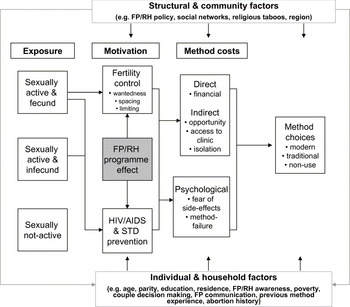
A conceptual framework is developed that outlines the motivation and barriers associated with contraceptive method choices (Fig. 1). From this, the key research hypotheses on the effects of poverty, geographic isolation and FP/RH programmes on the choice of traditional methods are derived.
Conceptual framework illustrating the motivation and barriers associated with contraceptive method choices.

The framework, adapted from Easterlin (Reference Easterlin1979), explains the cost barriers in accessing contraceptive methods and the individual motivation underlying reproductive health needs, such as motivation for fertility control and prevention of HIV/AIDS and other sexually transmitted diseases. Family planning/reproductive health programmes aim to meet individual contraceptive and reproductive health needs, provide quality services and motivate couples to make appropriate method choices for limiting fertility, preventing diseases or both.
Couples may be discouraged from using modern contraception by prohibitive costs. These costs are not recorded in the DHS so their effect is measured through proxy variables. Modern methods have a direct (financial) cost, whereas traditional methods have no such costs, as no supplies need to be purchased and no clinical consultation is required. Women of lower economic status may be unable to afford modern contraception and may instead use traditional methods (Serbanescu et al., Reference Serbanescu, Morris, Stupp and Stanescu1995; Johnson et al., Reference Johnson, Horga and Fajans2004). The indirect cost is the opportunity cost of obtaining a method (Easterlin, Reference Easterlin1979). It is hypothesized that women who cannot access a family planning clinic or who live in an under-served area (e.g. rural areas) are less likely to use a modern method and instead rely on a traditional method.
Three aspects of FP/RH programmes on method choices are examined. The NPRH explicitly promotes modern contraceptives through media campaigns, particularly encouraging traditional method users to switch to modern methods (NCPM & ORC Macro, 2006). It is therefore expected that higher family planning media exposure will be associated with higher modern and lower traditional method use.
The NPRH is also evaluated by assessing the programme effect in determining whether women accept modern methods by discontinuing their previous (traditional) method. However, it is not unlikely that women who have previously discontinued a traditional method may still continue using the same method after a birth or an induced abortion in the case of method failure (Kost, Reference Kost1993; Goldburg & Toros, Reference Goldburg and Toros1994). This analysis further evaluates the potential impact of NPAIDS on contraceptive behaviour. Only condoms offer protection against HIV/AIDS; traditional methods do not (Kowal, Reference Kowal and Hatcher2004). It is hypothesized that higher exposure to NPAIDS through media would encourage women to use modern methods, specifically condoms.
The conceptual framework incorporates the exposure to risk of conception identified by Easterlin (Reference Easterlin1979), which is expanded to incorporate HIV/STD prevention as a motivation to use contraception. The influences identified are (i) exposure to sexual activity, (ii) exposure to risk of conception (fecundity) and (iii) the motivation to prevent pregnancy or HIV/AIDS and other STDs. These concepts are operationalized in the Methods section. In a multilevel framework, method choices and decisions are determined by individual, household and structural/community characteristics mediated by other main effects such as motivation and cost factors. Contraceptive network effects are also important, and can influence individual-level decisions even after controlling for individual-level characteristics (Montgomery & Casterline, Reference Montgomery and Casterline1996; Kohler et al., Reference Kohler, Behrman and Watkins2001). The inclusion of contextual information can therefore provide an understanding of the effect of contraceptive networks on individual method choices.
Traditional method use is associated with a range of demographic and socioeconomic correlates. Traditional method use is popular among older women (Robinson, Reference Robinson1996; Magadi & Curtis, Reference Magadi and Curtis2003; Westoff, Reference Westoff2000, Reference Westoff2005) but is less common among higher parity women (Magadi & Curtis, Reference Magadi and Curtis2003). Education seems highly influential, although the effect is inconsistent. Robinson (Reference Robinson1996) finds that higher education can encourage women to switch from traditional to modern methods, although in some contexts educated women are more likely to use a traditional method (Robinson, Reference Robinson1996). Cultural and religious influences are also important. In general, there are fewer taboos toward traditional methods than modern methods. Roman Catholicism prohibits withdrawal, although the use of periodic abstinence is allowed since it promotes celibacy (Santow, Reference Santow1993, Reference Santow1995). In contrast, the Orthodox Church does not interfere in contraceptive choices (Christopher, Reference Christopher2006).
Data
Data for this study are drawn from the 2005 Moldova Demographic and Health Survey (MDHS). The survey collects detailed information on FP/RH including birth and abortion histories, maternal and child health, HIV/AIDS knowledge and attitudes as well as other background demographic and socioeconomic characteristics. The survey was conducted in all regions excluding Transnistria, which contains approximately 15% of the Moldovan population (NCPM & ORC Macro, 2006).
The MDHS has a probability two-stage cluster design. A total of 400 primary sampling units (PSUs) were selected from the 2004 Moldovan Census using systematic sampling with probability proportional to size, with an oversample of urban PSUs: 30 households were then selected from each PSU where all women aged 15–49 were interviewed. The survey includes sampling weights to account for the complex sampling design and unequal selection probabilities. Responses between women may be correlated due to area-level effects, such as those of contraceptive networks (Montgomery & Casterline, Reference Montgomery and Casterline1996; Kohler et al., Reference Kohler, Behrman and Watkins2001), other community-level (PSU) characteristics and interviewer effects, leading to clustering of women within communities. The overall response rate was 95% (comparable to response rates in other DHS in post-socialist republics, e.g. Ukraine 90.2%, Armenia 88.8%), with a total of 7440 women interviewed. Women who reported never having had sex (n=1401) were excluded, since they are conceptually not relevant to the study. Infecund or pregnant women are retained since they may use barrier contraceptives to protect against HIV/AIDS. The final analysis sample consists of 6039 women aged 15–49 years.
There are some data limitations. The MDHS records only one current method use per woman. Where more than one contraceptive is used, only the most effective method is recorded, leading to potential under-reporting of traditional methods (Rogow & Horowitz, Reference Rogow and Horowitz1995). Existing literature indicates that religion is important in determining the choice of contraceptive method. However, the MDHS collects data on religious affiliation rather than religiosity, which limits the understanding of the influence of religion on contraceptive use. Another potential factor associated with method choice is sexual abstinence due to high male migration from Moldova to Russia and Western Europe, particularly since the 1998 Russian financial crisis, and which accounts for nearly 25% of the Moldovan working population (World Bank, 2005). This short-term displacement demonstrates the importance of controlling for reported sexual activity, as well as the other commonly used indicators of sexual activity (e.g. marital status).
Methods
The dependent variable for this analysis is current contraceptive method use. The MDHS asked women, ‘Are you currently doing something or using a method to avoid getting pregnant?’ (NCPM & ORC Macro, 2006). Respondents who answered affirmative were asked to mention the specific method they were using at the time of survey. The responses were re-coded into three categories: women currently using a modern method, a traditional method or no method.
The effects of selected explanatory variables on method choice are modelled using multinomial logistic regression, controlling for the hierarchical data structure and accounting for unexplained variance resulting from the sampling design. A multilevel model allows for correlation in probabilities of method choice for women living in the same area (clustering), resulting from community-level effects (Magadi & Curtis, Reference Magadi and Curtis2003; Lindstrom & Munoz-Franco, Reference Lindstrom and Munoz-Franco2005). Failure to account for such clustering leads to underestimated standard errors and incorrect inferences. Other advantages of the multilevel model include allowing the effect of covariates to vary across communities (random slopes), incorporating covariance between the unobserved area influences on the different types of method choices and information defined at the cluster level (contextual variables).
The dependent variable yij is current method choice for woman i living in area j, which is coded 0 for modern method users (40.3%), 1 for traditional method users (21.1%) and 2 for non-users (38.6%). The probability of method choice is expressed as:

where s=0, 1, 2. The model is presented as:
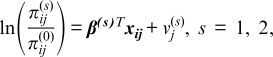
where β (s) is a vector of coefficients, xij is a vector of explanatory variables including interaction effects and νj (s) represents unobserved random PSU effects. The PSU random effects νj are assumed to follow a bivariate normal distribution, such that:

with Ω defined as:
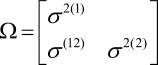
where σ2(1) and σ2(2) denote PSU-level variances for traditional and non-use respectively, and σ (12) denotes the covariance between PSU effects on traditional and non-use use. A positive (negative) residual covariance is expected if areas that have high rates of traditional method use tend also to have high (low) rates of non-use. Equation (1) is referred to as a random intercept model because the effect of area j is to change the log-odds of traditional or non-use versus modern method by νj (s), regardless of the values x ij (s). In the more general random slopes model, β (s) may vary randomly across PSUs. The model does not incorporate clustering at the household level. Although the sampling design of the MDHS interviews all women living in a randomly selected household, there are only 1443 households out of a total of 11,095 households (13%) in the analysis sample with more than one woman eligible for interview. The scarcity of the data therefore does not lend itself to a random effect at the household level. (The random effect at the household level was nevertheless tested but was not found to be significant.)
The operationalization of the key variables explored in the model was as follows. Since the MDHS does not collect information on household income directly and the cost of contraceptive method is only recorded for current modern method users, this analysis considers a proxy variable of asset wealth to measure the effect of direct costs. This proxy variable was derived as an index score using principal component analysis (PCA) (Filmer & Pritchett, Reference Filmer and Pritchett2001) based on variables related to ownership of assets, where higher scores indicate more affluent households. The variables ‘access to water’ and ‘toilet’ were excluded from the PCA since the variance of these variables was small.
The effects of indirect costs are measured with the help of proxy variables, first directly in terms of access at the individual level (i.e. whether respondents have accessed a family planning clinic in the past year) and at the PSU level (defined as the proportion of women in each cluster who accessed a clinic in the past year). Secondly, two indirect measures of access are employed: region of residence and the urban/rural residence indicator. Region is also included to account for the potentially differing level of quality in FP/RH services organized at a regional level.
The variables that capture aspects of the national programmes are exposure to family planning media, discontinuation of last contraceptive method within the last five years preceding the survey (to evaluate the effect of NPRH), individual knowledge of the ways to prevent HIV transmission (to evaluate NPAIDS) and induced abortion history. A score for family planning media exposure is derived using principle component analysis (PCA) in a similar way to Filmer & Pritchett (Reference Filmer and Pritchett2001), based on whether the respondent had heard about family planning through media (television, radio, newspaper) within the past month, categorized into tertials. Each respondent reports on whether they had heard of family planning through each medium. A higher index score indicates a higher exposure to family planning media at the individual level.
The exposure and control variables include fertility preferences, coital exposure measured in terms of marital status at time of survey, fecundity status and reported sexual activity within the past 4 weeks. These measures are used to account for lack of information in the MDHS data on exposure to coitus resulting from economic migration of spouses (World Bank, 2005). Demographic and socioeconomic variables include respondent's age, parity, recent birth experience, education and ethnicity.
Different specifications of the multilevel models were considered. First, a random intercept was specified (null model) without any covariates. Fixed and random effects (on asset wealth and family planning programme variables) and selected interactions between socio-demographic variables and asset wealth and FP/RH variables were explored to allow for variation in the effects among different social groups. Two area-level variables were tested for significance to explain area-level variances. These variables were derived as aggregate measures of individual-level characteristics at the community level (Magadi & Curtis, Reference Magadi and Curtis2003; Lindstrom & Munoz-Franco, Reference Lindstrom and Munoz-Franco2005), specified as contextual variables varying at the PSU level. To measure access, the proportion of women visiting a clinic in the past year was derived (see discussion above); to capture possible network effects on individual method choices, a measure of media exposure to family planning within each community was derived, defined as the mean of the individual-level family planning media exposure scores for each PSU. Cross-level interactions were tested to identify potential interaction effects between individual- and network-level effects (see also Conceptual framework). All variables considered were screened for multicollinearity.
Results
Sample characteristics
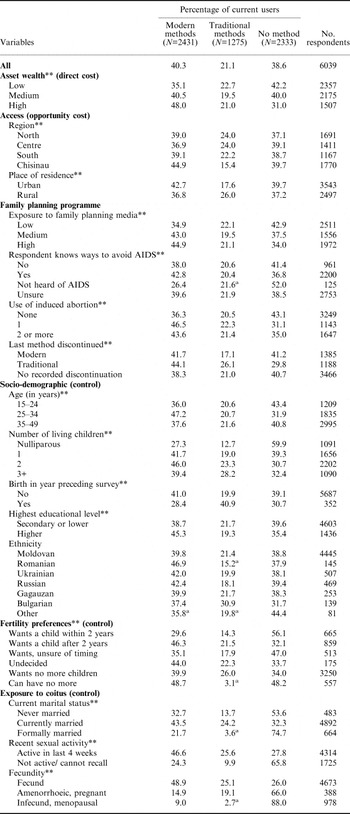
Modern method use represents the largest response category: 40.3% of respondents in the analysis sample used a modern method at interview. The percentage of respondents using a traditional method (21.2%) is substantial. The distribution of the type of current method used by explanatory variables is shown in Table 1. All variables were tested for statistical independence using bivariate chi-squared tests. Women in the lowest wealth category have the highest use of traditional methods, and the highest non-use. The proportion of women using a modern method increases with increasing economic status, while the proportion of non-users falls considerably. The proportion of traditional method users in rural areas is 8.4% points higher than in urban areas. Traditional method use is lowest in Chisinau, which includes both urban and rural residents (approximately 7% of Chisinau residents live in rural areas).
Percentage distribution of respondents by current contraceptive method use and selected characteristics, MDHS 2005

a Denotes a small cell count (n<30).
The row percentages may not sum to 100% due to rounding errors.
** p<0.01
* p<0.05 in the χ 2 tests.
All variables related to FP/RH programmes show a statistically significant association with method choice. Women with low media exposure have relatively high traditional method use, although there is no monotonic decrease with higher exposure. As expected, there is a fall in non-use and increase in modern method use with higher family planning exposure. About 18% of respondents are unaware of the existence of AIDS or do not know how to prevent it. These women are most likely to be non-users. Conversely, modern method use is highest among women who know how to prevent AIDS transmission. There is a substantial concentration of traditional method use in women who had previously discontinued a traditional method, as expected (Kost, Reference Kost1993; Goldburg & Toros, Reference Goldburg and Toros1994). The use of induced abortion has surprisingly little influence on traditional method use. Women who have had abortions in the past are considerably more likely to use a modern method.
Regression analysis
The PSU-level random effects for both traditional and non-use were significant at the 5% level in the null model (results not shown). A significant covariance indicated that areas with a high (low) proportion of women using no method have a low (high) proportion of women using a traditional method. In the final model, the random intercepts for traditional method use remain significant, but the area-level variance for non-use and the covariance are no longer significant (Table 2). No significant random slopes were found, which indicates that the coefficients do not vary between PSUs. Area-level variables (e.g. PSU mean of family planning media score) and cross-level interactions were also non-significant in the final model.
Estimated between-area variance–covariance matrix of the final multilevel model for traditional method use and non-use

Model estimated using 80,000 MCMC samples with 5000 burn-in. Starting values for MCMC from 2nd order PQL (RIGLS).
* p<0.05.
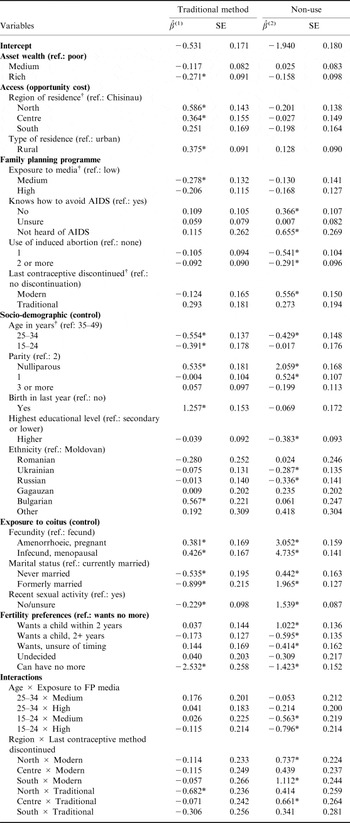
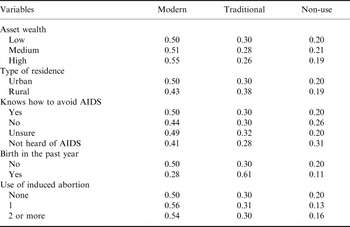
Table 3 presents the estimated coefficients and standard errors of the explanatory variables included in the final multilevel model. Since the interpretation of odds ratios can be ambiguous for multinomial models, predicted probabilities are presented for important main effects (Table 4). To generate predicted probabilities, all categorical variables are set to their baseline category, except the variable ‘fertility preference’, which is set to the category ‘wants children within the next 2 years’ in order to provide a better interpretation of non-use. Traditional use is significantly higher for women from poorer backgrounds than for women in the highest wealth category. This finding is consistent with the situation in other former socialist contexts (Serbanescu et al., Reference Serbanescu, Morris, Stupp and Stanescu1995; Carlson & Lamb, Reference Carlson and Lamb2001; Johnson et al., Reference Johnson, Horga and Fajans2004) and supports the research hypothesis that direct costs can constrain the choice of contraceptive method. However, the predicted probabilities show that the size of this effect is small, with only a 5% point difference between low and high wealth groups.
Estimated coefficients with standard errors (SE) of the final multilevel model for traditional contraceptive method use and non-use

† Denotes involvement in 2-way interaction.
Model estimated using 80,000 MCMC samples with 5000 burn-in. Starting values for MCMC from 2nd order PQL (RIGLS).
* p<0.05.
Predicted probabilities of contraceptive method choice for selected main effects

The study found that the indirect measures of access are significant. Women in rural areas are significantly more likely to use a traditional method than urban women (p<0.05, Tables 3 and 4). Probability of modern method use is lower in rural areas. In a model without interaction effects (results not shown), traditional method use was significantly higher in the northern and central regions compared with Chisinau. The higher probability of traditional method use in rural areas and regions outside Chisinau suggests higher opportunity costs in poorly serviced regions, and lack of access to modern methods may dissuade women from use, increasing the probability of traditional contraceptive use.
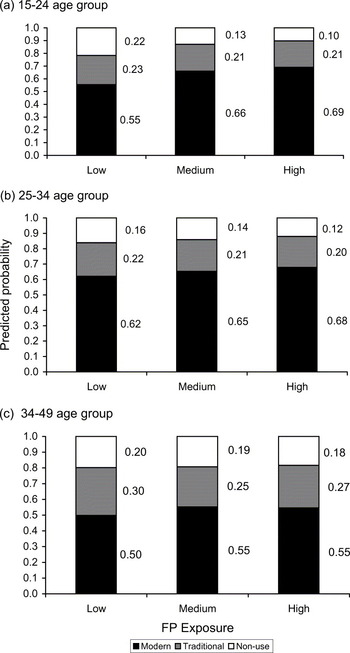
There is a significant interaction between age and family planning media exposure. Overall, older women are more likely to use traditional methods than younger women, for all levels of exposure (Fig. 2). Although higher family planning media exposure is associated with greater modern method use, this effect attenuates with increasing age. For the 15–24 year age group, the difference between the highest and lowest media exposure is 14% points, but for the 35–49 year group this difference is only 5% points. The reverse effect is seen for non-use, with a large fall in the probability of non-use associated with higher family planning media exposure in the youngest age group, but less for older ages.
Predicted probabilities of contraceptive method use by family planning media exposure and age groups.

There is a greater probability of traditional method use among women who do not know how to avoid AIDS and who have never heard of AIDS, but these effects are not significant (Table 3). However, AIDS awareness does have a significant effect on non-use. Women who have not heard of AIDS are significantly more likely to be non-users. Women who are aware of how to prevent AIDS have the highest probability of modern method use (Table 4). These results are consistent with the hypothesized association between AIDS awareness and greater modern method use and highlight that low awareness is associated with a greater risk of AIDS transmission due to non-use. Since not all modern methods offer protection against HIV/AIDS, further analysis was conducted with condom as a separate response category (results not shown). As expected, greater AIDS awareness was found to be significantly associated with a higher probability of condom use. It should be stressed that the probability of condom use was found to be very low: 6% for women aware of AIDS and less than 1% for women who have not heard of it.
Women who had one or more induced abortions are significantly less likely to be non-users; instead they are significantly more likely to use a modern method. The magnitude of this effect is small, however: compared with a baseline woman (no abortions), the increase in modern method use due to 1 or 2 or more abortions amounts to only 6% and 4% points respectively. Although the effects are not significant, the probability of traditional method use is about 30% for women regardless of abortion experience, suggesting that abortion is not sufficient motivation to abandon traditional contraception for a more effective method.
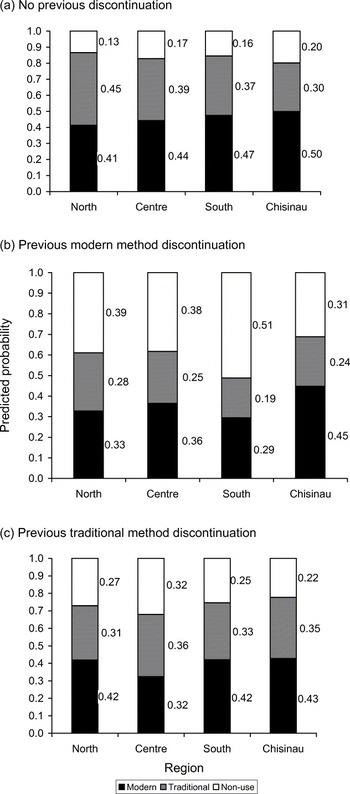
The results show that the effect of previous discontinuation depends on regions of residence due to a significant interaction. For all regions outside of Chisinau, the probability of traditional method use is highest among women who reported no discontinuation, contrary to the results of Goldburg & Toros (Reference Goldburg and Toros1994) and Kost (Reference Kost1993). Regardless of region, women reporting any discontinuation have a high probability of non-use. This indicates that the majority of contraceptive discontinuation is followed by non-use, rather than method switching. This effect varies by region, however, with the probability of non-use being 8%, 7% and 20% points higher in the North, Centre and South regions compared with Chisinau. This is indicates that abandonment is highest in the regions outside the capital. For women who have discontinued a traditional method, the probability of modern method use is slightly lower in the North and South regions and especially in the Centre region compared with Chisinau (Fig. 3). This indicates that modern method use following a traditional method discontinuation is less common outside of Chisinau. The probability of traditional method use given a previous modern method discontinuation is low in all regions, suggesting that switching from modern to traditional methods is rare.
Predicted probabilities of contraceptive method use by region and previous discontinuation.

With respect to other control variables, the probability of traditional or non-use is lower among younger women. These results are consistent with the findings of Westoff (Reference Westoff2005) and Robinson (Reference Robinson1996). Considering the effect of the number of living children, nulliparous women are most likely to use a traditional method. This is consistent with the findings of Magadi & Curtis (Reference Magadi and Curtis2003). There is also high traditional method use among women with three or more children, although this effect is not significant. Nulliparous and parity one women are considerably more likely to be non-users, suggesting that modern contraceptive use is concentrated among higher parity women. Those who have had a birth within the past year have a high probability of traditional method use (Table 4). This is attributed to the use of LAM. There is also a low propensity to use a modern method in the first year postpartum. Presumably women with a recent birth may not resume modern method use immediately postpartum, which explains the slow uptake of modern methods.
When compared with women with secondary education, those with higher education are less likely to use traditional methods. The estimated size of this effect is small and non-significant after controlling for asset wealth and residence. The effect of education is significant for non-use, perhaps indicating an increase in overall contraceptive use among women with high education; this finding is consistent with the findings of Robinson (Reference Robinson1996). Due to data sparsity, religion, however, was not significant in the final model. It was expected that religion would be a key determinant of contraceptive choice (Christopher, Reference Christopher2006). Ethnicity, which is associated with religious affiliation (χ 2=224.4 on 24 df, p<0.01), is significant in the final model, although the only significant category is the Bulgarians, who are more likely to use traditional methods compared with Moldovan women. As expected, women with a low risk of pregnancy (depending on their fecundity, sexual activity and marital status) have a lower probability of traditional method use, and higher probability of non-use. Women who want a birth within the next 2 years are substantially more likely to use no method, while traditional method and non-use are significantly higher among women who believe they are infecund.
Discussion and policy recommendations
This study presents a conceptual framework based on existing literature that forms the basis for testing the key research hypotheses. The analysis confirms the main hypothesis that economic disadvantage and spatial isolation increase traditional contraceptive method use. Although the analysis was unable to investigate the direct costs of contraception, the findings support the argument that poor and unstable economic conditions can deter women from using modern methods and compel them to use traditional methods. This finding is consistent with the Easterlin framework for contraceptive use (Easterlin, Reference Easterlin1979), and mirrors the outcome in many other former socialist countries, where prohibitive method costs limit modern method uptake (Serbanescu et al., Reference Serbanescu, Morris, Stupp and Stanescu1995; Johnson et al., Reference Johnson, Horga and Fajans2004). Considering the effect of indirect costs, traditional method use is greater among women in rural areas and those residing in areas outside the capital region, suggesting possible high opportunity costs in accessing a modern method. The evaluation of family planning programme effects indicates that higher family planning media exposure has only a marginal effect on traditional method use, but increases the probability of modern method use. This finding contrasts somewhat with outcomes in other post-socialist republics, where increases in family planning awareness had little influence on modern method uptake (Carlson & Lamb, Reference Carlson and Lamb2003). However, this impact is observed only at younger ages, and the effect attenuates with age. Knowledge of HIV/AIDS has no effect on traditional method choice, as expected, but has a positive effect on modern method use, though condom use is extremely low. Indeed, the low prevalence of condom use in Moldova precludes the specification of barrier contraceptives as a separate method type, limiting the analysis to the broader category of ‘modern methods’. Family planning programmes designed to encourage women to switch from traditional to modern methods have some success, although the effect is considerably reduced in regions outside of Chisinau. Previous induced abortion experiences do not influence traditional method use, but reduce non-use and increases modern method use. This suggests that abortion alone is not sufficient to motivate women to discontinue traditional methods in favour of modern methods. Traditional method use is greater among older, nulliparous and high-parity women. As expected, women who had a birth within the last year are significantly more likely to use a traditional method. The results show an influence of contraceptive networks on method choice, consistent with the findings of Kohler et al. (Reference Pariani, Heer and Van Arsdol2002) and Montgomery & Casterline (Reference Montgomery and Casterline1996), who identified the importance of peer networks on choice of contraceptive method. Furthermore, this study shows that the correlates of traditional method use are different from those of non-use. The present analyses identified network effects but, due to lack of community-level data, could not explore further the nature of these networks (i.e. if sparse or dense, Kohler et al., Reference Pariani, Heer and Van Arsdol2002) or the exact interaction between the individual and her peer network.
The policy implications of these results are wide-ranging. Efforts directed towards the poorest – for example potential contraceptive subsidies – may have limited impact in increasing modern method use due to the small effect of economic wealth. Interventions targeted at, and designed for, older women could increase modern method use and reduce the burden of unwanted pregnancies and induced abortions, since these women are unresponsive to existing efforts (Agajanian, 2002; Westoff, Reference Westoff2005, Reference Westoff2000). This could be best achieved by integrating family planning media with existing services used by older women, for example maternity or abortion services, and by improving access to family planning counselling services, which are currently neglected (Comendant, 2005). Despite efforts in the NPRH to increase the use of modern methods post-abortion, this analysis found only a limited increase in the propensity to use modern methods for women with abortion experience. Interventions such as those highlighted by Comendant (2005), which facilitate both post-abortion and FP/RH counselling, are therefore vital to improving the interaction between women and service providers.
The results indicate that there is some effect of isolation from services that increases reliance on traditional contraception. Although the NPRH has attempted to improve provision in communities through the primary health care network, a lack of availability of modern contraception clearly persists, limiting the potential for switching from traditional to modern methods in these regions. This is an intervention point for future FP/RH programmes aimed at improving the coverage of contraceptive provision in rural areas and regions outside Chisinau.
Finally, although NPAIDS has presumably contributed to increasing the uptake of modern contraceptives, about one in five women are unaware of either AIDS or its transmission routes. These women are significantly more likely to be non-users, and hence have no protection against HIV/AIDS. This analysis shows low probability of condom use in Moldova, even among women who have the highest awareness of AIDS, indicating that there is little impact of NPAIDS on their contraceptive choice. Thus NPAIDS needs to increase efforts to ensure that women at risk of HIV/AIDS receive adequate information to protect themselves from infections, and that information is sufficiently translated into behavioural change.
Acknowledgments
The authors thank the UK Economic and Social Research Council for providing financial support (PTA-031-2006-00188) and two anonymous referees for providing invaluable comments and suggestions.