Flaxseed hull, a co-product obtained from flax processing, is a rich source of plant lignans (Côrtes et al. Reference Côrtes, Gagnon, Benchaar, Da Silva, Santos and Petit2008), which are strong antioxidants (Kitts et al. Reference Kitts, Yuan, Wijewickreme and Thompson1999). Flaxseed hulls contain 29·4% ether extract and most of it is digested in the rumen as shown by higher digestibility of ether extract when hulls are administered in the rumen than when they are administered in the abomasum (Kazama et al. Reference Kazama, Côrtes, da Silva, Gagnon, Benchaar, Zeoula, Santos and Petit2010). However, although flaxseed hulls are a rich source of n−3 FA (Petit et al. Reference Petit, Côrtes, Da Silva, Kazama, Gagnon, Benchaar, Dos Santos and Zeoula2009), there is no information on the effect of flaxseed hull supplementation on digestibility of fatty acids.
Monensin has been shown to increase concentration of conjugated linoleic acid (Bell et al. Reference Bell, Griinari and Kennelly2006; da Silva-Kazama et al. 2011) and to decrease those of saturated FA in milk fat of dairy cows. Although a combination of monensin and flaxseed hull supplementation may contribute to modify milk composition for better human health as shown by Silva-Kazama et al. (2011) there is no information on the effect of feeding both monensin and flaxseed hulls on digestibility of fatty acids and nutrients. Therefore, the main objective of the experiment was to determine the effect of feeding diets supplemented or not with monensin and flaxseed hulls on total apparent tract digestibility of FA and nutrients.
Materials and Methods
Cows and diets
The present study is part of a larger project with results on milk production, milk composition and concentration of the mammalian lignan enterolactone in the rumen and milk reported elsewhere (Petit et al. Reference Petit, Côrtes, Da Silva, Kazama, Gagnon, Benchaar, Dos Santos and Zeoula2009). Results on ruminal fermentation characteristics and fatty acid profile of milk fat and rumen fluid from the same study also are reported elsewhere (da Silva-Kazama et al. 2011). Four lactating multiparous Holstein cows fitted with ruminal cannulas (10 cm, Bar Diamond Inc., Parma, ID, USA) averaging 665±21 kg of body weight and 190±5 days in milk at the beginning of the experiment were used in the experiment. Cows were assigned to a 4×4 Latin square design balanced for residual effect to determine the effects of monensin and flaxseed hulls supplementation on intake and digestibility of fatty acids and apparent digestibility of the diet. The experimental diets consisted of four different total mixed diets (Petit et al. Reference Petit, Côrtes, Da Silva, Kazama, Gagnon, Benchaar, Dos Santos and Zeoula2009: Table 1) with a 2×2 factorial arrangement of treatments: (1) diet CO: control with neither flaxseed hulls nor monensin added; (2) diet FH containing 19·8 g flaxseed hulls/100 g dry matter (DM); (3) diet MO with 16 mg monensin/kg DM; (4) diet HM containing 19·8 g flaxseed hulls/100 g DM and 16 mg monensin/kg DM. Feeding management were as described by Petit et al. (Reference Petit, Côrtes, Da Silva, Kazama, Gagnon, Benchaar, Dos Santos and Zeoula2009). Cows were housed in tie stalls, fed individually for ad libitum intake (10% refusals) twice a day (0830 and 1530 h), and milked twice daily in their stalls at 0800 and 1900 h. The experimental protocol complied with the Guide to Care and Use of Experimental Animals of the Canadian Council on Animal Care (CCAC, 1993) and was approved by the local animal care committee.
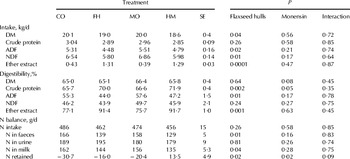
Intake and digestibility of nutrients and N output in faeces, urine and milk of Holstein cows fed total mixed diets with no flaxseed hulls and no monensin (CO), flaxseed hulls and no monensin (FH), no flaxseed hulls with monensin (MO) or a mixture of flaxseed hulls and monensin (HM)

Sampling
Each experimental period consisted of 28 d with 20 d of adaptation to the diets and 7 d of total faeces and urine collection. Samples of the total mixed diets were taken daily from d 22 to d 28 and pooled within period for each cow. All samples were frozen at −20°C for subsequent drying at 55°C. On d 20, cows were fitted with harnesses and tubes allowing the total collection of faeces and urine separately. From d 21 to 27, faeces were collected from a rubber mat placed behind the animals and stored in plastic containers. Daily faeces were weighed and mixed thoroughly and a 2%-subsample was taken and stored at −20°C for subsequent freeze drying. Total daily urine was collected in stainless steel containers via Gooch tube (BF Goodrich Co., Kitchener, ON, Canada) attached to the cow with a nylon netting covered with neoprene (Spall Bowan Ltd, Guelph, ON, Canada) affixed to the vulva. Urine was acidified daily with 100 ml 5 m-H2SO4. A 1%-daily subsample was taken and kept frozen until analysis. All samples were frozen at −20°C for subsequent drying at 55°C. Digestibility of nutrients and FA was calculated as the difference between intake and faecal output of the nutrient or FA, expressed as a percentage of the nutrient of FA intake.
Chemical analyses
Dry matter of the diets and faeces were determined in a forced-air oven according to the procedure 934·01 (AOAC, 1990). Total mixed diets and dried faeces were ground to pass a 1-mm screen in a Wiley mill before analyses of N, ether extract, acid detergent fibre (ADF), and neutral detergent fibre (NDF). Chemical analysis of diets and faeces was carried out using the procedures described by Côrtes et al. (Reference Côrtes, da Silva-Kazama, Kazama, Gagnon, Benchaar, Santos, Zeoula and Petit2010). In situ transesterification of FA was performed on diets and faeces according to Park & Goins (Reference Park and Goins1994). Individual FA were identified as described by Côrtes et al. (Reference Côrtes, da Silva-Kazama, Kazama, Gagnon, Benchaar, Santos, Zeoula and Petit2010). Separations of all FA were obtained with a single chromatographic run.
Statistical analysis
All results were analyzed using the MIXED procedure of SAS (2000) within a 2×2 factorial arrangement of treatments. Data were analyzed using a 4×4 Latin square design with the following general model:

where: Y ijkl=the dependent variable, μ=overall mean, C i=random effect of cow (i=1 to 4), P j=fixed effect of period (k=1 to 4), T k=fixed effect of treatment (k=1 to 4), and e ijk=random residual error. Treatments were compared to provide factorial contrasts: (1) with versus without monensin, (2) with versus without flaxseed hulls, and (3) the interaction between monensin and flaxseed hulls. The residual effect was initially included in the model but was removed when it was not significant. Results are reported as least squares means. Significance was declared at P⩽0·05 and a trend at 0·05<P⩽0·10.
Results and Discussion
Feed composition and consumption
Results of the chemical composition of diets and dry matter intake have already been published (Petit et al. Reference Petit, Côrtes, Da Silva, Kazama, Gagnon, Benchaar, Dos Santos and Zeoula2009). Briefly, chemical composition was similar among diets although ether extract (i.e., crude fat) concentration was greater for FH and HM (6·9 and 6·9%) than for CO and MO (2·1 and 2·0%) as expected as a result of high fat concentration in flaxseed hulls. Proportions of saturated FA were lower for diets containing flaxseed hulls. Proportions of cis9,12–18:2 FA were higher for CO and MO than for FH and HM. On the other hand, proportions of cis9,12,15–18:3 were lower for CO and MO than for FH and HM due to the high supply of n−3 FA provided by flaxseed hulls. Intake of DM was higher for CO and MO diets (20·1 and 20·0 kg/d, respectively) than for FH and HM diets (19·0 and 18·6 kg/d, respectively) and monensin had no effect.
Intake, digestibility and N balance
There was no significant interaction between flaxseed hulls and monensin supplementation for intake, diet digestibility and N balance (Table 1). Intake of DM, crude protein, ADF and NDF was higher for CO and MO than for FH and HM while the opposite effect was observed for intake of ether extract (Table 1). Supplementation with flaxseed hulls had no effect on total tract apparent digestibility (henceforth called digestibility) of DM but monensin tended to increase it (P=0·08; Table 1). Diets containing flaxseed hulls (FH and HM) presented higher digestibility of crude protein and monensin increased digestibility of crude protein compared with the control diet. Earlier studies showed inconsistent effects of monensin on digestibility of N in dairy cows. For example, Plaizier et al. (Reference Plaizier, Martin, Duffield, Bagg, Dick and McBride2000) reported an increase in digestibility of N when early lactating dairy cows were fed monensin in the post-calving period while Ali-Haimoud et al. (Reference Ali-Haimoud, Vernay, Bayourthe and Moncoulon1995) observed no effect of monensin on N digestibility in lactating dairy cows. Discrepancies between studies could partly be due to differences in diet composition and monensin concentration in diets. According to Plaizier et al. (Reference Plaizier, Martin, Duffield, Bagg, Dick and McBride2000), monensin administration increases N digestibility in cows fed high concentrate diets while it has no effect in those fed high forage diets. Diets used in the present experiment contained approximately 57% concentrate (Petit et al. Reference Petit, Côrtes, Da Silva, Kazama, Gagnon, Benchaar, Dos Santos and Zeoula2009), which would corroborate that hypothesis.
Digestibility of ADF was higher for CO and MO diets than for FH and HM diets (Table 1). Diets containing whole flaxseed have usually lower ADF digestibility than those without flaxseed (Petit, Reference Petit2002; Petit et al. Reference Petit, Ivan and Mir2005). Supplementation with flaxseed hulls and/or monensin had no effect on digestibility of NDF. Digestibility of ADF and NDF were not affected by monensin supplementation. This would agree with the results of Plaizier et al. (Reference Plaizier, Martin, Duffield, Bagg, Dick and McBride2000) who reported that monensin increased digestibility of NDF and ADF in cows fed high forage diets while there was no effect on fibre digestion in cows fed high concentrate diets as observed in the present study.
Significant lower digestibility of ether extract was observed for treatments without flaxseed hulls compared with treatments with flaxseed hulls (Table 1). Supplementation with fat sources has been reported to augment fat digestibility due to dilution of highly digestible fats in the diets by the contributions of poorly digested lipids other than FA (Garcia-Bojalil et al. Reference Garcia-Bojalil, Staples, Risco, Savio and Thatcher1998). Compared with the diets with flaxseed hulls, those without flaxseed hulls contained more saturated FA, which are less digestible than unsaturated FA (Byers & Schelling, Reference Byers, Schelling and Church1993), such as those present in flaxseed.
Nitrogen balance, expressed in grams per day, is presented in Table 1. Intake and output of N in urine were similar among treatments. Output of N in faeces was significantly greater for cows fed CO and MO compared with those fed FH and HM as a result of lower digestibility of crude protein for cows fed the former diets. Output of N in milk was lower for cows fed FH and HM compared with those fed CO and MO. Retention of N tended to be higher (P=0·09) for cows supplemented with both flaxseed hulls and monensin, which may be a result of the positive effects of feeding monensin and flaxseed hulls on crude protein digestibility. Monensin premix supplementation has increased N retention in post-calving cows, but not in precalving cows (Plaizier et al. Reference Plaizier, Martin, Duffield, Bagg, Dick and McBride2000). The increased N retention has usually been explained by improved N digestibility (Tedeschi et al. Reference Tedeschi, Fox and Tylutki2003) as observed in the present experiment.
Intake of fatty acids
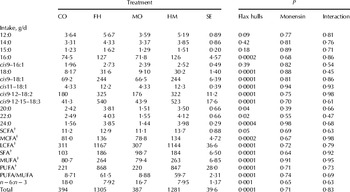
There were no significant interactions between flaxseed hulls and monensin supplementation for intake of individual FA and monensin had no effect (Table 2). Although DM intake was lower for cows supplemented with flaxseed hulls, intakes of 12:0, 16:0, 18:0, cis9–18:1, cis9,12–18:2, cis9,12,15–18:3, 20:0, 22:0, 24:0, total short-chain, medium-chain, long-chain, saturated, monunsaturated, and polyunsaturated FA were significantly higher for treatments with flaxseed hull as a result of higher intake of ether extract from the flaxseed hulls based diets (Table 2). Moreover, the n−6:n−3 ratio was decreased significantly by flaxseed hull supplementation as a result of higher concentration of n−3 FA in flaxseed hulls than in other feed ingredients.
Intake of selected fatty acids of Holstein cows fed total mixed diets with no flaxseed hulls and no monensin (CO), flaxseed hulls and no monensin (FH), no flaxseed hulls with monensin (MO) or a mixture of flaxseed hulls and monensin (HM)

† SCFA=short-chain fatty acids (4:0+6:0+12:0, cis11–12:1+cis12–13:1); MCFA=medium-chain fatty acids (14:0+15:0+16:0+cis9–16:1); LCFA=long-chain fatty acids (17:0+18:0+cis9–18:1+cis11–18:1+cis9,12–18:2+cis9,12,15–18:3+20:0+cis11–20:1+cis11,14–20:2+22:0+24:0); SFA=saturated fatty acids (4:0+6:0+12:0+14:0+16:0+17:0+18:0+20:0+22:0+24:0); MUFA=monounsaturated fatty acids (cis11–12:1+cis12–13:1+cis9–16:1+cis9–18:1+cis11–18:1+cis11–20:1); PUFA=polyunsaturated fatty acids (cis9,12–18:2+cis9,12,15–18:3+cis11,14–20:2)
Digestibility of fatty acids
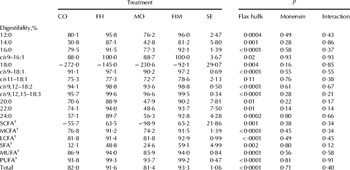
There was no interaction between flaxseed hulls and monensin supplementation for digestibility of FA and monensin had no effect (Table 3). Digestibilities of 12:0, 14:0, 16:0, cis9–16:1, cis9–18:1, cis9,12–18:2, cis9,12,15–18:3, 20:0, 22:0, and 24:0 were significantly greater for cows supplemented with flaxseed hulls (Table 3), which would agree with the greater ether extract digestibility for the flaxseed hull supplemented diets (Table 1). Digestibility of 18:0 was negative for all treatments and digestibility of total short-chain FA was negative for CO and MO. In the present experiment, all four diets were high in concentrations of C18:2 and C18:3 (Petit et al. Reference Petit, Côrtes, Da Silva, Kazama, Gagnon, Benchaar, Dos Santos and Zeoula2009) and it is known that the input to the intestinal pool of short-chain FA and 18:0 is of dietary origin or results from the extensive ruminal biohydrogenation of dietary polyunsaturated FA (Kalscheur et al. Reference Kalscheur, Teter, Piperova and Erdman1997). Therefore, ruminal biohydrogenation of these FA would have increased their concentrations in the faeces, thus leading to negative digestibility values for 18:0 as previously reported by Romo et al. (Reference Romo, Erdman, Teter, Sampugna and Casper2000). Fatty acid digestibility increased with the degree of unsaturation (PUFA>MUFA>SFA). Similarly, Doreau & Ferlay (Reference Doreau and Ferlay1994) reported that digestibility of 18 carbon FA was greater for acids with one or two double bounds.
Digestibility of selected fatty acids of Holstein cows fed total mixed diets with no flaxseed hulls and no monensin (CO), flaxseed hulls and no monensin (FH), no flaxseed hulls with monensin (MO) or a mixture of flaxseed hulls and monensin (HM)

† SCFA=short-chain fatty acids (4:0+6:0+12:0, cis11–12:1+cis12–13:1); MCFA=medium-chain fatty acids (14:0+15:0+16:0+cis9–16:1); LCFA=long-chain fatty acids (17:0+18:0+cis9–18:1+cis11–18:1+cis9,12–18:2+cis9,12,15–18:3+20:0+cis11–20:1+cis11,14–20:2+22:0+24:0); SFA=saturated fatty acids (4:0+6:0+12:0+14:0+16:0+17:0+18:0+20:0+22:0+24:0); MUFA=monounsaturated fatty acids (cis11–12:1+cis12–13:1+cis9–16:1+cis9–18:1+cis11–18:1+cis11–20:1); PUFA=polyunsaturated fatty acids (cis9,12–18:2+cis9,12,15–18:3+cis11,14–20:2)
In conclusion, the effects of feeding 19·8% flaxseed hulls in the diet on digestibility of nutrients and fatty acids were more pronounced than those of monensin supplemented at 16 g/kg DM. Flaxseed hull supplementation increased digestibility of crude protein and ether extract but decreased that of fibre while monensin increased crude protein digestibility. Fatty acid digestibility was increased by supplementing 19·8% flaxseed hulls in the diet and there was no increase in digestibility of fatty acids when supplementing monensin at 16 g/kg of dry matter.