Just as bodies are inscribed with greater and lesser degrees of perceived power on the basis of race and ethnicity, age gender and (dis)ability, so the value of knowledge from the body reflects the social power associated with the individual: more powerful individuals define what knowledge is accepted and embodied by social institutions (Tangenberg & Kemp, Reference Tangenberg and Kemp2002, p. 15).
In general, the body has been absent, or at best, on the periphery of social work practitioners’ and academics’ professional interest. While the emergence of relational, body-oriented and brain-based approaches (e.g., Ogden, Minton, & Pain, Reference Ogden, Minton and Pain2006; Ruch, Reference Ruch2012; Siegel, Reference Siegel2010; van der Kolk, Reference van der Kolk2014) have gained attention in the wider human service sector, there remains little in the social work or the wider human services literature that encourages, supports or challenges the exploration of social constructions and/or individual understandings of the impact of the body in and/or on practice. As a social worker with both practice and academic experience, and as a long-term yoga practitioner, I have
found it surprising that there has not been more formal discussion had about how embodied practices like yoga can facilitate practitioners’ abilities to navigate their own somatic maps as they interact with others and as a way to build their personal resilience (Mensinga, Reference Mensinga2011). Although mindfulness practices have gained recognition in recent years (e.g., Lynn & Mensinga, Reference Lynn and Mensinga2015; Northcut & Strauss, Reference Northcut and Strauss2014) and neuroscience has highlighted the importance of exploring the body when working with traumatised individuals (van der Kolk, Reference van der Kolk2014), social work continues to lag behind in having professional discussions about how to better understand and include the body to meet its agenda. As a researcher, I am interested in why social workers and human service workers seem reluctant to discuss the impact of their own visceral experience on their professional practice and have sought to explore this both informally (with colleagues and students) and formally as part of my research.
Little Acknowledgment of the Body in the Professional Conversation
Tangenberg and Kemp (Reference Tangenberg and Kemp2002) contend that although the body plays an important role in social work practice, for example, acknowledging body language when talking to clients, ‘little attention is given to issues of the body that transcend actual physical states, including social constructions of the body, mind and body relationships, and the role of power in determining how bodily knowledge and experience are defined, interpreted, and managed’ (p.15). They argue that body experiences of clients and how they are interpreted, both cognitively and emotionally, are at the core of social work practice and should be included and valued in practice. Similarly, although some years previously, Saleebey (Reference Saleebey1992) and Peile (Reference Peile1998) maintain that including and attending to rich descriptions of social workers’ embodied experience is needed to capture the sensual nature of the profession and to provide an additional dimension of experience when critically reflecting on practice. More recently, Ferguson (Reference Ferguson2011) also makes the observation that the way that social work practice is written and talked about ‘fails to capture the texture, feel, the lived experiences of where the work goes on and how this impacts on perception and what does (and does not) get done’ (p.3). While Ferguson himself has begun to address this by contributing rich descriptions of the somatic experiences of workers in the child protection sector (e.g., Ferguson, Reference Ferguson2010; Reference Ferguson2011), there remain few accounts and little encouragement to engage in and deliver the rich accounts that have been suggested.
Cameron and McDermott (Reference Cameron and McDermott2007) believe that the lack of literature exploring the role of the body (of which the brain is integral) in social work is largely due to (a) difficulties in defining what it is; (b) the recognition that many injustices have been perpetuated on the basis of body characteristics such as gender, race and or genes, and; (c) the reductionist nature of the biological sciences. Bell (Reference Bell2012) goes further and argues that it is due to the profession's philosophical underpinnings that the cognitive mind is given preference at the expense of somatic experience. She maintains that social work's acceptance of a positivist biomedical discourse in which the mind and body are separated is what has ultimately reinforced oppressive power relationships. Bell (Reference Bell2012) challenges the profession to adopt a post-conventional paradigm in which ‘people are reconceptualised as corporeal, biological bodies engaged in constant interrelationships and connections with others’ (p.419) and makes the case that while it is paramount that the embodied experiences of clients be sought to restore their ‘epistemic agency’, it is also necessary that the social worker's experience be taken into account.
Exploring the Body in a Research Conversation
In 2008, I began a PhD project that explored conversations I had with participants about: How they incorporated the body into their professional practice; what meaning they made of their own bodies, and; if they thought engaging in an embodied practice like yoga could benefit workers. In the project, I used a narrative methodology (Frank, Reference Frank, Holstein and Gubrium2012; Tamboukou, Reference Tamboukou, Livholts and Tamboukou2015) to both collect and guide the analysis of the stories told by the participants. Because I also had an interest in what strategies and power structures supported or discouraged storytellers’ experiences of the body, I adopted Bell's (Reference Bell2012) post-conventional lens through which to explore the participants’ narratives. In doing so, I aimed to ‘thicken the stories’ (White, Reference White1997) told about how the human service workers used their own bodies as a source of knowledge and/or as an intervention strategy both in the ‘private’ conversations they had during professional supervision and those had in the larger organisational and professional spaces in which they worked.
In this paper, I explore one of many stories told by Coral who was employed as a team leader in a domestic violence centre in a regional centre in Queensland, Australia. She was one of the nine women (six who were qualified social workers, one psychologist, a certificated counsellor and she a trained human service worker) I interviewed over a period of 17 months during the period 2010–11. Coral was interviewed both as part of a focus group of five (who all worked in Queensland) that was convened on three occasions and one of six of the participants (who lived in a number of different places, including the USA) who were interviewed individually either once or on three occasions. She was the youngest of all the participants (34 when interviewed) with the others ranging in age from 46 to 69. Coral noted, prior to participating in the research, that she generally used the body as a source of knowledge and as an intervention tool and incorporated mindfulness and co-regulation as strategies when working with clients. Unlike other participants, Coral did not identify an embodied practice of her own, but stated she was familiar with the practice of yoga.
Coral's Stories Exploring the Body
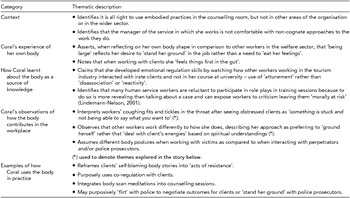
Coral told a large number of stories during the two focus groups and individual interview in which she participated. By way of a summary, and to contextualise the ‘story’ I have chosen to explore in this paper, Table 1 records a number of key thematic descriptors that emerged from Coral's stories to illustrate her overall appreciation of the body in practice. In general, Coral reveals a developed sense of awareness and purposeful use of her body in practice. This awareness not only extends to her work with clients, but is something that underpins her interactions with colleagues in the agency she is employed and with those in the wider sector, e.g., police prosecutors outside the court room. Coral also reveals that her understanding of her body as a source of knowledge and use as a professional tool was not something she learnt at university or through an embodied practice of her own, but rather from working in the tourism industry where ‘managing’ client reactions and regulating her own emotions was a necessary asset.
Key themes identified in Coral's stories.

‘No Coughing for me, But I'm Okay!’
The following story is taken from the individual interview I had with Coral in which she reflects on the different interpretations workers in the agency where she works have of their own body reactions when interacting with clients. In presenting this story, I use much of Coral's own words but, for ease of reading, I have ‘tidied’ the grammar and broken it into three sections using the headings: OBSERVATION, REFLECTION and CONCLUSION. While remaining still somewhat disjointed, in adopting this approach, I provide the story some chronological cohesion (Linde, Reference Linde1993) and highlight the critically reflective process in which Coral engages when exploring her own embodied experiences in the workplace (Peile, Reference Peile1998).
Observation
What I have noticed is that there are some other workers who work differently - and that's fine because we all work differently and everything works for different reasons - but some workers are really affected by that energy, and you know sometimes, even there have been workers who will find themselves coughing lots or going into coughing fits. Or they will get that tickle in their throat when they have got someone who has got an energy that is really draining, especially adult clients who have no hope and feel completely powerless and can't see a way out to navigate that or find one shred of hope. And it's interesting because there have been a couple of workers who do find that they do get choked up or they will have the coughing fit and have attributed that to the energy of the client. And I am left wondering if, I don't know whether it is I am too hard line or is it that other workers are more affected, but I just don't know why that is. Whether that is about supporting their own resilience or attending to their own self-care.
Reflection
Having said that, they are probably workers that I would consider, and I guess it's not that I am not spiritual because there are aspects of me that are spiritual, but I feel that perhaps I am a lot more connected to some of the aspects of . . . probably more connected in almost a yoga like way, when we talk about energies . . . . . . and that kind of stuff. And for me it's rare for anything like that to happen . . . So then I will kind of go ‘aww is that me?’ or ‘is that my problem? is it me?’ or is it that I tend to just soldier on because sometimes you just have to. I don't know whether that's personality or just you know where I come from, and I don't feel things. Like things don't weigh me down, I tend to kind of go ‘yeah let's go, that's fine’. So I think that's what gets me a little bit concerned whether I am empathic enough. But the feedback from my clients is always really positive. There is rapport there and warmth there, otherwise I don't think we would be having some of the conversations that we do end up having.
Conclusion
Me - So do you discuss bodies from that point of view, or body reactions or. . .
A little bit and I guess it's been more of a discussion where the other workers have gone ‘oh yes I dealt with that client’. I guess one of the examples was when a child counsellor spoke to a particular client and one of the other adult counsellors spoke to the same client and they both had that reaction to that client, and so they were kind of going ‘ohh, I know, the energy!’ and ‘rah, rah’, and I was kind of going ‘No coughing fit for me, but I'm ok!’. . . Um so I think it has probably come up in that . . . but I am glad that it is a safe enough workplace that people can do that and they can feel comfortable talking about it and doing those things and don't feel too awkward . . . although they might feel a little bit awkward because of how the manager is because she is so like ‘you are doing what?’.
[Coral, 10/11/2011]
Exploring Coral's Body Story
In keeping with my interest in why social workers and human service workers are reluctant to discuss and/or draw on embodied knowledge in their professional practice, I will focus on the narrative strategies that Coral uses in telling her story in the remainder of this paper, rather than the themes that have already been identified. Frank (Reference Frank, Holstein and Gubrium2012, pp. 44–45), when describing his Dialogical Narrative Analysis approach, invites the researcher to first identify the available resources (such as character types, plotlines and genres) that the storyteller uses to tell their story and to then to consider if other narrative resources were available, whether different stories would be told and a change in people's perceptions emerge. He also encourages the researcher to ask a number of questions to identify any underlying power dynamics that may be inherent in the story and/or may have influenced the telling of the story. These questions include: ‘Who and/or who wouldn't understand the story?’; ‘Are there people this story couldn't be told to?’; ‘Are there those who, if they understood the story, would be excluded or accepted into a group?’; ‘How does the story teach people who they are or who they may become?’; and ‘How does the storyteller maintain his/her social standing/positioning telling the story in the way he/she did?’. It is these questions that I now turn to explore Coral's story.
1. Narrative resources
Although I chose the headings used to present Coral's story, they reveal what is a common story in the human services – a critically reflective account of a practice issue being explored with another professional, usually during supervision (Kadushin & Harkness, Reference Kadushin and Harkness2002). As is typical of this genre of professional storytelling, Coral begins by first describing what she has observed about her colleagues’ and her own embodied reactions to specific clients – specifically, those clients who feel powerless and have little hope for their future. Observing that she reacts differently to the other workers she initially wonders if she is not as empathic as she should be, but is then able to recall her own ability to connect with clients which then allows her to explore other possibilities as to why her colleagues’ embodied reactions may be different. During the reflection stage of her story, Coral turns to a discourse that is more prevalent in this agency, spirituality, to try to make sense of their reactions while attributing her own to a more yogic approach by which she chooses to use more embodied descriptors like ‘soldier on’ and ‘don't weigh me down’. Nonetheless, although her concluding story – ‘No coughing fit for me, but I'm ok!’ – is not something she shares with her colleagues, Coral indicates that she is encouraged that they feel safe enough to have these conversations in the agency and are willing to explore the impact of the work on their bodies – even if the manager may be somewhat derisive.
In adopting this genre of storytelling, Coral appears more at ease in discussing and exploring her own subjective experience of the body in the workplace. Moreover, creating space for new stories to be told is a process with which Coral is very familiar in the counselling room. As indicated in Table 1, Coral's other stories reveal that when she works with clients she helps them reframe their ‘self-blaming body stories’ into ‘stories of acts of resistance’. Although Coral is somewhat reluctant to explore her colleagues’ or manager's stories with them, seemingly because of the dominance of their stories in the work place, Coral does enter a process of re-storying her own experience. While initially feeling somewhat alienated by the spiritual discourse and underpinning managerialist accounts circulating in the agency, Coral reframes her own reaction of not coughing as an ‘act of resistance’ to the stories being told around her. In making the statement ‘No coughing fit for me, but I'm ok!’, Coral not only makes claim to her own embodied experience, but also highlights the importance of listening to her own body's voice to make sense of her practice approach.
2. Who can this story be told to and who would be accepted or prevented from being a ‘group member’ by understanding the story?
People's stories report their reality as they need to tell it, as well as reporting what they believe their listeners are prepared to hear (Frank, Reference Frank, Holstein and Gubrium2012, p. 38).
To whom Coral's story can be told has been partly addressed in the section above. However, although Coral is heartened by her colleagues’ discussion, she also suggests that talking about embodied experience remains a challenge without an accepted discourse and/or the ‘evidence’ to give the body entrance into the conversation (Gambrill, Reference Gambrill2006). For instance, while the dominant spiritual discourse in the agency enables her colleagues to make sense of their embodied reactions, it does not allow her to account for her own. Moreover, Coral appears loath to enter the discussions noting that she values more her colleagues’ feeling of safety to discuss their reactions. Although it is not entirely clear in this excerpt why Coral is reluctant to discuss her lack of reactivity to clients’ stories, working in an agency in which clients’ bodies are inevitably at risk may explain why she does not feel comfortable in doing so. While Coral feels safe enough to talk to me of her experience with me as a researcher with a particular interest in the body, it is likely that this story will not be shared by her with many other workers. As noted previously, Cameron and McDermott (Reference Cameron and McDermott2007) argue that the reasons social workers seem reluctant to explore the body is due in part to being unable to define the body and embodied experiences and because of injustices perpetuated in the name of particular body characteristics. On reflection, these issues indeed seem to underlie much of Coral's story of lived experience – an understanding that helps determine who she chooses to share her body stories with in order to secure her ‘membership’ in the agency.
3. How does the story teach people who they are, who they may become and how to maintain their social/professional standing while telling a body story?
Frank (Reference Frank, Holstein and Gubrium2012) suggests that much can be learnt about ‘being a particular identity’ by listening to underlying messages in the stories told by participants. Coral's story highlights well the challenges that human service workers face as they attempt to navigate their own somatic experiences and when trying to give their body voice in practice. She reveals that practitioners’ bodies are indeed impacted upon during their interactions with clients and that providing space to explore and create subjective meaning of these experiences is important to facilitate workers’ resilience and self-care. However, not surprisingly, Coral's story also suggests that the lens through which these experiences are explored determines how they are understood and whether they are taken seriously in the workplace. As noted in the previous section, using a ‘spiritual lens’ provided workers with a particular understanding of their experience while other discourses either facilitated or discredited individual worker's body stories. However, although Coral's story also teaches human service workers ways in which they can explore their embodied experiences in ways that will keep them both relatively safe and maintain their professional standing in the agency (Lindemann-Nelson, Reference Lindemann-Nelson2001), i.e., using a critically reflective genre of storytelling, Coral's story also reveals a lack of ‘evidence’ or credible storylines available to workers.
Shaw (Reference Shaw2004), in a study of how psychotherapists used their bodies in the counselling room, concluded that the body provided the therapist with much useful information through either of two ways – through the ‘body as receiver’ or as ‘body empathy’. The body as receiver was identified as a passive process in which the therapist's body picks up the felt experience of the client while in their vicinity, whereas body empathy was described as an active practice that invites the therapist to purposely acknowledge his/her own body experience as a result of participating in the session. Although both uses of the body are evident in Coral's story, Shaw states that the psychotherapists in his study suggest that rather than ignore them or discuss them away from the counselling room, they need to be shared with the client so that a mutually co-constructed story can be created to separate what is the client's experience from what belongs to the therapist. This, they suggest, is more likely to result in the client's needs being met rather than possibly subverted to those of the worker. Within the light of these findings, it could be suggested that a failure to acknowledge and explore the workers’ embodied feelings could lead to unsafe outcomes for the client.
Conclusion
Although there is little in the literature to support the telling of and listening to body stories told by workers in the human services sector, Coral's story reveals that there is much to learn from their exploration. Not only are workers’ bodies impacted upon by their own and their client's physical positioning (Trevithick, Reference Trevithick2012), but they are also affected by the stories they hear around them (both from clients and those circulating in the agency) and those they, themselves, tell. Creating a safe place for workers to explore embodied experiences is important to Coral, but her story also confirms that without an acceptable discourse or narrative template including the body in the professional conversation is difficult. While Coral demonstrates that adopting a critically reflective genre of storytelling to explore embodied experience may facilitate the body's inclusion, there are also few spaces for this type of story to be told. Nonetheless, given the opportunity, it appears that recognising the ‘body as subject’ in practice not only encourages better outcomes for clients (Shaw, Reference Shaw2004), but also provides much richer accounts of what it means to be a human service worker. This, in turn, encourages workers to facilitate their own self-care and to build personal resilience in the field.