In Wharfedale's farming community, as in many others, the auction mart was a space loaded with significance. Beyond its primary function as a location for business transactions, it effectively distilled and laid bare the social interactions of those who considered themselves the core element of the farming community: the farmers and labourers themselves. The mart site was physically, metaphorically, culturally and architecturally expressive of masculinity, segregation, identity and behavioural norms which starkly defined those who were in and those who were out. Furthermore, the particular atmosphere which surrounded the auction mart allowed these judgments to be made absolutely clear, in a way which would not be acceptable in another social situation. These qualities separated the attendees of the auction mart from the wider farming committee for a designated period of time each week, making them a community within a community.
The auction mart was, and still remains, a physical location to which livestock and other goods may be brought for sale on specified days. The auctioneers’ companies which run the sites often send out auctioneers and staff to run farm sales for private clients, for example at the close of a tenancy or following a significant change in agricultural focus. Cattle, sheep, pig, horse, fur and feather, and equipment or scrap sales take place on different days of the week, and the physical layout of the auction site often separates, for instance, dairy from beef cattle, finished cattle from stores, and adult animals from juveniles.Footnote 1 Marts in neighbouring towns tend to cooperate with one another when arranging sale schedules, so that it would be possible to visit different sales to buy the same variety of animal six days per week.
During the early twentieth century, however, Wharfedale farmers were well supplied with locations to buy and sell livestock in this unique and highly ritualised social setting. In Wharfedale, local farmers could buy and sell livestock at Knaresborough, Wetherby, Pannal, Otley or Skipton, and in Otley alone four separate sites have hosted auction marts, with at least two being active simultaneously throughout the twentieth century, until the closure of Otley Bridge End Auction Mart in 2000.
The closed nature of the mart communities and the perception of the mart sites as sanctuaries for insiders in the livestock farming community have preserved the cultural and behavioural norms and traditions into the present day. Access to the community makes available a space which exists almost as a time capsule, and in which even small actions are loaded with traditional meanings, derived from the multiple functionality of the mart site. As well as providing a location for the sale of animals, the auction mart offers a secure arena for financial transactions, and acts as a social hub for an often scattered and isolated community. The communities belonging to the auction marts are, geographically, far larger than the market town and its immediate surroundings, but insider status can only be maintained by rigorous adherence to a set of complex cultural norms. Long term, regular attendance, and up to date knowledge of personal gossip and price fluctuations are also necessary. In this way, the calendars of livestock farmers can often be dictated as much by the mart schedule as by the season.
The importance of the marts throughout the twentieth century can be seen in the popular culture of the farming community. In 1987, The Dalesman published a short collection of farming anecdotes and cartoons, including a story which has been repeated in a number of interviews and casual conversations. According to the story, a man's wife has died, and the family has met with the funeral director to make arrangements for the burial. After giving his condolences, the funeral director gently suggests a particular day might be suitable for the funeral. The family nod in agreement, but the widower pipes up, ‘No, that won't do!’ ‘Why not?’ he is asked. ‘Well,’ he replies, ‘It's auction day!’Footnote 2 Sometimes the wife and widower are replaced by a deceased father and his eldest son, but the events remain the same. In all versions, the dissenting speaker is male and the person who might be expected to have the greatest stake in the farm: the farmer who has to continue without his wife or the eldest son who must take over from his father. The story should perhaps not be taken literally, but the recurrent elements demonstrate the perception that mart attendance is so important to male members of the farming community that they would place it above their own grief.
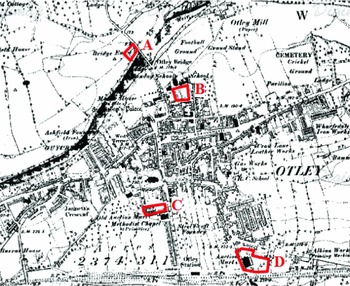
Locations of livestock markets in Otley. A: Bridge End Auction Mart, which took over from the Licks Cattle Market c. 1934, and ran until its closure in 2000. B: The Licks Cattle Market, purchased by the Otley Local Board in August 1880, and established as a cattle market by the mid-1880s, closing when its business transferred to Bridge End in the early 1930s. C: Otley Old Auction Mart on Station Road, established in 1874, and bought out by the Wharfedale Farmers’ Auction Mart in 1919. D: Wharfedale Farmers’ Auction Mart, the last surviving mart in Otley, established in 1893 and still operating today. Ordnance Survey County Series 1:10560, Yorkshire, 1st edition (1892), SE14, http://digimap.edina.ac.uk/ancientroam/historic, © Crown Copyright and Landmark Information Group Limited (2014). All rights reserved. (1892).

Lower Wharfedale
Lower Wharfedale, the location for this study, is situated on the border between North and West Yorkshire, in the rural area to the north of the industrial cities of Leeds and Bradford, but outside the Yorkshire Dales National Park. The extent of the study area was based loosely on the areas identified by two walking guides: Edmund Bogg's The Middle Valley of the Wharfe: From Woodhall Bridge to Harewood, Otley and Ilkley, and Fred Cobley's On Foot through Wharfedale: Descriptive and Historical Notes of the Towns and Villages of Upper and Lower Wharfedale. Footnote 3 These two books suggested a study area which stretches from Woodhall Bridge to Skipton. Across the valley, the study area covers the landscape between the little towns which are now being subsumed into the sprawl of Leeds and Bradford, and the villages in Nidderdale on the edge of the rougher moorland. This isolates a study area in which the landscape and farming styles are mostly of uniform type: small, tenanted farms, usually of less than 100 acres in the earlier part of the twentieth century, positioned on hilly and undulating, mostly rather rocky and stony ground, within close proximity to moorland suitable only for grazing sheep. Most farms were mixed, keeping mainly cattle and sheep, supplemented by small numbers of pigs and poultry, although a handful of farms specialised in these. Arable farming did occur here, and of course a lot of land was ploughed during wartime, but there is no comparison to the vast tracts of arable land further south.
The key source for the investigation of this area was oral history, with the personal networks exposed by the ‘snowball’ sampling technique confirming the cultural relevance of the geographical boundaries of the study area. ‘Snowball’ sampling relies on previously established connections, to accumulate interviewees by personal recommendation. This method has been used by oral historians such as Anna Bryson in her study of Maghera in Mid-Ulster, Rhoda Wilkie in her investigation into a Scottish farming community, and Maggie Morgan's work on the Women's Institute.Footnote 4 These interviews were supported by archived photographs and documents, personal photograph collections belonging to interviewees, and the findings of the National Farm Survey.
Literature, theory, and the mart
The auction mart has stimulated little historical or sociological literature in comparison to other aspects of twentieth-century rural life. Koenraad Kuiper and Douglas Haggo conducted a study into the ‘oral poetry’ of the auction mart in New Zealand, in which they analysed the specific language and speech patterns of livestock auctioneers. Rhoda Wilkie's Livestock/Deadstock (2010), an ethnographic study of agricultural workers in north-eastern Scotland, discusses the meaning of the livestock mart to modern farmers and explores the gendered culture which pertains to it.Footnote 5 The study investigates the importance of the mart to an agricultural community, and highlights that tradition kept it alive. Wilkie refers to Charles Smith's 1989 Auctions: The Social Construction of Value, which acknowledges that the auction as an entity is governed by ‘its own communal structures, rules, and practices, which determine everything from who can participate and the form of bidding to relationships among and between buyers and sellers and the role of the auctioneer’.Footnote 6 Aside from this, however, the majority of the literature relating to the auction mart approaches the subject from either an economic or a nostalgic point of view. For example, C. Zulehner's article, ‘Bidding Behaviour in Sequential Cattle Auctions’ (2009) focuses heavily on themes such as ‘the effects of the order of sale according to quality, secret reserve prices, bidders’ multi-unit demands and the characteristics of the bidders’ in auctions at Amstatten, in Austria.Footnote 7
Economists such as Paul Klemperer, Vijay Krishna and William Vickrey have written on the subject of ‘auction theory,’ which tackles the economic forces at work in both the ascending auction, such as the livestock mart, and in the first price sealed bid auction.Footnote 8 Ian Graham's doctoral thesis from the University of Edinburgh, to which Wilkie's work refers, addresses the rise of the electronic bidding system in order to question the wider understanding of the use of electronic commerce.Footnote 9 Similarly, an investigation into auction marts by J. Wright, T. Stephens, R. Wilson, and J. Smith produced ‘The Effect of Local Livestock Population Changes on Auction Market Viability – A Spatial Analysis’ (2002), which links economic questions with those of science and animal welfare.Footnote 10 At the opposite end of the spectrum lie articles like N. Farndale's ‘Going, Going, Gone?’ published in Country Life in 1995, which place the traditional auction mart in romantic countryside folklore, and simplify the complex social interactions and meanings which take place there. To Farndale:
The auctioneer's banter is as much a sound of the countryside as is the first cuckoo. His ability to read the minds and interpret the twitches and nods of craggy-faced buyers is as much a part of rural folklore as is the shepherd's delight of the red sky at dusk.Footnote 11
Writing in 1995, he describes the farmers who patronised the mart as ‘rubbing besmocked shoulders’ with one another.Footnote 12 The image of men in the final decade of the twentieth century wearing smocks, a garment which would have been outdated a century earlier, emphasises the distance between the mart of non-farming imagination and that of reality. This image, redolent of rural simplicity, also belies the complexity of social interactions in the mart environment. The multiple functions of the mart as a place of business, a social space, a crucible where male farming identity was formed and a sanctuary in which it was reinforced mean that it is high time that a number of theoretical aspects of auction mart culture are addressed.
This space is male dominated today, and was almost exclusively masculine during the early twentieth century. The theories surrounding masculinity are obviously deeply relevant to how male identities were moulded and expressed here, and to the questions about insider/outsider status which ran through almost every interaction within the farming community. As Joanna Bourke has shown in Dismembering the Male: Men's Bodies, Britain and the Great War (1996), the First World War prompted questions about the nature and meaning of masculinity.Footnote 13 Those who went to the Front had to face up to the idea that, simply by being male, the male body could apparently be maimed and sacrificed in a way which would not be socially acceptable for a female body. The soldier who was invalided home must deal with his new status as less than masculine, ‘the potent man rendered impotent’, and the man who stayed at home, while remaining physically fully masculine, was compared unfavourably to the ‘manly’ soldier.Footnote 14
Bourke's work is one of an increasing number to investigate the male body and the nature of masculinity in a historiography which has generally focused far more on the experience of the feminine. The twentieth-century surge in interest in the experience of life in the feminine private sphere was a backlash against the predominantly male, and therefore public, approach to history which had gone before. Aileen Kraditor explains that ‘strictly speaking, men have never had a “proper sphere,” since their sphere has been the world and all its activities’.Footnote 15 However, those men who have shaped the ‘world and all its activities’ have been few, and in focusing on revealing the hidden history of the experience of women, the embodied experience of the ordinary man became ignored. Lawrence D. Berg and Robyn Longhurst cite Gillian Rose's Feminism and Geography (1993) as the beginning of an explicit focus on masculinism and masculinity in feminist and gender geography, yet writing on men's health in 2000, Jonathan Watson could still note that, ‘what is striking is the absence of knowledge grounded in the everyday experiences of men themselves’.Footnote 16 This was also true in the case of the male body, in which the embodied experience of the privileged few was presented as representative of the whole, as historians studied the sports, public schools, and hunting expeditions of the élites which yielded the most evidence of nineteenth- and twentieth-century thought about the moulding of the male body.Footnote 17
Berg and Longhurst describe masculinity as ‘both temporally and geographically contingent’ and this absolutely applies to masculinity at the mart.Footnote 18 In this unique environment, as in wider culture at this time, masculinity was linked to the physical abilities of the male body. However, the mart also demanded a further dimension: knowledge about livestock, local people and the culture of the auction mart, and the skills to demonstrate this knowledge. The aspects discussed here came together to form a body of proof that a particular individual was deserving of trust, and could therefore take insider status and masculinity at the auction mart as part of their personal identity. Many studies of the nature and meaning of ‘community’ have identified the importance of trust and togetherness as bonding agents between people who imagine themselves to be in a ‘community’. Indeed, Gerard Delanty identifies trust as one of the essential features of modern society.Footnote 19 In her work on philosopher Walter Benjamin, Kia Lindroos describes ‘Benjaminian’ communities, which appear, ‘as human networks that are temporally redefinable according to the actual conditions of their existence, and they are especially dependent on the continuity of “tradition”’. Further, Lindroos identifies that despite discussing the ‘modern’ phenomenon of the scattered community, Benjamin leaves open the possibility that a feeling of ‘togetherness’, coupled with the mutual exchange of knowledge and information, can still constitute community.Footnote 20
The reliance on trust, and the exclusivity of insider status, means that the mart space is also highly ritualised, and those who become insiders must endure a period of transition, such as the three-stage process identified by Arnold Van Gennep in The Rites of Passage, and expanded upon by Victor Turner in The Ritual Process.Footnote 21 The three stages, separation, margin, and aggregation, can be observed in terms of both individuals entering the community and in the community coming into its own identity in the late nineteenth century.Footnote 22 This article will argue that the people who attended this event regularly formed a community within a community: a separate, masculine, highly ritualised congregation inside the boundaries of the Wharfedale farming community. This inner community relied even more heavily than the more general farming community on the precepts of the ‘Benjaminian Community’. They enjoyed a feeling of ‘togetherness’, temporal redefinability, shared knowledge and tradition. Through an exploration of the reasons auction marts were established, the skills on show there and their importance, initiation rites, the boundaries between insiders and outsiders, the rituals of membership and the consequences of not obeying cultural norms, it argues that the dangers of the auction mart, both physical and financial, distilled the themes of status, belonging, trust, and identity which run throughout Wharfedale's farming community to their most extreme forms.
Livestock, skill, and the establishment of auction mart space
Otley's first designated mart site was established on the Licks in the 1880s, following a meeting of the Otley Local Board, reported in the Ilkley Gazette thus:
Mr Greaves referred to cattle dealers making use of the streets for the exposure of cattle for sale. It appeared that dealers were opposed to the market being removed from the streets. Mr Greaves said that before the Board proceeded to lay out a great sum of money in fitting up a new cattle market, they should first consider whether they could compel the dealers to go there.Footnote 23
Specialised livestock markets were far from an innovation by the 1880s. The Smithfield Removal Act, which relocated live animals for sale from the streets of Smithfield in London to a dedicated site north of Islington, was passed in 1852, creating one of the largest and most iconic markets in the world.Footnote 24 The separation of the livestock market from the food and goods markets tended to be on the grounds of public health and public safety. In The Adventures of Oliver Twist, Charles Dickens describes Smithfield:
It was market-morning. The ground was covered, nearly ankle-deep, with filth and mire; and a thick steam, perpetually rising from the reeking bodies of the cattle. . . the whistling of drovers, the barking of dogs, the bellowing and plunging of oxen, the bleating of sheep, the grunting and squeaking of pigs; the cries of hawkers, the shouts, oaths, and quarrelling on all sides; the ringing of bells and roar of voices, that issued from every public house; the crowding, pushing, driving, beating, whooping and yelling; the hideous and discordant din.Footnote 25
These problems of manure, smells, noise, danger from loose animals, and inconvenience for the local populace, would be common, albeit on a smaller scale, to every location where cattle were sold in the streets. Non-specialised premises, such as the three acre open square with makeshift pens at Smithfield, or the winding streets of Otley, created problems for the men charged with handling the animals. Judith Flanders, in her detailed reconstruction of Dickens’ London, describes the way that the overcrowded and disorganised space resulted in cruelty, as animals were beaten, forcing them to stand closer together, and ‘hocked’, beaten on the hind legs until they found it too painful to walk away.Footnote 26 Animals tired from their walk to the market, in pain and under extreme stress, with no proper facilities to contain them, were likely to get loose and cause chaos. Dickens, in Dombey and Son and his own diaries, describes the cries of ‘Mad bull! Mad bull!’ and the screams and general pandemonium as people scrambled and fought one another to reach safety.Footnote 27
Despite the far smaller size of Otley's market, some of Smithfield's problems were echoed here. In 1885, the Wharfedale and Aireborough Observer reported:
The cattle nuisance in the Otley streets has about reached its culminating point just as the Local Board has obtained its power to remedy it. On Easter Wednesday, the public thoroughfares were literally impassable, and I hope the Board will now adopt vigorous measures for speedily removing the intolerable nuisances. Last Friday there was a complete block at Robinson's corner; three carriages had to stand still for some time until the drovers cleared a road through the herd of cattle, and that operation was not performed without the use of such language as should not have been heard by the occupants of the conveyances.Footnote 28
The solution to these problems was the establishment of the mart on the area of Otley known as The Licks. This appears originally to have been a public selling area, based on bartering and haggling, rather than an organised mart system with auctioneers. This is supported by the fact that a small formal mart with a sale ring had been built on Station Road in 1874.Footnote 29 The informal nature of the selling on the Licks is also supported by the lack of archival sources beyond a few photographs. Furthermore, the Ordnance Survey map of Otley from the 1890s, on which three separate spaces for selling livestock are marked, designated Otley Old Auction Mart and the Wharfedale Farmers’ Auction Mart as ‘Auction Mart’, while the Licks is simply marked ‘Cattle Market’, indicating a subtle difference in the way the spaces were used.Footnote 30
This is Otley's first recorded instance of physical separation between those who were involved in agricultural business in the town, and those who were not, and as such may be viewed as deeply symbolic of the function the marts were to perform in future years. Crucially, it also removed the livestock and the men who handled the beasts from the space occupied by the rest of the local community, and sequestered them away to a more private spot, where the animals would be controlled with high metal fences. The effect of this was to emphasise the inherent danger in handling large animals, and, as a corollary to this, the skill of the men who did it. This shift was an echo of that which occurred across a much wider geography in the late nineteenth and early twentieth centuries, and can be seen in the way the authors of contemporary rural fiction envision the landscapes and spaces their characters inhabit. Florence Bone, in The Furrow on the Hill describes:
It was market-day, and all the cobbled street was full of carts and stalls and farmers, who were all talking at once in a babel of broad Yorkshire about barley and oats, and sheep and pigs, and all the other things that belong to market-day in the country.Footnote 31
In this tale, published, tellingly, by the Religious Tract Society, the Christian values of a highly traditional and somewhat sentimentalised rural Yorkshire village are contrasted with the starkly differing world of non-Christian India. Bone uses this very agriculturally centred image of a small market town to suggest ideas of home, safety, and a comfortable belonging, which cast her protagonist's experiences in India in an exaggeratedly alien light. It is striking, therefore, that a slightly nostalgic conjuring of ‘home’ in the earliest decades of the twentieth century should include such a high level of intermingling between agricultural and non-agricultural people.
In striking contrast to this are Ted and Betty Haxby's recollections of the market on the Licks in Otley during their childhood in the 1930s:
Mr Haxby: I never went to the auction, you know. I mean -
Mrs Haxby: You didn’t, then, did you?
Mr Haxby: - they didn't allow – Well if you did you’d probably get chased out anyway, unless you knew somebody.Footnote 32
This presents a very different image of the market day, in which the market, removed from the streets, has become a closed space, into which non-agricultural people were no longer welcomed. To the majority of the increasingly urban population, the sights and sounds of the farmers buying and selling were no longer associated with ‘home’. Kuiper and Haggo, in their linguistic exploration of auctioneers’ patter, noted that we cannot know how long the particular speech patterns of auctioneers today have been present, although they described the auctioneer as ‘heir to an oral tradition’.Footnote 33 However, the way the auctioneer uses ‘tone-units’, or ‘chunks’ of words, coincides both with monetary units and with ‘breath groups’, while the famous repetitive patterns are a reaction to the heavy demands of the job on the short-term memory.Footnote 34 They further add that, ‘auction speech sounds terribly fast to lay people [due to] its unfamiliarity. If they do not know the kinds of things that auctioneers say, they cannot follow what is being said.’Footnote 35 The mart was a separate space with its own vocabulary, the understanding of which emphasised insider status.
By 1906, H. Rider Haggard, in his tour of rural England, could write: ‘Otley, by the way, possesses two excellent auction marts, with weekly sales, at which are disposed of almost all the stock reared in the district’.Footnote 36 He also noted that the method of farming used to produce this stock, ‘seems well suited to the locality, and new comers who attempt other fashions usually fail or fall into line with the local custom’.Footnote 37 From the beginning, therefore, the business of attending the marts in Otley was associated with skill and livestock knowledge. The establishment of the market on the Licks signified a separation between those who could handle livestock, and those who could not; between those who accepted the use of ‘such language as should not have been heard’ by those in the carriages at Robinson's corner as a natural part of working with cattle, and those who did not; and between those who believed that the selling of cattle was important enough to take over the town centre, and those who disagreed. The physical embodiment of separation in the walls which encircled the marts was echoed in the cultural norms which sprang up to differentiate between ‘us’ and ‘them’. This created the sense of ‘togetherness’ which Kia Lindroos identified as one of the central tenets of the ‘Benjaminian’ community model, and crafted the conditions in which knowledge could be shared privately among proven insiders only.
Additionally, van Gennep's three stages of transition can be seen here, experienced by the mart community as a whole. Turner describes phase one as comprising ‘symbolic behaviour signifying the detachment of the individual or group either from an earlier fixed point in the social structure, from a set of cultural conditions (a “state”), or from both’.Footnote 38 For the mart community, this phase was a long one, shown in the fading of the cattle market from fictional and popular representations of ‘home’, and an increasing public disgust at livestock and their attendant dirt, noise and smells in the streets. The way in which non-farmers referred to the farmers and cattle-dealers as a group entirely separate from themselves in conversation at meetings, which would be reported and read by the wider public, indicates the construction of an imaginary boundary. The verbal ousting of the stockmen from evocations of ‘us’ in the town, therefore, is symbolic of the impending transition. Phase two, the liminal period, is one of ambiguity, when the subject is neither of the past cultural realm nor the coming one.Footnote 39 Here this phase was characterised by the period in which existing practices were adapted to a more limited geography, but also by the simultaneous existence of a formal mart site on Station Road and the old fashioned bartering and haggling system in the streets. Containment of this system on the Licks made interactions there more formal, as dealers had to work together to use the space. In the final phase, aggregation, ‘the ritual subject. . . is in a relatively stable state once more and, by virtue of this, has rights and obligations vis-à-vis others of a clearly defined and “structural” type’.Footnote 40 In the case of the auction mart, this phase describes the new place the organisation held in the town: economically important, but physically separate. Formalised and given space and recognition, the mart now had the right to exist and to be respected as a legitimate business, but it also had an obligation to keep to its designated space.
Livestock knowledge could be demonstrated through the body of the handler, or of the beast. Joanna Bourke explained the association in the early decades of the twentieth century, particularly during the First World War, between the whole, strong male body and masculinity. During wartime this manifested itself as a sense that the injured, disabled, or otherwise incapable man was less than fully male, more like a child than a man, because of his inability to fully take on traditional male work.Footnote 41 Bourke illustrates this with the example of injured soldiers’ compensation, which was awarded for the ‘loss of amenity’, rather than the ‘loss of working capacity’. The missing or damaged body part ‘incapacitated a man from “being” a man, rather than “acting” as one’.Footnote 42 It is therefore arguable that, at the auction mart, the correct handling of the animals, demonstrating physical strength and physical skill, was a sign of a man being fully masculine. His ability to perform these tasks would be adversely affected by damage to his body, and limited by the same youth or old age which kept men from fighting in the trenches and thus compromised their masculinity.Footnote 43
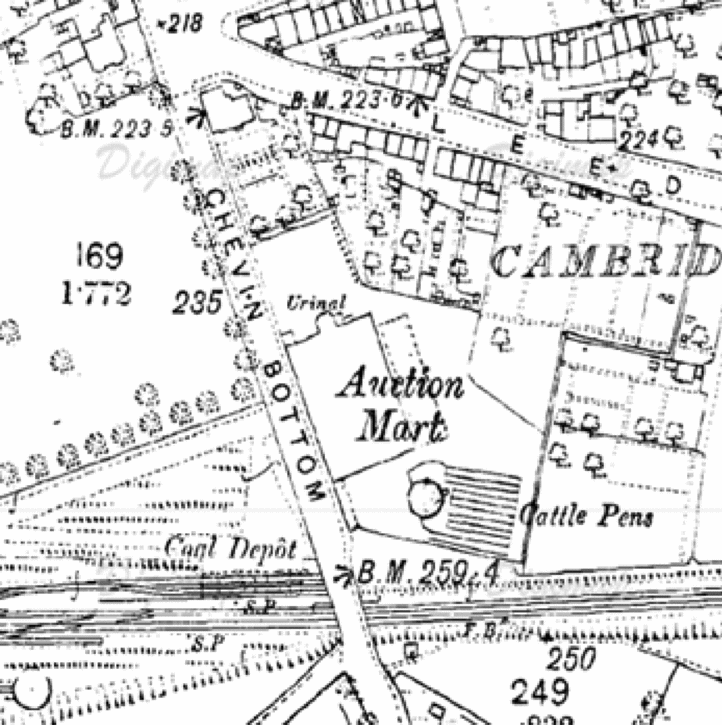
In the case of Wharfedale Farmers’ Auction Mart, the masculine nature of the space is evident in its geography, particularly in the nature and placing of the facilities available to the patrons. On the 1891 Ordnance Survey map of Otley, the Wharfedale Farmers’ Auction Mart site is marked, and its lone building stands on the same foundations as the mart's main building today. On the front wall of the building is a small semi-circular structure labelled ‘Urinal’. The maleness of this particular facility is unquestionable, and it indicates the requirements of the mart clientele. This structure was replaced by the office at some point between the production of the 1909 and 1921 maps. The architectural evidence from today supports the idea that women's attendance at auction marts was a later development. While the men's toilets are situated at the corner of the main mart building, a central location from which all the sale rings are easily accessible, the women's toilets stand behind the café, in a spot which still appears to be empty on the 1964 map, and was filled with cattle pens in the 1921 edition. This location is convenient for the café, but is liminal in terms of the business of the mart itself. Furthermore, while the men's toilets are incorporated into the fabric of the central mart building, the women's toilets are built as a somewhat incongruous red brick lean-to structure, setting them apart, architecturally, from the rest of the space. The liminal and separate nature of the women's facilities echoes the liminal and separate nature of women throughout much of the auction mart's history, and marks mart space as masculine space.
This was not mere prejudice, and the lines between insiders and outsiders, skilled and unskilled, were not drawn solely along gender lines. The need for physical skill also separated skilled farming men from unskilled male outsiders. Knowledge and animal-handling skills were cornerstones of trust in the mart environment, where large, stressed, unfamiliar animals would be gathered, creating a potential danger for everyone involved. In this context, it was crucial for the men attending to rely on one another's skills in order to ensure mutual safety. One photograph, depicting the Christmas Show and Sale at Wharfedale Farmers Auction Mart in 1935, shows the cattle being shown outdoors, in a ring formed by a circle of men, who must all rely on one another to contain the beasts, with whose behaviour they could not all be personally familiar.
Wharfedale Farmers’ Auction Mart, 1890s, showing the urinal for the male attendees. The modern female toilets are situated where the cattle pens are marked on this map, while the main sale ring is inside the large building. Ordnance Survey County Series 1:10560, Yorkshire, 1st edition (1892), SE14, http://digimap.edina.ac.uk/ancientroam/historic. © Crown Copyright and Landmark Information Group Limited (2014). All rights reserved. (1891).

Interviewees emphasised the dangers of handling farm animals by telling stories in which inexperienced handlers, or those who took an animal's temperament for granted, were injured or narrowly escaped death. These cautionary tales indirectly highlight the speaker's own knowledge and experience. For example John Dalby related an incident in which his father's caution around animals proved him superior to a ‘know it all’ Ministry man:
Ministry man used to come . . . and punch a hole in their ear – We had about half a dozen in this shed, and my Dad said, ‘We’ll go get a gate so we can pin them behind this gate to hold them’.
We went out and the next thing we heard was this shouting, ‘Help! Oh, help!’
Well, there were a window frame – no window in it, like, just the frame – and one of these bullocks had pushed this bloke straight up through the window frame, and he were laid on the ground looking up at us when we got back. It was funny, but we got a nasty letter from the government saying that we shouldn't have let him go in and all that. He didn't think it was funny. But it was funny.Footnote 44
In this case, the superiority of a lifetime's farming knowledge over that of the ‘Ministry man’ is tinged with an element of Schadenfreude, but the rendering of the words, ‘Help! Oh, help!’ into a significantly higher pitch than the interviewee's normal speaking voice implied that the inability to cope with livestock had less than masculine connotations. When a story about a woman handling livestock is related, lack of ability was not met with the same derision. For example, Jimmy Goodall recalled his mother's attempts to help with moving cattle:
If they wanted help moving some cattle she would go there and try and flap her arms about, but if it came towards her she’d walk the other way. Yes. She used to look after drinkings for the farm staff during harvest and haymaking, and did all the cooking and everything.Footnote 45
A woman's inability to handle livestock was balanced by a reiteration of the ways in which she was useful to the farm. It was a masculine quality, the lack of which did not detract from a woman's femaleness, whereas a man's masculinity was questionable in the same situation.
Furthermore, many male interviewees made unconscious distinctions between the time they were not fully masculine, and the time that they became fully masculine. Victor Thompson expressed his difficulties handling milking cows as a young lad as a formative experience, which, once overcome, provided him with valuable skills and propelled him into leaving school early and taking on a man's role as a farm labourer
I could milk a cow, by hand, when I were about seven. . . and when I first sat down to a cow. . . I used to look up, and I thought, “well, if the bloody thing comes my way I’m going to be pushed down underneath that cow”. . . but I ended up so as I could milk six cows an hour by hand. Aye. And when I left school – I left school when I were fifteen – and I went to Guiseley and Aireborough Grammar School to finish up, and I got that pig sick of it I left a year early. . . We had this here cowman that were poorly, and then he died, so it was, “Right, Victor, you’re cowman now.” I just had thirty cows to milk, and youngstock to look after. I think there were about forty youngstock, different ages, and eventually, I ended up calving about a hundred heifers.Footnote 46
In the First World War, the very old and very young were left at home alongside the women and the disabled, thereby being spared the bodily destruction accorded to the male on the battlefield, but also rendering their masculinity questionable at best, illegitimate at worst.Footnote 47 Similarly, in the farming world of this period, children and old men, like women, were not expected to be capable of masculine responsibility for livestock. Men remembered with pride being permitted to attend the mart alone, or to walk animals to and from the sales. John Barr “J. B.” Liddle recalled:
In those days before transport we used to walk all our sheep that were sold, to Bolton Abbey Station. Anything we bought we walked from Bolton Abbey Station which was a good six miles. I’ve walked that road more times than I can count, and enjoyed every minute.Footnote 48
Similarly, Frank Morphet remembered the feeling of importance when he was allowed to take the cart horses, one ridden and one in hand, down to the blacksmith's for replacement shoes.Footnote 49 Throughout the interviews, being entrusted with the handling of livestock alone marked a transition from boyhood to manhood. This process can be viewed through the lens of van Gennep's three phases of transition. In stage one, separation, the individual became detached from his earlier fixed point in the social structure. In leaving school, going to the mart for the first time, or beginning to learn a new skill such as milking or droving, the boy moved to spend at least some of his time in a new physical location, symbolically leaving his childhood behind. The second, liminal phase of this transition took the form of learning the skills and information necessary for full insider status and full masculinity. The achievement of this masculinity was the final phase of the transition, when the man would take over more responsible jobs such as pig-killing or purchasing livestock. At this point, say van Gennep and Turner, ‘he is expected to behave in accordance with certain customary norms and ethical standards binding on incumbents of social position in a system of such positions’.Footnote 50 At the auction and at home he was expected to manage livestock in a manner which ensured the safety of others.
This transformation was reversed when men became too old or physically restricted to handle livestock safely. John Dalby remembered:
The next farm along there, old Mr Hay, well, he was in his eighties and he used to walk with two sticks. Well, he went up to feed the sheep, and this ram come up behind him and knocked him to the floor – he had a job getting up anyway, like, with these sticks – but every time he got halfway up it used to come and knock him down again! He were there for about an hour or more before somebody saw him, like. Well, his son went, ‘Where's my Dad?’ and he went up the field and there was this bloody tup, knocking him down.Footnote 51
In this situation, the old man, although accorded respect in being referred to as ‘Mr’, had lost a part of his masculinity. He was no longer capable of handling the livestock alone, and had to be rescued by his younger, fitter, and therefore more masculine son.
The male body, therefore, was of crucial importance at the auction mart, as men relied upon one another's physical skills and strength when handling livestock to ensure safety for the whole group. A man who had insufficient knowledge or skill could not claim full insider status within the mart community as he could not be trusted with another man's safety. The life cycle of the male body was also important. While men who were too aged to safely handle livestock were removed from the dangerous areas of the mart, so losing a degree of their masculinity, they remained incorporated into the mart community through the sense of ‘togetherness’ with those who had similar life experiences, and through sharing knowledge they had built up over a lifetime of farming. The loss of full masculinity in no way correlated with a loss of respect, as their knowledge ensured this would still be given. It simply changed the method by which the man contributed to the mart community. This may explain why the social element of the mart in particular became so important to elderly farmers. In wider society their age made them a part of the group, identified by Bourke, which was ‘not deemed to be worthy of active membership in the wider body-politic’.Footnote 52 At the mart, their knowledge was relevant and valuable, and, while they could no longer be fully physically active there, they could inform other men of the most effective ways to use their bodies, skills, and physical strength.
The importance of the body of the farmed animal in demonstrating livestock knowledge also arose repeatedly throughout the interview process. Most obviously, this could be seen in the quality of the animals bought and sold in the ring. J. B. Liddle succinctly described what reputation meant for livestock farmers: ‘It isn't what you have, it's who you have – Who's looking for you, and what you have produced to a certain standard.’Footnote 53 The names of both vendor and purchaser were announced for all to hear, and stock would be judged not only on its condition on the sale day, but also on its provenance, while the prices paid and beasts bought determined the reputation of a buyer as a man with a good eye for a bargain, or a fool who was ‘rash with his cash’.Footnote 54
One great source of pride for particular farmers, and a sure method of securing a reputation as a good livestock man, was the ability to cure sick animals. By buying a cheap animal and investing time and expertise, a greater profit could sometimes be made than in buying a fit beast with a higher chance of survival, but a higher price tag. This was a phenomenon which has gradually reduced, as greater restrictions on the movement and treatment of ill stock were brought in. For example, Bert Verity recalled:
If 20 beasts get foot and mouth, probably 15 or 16 of them will survive, maybe more, maybe only one will die. It's an infection of the tongue, the tongue swells, and they can't eat for about a week. And if they’re in good strong condition when they get it, they can drink water but they can't eat solids, you see. My father used to buy them when they had foot and mouth and nurse them better. Used to give them oatmeal porridge with a bit of warm water, and they could slurp it up and it kept them alive. And once they got over it they’d get fat in a month. They never looked back.Footnote 55
This practice could not continue after the introduction of compulsory slaughter for animals displaying symptoms of the disease. By 1922, Mr Verity remembers, things had changed:
It broke out at Pannal auction mart. . . 200 Irish bullocks had come to Pannal station, and they got the infection coming on the boat to Birkenhead. They came from Birkenhead to Pannal by train, and they broke out with it there. But they were all slaughtered and burnt.Footnote 56
However, there were other ailments which could still be cured. Alan Dalby used an old trick involving brown sugar to deal with mild cases of New Forest Disease, a painful and highly infectious complaint in cattle, in which the eye clouds over and weeps, causing temporary blindness and photophobia which seriously disrupts grazing leading to weight loss and, if untreated, death. Combined with a willingness to take the time to pay extra attention to the infected beast, and the facilities to keep it isolated, this could be a way to make profits on undesirable stock:
It's only a matter of feeding them better, you see, to get rid, and anyway, you see, when I set off I had to take all that anybody didn't want, if there was some sort of a disease I tended to take them and sort it out like after, you see. . . But that's how you learn isn't it?Footnote 57
David Lister was another interviewee who had a long history of association with the auction mart at Otley, and recalled many treatments which are no longer used, but which he recalled seeing performed:
There's a thing called Quarterfelon. . . They used to take a Hellebore leaf and just make a little incision, I think it was somewhere here [indicates neck area] an incision in the skin and just put this Hellebore leaf in and that was supposed to prevent it. . . And then, they used to also pierce a hole through the brisket and put tar, I think it was, or a string with tar on it, and just put this string through, and that was supposed to – I think that was for Quarterfelon.Footnote 58
Some remedies required a combination of knowledge and physical strength, for example ‘scawping’ lambs. David Lister continued:
The scawp, that's the scalp, really, they used to go and get their forehead and give it a right [miming a thump]. The strong men would do it with their knuckle, or you’d do it with a good penknife, and they were what they called “double scawped” and funnily enough if one wasn't doing so well, a poor one, it usually had a double scawp. . . There's sort of a bit of regrowth somehow on the brain, on the scalp, and we used to crack it and [laughs] now I’ve never heard of that being done, not for years, but they used to do it regularly. . . Nobody ever mentions scawping nowadays. Whether there was anything in it I don't know, but you could tell, if there was a lamb that was doing badly it fairly crunched, you know. If you hit it and it was rock hard well, you’d find that it was alright anyway.Footnote 59
These remedies and techniques performed the dual function of attempting to safeguard profits as well as displaying livestock knowledge and skill. Of course, the efficacy of these methods is questionable today, but, to contemporaries, their correct, clean, and swift application, and any subsequent improvement in the health of the beast, carried a high level of prestige.
It is interesting that Mr Lister emphasises the strength of the men who ‘scawped’ with their knuckle, as this links back to proving masculinity through physical strength, but it also echoes the fighting culture of the time, identified by Joanna Bourke. She writes that the deliberate injuring of other men was part of growing up for the generations who experienced the First World War; ‘to be “decorated” or “well-painted” with blood was a manly accomplishment’.Footnote 60 In such a culture, and in a livestock-farming setting, it is arguable that to be ‘well-painted’ with animal blood was of equal value to the forming of a masculine male identity. Indeed, J. B. Liddle recalled proudly:
The very first year I farmed I had a fat pig and I killed it and dressed it myself and cured the bacon and the fat. We used the lard for our own baking, the ladies baked our own bread and we had the bacon [Emphasis added].Footnote 61
Killing and butchering a pig was another physical task, requiring strength, skill, animal handling skills, and a steady hand, but it was also a bloody task. To kill one's own pig in the first year of farming was a symbol of full, adult masculinity, both physically and in terms of knowledge, and the distribution of bacon, ham, brawn, and so on to friends and neighbours was also an act loaded with symbolism. It spoke volumes about masculinity, completed rites of passage, and ‘togetherness’ within the community, all of which would communicate into the auction mart environment, promoting trust between the young farmer and the established members of the community.
Networking and the right people
It is clear that those who were established as insiders exerted considerable influence over the acceptance or rejection of prospective new community members. In N. J. Reed and J. S. Smelser's Usable Social Science, the key factors in the understanding of the way networks function are identified as homophily, density of interaction, centrality, and the idea of ‘structural holes’ or gaps in communication. ‘Homophily’ describes ‘the principle that recruitment to networks is based on similarities in attitudes, behaviour. . ., ethnic and racial group identity, and “friends of friends”’.Footnote 62 ‘Centrality’ refers to ‘the strategic place that discrete members have in networks, which is closely related to leadership’.Footnote 63 These two aspects of the network were particularly relevant in the auction mart environment.
During the war, interwar, and immediate postwar periods, the pubs of Otley and other local market towns were filled with farmers on mart days. Ted Haxby remembers: ‘you could tell it was auction day because there were all these farmers about in pubs’.Footnote 64 Bert Verity remembered:
You know the Licks? That used to be a selling place, and they used to garage the cows in the pub yards until 11 o’clock on a Friday morning and they’d take them all down there and they’d have a market.Footnote 65
On these specific days, the pubs functioned as an extension to the auction mart space, in which insiders could continue to socialise, and create and cement network links even after the conclusion of the sale. For the younger farmers, the post-mart drink was an invaluable opportunity to take part in the knowledge exchange which would induct them into the auction mart community. This was articulated particularly clearly by Jimmy Goodall:
We would go to market, and then if you’d been to market you went to the pub afterwards and had a drink, and that's where you used to do some more dealing. In the olden days you would go to market and you’d take your cattle, et cetera, and you would sell them, and then you would come in. And you learnt, believe it or not, you learnt more in the pub afterwards than what you could do in a whole week on the farm, simply by talking to different farmers, saying, ‘I’m having a problem with so-and-so’, and someone would say, ‘Oh, I had that problem, years ago, and I found that so-and-so’.
‘Oh, thank you very much indeed, I’ll try it’, and you could perhaps cure a cow or repair something by just going to market for a couple of hours and afterwards having a pint or whatever, a couple of pints, and then coming back home and carrying on working. That's what markets were for. It was a social occasion to a certain degree, but it was also a learning curve too, and that's what markets were for.Footnote 66
This type of interaction embodies both the homophilic nature of networks as described by Reed and Smelser, and the importance of knowledge and information exchange in the ‘Benjaminian’ community model. By conversing with younger farmers in the pub, established community members were able to vet them for similarities in attitude, behaviour and background, and either accept them into the community by dispensing advice, or reject them by withholding it.
The majority of interviewees first went to the local auction marts with an older man, generally a father or an uncle, but occasionally an employer or fellow labourer, who was already established in the community. This satisfied the ‘friends of friends’ condition of acceptance into the homophilic network by verifying pre-existing links to the local farming world. Many interviewees also talked about loyalty to particular marts, wearing their lifetimes of regular attendance as a badge of honour. For example, J. B. Liddle told his interviewer: ‘I have gone to Otley markets regularly all my life,’ a phrase which was often repeated by my own interviewees.Footnote 67 Reed and Smelser identify a particular form of network, based primarily on kinship and friendship, and identifications share many of the defining characteristics of groups: commonality, belonging, membership, and loyalty.Footnote 68 As the networks which existed within the auction mart, and the communities which were linked through it, were based on these foundations, this helps to explain some of the aspects of auction mart behaviour towards outsiders, such as that described by Thomas Mickle: ‘Some people, some didn't like you. They wanted to buy stuff and they didn't like you interrupting, did they? So they’d bid against you to knock you out, like.’Footnote 69 Mr Mickle also described how some buyers expected behaviour from other insiders which went against the key principles of buying at auction: ‘There's some’d say, “Well, you knew I wanted to buy that, what were you bidding against me for?”’Footnote 70 This assumption of intimate knowledge accompanied by loyalty in a commercial environment could only occur within a kin or friendship based network, where intimate personal knowledge of another member's tastes might be expected. Among strangers or acquaintances the idea would be ridiculous.
However, the networks which existed at the auction marts do not fully fit the sociological definition of ‘groups’, because they extended beyond known individuals and locations to form a national network in which prior personal connections and ‘friends of friends’ allowed trust to be established in unfamiliar marts, despite the ‘structural holes’ which existed due to a lack of personal communication with the unfamiliar mart itself. Thomas Mickle explained:
I’ve gone to markets where you’d to take a letter to say you could buy cattle on behalf of who you worked for, you know, or they wouldn't accept your bids because they were frightened to death that you wouldn't pay, you see. But when I used to go to Ireland I allus had a letter saying I could buy cattle on behalf of Major Horton-Fawkes with his heading, his title on, you see, signed by him. And of course you’d to take your cheques to pay for them, like, you allus had to pay on the day, you couldn't say, ‘Well I’ll pay next week’, you had to pay on the day. But locally they never bothered, because, besides buying stuff at the markets, you sold stuff at the same markets, didn't you, so they’d get to know you, you see. . . In fact I had a bit of a story about when I went down on holiday to Wales, and I went to the market at Abergele, and by there were a lot of good cattle! And I hadn't any cheques or nothing like with me, and I went in, and the office that you went in, it were a right long narrow place, and I saw right at the bottom there were a chap from York, Joe Sleightholme, who were a dealer feller, you see, and I went in and I said, you know ‘I work for Long Stoop Partners at Norwood’, I said, ‘But I’ve no identification and any proof that I work for them, but’, I said, ‘I’d like to buy some store cattle’. But, you know, I’d have to send the cheque on, you see. ‘Oh’, he says, ‘That's rather difficult like, when we don't know you’. And, as I say I looked up and I said, ‘I know that feller down there, Joe Sleightholme’. ‘Well’, he says, ‘If you know Joe Sleightholme, right enough’. You see. And that were a reference to him, like, wasn't it?Footnote 71
Knowing the right people, who had connections to other auction marts, allowed trust to spread through the national mart network, beyond the scope of kinship, friendship, or even acquaintance groups to form an entity which incorporated, but was not limited by, these ‘structural holes’ or gaps in communication. In her chapter, ‘“You cannot be a Brahmin in the English countryside”: The Partitioning of Status, and its Representation within the Farm Family in Devon’, Mary Bouquet borrows her titular phrase from Julian Pitt-Rivers’ 1963 investigation into Mediterranean hospitality to explain the non-transferable nature of status from one community to another.Footnote 72 Just as in Pitt-Rivers’ analogy, trustworthy status within the community of one auction mart did not translate to trust within the community of another. However, the links between communities which formed the nationwide mart network connected people who, although not intimately known to one another, nevertheless shared similar attitudes, behaviours and backgrounds. This formulation of the network has much in common with Benedict Anderson's Imagined Communities, in which members of a nation identify themselves as a community despite the fact that they only have personal contact with a few individuals.Footnote 73
The picture of the auction mart as a community base, where young farmers could find support and advice should nevertheless not obscure the commercial and competitive elements of the mart. Alan Dalby explained how the importance of knowing people extended beyond social acceptance:
First thing when I get round the ring I size all the people up. Never mind cattle. People. And I think, well, he's going to buy that, and he's going to buy that, and he’ll buy that, what am I going to buy? And the art of the job is to try to keep them eyeing what they’re buying, and hope then to slip onto something they don't want. And I don't know what it's going to be. In fact you want to come home with some, but it can be anything. . . And that's the art of the job, you see, if you can keep the price up in what everybody else is buying.Footnote 74
This demonstrates the other important reason to get to know other members of the community. Familiarity with other individuals’ behaviour, buying patterns, and personal tastes allowed, and continues to allow, farmers to make buying decisions to benefit their own business.
The ultimate insiders were the auction staff, epitomised by the auctioneer. As shown in the oral history excerpts, the mart staff had the power to grant permission for buyers to pay their accounts in unconventional timeframes: taking the stock away and sending the cheque on later, or paying off the account at the following week's sale. The granting of this permission was a sign of great trust, as failure to pay off the debt would leave the mart accountable for the money owed to the seller.
Cultural norms
Insider status in many communities can be recognised through knowledge of, and adherence to, the cultural norms of the group in question. A. P. Cohen's The Symbolic Construction of Community argues that symbols of the boundary between the insiders in a community and those outside it can heighten awareness of the community among its membership.Footnote 75 These symbols can be physical, as in the case of the walls built around the auction sites, or behavioural, excluding outsiders through their unknowing non-compliance. This latter form of boundary contains strong ritualistic elements, seen in practice in the unofficial dress-code; the order of the sale day, organised to ensure fairness to all parties; and the financially redundant but culturally significant custom of giving and receiving ‘luck money’. Cohen argued that, despite the myriad applications of the term ‘ritual’, most anthropologists can agree that, ‘ritual confirms and strengthens social identity and people's sense of social location: it is an important means through which people experience community’.Footnote 76 In the case of the auction mart, this connects to the importance of tradition, highlighted by Benjamin. Observing traditional rules and behaviours, and making them into ritual, preserves them, promotes a sense of ‘togetherness’ and communal identity which creates a community among scattered people.
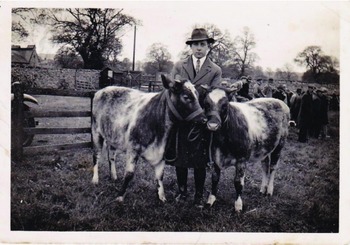
The behavioural tradition which is most obvious to the outsider is the uniformity of dress which can be observed in photographs showing the auction mart's past. Of course there are stylistic differences between periods, the dress in nineteenth-century photographs, for example, does not resemble that from the Second World War or the 1960s. However, we can see certain themes in dress continue throughout the period covered by photographs. In the photographs above and below, especially the photograph of the Wharfedale Farmers’ Auction Mart Christmas Show 1935 (Figure 3), the vast majority of the men present wear hats or caps. Whatever the cut and style of clothes, the mart costume throughout the first sixty years of the twentieth century was a combination of smart and practical. The shirts, ties, and smart shoes demonstrated respect for the environment without being inappropriately formal. They displayed the farmer as a businessman, and they indicated that he was taking the occasion seriously. However, concessions were made to practicality, and the photographs show that the donning of a long coat to protect the smart outfit was almost universal.
Christmas Show and Sale, December 1935, Wharfedale Farmers’ Auction Mart (Otley Museum).

Otley Bridge End Auction Mart, undated, probably 1950s or early 1960s (Otley Museum).

Bert Verity at Masham Young Farmers’ Calf Show and Sale, 1933 (M. Verity).

Keith Liddle, speaking about the auction mart today, made it clear that the same guiding principles continue to influence dress: ‘you should go in your wellies, and a pair of waterproof trousers or leggings on, because I approve of them up to a point, because they’re easy to wash’.Footnote 77 While practicality naturally remains important, especially in an age which recognises the importance of disinfecting, we can also see that choosing an outfit which will conform to expectations has also stayed part of auction mart culture in the choice of the word ‘approve’.Footnote 78 The uniformity of dress, alongside modes of behaviour and the sharing of knowledge which confirmed shared backgrounds, was another aspect of the homophily which characterised the mart community. This is perhaps expressed best by the agricultural comedy writer Henry Brewis, in his poem ‘Out to Lunch’, which describes the mart canteen:
As a good deal of the interaction in the auction mart environment is based on establishing and maintaining trust, it is unsurprising that fairness should also be a key theme in the mart's culture. The rituals of the mart have been designed in such a way that their performance gives participants a sense that everyone will be treated equally. The importance of the rituals of fairness can be seen in a catalogue for the Otley Old Auction Mart, from 1902. It contains a ‘Notice to Vendors’ declaring: ‘All stock to be on the Ground not later than 10 a.m., and must not, under any circumstances, be sold privately. Double Commission charged on all stock bought in or reserved.’Footnote 80
These rules discourage, and in the case of private sales downright prohibit, unfair tactics. If a reserve price for an animal is not met, one might argue, the animal is probably not worth that price, and the vendor may be seen to be trying to make more money than he deserves. A private sale, on the other hand, means that the reserving buyer is taking away the chance for other bidders to try their luck. It essentially uses the auction mart facilities as a convenient handover location, without paying the mart commission. Discouraging such behaviours reinforces the idea of ensuring fairness between all buyers, instilling confidence in the mart as a business.
With the sale rules established and publicised the next step would be to enact the rituals which promised fairness during the sale. The first and most important of these is the ritual of taking the ballot. Animals for sale are placed in numbered pens, and a pen number is drawn at random to be the first into the ring. The next thirty or forty pens then follow in numerical order, according to the particular mart's convention, and then the sequence restarts at number one. Any further pens then follow at the end. The reason for this lies in buying behaviour, as explained by Alan Dalby:
You’ve to be there before it starts, and a lot’ll come ten minutes too late, so that they might have missed a bargain, they might not, and when they’re getting near to the end of the sale, “Oh, I don't want to be in the queue in the office, better be off!” So they’re all off, and there might be something. It doesn't allus work but there might be something that eases off, are you with me?Footnote 81
At the beginning and end of the sale, there are fewer bidders and fewer bids, meaning lower prices. The drawing of the ballot ensures that every vendor has an equal chance of their pen of cattle falling in the coveted middle ballot. The result of the ballot is written on a chalkboard where it can be seen by everyone, an act which makes the ritual a public demonstration of fairness. This was explained by Dick Garnett, a former director of the Wharfedale Farmers’ Mart:
I’ve drawn the ballot for donkeys’ years at Otley, and even now, I was there last Monday, ‘Will you draw the ballot for us?’ so I keep drawing it for them, but I mean, it is a thing that spreads it about, you know. You see, if you started at number one every Monday morning, all those that go early - and you could do with them going early, you know, so that you can get a lot done before, a rush comes in - they’d say, ‘Well I’m not coming here early on a morning because I’ll be first in’. And ninety per cent of the time, the price will increase from the start, ninety per cent, I mean it has been known to, if there's a very big show, sometimes it can go the other way, but nobody likes being on first, and especially regularly. . . So that's why, not the only reason, but so people have a fair chance of getting a different spot on the ballot. I mean, it is drawn fairly, at Otley at least, it's drawn fairly. . . What comes out is what's on that board.Footnote 82
Not only is the importance of fairness and integrity made clear here, but Mr Garnett also highlights that the ballot must be drawn by a trustworthy person, known to the auction staff. This is a sign of a ritual taken seriously, and with some considerable weight of meaning behind it. It is not merely a tradition, but a functional action.
If the ritual of drawing the ballot defines the beginning of the sale, then the ritual of ‘luck money’ defines the end. ‘Luck money’ is a small sum of money which is given to the buyer by the vendor. While not large enough to be of any financial significance, the action of ‘giving luck’ is loaded with connotations of trustworthiness, honesty, and confidence in the animal in question. Victor Thompson explained:
I once took two cows, and George didn't believe in owt like that, didn't our old boss, and he says, ‘How much did it make?’ There were two of them, and I told him. I said, ‘I had to give a bit of luck money’, and he played hell with me for giving luck money. But you see it was the done thing. . . You see, if it had been put about that I wasn't going to pay some luck money, it were only a couple of quid, but then cows only made about a hundred, hundred and fifty quid. So it were in balance with the price that they made, but he went berserk, did t’owd feller, and this Stanley Lawson, who were a friend of his, who farmed on Castley Lane, and he said, ‘Nay’, he said, ‘Don't play hell wi’ t’lad’, he says, ‘He wouldn't have sold the cows if he hadn't given a bit o’ luck. It's dishonest!’ Well, it isn't really, it's bribery and corruption, but, you know! ‘Aye, you’re alright with him, he’ll give you a bit of luck money’ you know.Footnote 83
Dick Garnett continued:
Because they’ve helped you get a good trade, you give a little bit back. . . They used to give them a shilling in the pound if they paid on the day, because some people want a bit of never never, you know, pay next week or next fortnight, you know. . . But you know, they look for a bit of luck, and I think that it's only a gesture of thanks, well, it's something that's carried on long enough it's just one of those things now.Footnote 84
Once again, as in the theoretical model of the ‘Benjaminian community’, tradition is shown to be a cornerstone of the farming community of Lower Wharfedale. It was not only accepted, but expected, and the performance of the little ritual of handing over the small sum served to cement network links, reassure peers of honesty, reinforce confidence in animals for sale, and encourage trade through mutual benefit to buyer and seller alike. The vendor who did not give luck soon found his customer base shrinking; not to give luck was not only frowned upon, but considered dishonest. This indicates that failure to adhere to cultural norms would have a detrimental effect on a farm business. The efficacy of these traditions and their value to the mart as an entity is proven by the fact that every ritual mentioned here continues today.
When cultural norms broke down
The difference between an interesting but esoteric cultural practice and a ritual or tradition which forms the basis for a community to function is shown when cultural norms are broken. This was not a common occurrence at any mart in Wharfedale, but one case from 1921 may be taken as an illuminating exception. The facts of the case, as summarised by Sinclair and Atkinson, Solicitors of Otley, in a letter to the secretary of the Wharfedale Farmers’ Auction Mart, and supplemented by other correspondence, are as follows. On 3rd October 1921 Thomas Penny of Carlton Hall near Yeadon sold a cow through the Wharfedale Farmers’ Auction Mart to Joseph Taylor of Nefferton House, Hull. The cow, lot fifty-one, was described as a ‘roan milk cow with down horns’, and sold for twenty-one pounds and ten shillings. On 6th October, Taylor informed the Mart that the cow was a ‘screw’ and returned it to Otley by rail. The term ‘screw’ refers to an animal which has matured poorly, usually being small for its age, with poor conformation, and is unlikely ever to make good. On 7th October, Penny took the cow back to his home and arranged for a vet to examine it. On 8th,October, Penny wrote to Taylor:
Dear Sir
I am writing to say that I cannot understand your reason for sending the cow back.
I have had this day the cow thoroughly examined by a Veterinary Surgeon and I am enclosing you a copy of certificate of the cow being correct.
The cow is here entirely at your risk and expense.
I enclose you the Vet's account and the railway charges are £1/4/10d.
Yours faithfully,
T. Penny
The accompanying letter from W. M. Crawford M.R.C.V.S. certified that the vet found ‘said animal healthy therefore in my opinion sound’.
On 10th October, the following Monday, Taylor attended the Wharfedale Farmers’ Auction Mart again, buying more cattle, deducting the cost of the ‘screw’ cow, and settling his account for twenty-one pounds and ten shillings less than the value of the cattle he had purchased that day. Sinclair and Atkinson's summary notes that, ‘the mart assented to this’. Following this, on 17th October, the Mart deducted the same twenty-one pounds ten shillings from an account which was to be paid to Penny. Penny subsequently sold the cow as ‘in dispute’ on 14th November, this time only realising six pounds.
The conclusion of Sinclair and Atkinson was that ‘Taylor had no right to deduct the price of the cow against the mart, and the mart made a mistake in assenting to his doing so. . . Taylor still owes the mart £21.10.0 and the mart owes Penny the same amount’. On 29th December the Live Stock Traders’ Association of Great Britain became involved, supporting Joseph Taylor against the Mart, but things continued to escalate. On 16th March 1922 a High Court of Justice (Chancery Division) summons was issued against the Wharfedale Farmers’ Auction Mart, with Penny as the plaintiff. Backing away from such a serious legal step, discussions between the parties’ various solicitors ensued, with the result that on 4th September 1922 a receipt was issued by the solicitors for the Wharfedale Farmers’ Auction Mart for the fifteen pounds and ten shillings difference in the two sale prices of the disputed cow due to Thomas Penny, and a further five pounds and twelve shillings to cover the costs of the dispute.Footnote 85
The reason this dispute went so far was due to the key aspects of mart culture having been subverted. The livestock knowledge and skills of both men were called into question. Had Thomas Penny conceded that the cow was a ‘screw’, the quality of his livestock, and his ability as a stockman may have been doubted at subsequent sales. The second sale of the animal for only six pounds added to this risk. On the other hand, had Joseph Taylor been seen to accept paying over the odds for a ‘screw’, which would have been visible to his neighbours as part of his herd, his ability to judge stock may have been questioned. Consequently, the loser in this dispute risked damage to his reputation and business, while the lack of fairness exhibited by the mart itself was contrary to the cultural norms of the auction. This threatened to make a mockery of the rituals which sought to ensure fairness. The mart accepted the word of Joseph Taylor over that of Thomas Penny, and allowed Taylor to dictate how the finances should be reorganised before the dispute was resolved to the satisfaction of both parties, thereby violating the cultural norm of ensuring fairness.
One case alone could be seen as unrepresentative. In this instance, however, there is an argument to support its relevance and significance. The documentary evidence which preserves this case comes from the archived papers of Sinclair and Atkinson, Solicitors of Otley, and not from the mart itself. It is also worth noting that although the original sale took place on 3rd October and Penny consulted Sinclair and Atkinson on 20th October, the solicitors did not become involved with the auction mart as a party in the dispute until 15th December. It is therefore likely that similar disputes on other occasions were resolved without recourse to legal representation. Indeed, the very fact that this case progressed so far indicates how integral and effective the customs and cultural norms of the auction mart were to keeping the mart community functioning. Normally these would have been adequate to mediate such a disagreement, but this case, which threatened the very foundations of mart culture, caused unparalleled legal escalation.
Conclusion
The auction mart was not only a financial centre and a social hub for the farming community of Lower Wharfedale in the first half of the twentieth century, but it encompassed its own community within a community: a closely linked group of individuals, joined together by shared backgrounds, shared information, shared rituals, shared ideas about masculinity, and, ultimately, shared identity. Acceptance into the farming community of the whole geographical area did not automatically grant inclusion in the mart's community, but insider status in the mart community could confer honorary membership of a distant mart community. The auction marts actively encouraged this building of networks by planning their schedules to allow men to visit a different mart for the same type of stock up to six days per week. However, the wide geographies covered by mart communities during non-sale time, and the consequent infrequency of meetings between members meant that the mart community was ephemeral in nature, fully functioning only on sale days, and becoming secondary to the wider farming community at other times.
Interactions with livestock stimulated the mart to become its own community, separated from the wider world by both physical and cultural boundaries. Non-auction-going individuals created the physical boundaries through council action to remove livestock from the streets, while the auction-goers themselves created the cultural boundaries by assessing aspiring insiders and demanding adherence to a complex set of behavioural norms and rituals in order for insider status to be achieved. Those who were not insiders were not afforded the same privileges, nor included in the sense of ‘togetherness’ pervading the mart community. Handling livestock in the context of the mart allowed proof of skill and physical ability to be shown in a semi-public setting, establishing masculine identities based on these traits. Reputations could be built and destroyed as a result of stock bought and sold, prices paid, prices realised, stock improvement, and adherence to the rituals and rules of fairness.
The marts were also places to network, to learn, and to socialise, and this aspect was carried over into the pubs after the sales. In this context, it is possible to see the pubs as extensions of auction mart space, but, as with so many aspects of auction mart culture, this was only the case on a temporary basis. The pub would not be extended auction space on a non-sale day, nor on the morning of the sale. The fluid and temporally redefinable nature of the auction mart community permitted the movement of an individual between marts, but once again, pre-existing network links were crucial. This comes back to the theme of trust. In order to be an insider, one must be trusted, and this could only occur by proving possession of the skills and knowledge necessary to keep other insiders safe and to fit in with established buying patterns: for example by not putting forward substandard livestock with an inappropriate reserve price, and by not bidding unrealistic amounts and causing inconvenience to other bidders.Footnote 86
The cultural norms of this community regarding appearance, knowledge, skill, communication and actions were encompassed into a behavioural code by which individuals could demonstrate their similarities to established members of the community. This homophily, as identified by Reed and Smelser, was key to the sense of ‘togetherness’ or communitas which existed within the mart as a community.Footnote 87 Violation of the rules was not only culturally subversive, but threatened the local social structure, confidence in the mart itself, and the stability of the wider farming network. Van Gennep's three stages of transition can be applied to the creation of the auction mart community as a whole, to entry into farming manhood, and to an individual becoming part of the auction mart community, indicating that these were separate ‘states’ of being in which different cultural conditions existed.Footnote 88 Furthermore, the twentieth-century auction mart as a separate community or ‘state’ of its own has not previously been examined in any depth beyond the usual image of the mart as a social place for old men, which does not take into account the full complexity of mart interactions, nor the influence of time and context.
The auction mart community conformed to Lindroos’ ‘Benjaminian’ community model, in that it was temporally redefinable. It centred around feelings of togetherness and shared knowledge, while tradition played a role in creating a feeling of shared history which emphasised the homophily of the group. The transition from membership of the wider farming community to the more select membership of the auction mart community implied a change in status, at least to those who were already insiders at the mart. In this way the mart community links to Benedict Anderson's concept of the imagined community, in which the community exists because it self-identifies as such. This in turn connects to theories about identity. Not only was mart insider status subsumed into the individual's personal identity, but the same activities, knowledge and skills which promoted higher status within the context of the mart also contributed to the private masculine identity of the man.