I. INTRODUCTION
The most widespread interpretation of Ludwig von Mises's epistemology, among both its adherents and its critics, is that of Murray N. Rothbard’s (Reference Rothbard1957) extreme apriorism. According to this interpretation, Mises would have said that economic science is completely a priori, without any room for auxiliary hypotheses that are not directly deducible from praxeology.Footnote 1 This interpretation has been so widespread that Mark Blaug (1992, p. 81), in a sharply critical passage that has become a classic, says, “In the 1920s, Mises made important contributions to monetary economics, business cycle theory and of course socialist economics, but his later writings on the foundations of economic science are so idiosyncratic and dogmatically stated that we can only wonder that they have been taken seriously by anyone.”
Because of Friedrich A. Hayek’s (1958, chs. II–IV) work on epistemology, not all Austrian economists follow Rothbard’s position of extreme a priorism, and many differentiate Mises from Hayek on precisely this point. It is still common, however, to find supporters and critics of Mises who have primarily followed Rothbard’s interpretation and pay little to no attention to other authors, such as Fritz Machlup, who provide alternative interpretations of Mises’s epistemology.Footnote 2 An example is Bryan Caplan (Reference Caplan1999), who labels the Mises-Rothbard paradigm as the alternative to neoclassical economics.Footnote 3 Machlup’s (Reference Machlup1955) interpretation was a notable exception that went unnoticed among Austrians and non-Austrians alike (by “non-Austrian economics,” we are referring to mainstream economics but not other heterodox approaches).Footnote 4 As far as we can tell, Roger G. Koppl (2002, ch. 2) is the only exception that offers an interpretation of Mises’s epistemology similar to ours. It is not that Machlup’s paper in itself was unnoticed and became forgotten, but that Machlup’s interpretation that Mises did not hold an extreme a priori position has been overlooked in a paper that developed into a classic of the pre-1980s economic literature and has been said to have advanced some of Imre Lakatos’s contributions to epistemology (Langlois and Koppl, Reference Langlois and Koppl1991). Even though there has been some effort to reorganize the epistemology of Austrian economics using Lakatos’s research program, the fact that Machlup’s interpretation of Mises is substantially different from that of Rothbard’s remains unnoticed. Our argument is not that Machlup’s (Reference Machlup1955) presentation is, at face value, a representation of Mises’s position, but that Mises was not an extreme aprioristic thinker and that Machlup’s work offers a bridge between Mises and Lakatos that has been unexplored.Footnote 5
Rothbard’s article is a direct answer to Machlup’s, who said that neither Mises nor other aprioristic economists were ‘extreme aprioristics’ as defined above. In fact, the title of Rothbard’s article, “In Defense of 'Extreme Apriorism,” is a direct allusion to Machlup’s paper. Machlup’s interpretation of Mises should stand head to head with that of Rothbard’s, rather than the latter's being the default interpretation of Mises.Footnote 6
Therefore, there are two ex-ante, equally plausible, interpretations of Mises: Machlup and Rothbard. The former is moderate aprioristic, the latter is extreme aprioristic. We acknowledge that some of Mises’s passages, taken at face value, can point to either interpretation if taken outside the context of his overall work. However, the neutral academic position is to see Machlup’s interpretation as a competitive window into Mises’s epistemology. To accept Machlup’s interpretation as plausible has important implications for both Austrian economics and non-Austrian economics. For Austrians, this means a closer relationship among Mises, Hayek, and Karl R. Popper than is usually recognized. For non-Austrians, a more balanced appraisal of Mises shows that the critical position represented by Blaug’s passage is based on a misreading of Mises and that Austrian and non-Austrian epistemologies are closer to one another than is usually accepted by either party. A reading of Mises à la Machlup has implications that go beyond an interpretation problem in the history of economic thought; it defines how Austrian and non-Austrian economics relate to each other.
Section II introduces Machlup’s methodology and his reading of Mises. Section III discusses the implications of accepting Machlup’s interpretation as a plausible interpretation of Mises’s thoughts. Section IV concludes.
II. MACHLUP’S INTERPRETATION OF MISES
The “a Priori” in Machlup’s Philosophy of Science
The Non-disconfirmation
Like Carl Hempel (1966, sec. 2) and Popper (1974, sec. 12; 1983, ch. 1), for Machlup, it is clear that in the hypothetical-deductive model (hereafter HDM), the assertion of the consequent does not prove the hypothesis. Namely, if p then q, the assertion of q does not imply p; p is a non sequitur from q. There can be causes of q other than p. For Machlup (1955, p. 4), “[a]bsence of contradictory evidence, a finding of non-contradiction, is really a negation of a negation: indeed, one calls a hypothesis ‘confirmed’ when it is merely not disconfirmed.” This is why Machlup talks about “illustration,” rather than “empirical testing,” of a theory.
This does not mean complete frustration of all attempts to verify our economic theories. But it does mean that the tests of most of our theories will be more nearly the character of illustrations than of verifications of the kind possible in relation with repeatable controlled experiments or with recurring fully identified situations. And this implies that our tests cannot be convincing enough to compel acceptance, even when a majority of reasonable men in the field should be prepared to accept them as conclusive, and to approve the theories so tested as ‘non-disconfirmed,’ that is, as ‘O.K.’ (Machlup Reference Machlup1955, p. 19)
Despite some contemporary pre-Popperian attempts to 'almost prove' hypotheses, Machlup already assumed this problem to be settled.
Nothing that I have said thus far would, I believe, be objected to by any modern logician, philosopher of science, or scientist. While all the points mentioned were once controversial, the combat has moved on to other issues, and only a few stragglers and latecomers on the battlefield of methodology mistake the rubble left from a long ago age for the marks of present fighting. So we shall move on to issues on which controversy continues. (Machlup Reference Machlup1955, p. 9)
For Machlup and scholars of his time, the implications of the fallacy of the converse—affirming the consequent or post hoc ergo propter hoc—was an issue that could be assumed to be understood and settled.Footnote 7
From Popper to Lakatos
Also like Hempel and Popper, Machlup recognized the role of general hypotheses that give meaning to specific cases and predictions. Applying this principle to HDM in social science and economics, Machlup (1955, pp. 2–3) claimed, “This is the reason why it has to be said over and over again that most of the facts of history are based on previously formed general hypotheses or theories.” But with a Lakatosian turn on the Duhem-Quine thesis, he made it clear that in the HDM, general hypotheses are a set of interlinked assumptions so that none of them can undergo independent empirical testing.Footnote 8
This is an important point because, while a successful experiment does not prove the theory under evaluation, an unsuccessful experiment fails to disconfirm the theory, since none of the hypotheses can be tested without a priori assuming that the other hypotheses hold. Machlup then concludes that the fact that
there is no way of subjecting fundamental assumptions to independent verifications should be no cause of disturbance. It does not disturb the workers in the discipline which most social scientists so greatly respect and envy for its opportunities of verification: physical science. The whole system of physical mechanics rests on such fundamental assumptions: Newton’s three laws of motion are postulates or procedural rules for which no experimental verification is possible or required: and, as Einstein put it, ‘No one of the assumptions can be isolated for separate testing.’ For, he went on to say ‘physical concepts are free creations of the human mind, and are not, however it may seem, uniquely determined by the external world.’ (Machlup Reference Machlup1955, p. 9)Footnote 9
Machlup’s Interpretation of Mises
Machlup distinguishes between two extreme epistemological positions: (1) extreme apriorism, and (2) ultra-empiricism. According to Machlup, extreme apriorism existed only as a theoretical model, and the history of epistemology in economics shows that all aprioristic authors were following John S. Mill. According to Machlup, what aprioristic thinkers have in mind is the development of an a priori theory followed by a strong denial of independent verification of the general hypothesis set of theories. For Mill, the predictions follow from the application of a general theory to a particular case. Such application is not just science anymore, but applied science. For Machlup (1955, p 7), “[t]he point to emphasize is that Mill does not propose to put the assumptions of economic theory to empirical tests, but only the predicted results that are deduced from them [emphasis in original]. And this, I submit, is what all the proponents of pure, exact or aprioristic economic theory had in mind, however provocative their contentions sounded [emphasis here inserted]. Their objection was to verify the basic assumption in isolation.” It is in a footnote to this paragraph that Machlup mentions Mises (for the third time) as an example of these aprioristic economists:
‘Aprioristic reasoning is purely conceptual and deductive. It cannot produce anything else but tautologies and analytical judgments.’ While this sounds like an “empiricist’s” criticism of the aprioristic position, it is in fact a statement by Mises.... Mises emphasizes that ‘the end of science is to know reality,’ and that ‘in introducing assumptions into its reasoning, it satisfies itself that the treatment of assumptions concerned can render useful services for the comprehension of reality.’ ... And he stresses that the choice of assumptions is directed by experience. (Machlup Reference Machlup1955, p. 7; emphasis added)
Is Machlup right? Can Mises’s thought be framed in a Lakatosian framework? There are a number of passages that make Machlup’s interpretation at least as, if not more, plausible as that of Rothbard’s. Without trying to produce a “textual proof” of Machlup’s interpretation, a few passages may illustrate that his interpretation does not contradict Mises’s own words. Note first the opening paragraph of chapter 2.10 (“The Procedure of Economics”) in Human Action (1996, p. 64):
The scope of praxeology is the explication of the category of human action. All that is needed for the deduction of all praxeological theorems is knowledge of the essence of human action. It is a knowledge that is our own because we are men; no being of human descent that pathological conditions have not reduced to a merely vegetative existence lacks it. No special experience is needed in order to comprehend these theorems, and no experience, however rich, could disclose them to a being who did not know a priori what human action is. The only way to a cognition of these theorems is logical analysis of our inherent knowledge of the category of action. Like logic and mathematics, praxeological knowledge is in us; it does not come from without.
While Rothbard sees in this and other passages support for his reading of Mises as an extreme aprioristic, Machlup (1955, p. 7) sees an example of “provocative” contentions. For Rothbard and Machlup, the “a priori” in Mises’s praxeology means different things. Shortly after, however, Mises (1996, p 65; emphasis added) continues to caution that “the end of science is to know reality. It is not mental gymnastics or a logical pastime. Therefore praxeology restricts its inquiries to the study of acting under those conditions and presuppositions which are given in reality.”
There are other passages that also support Machlup’s interpretation of Mises. In Chapter 2.3 (“A Priori and Reality”) of Human Action, for instance, Mises maintains, “It is not a deficiency of the system of aprioristic science that it does not convey to us full cognition of reality. Its concepts and theorems are mental tools opening the approach to a complete grasp of reality; they are, to be sure, not in themselves already the totality of factual knowledge about all things” (1996, p. 38; emphasis added). In Chapter 2.10 (“The Procedure of Economics”), Mises maintains that the “reference to experience does not impair the aprioristic character of praxeology and economics. Experience merely directs our curiosity toward certain problems and diverts it from other problems” (p. 65). Mises is also explicit in the paragraph that follows, in which he writes (emphasis added): “The disutility of labor is not of a categorical and aprioristic character. We can without contradiction think of a world in which labor does not cause uneasiness…. But the real world is conditioned by the disutility of labor. Only theorems based on the assumption that labor is a source of uneasiness are applicable for the comprehension of what is going on in this world.” What are aprioristic in Mises, similar to a Kantian approach, are the categories used to interpret reality, not the economic theory applied to the reality.
Experience teaches that there is disutility of labor. But it does not teach it directly. There is no phenomenon that introduced itself as disutility of labor. There are only data of experience which are interpreted, on the ground of aprioristic knowledge, to mean that men consider leisure … as a more desirable condition than the expenditure of labor. We infer from this fact that leisure is valued as a good and that labor is regarded as a burden. But for previous praxeological insight, we would never be in a position to reach this conclusion. (p. 65; emphasis added).Footnote 10
In case these remarks were not clear enough, Mises (1996, p. 66; emphasis added) describes economics with the following words, from which Machlup quotes (1955, fn18, p. 7):
Economics does not follow the procedure of logic and mathematics. It does not present an integrated system of pure aprioristic ratiocination severed from any reference to reality. In introducing assumptions into its reasoning, it satisfies itself that the treatment of the assumptions concerned can render useful services for the comprehension of reality. It does not strictly separate in its treatises and monographs pure science from the application of its theorems to the solution of concrete historical and political problems. It adopts for the organized presentation of its results a form in which aprioristic theory and the interpretation of historical phenomena are intertwined.
These passages not only show that Machlup’s interpretation is plausible, but they also provide a challenge to Rothbard’s (1957, p. 314) assertion that “their methodological views [Mises and Machlup] are poles apart” and that “Professor Mises and ‘extreme apriorism’ go undefended in the debate.”
In addition to explicitly mentioning the presence of empirical assumptions, Mises warns the reader that economic treatises do not separate pure science from the application of theorems. This can also be harmonized with Machlup; although pure theory must adopt general hypothesis—i.e., disutility of labor—the application of a theory to a particular case must assume particular hypotheses or conditions. These hypotheses and a priori categories, however, are intertwined. Given this complexity, Mises (1996, p. 66; emphasis added) continues that “one must not overlook the fact that the manipulation of this singular and logically somewhat strange procedure requires caution and subtlety, and that uncritical and superficial minds have again and again been led astray by careless confusion of the two epistemological different methods implied.”
Mises’s remarks on the empirical content of economic theory are present in other epistemological works as well. In Epistemological Problems of Economics (2003), this distinction is already present. For instance, for Mises (2003, pp. 15–16; emphasis added), “[b]ecause we study science for the sake of real life … we generally do not mind foregoing the gratification that could be offered by a perfect, comprehensive system of human action…. Instead, we are satisfied with the less universal system that refers to the conditions given in the world of experience.” Mises then offers numerous examples of conditions that are not deducible a priori, but are assumed by experience; for example, the presence of money, the presence of a socialist commonwealth, and the presence of symbols that allow individuals to communicate with each other. Man is not immortal, but lives and dies, and Mises (2003, p. 25; emphasis added) notes that the fact that “the passage of time is one of the conditions under which action takes place is established empirically and not a priori.”
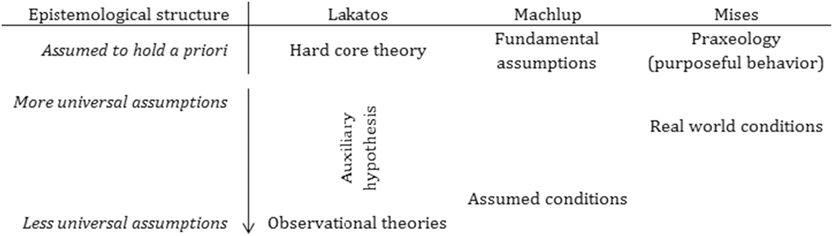
In Machlup’s methodological organization, there is a set of fundamental assumptions assessed to be universal and a priori by the scientist. The illustration of a theory is an application of the theory with general hypotheses to the predictions of a particular case. But the application of a particular case requires the presence of assumed conditions. This structure parallels that of Lakatos. Machlup’s fundamental assumptions are Lakatos’s hard-core theory, and Machlup’s assumed conditions are Lakatos's auxiliary hypothesis and observational theories. This means that in Machlup, the antecedent of this conditional reasoning is a set of fundamental assumptions plus the assumed condition: if q (fundamental assumptions + assumed conditions), then p. If its deduced effect were to be denied, the deductive conclusion is the negation of the whole set, not of a particular assumption. It is this presentation that has been interpreted as a Lakatosian framework in Machlup’s paper.
Even if Mises is not as explicit and clear as Machlup on separating fundamental assumptions from assumed conditions, it is still possible to draw a parallel between Mises’s praxeology and Machlup’s fundamental assumption, on one side, and Mises’s real-world assumptions and Machlup’s assumed conditions, on the other. And, if there is a parallel between Machlup and Lakatos, then there is also a parallel between Mises and Lakatos. It might be objected that Mises’s real-world conditions are more universal than Machlup’s assumed conditions. However, it could be said (1) that Mises’s fundamental assumptions are the set comprising his praxeology (i.e., purposeful behavior), plus real-world conditions (i.e., disutility of labor), plus his deduced economic laws, intertwined in a permanent application of this general theory to historical cases; or (2) that the assumed conditions can be of more or less generality, and that Mises was working with a more general level of assumed conditions than the sample offered by Machlup.Footnote 11 For instance, the assumption of disutility of labor is more general than the assumption of the presence of money. Disutility of labor is assumed to be present in either a barter or monetary economy. In turn, the presence of money is a more general assumption than the presence of either commodity money or fiat money. This puts Mises under the same methodological structure as Machlup. It should also be noted that Human Action is a treatise on economics, and Machlup’s piece was a paper within a specific methodological debate with detailed examples. It is to be expected that the assumed conditions in a treatise on economics will be more general than the ones present in a paper like Machlup’s.Footnote 12 The fact that none of this proves or disproves a general theory is consistent with Machlup’s philosophy of science, according to which there is no deductive proof but a humble non-disconfirmation—empirical data illustrates, rather than tests, a theory. It should be added that this illustration is, for Machlup, a characteristic shared by both natural and social sciences. Figure 1 compares Lakatos’s, Machlup’s, and Mises’s epistemology. Note that Lakatos’s distinguishes between auxiliary hypothesis and observational theories, the last two blended together in Lakatos and Mises.
Epistemological Structure: Lakatos, Machlup, and Mises.

Following Figure 1, it can be argued that Mises’s hard core is composed of purposeful behavior (praxeology) plus general assumptions such as time preference and disutility of labor. Mises’s auxiliary hypotheses could be other, less general, empirical assumptions, such as the presence of a monetary economy or the institutional framework present at any given time; for instance, gold standard or fiat money. It should be noted, however, that Mises does not present his epistemological stand on economics on these terms, and that there is no clear distinction between an empirical assumption that belongs to the hard core and an auxiliary hypothesis of a high degree of generality that a scientist is willing to let go but is considered to apply in almost all cases. It can also be the case that sometimes the same scientist (maybe unconsciously) treats the same empirical assumption as part of the hard core, and, at other times, as an auxiliary hypothesis with a high degree of universality. What is considered to be part of Mises’s hard core and what is part of his auxiliary hypothesis will probably remain open to different interpretations. The distinction we offer is intended to exemplify Mises’s thought, but we do not contend this is the only plausible way to separate hard-core empirical assumptions and auxiliary hypothesis in an author who did not mention this problem explicitly. However, to understand that economic theory for Mises includes both a priori and contingent claims is the key to understanding his epistemology and his method.
Why is there room for both interpretations (extreme and moderate a priori) of Mises? This is the result of three characteristics. The first is that some of Mises’s passages can be ambivalent if taken out of the general context of his work. The second is that Mises does not explicitly separate assumptions in different degrees of generality. By bundling fundamental and assumed conditions together, both the supporter and critic of Mises’s epistemology can be right, depending on what is understood by “a priori.” The third is that the fundamental assumptions are neither logical nor factual. This means that for a logical positivist position, they are neither a priori nor a posteriori, being free to be interpreted in either way.Footnote 13 A charitable interpretation of Mises’s own writings is not that he contradicted himself repeatedly in the same chapters when he talks about the a priori of economics and, immediately after, introduces assumptions, as Rothbard’s interpretation unintentionally concludes, but that he was implicitly working under a methodological structure similar to that of Machlup's.Footnote 14
Machlup (1955, p. 16) suggests that Max Weber’s ideal types play a central role in the social sciences and fit into this category. Ideal types and the meaning of action also play a central role in Mises’s epistemology.Footnote 15 In fact, Machlup (1955, p. 17) cites Alfred Schütz (Reference Schütz1953) to distance himself from Milton Friedman. This is a significant point, which places doubt on the interpretation that Machlup was an instrumentalist, as was Friedman. Richard N. Langlois and Roger Koppl (1991) maintain that, by referring to Schütz, Machlup points to a requirement for theories to be “understandable” in the sense that both—the observed agent and that of the social scientist—have the same understanding of the observed agent’s behavior. This “understanding” is sometimes captured with the word verstehen (borrowed from Weber) in the Austrian literature and usually referred to as methodological subjectivism, an aspect considered to be distinctive of “Austrian economics.” Methodological subjectivism does not mean that the scientific method does not matter; it means that an economic agent must subjectively understand (in his life-world) the behavior of other individuals in the same way they do. This suggests that the work of Schütz is a project worth exploring, with potential results compatible with those of this paper. This line of research was started by Donald C. Lavoie (Reference Lavoie and Kirzner1986, Reference Lavoie2011).Footnote 16 Though such exploration requires a treatment that would take us too far away from the approach in this paper, we think it is worth presenting a few insights.
For Austrians, Alfred Schütz and Helmut R. Wagner (1970) are important because they add clarity to the interpretation of intentional and rational behavior by separating “subjective meaning” and “objective meaning.”Footnote 17 The former is about the personal motivation of the actor, while the latter is about the attributed end as understood by an exogenous observer. The exogenous observer's interpretation depends on ideal types. The observer and the observed have the same mental tools—ideal types—to understand the world they share: “If a visitor from Mars were to enter a lecture hall, a courtroom, and a church, the three places would seem quite the same to him in outward appearance. From the internal arrangements of none of the three would he be able to comprehend what the presiding official was about. But let him be told that one is a professor, another a judge, and the third a priest, and he would then be able to interpret their actions and assign motives to them” (Schütz and Wagner Reference Schütz and Wagner1970, pp. 197–198).
For this reason, Schütz and Wagner (1970, p. 282) distinguish the natural from the social phenomena in which actors attach meaning to their behavior: “Social phenomena, on the contrary, we want to understand and we cannot understand them otherwise than within the scheme of human motives, human means and ends, human planning—in short—within the categories of human action.”
When Mises, for instance, defines money as a means of “indirect exchange,” he refers to the “objective meaning” of action as long the object of exchange does not have direct consumption as an end, but the object of exchange is to be used in a later exchange. A good performs as money not because of physical intrinsic qualities, but because of the meaning attached by the actors involved. Schütz contributes, then, to framing Misesian praxeology into hermeneutics and German phenomenology, especially that of Edmund Husserl and Hand-Georg Gadamer, without the need to rely on Martin Heidegger (who might have stunted Lavoie’s noble project).
A Note on Rothbard’s “Extreme Apriorism”
Rothbard’s exposition In Defense of “Extreme Apriorism” warrants two comments. First, Rothbard unequivocally states in the opening of his article that Mises’s position is not represented by that of Machlup, and that Mises is barely mentioned by Machlup. He overlooks, however, that Mises is the praxeologist Machlup quotes as an example of the methodology he is about to explain. It is not the number of times Machlup quotes Mises, but the particular places in his piece where Mises is mentioned as an example of what extreme apriorism is not. But, according to Rothbard (1957, p. 314), “Mises and ‘extreme apriorism’ go undefended in the debate. Perhaps an extreme apriorist’s contribution to this discussion may prove helpful.”
Second, soon after rejecting Machlup’s interpretation of Mises and stating that he is going to defend extreme apriorism, Rothbard (1957, p. 315) mentions the role of empirical assumptions in praxeology: “Actually, despite the ‘extreme a priori’ label, praxeology contains one Fundamental Axiom—the axiom of action—which may be called a priori, and a few subsidiary postulates which are actually empirical [emphasis in original].” Given the presence of assumptions, Rothbard (1957, p. 316) explains that it “is the task of the historian, or ‘applied economist,’ to decide which conditions apply in the specific situations to be analyzed.” This sounds similar to Machlup’s assumed conditions. Rothbard's (1957, p. 317) position is even more akin to Machlup’s if we consider what he says soon after: “We have seen that the other postulates, while ‘empirical,’ are so obvious and acceptable that they can hardly be called ‘falsifiable’ in the usual empiricist sense.”Footnote 18 And, if this is not close enough to Machlup, consider the following passage from a previous piece by Rothbard (1951, p. 944; emphasis added): “Clearly, neither Mises nor myself has ever cited ‘facts as if they provide support for his conclusions and for the axioms, postulates, and logical procedures.’ I cited facts such as ‘dollar gaps’ not as proof or test, but as illustrations of the workings of praxeological laws in (modern) historical situations.” If Rothbard acknowledges the role of auxiliary hypothesis, why does he endorse extreme apriorism as defined in the debate in which he is engaging? Rothbard (Reference Rothbard1957) does not only say he is going to defend extreme apriorism, but he also refers to himself as an “ultra-apriorist” (p. 134).
We want to make two clarifications to avoid potential confusions about what we do and do not do in this paper. First, we are not denying the axiomatic characteristic of human action in the hard core of praxeology; we sustain, like Rothbard, the presence of auxiliary hypothesis or conditional assumptions. But this implies that the method is not that of extreme apriorism as defined in the Machlup-Hutchinson debate and implicitly endorsed by Rothbard himself when he says he is going to defend “extreme apriorism” because he considers Machlup did not. To acknowledge the role of auxiliary hypothesis is a different issue from the problem of the epistemological foundations of the fundamental assumptions. It is the difference between the epistemological foundations of the “hard core” and the role of auxiliary hypothesis that Rothbard (and arguably some of his contemporary followers) does not seem to distinguish, contributing to a long-standing misunderstanding in the profession at large of what a priori means in Austrian economics. It should be noted that on the problem of the fundamental assumptions, Machlup refers to Schütz, a reference one would expect Rothbard to endorse but that he seems to have missed.
Second, we are not saying that monetary maximization (the example used by Machlup) is the central axiom. To repeat ourselves one more time, this paper is not about Machlup’s position (for instance, whether he is closer to Friedman or Mises),Footnote 19 but about the epistemological implications of Machlup’s interpretation of Mises’s epistemology. It should be patent that to use a Lakatosian framework to clarify (and update) Mises’s epistemology does not imply that, for Mises, the hard core (i.e., human action) is not a priori of (external) experience (more on this below). We do not believe that the bridge between Mises and Lakatos that Machlup offers can be crossed through Rothbard. It follows, also, that to call for the development of a “Machlupian system of economic theory” and contrast it to “Rothbard’s system of economic theory” is to confuse applied theory with epistemological problems.
The dilemma with Rothbard’s remarks is that they make Machlup’s interpretation even more plausible. To defend Rothbard’s position by mentioning his endorsement of auxiliary hypothesis implies accepting Machlup’s interpretation of Mises. Rothbard’s rejection of Machlup’s approach, contrasted with his subsequent similar but simpler exposition, begs the question of whether, in fact, it was Machlup who misunderstood Mises’s praxeology. We think the possibility deserves consideration that Rothbard might have misinterpreted Machlup, and some Austrians, through Rothbard, have misinterpreted Mises. We hope that this paper makes it clear that to criticize Rothbard’s apriorism is not the same thing as criticizing Mises’s apriorism.
III. IMPLICATIONS OF MACHLUP’S INTERPRETATION OF MISES
Three implications for Austrians and non-Austrians of filtering Mises through Machlup are: (1) Mises is closer to Hayek and Popper on philosophy of science than Rothbard’s interpretation allows; (2) Austrian and non-Austrian theory share similarities in their methodological structures; and (3) there is some question of what might have been the relationship between Austrian and non-Austrian economics had Machlup’s interpretation of Mises been seen to be at least as relevant as that of Rothbard.
Mises, Popper, and Hayek: Epistemological Friends or Foes?
Mises and Popper
For Mises (1996, p. 31), in the social sciences, there are no constants, because individuals act purposefully rather than mechanically in reacting to changes in the environment. An apple falling from a tree may always follow the same pattern, but a human apple decides when, in which direction, and at what speed to fall. Therefore, Mises (2003, p. 13) concludes that in “historical experience we can observe only complex phenomena, and an experiment is inapplicable to such a situation.” For this reason, for Mises (1996, p. 31), the laboratory approach to testing theories is denied to economics: “Complex phenomena in the production of which various causal chains are interlaced cannot test any theory [because the ceteris paribus condition cannot be imposed].” Like Machlup, this does not mean that empirical facts are useless for economic theory; on the contrary, Mises (2003, p. 31; emphasis added) maintains that “in science one cannot be too cautious. If the facts do not confirm the theory, the cause perhaps may lie in the imperfection of the theory. The disagreement between the theory and the facts of experience consequently forces us to think through the problems of the theory again. But so long as a re-examination of the theory uncovers no errors in our thinking, we are not entitled to doubt its truth.”
A contradiction between facts and theory points to a problem, but it remains unanswered from the experiment whether the problem lies in the theory, in an unquestioned fundamental assumption, or in an assumed condition particular to the case under study. The a priori categories and fundamental assumptions, however, are not open to direct verification. It is most likely, for instance, that a researcher will doubt his experiment’s results before assuming that there is no disutility of labor in his sample. In fact, the paragraph that follows the passage quoted above from Mises (2003, p 31) opens with a Popperian flavor: “On the other hand, a theory that does not appear to be contradicted by experience is by no means to be regarded as conclusively established.”Footnote 20
It is the presence of intertwined assumptions in a complex phenomenon that allows for any empirical result to be interpreted as a support of, or objection to, any given theory.Footnote 21 The Great Depression, for instance, is interpreted differently by Austrians, Monetarists, and Keynesians, even if they share the exact same information, because data, in either natural or social sciences, confront the theory-laden problem. The fundamental and assumed conditions can differ such that each group of scientists interprets the same event in support of a given theory and as a challenge to others. This disagreement cannot be solved empirically because the difference lies in diverse assumptions that go unquestioned by each point of view, not in differences in the data. It is understanding (data interpretation), not information (data), that differs; it is because of different (theory-laden) knowledge that theory affects how information is interpreted.
Mises’s position was more complex than just opposition to the use of empirical facts to aid economic theory. First, the nature of economic phenomena does not allow the testing of economic theories, due to reasons that can be interpreted in Machlup’s terms. Second, a contradiction between empirical facts and theory implies that the economist must consider revising his theory, rather than rejecting the empirical result offhand. But Mises did not hold a naive position with respect to empirical falsification. Pure theory, fundamental assumptions, and assumed conditions are intertwined in a manner that makes an empirical test unable to identify which auxiliary hypothesis was falsified. Third, there is no such thing as a conclusively established theory, no matter how a priori economic the categories are, not only because a non-disconfirmation of the fundamental assumption is not conclusive, but also because the philosophical foundations of the fundamental assumptions are always open to discussion. This not only puts Mises closer to Popper than the extreme a priori position would imply, but it also supports Machlup’s reading of Mises.
In later writings, Mises (1962, pp. 69–70) does in fact refer to Popper to argue that economics cannot follow the empirical falsification prescription that a hypothesis must be dropped when it is contradicted by empirical facts. But Popper’s position is more subtle and similar to Mises’s than the latter seems to realize (Champion Reference Champion2011; Di Iorio 2008; Sarjanovic Reference Sarjanovic2008). Popper (1974, sec. 12; 1983, ch. 1) clearly stated that falsification does not imply an automatic negation of the hypothesis because of the conjunction between the hypothesis and the initial conditions.Footnote 22 Mariano Artigas (1998, sec. I.1), for instance, has called the very spread of Popper’s so-called naive-falsificationism one of Popper’s “legends.”Footnote 23 In addition, Popper’s (2002b, ch. 4) treatment of social sciences is consistent with Machlup and Lakatos. Popper’s general conjectures can be interpreted as Machlup’s fundamental assumptions, initial conditions as assumed conditions, and the prediction as the deduced effects.
Mises and Hayek
Hayek's (1958, pp. 33–56) criticism of Mises’s a priori position also contributes to the extreme aprioristic interpretation of the latter. To argue that the economy moves toward equilibrium, Hayek argues, requires assuming that entrepreneurs learn from their mistakes, which is not a priori true.Footnote 24 This is why, for Hayek (1958, p. 91), “[t]o assume all the knowledge to be given to a single mind in the same manner in which we assume it to be given to us as the explaining economist is to assume the problem away and to disregard everything that is important and significant in the real world.” In the absence of perfect knowledge, the entrepreneurs must learn how to correctly read the market and learn from mistakes.Footnote 25 And, when Mises maintains that the market moves toward equilibrium a priori, then he is assuming a specific degree of entrepreneurial learning. Either way, whether knowledge is learnt or given is not an a priori condition, but an assumed condition.Footnote 26 Hayek’s point adds to the problem that data observation is theory-laden—the problem of knowing the meaning of the human actions observed. Economic data are the result of, and are subject to, the meaning individuals attach to their actions. To take this position means that there is no such thing as objective data, and the economist should talk about empirical illustration rather than empirical evidence.
Nonetheless, in the same paper, Hayek (1958, p. 47; emphasis added) holds a similar position to that of Mises when he maintains that “in the field of the Pure Logic of Choice our analysis can be made exhaustive, that is, while we can here develop a formal apparatus which covers all conceivable situations, the supplementary hypothesis must of necessity be selective, that is, we must select from the infinite variety of possible situations such ideal types as for some reason we regard as specially relevant to conditions in the real world.”
As long as the movement toward equilibrium is taken for granted, then the learning assumption Hayek refers to is a fundamental assumption rather than an assumed condition. However, to criticize Mises’s position on the grounds that he argues economics is a priori of the extreme kind when, in fact, he is implicitly assuming learning is different from criticizing Mises because among his fundamental assumptions he (may have) overlooked learning. The former criticism implies a rejection of the methodological structure; the latter implies adding a new assumption. In such a case, Hayek would be contributing to Mises’s epistemological structure rather than rejecting his approach. There is a widespread interpretation that Hayek and Mises hold different, if not opposite, epistemological positions.Footnote 27 But, in two letters by Hayek to Hutchison, quoted in Caldwell (2009, pp. 323–324; emphasis added), Hayek maintains that Mises saw no conflict between Hayek’s paper and praxeology: “But the main intention of my lecture was to explain gently to Mises why I could not accept his a priorism. Curiously enough, Mises, who did not readily accept criticism from juniors, accepted my argument but insisted that it was not incompatible with his view which, by implication he restricted to what I called the Logic of Choice or the Economic Calculus.”Footnote 28 This supports the interpretation that Mises did not see a conflict between his own epistemology and Hayek’s paper, but that Mises did not use an explicit term such as “auxiliary hypothesis,” as Hayek did.
It is not that Hayek is closer to the Rothbardian Mises’s position than is usually assumed, but that Mises’s position was, in fact, according to Machlup’s reading, closer to Hayek than at least Hayek seems to have acknowledged. Given Mises’s response to Hayek, it seems a Mises-Machlup interpretation would be a more accurate description of Austrian epistemology than the usual Mises-Rothbard approach.
How Far Away from Post-Popperian Epistemology Is Austrian Economics?
The Historical Turn: Popper-Kuhn-Lakatos-Feyerabend
Post-Popperian epistemology is characterized by the Popper-Kuhn-Lakatos-Feyerabend debate. While, certainly, differences between these authors are clearly present, these authors build on each other through a common line that connects them. It is just as wrong to envision Popper-Kuhn-Lakatos-Feyerabend as an homogenous group as it is to envision two groups (Popper-Lakatos versus Kuhn-Feyerabend) without points in common. The debate should be understood as a four-stage process and not just as a clash of two positions (Bird Reference Bird, Psillos and Curd2008; Carrier Reference Carrier and Robert Brown2012; Nola and Sankey Reference Nola and Sankey2000; Zanotti Reference Zanotti and Dolfi2006, Reference Zanotti2009). Popper (2002c, pp. 66–67) offers the seed for Thomas S. Kuhn’s paradigms and normal science when he recognizes that science begins with “myths” and that theories are built under a definite theoretical framework. Popper’s criticism is not aimed at Kuhn’s paradigms per se, but at what he sees as Kuhn’s relativism. Lakatos’s hard core supplies a definite set of assumptions and preconceptions that defines different paradigms. Lakatos provides, as it were, the missing base in Kuhn’s paradigms. However, because the hard core is taken as given, Paul Feyerabend points out that the debates between different paradigms is an exercise of persuasion, not of empirical testing. While it is true that Lakatos tries to save Popper’s falsability and Kuhn and Feyerabend do not, it is contestable that the latter reject rationality and embrace a relativist “anything goes.” These authors are open to epistemological pluralism (different paradigms), which is not the same as being skeptical about science practice. The Popper-Kuhn-Lakatos-Feyerabend episode is referred as the “historical turn” because all of them introduce the history of science as a protagonist in the philosophy of science. It is in this sense that these four authors should be understood together as an evolving debate, but neither as an homogenous group nor as two opposite groups.
If Mises’s epistemology is a central reference for Austrian economics, and if Mises fits well into a Lakatosian structure, how far away from post-Popperian epistemology is Austrian economics? If the non-Austrian critique of Austrian economics is built on epistemological concerns, and these concerns become ill-founded if we take Machlup’s reading as plausible, then the relation between Austrian economics and post-Popperian epistemology must be revised.
The tension between Austrian economics and empirical experiments is well known. But, after the Popper-Kuhn-Lakatos-Feyerabend debate, it is not so clear that empirical experiments are the correct approach to assess a scientific theory. Popper argued that there is no data analysis that can be independent from theory, introducing the theory-laden problem: the test has meaning only by assuming the hypothesis to be tested. Economic indicators, for instance, are built within a given theoretical framework: Keynesian-inspired macroeconomics. How much confidence does an empirical confirmation of a Keynesian model using Keynesian-inspired indicators provide? Or, how much confidence does an empirical rejection of an Austrian theory using Keynesian-inspired indicators provide? It is theory that points out what should be considered relevant data in the first place, and because Böhm-Bawerk’s capital theory was set aside by non-Austrian economics, proper economic indicators related to theories such as the Austrian business cycle theory are not readily available. The fact that fundamental aspects of Austrian economics do not find a place in non-Austrian models does not make the Austrian theory wrong any more than it makes these models incomplete.
Additionally, Kuhn (Reference Kuhn1996) argued that data interpretation, not only data selection, was dependent on the theoretical content in different paradigms, and that the same terms can mean different things to different scientists. Empirical tests, according to Kuhn, may work inside a paradigm, but cannot resolve a dispute between theories from different paradigms because the test must take the paradigm for granted; therefore, the paradigm is not testable. And it is the paradigm that defines what are to be considered interesting questions and passes for a scientific answer.
Lakatos (1999, ch. 1) argued that scientists embrace a nucleus surrounded by a protective belt of assumptions. And, just as Machlup posits, this imposes a challenge to the problem of verification in economics because a theory cannot be tested independently of empirical assumptions. It is not only a problem to identify which assumption failed; no less a challenge is the fact that some assumptions are not observable. For instance, as Lachmann (Reference Lachmann1943) and Mises (Reference Mises1943) discussed, the Austrian business cycle theory assumes that expectations behave in a particular way with respect to changes in interest rates; expectations, however, cannot be observed.
Feyerabend (2010, chs. 1, 2), then, concluded that because the hard core is taken as given, it is not through empirical tests, but through persuasion and critical discussion, that scientists convince each other.Footnote 29 In a debate between paradigms, each group uses its own paradigm to argue its case; but empirical evidence does not work in deciding between paradigms, owing to the different sets of fundamental assumptions adopted by each paradigm. Scientists must resort to persuasion. The scientists must deal with theory versus theory, rather than with theory versus data.
Certainly, the Austrians have not been prone to use empirical data to test their theories in a logical positivist fashion, but their empirical work is in accordance with Machlup’s illustration and Hayek’s pattern predictions, and not as far away from post-Popperian epistemology as the critique influenced by the Rothbardian reading implies.
If Mises and Austrian economics can be framed in post-Popperian epistemology, what can be said about Austrian and non-Austrian economics as two different paradigms?
“Austrian” Economics and “Non-Austrian” Economics as Two Different Paradigms
Mises (1996, p. 38) uses geometry as an example to defend aprioristic reasoning: “All geometrical theorems are already implied in the axioms. The concept of a rectangular triangle already implies the theorem of Pythagoras. This theorem is a tautology, its deduction results in an analytic judgment. Nonetheless nobody would contend that geometry in general and the theory of Pythagoras in particular do not enlarge our knowledge.” Mises’s use of geometry as an example provides a simple but delicate case to represent his epistemological position. His example is inaccurate; geometry is not detached from empirical content and therefore is not pure tautology.Footnote 30
In Euclidean geometry, we know a priori from experience that the sum of the internal angles of a triangle is equal to 180 degrees. However, this result does not hold in non-Euclidean geometries. The difference between Euclidean and non-Euclidean geometries is the assumed type of surface; a plane surface results in Euclidean geometry, and non-plane surfaces result in non-Euclidean geometries. But the type of surface is not known a priori; it is either observed or assumed.Footnote 31 Still, one does not claim a refutation of Euclidean geometry if a measurement of the internal angles of a triangle does not equal 180 degrees. Any sort of explanation will be accepted before concluding that Euclidean geometry has been falsified. The introduction of assumed real-world conditions does not affect the aprioristic characteristic of economics, just like the assumption of the type of surface does not change the aprioristic characteristic of geometry.
It is in this sense that there is a parallel between praxeology and geometry: a set of a priori categories that are necessarily true plus a plane surface as an empirical assumption. The geometry example brings to the surface the question of from where the empirical assumptions come. In the case of geometry, the answer can be inferred from observation or assumed.Footnote 32 In Mises, however, it is neither of them; the assumption of purposeful behavior—free will—comes from inner, rather than outer, observation.Footnote 33 The concept of human action is open to discussion in the sphere of philosophical anthropology, not in the sphere of empirical testing.
The geometry example also allows one to put Austrian and non-Austrian economics side by side. If a different Lakatosian core is what underlies different Kuhnian paradigms, then Austrian and non-Austrian economics are like two economic geometries that assume a different type of surface as part of their hard core. The distinction, for instance, between a Monetarist and a Keynesian is different from the distinction between an Austrian and either of them. The Monetarists and Keynesians share the same paradigm, or economic-geometry view of the world (two sub-paradigms inside the non-Austrian paradigm), but the Austrians see the world through glasses with a different economic-geometry.Footnote 34 This is why communication between Monetarists and Keynesians is easier than communication between either of them and Austrians.Footnote 35
This puts the relation between Austrian and non-Austrian economics in a different light from that usually adopted. First, the non-Austrian is just as aprioristic as Mises and the Austrians are; what differs is (1) what is considered to be a priori, and (2) a much less logical positivism attitude in the Austrians than in the non-Austrians. Non-Austrians, however, do not object to Austrians' apriorism and then turn to an empirical experiment to see if demand curves slope downward. A non-Austrian economist will look for any other possible explanation before claiming he has empirically refuted downward slope demand curves. But this also means that the critic of Austrian economics who feels comfortable referring to geometry as a priori should not object to the a priori terminology per se in Austrian economics.
Second, since Austrians and non-Austrians work under different paradigms constructed over a different set of non-observable fundamental assumptions, the debate between Austrian economics and non-Austrian economics is not, or should not be, an empirical one, but a foundational one. The underlying question is which economic-geometry—the Austrian, the non-Austrian, or a third one—is a more plausible reflection of the real world. This is not a problem that can be solved empirically, since this requires assuming that certain empirical conditions hold, exactly the same position that is used to criticize the extreme aprioristic version of Mises. The debate between Austrians and non-Austrians comes down to a persuasion exercise through empirical work that illustrates how each paradigm works. It is no accident that Austrians insist on the reality of the assumptions used in economic theory. It should be noticed, however, that to distinguish between assumptions that are part of the hard core or part of the auxiliary hypotheses is not always a straightforward exercise.
It may be objected that while Austrian economics can be interpreted as a continuation of the classic tradition of economics as the study of spontaneous order, non-Austrian economics implied a paradigmatic shift into the New Economics, and therefore that economic science has moved forward.Footnote 36 It should be noted, however, that because a paradigm is built on unquestioned fundamental assumptions, some of which may not be observable, and that a paradigmatic shift is the result of a persuasion exercise and not the result of decisive empirical tests, nothing guarantees that a change in paradigm is a step forward towards a real reflection of the economic phenomena; it may just as well mean a step back.
If Austrian economics can be interpreted as a continuation of the classic spontaneous order tradition, and if the aprioristic characteristic of economics was not an invention of Mises, what, then, was his contribution?Footnote 37 Using once more the geometry example, Mises’s contribution to economic epistemology was similar to that of Euclid’s. Mises’s epistemology consists in suggesting an ultimate given—purposeful behavior—for the epistemology of economics. He might be right or wrong in identifying purposeful behavior as an ultimate given, but this is where he departs from those who intended to base economics on empirical grounds without a clear a priori ultimate given.Footnote 38
This parallel between Austrians and non-Austrians can be extended to clarify the point. Leeson (2012, p. 189) argues that Gary S. Becker (Reference Becker1976, Reference Becker1993) has an approach similar to that of the Austrians’. Becker's (1993, p. 386) assertion that economic “analysis assumes that individuals maximize welfare as they conceive it, whether they be selfish, altruistic, loyal, spiteful, or masochistic” sounds very Austrian. There is, however, an important distinction to be drawn, which is the concept of rationality used by Austrians and non-Austrians. This difference, which may seem trivial at first sight, is the kind of divergence that can result in communication barriers and can be the reason why a change in auxiliary assumptions is considered plausible by one paradigm but as an ad hoc position for another paradigm. Rationality, after all, is what defines what is to be taken as an accepted behavior by economic agents.Footnote 39 In other words, Mises’s economic-geometry is different from Becker’s economic-geometry, even if in some cases they yield similar results, just like Euclidean geometry may be a good enough approximation in a small piece of a curved surface but fails to accurately fit into a larger scale.
Theories as Illustration of Economic Phenomena
Boettke and Leeson (Reference Boettke, Leeson, Boettke and Leeson2006b), Boettke (Reference Boettke and Boettke1998), and Horwitz (2012) discuss the role of empirical work in Austrian economics. Their discussions, however, do not present the empirics of Austrian economics in the context of Machlup’s work or post-Popperian epistemology, as we do above. This enables the important distinction between the hard core and the assumed conditions to remain hidden. Two examples can demonstrate the illustrative characteristic of economic theories as envisioned by Machlup and Mises.Footnote 40
Boettke (Reference Boettke and Stringham2005) identifies the literature on self-governance as a progressive research program of contemporary Austrian economics. This literature applies Austrian and Hayek’s ideas on spontaneous order to illustrate how an endogenous mechanism of self-governance can yield economic and social order without the presence of a central authority like a state. Some applied cases are the study on endogenous rules in the Amsterdam stock exchange in the seventeenth century, economic order in stateless countries such as Somalia after the state collapse in 1991, and the emergence of informal rules that govern the social interaction among criminals such as pirates and prison gangs.Footnote 41 This literature makes use of general principles of Hayekian spontaneous orders next to varying empirical assumptions that are specific to the cases under examination. The authors working in this research program also see in Elinor Ostrom’s work a similar application of Austrian and Hayek’s ideas to their own work. While there is a core of common assumptions in these different applications, the particular assumed conditions vary as needed. The approach in this literature is to use the case studies as illustrations of the theories used.
The 2008 financial crisis renewed the interest in the Austrian business cycle theory (ABCT) among non-Austrian economists.Footnote 42 The ABCT, however, can be traced back to Mises (1981, part III, ch. VI). The ABCT was used by Hayek (Reference Hayek1967, Reference Hayek1933) and Robbins (Reference Robbins1971) as a challenging theory to that of Keynes as an explanation of the Great Depression. There is almost a century between 1912 and the 2008 financial crisis. It is to be expected that some of the original empirical assumptions must be revised if the theory is to be applied to modern events. Callahan and Horwitz (Reference Callahan and Horwitz2010) argue that the ABCT is built with assumptions and ideal types of different levels of generality. The canonical version of ABCT assumes, for instance, a gold standard and is silent with respect to risk exposure, a problem identified as a key aspect of the 2008 crisis. Cachanosky (2012a) and Andrew T. Young (2012) offer versions of the ABCT with modified assumed conditions regarding the monetary institutions and risk that updates the theory to contemporary market conditions. By assuming fiat currencies and exchange rates, rather than an international gold standard, Cachanosky (2012b) and Hoffmann (Reference Hoffmann2010) offer an international application of the ABCT with a better fit to the events of the 2008 crisis than the canonical version of the ABCT allows. Young (2012) modifies Roger Garrison's (Reference Garrison, Rizzo and White2002) ABCT model to explicitly account for risk and offers a better application of the theory to the events that led to the 2008 crisis. These modifications are on the assumed conditions, and not on the core of the theory; these versions of the ABCT are variations on a theme, not alternative theories.
It is not, then, that Austrian economics is anti-empiric. On the contrary, it is quite empiric. What Austrian economics does not do is take a logical positivist position, which is not the same as being anti-empiric. The contemporary work in Austrian economics, such as the one discussed above, is a clear exercise of taking pure theory into the realm of applied theory and empirical work (either in the form of historical case studies or applied statistics). Pure theory opens the door to relevant empirical questions. Those empirical questions require an empirical answer; theory can give the framework to answer the question, but it cannot give the empirical answer. What Austrians traditionally object to is the use of these empirical answers to question the hard-core building blocks of economic theory, not because the hard core cannot be questioned, but because, for Austrians, that is an epistemological problem, not an empirical one.
What if Machlup’s Interpretation Had Received More Attention?
We conjecture that if Machlup’s interpretation had received more attention by both Austrians and non-Austrians, the Austrian parallel economic world would not have lost its relevance and more gains from trade could have taken place between the two paradigms. Austrian economists played a central role in the development of post-marginal economic theory. Austrians’ key role in central debates such as the problem of economic calculation under socialism, capital theory, and business cycles are probably the most well known. Especially after the Austrian revival in 1974, communication between Austrians and non-Austrians could have been much more productive. Cases such as Oskar Morgenstern (Mises’s student), who was a protagonist in the development of game theory, or the strong Austrian presence in Robbins’s (1945, sec. I, II, III) influential work on the nature of economic science, come to mind. Had the Austrians followed Machlup’s lead rather than Rothbard’s, their economic approach would not have been considered too idiosyncratic to have been taken seriously.
However, we believe that this parallel Austrian world could not have avoided two problems. The first problem was the clash with the philosophy of science prevalent in 1955; it was the time of Hempel, Nagel, and Friedman, whose focus was on the justification context. Popper's (2002a, chs. I–V) The Logic of Scientific Discovery had not been translated to English yet and the Popper-Kuhn-Lakatos-Feyerabend debate had not even started. The second problem was the clash with logical positivism, still present in contemporary economics.Footnote 43 It was the Popper-Kuhn-Lakatos-Feyerabend sequence that showed the problems of logical positivism. Machlup was ahead of his time, and this could have been the problem in 1955.
Mises, rather than being the extreme aprioristic thinker as defined by Rothbard and ridiculed by Blaug, could have been another case of the Beckerian economic way of looking at human action. Mises’s position may have been found challenging, but not unacceptable. The separation between the so-called Misesians and Hayekians would not have taken place. It would be more natural to read Mises as a Hayekian and Hayek as a Misesian who continued Mises’s research program. The Lakatosian structure in Machlup would have allowed Austrians to connect, and present their work, with non-Austrian economics, rather than being seen as poles apart.Footnote 44
IV. CONCLUSIONS
The implications of seriously considering Machlup’s interpretation of Mises as an alternative to Rothbard’s go beyond a mere exercise in the history of economic thought.
For Austrians, Machlup’s interpretation poses two challenges. The first challenge is to re-evaluate what should be understood as the a priori in economics. Rothbard’s extreme apriorism is outdated, if not inconsistent. The second challenge is that, even if Austrians have not fallen for the logical positivist turn, attempts to phrase Austrian epistemology in post-Popperian terms should not be abandoned. As we have tried to show in this paper, standing on the wrong epistemological shoulders has significant consequences. Recent attempts to apply Lakatos to Mises and Austrian economics have failed or fallen short, owing to the Rothbardian influence and to the need to rebuild the work already done by Machlup.
For non-Austrians, Machlup shows that to criticize Austrians on the grounds of their apriorism invites the same criticism. Feyerabend’s ironic passages concerning such attitudes should be a warning. Blaug’s passage that exemplifies a common attitude towards Austrians is simply ill-founded if Machlup’s interpretation of Mises is accepted as plausible. Conversations between Austrians and non-Austrians cannot yield a fruitful outcome if the outdated and untenable extreme apriorism of Rothbard is criticized with an equally outdated and untenable logical positivist point of view. Non-Austrian logical positivists may want to criticize Austrians for not being logical positivists, but they cannot criticize Austrians on the ground of following an old and no longer accepted philosophy of science.
Once these implications are taken into consideration, and once the protagonists of both paradigms can understand why and how they differ, then gains from intellectual trade can be reaped. Machlup’s illustrations and Hayek’s pattern prediction can become tools of inter-paradigm persuasion once it is acknowledged that there is no such thing as empirical evidence for theories, only empirical illustration of theories, and that the underlying debate is about which paradigm offers a more plausible representation of economic phenomena.