The spread of free trade agreements (FTAs) raises concern about the standards devised to determine who qualifies for preferential treatment in an FTA, known as rules of origin. Barton and colleagues caution that “bilateral arrangements could ultimately undermine interest in more global trade relations … and strict rules of origin may exacerbate the diversion of trade that arises from such preferential access.”Footnote 1 Gilpin considers regionalization “a very important challenge to the WTO trade regime” because FTAs “employ industry-specific ‘rules of origin’ to restrict imports.”Footnote 2 Mansfield and Milner expect FTAs to be less liberalizing than customs unions, “since elaborate rules of origin … are necessary to enforce [an FTA].”Footnote 3
Although rules of origin have gained salience recently, they are easily seen as arbitrary technicalities because of their esoteric nature. Rules of origin mainly operate on the basis of tariff classification shifts: a product earns preferential treatment if it has a different Harmonized Tariff System (HTS) classification than its imported inputs at a specified statistical level.Footnote 4 Alongside the change in tariff code standard there can be additional value content or technical process tests. In a value content test, such as the requirement in the North American Free Trade Agreement (NAFTA) that automobiles contain 62.5 percent originating materials, a minimum share of final value must be produced in the FTA to qualify for preferential treatment. A technical process test grants preferential treatment when specific stages of manufacturing occur inside the FTA: for example, “yarn forward” or “triple transformation” rules allow apparel to be traded freely only when FTA countries undertake all stages of production from yarn to fabric to cloth.
Whether rules of origin demonstrate empirical regularities remains unknown because systematic analysis of their determinants is scant. This article suggests that these regulations can be understood in terms of the incentives for industry groups to seek rules of origin of varying restrictiveness. I argue that industry demands for rules of origin respond to a policy variable—the level of external trade protection—and two technological variables—the returns to scale in production and the extent of multinational supply chains. In brief, highly protected industries are likely to favor strict rules of origin to alleviate adjustment costs from trade liberalization in an FTA; industries with large returns to scale tend to prefer tough rules of origin to block foreign firms from fragmenting the FTA market and hindering cost reduction; and industries dependent on offshore procurement generally want lenient rules of origin to accommodate foreign sourcing of inputs.
The article tests these propositions by examining how characteristics of U.S. industries conditioned the rules of origin in NAFTA. Because NAFTA provided a template for future FTAs, the factors underlying the structure of its rules of origin are likely to operate in other FTAs involving the United States, if not more widely. Using a two-stage Tobit model with instrumental variables to correct for endogeneity in the determination of preexisting trade barriers, I find that NAFTA rules of origin were more restrictive the higher the level of trade protection and the larger the returns to scale, and more permissive the greater the involvement in cross-border production. The results suggest that tough rules of origin help to neutralize dissent from heavily protected industries and gain the support of industries with large returns to scale, but risk alienating industries with multinational supply chains. By illuminating domestic influences on rules of origin—an important policy area that has not been previously examined—the article provides useful implications for the politics of FTA ratification.
Along with technological considerations, organizational and institutional factors also are likely to affect rules of origin. If the political influences on rules of origin parallel the determinants of trade protection generally, then rules of origin should be tougher in geographically concentrated industries, large industries with manufacturing operations in many electoral districts, and industries with institutionally powerful representatives. In the empirical models, however, rules of origin were less restrictive in geographically concentrated and large, politically decentralized industries. At least for U.S. industries in NAFTA, hypotheses about the politics of who gets protected explain tariff and nontariff barriers better than rules of origin. This article therefore leaves organizational and institutional sources of industry influence over trade agreements as a puzzle for future research.
Trade and Domestic Politics: Who Gets Protected?
The study of trade protection focuses on two issues: What do industry groups want and how are they organized? What industry groups want follows the distributional effects of trade: in the short run, when factors of production are relatively fixed, import-competing specific factors prefer more trade protection than export-oriented specific factors.Footnote 5 When industries face import competition, multinational linkages through intrafirm trade mitigate protectionist pressures.Footnote 6
Because the trade preferences of industries have been extensively developed, recent research examines organizational and institutional factors. Busch and Reinhardt propose that industry mobilization increases with geographic concentration because closeness reduces collective action costs; consistent with this hypothesis, they show that the incidence of nontariff barriers in the United States increases with geographic concentration.Footnote 7 Others counter that an industry's distribution across political boundaries matters more than spatial proximity because groups must be spread across many electoral districts to influence representatives in majority-rule systems.Footnote 8 In this vein, McGillivray suggests that large, politically dispersed industries wield greater influence than concentrated ones, though her empirical model reveals higher tariffs for both types of industries.Footnote 9 Still others emphasize the location of industry in relation to institutional sources of power such as majority party status, seniority, and committee assignments because representatives can use agenda control and committee membership to channel protection to favored groups, particularly when parties are weak. For example, Hansen finds that industries represented by congressional Democrats on the House Ways and Means Committee are more likely to prevail in trade remedy decisions.Footnote 10
Whether forms of protection such as rules of origin respond to the same influences is unclear. Generally speaking, rules of origin are redistributive, so policymakers have incentives to manipulate them in response to domestic pressures. They also can be made product-specific, as trade negotiators need not set a uniform standard to determine which goods qualify for preferential treatment. The ability to differentiate rules of origin to a product's unique characteristics allows trade negotiators to devise measures that please industry groups. Moreover, their complex and technical nature, which obscures how many and to whom rents have been redistributed, elegantly satisfies Magee, Brock, and Young's “principle of optimal obfuscation.”Footnote 11 Thus, there is reason to expect that industry lobbies influence the design of rules of origin. How they do this is the subject of the next section.
Theory and Hypotheses
The analytical approach develops hypotheses about the motives for industries to lobby to influence rules of origin in identifiable ways. Insights into the political determinants of who gets protected—namely, the organization and institutional factors reviewed in the last section—inform the empirical analysis later in the article. But the theoretical framework focuses squarely on the demand side.
The hypotheses in this article build from two assumptions: first, industry groups lobby to influence the rules of origin until the marginal benefit of political activity ceases to exceed its marginal cost; second, rules of origin restrictiveness is correlated with the direction and intensity of this lobbying effort, other things being equal.Footnote 12 Connecting industry preferences to policy outcomes in this way further supposes that trade negotiators are sensitive to industry pressures and that rules of origin are determined unilaterally, not strategically.
The expectation that trade negotiators know industry preferences and try to satisfy them is not farfetched. Since trade negotiators usually lack the technical understanding to grasp the practical differences between different rules of origin, they tend to rely on industry representatives for advice. More generally, industry pressure in the negotiation phase informs trade negotiators about how the terms of an FTA will affect future lobbying on domestic ratification. The need for industry backing to ratify an FTA means that “trade negotiators look for particularized benefits they can offer important industries in exchange for their support.”Footnote 13 As a U.S. trade official explains, “[w]e sit down and evaluate who will be pissed off or will support this” in an effort to persuade legislators that “we have all these important sectors on board, and the sensitive sectors are quiet.”Footnote 14 Trade negotiators therefore have incentives to be responsive to industry groups because minimizing domestic opposition improves the chances of legislative approval of an FTA.
By comparison, the presumption that rules of origin are set unilaterally is descriptively inaccurate. Because my purpose is to develop hypotheses about industry lobbying, I omit interstate bargaining for simplicity. Where industry preferences in prospective FTA members align, the omission is not problematic; it is when national interests diverge that strategic interaction comes to the fore. To the extent that conflicting national preferences are compromised or traded off in interstate negotiations, industry lobbying in the domestic sphere may have less influence on the terms of an FTA. However, the omission will not bias the estimated effects of industry preferences on rules of origin as long as strategic factors are not correlated with the main explanatory variables—and it is not apparent that they should be.
Before identifying the key influences on industry preferences, I will clarify what is to be explained: rule of origin restrictiveness. Rules of origin can be viewed on a continuum of trade restrictiveness, as represented in Figure 1. Different points on the continuum have different implications for the production strategies of firms using inputs from outside the FTA—“nonoriginating materials” in the jargon of trade law—because rules of origin influence private choices about where to procure, process, and assemble intermediate goods. At one end of the range, permissive rules of origin allow trade deflection: firms using nonoriginating materials can export to the least protected market and transship freely inside the FTA. At the point where rules of origin are just restrictive enough to prevent trade deflection, the effect is to induce firms using nonoriginating materials to source more inputs inside the FTA. Toward the other end of the range, prohibitive rules of origin lead firms using nonoriginating materials to forgo the benefits of tariff preferences in the FTA because compliance is too costly.
Rules of origin restrictiveness

How industry groups value these potential outcomes provides the basis for testable hypotheses about the demand for rules of origin. In the theoretical argument, three factors are critical to industry lobbying: the level of trade protection toward countries outside the FTA, the size of the returns to scale in production, and the dependence of FTA producers on multinational supply chains.
External Trade Protection
External trade protection influences industry preferences on rules of origin for two reasons. The first is trade deflection: tariff-protected industries have incentives to seek rules of origin that prevent outside imports from entering via FTA partners. The second is circumvention: industries with antidumping and countervailing duty orders, safeguards, or quotas have incentives to seek rules of origin that deter outsiders from evading extant nontariff barriers by producing inside the FTA. While the effects are the same, I discuss each separately.
Starting with tariffs, the benefits of restrictive rules of origin to block trade deflection are greater the higher the tariff. When tariffs are low, transshipment from elsewhere in the FTA is less likely and downward price pressure after the liberalization of trade with FTA partners is minimal anyway; correspondingly, the incentives for domestic producers to seek tough rules of origin are low. As tariffs rise, however, rules of origin that block trade deflection segment FTA markets and prevent the equalization of prices in the FTA, generating rents for both intermediate and finished goods producers. In these circumstances, restrictive rules of origin create “hidden protection” for intermediate goods by encouraging finished goods producers to shift procurement from low-cost sources outside the FTA to high-cost FTA suppliers. Finished goods producers also gain protection to the extent that foreign rivals forgo cheaper sources of supply outside the FTA and buy more inputs from FTA suppliers to satisfy the rules of origin.Footnote 15
In principle, producers of both intermediate and finished goods may be eager for as much protection as they can get (except when they operate multinational supply chains, as noted later in this section), so prohibitive rules of origin are better than ones that merely restrict transshipment and induce increased FTA procurement by outsiders. But the additional lobbying expenditure to achieve this outcome is worthwhile only when tariff protection is significant. For outsiders, the opportunity cost of not satisfying rules of origin is a function of the tariff preference lost by producing with too many nonoriginating materials; the incentive to comply with rules of origin to save on tariff payments therefore rises with the tariff. As a result, the higher the tariff, the tougher the rules of origin must be to discourage outsiders from satisfying them. This means that the rents FTA producers earn from additional restrictiveness in the rules of origin increase with the size of the tariff. Thus, industry groups will seek more restrictive rules of origin the higher the tariff on their goods.
Nontariff barriers affect the demand for rules of origin similarly. Here the risk for FTA producers is circumvention of national nontariff barriers by foreign competitors, since most nontariff barriers are country-specific. For example, suppose the United States places antidumping duties on semiconductors from Japan, while Mexico has no nontariff barriers on semiconductors from any source. In this scenario, Japanese producers could try to circumvent U.S. antidumping duties by exporting semiconductors to Mexico and transshipping them to the United States—indeed, this can occur whether or not the United States has an FTA with Mexico. An FTA, however, enhances the incentives for circumvention: if rules of origin are too lax, Japanese semiconductors exported to Mexico could be assembled into consumer electronics and then sent to the United States as a different article of commerce, evading the antidumping order on the imported input while trading the finished good freely within the FTA. In this case, tough rules of origin would compel consumer electronics producers in Mexico to buy U.S.-made semiconductors instead of Japanese ones to qualify for preferential treatment, bolstering nontariff protection for the U.S. semiconductor industry.
Officially, FTA rules of origin are unrelated to the enforcement of trade remedy laws: separate “marking rules” determine country of origin when products are made in multiple locations or composed of imported inputs. Originating status therefore does not release a product from applicable nontariff barriers against non-FTA countries. But in practice there are several reasons why an FTA enhances the risk of circumvention. First, most FTAs permit self-certification of country of origin by the manufacturer or the importer, creating opportunities for cheating. Second, FTAs have no common enforcement of antidumping and countervailing duty orders, safeguards, or quotas, so it is challenging for national authorities to trace the value of nonoriginating materials in merchandise imported from FTA partners. Third, as imports increasingly contain foreign inputs, national authorities face greater difficulty administering separate customs regimes for FTAs and trade remedy laws. As a result, marking requirements are less likely to detect foreign content in products satisfying FTA rules of origin.
This reasoning suggests that national nontariff barriers also influence industry lobbying on rules of origin. The tougher the rules of origin, the higher the compliance costs of satisfying them; the higher the compliance costs, the more likely it is that outsiders will decline to produce and/or buy more inside the FTA. The marginal benefit of additional restrictiveness in the rules of origin therefore increases with the level of nontariff protection.
H1:
The higher the level of external trade protection, the more restrictive the rules of origin that industry groups will seek.
Returns to Scale
The returns to scale in production affect industry preferences on rules of origin because the benefits of an FTA depend on the size of the scale economies that producers gain as the market is opened.Footnote 16 An FTA helps producers gain scale economies in two ways. First, free trade encourages firms to concentrate production for the entire FTA at fewer locations. If there are unexploited economies of scale, expanding output or consolidating fragmented operations reduces unit costs; these benefits of restructuring after an FTA is formed increase the larger the returns to scale. Second, FTAs retain trade barriers against non-FTA countries. This allows producers in the FTA to internalize the cost-reduction effects of access to an enlarged, preferential market—as long as new entry does not fragment this market.
Because industries with large returns to scale have the potential to gain more from an FTA than industries with constant returns to scale, the gains from prohibitive rules of origin are larger. Generally speaking, the incentives to exclude outsiders from investing in an FTA, as Froot and Yoffie demonstrate, are greater in the presence of scale economies.Footnote 17 When returns to scale are large, an increase in the market share of foreign rivals reduces opportunities for FTA producers to concentrate production. Prohibitive rules of origin provide a means to restrain entry because high compliance costs discourage foreign competitors from producing and/or sourcing more inside the FTA. Deterring foreign entrants from enhancing their market presence helps FTA producers consolidate operations and reduce unit costs. The steeper the cost curve (that is, the larger the returns to scale), the greater the gains from excluding outsiders and the tougher the rules of origin that industry groups will seek.
Producers with large returns to scale also prefer restrictive rules of origin over permissive ones more strongly than producers with constant returns to scale. As the discussion of external trade barriers noted, foreign rivals that choose to satisfy the rules of origin in effect pay an entry fee—the cost of sourcing more expensive FTA inputs—to earn preferential treatment, channeling rents to FTA producers. These rents are greater the larger the returns to scale because normally foreign rivals will transfer only a portion of their productive capacity to the FTA. Entry into the FTA market is not cost-effective at a small scale, but the more production that foreign competitors move to the FTA, the more they sacrifice scale economies in their home plants. If foreigners are to share in the benefits of the FTA, therefore, increased FTA production is better than allowing foreign rivals to transship freely at existing scales of output and factor costs. This suggests that the marginal benefit of additional restrictiveness in the rules of origin increases with the returns to scale: industry groups will lobby for more restrictive rules of origin the larger the returns to scale.
H2:
The larger the returns to scale in production, the more restrictive the rules of origin that industry groups will seek.
Multinational Supply Chains
Multinational supply chains affect industry preferences because rules of origin are based on the use of nonoriginating materials, not the nationality of the producer—their function is to discriminate against firms that do not substantially transform their goods, generate a minimum share of total value, or perform certain technical processes inside the FTA. Generally intensive use of nonoriginating materials is more common among firms headquartered outside an FTA. But the more that FTA producers use foreign-made inputs, the harder it is for rules of origin to differentiate them from outsiders. Overly restrictive rules of origin may therefore disrupt the offshore operations of FTA producers.
Because FTA producers with multinational supply chains face higher production costs if their inputs are excluded from free trade privileges, they have incentives to lobby against rules of origin that are too stringent. Multinational firms closely integrated with foreign affiliates generally oppose protectionism because trade barriers disrupt intrafirm trade.Footnote 18 Outsourcing to unaffiliated foreign suppliers has the same effect: global sourcing requires unimpeded trade across the borders that connect the supply chain's links. As a result, multinational supply chains are likely to restrain prohibitive rules of origin, even when external trade protection is high or returns to scale are large.
However, FTA producers using foreign-made inputs face diminishing returns from lobbying for less restrictive rules of origin. Multinational supply chains tend to involve large sunk costs in terms of capital expenses for plant and equipment, and information, search, and negotiation costs for identifying production sites abroad or contracting with foreign suppliers. This makes lobbying for hospitable rules of origin less expensive than restructuring supply chains after an FTA is formed—to a point. Beyond some optimum, easier rules of origin disproportionately help outsiders; the marginal benefit of additional leniency turns negative at the point where FTA producers would prefer to bring part of their supply chain inside the FTA to satisfy rules of origin that prevent foreign rivals from transshipping freely. Thus, while the direction of the effect is negative—FTA producers with multinational supply chains will seek less restrictive rules of origin than those with operations contained inside the FTA—the desired restrictiveness is not likely to decline across all levels of offshore procurement.
H3:
The greater the dependence on multinational supply chains, the less restrictive the rules of origin that industry groups will seek (at least to an optimum level of permissiveness).
The next two sections test these hypotheses in an econometric analysis of rules of origin in NAFTA. Presently there are no empirical studies of the determinants of rules of origin at the industry level. The rest of the article fills this gap.
Variables, Data, and Methods
The hypotheses developed in the previous section consider the motives for industry groups to lobby to influence rules of origin. In principle, political activity can be measured in terms of campaign contributions and other proxies for lobbying expenditures, though such data reveal little about industry preferences on any specific policy issue. Alternatively, case analysis of the statements of industry representatives at public hearings permits inferences about the substance of unobservable contacts between industry groups and trade negotiators.Footnote 19 While both methods have value, I instead focus on the product of lobbying effort—policy outcomes—to facilitate statistical testing of the hypotheses on a large number of observations. A correlation between the preferences imputed to industry groups and the rules of origin in an FTA offers powerful circumstantial evidence that actual lobbying behavior matches theoretical expectations.
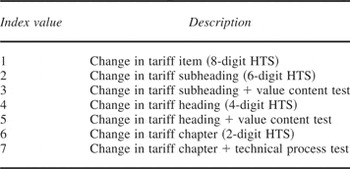
The dependent variable in the analysis, nafta origin rule, is derived from Estevadeordal's index of rules of origin restrictiveness. The index categorizes rules of origin based on three assumptions: the larger the required change in tariff classification, the greater the restrictiveness; a change in tariff classification with a value content test is more restrictive than one with no such test; and a technical process test is the most restrictive of all.Footnote 20 The coding, shown in Table 1, ranges from one (least restrictive) to seven (most restrictive). Figure 2 displays the distribution of NAFTA rules of origin for 5,021 six-digit HTS product lines. About three-quarters of all products must change tariff heading or tariff chapter to attain originating status. Another 9 percent require value content tests and 13 percent require technical process tests.
Coding for nafta origin rule

Notes:
HTS = Harmonized Tariff System.
Distribution of NAFTA rules of origin

To generate the dependent variable, I average rules of origin index values over all HTS products in a four-digit Standard Industry Classification (SIC) code. Though NAFTA rules of origin are common standards adopted by United States, Canada, and Mexico, my argument implies that industry preferences can be induced from the structure of nafta origin rule. Accordingly, I measure all of the independent variables for U.S. industries in 1992. The units of analysis are four-digit SIC codes.
For external trade protection, I measure tariffs and nontariff barriers. mfn tariffs is duties collected divided by U.S. imports for all countries except Canada, Mexico, and Israel. Nontariff barriers are quantified in ntb coverage, which measures the share of imports in an industry that are subject to a nontariff barrier in the U.S. market. The data are from the United Nations Conference on Trade and Development (UNCTAD), which reports the incidence of “core nontariff measures” at the six-digit HTS level.Footnote 21 To construct ntb coverage, I weight the nontariff coverage ratio by U.S. imports for all products in an SIC code such that:

In this formula, NTM i is the proportion of tariff lines covered by core nontariff measures in the HTS product code indexed by i and M i is the value of imports of the product. The first hypothesis predicts that both mfn tariffs and ntb coverage will be positively associated with nafta origin rule.
To measure returns to scale, I estimate the slope of industry cost curves by calculating variations in value added per worker in plants of different sizes.Footnote 22 In this measure, values at or near zero indicate constant returns to scale, while positive values indicate economies of scale and negative values indicate diseconomies of scale. The second hypothesis predicts a positive association between returns to scale and nafta origin rule.
Multinational supply chains are measured as imports under the Offshore Assembly Program (OAP) as a share of total shipments.Footnote 23offshore assembly effectively measures dependence on foreign inputs because it includes subcontracting between unaffiliated parties (offshore outsourcing) and trade between affiliated firms (intrafirm trade). The third hypothesis expects offshore assembly to be negatively associated with nafta origin rule.
The models also include control variables to capture organizational and institutional influences on policy outcomes. These controls are necessary to account for the policymaking process, which may or may not satisfy industry demands. industry concentration is the share of total shipments made by the four largest firms. geographic concentration is industry concentration across geography.Footnote 24 Because concentrated groups are thought to be better able to gain trade protection, industry concentration and geographic concentration should be positively associated with nafta origin rule. McGillivray counters that the influence effect of political dispersion outweighs the mobilization effect of geographic and industrial concentration in electoral systems with weak parties. To capture the political strength of industries in electoral geography, electoral concentration is a Herfindahl index of industry concentration across electoral districts; industry size is total employment in the industry; and large, decentralized industries is an interactive term specified as the inverse of electoral concentration divided by industry size.Footnote 25 If large and politically dispersed industries more easily gain protection, then electoral concentration will be negatively signed while industry size and large, decentralized industries will be positively signed. Two more variables represent the institutional advantages of agenda control: democratic leadership and republican leadership are the number of Democratic (Republican) Party leaders and committee chairs in the U.S. House of Representatives with the industry in their district.Footnote 26 If more senior representatives are able to channel protection to favored industries, then both variables will be positively related to nafta origin rule.
In the estimation of the models, two methodological issues must be addressed: first, the potential endogeneity of mfn tariffs and ntb coverage as regressors; and second, censoring in the observed values on the dependent variable, nafta origin rule.
Beginning with endogeneity, some of the factors conditioning the restrictiveness of rules of origin also influence tariffs and nontariff barriers. To correct for endogeneity bias in the estimates for nafta origin rule, the models employ instrumental variables. In this method, exogenous factors influencing mfn tariffs and ntb coverage but not nafta origin rule are included as instruments in the first-stage estimates and then predicted values for mfn tariffs and ntb coverage are entered in the second-stage equations for nafta origin rule. In the reduced-form equations for mfn tariffs and ntb coverage, the exogenous factors and the direct influences on nafta origin rule appear as instruments. By design, the first-stage equation is overdetermined in that it includes variables affecting nafta origin rule that may not be theoretically relevant to mfn tariffs or ntb coverage. The purpose of the first-stage estimation is not to test hypotheses about the determinants of tariff and nontariff barriers, but rather to employ factors correlated with these measures to produce unbiased estimates for nafta origin rule.
In the analysis in the next section, I estimate separate reduced-form equations for mfn tariffs and ntb coverage using the same exogenous variables. To identify relevant instruments, I select variables employed in studies of the determinants of tariffs and nontariff barriers.Footnote 27 The reduced-form equations distinguish intermediate imports, which is the consumption share of imports in product codes containing the word “parts” in the description, and finished imports, which is the consumption share of total imports minus parts imports. export dependence is exports as a share of industry shipments. hourly wage, which is the average hourly wage of production workers in the industry, and r&d employment, the percentage of workers in the industry employed in research and development, are measures of skill-intensity. capital-labor ratio, which is capital expenditures divided by payroll, measures factor use. The last three variables capture elements of comparative costs not reflected in trade patterns.
The second methodological issue is censoring in the dependent variable, nafta origin rule, which takes on a minimum of one and a maximum of seven. With limited dependent variables, the linear regression model is inappropriate: ordinary least squares will generate predicted values for nafta origin rule less than one and greater than seven. Censoring is also present in the instrumented variables, mfn tariffs and ntb coverage, which cannot be less than zero or greater than one. To correct for censoring, I use the censored regression or Tobit model.Footnote 28 The method of analysis is two-limit Tobit, where observations are censored at the top and bottom of the range.Footnote 29
Tobit Results
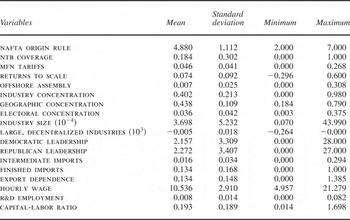
The presentation of the results begins by evaluating the first-stage models for mfn tariffs and ntb coverage, and then discusses the second-stage models for the dependent variable, nafta origin rule. The Appendix reports descriptive statistics; and Table A1 lists the sources for the data.
First-Stage Estimates for mfn tariffs and ntb coverage
In the first part of the analysis, mfn tariffs and ntb coverage are a function of the explanatory factors that condition nafta origin rule and a set of exogenous influences on trade protection that are not directly related to nafta origin rule. The purpose of the first-stage model is simply to evaluate whether the instruments are valid. For validity, instruments must be relevant (correlated with the instrumented variable) and exogenous (uncorrelated with the disturbance in the second-stage model).
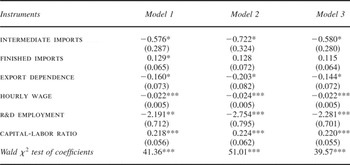
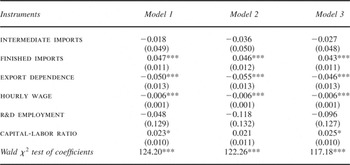
To evaluate relevance, I examine the coefficients in the reduced-form equations and perform Wald tests of the null hypothesis that the instrument coefficients jointly are equal to zero. Results for ntb coverage are in Table 2 and mfn tariffs in Table 3. To conserve space, I show first-stage estimates for the instruments alone. In both tables, the models differ only in the explanatory variables included in the second stage.
Tobit estimates for instruments for ntb coverage

Notes:
Only the exogenous instruments are displayed. Cell entries are two-limit Tobit coefficients, with a lower limit at 0 and an upper limit at 1. Standard errors are in parentheses. N = 381.
*** p < .001;
** p < .01;
* p < .05.
Tobit estimates for instruments for mfn tariffs

Notes:
Only the exogenous instruments are displayed. Cell entries are two-limit Tobit coefficients, with a lower limit at 0 and an upper limit at 1. Standard errors are in parentheses. N = 379.
*** p < .001;
** p < .01;
* p < .05.
In Table 2, five of the six instruments are significant at the .05 level. Nontariff barriers are less prevalent in industries intensively using intermediate imports. export dependence, hourly wage, and r&d employment also are negatively associated with ntb coverage. The positive coefficient for capital-labor ratio indicates that capital-intensive industries have more nontariff barriers, controlling for the other instruments. The Wald test easily rejects the null hypothesis that the instruments are not good predictors of ntb coverage at the .001 level.
In Table 3, three of the exogenous instruments are consistently significant at the .05 level. The most relevant determinants of tariffs are finished imports, export dependence, and hourly wage. capital-labor ratio is also significant in all models except the second, but intermediate imports and r&d employment are not significant. The Wald test again strongly indicates that the instruments have explanatory value.
The relevance of the instruments is unsurprising, as previous studies have demonstrated that these variables are correlated with trade protection. There is no simple way to verify that they are exogenous, however. Theoretically, it is hard to imagine how broad factor-intensity considerations such as hourly wage, r&d employment, or capital-labor ratio would directly influence industry lobbying on rules of origin. It is also difficult to discern a predictable relationship with trade patterns because rules of origin can protect import-competing producers and exporters alike. Intuition therefore suggests that the instruments enter the process of determining rules of origin only through their influence on the endogenous variables, mfn tariffs and ntb coverage.
To test this reasoning, I evaluate the explanatory value of the instruments as regressors for nafta origin rule by adding one at a time to the second-stage models.Footnote 30 In the models with ntb coverage as the instrumented variable, the null hypothesis that an instrument has a zero coefficient cannot be rejected for five of the six instruments; only capital-labor ratio is statistically significant. In the models with mfn tariffs as the instrumented variable, capital-labor ratio and intermediate imports are statistically significant. For the other instruments, exclusion from the second-stage models appears warranted. Overall, while the validity of the instruments cannot be conclusively established, empirical testing combined with theoretical intuition provides reasonable confidence that the relationship between external trade protection and nafta origin rule in the second-stage models is purely the influence of the instrumental variables on mfn tariffs and ntb coverage.
Second-Stage Estimates for nafta origin rule
In the second-stage estimates for nafta origin rule, the predicted values for mfn tariffs and ntb coverage in the first stage are entered as fixed regressors. The instrumented form of external trade protection captures basic motives to lobby for tough rules of origin to prevent nonparticipants in an FTA from evading extant tariffs and nontariff barriers. In addition to incentives to maintain external trade protection, I expect considerations based on the returns to scale and the extent of multinational supply chains to enter industry calculations to seek rules of origin of varying restrictiveness.
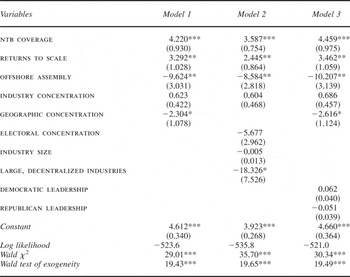
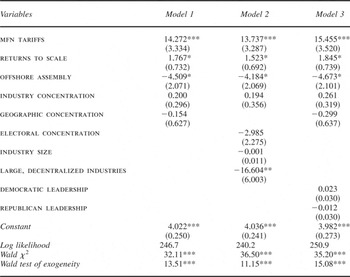
Table 4 displays the second-stage Tobit estimates for nafta origin rule using ntb coverage as the instrumented variable. Comparing across models, all of the variables representing industry preferences and political influence have the same signs and significance levels. In all three specifications, the Wald test statistic rejects the null hypothesis of no endogeneity at the .001 level. Instrumenting for ntb coverage is therefore appropriate, as single-equation estimates are biased.
Tobit estimates for nafta origin rule using ntb coverage

Notes:
Cell entries are two-limit Tobit coefficients, with a lower limit at 1 and an upper limit at 7. Standard errors are in parentheses. N = 381.
*** p < .001;
** p < .01;
* p < .05.
The coefficients in Table 4 conform to theoretical expectations. Notably, returns to scale is positively signed and statistically significant in all of the models: the larger the returns to scale, the more restrictive the rules of origin. This supports the second hypothesis that producers with significant economies of scale will lobby to restrain outsiders from gaining FTA privileges. The statistically significant negative sign for offshore assembly suggests that multinational supply chains motivate lobbying against restrictive rules of origin. The instrumented variable ntb coverage is positively signed and significant: as expected, industries with significant nontariff barriers received tougher rules of origin to limit circumvention by exporters outside the FTA.
The estimates for the control variables yield two intriguing results. First, geographic concentration has a statistically significant negative effect on nafta origin rule. While some industries that sought restrictive rules of origin, such as textiles, may have been regionally concentrated, overall geographic localization was associated with more lax rules of origin. Second, the three proxy variables for political influence in the second model—electoral concentration, industry size, and large, decentralized industries—are negatively signed, with the last of the three statistically significant at the .05 level. Again this is counterintuitive: the industries thought to have the most political advantages in lobbying received less restrictive rules of origin. Finally, rules of origin were tougher in industries located in the districts of Democratic House leaders and easier in industries located in the districts of Republican House leaders, though neither result is statistically significant.
Table 5 shows the estimates for nafta origin rule with mfn tariffs as the instrumented variable. As in the last set of models, the results are robust to the inclusion of control variables and the Wald test statistic rejects the null hypothesis of no endogeneity at the .001 level in all specifications. returns to scale is again positively signed and significant, as the second hypothesis anticipates, and offshore assembly is negatively signed and significant, consistent with the third hypothesis. mfn tariffs also influence rules of origin, as the first hypothesis predicts: industries with higher tariffs received tougher rules of origin to block the use of Mexico (and Canada) as an “export platform” to the United States. In addition, rules of origin were more permissive in large, decentralized industries. The other organizational and institutional variables are not statistically significant.
Tobit estimates for nafta origin rule using mfn tariffs

Notes:
Cell entries are two-limit Tobit coefficients, with a lower limit at 1 and an upper limit at 7. Standard errors are in parentheses. N = 379.
*** p < .001;
** p < .01;
* p < .05.
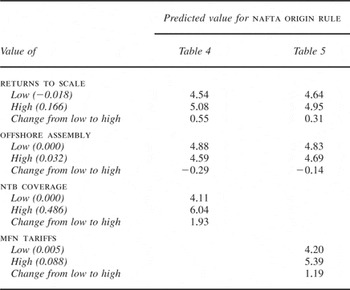
Simulations reveal the substantive impact of the Tobit coefficients in Table 4 and Table 5. Table 6 displays predicted outcomes for nafta origin rule with discrete changes in returns to scale, offshore assembly, ntb coverage, and mfn tariffs individually, holding other independent variables at their mean values. These figures reveal large marginal effects for external trade protection: nafta origin rule increases by 1.93 as ntb coverage changes from low to high and 1.19 as mfn tariffs changes from low to high. Given that a one-point increase in the rule of origin index is equivalent to adding a value content test to the change in tariff classification standard, this is a substantial effect. The impact of returns to scale, though not as great, is considerable: as industries shift from small diseconomies of scale to moderately large returns to scale, the rules of origin index increases by 0.55 in Table 4 and 0.31 in Table 5. By comparison, the effect of offshore assembly is smaller, as a shift from low to high changes nafta origin rule by −0.29 in Table 4 and −0.14 in Table 5. This result is consistent with the expectation that industries with extensive multinational supply chains will not want rules of origin to become too permissive.
Marginal effects

Notes:
Categories for returns to scale, offshore assembly, ntb coverage, and mfn tariffs are values at one standard deviation below the mean (low) and one standard deviation above the mean (high). Predicted values for nafta origin rule are averaged across the three models in Table 4 and Table 5, conditional on nonlimit outcomes, with all other variables held constant at their mean values.
The findings illuminate two important elements of industry lobbying on NAFTA rules of origin. First, the effect of large returns to scale explains why some industries insisted on tough rules of origin despite low external trade barriers. For instance, automobile executives strenuously complained when the value content rule was set below their desired 65 percent, to which a perplexed U.S. negotiator responded: “We're talking about a 2.5 percent difference on a 2.5 percent tariff!”Footnote 31 For U.S. firms, a tough value content test was critical to compel foreign rivals to source important inputs in NAFTA so that Japanese assemblers could not easily satisfy the rule of origin in the period while U.S. firms were restructuring to gain economies of scale. Moreover, German and Korean automakers that were not already established in NAFTA would be deterred from investing in North America if they had to undertake large-scale production of expensive components such as power trains.
Second, the results demonstrate how global procurement restrained the adoption of tough rules of origin in industries with multinational supply chains. Computer equipment and electronic components are two such examples: firms traded heavily with both Mexican and Asian suppliers, so they objected to rules of origin that would penalize sourcing outside NAFTA. IBM reportedly “had a fit” over plans to require North American production of motherboards, screens, and hard drives for computers.Footnote 32 Instead, rules of origin were made flexible and negotiators agreed on a low common tariff—an externally liberalizing outcome.
Conclusion
Lobby groups have persistently tried to manipulate rules of origin in NAFTA and other FTAs, yet to date there has been no systematic analysis of their industry-level determinants. This study's findings imply that rules of origin may be critical to forging coalitions between prospective winners of an FTA and neutralizing opposition from industries that expect losses. Notably, the factors associated with support for an FTA are not the same as the factors that motivate lobbying for restrictive rules of origin: industries with large returns to scale seek tougher rules of origin to gain scale economies in an FTA, while industries with multinational supply chains prefer accommodating rules of origin to permit foreign sourcing. At a theoretical level, the study suggests that current trade policy issues such as rules of origin are not easily explained by traditional models of trade in end products made wholly in one country subject to constant returns to scale.
An unresolved puzzle is the policymaking process that aggregates industry demands. In NAFTA, rules of origin were less restrictive in geographically concentrated and large, politically dispersed industries—precisely the industries thought to be most effective at gaining trade protection. One explanation for this anomaly is that existing theories are limited to cases where the legislature makes trade policy, or where legislative principals closely control bureaucratic agents. In the United States under fast-track authority, however, legislative influence is indirect because it is exerted at the delegation and ratification stages. In this setting, influential industries may not be geographically concentrated, large and politically dispersed, or located in the districts of powerful representatives. Instead, industries important to potential veto points—specific legislators whose votes are needed for ratification—are likely to be favored.Footnote 33 Future research should examine how many and what types of legislative votes actually hinge on provisions such as rules of origin to illuminate how these special forms of trade protection affect the political viability of FTAs.
Appendix. Sources of Study Variables
Dependent Variable
ʼn nafta origin rule: Rules of origin index values were provided at author's request from Estevadeordal Reference Estevadeordal2000.
Descriptive statistics

Independent Variables
ʼn ntb coverage: Coverage ratios were compiled from UNCTAD 1995. Import weights are from USITC Interactive Tariff and Trade Dataweb Web site: ⟨http://dataweb.usitc.gov⟩. Accessed 27 May 2006.
ʼn mfn tariffs: Tariff rates were calculated from USITC Interactive Tariff and Trade Dataweb: ⟨http://dataweb.usitc.gov⟩ Accessed 27 May 2006.
ʼn offshore assembly: OAP trade was provided at author's request from Feenstra, Hanson, and Swenson Reference Feenstra, Hanson, Swenson and Feenstra2000. Shipments are from U.S. Department of Commerce 1997.
ʼn returns to scale; industry concentration; industry size; hourly wage; capital-labor ratio: Calculated from U.S. Department of Commerce 1997.
ʼn geographic concentration: Busch and Reinhardt Reference Busch and Reinhardt1999. These data are available at: ⟨http://userwww.service.emory.edu/~erein/research/#geocon⟩ Accessed 18 September 2005.
ʼn electoral concentration; democratic leadership; republican leadership: Industry employment by county was compiled from U.S. Department of Commerce 1994. Counties were aggregated into congressional districts using a mapping file for the 102d Congress provided at author's request from Ladewig Reference Ladewig2006.
ʼn intermediate imports; finished imports; export dependence: Import values are from Schott Reference Schott2004. These data are available at: ⟨http://www.som.yale.edu/faculty/pks4/files/international/parts_imports_7201_20040413.dta⟩. Accessed 12 September 2006. Exports are from USITC Interactive Tariff and Trade Dataweb Web site: ⟨http://dataweb.usitc.gov⟩. Accessed 27 May 2006. Shipments are from U.S. Department of Commerce 1997.
ʼn r&d employment: Calculated from data provided at author's request by the U.S. Bureau of Labor Statistics.