The International Coffee Organization reported that world production of coffee was greater than 9 million MT in 2016/2017, and the United States imported over 1.7 million MT of coffee in 2015/2016 (http://www.ico.org/). Thus, over 4,600 MT of coffee are consumed daily in the nation. When roasted and ground coffee beans are brewed, the grounds lose approximately a quarter of their original weight. Accordingly, about 3,500 MT of spent coffee grounds (SCG) require disposal in the United States every day. SCG can be problems for landfills and composting sites (Silva et al. Reference Silva, Nebra, Machado Silva and Sanchez1998).
SCG contain about 16% oil, 15% protein, and 2.4% N, and therefore may have value as nutrient-rich soil amendments or sources of biodiesel, bio-oil, or biochar (Vardon et al. Reference Vardon, Moser, Zheng, Witkin, Evangelista, Strathmann, Rajagopalan and Sharma2013). Additionally, the World Wide Web is replete with other ways to use SCG, such as as a refrigerator deodorizer, hair conditioner, and abrasive cleanser for cookware. Some of these practices likely have limited appeal.
The ability of SCG to serve as a soft abrasive, however, may have application in weed management. Various soft grits derived from agricultural residues can be entrained in high-velocity air streams and used to abrade small weed seedlings, often selectively, in the presence of larger agronomic and horticultural crops (Erazo-Barradas et al. Reference Erazo-Barradas, Friedrichsen, Forcella, Humburg and Clay2017; Wortman Reference Wortman2015). The purpose of this note is to examine whether SCG also can be employed as an abrasive grit to control weeds. If so, then such a finding may valorize waste material generated in abundance by modern society’s coffee-consuming lifestyle.
Materials and Methods
Spent coffee grounds were collected daily from the employees’ lunch room at the North Central Soil Conservation Research Laboratory of the US Department of Agriculture–Agricultural Research Service, located in Morris, Minnesota. Employees prepared two types of conventionally filtered drip coffee in approximately equal volumes depending upon time of day: Folgers Classic Roast Medium and Folgers Classic Decaf. Unit densities of these two brands before brewing were nearly identical (means±SE; N=3): 0.36±0.003 and 0.38±0.002 g cm−3, respectively. Therefore, SCG were not differentiated in terms of coffee type. SCG were dried overnight at 45C and stored until used experimentally. Aggregate unit density of dry SCG used in all experiments was 0.48±0.005 g cm−3 (N=3).
Fresh coffee grounds were weighed, placed into a filter of known weight, and brewed for conventional filtered liquid coffee. The SCG were then removed, dried as above, and reweighed to determine percent weight loss upon brewing. The process was repeated three times each for Classic Roast and Classic Decaf brands. The visual pattern of grit application on a horizontal surface with a nozzle 50 cm distant from the center point was then measured. Clear plastic envelopes (22 by 28 cm) were coated with white spray paint, and black paper was inserted into the envelopes. The envelopes were then mounted on a wooden board and 2 g of SCG grit was applied as described below. The grit easily removed the paint upon contact with the envelopes. Weed seedlings were grown in a greenhouse from locally collected seeds sowed in 10- by 10-cm pots filled with 500 cm3 of potting soil. Greenhouse conditions included natural radiation at about 400 μmolm−2s−1 on clear days, natural photoperiods of 10±0.07 h, regulated day/night temperatures of 25/15 C, daily irrigation, and weekly treatment with a complete nutrient solution.
Two weed species were tested: tall waterhemp and velvetleaf, with small and large seeds, respectively. The 1,000 seed weights of these species were 0.21±0.002 and 9.10±0.055 g (N=3), respectively. Both species are common agricultural weeds in the midwestern United States. Seedlings were thinned to one plant per pot. Once seedlings reached predetermined stages of growth they were subjected to abrasion treatments in two types of experiments.
Experiment 1: Effects of SCG Rates
Seedlings of velvetleaf (second true leaf 10 mm long) and tall waterhemp (second true leaf 2 mm long) were exposed to the following SCG rates: 0 (air only), 0.5, 1, 2, 4, and 6 g per application, with three replications for each treatment. The grit application apparatus consisted of a pistol-type sand blaster mounted on a laboratory ring stand and connected to an air compressor. The grit was fed into the sand blaster by gravity. Grit was delivered in an air stream at 690 kPa. The nozzle of the applicator was 50 cm from the plants and angled 40° from horizontal. The duration of application was about 1 s. Plants were assessed for injury 2 days after treatment (DAT). Injury was scored on a scale of 0 (no injury) to 10 (death). Maximum seedling heights above the soil surface were measured to the nearest mm. The entire experiment was performed twice.
Experiment 2: Comparison with Corncob Grit
Corncob grit served as a comparison to SCG. It is effective for abrading and controlling weeds in field plots of organic field corn (Erazo-Barradas et al. Reference Erazo-Barradas, Friedrichsen, Forcella, Humburg and Clay2017). Commercially available corncob grit (20–40 mesh) was used; its unit density was 0.45±0.003 g cm−3 (N=3). Treatments consisted of applying 2 g of SCG, 2 g of corncob grit, or air only, in the same manner as experiment 1. There were five replications for each treatment. At the time of grit applications, velvetleaf plants had fully expanded cotyledons and tall waterhemp plants were in the first true leaf stage. Observations recorded after grit applications were identical to those in experiment 1. The entire experiment was performed twice. An additional experiment examined the same treatments on velvetleaf and tall waterhemp at the four- and six-leaf stages of growth, respectively. Observations were recorded as above, but included leaf area assessment 2 DAT with a LI-COR Model 3100 leaf area meter.
Statistical Analyses
Nonlinear regression and ANOVA were used to summarize results from experiments 1 and 2, respectively, using Statistix-10 software (Anonymous 2013). Analyses included arcsine–square root transformations of injury scores, but such transformations never appreciably altered P values or interpretations of statistical outcomes; thus, only results from the more straightforward nontransformed data are discussed.
Results and Discussion
Weight losses of coffee grounds after brewing were 26.4% (±0.73) for Folgers Classic Roast Medium and 25.7% (±0.36) for Folgers Classic Decaf. Weight losses upon brewing closely matched increases in specific gravities after brewing (approximately 23%).
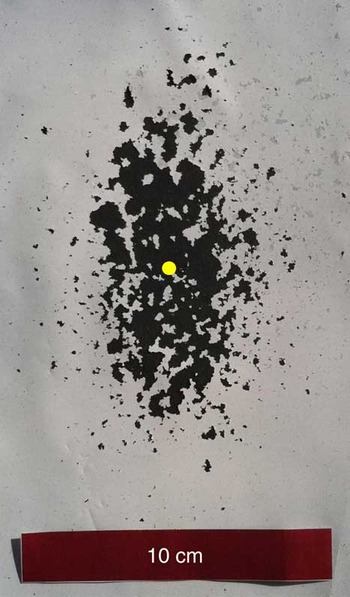
The pattern of grit application on a horizontal surface 50 cm distant from the nozzle is shown in Figure 1. The application pattern of grit was oval, about 8 cm wide and 15 cm long, and approximated the surface area of the 10- by 10-cm pots. Thus, the probability of even small weed seedlings being abraded by grit was high.
Example of the pattern of deposition of 2 g of spent coffee grounds on a horizontal surface of spray-painted clear plastic with black backing. Center point (yellow dot) was 50 cm from the stationary nozzle, which was positioned at a 40° angle. Air pressure was 690 kPa.

Experiment 1
Tall waterhemp seedlings were immediately and completely destroyed by all grit applications, regardless of rate, except for a single surviving plant at the 0.5-g application rate. At 2 DAT, heights of seedlings exposed to pressurized air (control plants) were 27±2.2 mm, their second true leaves were about 5 mm long, and they appeared identical to unexposed plants. The lone grit-treated survivor was 15 mm tall with one true leaf.
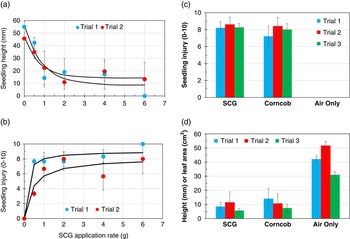
Velvetleaf injury at 2 DAT increased quickly with grit application rate and reached a nadir at 2 g SCG (Figure 2). In many cases stems of seedlings were broken or bent, with vascular connections apparently maintaining viability, but with the seedling laying prostrate on the soil surface. Accordingly, seedling heights at 2 DAT mirrored the injury responses, with heights decreasing from about 50 mm for the control (air only) seedlings to a low of 10 to 15 mm for seedlings treated with the 2-g SCG rate (Figure 2). The control seedlings had second true leaves that were about 15 mm long, whereas surviving grit-treated plants remained in the one-leaf stage of growth.
(a) Effects of rate of application of spent coffee grounds (SCG) on height of velvetleaf seedlings 2 days after treatment in two separate experiments (trial 1 and trial 2). Fitted lines represent asymptotic regression models (R2=0.85 and 0.91): Height=8.63+47.41*0.33Rate and 14.32+32.68*0.27Rate in trials 1 and 2, respectively. (b) As above, except response variable is seedling injury. Fitted lines represent saturation growth models (R2=0.96 and 0.86): Injury=9.01 × Rate/(0.12+Rate) and 8.14 × Rate/(0.42+Rate). (c) Velvetleaf seedling injury scores (1=no injury, 10=death) 2 days after treatment with air-propelled SCG, corncob grit, or air only in three separate trials. Air-only injury values=0. (d) As above, except measured variable is seedling height in trials 1 and 2 and leaf area in trial 3. All vertical bars represent standard errors of mean values.

Experiment 2
No tall waterhemp seedlings survived the 2-g application rates of either SCG or corncob grit in either of the first two trials. Control seedlings were 26±1.5 mm, averaged across the first two trials, and they were at the two-leaf growth stage 2 DAT. In the third trial, with larger, six-leaf plants (46±1.7 mm), no SCG-treated seedlings survived, and corncob-treated seedlings were reduced in height to only 4±2.6 mm at 2 DAT. In contrast, heights of control seedlings at 2 DAT were 52±2.5 mm.
Velvetleaf injury after exposure to 2 g of grit was severe (P<0.01) (Figure 2), but did not differ between grit types or between the two repeated trials with cotyledon to one-leaf stage seedlings (P=0.55). No treatment by trial interaction was detected (P=0.85). Similarly, seedling heights of velvetleaf 2 DAT were stunted greatly, and were nearly identical for SCG and corncob treatments (P<0.01) (Figure 2). Control seedlings were 40 to 50 mm tall, at the one- to two-leaf growth stage, and vigorous in appearance. As with injury scores, there were no differences in seedling height due to experiment (P=0.55), nor was there a treatment by trial interaction (P=0.58).
In the third trial, with larger and sturdier four-leaf stage velvetleaf seedlings, plant heights were not a good measure of injury as the main stems remained standing even though the leaves were shredded. Heights of seedlings treated with SCG, corncob grit, or air were 63±4.5, 64±4.7, and 72±1.7 mm, respectively, but associated injury scores were 8.3±0.48, 8.0±0.71, and 0. Accordingly, leaf areas were better reflections of effects of grit on these older plants at 2 DAT: 6±1.3, 7±2.8, and 31±2.4 cm2 for plants treated with SCG, corncob grit, or air only, respectively.
Common food wastes and agricultural residues may have untapped value. For instance, materials that can be formulated as grits may be used as air-propelled abrasive agents for controlling weeds. Admittedly, the probability of these grits attaining widespread use on conventional farms is low, because other control techniques that comprise modern weed management systems likely are cheaper and more reliable. However, many of these conventional techniques cannot be used by organic growers. Thus, new and diverse weed control practices are needed for successful integrated weed management on organic farms. Abrasive grit may be especially useful for high-value horticultural crops like sweet pepper (Capsicum annuum L.) (Wortman Reference Wortman2015), and machinery is being designed and constructed to apply abrasive grits in field settings (Erazo-Barradas et al. Reference Erazo-Barradas, Friedrichsen, Forcella, Humburg and Clay2017; Lanoue Reference Lanoue2012). Air-propelled SCG represents such a new practice, which may assist with waste disposal and weed management simultaneously, thereby making use of a plentiful food waste product and eliciting organically-compatible control of seedlings of important annual weeds.