Consumers are increasingly interested in the relationship between their food purchasing decisions and the environmental and social sustainability of our food production systems (Banterle et al., Reference Banterle, Fritz and Cereda2010). As consumers’ purchasing preferences can influence the food industry's behavior towards and expectations of their vendors, consumer motivations related to buying food produced under verifiable certification structures can help drive the development of sustainable food systems (Zander and Hamm, Reference Zander and Hamm2010; Macdiarmid et al., Reference Macdiarmid, Kyle, Horgan, Loe, Fyfe, Johnstone and McNeill2012).
With rising industry recognition of consumer interest in sustainable purchasing, alternative labels have emerged to differentiate food products which align with various sustainability metrics. Many different labeling initiatives (e.g., eco-labels, fair trade, animal welfare) have evolved to provide consumers with an opportunity to demonstrate their support for alternatively produced and environmentally sustainable food products (Ray, Reference Ray1998; Barham, Reference Barham2002; Raynolds, Reference Raynolds2002; Howard and Allen, Reference Howard and Allen2006). Different labels vary in their approach to addressing sustainability as measured by the ‘triple bottom line’, depending on different emphases on each of the three pillars of sustainability: ecological/environmental, social and economic (Shreck, Reference Shreck2005; Manning et al., Reference Manning, Boons, von Hagen and Reinecke2012). While labels such as US Department of Agriculture (USDA) Certified Organic have attracted consumers for almost two decades, recent consumer surveys indicate that alternative labeling models, such as animal welfare or locally produced, now have greater appeal to food purchasers, particularly those of the millennial generation (Langen et al., Reference Langen, Roidl and Hartmann2010; Constanigro et al., Reference Langen, Roidl and Hartmann2011; Hazenzade et al., Reference Hazenzade, Osburg and Toporowski2018; Spain et al., Reference Spain, Freund, Mohan-Gibbons, Meadow and Beacham2018).
Young consumers can be critical actors in shaping the direction of our food system (Vermeir and Verbeke, Reference Vermeir and Verbeke2008; Janßen and Langen, Reference Janßen and Langen2017). Universities have recognized the present generation's interest in food production systems and policy and their roles in shaping these institutions and initiatives. Many institutes of higher education have turned their attention to adopting and demonstrating sustainable purchasing patterns and behaviors, including with food-related purchasing. In part, this response is driven by student (‘consumer’) demand, as evidenced by sustainable food initiatives such as the ‘Real Food Challenge’, which have become increasingly common on college and university campuses (Barlett, Reference Barlett2011; Real Food Challenge, 2018). However, the response is also driven by the recognition of colleges and universities of their own responsibility in the development of environmentally sustainable technologies and policies, as well as the advancement of an environmentally responsible society through education (Smola and Sutton, Reference Smola and Sutton2002; Babich and Smith, Reference Babich and Smith2010). Generally, the higher education sector has lagged behind government and business sectors in rising to the environmental challenge, but over the last decade universities have demonstrated increased action in the adoption of sustainability principles (Blanco-Portela et al., Reference Blanco-Portela, Benayas, Pertierra and Lozano2017). Significant numbers of senior university leaders have signed one or more international declarations that promote sustainability in higher education, including the University of Wisconsin-Madison (Bezbatchenko, Reference Bezbatchenko2010; Ralph and Stubbs, Reference Ralph and Stubbs2014).
Food purchasing decisions at campus dining halls are another common venue through which students can express their commitment to the implementation of sustainable food systems. As universities determine policies, marketing strategies and purchasing plans related to supporting sustainable food systems, these initiatives must also consider the values, preferences and behavior of student consumers. However, our understanding of public university undergraduate students’ food sustainability values and related purchasing decisions is incomplete. The demographics of university student consumers may have unique decision-making processes and motivations when purchasing food as compared with the broader consumer population. While previous work with broader consumer audiences has sought to characterize and compare willingness to pay for food with specific sustainability attributes (e.g., organic and local) (Carpio and Isengildina-Massa, Reference Carpio and Isengildina-Massa2009; Carroll et al., Reference Carroll, Bernard and Pesek2013; Bartels and Onwezen, Reference Bartels and Onwezen2014; Connolly and Klaiber, Reference Connolly and Klaiber2014; Denver and Jensen, Reference Denver and Jensen2014), more limited research exists to document the values specifically of young adults and university students. Pelletier et al. (Reference Pelletier, Laska, Neumark-Sztainer and Story2013), in their evaluation of student purchasing attitudes in Minnesota, found that approximately 50% of students cited alternative production practices (e.g., local, organic or sustainable) to be moderately or very important to them. Similarly, Dahm et al. (Reference Dahm, Samonte and Shows2010), measuring similar criteria at a Southern US university, found that organic food was viewed positively by 40% of students, and more than half of students supported the inclusion of organic food on campus. These numbers align with those reported by Feenstra et al. (Reference Feenstra, Allen, Hardesty, Ohmart and Perez2011) within their national data set on college student purchasing behavior, where approximately 41% of students considered it important that their food was grown sustainably, 30% considered locally-grown as important and 25% considered certified organic as important.
With the gap in knowledge of the purchasing preferences of public university undergraduate students’ food sustainability values, the goal of this research was to assess the food sustainability values of students as they relate to their purchasing decisions of produce from campus dining facilities at a major public university in the USA. This research was undertaken in order to guide the university's approach to sustainable food purchasing to align with student preferences. To achieve this goal, a survey tool was used to evaluate perceptions of sustainability metrics related to food labels on the part of campus students. Results were also used to determine the relationships between students’ food system concerns and their perceptions of sustainability factors and resource use product attributes.
Materials and methods
A survey was developed to assess student perceptions of food sustainability parameters as they pertained to food service in University of Wisconsin-Madison dining facilities. The survey examined several aspects of sustainability criteria that could be incorporated into labeling and marketing of products. These included metrics that involved ecological and production-based criterion (including organic products); geographical criterion (e.g., locally produced); and ethical criterion (e.g., fair-trade products and animal welfare). A pre-test questionnaire was administered to ten students at the University of Wisconsin-Madison who had been patrons on the university dining facilities in order to identify any weaknesses or ambiguity in the questions. Based on student feedback, the survey was revised for clarity. The survey was approved by the University of Wisconsin-Madison Institutional Review Board.
Student participants were drawn from patrons of two large university dining halls in close proximity to major residence hall communities housing approximately 2600 students attending the University of Wisconsin-Madison. One dining facility, which is located within a residence hall housing 440 students, served patrons comprised 84% residence hall inhabitants and 16% nonresidents; the other dining facility, nearer to campus and adjacent to a large residence hall complex of 2200 students, served patrons consisting of 75% residents and 26% nonresidents. Both dining halls are open to the public and non-housing customers, as well as to residence hall inhabitants.
Paper surveys were distributed to dining hall customers in March and April 2014. Data were collected over the course of four days and approximately 12 h (3 h day−1). To maximize responses from students within the residence halls, rather than faculty, staff, and students residing off-campus, surveys were implemented during the evening dinner hours at each location. Researchers worked to minimize self-selection bias by training survey administrators to randomly approach customers rather than having students approach them. Every few minutes, the survey administrators randomly approached customers, introduced themselves and the purpose of the study, confirmed eligibility (at least 18 years of age and no prior completion of survey), obtained consent and distributed surveys for students to complete at their own pace and return to survey administrators upon exiting the facility. In less than one-quarter of cases, students approached survey administrators to obtain a copy of the survey.
Before proceeding with the completion of the entire survey, students were asked if they purchased food at the campus housing dining facilities. The survey asked customers to rate the extent to which the following six sustainability attributes related to food production and sourcing influenced their purchasing decisions of produce (fruits and vegetables) served in campus housing dining facilities: ‘locally grown’, ‘certified organic’, ‘grown with verifiable sustainability practices’, ‘certified carbon footprint’, ‘grown under a third-party audited food safety program’, and ‘grown using fair labor standards’. Respondents were then asked to rate the extent to which the following four traditional attributes influence these same purchasing decisions: ‘taste’, ‘appearance’, ‘cost’ and ‘nutritional value’. A rating scale consisted of five points: ‘definitely’, ‘probably’, ‘possibly’, ‘probably not’, ‘definitely not’, as well as an option ‘not sure what this means’. At the time of the study, while students did have the occasional option to purchase organic and grass-fed products, no effort existed by food service to strongly market products with these labels.
To assess customers’ level of concern about resources used in the production of their campus dining produce options, respondents were then asked how concerned or unconcerned they are about the amount or type of four different resources used to produce fresh fruits and vegetables for these facilities: ‘labor’, ‘water’, ‘electricity’, and ‘fuel’. They rated each on a five-point scale of ‘very concerned’, ‘somewhat concerned’, ‘neither concerned nor unconcerned’, ‘somewhat unconcerned’, or ‘very unconcerned’. Customers were also asked to what degree they felt that their food choices influenced the wider community and environment a five-point scale (‘definitely’, ‘probably’, ‘possibly’, ‘probably not’ and ‘definitely not’).
The analysis included 338 surveys, including 233 and 105 from the two dining halls. Survey results were analyzed using SPSS version 22. Spearman's correlation coefficients (P ⩽ 0.05) were used to assess the correlation between ordinal variables. Correlations were analyzed between the ten attributes, between resource concerns and influence of associated attributes (e.g., concern for labor, electricity, water and fuel correlated with level of influence of organic on purchasing), and between the attitudinal question ‘My food choices influence the wider community and environment’ and other ordinal questions including willingness to purchase. Crosstabs were used to assess associations between variables: concern and influence of associated attribute, attitude and willingness to purchase, locally grown attribute by the purchase of local salads recently and willingness to purchase and influence of cost attribute.
Linear regression was used to determine the extent that one's belief in the influence of their food choices on the wider community and environment predicts the six sustainability attributes’ influence on purchasing. A score was used as the dependent variable, created by computing the mean rating for the six sustainability attributes for each respondent. A response of ‘Definitely’ was coded as 5, ‘Probably’ as 4, ‘Possibly’ as 3, ‘Probably Not’ as 2, and ‘Definitely Not’ as 1. For example, if a respondent said that three attributes were ‘Definitely’ influential, two attributes were ‘Probably’ influential, and one was ‘Possibly’ influential, their mean rating would be (5 + 5 + 5 + 4 + 4 + 3)/6, or 4.33.
Results
Purchasing priorities
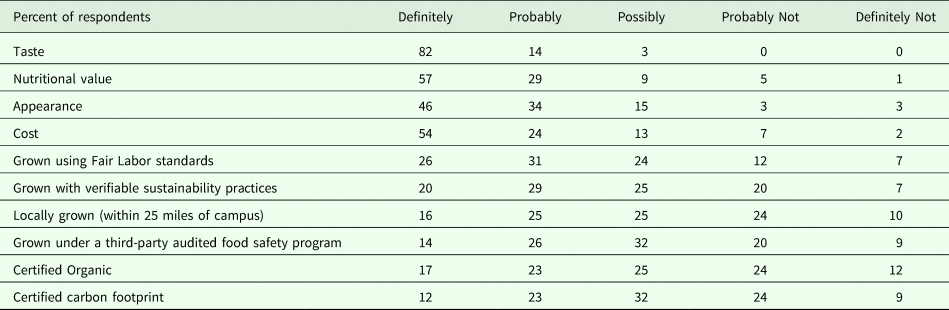
Product attributes of the food itself—taste, nutrition, cost and appearance—were ranked as more influential in determining purchasing decisions than sustainability attributes related to production and source (Table 1). The taste was most influential with 96% of respondents reporting that it ‘definitely’ or ‘probably’ influences purchasing decisions of produce served in campus dining facilities. Nutritional value, appearance and cost were the next most influential, each ranking at 75% of respondents answering ‘definitely’ or ‘probably’ influences purchasing decisions. With respect to the impact of production practices on purchasing decisions, ‘grown using fair labor standards’ ranked as statistically more significant in impacting purchasing decisions than the other parameters at 57%. Forty-nine percent of respondents indicated that the identification of ‘grown with verifiable sustainability practices’ would ‘definitely’ or ‘probably’ impact their purchasing decisions, followed by ‘locally grown’ (41%), ‘certified organic’ (40%), ‘grown under a third-party audited food safety program’ (40%) and ‘certified carbon footprint’ (35%). A non-parametric sign test indicated that ‘grown with verifiable sustainability practices’ was rated differently (more influential) than ‘locally grown’, ‘certified organic’ and ‘certified carbon footprint’ (P ⩽ 0.001). These results support previous findings which found that purchasing criteria that have greater impact on the consumer themselves – i.e., safety, freshness, taste, convenience, nutrition\ and price—were more frequently identified as important factors in their buying decisions (Connors et al., Reference Connors, Bisogni, Sobal and Devine2001; Lusk and Briggeman, Reference Lusk and Briggeman2009; Dahmet al., Reference Dahm, Samonte and Shows2010), including in the case of college students (Marquis, Reference Marquis2005; Feenstra et al., Reference Feenstra, Allen, Hardesty, Ohmart and Perez2011). Overall, for each of the ten attributes queried, the sample was highly skewed towards ‘definitely’ influential for all product attributes, especially taste, indicated a curve deviating from a normal distribution. The sample was slightly skewed towards ‘probably’ influential for fair labor and verifiable sustainability practices, while the distribution was fairly normal for the other four sustainability attributes.
Number of survey respondents (total n = 338) indicating level of influence of various factors related to food production and quality on the potential purchasing decisions of university students served in campus housing dining hall facilities at the University of Wisconsin-Madison, 2014

Resource use
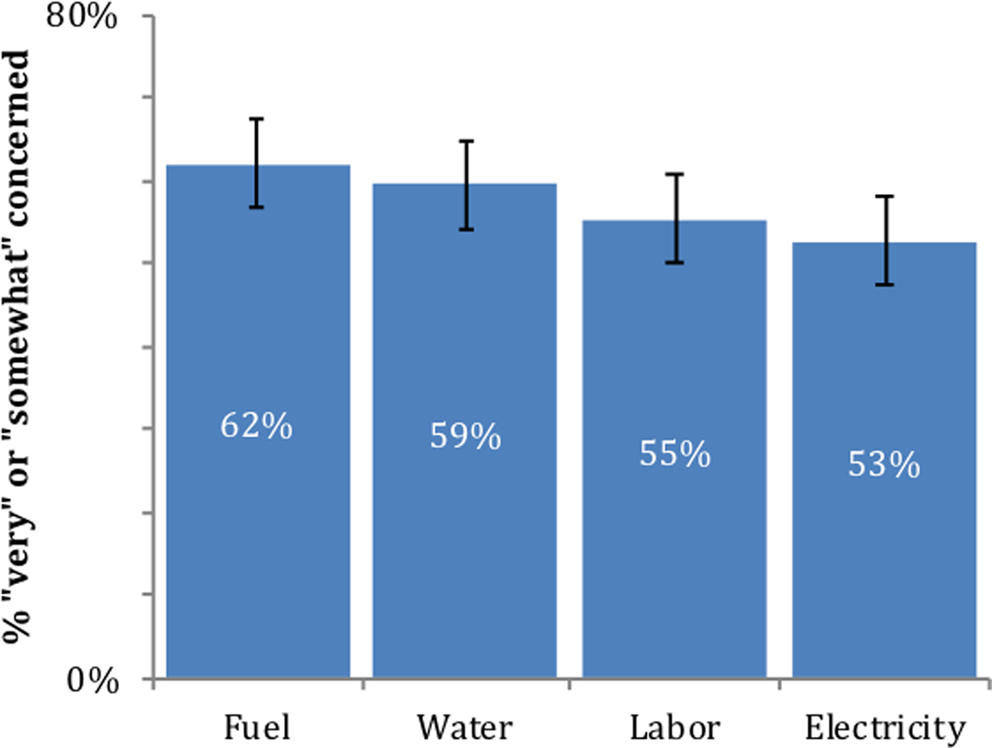
When asked about their level of concern regarding the amount or type of resource (labor, water, electricity and fuel) used to produce fresh fruits and vegetables for housing dining facilities, a majority of students surveyed (53 to 62%) were at least ‘somewhat concerned’ about each of these factors (Fig. 1), with this response occurring as both the most common (mode) and median response for all four resources (data not shown). A non-parametric sign test showed that there was more concern for both water and fuel than both labor and electricity (P ⩽ 0.001).
The proportion of the University of Wisconsin –Madison dining hall survey respondents answering ‘very’ or ‘somewhat’ concerned about each resource as related to produce purchasing. Error bars represent 95% confidence intervals.

Relationship between students’ food system concerns and their perceptions of sustainability factors and resource use product attributes
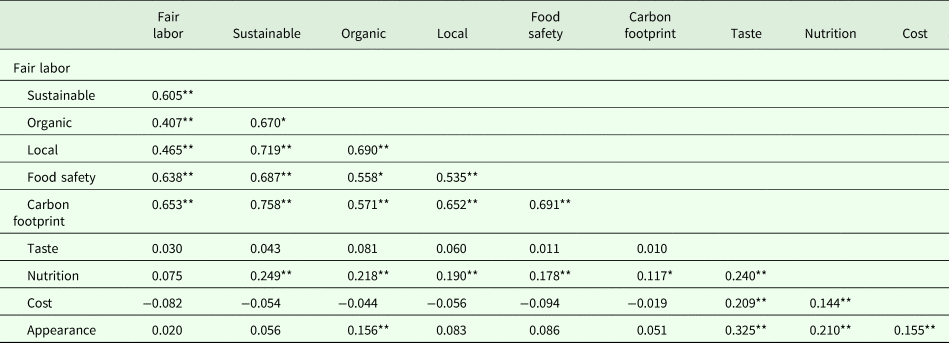
Many of the sustainability attributes moderately to strongly correlate with each other. For example, ‘grown with verifiable sustainability practices’ was moderately correlated (r > 0.6; P < 0.05) with the factors ‘locally grown (within 25 miles of campus)’, ‘certified organic’, ‘grown with verifiable sustainability practices’, ‘certified carbon footprint’, ‘grown under a third-party audited food safety program’ and ‘grown using fair labor standards’. Influence of carbon footprint was moderately correlated with the influence of local, fair labor and food safety. The responses ‘grown under a third-party audited food safety program’ and ‘grown under a third-party audited food safety program’ were also moderately correlated, as were organic and local (Table 2).
Spearman correlation coefficients between production and attribute factors influencing respondent's purchasing decisions regarding produce

**P < 0.01.
*P < 0.05.
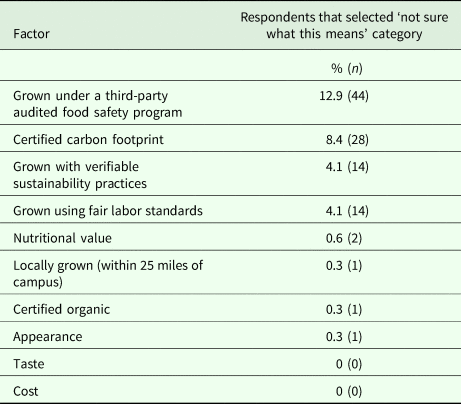
In contrast to the correlations among sustainability attributes above, the product attributes were only weakly correlated among themselves (although all are significant), ranging from r = 0.144 to r = 0.325 (P < 0.05) (Table 2). A possible reason for this discrepancy between the high correlation of factors of production and low correlation of attributes of the food itself could be that respondents hold a greater understanding of taste, appearance, cost, and nutrition and are therefore able to give a more nuanced response. In contrast, respondents may conflate the labels associated with food production practices (e.g., local, sustainable, organic) due to lack of clarity as to what the labels indicate. This explanation is supported by the much larger proportion of respondents who chose ‘not sure what this means’ for factors of production as compared with attributes of the food itself (Table 3). Another possible conclusion is that it is simply unlikely for a person to be influenced by only one factor of production, as much as it would be unlikely for a person to be concerned about only one environmental cause, such as energy efficiency, without being concerned about others, such as climate change.
Percent and number of respondents who were unsure as to the meaning of each product or sustainability attribute

Attitudes toward the influence of purchasing on the community and environment
Forty-nine percent of the sample ‘probably’ or ‘definitely’ thought that their food choices influenced the wider community and environment. The relationship between this question and the specific attributes and concerns about resources, while significant, were fairly weak (R 2 = 0.089; P < 0.01). Regression analysis also revealed a similarly small (R 2 = 0.071) but statistically significant (P < 0.01) relationship with respect one's belief in the influence of their food choices; as this metric increased by one category (e.g., from ‘possibly’ to ‘probably’), the influence of sustainability attributes on purchasing decisions increased by 0.24 (e.g., roughly one quarter of a move between categories of ‘definitely’, ‘probably’, ‘possibly’, ‘probably not’ or ‘definitely not’).
Study limitations
While findings from this study contribute to the scientific discussion on attitudes towards sustainability-related food labels in an understudied age group, several limitations are apparent. First, the limited, single population on dining hall patrons at one land-grant university that was sampled limits our capacity to draw broader causal inferences from our findings. However, although conducted only at one university, the sample size was large (n = 336). Also, due to our desire to maintain brevity and focus in our survey efforts, we limited some demographic variables with respect to students’ background and previous exposure to sustainability concepts. Despite these potential limitations, this study contributes to our broader understanding of public university students’ attitudes towards food values and product labeling. Finally, this study is one of the few to evaluate perceptions of food values and food labels held by university students of the millennial generation.
Discussion
The results of our survey contribute to our understanding of public university students’ perceptions of and reactions to different quality and sustainable attributes labeled on produce purchased from dining halls. University students’ buying behaviors can help shape the future structure and priorities of our food systems. As indicated by our survey, however, produce taste, appearance, cost and nutritional quality remain the primary drivers for students’ choices from campus dining menus, as opposed to environmental or ethical priorities, at this one public university. Our survey results align with previously funded research which indicated that the impact of environmental labels will diminish if other product attributes (e.g., taste, quality, healthfulness) are weak (Tang et al., Reference Tang, Fryxell and Chow2004). Furthermore, our findings agree with data documenting that millennials hold rational and self-oriented rather than emotional and others-oriented motives lead millennials to act pro-environmentally, and that college students are interested in the same food qualities prioritized in broader consumer research (e.g., safety freshness, taste, convenience, nutrition and price) (Feenstra et al., Reference Feenstra, Allen, Hardesty, Ohmart and Perez2011; Naderi and Van Steenburg, Reference Naderi and Van Steenburg2018).
In addition to demonstrating prioritization of quality attributes, our study also supported that the purchasing priorities of UW-Madison dining hall patrons align with more global trends in which consumers are placing increasing emphasis on ethical parameters of food production over environmental metrics. Consumers concerned with ethical production of food are guided by labels defining product attributes such as fair trade, labor conditions, fair prices to farmers and animal welfare when making decisions to purchase and consume food products (Sebastiani et al., Reference Sebastiani, Montagnini and Dalli2013). In their analysis of the impact of additional ethical attributes of organic foods purchases, Zander and Hamm (Reference Zander and Hamm2010) found that a considerable proportion of consumers would be willing to pay more for ethically-produced food, such as animal welfare, regional production and fair prices to farmers. Similarly, in a California-based study, consumers indicated that standards for the humane treatment of animals, working conditions and wages had a similar level of interest to the environmental impacts of their food purchases (Sebastiani et al., Reference Sebastiani, Montagnini and Dalli2013). While these studies involve a broader consumer base, data specifically focused on the behavior of college students found that after criteria having a direct individual impact (e.g., taste, nutrition), the next highly ranked are values that involve the welfare of others (e.g., humanely produced and fair living wage) (Feenstra et al., Reference Feenstra, Allen, Hardesty, Ohmart and Perez2011).
Despite the lower prioritization of sustainability metrics by students at the University of Wisconsin, the survey data still suggests a consumer desire for more knowledge about agriculture and food production and indicates a need for clearer communication about the source and production of dining hall foods. Previous research has supported similar conclusions; for example, while premium prices and lack of availability remain primary barriers in organic food consumption, other important barriers include lack of information and consumer knowledge (Hand, Reference Hand2009). As one respondent to our survey noted, ‘simply saying where ingredients or whole foods are from would be a huge improvement.’ This comment highlights that clearer communication about food sourcing could influence student purchasing behavior, as well as serve as an opportunity for education as to the structure and function of our food systems (Porter et al., Reference Porter, Conner, Kolodinsky and Trubek2017).
As with other research investigating consumer motivations as related to food labels, it is important to highlight the possible incongruence between consumer attitudes and their corresponding behaviors regarding sustainable consumption practices (Howard and Allen, Reference Howard and Allen2006; Seyfrang, Reference Seyfrang2006). This study, as with many other peer-reviewed studies which focus on the impacts of food labels, focuses on sustainable purchase intention rather than actual purchasing behavior (Shrum et al., Reference Shrum, McCarty and Lowrey1995; Robinson and Smith, Reference Robinson and Smith2002; Lockie et al., Reference Lockie, Lyons, Lawrence and Grice2004; Janßen and Langen, Reference Janßen and Langen2017). Yet, intention does not always translate to behavior, and gaps between intention and behavior can be strongly influenced by situational factors. The ease of purchasing and product availability, confidence in the product label claims, social pressures and consumer economic status can impact purchasing decisions, despite what the perceived ideal would be on behalf of the individual consumer. However, with the interest existing on the part of the consumer, shared responsibility and values throughout the food production and distribution systems can contribute to the building of a more sustainable global food production model.
Conclusion
By identifying the sustainability values of students and their willingness to pay more for specific types of sustainable food, results from this study can inform efforts to align priorities of food service purveyors and campus dining services with the values of their student patrons, as well as identify educational opportunities around agriculture and food production. Nationally, both private and public universities are addressing student demand for alternative food purchasing strategies, including through the Real Food Challenge, which integrates not only sustainable production criteria, but aspects of food sovereignty, economics, animal welfare, health and food justice (Real Food Challenge, 2018). Through sourcing food that meets customer sustainability values, colleges and universities can improve both fiscal and ecological metrics of success, while integrating policies that are meaningful to the campus student community.
Acknowledgements
This research was funded in part by the University of Wisconsin-Madison Office of Sustainability.