Introduction
The practice of setting aside small patches of forests as sacred and inviolate is widespread throughout the world’s native cultures (Bhagwat & Rutte Reference Bhagwat and Rutte2006, Verschuuren Reference Verschuuren2010). Although the cultural bases for identifying and protecting such forests and the endogenous rules applied to govern such forests may vary among regions (Miehe et al. Reference Miehe, Miehe, Koch and Will2003, Wadley & Colfer Reference Wadley and Colfer2004, Dafni Reference Dafni2006, Sheridan Reference Sheridan2009), there is an underlying unity of purpose defined by how people interact with nature (Dudley et al. Reference Dudley, Higgins-Zogib and Mansourian2009, Sponsel Reference Sponsel2012). Sacred forests (SFs) are largely held to be of cultural and religious significance (Chandran & Hughes Reference Chandran and Hughes1997, Allendorf et al. Reference Allendorf, Brandt and Yang2014), but their ecological importance as a complementary biodiversity conservation model with associated environmental benefits is now being widely recognized (Boraiah et al. Reference Boraiah, Vasudeva, Bhagwat and Kushalappa2003, Bhagwat et al. Reference Bhagwat, Kushalappa, Williams and Brown2005, Salick et al. Reference Salick, Amend, Anderson, Hoffmeister, Gunn and Zhendong2007, Metcalfe et al. Reference Metcalfe, Ffrench-Constant and Gordon2010, Brandt et al. Reference Brandt, Butsic, Schwab, Kuemmerle and Radeloff2015, Ballullaya et al. Reference Ballullaya, Reshmi, Rajesh, Manoj, Lowman and Allesh Sinu2019).
Contemporary efforts in biodiversity conservation typically place emphasis on networks of protected national parks and sanctuaries located in biodiversity-rich areas, where human activities are restricted by law (Virtanen, Reference Virtanen2002, Laurance et al. Reference Laurance, Useche, Rendeiro, Kalka, Bradshaw, Sloan and Laurance2012). However, this model has often pitted humans against nature by restricting the rights and livelihoods of communities (Hutton et al. Reference Hutton, Adams and Murombedzi2005, Saout et al. Reference Saout, Hoffmann, Shi, Hughes, Bernard, Brooks and Bertzky2013). Such alienation has understandably reduced the efficacy of the centralized system of parks and sanctuaries in conserving biodiversity (DeFries et al. Reference DeFries, Hansen, Turner, Reid and Liu2007), and unregulated activities may persist, causing degradation of habitat and biodiversity (Bruner et al. Reference Bruner, Gullison, Rice and da Fonseca2001, Parrish et al. Reference Parrish, Braun and Unnasch2003, Struhsaker et al. Reference Struhsaker, Struhsaker and Siex2005). These limitations of the protected areas model have encouraged alternative models and complementary roles for local communities in governing forests and biodiversity (Ramakrishnan Reference Ramakrishnan1996, Berkes Reference Berkes2007, Shahabuddin & Rao Reference Shahabuddin and Rao2010).
Although SFs as a land tenure system were not created to primarily conserve biodiversity (Allendorf et al. Reference Allendorf, Brandt and Yang2014), the customary practices that govern SFs may have resulted in conserving elements of biodiversity that are often lost from forests subject to exploitation (Byers et al. Reference Byers, Cunliffe and Hudak2001, Boraiah et al. Reference Boraiah, Vasudeva, Bhagwat and Kushalappa2003, Mgumia & Oba Reference Mgumia and Oba2003, Ambinakudige & Sathish Reference Ambinakudige and Sathish2009). The endogenous rules that govern SFs vary among regions (Virtanen Reference Virtanen2002), but by design, resource extraction and human activities tend to be minimal (Gadgil & Vartak Reference Gadgil and Vartak1976, Ormsby & Bhagwat Reference Ormsby and Bhagwat2010). There is evidence that SFs preserve elements of biodiversity that are lost in intensively used forests (Ruelle et al. Reference Ruelle, Kassam and Asfaw2018, Singh et al. Reference Singh, Bhat, Malik, Youssouf, Bussmann and Kunwar2019), but this is not well known from many regions of the world that have significant numbers of SFs. How the community structure of SFs differs from that of intensively used forests is also not well known. There is ample evidence, however, that anthropogenic disturbance has a negative impact on biodiversity and plant communities in a wide range of ecosystems (Rao et al. Reference Rao, Barik, Pandey and Tripathi1990, Mishra et al. Reference Mishra, Tripathi, Tripathi and Pandey2004). Therefore, if SFs are to be considered as a valuable complementary conservation model, then their diversity and structure need to be more widely investigated. The overall biodiversity value of SFs will depend not only on their sizes and numbers, but also on the nature of the biodiversity they support.
Here, we report on tree species diversity and community structure in SFs from a site in the state of Odisha (eastern India). Odisha state has high forest cover (38% of total land area; Forest Survey of India 2017) and a significant proportion of indigenous native people (23% of the total at the state level, but much greater in parts) who follow traditional livelihood practices dependent on forest resources to varying extents. Odisha may have many SFs, which are only now being systematically documented and studied (Rath & John Reference Rath and John2018, Pradhan et al. Reference Pradhan, Ormsby and Behera2019); however, traditional practices of community-based forest conservation and forest dependence are well known from the region (Nayak & Berkes Reference Nayak and Berkes2008, Singh Reference Singh2013). We focused on one administrative block (Banspal) in the Keonjhar district of Odisha and carried out comparative analyses of tree species diversity and tree size structure in two contrasting land tenure systems: SFs and reserve forests (RFs).
Our motivation for comparing SFs and RFs lies in the fact that only c. 27% of India’s forest land is protected as national parks and wildlife sanctuaries, while c. 56% of the forests are classified as RFs. The remainder includes community forests, private forests, forestry plantations and miscellaneous types that are not classified in national forest surveys (Forest Survey of India 2017). Although RFs are protected by national and state laws (Indian Forest Act 1927), state governments have jurisdiction in granting rights for resource use, and RFs tend to support varying levels of human dependence across the country, which results in significant disturbance (Kadavul & Parthasarathy Reference Kadavul and Parthasarathy1999, Sagar et al. Reference Sagar, Raghubanshi and Singh2003). Given their huge geographical extent, the degradation of biodiversity in RFs could have substantial impacts on the national scale.
SFs are abundant and widespread in the Indian subcontinent (Malhotra et al. Reference Malhotra, Gokhale and Chatterjee2007), but are individually mostly small and of limited utilitarian value (Malhotra et al. Reference Malhotra, Gokhale and Chatterjee2007, Rath & John Reference Rath and John2018). SFs across India are typically governed by local communities following traditional practices (Rutte Reference Rutte2011, Ballullaya et al. Reference Ballullaya, Reshmi, Rajesh, Manoj, Lowman and Allesh Sinu2019), and in our study site, we found that SFs were identified exclusively for spiritual reasons where each patch typically had a stone deity or a man-made material object that was worshipped. Local communities have the right to enter these forests for worship, but in all cases, it was considered taboo to extract any form of goods from these sites. Since the SF patches were fully community managed, they had no legal protection like protected areas.
In RFs in our study site, we found limited extraction of wood, wood debris, leaf litter and flowers of at least one tree species (Madhuca indica, local name ‘mahua’), but we did not observe grazing or other forms of intensive use. In comparison, SF sites clearly had lesser resource-extractive or intensive human activities compared to the RF sites. We derived a consistent long-term picture of these differences in land use between SF and RF sites by talking to local communities and government officials. We hypothesize that if RFs have indeed experienced moderate but persistent levels of resource extraction and disturbance compared to SFs in the long term, SFs will be floristically richer with greater numbers of species and overall species diversity and will show less dominance in community structure. Furthermore, any differences in size-specific tree mortality rates caused by harvesting or disturbance between the two land tenure types should be evident in the stem size density distributions (SDDs) (Coomes et al. Reference Coomes, Duncan, Allen and Truscott2003).
Materials and methods
Study site
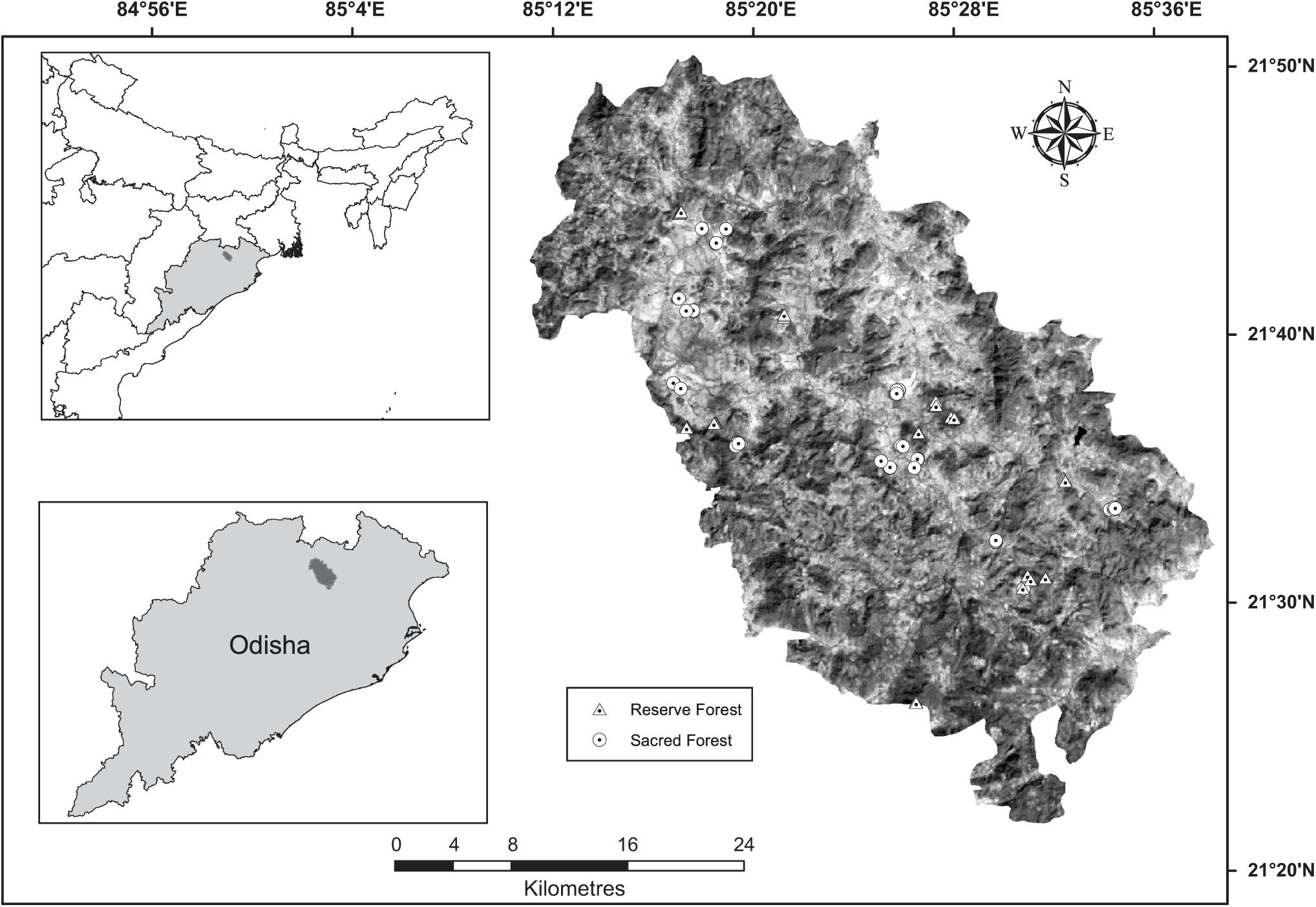
Our study site falls within the administrative block called Banspal in Keonjhar district in the state of Odisha (Fig. 1), because it represents conditions in the interior districts of Odisha where forest cover is highest and indigenous cultures are common. However, deforestation is also increasing here due to mining and industrial activities. Banspal block has a land area of 110 800 ha, of which c. 51% is under forest, and almost all of it is RF except the 32 known SF patches that have a total area of 14.9 ha; most SFs are smaller than 0.5 ha, and many have just a few trees. The population density of Banspal block is 63 persons/km2, which is much lower than India’s average of 382 persons/km2 (Office of the Registrar General & Census Commissioner 2011). Approximately 78% of the population consists of indigenous people designated as ‘Scheduled Tribes’ (STs) by the Government of India. There are five STs reported from Banspal, but just one group called the Juang, who are officially classified as a ‘Primitive Tribal Group’, account for over 70% of the population (Government of India 2013).
Locations of sacred forest and reserve forest sampling sites in the Banspal Block of Odisha state. The greyscale palette in the background indicates the density of vegetation computed using the normalized difference vegetation index obtained from Landsat 8 data for the year 2018. Darker shades indicate higher density.

Our sampling sites were located within latitudes 21°20´N and 21°50´N and longitudes 85°12´E and 85°36´E. The climate is tropical monsoonal, with mean annual rainfall of c. 1513 mm, most which falls during the monsoon months from June through October (Hijmans et al. Reference Hijmans, Cameron, Parra, Jones and Jarvis2005). The dry season extends for 5–6 months, beginning soon after the monsoon, during which total rainfall has a mean value of 280 mm. The summer months are extremely hot, with maximum daytime temperatures of over 40°C, and often exceeding 45°C.
Tree diversity sampling
Within the block, we carefully selected 10 SF patches (>0.5 ha each) and sampled four 30 m × 30 m quadrats in each. However, in two SF patches, only two square quadrats were sampled due to constraints with patch size and shape, so these patches were not considered for diversity analyses. Since all patches were small and the quadrats were not independent replicates, we pooled the quadrat data at each site to express diversity in each patch. RF patches were large, so it was easy to find a comparable number of sites to match the sampling effort of SF sites. We chose nine RF patches that occurred near the SF sampling sites to ensure that SF and RF sampling sites occurred in very similar eco-geographical environments, with the plant community differences determined mainly by land tenure. In each quadrat, we sampled all woody plants ≥10 cm in girth at breast height (GBH) (1.3 m above ground), identified each individual to the species level and measured the exact GBH. All of this fieldwork was carried out from May 2016 to April 2018.
Climatic data
Since primary weather station data were not available, we studied climatic variation using the global WORLDCLIM database. We extracted mean monthly temperature, mean annual rainfall and dry season rainfall for the sampling sites (Hijmans et al. Reference Hijmans, Cameron, Parra, Jones and Jarvis2005). Using data on elevation from the ASTER Digital Elevation Model (DEM; 30-m spatial resolution; https://lpdaac.usgs.gov/tools/data-pool/?_ga=2.262614156.1806004703.1575620336-1450836343.1575620336), we derived the slope, aspect and topographical convergence index for the sampling sites. We used these environmental data to assess these conditions at the sample sites and also to account for any role for climate and topography in contributing to the differences in species composition among sites (see Supplementary Material S1, available online).
Testing differences in species diversity, basal area and SDD between SFs and RFs
After accounting for any environmental influence on species abundances using redundancy analyses (see Supplementary Material Annexure S1), we designed simple and direct analyses to test for significant differences in basic community attributes between SFs and RFs. We built four simple linear mixed-effects models (Zuur et al. Reference Zuur, Ieno, Walker, Saveliev and Smith2009), in which land tenure was treated as a mixed-effects predictor in all cases, with the differences among models being the response variables: (1) species richness (S); (2) Shannon’s diversity (H); (3) evenness (H/log(S)); and (4) plot basal area (BA) (Magurran Reference Magurran1988). We also computed the rank abundance curves for the two land tenure regimes to examine differences in dominance and diversity.
Stem SDDs can reveal the ecological and demographic processes that influence size-specific mortality. When mortality is determined by purely asymmetric competition in even-aged self-thinning stands, it decreases sharply with tree size and produces a scaling relationship between stem size and size density, with an exponent value close to −2. On a log-log plot, therefore, we would obtain a straight line with slope equal to −2 (Enquist & Niklas Reference Enquist and Niklas2001). Departures from this scaling relationship could be due to extrinsic causes of mortality. In particular, if the probability of mortality becomes independent of size, then the numbers of deaths will simply be proportional to the abundance within that size. This should yield a negative exponential distribution, yielding a straight line on a log-linear plot (Coomes et al. Reference Coomes, Duncan, Allen and Truscott2003). Tree populations that are subject to extraneous disturbance may show greater mortality in the large sizes than expected under pure asymmetric competition. We computed SDDs using 2 cm diameter at breast height (stem diameter at 1.3 m height) bins and examined the scatterplots on log-log and log-linear axes (Coomes et al. Reference Coomes, Duncan, Allen and Truscott2003). We then fitted the power-law scaling relationship and the negative exponential distributions to the scatterplots and used the small sample-corrected Akaike information criterion (AICc) for model selection. The model with the lowest AICc was chosen as the best model (models are considered to have equal support if the difference in AICc is less than 2; Burnham & Anderson Reference Burnham and Anderson2002). We thus fitted three models: (1) a scaling function (logN = alogD + c); (2) a negative exponential function (logN = aD + c); and (3) a negative exponential function with a quadratic term (logN = aD + bD 2 + c), where N is the density of stems in a size class, D is the mid-point of the stem diameter size class and log is the base 10 logarithm (Coomes et al. Reference Coomes, Duncan, Allen and Truscott2003). In model fitting, we only included size class bins with at least three individuals. We realize that the variance can be very high at these low sample sizes, but applying higher cut-off values would have greatly reduced the number of size classes. All data analyses were carried out in R software (R Core Team 2018).
Results
We recorded a total of 5695 individual trees ≥10 GBH and 76 species of woody plants, including all sites. Our sampling effort was almost equal for SF and RF sites, with 2816 individuals sampled in SF sites and 2879 individuals sampled in RF sites. We found 68 species in SF sites and 49 species in RF sites, with 41 species common to both of these land tenure types. Furthermore, we found that 27 of the 68 species found in SF sites were absent in RF sites, while 8 species found in RF sites were absent in SF sites (Supplementary Table S1). Most of the tree species absent from RF sites are typical moderate- to low-abundance species found in the dry and moist deciduous forests of India. This species that we did not find in RF sites include species in the genus Ficus, large trees like Garuga pinnata Roxb., Hymenodictyon orixense Roxb., Grewia tiliifolia F. Muell. ex Benth., Stereospermum chelonoides (L. fil.) DC and Bombax ceiba L. All except B. ceiba are typical of old-growth deciduous forests. Among the species in RF sites that were not found in SF sites, Tectona grandis L. f. was most prominent, and there were other well-known trees like Ougeinia oojeinensis (Roxb.) Hochr. and Alstonia scholaris (L.) R. Br., which are large trees. Among the smaller trees, Callicarpa tomentosa L. (Murr.) and Naringi crenulata (Roxb.) D.H. Nicolson were notably absent in SF sites. We found no significant spatial trends, spatial structures or influences of any environmental factors on the variation in species abundances among the sites (see Supplementary Material Annexure S1).
Influence of land use on species diversity and BA
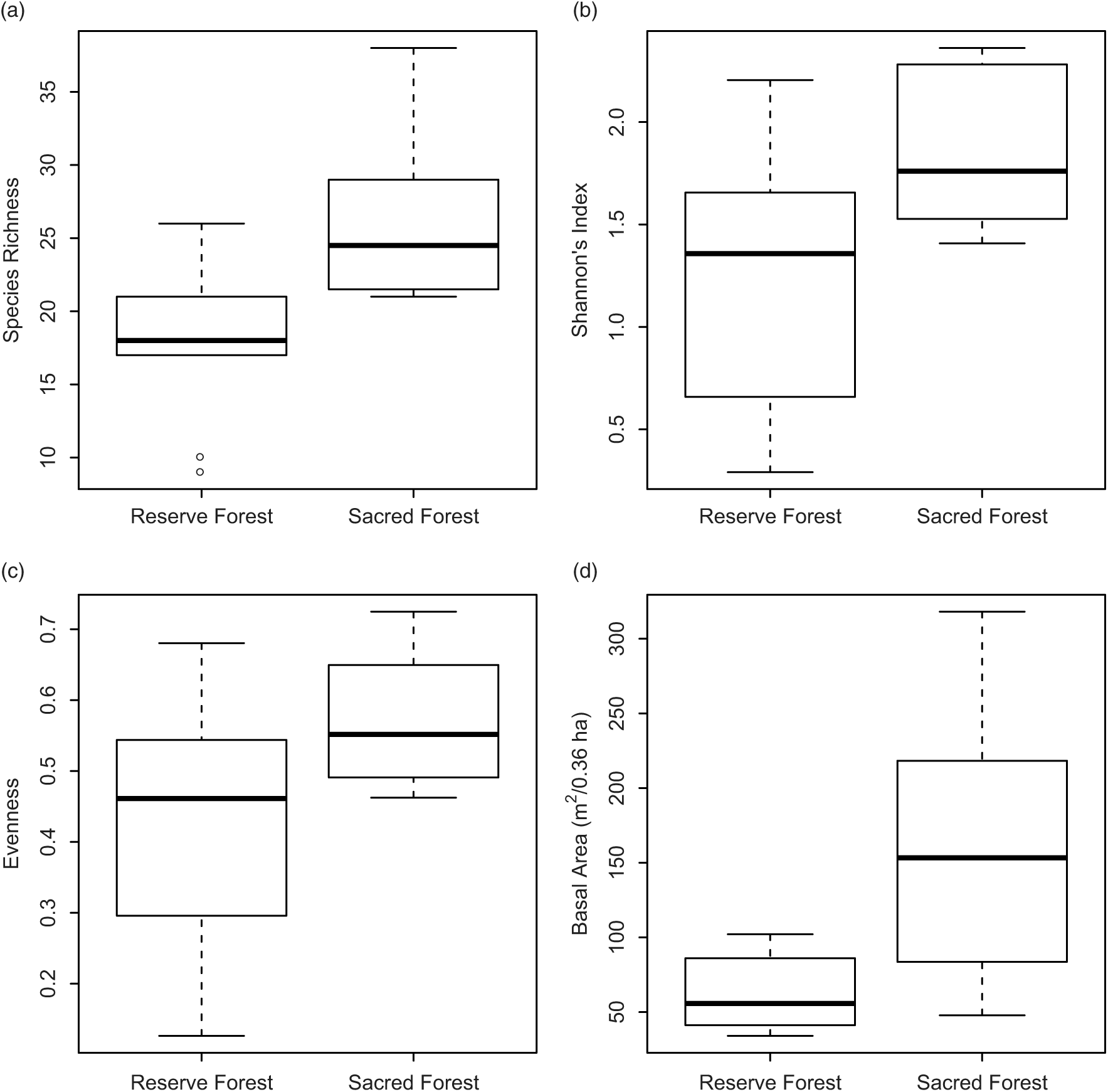
Boxplots showed a clear difference in species richness (Fig. 2(a)), but smaller differences in Shannon’s species diversity (Fig. 2(b)) and evenness (Fig. 2(c)) between SF and RF sites. The median values and interquartile ranges of the two boxes barely overlap for species richness and BAs, but they do overlap for Shannon’s diversity and evenness (Fig. 2(a)–(d)). Linear mixed-effects models and likelihood ratio tests showed that only species richness was significantly greater in SF sites compared to RF sites (χ2 = 5.119, df = 1, p = 0.0237), while Shannon’s diversity and evenness were not statistically significant (χ2 = 3.815, df = 1, p = 0.0508 and χ2 = 3.121, df = 1, p = 0.0772, respectively), although the patterns of species richness and evenness between SF and RF sites were also evident in the rank-abundance curves (Supplementary Fig. S1). The BAs of SF sites appear to be distinctly greater than those of RF sites (Fig. 2(d)), and the linear mixed-effects model confirmed that SF sites had greater BAs (χ2 = 5.553, df = 1, p = 0.0184) (Supplementary Annexure S2).
Boxplots of (a) species richness, (b) Shannon’s diversity, (c) evenness and (d) basal Area in 0.36-ha samples in eight sacred forest and nine reserve forest sites. See text for statistical analyses of these differences.

In both SF and RF sites, Shorea robusta (commonly known as ‘sal’) was dominant, accounting for almost 50% of all individuals in SF sites and 70% of all individuals in RF sites. Since the common species were mostly present in both land tenure types and the differences were mainly due to the rare species, the correlation in species abundances between SF and RF sites was very strong (Pearson’s R = 0.9882, p < 0.001). Without inclusion of Shorea, the correlation was weaker but still statistically significant (Pearson’s R = 0.7919, p < 0.001).
Size density distribution and land use
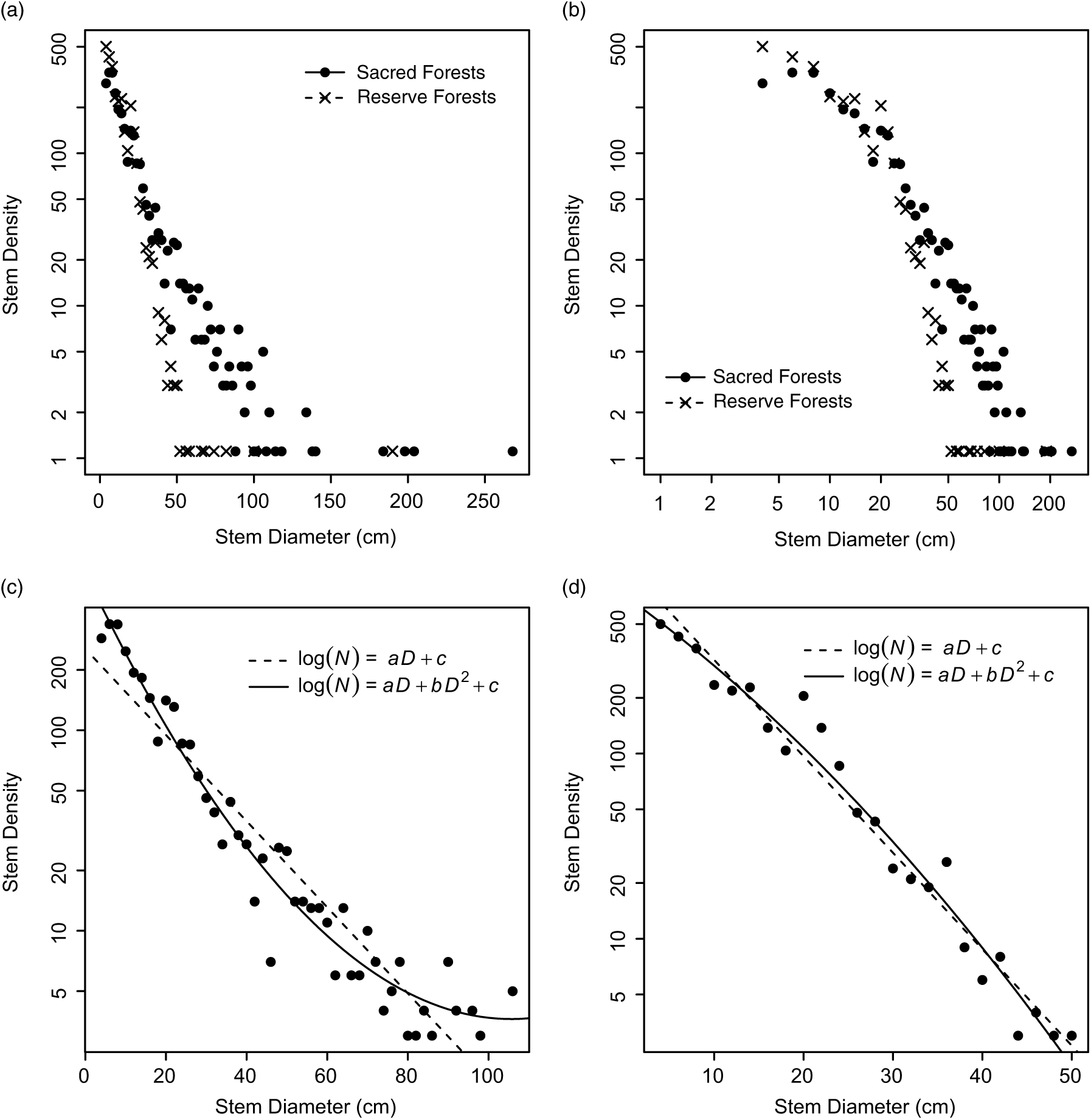
Stem SDDs deviated significantly from the expected −2 scaling relationship (Fig. 3(a)). On a log-linear scale, based on the negative exponential distribution, the SDD appeared more linear (Fig. 3(b)). The fit of the −2 exponent scaling relationship of the SDD was poorer than the negative exponential for both land tenure regimes. For the SF sites, the AICc values for Models 1, 2 and 3 were 62.14, 64.23 and 25.14, respectively, which shows that Model 3 had the best fit among these models (Fig. 3(c)). For Model 1, the estimated value of the scaling exponent (a) was −1.776. For RF sites, the AICc values for Models 1, 2 and 3 were 55.51, 17.00 and 12.45, respectively, and the estimated scaling exponent (a) was −2.259. The negative exponential models were far better fits than the scaling model for RF sites, and again Model 3 was the best for RF sites (Fig. 3(d)).
Stem size density distributions in sacred forest and reserve forest sites. (a) The scaling relationship on log-log axes; (b) the negative exponential on log-linear axes; (c) the fits for Models 2 and 3 for sacred forests; and (d) the fits for Models 2 and 3 for reserve forests.

Discussion
After accounting for differences due to environmental variation, we found that species richness was clearly greater in SF sites. Species diversity was also greater, albeit statistically marginally so. We also found that BA (an approximate measure of biomass) was greater in SF sites and that the SDDs showed a greater range at the upper end of stem size and of the abundance of large trees. The SDDs showed significant departures from the −2 scaling relationship (Enquist & Niklas Reference Enquist and Niklas2001), and the significantly better fit of the negative exponential distributions implies extraneous mortality, which increases the mortality rates of larger tree sizes above what is expected from pure self-thinning caused by asymmetric competition (Coomes et al. Reference Coomes, Duncan, Allen and Truscott2003). Together, these results are consistent with our hypothesis and expectations that the cultural practice of protecting SFs led to significant gains in the conservation of plant diversity and community structure compared to forests that experience greater levels of human activities.
Although the practice of setting aside SFs is old and unconnected to contemporary ideas of biodiversity conservation (Rutte Reference Rutte2011), SFs can make a valuable contribution to biodiversity conservation (Virtanen Reference Virtanen2002, Bhagwat et al. Reference Bhagwat, Kushalappa, Williams and Brown2005). Since most SF patches are small, they may possess more symbolic meaning than any economic importance, but communities could derive substantial environmental benefits from these sites (Ballullaya et al. Reference Ballullaya, Reshmi, Rajesh, Manoj, Lowman and Allesh Sinu2019). Nevertheless, even where SFs occur in large numbers, their total area may only account for a small fraction of the forest cover. Therefore, we need to evaluate whether SFs can serve to protect rare or endemic species that are sensitive and survive poorly in intensively used landscapes. The observed differences in diversity between SF and RF patches that we found lend support to this idea. Nevertheless, because of their much larger expanse, RFs in India can potentially accommodate greater numbers of species overall, if pervasive disturbance and degradation do not decrease diversity to well below their potential (Kadavul & Parthasarathy Reference Kadavul and Parthasarathy1999).
Numerous studies on SFs support the view that the practice leads to tangible conservation benefits (Byers et al. Reference Byers, Cunliffe and Hudak2001, Boraiah et al. Reference Boraiah, Vasudeva, Bhagwat and Kushalappa2003, Mgumia & Oba Reference Mgumia and Oba2003, Bhagwat & Rutte Reference Bhagwat and Rutte2006, Verschuuren Reference Verschuuren2010). Although such comparisons of SFs have often been made against intensively managed systems (Ambinakudige & Sathish Reference Ambinakudige and Sathish2009), this appears to hold true even with more equitable comparisons (Metcalfe et al. Reference Metcalfe, Ffrench-Constant and Gordon2010, Ruelle et al. Reference Ruelle, Kassam and Asfaw2018, Pradhan et al. Reference Pradhan, Ormsby and Behera2019). For plant groups or resources that are intensively extracted (e.g., medicinal plants), the contrast is usually starker (Boraiah et al. Reference Boraiah, Vasudeva, Bhagwat and Kushalappa2003). Our SF sites were all small and isolated fragments and should have experienced greater edge effects, demographic stochasticity and Allee effects (Cardelús et al. Reference Cardelús, Scull, Hair, Baimas-George, Lowman and Eshete2013) compared to our RF sites. Nevertheless, we found that diversity and SDD patterns reflect a more robust plant community compared to RFs, which indicates that SF management more than makes up for the losses due to their fragmentation and small size.
Plant community structure has rarely been examined in SFs, and we found – in accord with our expectations – that large trees were significantly better represented in SFs, and the largest of trees were absent in intensively used RFs. BAs were therefore greater in SFs, indicating greater aboveground carbon storage and canopy density, a pattern that is now becoming apparent at other SF sites (Waikhom et al. Reference Waikhom, Nath and Yadava2018). Other ecosystem service benefits conferred by SFs are poorly understood and need to be investigated (Gokhale & Pala Reference Gokhale and Pala2011, Ballullaya et al. Reference Ballullaya, Reshmi, Rajesh, Manoj, Lowman and Allesh Sinu2019).
Despite the obvious merits of SF sites in contributing to biodiversity conservation, several caveats must be mentioned. Including sacred sites along with protected areas to create a larger conservation framework may make their governance difficult (Allendorf et al. Reference Allendorf, Brandt and Yang2014). Protected areas staff need to be made aware of traditional cultures and practices (Dudley et al. Reference Dudley, Higgins-Zogib and Mansourian2009) and to learn to integrate the different approaches to conservation. There are also situations in which the protected area governance has proved stronger than SFs in avoiding deforestation (Brandt et al. Reference Brandt, Butsic, Schwab, Kuemmerle and Radeloff2015), particularly in dealing with contemporary environmental pressures, so an integrated framework may confer some benefits. In other cases, community-managed forests are shown to be no more effective than protected forests at conserving biodiversity (Shahabuddin & Rao Reference Shahabuddin and Rao2010). It therefore emerges that the long-term sustainability of SF patches is the most important ecological question that remains poorly addressed. Increasingly, SF patches are completely isolated and occur in a matrix of human-dominated land uses, and they are vulnerable to degradation due to their small size and isolation (Cardelús et al. Reference Cardelús, Scull, Hair, Baimas-George, Lowman and Eshete2013). Similarly, the SFs in Odisha were mostly small, isolated patches around human settlements, and their future remains uncertain. There is increasing pressure from industrial activities, but since so little has been documented historically about SFs from Odisha, it is difficult to assess how SFs have held up against this pressure of deforestation.
SDDs show that negative exponential distributions fit the data reasonably well, with clear departures from the scaling relationship. However, the SDD for SFs was more complex, with a significant long, shallow tail for large trees. The SDDs for SFs and RFs appear clearly different for the larger sizes, while there is considerable overlap at the smaller sizes. We do not have demographic data, so we cannot compare mortality rates at different sizes, which would be needed to understand these SDDs, but the closer fit of the negative exponential does suggest elevated mortality at the larger sizes due to extraneous factors and not competition (Coomes et al. Reference Coomes, Duncan, Allen and Truscott2003). Long-term demographic studies would be well worth undertaking in SFs and different forests that are used by people. This would provide direct measures of how different management practices affect species composition and community structure, and therefore the long-term sustainability of SFs to complement other systems for biodiversity conservation. Protected areas may not be fully effective (Naughton-Treves et al. Reference Naughton-Treves, Holland and Brandon2005) or represent all of the biodiversity worth protecting (Margules & Pressey Reference Margules and Pressey2000, Mittermeier et al. Reference Mittermeier, Mittermeier, Brooks, Pilgrim, Konstant, da Fonseca and Kormos2003), but as our study shows, SFs, although small, have the potential to complement protected areas in conserving a larger range of species.
Supplementary material
To view supplementary material for this article, please visit https://doi.org/10.1017/S0376892919000390
Acknowledgements
We thank Mr Sarat Jena, field taxonomist, and Mr Shantanu Kumar Nayak, tracker, for helping us carry out the fieldwork. We thank Orissa Space Applications Centre (ORSAC) for supplying us with all of the base files required for remote sensing and Geographical Information System (GIS) work.
Financial support
SR thanks DST-INSPIRE FELLOWSHIP PROGRAMME 2012–2013 (IF-120492).
Conflict of interest
None.
Ethical standards
None.