What factors cause political parties to shift their positions on issues? Moreover, under what conditions will parties “trade places” on an issue, triggering a realignment? Notable examples include the civil rights realignment of the 1960s in the United StatesFootnote 1 and the more recent partisan shifts on European integration in the United Kingdom.Footnote 2 Some theories link party position change to the replacement of previous party leaders with new officeholders who hold different policy preferences or cater to different constituencies,Footnote 3 while others focus on the adaptation of incumbents to shifts in preferences among voters or interest groups.Footnote 4
In this paper, I put forward a new framework of party position change in which office-motivated incumbents adapt their positioning even without any voters changing their preferences. I argue that internal migration can induce shifts in positioning, and even realignment. My argument links a persistent political geography to an evolving economic geography. In advanced plurality countries, Left incumbents represent mostly high-density constituencies, while Right incumbents predominantly represent low-density constituencies.Footnote 5 In pursuit of higher wages, college-educated workers move to high-density constituencies. Because those workers tend to support free trade, this migration induces more pro-trade positioning by Left incumbents. At the same time, the “brain drain” of highly educated workers from low-density electorates yields more protectionist positioning by Right incumbents. Due to changing party positioning, I predict that college-educated voters will increasingly support the Left, while less educated voters should increasingly turn out for Right candidates.
I focus on the issue of trade for two reasons. First, this is an issue where the core cleavage is education. Workers of different skill types differ in their policy preferences on trade: survey data suggest that college-educated citizens are substantially more supportive of trade than those without college education. As a result, skill-biased internal migration—the internal migration of workers of different educational backgrounds—should influence party positioning on trade. The second reason I focus on trade is that trade policy is not core to either Left or Right parties: it is hard to imagine the Right becoming the party of redistribution or the Left becoming the party of low taxes, but Left and Right parties have historically shifted on trade policy.Footnote 6 In the United States, the parties have stronger “brands” on domestic policy issues like taxes, gun control, or abortion than they do on foreign policy issues like trade,Footnote 7 so incumbents have the flexibility to stake out new positions on trade in response to shifting electoral incentives.
Despite the surge of academic interest in understanding the contentious politics of trade in advanced democracies, research has not addressed the emerging realignment of parties in advanced plurality countriesFootnote 8 with regard to trade policy. Previously protectionist Left parties are increasingly endorsing globalization, while formerly “free market” Right parties are increasingly becoming the parties of protectionism (though both Left and Right parties are beset by internal divisions on trade). Take, for example, the UK Labour Party. Its 1983 platform argued that “We must therefore be ready to act on imports directly … to safeguard key industries … using tariffs and quotas, if these prove necessary.” But its 2017 platform argued that “Labour is pro-trade … Prosperity depends on minimising tariff and non-tariff barriers.”Footnote 9
In the United States, this shift predates Trump; examining Republican platforms from 2000 to 2012, Kuk, Seligsohn, and Zhang find a persistent trend toward a more pessimistic tone about trade (with an increasing emphasis on concerns about “fair trade,” for example) and away from prior enthusiasm for “free and open trade.”Footnote 10 Cerrato, Ferrara, and Ruggieri similarly find a consistent trend toward protectionism in Republican presidential campaign rhetoric from 2008 to 2016.Footnote 11 The 1988 Canadian Liberal platform expressed strong opposition to the Canada–United States Free Trade Agreement, the central issue of that year's election; by 2015 the Liberal platform stated that “Canada's economic success relies on strong trade relationships with our closest neighbours … We will work to reduce the barriers that limit trade … Trade is vital for our economy. It opens markets, grows Canadian businesses, and creates good-paying middle class jobs.”Footnote 12 Still, trade is a contentious issue on both the Left and the Right, as trade advocates clash with those who have been “left behind” by globalization.
At the same time, Left parties in advanced plurality countries have become more popular with highly educated citizens, while Right parties have gained less educated supporters, at the expense of losing support among educated voters.Footnote 13 What is driving these puzzling realignments? I link these related realignments to internal migration:Footnote 14 as skilled individuals sort into high-density constituencies controlled by the Left, Left parties increasingly endorse free trade and Right parties turn toward protectionism.Footnote 15 As a consequence of changing party positioning, educated voters defect from the Right to the Left, while less educated citizens increasingly support the Right.
I begin by providing evidence for several assumptions underlying my theory. I then present the formal model, which embeds a spatial equilibrium model from economic geography within a formal model of incumbents choosing party platforms. I conclude by testing the predictions of my model in Australia, Canada, the United Kingdom, and the United States, and find strong and consistent evidence in favor of my theory. Until recently, Republican constituencies were more educated than Democratic constituencies; today, Democratic constituencies are disproportionately college educated. The relative skill of Left constituencies has risen across other advanced plurality countries as well. Finally, I find that Left parties have become relatively more supportive of free trade over the last few decades; at the same time, they have become relatively more popular with college-educated voters in all four countries.
The rise of a more protectionist Right and a pro-market “New Left” have largely been studied separately. One possible factor driving party repositioning on trade is changing voter preferences; exposure to import competition seems to induce “authoritarian” preferences and support for far-right parties.Footnote 16 While preference change in favor of authoritarianism can explain more protectionist positioning by the Right, it cannot explain why Left parties have become more supportive of free trade in advanced plurality countries. A separate literature studies the emergence of a “New Left” in advanced democracies that is increasingly capitalistic and supportive of free trade. For example, Ford and Goodwin argue that the UK's Labour Party abandoned its working-class constituency to gain the support of the expanding university-educated middle class.Footnote 17 However, arguments of this nature cannot explain why Right parties in advanced plurality countries have become more protectionist at the same time that a “New Left” has emerged. My theory is unique in explaining both a liberalizing Left and a more protectionist Right. Furthermore, my argument is consistent with other evidence of policy-driven changes in voting in advanced plurality countries, such as the defection of southern whites from the Democratic party in response to the party's endorsement of civil rights,Footnote 18 or the recent realignment of British voters following the Conservative Party's shift on Brexit in the aftermath of the 2015 referendum.Footnote 19
My findings also add nuance to a disagreement in the literature on whether exposure to globalization increases or diminishes future support for trade.Footnote 20 For example, Milner argues that trade creates pro-globalization constituencies among firms with international interests.Footnote 21 Examining support for trade among political parties, Milner and Judkins find that exposure to globalization leads to higher support for trade among all parties: “Parties in countries that are more open (holding size and level of development constant) are less protectionist … As globalization grows, the differences among parties in a country over trade policy decline, as all become more free trade oriented.”Footnote 22 However, more recent work finds a link between trade exposure and backlash to globalization at the voter levelFootnote 23 and at the party-platform level.Footnote 24 I present a middle ground between these competing findings: in advanced plurality countries, trade-induced migration yields more support for trade among Left legislators, but also more enthusiasm for protectionist policies among Right legislators.
Empirical Motivation for a New Theoretical Framework
My argument links the internal migration of college-educated workers to emerging realignments on trade policy in advanced plurality countries. I now present a set of empirical facts to motivate my theoretical focus on the interaction of economic and political geography. These facts are consistent with a broader literature highlighting that college-educated individuals are less likely to support protectionism, and that (American) legislators who represent more educated constituencies are more likely to support pro-trade legislation. I also provide evidence that Left incumbents in advanced plurality countries disproportionately represent high-density constituencies, consistent with the strong empirical relationship between population density and Left voting demonstrated by Rodden.Footnote 25 Finally, I demonstrate that economic forces disproportionately boost the wages of college-educated (American) workers in high-density constituencies, and that high-density constituencies are becoming disproportionately college-educated (“skilled”) in all four advanced plurality countries, consistent with the work of Autor,Footnote 26 which shows that urban wage premiums have disproportionately increased for college-educated workers in the United States at the level of “commuting zones” (areas in which there is much commuting within the area but not between areas—that is, local labor markets).
Education and Individual Preferences on Trade
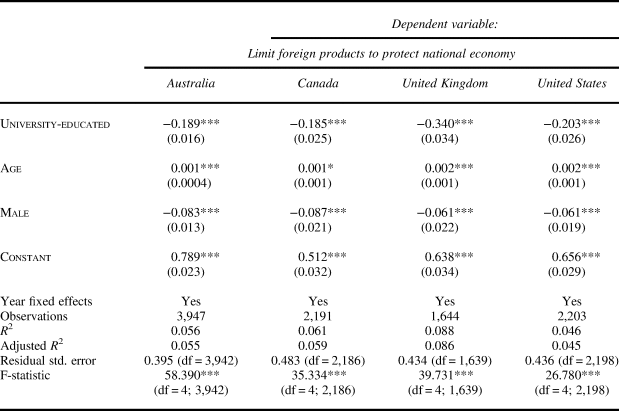
The literature links individual-level attainment of postsecondary education with support for liberal trade policies in the United StatesFootnote 27 and Europe.Footnote 28 I follow O'Rourke and colleagues in analyzing data from the International Social Survey Programme National Identity surveys (1995 and 2003), which include all four countries in my sample.Footnote 29 I examine answers to the question of whether the respondent's country “should limit foreign products in order to protect its national economy.” Answers are on a five-point scale from “strongly agree” to “strongly disagree.” For ease of interpretation, I create a binary variable that equals 1 for “strongly agree” or “agree,” and 0 otherwise. I regress this dependent variable on a binary indicator of whether a respondent has completed university education, and include controls for age, gender, and year fixed effects. In the United Kingdom, university-educated respondents are 34 percent less likely to endorse protectionism; in the other nations, they are 18 to 20 percent less likely. These results are consistent with other work demonstrating a link between university education and pro-trade sentiment.Footnote 30 I conclude from this analysis that education is likely the key cleavage for individual preferences on trade, in line with the existing literature.
Educated Constituencies and Legislator Voting on Trade
I have shown that college-educated individuals are more supportive of liberal trade policy, so the influx of college-educated voters into a constituency should indicate rising pro-trade sentiment. Legislators should adapt to these shifting preferences, given that there is evidence of “dynamic responsiveness”Footnote 31 to changing constituency preferences in the United States,Footnote 32 the UK,Footnote 33 and Canada.Footnote 34
In the US context, Bailey finds that members of Congress (both House and Senate) who represent skilled constituencies are more likely to vote in favor of trade agreements;Footnote 35 this finding has been widely replicated.Footnote 36 Furthermore, there is evidence from the United States that members of Congress vote in line with constituency opinion on trade bills.Footnote 37
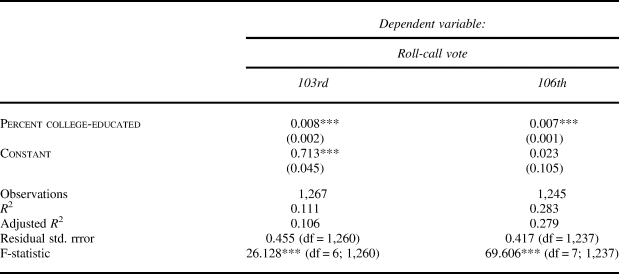
I now examine data from Milner and Tingley on voting on trade bills in the House of Representatives.Footnote 38 Their data set includes votes on three types of bills: trade negotiating authority for presidents, international trade agreements, and individual legislators’ bills to regulate trade policy. They include only trade votes that were consequential for US trade policy (not procedural votes or “sense of Congress” votes) and did not deal with individual products (unless those products involved major US industries—for example, steel, automobiles, textiles, and sugar—and had been used by previous scholars in analyses of roll-call votes). They coded the binary dependent variable such that 1 means support for trade liberalization, while 0 means opposition. I assess the cross-sectional relationship between percent college educated in a district and the probability a legislator votes in favor of a trade agreement for the 103rd (1993–1995) and 106th (1999–2001) sessions of Congress.Footnote 39 I match the Milner and Tingley data on legislative voting on trade to district-level data on education (percent over twenty-five years old with a bachelor's degree) from the 1990 and 2000 censuses (the 103rd and 106th Congresses, respectively). I include a set of controls from Milner and Tingley, which include the legislator's party, district-level percent foreign born, percent Black in the district, and a variable indicating whether a president from the same party supports the trade bill (controls are suppressed for presentation). Finally, I include vote fixed effects to control for any vote-specific factors. Consistent with the literature, I find that percent college educated is a robust predictor of pro-trade voting in both years (p < .0001): a 10 percent increase in district-level percent college educated is linked to a 7 to 8 percent increase in the probability of the district's representative voting in favor of trade liberalization.
University education and support for protectionism

Note: *p < .1; **p < .05; ***p < .01
Congressional voting on trade

Note: *p < .1; **p < .05; ***p < .01.
Political Geography
I have thus far provided evidence that college-educated individuals are less likely to support protectionism, and legislators who represent highly educated constituencies are more likely to vote in favor of trade liberalization. I now turn to evidence for the foundations of my theoretical argument linking political and economic geography. Rodden demonstrates a robust relationship between population density and Left voting in advanced plurality countries.Footnote 40 Though it initially emerged out of the working-class politics of the Industrial Revolution, “urban–rural polarization” persists in Australia, Canada, the United States, and the United Kingdom.
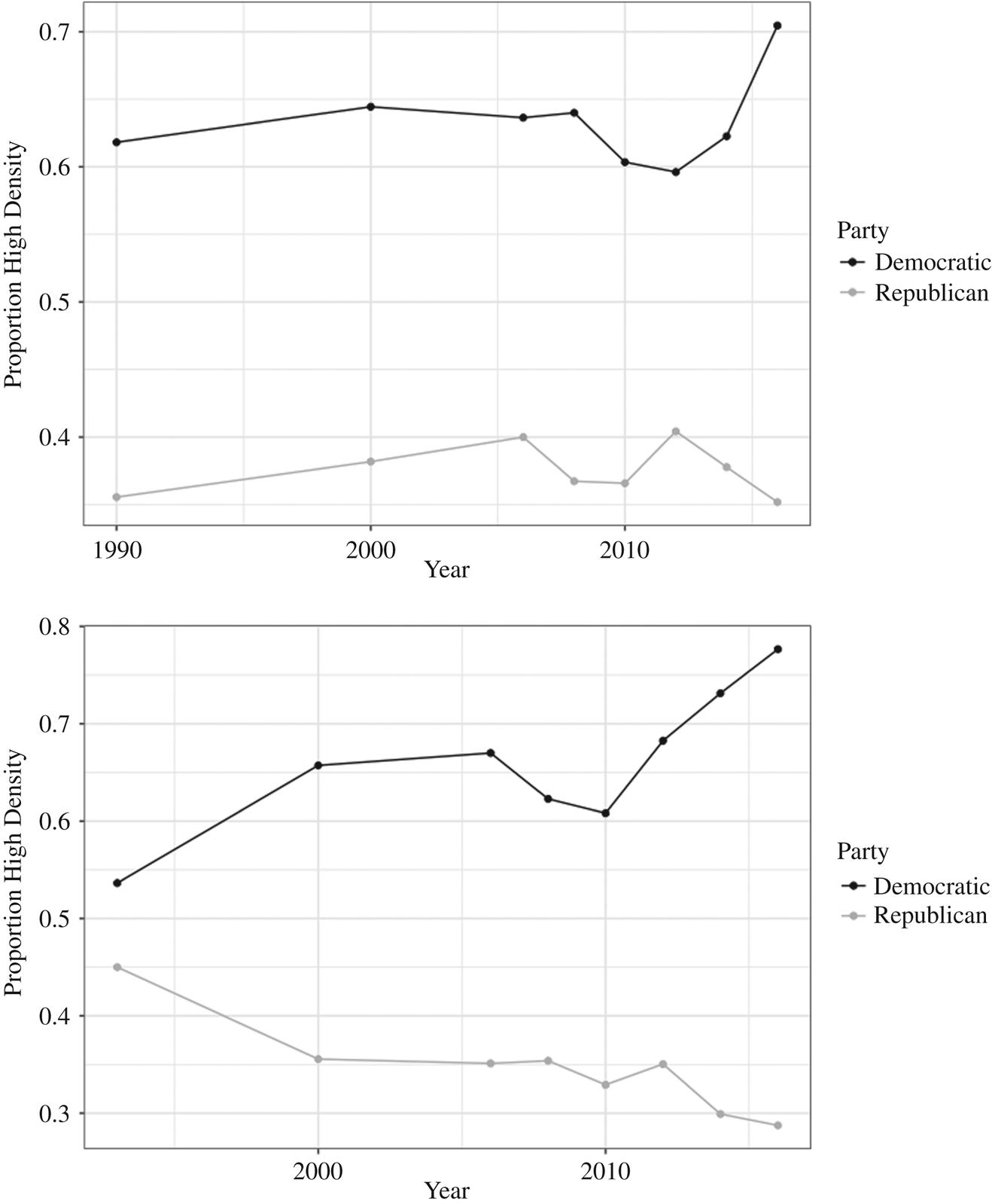
I first validate the assertion that Democratic incumbents maintain consistent control of high-density electoral constituencies. I divide districts by population density into a top half (“high-density”) and a bottom half; I then calculate what proportion of Democratic and Republican members of the House of Representatives are in high-density districts.Footnote 41 Most Democratic members of the House are in high-density districts in all years of the sample, while most Republican representatives are in low-density districts in each year (Figure 1). I perform the same analysis for the Senate, finding that a majority of Democratic seats are in high-density states in each year.
Proportion of constituencies that are high-density (by party) in the Senate (top) and the House (bottom). Democrats (Republicans) primarily control high-density (low-density) constituencies

I now extend my analysis of partisan constituencies by examining data from Australia, Canada, and the United Kingdom.Footnote 42 For Australia, Canada, and the United Kingdom, I divide constituencies by population density into a top half (“high-density”) and a bottom half (“low-density”) in each of the country years in my sample.Footnote 43 In every year for which I have data, most of each country's major Left party constituencies are high-density, and most of each country's major Right party constituencies are low-density (Table 3).Footnote 44
Percentage of left and right constituencies that are high density

Economic Geography
I consider the interaction of this relatively constant political geography with an evolving economic geography.Footnote 45 Research in economic geography finds that “skilled” (college-educated) workers now earn significantly higher wages in high-density US metropolitan statistical areas.Footnote 46 Until a few decades ago, both skilled and unskilled workers earned higher wages in urban areas, but
urban non-college workers currently perform substantially less skilled work than in prior decades. This deskilling reflects the joint effects of automation and international trade, which have eliminated the bulk of non-college production, administrative support, and clerical jobs … attenuating, to a startling degree, the steep urban wage premium for non-college workers that prevailed in earlier decades.Footnote 47
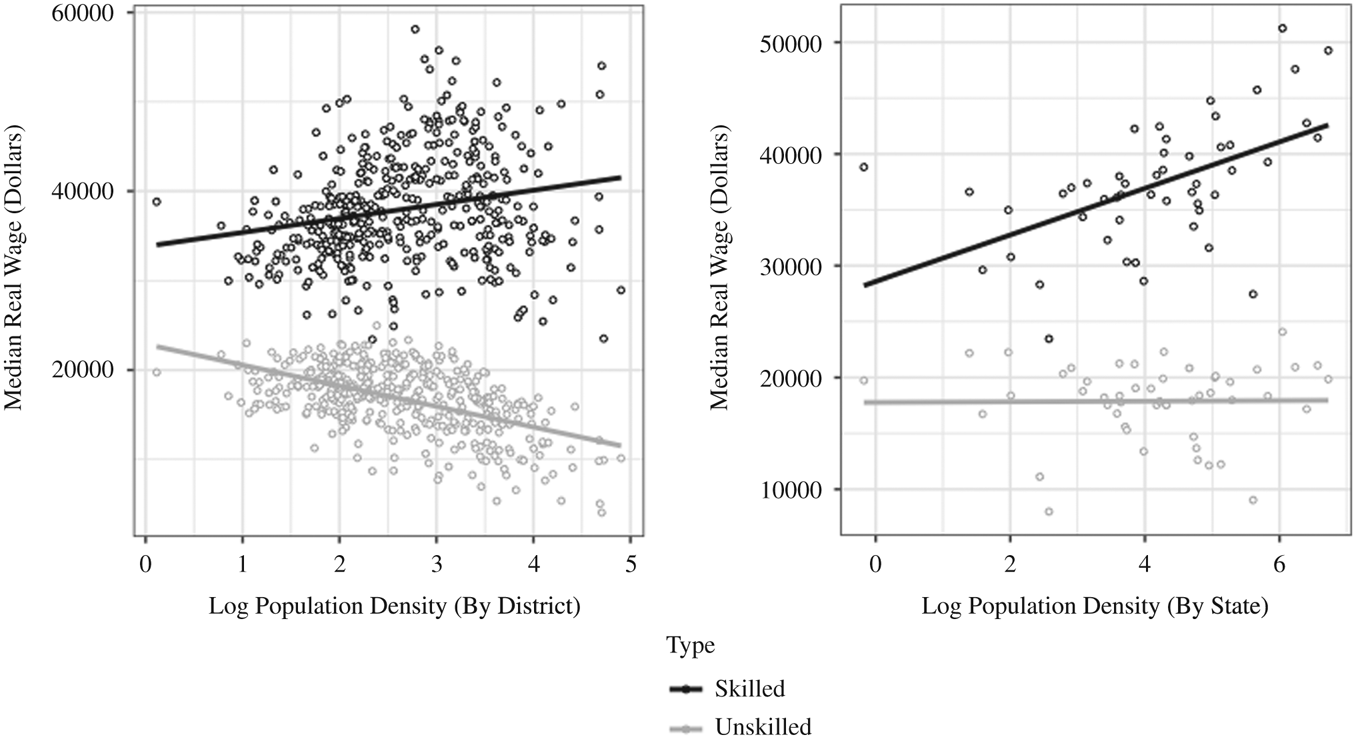
I now verify that the same economic dynamics uncovered by Autor hold at geographic levels that are relevant for American trade politics, namely congressional districts (the House of Representatives) and states (the Senate). I use American Community Survey data from 2016 on the median earnings of workers whose highest level of education is a bachelor's degree (“skilled”) and workers whose highest level of education is a high-school diploma (“unskilled”). I then subtract the median gross rent (contract rent plus the cost of utilities) from these wages to calculate the median skilled and unskilled “real” wages. In Figure 2, I plot real wages against log population density. As expected, I find that skilled workers earn higher real wages in denser congressional districts and states. The same does not hold true for unskilled workers, who actually earn lower real wages in denser congressional districts.
In US states and congressional districts, there is a positive relationship between population density and skilled real wages

These geographic differences in real wages are a source of spatial “skill sorting” in advanced countries. For example, Lindley and Machin find evidence of “increased spatial concentration of more educated workers” in US metropolitan statistical areas between 1980 and 2010.Footnote 48 Relatedly, Diamond finds that American “cities which became disproportionately productive for high skill workers attracted a larger share of skilled workers … driving up local rents … Low skill workers were less willing to pay the ‘price’ of a lower real wage … leading them to prefer more affordable … locations.”Footnote 49 In Canada, because of “the interprovincial migration process, human capital is redistributed from the more rural to the predominantly urban provinces.”Footnote 50
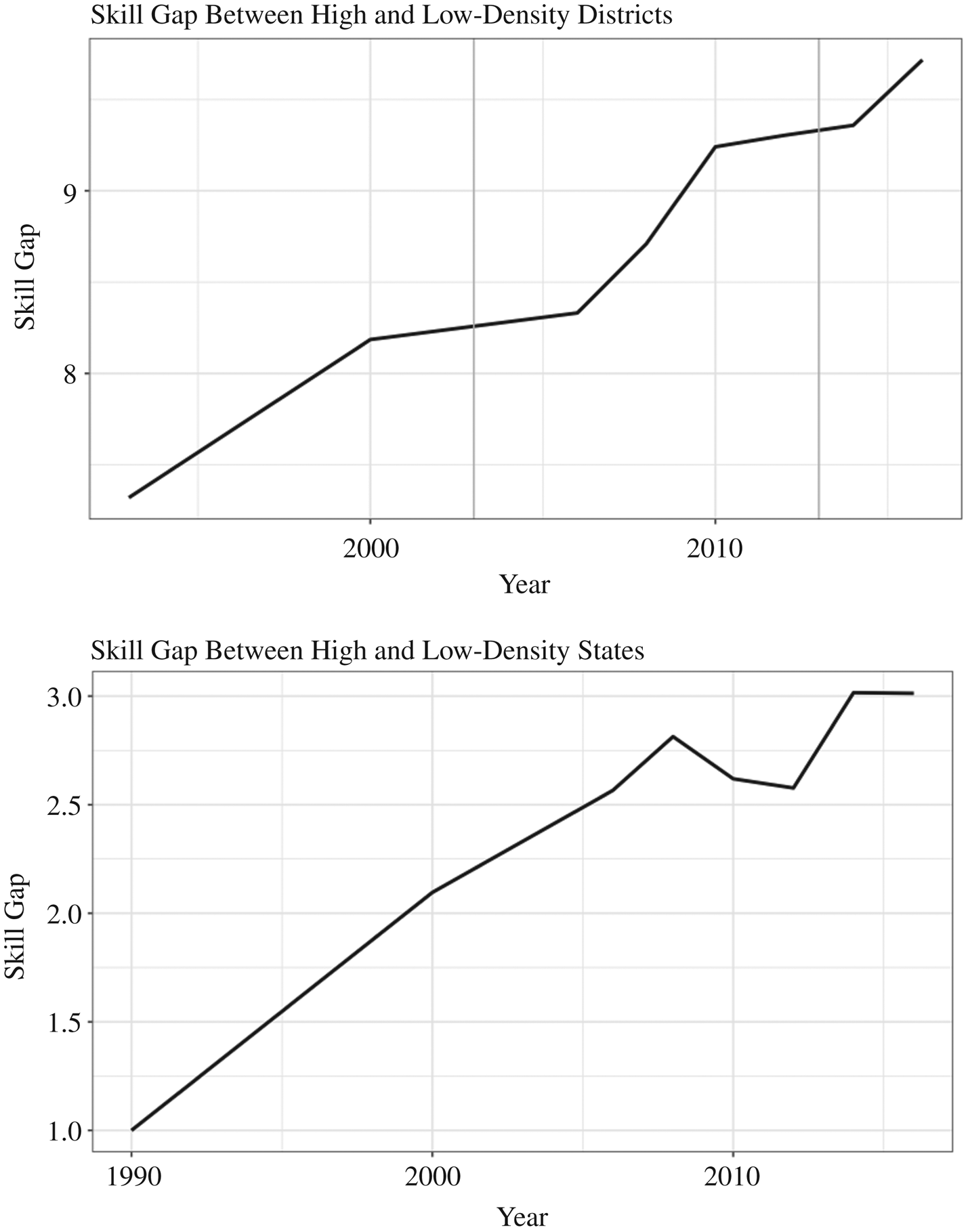
I now provide evidence that high-density constituencies have become disproportionately skilled in advanced plurality countries, starting with the United States. I calculate the “skill gap” between high- and low-density constituencies, which is the difference between high- and low-density constituencies in average percent skilled (the percent of adults over twenty-five with a bachelor's degree or higher). In Figure 3, I plot this measure over time for both congressional districts and states, finding evidence of a strong positive time trend.Footnote 51 In 1990, high-density states were about as skilled as low-density states; by 2016, there was a substantial skill gap. The growing skill gaps between high- and low-density states and districts are not driven by outliers, as the skill gap between the median high-density constituency and the median low-density constituency exhibits the same positive time trend, as shown in the online supplement. It is true, however, that this skill gap has exhibited especially significant growth when comparing the densest and least dense constituencies. In 1990, the top 10 percent of congressional districts in terms of density were less than 1.5 percentage points more skilled than the bottom decile; by 2016, this skill gap had grown to almost 10.5 percentage points. This combination of “brain drain” from rural areas and skilled migration into dense areas has substantial implications for partisan constituencies, as Democrats controlled 93 percent of the densest decile of congressional districts in 2016, while Republicans controlled 87 percent of the least dense decile.
The growing skill gap between high- and low-density constituencies in the United States in the House (top) and Senate (bottom)

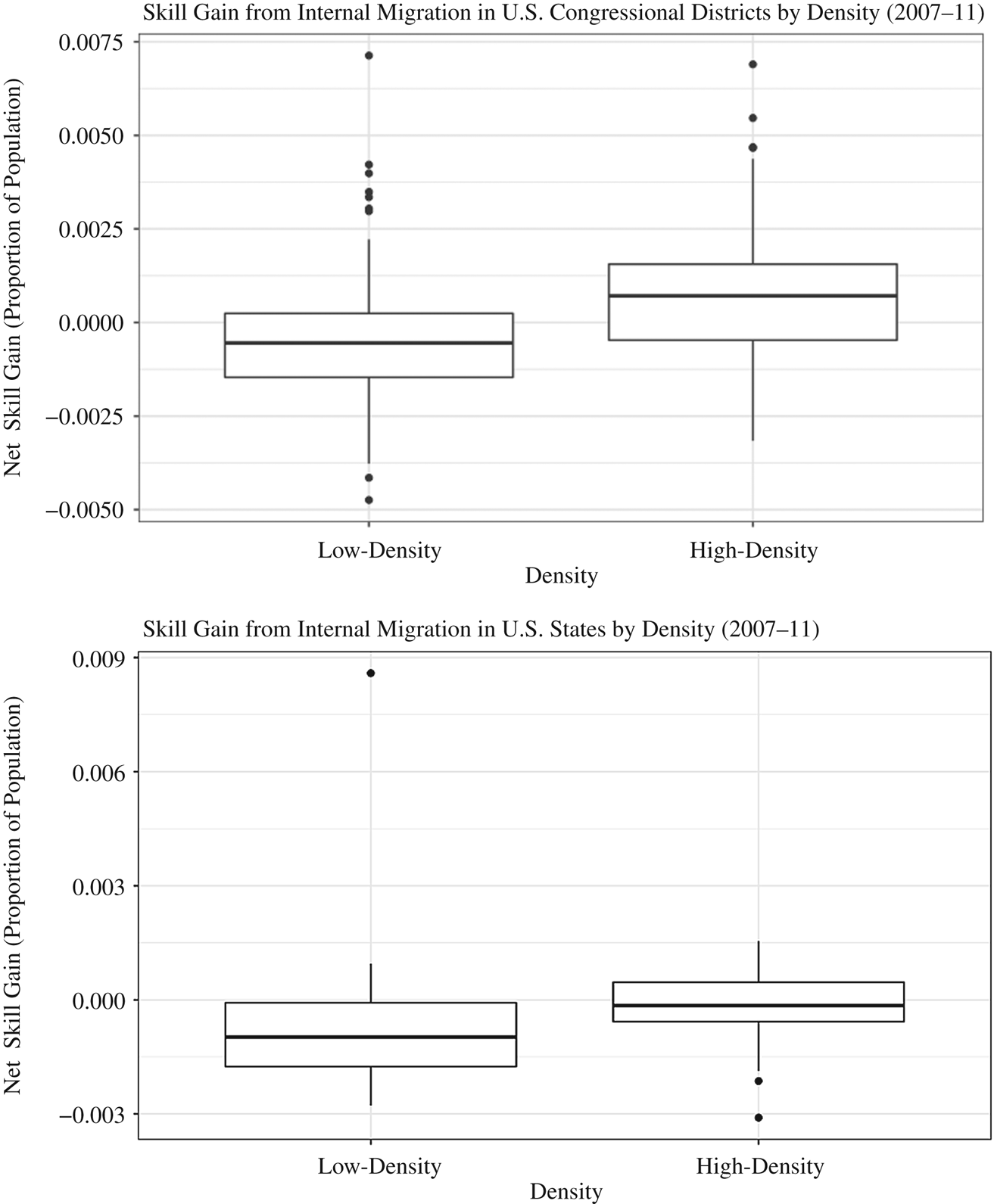
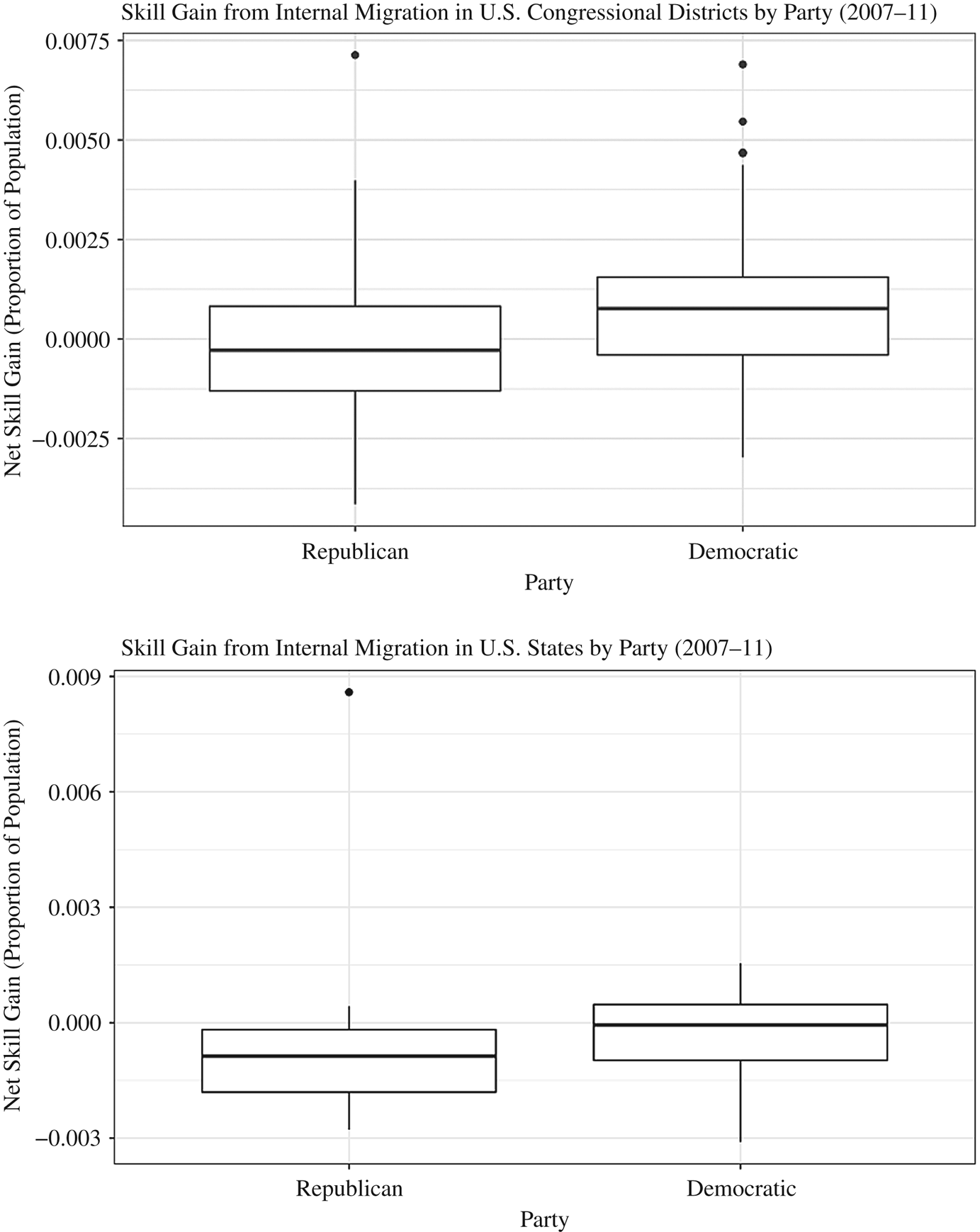
To isolate the mechanism of internal migration, I analyze data on county-to-county migration in the previous year (by level of educational attainment) from the five-year American Community Survey spanning 2007 to 2011 (this is the only period for which data on migration by educational attainment are available). As before, I code college and above as “skilled.”Footnote 52 I match this migration data to population data from the same five-year American Community Survey sample to construct a “high-density” half and a “low-density” half. At both the congressional district and the state level, I calculate net skilled migration as the number of skilled in-migrants plus the number of unskilled out-migrants minus the number of skilled out-migrants minus the number of unskilled in-migrants. High-density constituencies disproportionately gained skilled workers from internal migration (Figure 4).
High-density constituencies in the House (top) and Senate (bottom) have disproportionately gained skilled workers due to internal migration

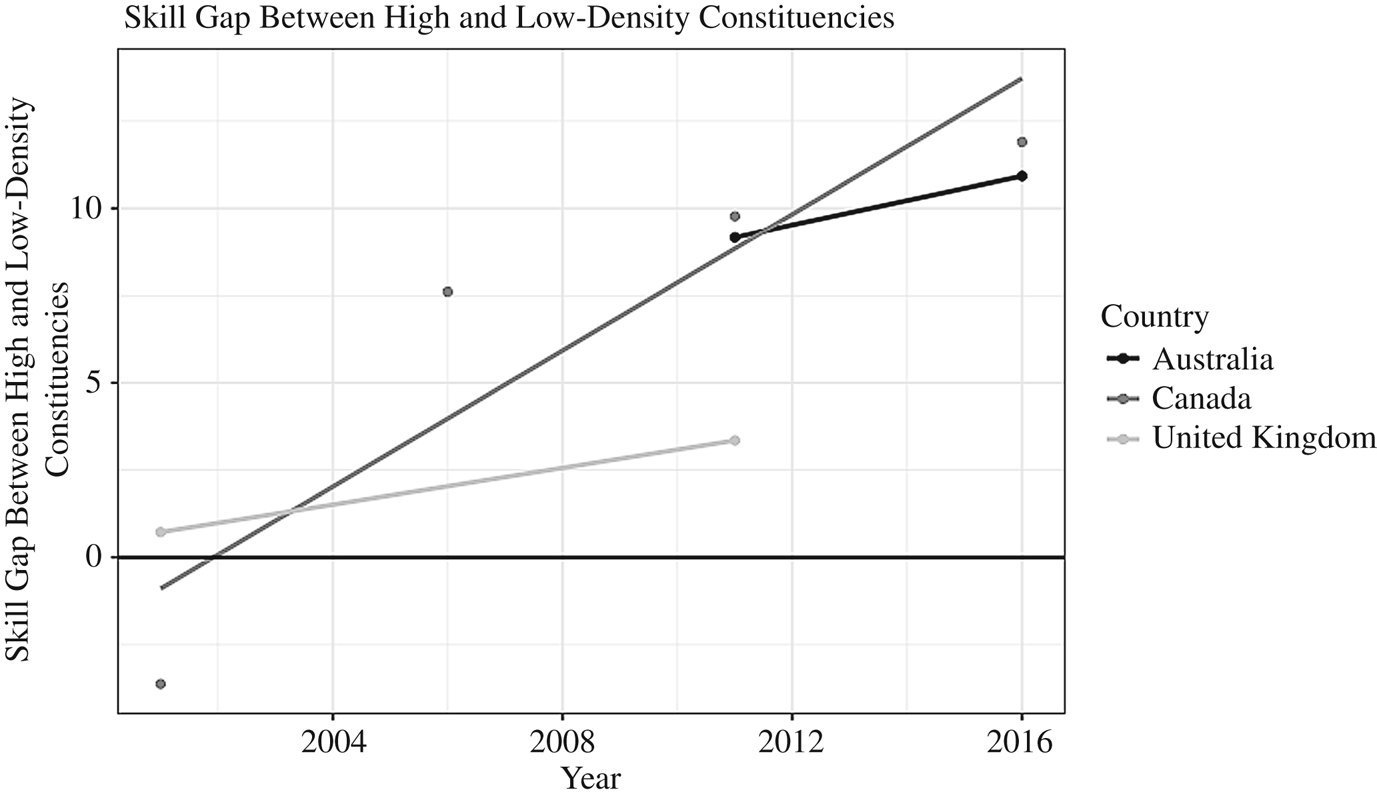
Finally, I examine whether high-density constituencies have become disproportionately skilled over time in the other advanced plurality countries. As before, I divide constituencies into a high-density top half and a low-density bottom half. I again calculate the average “skill gap” between high-density and low-density constituencies, but I now conduct this analysis for the Australian House of Representatives, the Canadian House of Commons, and the UK House of Commons, using the broadest data coverage available (2001, 2006, 2011, and 2016 for Canada; 2001 and 2011 for the United Kingdom; and 2011 and 2016 for Australia). I do in fact find evidence of a growing skill gap in these countries.
Modeling the Interaction of Political and Economic Geography
Having demonstrated evidence of an evolving economic geography and persistent political geography in advanced plurality countries, I now consider the interaction of political and economic geography in a formal theoretical framework. I combine two models: a game-theoretic model from political science and a spatial equilibrium model from economic geography. To capture the notion of self-interested incumbents catering to their local constituencies in a plurality system, I build on the basic framework of Snyder.Footnote 53 National party platforms are determined by self-interested party leaders who must cater to their particular (geographically defined) constituencies to win re-election.Footnote 54 This theoretical framework conceptualizes political parties as groups of office-seeking politicians, echoing Aldrich, who argued, “It is political leaders … those who seek and those who hold elective office—who are the central actors in the party.”Footnote 55 To capture the dynamics of the internal migration of workers of different skill levels, I draw on the basic spatial equilibrium framework of Moretti.Footnote 56 The model generates predictions about the relative skill of Right-controlled constituencies over time, as well as the relative positioning of Right parties on trade and the relative popularity of Right parties with college-educated voters. The model also presents the conditions for a partisan realignment on trade and for a voter realignment by skill level. Combining these models allows me to unify economic and political geography into one theoretical framework—and ultimately to tease out the political implications of an endogenously evolving “spatial economy.”Footnote 57 I argue that migration-induced changes in the demographics (and thus, the preferences) of partisan constituencies yield shifts in party positioning.Footnote 58
The Political System
I first consider the political system. There are two constituencies within the political system which begin with the same population but differ in land area. We call the lower-density constituency a and the higher-density constituency b. In each constituency, there are legislative candidates from the Left (L) and the Right (R) parties. Candidate P c of party P ∈ (L, R) competes in constituency c ∈ (a, b) in election period t ∈ (1, 2). At the beginning of the game (t = 1), the incumbent in constituency b is L b, while the incumbent in constituency a is R a; this initial condition operationalizes the historical relationship between population density and Left voting in advanced plurality countries. The game begins in autarky. Ahead of each election, incumbents take positions on tariff policy. Tariff policy is assumed to be pliable, that is, a policy dimension in which parties are open to changing their policies in response to electoral incentives.Footnote 59 I refer to the tariff position adopted by the Left member of the legislature in period 1 as τ L1, while the tariff position adopted by the Right incumbent is τ R1. Challengers are not strategic actors; they are associated with their “party brand,” that is, with the position taken by their co-partisan legislator in that election period.
In each constituency, the candidate who wins the majority of votes wins the election; formally, a candidate in constituency c must win the vote of the median voter in constituency c, m c. Voters are not strategic, and simply vote for the candidate in their constituency whose party's platform is closest to their ideal tariff policy. If m c prefers tariff  $\tau _{m_c}$, L c wins the constituency if
 $\vert {\tau_L-\tau_{m_c}} \vert < \vert {\tau_R-\tau_{m_c}} \vert $, and R c wins if
 $\vert {\tau_R-\tau_{m_c}} \vert < \vert {\tau_L-\tau_{m_c}} \vert $. Ties occur with zero probability, as I assume that incumbents win if their platform positions are the same (incumbency advantage).Footnote 60
The Spatial Economy
I now introduce the spatial economy. There are S skilled workers and U unskilled workers. θ c is the number of workers of type θ ∈ (S, U) in constituency c. Each worker's utility is their real wage, which is their skill- and constituency-specific nominal wage W θc for skill type θ ∈ (S, U) and constituency c ∈ (a, b) minus their constituency-specific cost of rent ρ c.Footnote 61 Workers of each skill type seek to maximize their real wage; migration occurs until workers of each skill type are indifferent between living in constituency a and constituency b (spatial equilibrium).Footnote 62 Formally, this means W θb − ρ b = W θa − ρ a in equilibrium.Footnote 63
Wages for skill type θ in constituency c are increasing in labor productivity X θc and decreasing in the number of workers of the same skill type in their constituency, θ c (W θc = X θc − θ c).Footnote 64 I assume the price of rent in constituency c is directly proportional to the number of people living in constituency c (ρ c = S c + U c).Footnote 65
Trade
Following each election, Nature chooses either constituency a or constituency b as the “median constituency.” The party P that wins the median constituency in election period t sets nationwide government tariff policy τ Gt = τ Pt ∈ [0, 1], where τ G = 1 indicates autarky and τ G = 0, free trade.Footnote 66 Starting from autarky, trade boosts the productivity of skilled labor in the high-density constituency (X Sb) intertemporally: X Sb2 = X Sb1 + (1 − τ G1)Δ, with Δ > 0. In line with empirical evidence (and consistent with their utility functions), I assume unskilled voters are more protectionist than skilled voters. However, I allow for some heterogeneity among voters of each skill type, and assume that skilled voters have tariff preferences τ S ~ U(0, 0.5) and unskilled voters have preferences τ U ~ U(0.5, 1).Footnote 67
Stage Game
The stage game in period t is as follows.
1. Incumbents set party platforms τ Lt and τ Rt.
2. Elections are held.
3. Nature chooses either a or b as the median constituency.
4. Party P in control of the median constituency implements tariff policy τ Gt = τ Pt.
Between t = 1 and t = 2, workers relocate across constituencies to maximize their expected utility (until spatial equilibrium is achieved).
Equilibrium Solution
Because there are many possible Nash equilibria of this game, I focus on the “trembling hand perfect equilibrium,”Footnote 68 which allows players to make mistakes and to play any strategy (in this case, for incumbents to choose any party platform) with positive probability. This refinement allows me to compute a unique equilibrium, rather than choosing among many possible equilibria. For example, the Right incumbent can choose any τ R that is better for the median voter in constituency a than the τ L chosen by the Left incumbent; in this case, there would be many possible equilibrium values of τ R. However, the trembling-hand refinement allows any tariff platform to be played by the Left incumbent with positive probability—in this case, the only optimal strategy for the Right incumbent is to match the low-density constituency's median preference, τ ma. In period 1, we have the equilibrium tariff positions  $\tau _{L1\ast } = \tau _{m_b1}$ and
 $\tau _{R1\ast } = \tau _{m_a1}$. By the same logic, we have
 $\tau _{L2\ast } = \tau _{m_b2}$ and
 $\tau _{R2\ast } = \tau _{m_a2}$. It is therefore a strictly dominant strategy for incumbents to position at their own constituencies’ median tariff positions—otherwise, there is a positive probability of losing their seats. Because incumbents cater to their constituencies’ median voters, challengers from both parties lose their elections in each period—political geography persists across periods.
The function M maps the skill ratio of a constituency to its median tariff preference; formally,  $M\left({{{S_c} \over {U_c}}} \right) = \tau _{m_c}$, where M is a decreasing function (more skilled demographics mean the median voter prefers a lower tariff). If all the voters in a constituency are skilled, the median tariff preference would be
 ${1 \over 4}$, because skilled voter preferences are uniformly distributed between 0 and 0.5, yielding 0.25 in expectation. If there are equal numbers of skilled and unskilled, the median tariff preference would be 0.5 (because unskilled voter preferences are uniformly distributed between 0.5 and 1), and if all the voters in a constituency are unskilled, the median tariff preference would be 0.75. If there are more skilled than unskilled (S c ≥ U c), the median voter's preference would be
 ${{S_c + U_c} \over {4S_c}}$ (this yields
 ${1 \over 4}$, or 0.25, when U c = 0, and if S c = U c, then the equation yields
 ${1 \over 2}$, or 0.5, as expected). If there are more unskilled voters than skilled in a constituency (U c ≥ S c), the median voter's tariff preference is
 $1-\left({{{S_c + U_c} \over {4U_c}}} \right) = {{3U_c-S_c} \over {4U_c}}$ (which equals
 ${3 \over 4}$, or 0.75, when S c = 0 and
 ${1 \over 2}$, or 0.5, when S c = U c, as expected).
We therefore have that if U c > S c, then  $M\left({{{S_c} \over {U_c}}} \right) = \tau _{m_c} = {{3U_c-S_c} \over {4U_c}}$, and if U c < S c, then
 $M\left({{{S_c} \over {U_c}}} \right) = \tau _{m_c} = {{U_c + S_c} \over {4S_c}}$. The particular equilibrium values of
 $\tau _{Lt\ast } = \tau _{m_bt}$ and
 $\tau _{Rt\ast } = \tau _{m_at}$ therefore depend on the initial spatial distribution of skilled and unskilled workers, as well as government tariff policy (which influences the spatial distribution of workers in period 2).
Comparative Statics
Relative Skill of Right Constituencies
Increasing skilled productivity in the high-density constituency by (1 − τ G1)Δ yields skilled migration to b and unskilled migration to a. Because X Sb2 = X Sb1 + (1 − τ G1)Δ,  $S_{a2} = S_{a1}-{{4( {1-\tau_{G1}} ) \Delta } \over {12}}$,
 $S_{b2} = S_{b1} + {{4( {1-\tau_{G1}} ) \Delta } \over {12}}$,
 $U_{a2} = U_{a1} + {{2( {1-\tau_{G1}} ) \Delta } \over {12}}$, and
 $U_{b2} = U_{b1}-{{2( {1-\tau_{G1}} ) \Delta } \over {12}}$. Because Δ > 0,
 ${{S_{b2}} \over {U_{b2}}} > {{S_{b1}} \over {U_{b1}}}$ and
 ${{S_{a2}} \over {U_{a2}}} < {{S_{a1}} \over {U_{a1}}}$.Footnote 69 The proof is given in the online supplement.
Relative Protectionism of the Right
We now assess the intertemporal change in relative party positions on tariffs. Because M is a decreasing function, and  ${{S_{b2}} \over {U_{b2}}} > {{S_{b1}} \over {U_{b1}}}$,
 $\tau _{l2} = \tau _{mb2} = M\left({{{S_{b2}} \over {U_{b2}}}} \right)< M\left({{{S_{b1}} \over {U_{b1}}}} \right) = \tau _{mb1} = \tau _{l1}$. The same argument shows that τ R2 > τ R1.
Define the relative protectionism of the Right in period t as τ Rt − τ Lt. Because τ R2 > τ R1 and τ L2 < τ L1, (τ R2 − τ L2) > (τ R1 − τ L1). The relative protectionism of the Right therefore rises over time. In the special case where the low-density constituency is relatively skilled at the beginning of the game but becomes relatively unskilled by the end of the game ( ${{S_{a1}} \over {U_{a1}}} > {{S_{b1}} \over {U_{b1}}}$ and
 ${{S_{a2}} \over {U_{a2}}} < {{S_{b2}} \over {U_{b2}}}$), there is a “partisan realignment on trade”: τ L1 > τ R1 and τ L2 < τ R2.Footnote 70
Relative Skill of Right Voters
θ Pt is the number of workers of type θ that vote for party P in period t. Define the relative skill of Right voters as  ${{S_R-S_L} \over S}-\left({{{U_R-U_L} \over U}} \right)$. Because the relative protectionism of the Right declines (τ R2 − τ L2) > (τ R1 − τ L1), the relative skill of Right voters declines as well:
 ${{S_{R2}-S_{L2}} \over S}-\left({{{U_{R2}-U_{L2}} \over U}} \right)< {{S_{R1}-S_{L1}} \over S}-\left({{{U_{R1}-U_{L1}} \over U}} \right)$. In the special case where there is a partisan realignment on trade (τ L1 > τ R1 and τ L2 < τ R2), there is a voter realignment by skill level:
 ${{S_{R1}} \over {U_{R1}}} > {{S_{L1}} \over {U_{L1}}}$ and
 ${{S_{R2}} \over {U_{R2}}} < {{S_{L2}} \over {U_{L2}}}$.
Propositions
From these results, I derive three propositions:
Proposition 1. As a result of internal migration and persistent political geography, the relative skill of Right constituencies declines between periods.
Proposition 2. As the relative skill of Right constituencies declines, the relative protectionism of the Right rises.
Proposition 3. As a result of the rising relative protectionism of the Right, the relative skill of Right voters declines.
In summary, I embed a spatial equilibrium framework within a game-theoretic model of party platform setting by re-election-driven incumbents. Trade exposure causes the high-density constituency to become more skilled, while the low-density constituency becomes less skilled. In response to changing constituency demographics, the Left incumbent adopts a more pro-trade platform than before, while the Right platform becomes increasingly protectionist. Finally, intertemporal changes in party platforms drive skilled voters toward the Left and make unskilled voters more likely to vote for the Right. If a partisan realignment on trade occurs, then a voter realignment takes place as well.Footnote 71
Empirical Analysis
Relative Skill of Right Constituencies
I now turn to examining the empirical evidence for the predictions of the model, starting with Proposition 1. I first undertake a quantitative case study of the United States, which has the broadest data coverage for population density, internal migration, and percent college educated of all the countries in the sample. After finding strong support for the model in the United States, I extend my analysis to other advanced plurality countries.
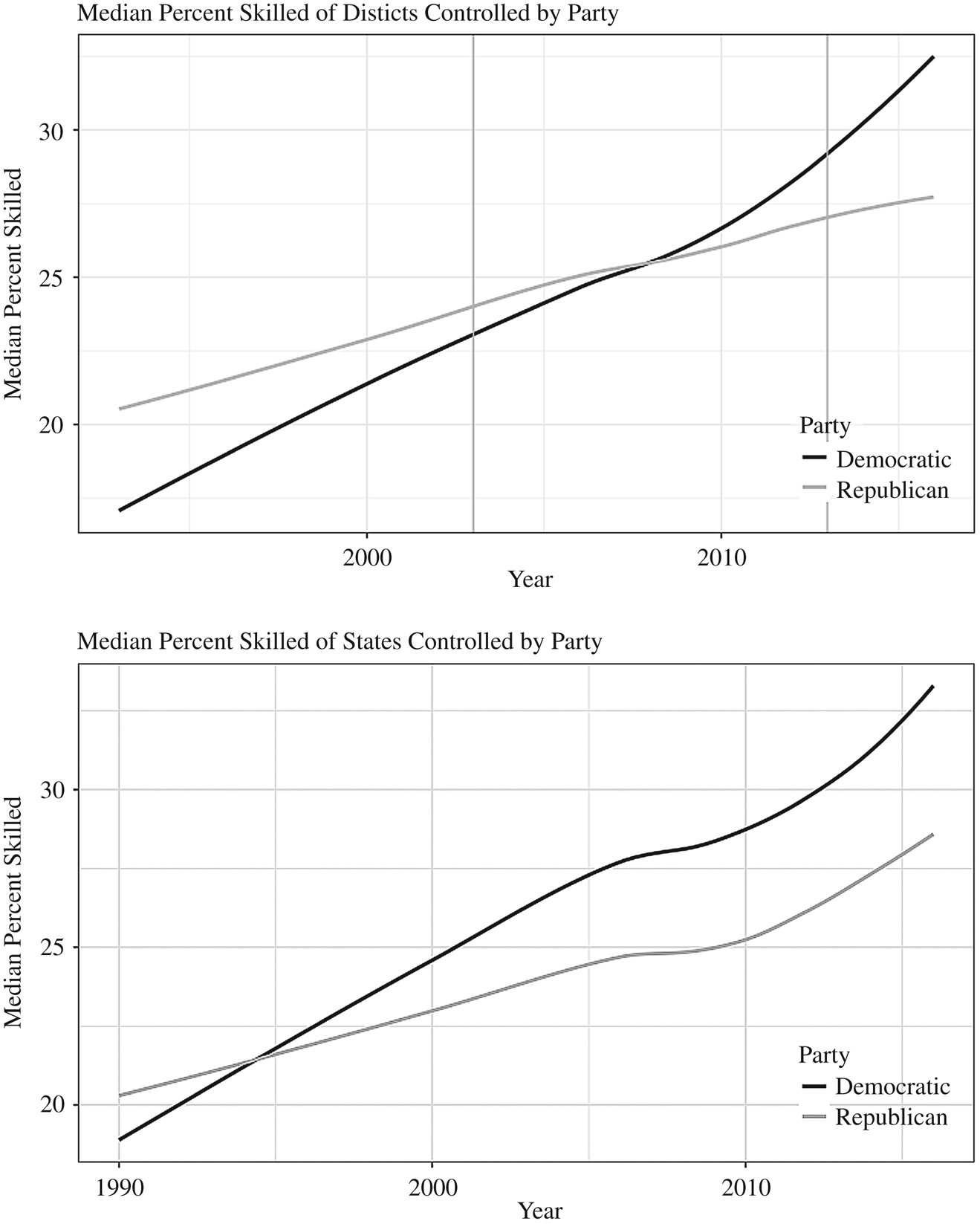
Given that the relationship between population density and Democratic political control has persisted, an increasing relationship between population density and percent college educated should result in Democratic constituencies that are increasingly skilled (and Republican districts that are comparatively less skilled). As before, I match data from the US census (1990 and 2000) and the American Community Survey (2006, 2008, 2010, 2012, 2014, and 2016) with data from VoteView on members of Congress to examine the skill levels of Republican and Democratic districts over time (Figure 6). I find that the median Republican-controlled district was more skilled than the median Democratic district in 1990, but Republican districts are now less skilled, and this gap has grown since 2006.Footnote 72 The same result holds when analyzing the mean district, rather than the median (see the online supplement). I perform the same analysis for the US Senate, and I find that in 1990 the median Republican Senate constituency was more educated than the median Democratic Senate constituency; but for the last two decades, Democratic Senate constituencies have been relatively more skilled than those controlled by Republicans.Footnote 73
To negate the concern that changes in relative skill levels are due to changes in the types of constituencies each party controls (rather than through demographic change in continuously held constituencies), in the online supplement I subset to constituencies held by each party throughout the whole period (for the House of Representatives, I must account not only for selection but also for redistricting). Continuously held Republican constituencies became relatively less skilled than continuously held Democratic constituencies over time.
To isolate the mechanism of internal migration, I again analyze data on county-to-county migration in the previous year (by level of educational attainment) from the five-year American Community Survey spanning 2007 to 2011. As before, I code college and above as “skilled,” and calculate net skilled migration as the number of skilled in-migrants plus the number of unskilled out-migrants minus the number of skilled out-migrants minus the number of unskilled in-migrants at both the congressional district and the state level.
I then assess whether Democratic (Republican) constituencies have gained (lost) skilled workers due to internal migration. I subset to House and Senate constituencies that were held by the same party throughout the whole period. Democratic constituencies disproportionately gained college-educated voters via internal migration (Figure 7).
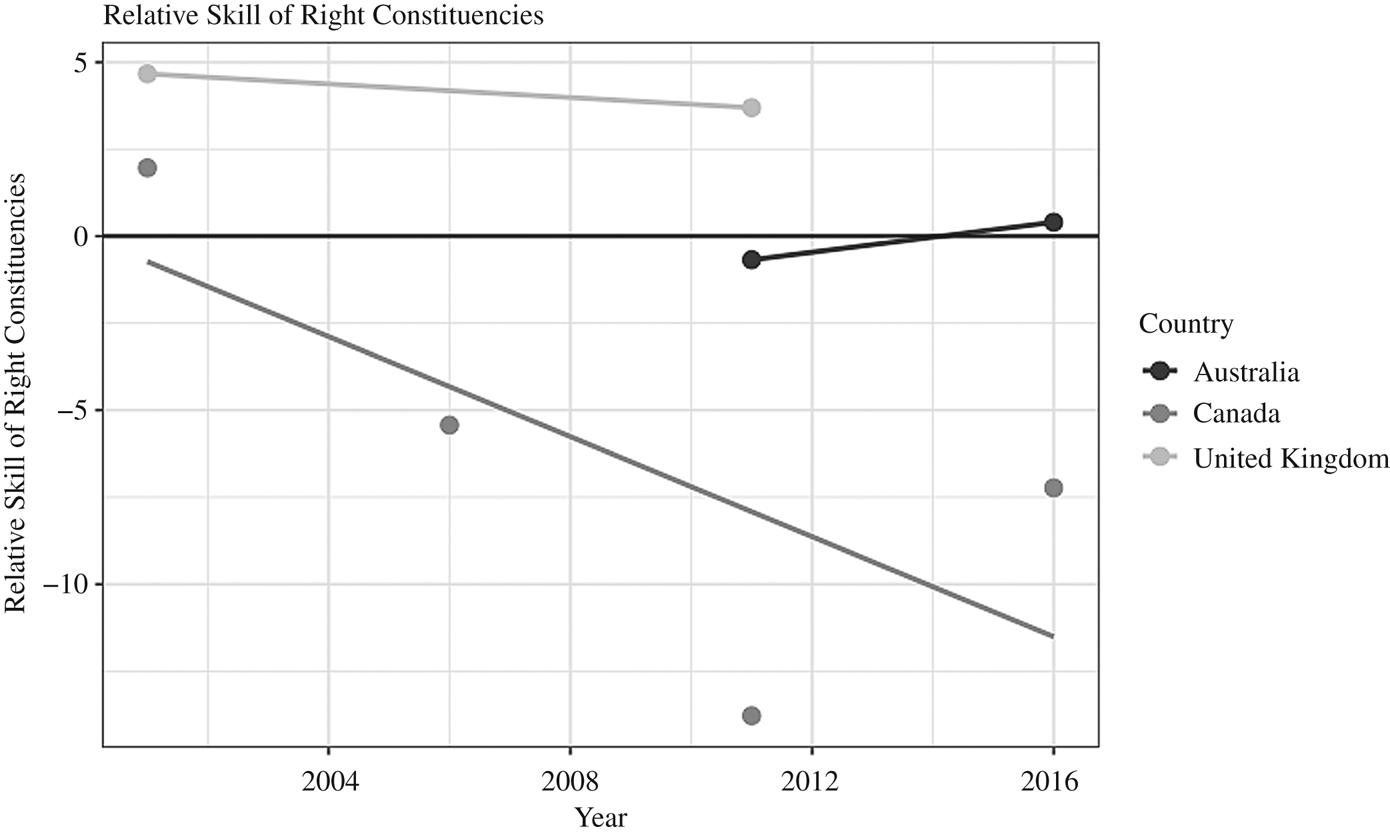
Finally, I examine cross-nationally whether Left-controlled constituencies have become relatively more skilled over time in the Australian House of Representatives, the Canadian House of Commons, and the UK House of Commons. I measure the relative skill of Right constituencies, which is the difference between the skill level of the median constituency controlled by the Right and the skill level of the median constituency controlled by the Left. I expect this variable to trend in a negative direction over time as high-density Left constituencies become disproportionately more skilled through internal migration.
The plot (Figure 8) shows the relative skill of Right constituencies in Australia, Canada, and the United Kingdom; values over the black line indicate that Right constituencies are relatively more skilled. The data coverage is the same as the plots before showing an increasing skill gap between high- and low-density constituencies. The relative skill of Right constituencies has sharply declined in Canada: Right constituencies were relatively skilled in 2001, but were relatively unskilled by 2006. In the United Kingdom, the relative skill of Right constituencies declined between 2001 and 2011, though values were positive in both years. As before, the data coverage for Australia includes only 2011 and 2016, but we see little evidence of change in the relative skill of Right constituencies (though the data coverage is only very recent). These cross-national differences may result from differences in political and economic geography: in Canada, only a fifth to a third of Right party constituencies were high density (as shown in Table 3), but in Australia about 45 percent of Right constituencies are high density. Furthermore, Figure 5 reveals a rapidly growing skill gap between high- and low-density Canadian constituencies; this gap does not appear to be growing as fast in Australia.
The growing skill gap between high- and low-density constituencies in Australia, Canada, and the United Kingdom

Median percent skilled of constituencies in the House (top) and Senate (bottom) by party in control. Democratic constituencies are now more skilled than Republican constituencies

Net skill gain from internal migration in the House (top) and Senate (bottom) by party. Democratic constituencies have disproportionately gained skilled constituents through internal migration

Right-controlled constituencies have disproportionately lost university-educated constituents in Canada and the United Kingdom, though there is little recent change in Australia

Relative Protectionism of the Right
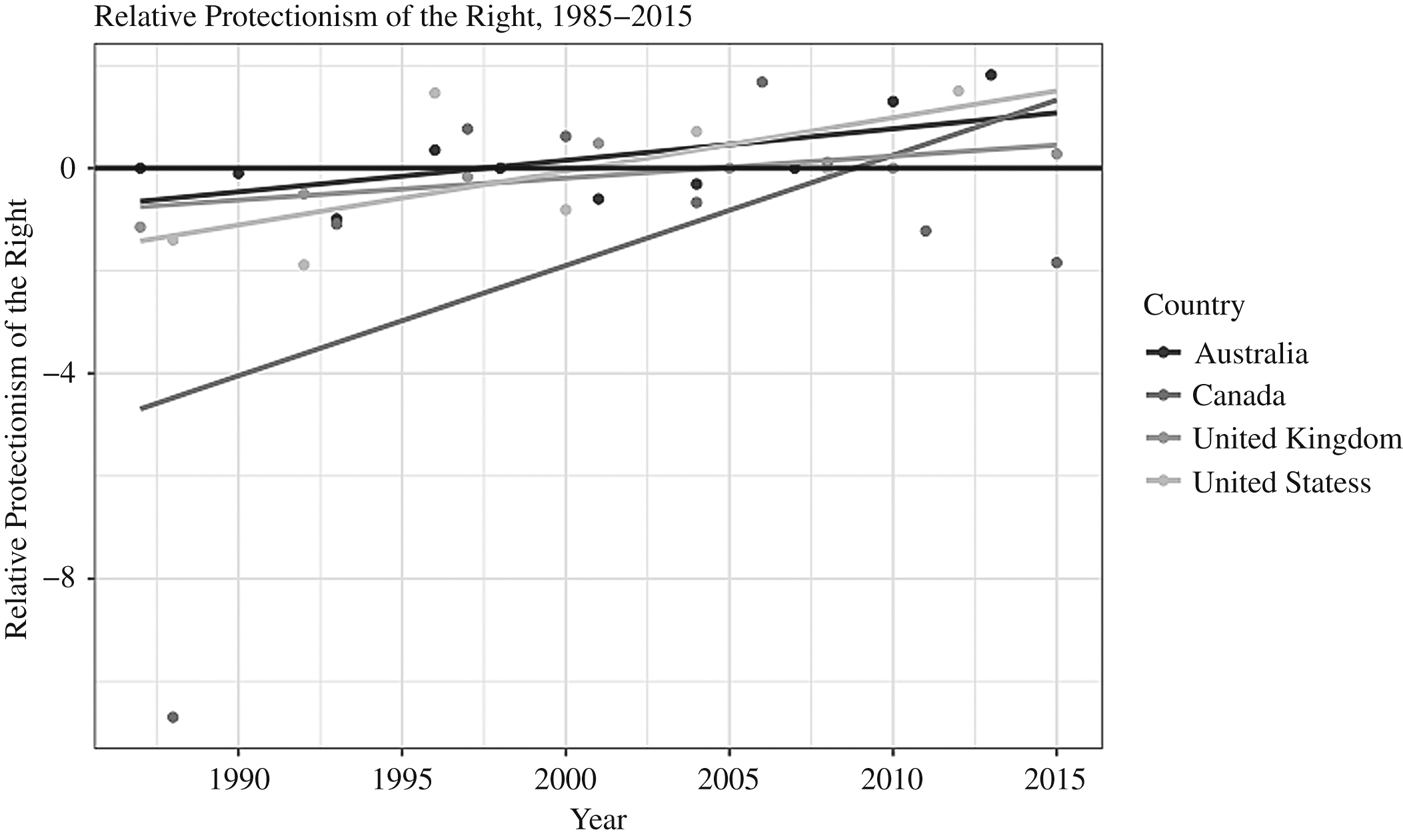
I now examine the empirical evidence for Proposition 2 in Australia, Canada, the United Kingdom, and the United States between 1985 and 2015.Footnote 74 I measure parties’ support for tariffs in a given election year by taking a Manifesto ProjectFootnote 75 measure of favorable mentions of protectionism in a party's platform and subtracting from it a measure of unfavorable mentions of protectionism.Footnote 76 To assess whether there is evidence of an emerging partisan realignment on trade, I measure the relative protectionism of the Right in each country-election year by subtracting the major Left party's support for tariffs value from the major Right party's value (i.e., for the United States in 1988, the relative protectionism of the Right is the Republicans’ 1988 support for tariffs minus the Democrats’ 1988 support for tariffs).
I focus on the relative positioning of the parties, rather than their absolute positioning, because my Downsian model of electoral competition assumes that relative positioning drives electoral outcomes. As Karol writes, “Politicians do not adopt stances in a vacuum. They care greatly about where a stand situates them vis-à-vis the other party … Parties’ relative proximity to voters is key, not their absolute distance from them.”Footnote 77
Figure 9 shows that in the 1980s most relative protectionism measures were negative, indicating relatively pro-trade Right parties; in the 2000s, most values are positive, indicating partisan realignments on trade. This trend is positive and statistically significant (see the online supplement). I also demonstrate there that the positive trend in the relative protectionism of the Right is robust to excluding the Canada 1988 outlier. I therefore demonstrate that Right parties in advanced plurality countries have become more protectionist over the last three decades, as predicted by the model.
The relative protectionism of Right parties has increased over time, especially in Canada

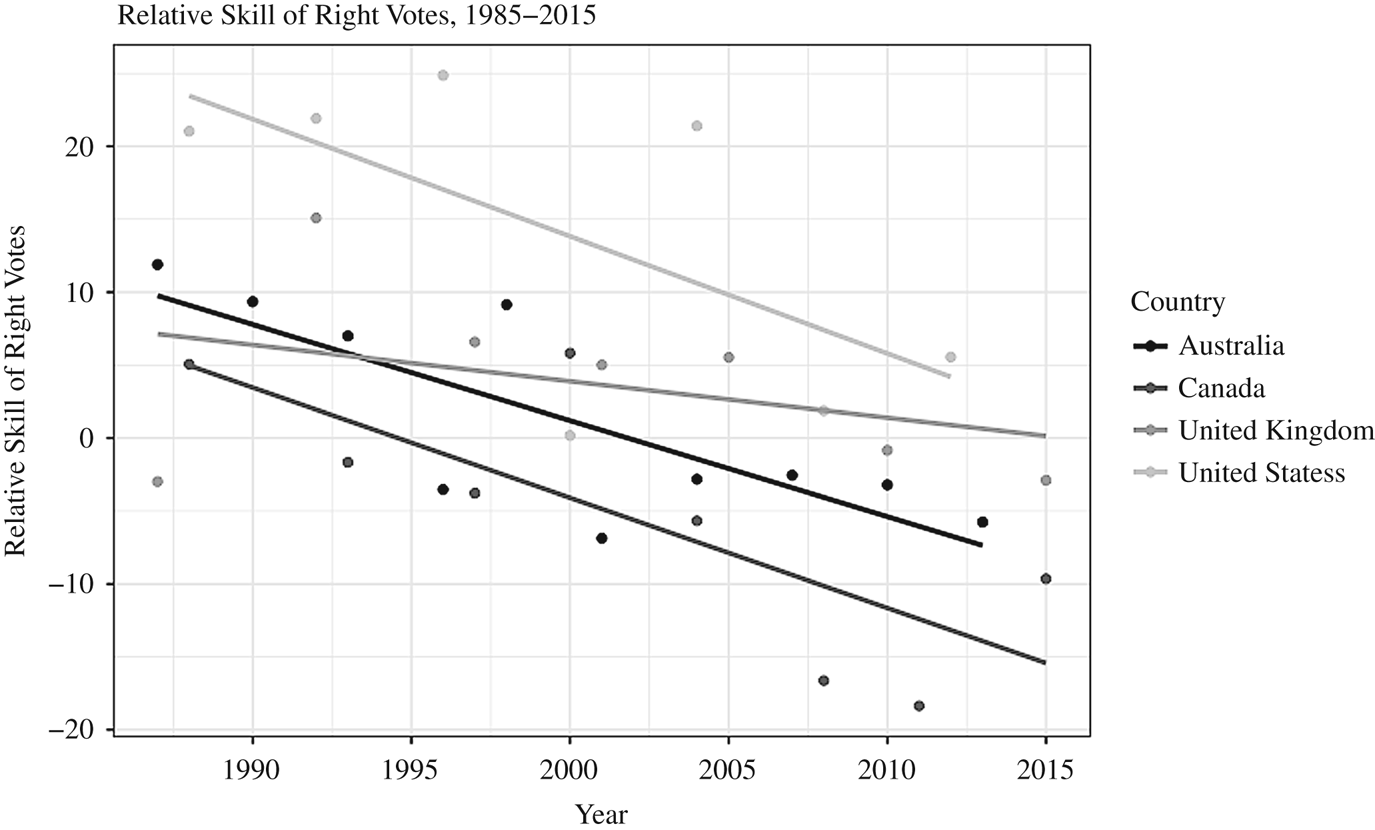
The relative skill of Right voters has decreased over time in all four countries

Relative Skill of Right Voters
Finally, I assess whether there is empirical support for Proposition 3. To analyze trends in voting by skill level, I rely on post-electoral survey data. I divide each country's sample into voters with university education and above (“skilled”) and those without (“unskilled”), and calculate the percentage of each voter type that supported the major Left (Right) candidate in their constituency's legislative election (I exclude survey respondents who did not vote).Footnote 78 I first calculate the skill gap in voting, which is the percentage of college-educated voters supporting a party minus the percentage of less educated voters turning out for the party. Positive (negative) values indicate that a party is more popular with college-educated (less educated) voters. I then subtract the major Left party's value of this measure from the Right's to generate the relative skill of Right voters. This measure is positive if the Right's electorate is more college-educated than the Left's, and negative if the Left's base of support is relatively more educated. The relative skill of Right voters has declined in all four countries (Figure 10). I examine the time trend for this measure in the online supplement, finding a negative and significant time trend in the relative skill of Right voters.
I therefore find empirical support for all predictions of my model; as the relative skill of Right constituencies declines, the relative protectionism of Right parties rises. The emergence of an increasingly protectionist Right coincides with a decline in the relative skill of Right voters.
Conclusion
Over the last three decades, two puzzling realignments have taken place in advanced plurality countries. Initially protectionist Left parties have increasingly become proponents of free trade, while formerly pro-trade Right parties have moved toward protectionism. At the same time, the Right has lost its appeal among college-educated citizens. The Left has gained these voters, at the expense of losing support among less educated voters. In this paper, I offer a formal theoretical framework for understanding these developments. Drawing on research in economic and political geography, I argue that exposure to trade causes skilled workers to move from low-density constituencies controlled by Right incumbents to high-density constituencies controlled by the Left. As the relative skill of Right constituencies decreases, the relative protectionism of the Right rises, yielding a corresponding decline in the relative skill of Right voters.
My research provides new causes for concern for the already embattled proponents of globalization in advanced countries. Rodden shows that advanced plurality systems are biased against urban citizens; as skilled workers sort into cities, the political power of globalization supporters will continue to wane, dimming the prospects for continued global economic integration.Footnote 79 Ultimately, my findings show the importance of economic geography not only for domestic electoral politics, but also for the international political economy. Future studies should further probe the political consequences of an ever-evolving spatial economy.
Data Availability Statement
Replication files for this article may be found at <https://doi.org/10.7910/DVN/YNVYO2>.
Supplementary Material
Supplementary material for this article is available at <https://doi.org/10.1017/S0020818321000217>.
Acknowledgments
Helpful comments and suggestions were provided by Meir Alkon, Eric Arias, Fin Bauer, Cameron Ballard-Rosa, Pablo Beramendi, Allison Carnegie, Brendan Cooley, Raphael Cunha, Rafaela Dancygier, Christina Davis, Lindsay Dolan, Nikhar Gaikwad, German Gieczewski, Noam Gidron, Joanne Gowa, Will Horne, Matias Iaryczower, Karen Jusko, Amanda Kennard, Lauren Konken, John Londregan, Helen Milner, Daniel Nielson, Kristopher Ramsay, Stephanie Rickard, Philip Rehm, Jonathan Rodden, Peter Rosendorff, Esteban Rossi-Hansberg, Ephraim Shimko, Will Smith, Sondre Solstad, Daniel Sturm, Federico Tiberti, and James Vreeland. Helpful comments were also provided by the Harvard Faculty Discussion Group on Political Economy, the University of California, San Diego, Political Economy Faculty Reading Group, the New York University International Relations Reading Group, the participants of the 2018 International Political Economy Society and the 2019 Midwest Political Science Association meetings, and the participants of the Analyzing the Anti-Globalization Backlash conference in Florence. Data collection was greatly assisted by Jeremy Darrington and the statistics bureaus of Australia, Canada, and the United Kingdom.