The Asian date mussel Musculista senhousia (Benson in Cantor, 1842) (Figure 1) is a small, thin-shelled mytilid bivalve that lives on both soft and hard substrates in the intertidal and shallow subtidal zones of bays and estuaries. Native to East Asia, from the Kurile Islands and the Siberian coast of the Sea of Japan to Singapore (Cohen, Reference Cohen2005), M. senhousia has successfully invaded various parts of the world. The first record outside its native range was in Japanese oyster (Crassostrea gigas) beds in Puget Sound, Washington, in 1924, but it probably did not establish at that time (Cohen, Reference Cohen2005). It was then reported in the 1940s from central California and in the mid-1960s in southern California, where its abundance increased dramatically in the 1990s (Crooks, Reference Crooks1996, Reference Crooks2001). On the Pacific coast of North America, the species is now distributed from the Strait of Georgia in Canada to Baja California in Mexico (Cohen, Reference Cohen2005). In the Mediterranean, it was first recorded in 1964 from the coast of Israel (Zenetos et al., Reference Zenetos, Gofas, Russo and Templado2003), then successively from: Bardawil lagoon, Egypt, in 1971 (Zenetos et al., Reference Zenetos, Gofas, Russo and Templado2003); three lagoons in Languedoc, France, in the 1980s (Etang de Thau in 1982, Etang de Salses-Leucate in 1985, Etang de l'Or in 1988) (Clanzig, Reference Clanzig1989; Hoenselaar & Hoenselaar, Reference Hoenselaar and Hoenselaar1989); in the Northern Adriatic Sea: Sacca di Goro in 1994 (Mistri, Reference Mistri2002), Valli di Comacchio in 1997-98 (Mistri et al., Reference Mistri, Fano, Rossi, Caselli and Rossi2000), Slovenia in 1997 (De Min & Vio, Reference De Min and Vio1997); in the Gulf of Taranto, north-western Ionian Sea, in 2001 (Mastrototaro et al., Reference Mastrototaro, Matarrese and D'Onghia2003); in the Gulf of Olbia, north-eastern Sardinia, Tyrrhenian Sea, in 2002 (Mistri, Reference Mistri2002); on the Romanian coast of the Black Sea in 2002 (Micu, Reference Micu, Ozturk, Mokievsky and Topaloglu2004). Besides its occurrence in the north-eastern Pacific and the Mediterranean, M. senhousia has been also introduced to New Zealand in 1978 (Willan, Reference Willan1985) and Western Australia in 1983 (Slack-Smith & Brearley, Reference Slack-Smith and Brearley1987). Finally, it has been reported from the Great Bitter Lake (Suez Canal), Red Sea, Aden, Zanzibar, Madagascar, Mauritius, India, Indo-China and New Caledonia (Barash & Danin, Reference Barash and Danin1972; George & Nair, Reference George and Nair1974), but its status as a native or introduced species in the Indian Ocean remains unclear (NIMPIS, Reference Hewitt, Martin, Sliwa, McEnnulty, Murphy, Jones and Cooper2002).
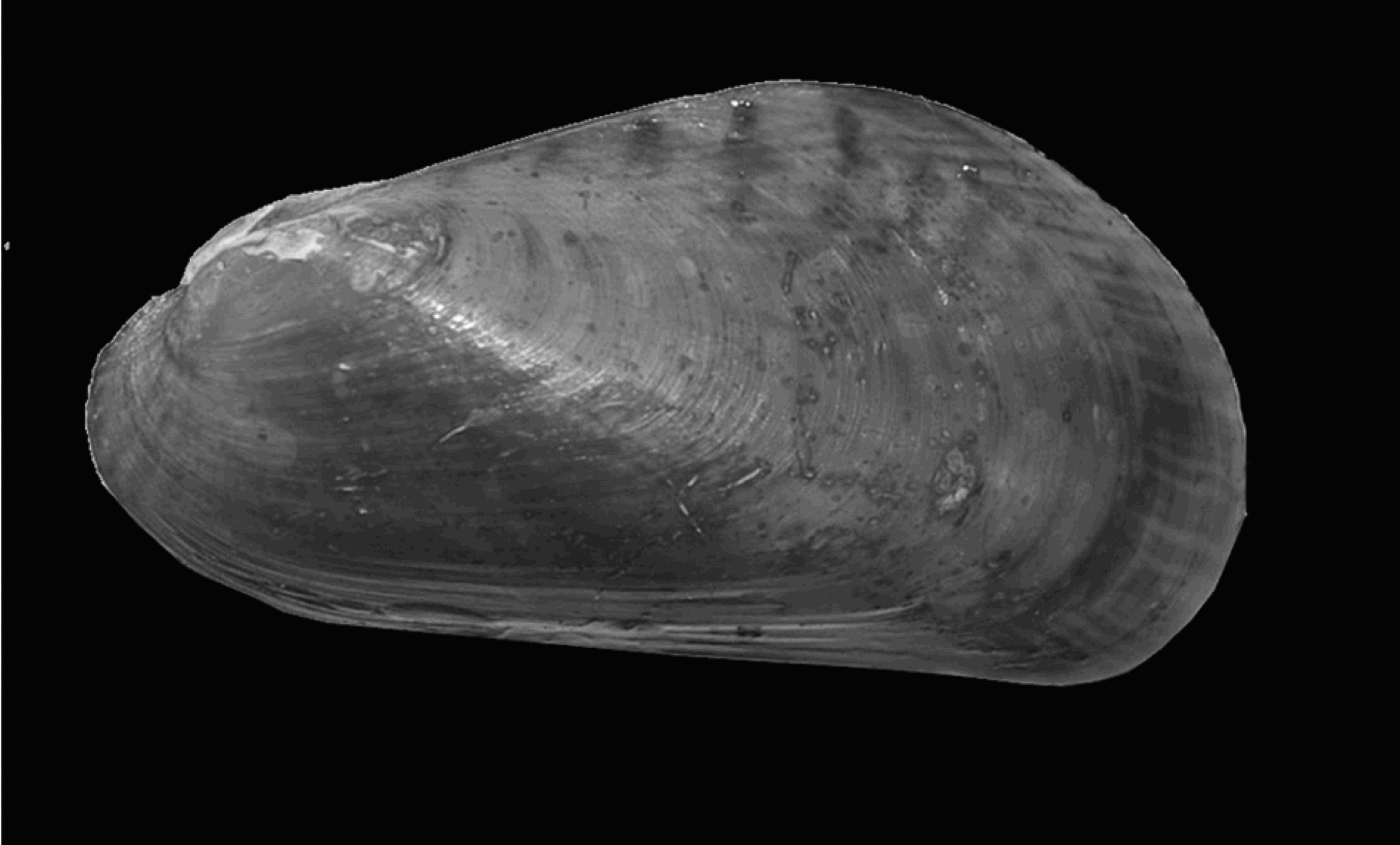
Musculista senhousia (23.7 × 12.6 mm) from Arcachon Bay.

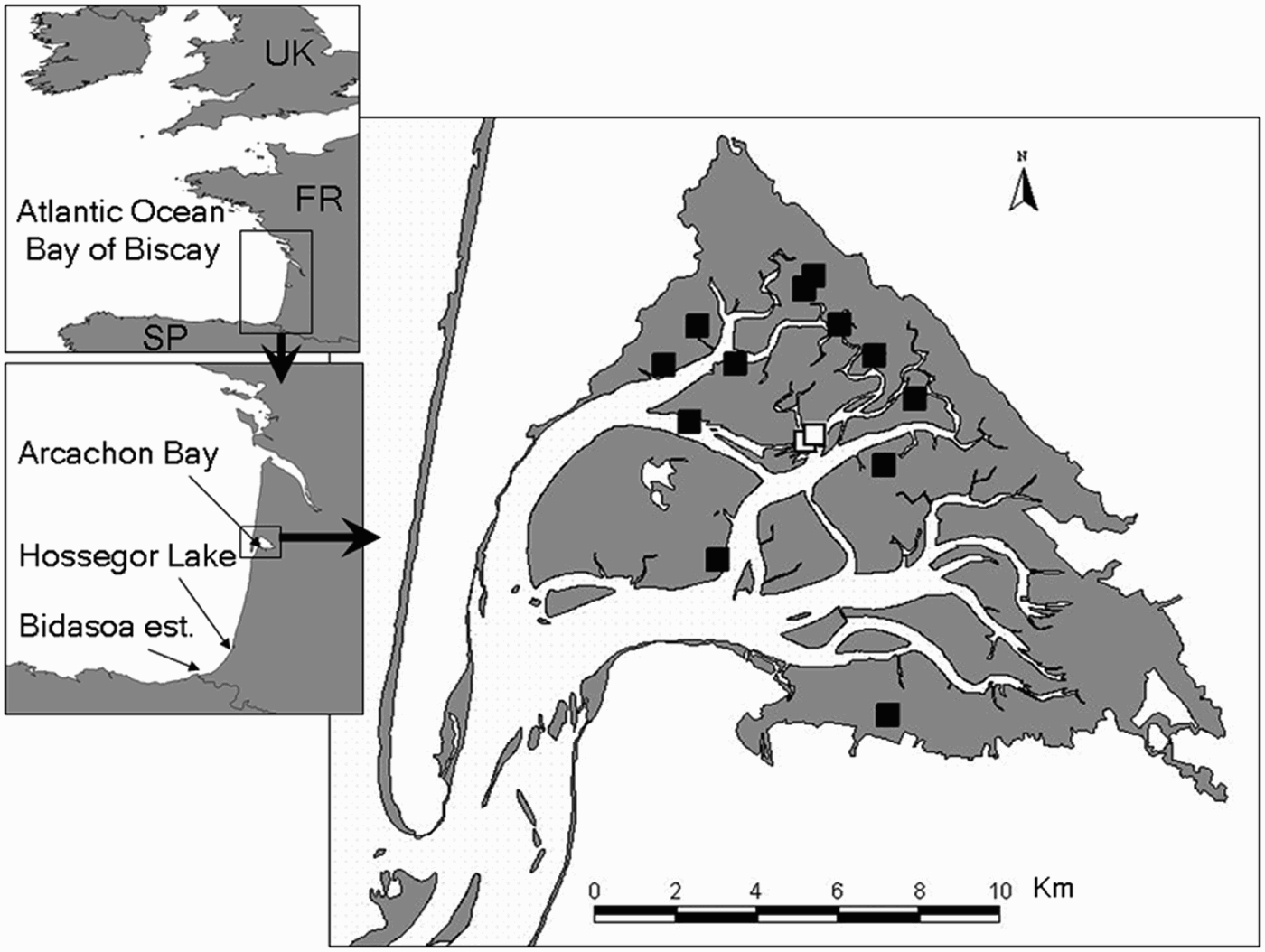
In the present paper, we report on new records of M. senhousia in three locations on the French coasts of the southern Bay of Biscay: Arcachon Bay, Hossegor Lake and the Bidasoa estuary (Figure 2; Table 1). This species has been already identified by Gruet et al. (Reference Gruet, Héral and Robert1976, as Musculus senhousei) on spat collectors of Crassostrea gigas imported from Japan to France in 1973. It was still alive after being transported by air in dry packaging and immersion in fresh water. However, one year after the immersion of these collectors on oyster parks in Bourgneuf Bay and Le Croisic (French Atlantic), no mussels were recovered. More recently, empty shells were found by Charles (Reference Charles2007) in March 2006, stranded on the beach on the eastern coast of Arcachon Bay. Therefore, the records reported here are the first ones for live M. senhousia in the Atlantic.
Maps showing the location of sampling sites in the Bay of Biscay and sampling stations (squares) with Musculista senhousia presence in Arcachon Bay. Open squares indicate stations A4 and CR (see Figure 3).

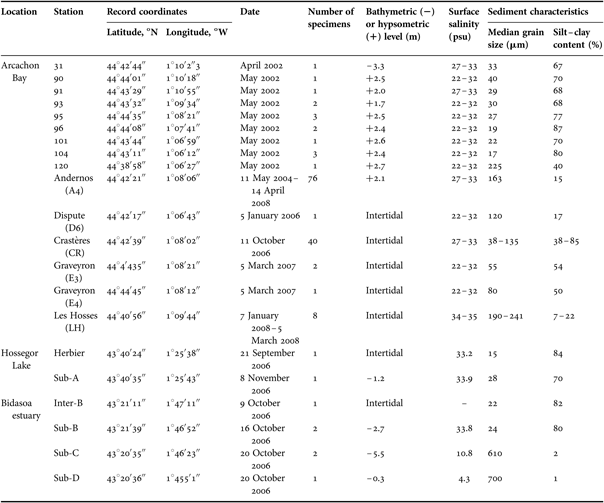
Records of Musculista senhousia in the Bay of Biscay. Surface salinity is given as annual salinity range for the stations in Arcachon Bay and as values measured at the sampling time in Hossegor Lake and Bidasoa estuary.

Arcachon Bay is a 180 km2 mesotidal (maximum tidal range: 4.9 m) coastal lagoon, connected to the Atlantic Ocean by a narrow channel through which considerable water exchange occurs at each tide. The maximum water depth reaches 24 m at the entrance of the lagoon but most channels are only 5–10 m deep. This lagoon is characterized by large intertidal flats covering 70% of the bay area. About 70 km2 of these tidal flats are covered by large Zostera noltii beds, while oyster (C. gigas) parks occupy 10 km2, mainly in the lower part of the intertidal. Most of the specimens of M. senhousia reported in this study were collected in Arcachon Bay (Table 1). The specimens collected from 2006 onwards were immediately identified as M. senhousia; those collected in April–May 2002 (Blanchet, Reference Blanchet2004) and in 2004–2005 were previously misidentified as Modiolus adriaticus (Lamarck), but finally ascribed to M. senhousia after careful re-examination. With a single exception (Station ‘31’), all date mussels were sampled in the intertidal zone of Arcachon Bay (Figure 2). Although sediment might be generally classified as muddy sand or sandy mud, its characteristics highly varied between stations: median grain size ranged from 17–241 µm, and silt–clay fraction from 7–87%. In the intertidal M. senhousia was mainly found in muddy substrates colonized by Z. noltii at various stages of development. However, at ‘Les Hosses’, 2 specimens were collected in muddy sand beneath raised oyster racks and 6 specimens were sampled within wild reef-forming oysters proliferating on abandoned racks.
Hossegor Lake is a small (0.9 km2), shallow marine water mass, communicating with the sea by a very narrow channel. It is highly impacted by human activities (embanking, oyster culture and dredging). Only 2 specimens of M. senhousia were collected in September and November 2006, one in an intertidal Z. noltii meadow, and one in shallow subtidal muddy substrate.
In the Bidasoa estuary, a short (11.1 km) estuary bordering France and Spain, some M. senhousia were found in October 2006: 3 in intertidal and subtidal muds in the downstream zone, and 3 in subtidal fine gravels in the upstream zone, at salinities as low as 4.3 psu.
A total of 151 specimens of M. senhousia were thus collected in the three locations, mainly in Arcachon Bay; this may be partially attributed to a greater sampling effort in this area than in Hossegor Lake and the Bidasoa estuary. In this lagoon, the first specimens were found in April–May 2002. At that time, M. senhousia was found in only 9 stations over 182 sampled by Blanchet (Reference Blanchet2004), and in low numbers (Table 1). Densities were always low: the highest abundance (only 22 ind m–2) was found at station ‘Graveyron (E3)’ in March 2007. However, Charles (Reference Charles2007) collected 50 bivalved, empty shells stranded on a beach on the north-eastern coast of Arcachon Bay in March 2006, which could indicate that dense populations are located elsewhere in the bay.
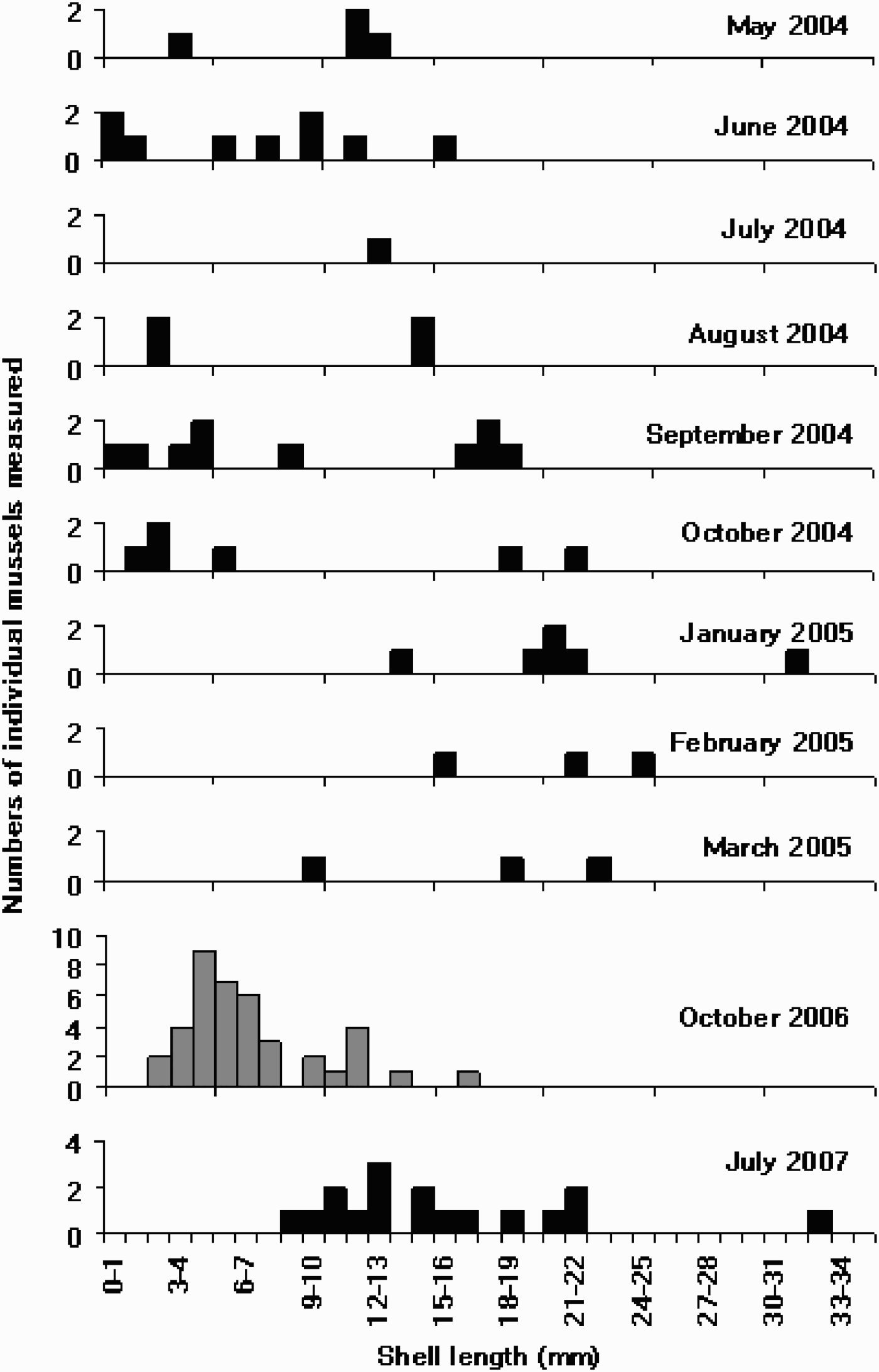
The largest mussel measured from Arcachon Bay was 33.0 mm in shell length, which is similar to the maximum length (29–34.2 mm) recorded in other introduced populations (Crooks, Reference Crooks1996; Creese et al., Reference Creese, Hooker, De Luca and Wharton1997; Reusch, Reference Reusch1998; Mistri, Reference Mistri2002; Mastrototaro et al., Reference Mastrototaro, Matarrese and D'Onghia2003). Although the mussel densities were very low, the size–frequency distributions at Station ‘a4’ from May 2004 to March 2005 show that small recruits (with shell height <5 mm) were present from June–October (Figure 3), indicating a prolonged spawning and recruitment period, as found in southern California (Crooks, Reference Crooks1996) and New Zealand (Creese et al., Reference Creese, Hooker, De Luca and Wharton1997). The almost unimodal size distribution centred on about 5 mm (extremes: 2 and 17 mm) in October 2006 might be attributed to the 2006 cohort, which reached a size of 8–22 mm in July 2007 (Figure 3), i.e. after one year. Similar annual growth rates from recruitment were observed by Crooks (Reference Crooks1996: 17–23 mm) and Creese et al. (Reference Creese, Hooker, De Luca and Wharton1997: 15–20 mm), while Mistri (Reference Mistri2002) calculated a much higher growth rate (24–25 mm) during the first year in the Sacca di Goro.
Length–frequency distributions of Musculista senhousia sampled at station ‘Andernos (A4)’ (black histograms) from May 2004 to March 2005 and in July 2007 (10 replicates of 0.25 m2 sieved on 1-mm mesh) and at the very close station ‘Crastères (CR)’ (grey histogram) in October 2006 (15 qualitative samples).

In the Bay of Biscay, M. senhousia appears to be adapted to a variety of habitats (intertidal/shallow subtidal, muds with or without Zostera noltii/fine gravels/oyster reef) and be able to tolerate low salinities, which may explain its invasive success. Due to the presence of ports in the three locations where M. senhousia was discovered, the species might have been transported as fouling on ship's hulls. However, an accidental introduction with oyster (Crassostrea gigas) transfers from a Mediterranean shellfish basin, in particular the Thau lagoon, is the most likely vector for the introduction of M. senhousia, at least in Arcachon Bay and Hossegor Lake. In France oyster transfers between national shellfish basins ensure optimal growth conditions for each part of the rearing cycle and are not subject to regulation. For example, transfers of spat from Arcachon to Thau, followed by transfers of half-grown oysters from Thau to Arcachon are a usual practice that may unfortunately result in the accidental introduction of non-indigenous species. This has been already demonstrated for macrophytes (Verlaque et al., Reference Verlaque, Boudouresque and Mineur2007) and the gastropod Cyclope neritea (Bachelet et al., Reference Bachelet, Simon-Bouhet, Desclaux, Garcia-Meunier, Mairesse, de Montaudouin, Raigné, Randriambao, Sauriau and Viard2004; Simon-Bouhet et al., Reference Simon-Bouhet, Garcia-Meunier and Viard2006).
In other invaded areas, M. senhousia has been shown to have a detrimental, although localized, effect on seagrass growth (Reusch & Williams, Reference Reusch and Williams1998; Allen & Williams, Reference Allen and Williams2003) and infaunal assemblages (Creese et al., Reference Creese, Hooker, De Luca and Wharton1997; Crooks, Reference Crooks2001; Mistri, Reference Mistri2003). It thus appears necessary to survey the newly colonized sites in the Bay of Biscay to assess the potential impact of M. senhousia, as well as the sites not colonized until now in north-western Europe, where we can predict a secondary dispersal within the next years.
ACKNOWLEDGEMENTS
We thank S. Jenkins and three anonymous referees for their constructive comments on an earlier version of the manuscript.