Introduction
Vogt–Koyanagi–Harada disease is a systemic disorder comprising bilateral panuveitis associated with a spectrum of cutaneous, neurological, auditory and vestibular signs.Reference Ibanez, Grand, Meredith and Wippold1 There are no definitive confirmatory diagnostic tests, and the diagnosis is based on clinical and angiographic findings.Reference Forster, Cano, Green and Rao2, Reference Sheu, Kou and Chen3
Although the disease has been reported throughout the world, it is more prevalent in Asian individuals and certain Latin-American groups.Reference Panitrungroung, Kulthanan and Chuenkongkaew4
The aetiology of Vogt–Koyanagi–Harada disease remains speculative. Some authors favour a viral cause, whilst others consider cell-mediated autoimmune mechanisms against melanocytes to play a role in the pathogenesis.Reference Kahn, Pepose, Green, Miller and Foos5 Immunocytological findings are consistent with a T-cell mediated disorder causing an autoimmune reaction to uveal and dermal melanocytes.Reference Yamaki, Gocho, Hayakawa, Kondo and Sakuragi6, Reference Read and Rao7 Numerous reports demonstrate an association between human leukocyte antigen major histocompatibility complex class II antigen and Vogt–Koyanagi–Harada disease in different racial groups.
Recent studies have indicated that the major factor contributing to disease susceptibility is the presence of the DRB 0405 cell surface receptor allele.Reference Read, Holland, Rao, Tabbara, Ohno and Arellanes-Garcia8
The suggested criteria for establishing a diagnosis of Vogt–Koyanagi–Harada disease are based on a combination of clinical findings and ancillary tests. In 1978, the American Uveitis Society recommended the first consistent set of diagnostic criteria. These included the absence of prior trauma or surgery and the presence of at least three of the following four groups of signs and symptoms: bilateral iridocyclitis; posterior uveitis including exudative retinal detachment or ‘sunset glow’ fundus; central nervous system manifestations (headache, tinnitus, hearing loss, meningism or cranial nerve involvement) or cerebrospinal fluid pleocytosis; and cutaneous findings (e.g. alopecia, poliosis or vitiligo).Reference Kahn, Pepose, Green, Miller and Foos5, Reference Read and Rao7 The criteria require that three of the four elements be present and two of the elements consistent of almost exclusively chronic feature; iridocyclitis and Cutaneous findings that make diagnosis of disease at early onset not possible.
Vogt–Koyanagi–Harada disease diagnostic criteria were subsequently revised at an international workshop on the disease in October 1999. The disease was recategorised into complete, incomplete and probable forms. In complete Vogt–Koyanagi–Harada disease, multi-organ involvement is present (i.e. ocular, neurological, auditory and integumentary). In incomplete Vogt–Koyanagi–Harada disease, ocular criteria are present together with either neurological or auditory or integumentary involvement. Probable Vogt–Koyanagi–Harada disease involves isolated ocular disease.Reference Read, Holland, Rao, Tabbara, Ohno and Arellanes-Garcia8
Although these revised diagnostic criteria are effective in establishing a final diagnosis of Vogt–Koyanagi–Harada disease, they are not effective in aiding the diagnosis of very early stage disease.Reference Yamaki and Sakuraqi9
The natural history of this inflammatory disease may be modified by the early use of high dose immunosuppressive therapy, especially oral corticosteroids.Reference Hayasaka, Okabe and Takahashi10
Freeman et al. Reference Freeman, Chavis and Tabbara11 reviewed 97 consecutive Saudi Arabian patients with Vogt–Koyanagi–Harada disease (both children and adults), and found that the disease was more aggressive and had more severe complications in children compared with adults.
There have been few notable reports on Vogt–Koyanagi–Harada disease (also known as Harada's disease) in the field of otolaryngology.Reference Yoshimoto12–Reference Kimura, Ohashi, Aso and Watanabe14 Accordingly, the present study was undertaken to analyse auditory and vestibular presentations in Vogt–Koyanagi–Harada disease patients, in order to acquaint the otolaryngologist with the neurotological manifestations of this disease.
Materials and methods
Twenty-four consecutive patients with Vogt–Koyanagi–Harada disease were seen over a six-year period at the ENT and ophthalmology departments of King Abdul Aziz University Hospital, King Saud University, Riyadh, Saudi Arabia.
All patients were assessed by an ophthalmologist (with an interest in retinal disorders) and by an ENT consultant (the author).
Diagnosis was based on the 1999 revised Vogt–Koyanagi–Harada disease criteria. Other diseases with the same features were excluded, such as sarcoidosis, tuberculosis, syphilis, sympathetic ophthalmia, uveal effusion syndrome, posterior scleritis, intraocular lymphoma, Lyme disease and ear infection; exposure to ototoxic drugs or excessive noise was also excluded.
Fifteen patients were female and nine male. Their mean age was 22 years (range, nine to 46 years); there were five children (23 per cent) (i.e. aged below 16 years). All patients were Saudi Arabian citizens.
A clinical history was taken (enquiring specifically about hearing loss, tinnitus, dizziness and vertigo) and a general ENT examination was conducted.
Hearing was assessed by pure tone audiometry (PTA), using an Interacoustics clinical audiometer (AC 40 model; Interacoustics, Otometrics, Taastrup, Denmark). Tympanometry was conducted using an Interacoustics impedance audiometer (AZ26 model). Auditory brainstem response (ABR) testing was performed using an Interacoustics EP 25 system. Otoacoustic emission (OAE) testing was conducted using an Otodynamics ILO292 system (Otodynamics, Otometrics, Taastrup, Denmark). Vestibular assessment was performed using an NCI480 water caloric stimulator (Integration of caloric stimulation (ICS) Charter; Otometrics, Taastrup, Denmark). Eye movement recording and analysis were conducted using an Interacoustics VO25 videonystagmography system.
In order to exclude other diseases with the same features as Vogt–Koyanagi–Harada disease, testing was undertaken for toxoplasmosis, rubella, cytomegalovirus and herpes simplex virus, analyses for rheumatoid factor and antinuclear antibody were conducted, and a purified protein derivative test and complete blood chemistry profile were performed.
Results
Of the 24 patients seen, 12 (50 per cent) had sensory hearing loss, which was bilateral in all but two cases. Hearing loss was mild (i.e. 20–40 dB) in six cases (11 ears), moderate (40–60 dB) in four cases (seven ears), and profound and bilateral in two cases (four ears). Two patients denied any hearing loss; however, PTA showed mild high frequency hearing loss. Distortion product otoacoustic emissions were present in all normal hearing ears and absent in ears with moderate or severe hearing loss. In the 11 ears with mild hearing loss, OAEs were present in six ears and absent in five ears. In all cases, click ABR results confirmed our PTA average values for hearing thresholds.
Ten patients (42 per cent) complained of tinnitus, and four patients (17 per cent) complained of vertigo. Bithermal water caloric testing with cold and warm water (33 and 44oC, respectively), used with videonystagmography eye movement recording and analysis, revealed unilateral canal paresis of more than 30 per cent in four cases. Of these four patients, two had unilateral hearing loss and two had bilateral hearing loss.
Another four patients (17 per cent) complained of headache, and two patients (8 per cent) had vitiligo. The onset of Vogt–Koyanagi–Harada disease was preceded by an upper respiratory tract infection in five patients (21 per cent). All blood tests were normal.
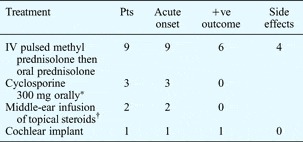
Nine patients with sudden onset Vogt–Koyanagi–Harada disease received intravenous pulsed methyl prednisolone (1 g/day) for 3 days followed by oral prednisolone (1 mg/kg/day) tapered by 10 mg every two weeks and maintained at 20 mg daily for four to six months. Vitamin D, calcium and a histamine antagonist were also administered.
Three Patients developed diabetes millets as complication of steroid, started on cyclosporine 300 mg orally given once daily, two of them had middle ear infusion of topical steroid as well with no response to either treatments (Table I).
Treatment options and outcomes

Data represent patient numbers. *For patients with steroid complications. †Surgical treatment for patients with bilateral profound hearing loss. Pts = patients; +ve = favourable; IV = intravenous
Four of the patients treated with steroids (44 per cent) suffered steroid side effects, in the form of hirsutism (one female patient), high blood pressure and diabetes mellitus (one patient), severe osteoporosis (one patient), and herpes zoster infection in the distribution of the right third thoracic nerve (one patient; treated with antiviral medication).
Of the nine patients treated with steroids, six were started on treatment within a few days of the onset of hearing impairment; these patients regained their hearing in the involved ears within several days. In the remaining three patients, treatment was initiated several weeks after the onset of hearing impairment; these patients showed no hearing improvement.
In three patients, steroid treatment was stopped abruptly due to side effects. However, these patients' symptoms relapsed a few weeks later, and treatment was resumed.
Of the two patients with bilateral profound hearing loss, one underwent cochlear implantation surgery, with excellent post-operative hearing results. At the time of writing, the other patient was on a waiting list for cochlear implantation.
Follow-up times ranged from two weeks (a single visit) to six years, with a mean of 32 months.
Discussion
Vogt–Koyanagi–Harada disease is a chronic granulomatous inflammatory disorder affecting the cochlear and vestibular end-organs. The disease probably affects the melanocytes of the endolymphatic sac, osseous spiral lamina, modiolus, striae vascularis, Reissner's membrane, ampullae, saccule, crus commune and utricle.Reference Seals and Rise13 The most likely pathogenesis of Vogt–Koyanagi–Harada disease involves an interaction between a virus, the immune response and a genetic predisposition.Reference Kahn, Pepose, Green, Miller and Foos5, Reference Yamaki, Gocho, Hayakawa, Kondo and Sakuragi6 Such an aberrant reaction may be primarily due to virally induced changes in melanocytic antigens.Reference Seals and Rise13 This probably explains the history of preceding upper respiratory tract infections in 21 per cent of cases in the present series.
Hearing loss develops at or near the same time as the onset of visual impairment. This hearing loss is variable, and is usually associated with tinnitus and sometimes vertigo.Reference Yoshimoto12 Fifty per cent of our Vogt–Koyanagi–Harada disease patients had sensory hearing impairment. This hearing loss was mild in 13 ears, moderate in seven ears and profound in four ears. One of our patients with bilateral profound hearing loss underwent unilateral cochlear implantation and regained hearing in the operated ear; this suggests that Vogt–Koyanagi–Harada disease affects the inner ear end-organs rather than the cochleo-vestibular nerve or the central pathway. This patient's excellent hearing outcome confirms the fact that Vogt–Koyanagi–Harada disease patients with bilateral profound sensory hearing loss are good candidates for cochlear implantation.
Tinnitus was the second most common complaint in our series, occurring in 10 patients (42 per cent). Headache was reported by four patients (17 per cent).
Seals and Rise, Kimura et al. and Maxwell have all reported canal paresis in patients with Vogt–Koyanagi–Harada disease.Reference Seals and Rise13–Reference Maxwell15 In our study, four patients (17 per cent) had vestibular disorder. In general, vertigo appears at approximately the same time as tinnitus and sensory hearing loss. Impairment of the peripheral vestibular function is compensated for by the brain, so that vertigo improves or disappears within two to several weeks of onset in most cases. Vertigo is usually not a recurrent problem.Reference Yoshimoto12
Patients with Vogt–Koyanagi–Harada disease have limited therapeutic options, and systemic corticosteroid therapy has become the mainstay of treatment. Various steroid treatment regimens have been reported, including intravenous drip infusion of 200 mg prednisolone and pulse therapy with 500–1000 mg methyl prednisolone sodium succinate.Reference Read, Accorinti, Bodaghi, Chee, Fardeau and Goto16
The interval between development of hearing loss and initiation of adequate treatment has a significant effect on the disease outcome. In our series, nine patients received intravenous pulsed methyl prednisolone 1 g/day for 3 days then oral prednisolone 1 mg/kg/day tapered by 10 mg every two weeks and maintained at 20 mg/day to complete four to six months. In six patients, steroid treatment was initiated within a few days of the onset of hearing impairment, and these patients regained their hearing in the involved ears. In the remaining three patients receiving steroids, treatment was initiated several weeks after the onset of hearing impairment; these patients did not respond to treatment.
Hayasaka et al. have suggested the use of oral corticosteroids when the disease is mild, with intravenous infusion possibly necessary in cases of more severe disease.Reference Hayasaka, Okabe and Takahashi10
All our nine patients treated with steroids received high doses; however four of these nine (44 per cent) developed side effects: hirsutism, high blood pressure, diabetes mellitus, severe osteoporosis and herpes zoster infection. All these side effects resolved with reduction or cessation of steroid treatment.
Not all patients respond to steroid therapy, and a variety of other immunosuppressive agents have been tried in an attempt to improve the prognosis. Nussenblatt et al., Wakatsuki et al. and others have reported favourable results for cyclosporin A as treatment for Vogt–Koyanagi–Harada disease.Reference Nussenblatt, Palestine and Chan17, Reference Wakatsuki, Kogure, Takahashi and Oguro18 However, this drug is primarily used in patients who develop chronic intraocular inflammation and respond poorly to systemic corticosteroids, or who develop significant adverse effects.Reference Read, Holland, Rao, Tabbara, Ohno and Arellanes-Garcia8, Reference Read, Accorinti, Bodaghi, Chee, Fardeau and Goto16 Three patients developed diabetes millets as complication of steroids, started on cyclosporine 300 mg orally given once daily, two of them had middle-ear infusion of topical steroid as well with no response to either treatments. Abrupt interruption of steroid treatment was followed by relapse of symptoms in three patients. High doses of steroid were associated with significant morbidity; we thus recommend reducing the steroid dose to 500 mg pulsed methyl prednisolone for 3 days, followed up by 0.5 mg/kg daily, and observing the patient closely.
• Vogt–Koyanagi–Harada disease is a chronic disorder involving the eye and the central nervous, auditory, vestibular and integumentary systems
• In this study, 24 patients diagnosed with this disease were assessed for auditory and vestibular dysfunction
• Vogt–Koyanagi–Harada disease patients have a high incidence of cochlear and vestibular end-organ involvement
• Timely initiation of adequate treatment has a significant effect on outcome
• Vogt–Koyanagi–Harada disease patients with bilateral profound sensory hearing loss are candidates for cochlear implantation
Our study showed that the sensory hearing loss associated with Vogt–Koyanagi–Harada disease can be reversed if an adequate corticosteroid dosage is initiated within a few weeks of onset. However, such hearing loss can become irreversible if steroid treatment is delayed by several weeks, or if there is a severe inner ear insult resulting in profound hearing loss.
Conclusion
Vogt–Koyanagi–Harada disease appears to have been overlooked by otolaryngologists, even though the incidence of cochlear and vestibular end-organ involvement is high. The interval between the appearance of symptoms and the initiation of adequate treatment has a significant effect on the outcome. Sensory hearing loss can be reversed if prompt, adequate doses of steroids are initiated within a few weeks of onset. Delay in treatment may result in permanent hearing loss. Vogt–Koyanagi–Harada disease appears to affect the inner ear end-organ rather than the cochleo-vestibular nerve or the central pathway. Vogt–Koyanagi–Harada disease patients with bilateral profound sensory hearing loss are good candidates for cochlear implantation.