Introduction
Population ageing poses a challenge to Western societies to cater for the increasing number of older consumers. In the European Union (EU), for example, the old-age dependency ratio (64+ people versus the 15–64-year-olds) has been estimated to rise to 40 per cent during the 2020s (Eurostat, nd). This demographic trend has major implications for cities, given that in the EU, for example, almost 75 per cent of consumers live in urban areas (EU, 2016). More specifically, population ageing should be taken into account in city centres because they are important shopping environments for older consumers (Bromley and Thomas, Reference Bromley and Thomas2002; Wrigley and Lambiri, Reference Wrigley and Lambiri2015).
Along with the challenge of adapting to the changes in demographics, several intra-urban centres have faced pressure to remain vital shopping environments. The growing attractiveness of out-of-town shopping centres and e-shopping has decreased the importance of the city centre as a retail location (e.g. Wrigley and Lambiri, Reference Wrigley and Lambiri2015; Teller et al., Reference Teller, Wood and Floh2016; Parker et al., Reference Parker, Ntounis, Millington, Quin and Castillo-Villar2017). Studies on older consumers have reported that inner-city decline has created difficulties for senior citizens taking care of their shopping (Bromley and Thomas, Reference Bromley and Thomas2002; Kohijoki, Reference Kohijoki2011; Temelová and Dvoráková, Reference Temelová and Dvoráková2012). Although urban development projects have aimed at revitalising the high streets, older consumers have usually remained outsiders, and thus considered undervalued resources, because the emphasis has been on younger consumers (Buffel et al., Reference Buffel, Phillipson and Scharf2012; Kohijoki and Marjanen, Reference Kohijoki and Marjanen2013; Buffel, Reference Buffel2018).
The concept of an age-friendly-city, initiated by the World Health Organization (WHO, 2007, 2018), has raised awareness of the impacts of population ageing on urban environments (Buffel et al., Reference Buffel, Phillipson and Scharf2012; Fitzgerald and Caro, Reference Fitzgerald and Caro2014; Steels, Reference Steels2015). It has emphasised that the most effective approach to responding to population ageing is developing cities to become more age-friendly. The aim is to adapt services and physical and social environments to be accessible to citizens of all ages with diverse needs and capacities. The fundamental aim is to support older citizens to age actively and healthily because this contributes to independence in living and taking care of daily chores (WHO, 2007, 2018; Sokolec, Reference Sokolec2016). Although the WHO-led projects have focused on older citizens, age-friendliness does not refer to the ageing of a specific age group. As active/healthy ageing is considered a lifelong process, an age-friendly city centre should not just be ‘old-age-friendly’ but ‘friendly for all ages’ (WHO, 2007; Buffel et al., Reference Buffel, Phillipson and Scharf2012).
With an emphasis on older consumers’ perspectives, the current study focuses on the age-friendliness of city centres in the context of shopping. As a daily chore outside the home, shopping is considered a vital means for older consumers to stay active and maintain their wellbeing (Hovbrandt et al., Reference Hovbrandt, Ståhl, Iwarsson, Horstmann and Carlsson2007; Kohijoki, Reference Kohijoki2011). Thus, it is necessary to promote active ageing also from the point of view of shopping. The shopping behaviour of older consumers and their perceptions of the shopping environment has received considerable attention in the grocery shopping context (e.g. Wilson et al., Reference Wilson, Alexander and Lumbers2004; Meneely et al., Reference Meneely, Strugnell and Burns2009; Kohijoki, Reference Kohijoki2011; Teller et al., Reference Teller, Gittenberger and Schnedlitz2013; Lesakova, Reference Lesakova2016) but corresponding studies on city centres, multipurpose shopping environments, are few in number (cf. Kohijoki and Koistinen, Reference Kohijoki and Koistinen2018).
Using a focus-group research method, the current study explores the perceptions of older consumers of the city centre as a physical and social shopping environment and compares their perceptions with those collected through a qualitative survey among younger consumers. The data were collected in Finland, where the old-age dependency ratio is one of the highest in the EU region (Eurostat, nd). As the framework of the qualitative content analysis, the study utilises the typology of the universal features that the WHO (2007) has identified as contributing to the age-friendly city. This typology has been commonly used in studies relating to social sciences and medicine (Steels, Reference Steels2015) but not in retailing. The current study contributes to the literature by exploring what kinds of content and meanings (if any) these age-friendly city features have in the context of shopping and whether older consumers differ from younger consumers concerning their city-centre shopping behaviour and perceptions of the shopping environment. The study offers new perspectives on retail and urban planning, in particular, in order to satisfy the needs and wants of an increasingly ageing society by recognising the characteristics of a shopping environment that are relevant in developing the city centres to become friendlier for different ages.
The features of the age-friendly city
The concept of the age-friendly city refers to an urban environment in which citizens are treated equally, regardless of their age. Citizens are enabled to engage in the different activities of city life and access both the public and private services as well as the physical and social environments (WHO, 2007). The age-friendliness of the urban environment is closely related to the concept of active/healthy ageing, which is seen as a process that enhances wellbeing and quality of life as people age (WHO, 2002, 2018). The age-friendly environment supports and maintains the ability of ageing citizens to meet their basic needs, to be mobile, to build and maintain social relationships, and to contribute to society, amongst other things (WHO, 2018). These issues are incorporated in the Finnish Land Use and Building Act (132/1999), the objective of which is to create a favourable living environment that is safe, healthy, pleasant, socially functional and provides for the needs of various population groups, such as elderly people (Finlex, 1999/132:5§).
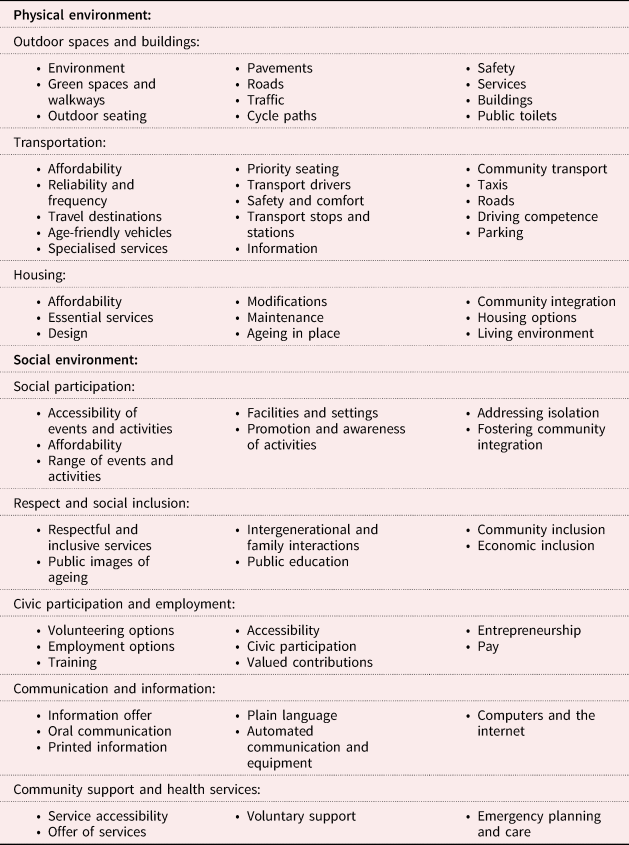
To encourage cities around the world to become more age-friendly, WHO (2007) has published a guide for age-friendly cities based on focus groups of people aged 60+ in 33 countries. The guide consists of eight core features (domains) of age-friendly cities that cover the policies, services and structures related to the city's physical and social environments. These somewhat overlapping and interacting features include elements which were found to be universally relevant for older citizens (see Table 1; WHO, 2007). Three of the core features are key elements of the physical environment. Outdoor spaces and buildings refers to both the built and natural environment. It includes elements related to the location and accessibility of buildings and services, convenience and safety to move around, and the ambience and aesthetics of the environment (e.g. beauty and cleanliness). Transportation refers mostly to public transport services because, according to the WHO (2007), driving is not an essential transportation option for older citizens. Housing includes elements of the housing structure, design and ageing in place in terms of the location of essential services to the home.

Five other core features reflect aspects of the social environment, but the physical features also affect some of them (WHO, 2007; Steels, Reference Steels2015). Social participation refers to engagement in different activities in city life. These include recreation, socialisation, and cultural and spiritual activities. In addition to the offerings of activities, the ability to participate depends on receiving information about the services and having access to transportation. Respect and social inclusion includes elements related to behaviour and attitudes towards older people, and the adaptation of products and services to older people's needs and preferences. It also includes aspects of community and economic inclusion. The experience of inclusion is closely linked to the level of engagement in city activities. Civic participation and employment refers to the contribution to the community through paid employment or voluntary work. Communication and information refers to the capability (including technical know-how) to stay connected with society and to receive timely and relevant information for managing personal matters and meeting personal needs. Community support and health services includes the availability and accessibility of social services. Given the aim of the WHO, it refers mostly to health-care services, but it also includes help with shopping.
In the current study, the WHO's typology is applied in the city-centre shopping environment. Several academic studies have emphasised the role of the physical features on the ability of older consumers to take care of their errands. Ageing-related studies have highlighted the meaning of the home and independent living to older citizens (Wiles et al., Reference Wiles, Leibing, Guberman, Reeve and Allen2011; Lux and Sunega, Reference Lux and Sunega2014; Sokolec, Reference Sokolec2016; Stones and Gullifer, Reference Stones and Gullifer2016). Walking is the typical form of physical activity among older people, and its health benefits are well documented. However, physical obstacles in the outdoor environment may decrease older people's independence in engaging in activities outside the home, i.e. prevent opportunities for active ageing (e.g. Hovbrandt et al., Reference Hovbrandt, Ståhl, Iwarsson, Horstmann and Carlsson2007; Mitra et al., Reference Mitra, Siva and Kehler2015). In retailing-specific studies, the physical environment has been a common object of study. However, the emphasis has been confined to the physical accessibility of the stores (including location, transportation) as a fundamental aspect for older grocery shoppers, in particular. Older people have often been considered disadvantaged consumers in terms of their ability to access grocery stores (Wilson et al., Reference Wilson, Alexander and Lumbers2004; Kohijoki, Reference Kohijoki2011; Teller et al., Reference Teller, Gittenberger and Schnedlitz2013).
The importance of social features has also been particularly highlighted for those old-age pensioners who seek new activities to fill the social vacuum created by retirement (Wiles et al., Reference Wiles, Leibing, Guberman, Reeve and Allen2011; Wallin, Reference Wallin2019). Several retailing studies have focused on the social perspective of shopping, but these studies have usually explored the relationship between customers and store personnel (e.g. Rosenbaum and Massiah, Reference Rosenbaum and Massiah2011). The studies focusing on the social features outside the store environment (i.e. external shopping environment) are few (e.g. Hart et al., Reference Hart, Stachow and Cadogan2013). The WHO's typology is considered to provide a useful tool for this purpose. The typology covers several aspects of city life. Some social features apparently only have an indirect connection with shopping activity. In the current study, however, all core features are explored as there is evidence that older consumers show a tendency towards multipurpose shopping, and they look for social interaction in the stores. In addition to services offered, both the built environment and social aspects of shopping are found to be important to older consumers (e.g. Wilson et al., Reference Wilson, Alexander and Lumbers2004; Meneely et al., Reference Meneely, Strugnell and Burns2009; Kohijoki, Reference Kohijoki2011; Lesakova, Reference Lesakova2016). The age-friendliness of city centres should be evaluated from the shopping point of view in order to create urban environments that enable consumers to have an active, healthy and independent life while they age (Buffel et al., Reference Buffel, Phillipson and Scharf2012).
Methods
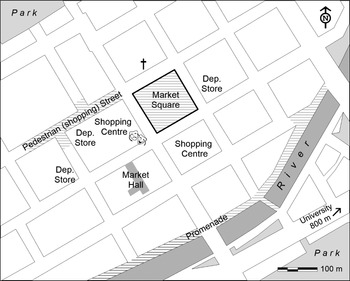
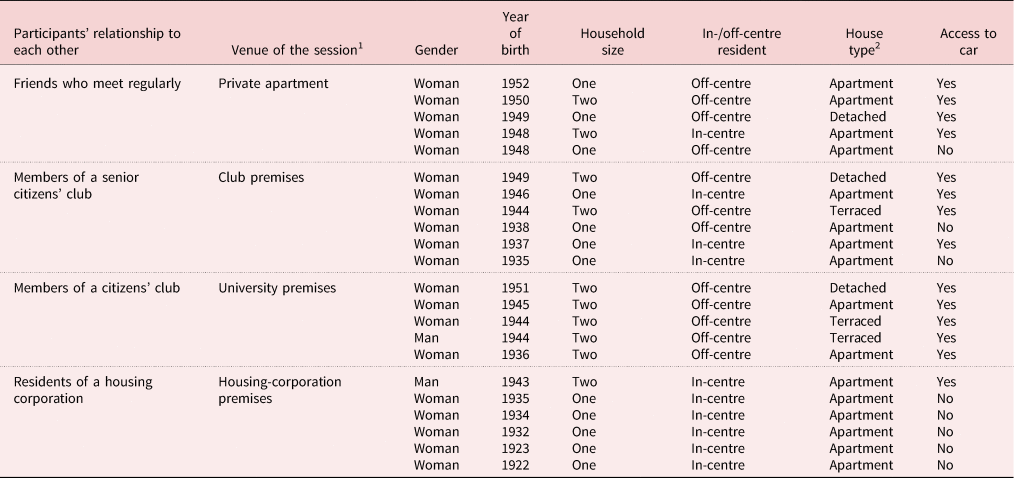
The study took place in the city of Turku (population 187,000) in south-west Finland as a part of the research project ‘The city centre as an age-friendly shopping environment’. According to the old-age dependency ratio, the population in the Turku area is older than in other large urban areas in Finland (Official Statistics of Finland, nd-a). The study focused on consumers who were familiar with shopping in the Turku city centre (Figure 1). To gain an understanding of the perceptions of older consumers of the city-centre shopping environment, in line with the recommended number and size of the groups (e.g. Krueger, Reference Krueger1988), four focus-group discussions with five or six participants (a total of 22 participants; two men, 20 women) were organised (Table 2) in autumn 2016. The method was convenient as it did not discriminate against those who were incapable of filling in questionnaires or using information technology (Kitzinger, Reference Kitzinger1995).
Turku city-centre shopping environment with places of interest.
Notes: Dep. Store: department store. m: metres.

Characteristics of older participants

Notes: 1. In autumn 2016. 2. Based on address.
The recruitment was conducted on a volunteer basis through senior clubs, a housing corporation and the authors’ networks. The authors guided their contact persons to compile the groups of volunteers, consisting of both men and women, aged around 60+, from the communities they represented. Otherwise, the volunteers were different by their background, which gave the desired variation among the participants to allow for contrasting views (cf. Krueger, Reference Krueger1988). However, women were easier to get involved in the focus groups than men; two men even cancelled at the last minute. The uneven distribution of men and women was not considered problematic as the aim was not to compare the gender perspective. In addition, the majority of the aged households in Finland consist of women living on their own, and in co-habiting households, like in other Western countries, females have the primary responsibility for household shopping (Dholakia, Reference Dholakia1999; Sidenvall et al., Reference Sidenvall, Nydahl and Fjellström2001; Official Statistics of Finland, nd-a).
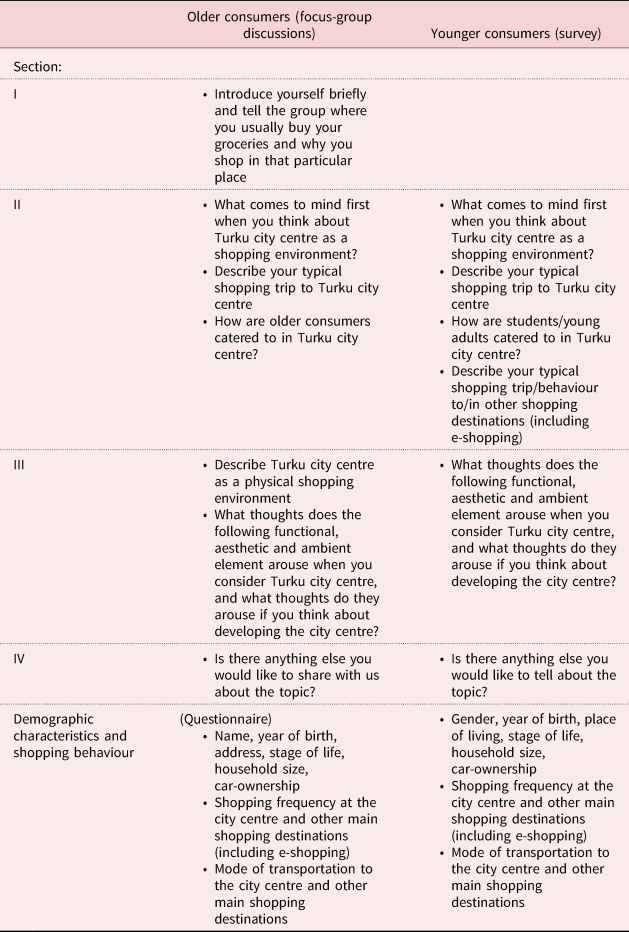
The focus-group participants were 64–94-year-old pensioners (average age 75) who lived and did their shopping independently. The discussions followed pre-formulated themes based on studies on the effect of the shopping environment on consumer experience (e.g. Hart et al., Reference Hart, Stachow and Cadogan2013; Kohijoki and Koistinen, Reference Kohijoki and Koistinen2018). The discussion themes are presented on the left-hand side of Table 3, divided into four sections. After a short round of introductions (section I), the participants described their typical city-shopping trip (section II), how they perceived the city centre as a shopping environment and how they were currently catered for (sections II and III). In addition to the current state of affairs, proposals for improvements were discussed. After a free discussion (section IV), a brief questionnaire (font size larger than normal) concerning background information on demographic characteristics and shopping behaviour (e.g. visit frequency and mode of travel to alternative shopping destinations) was completed. The average length of the discussions was two hours, and they were recorded and transcribed in their entirety.
The focus-group discussion themes and survey questions

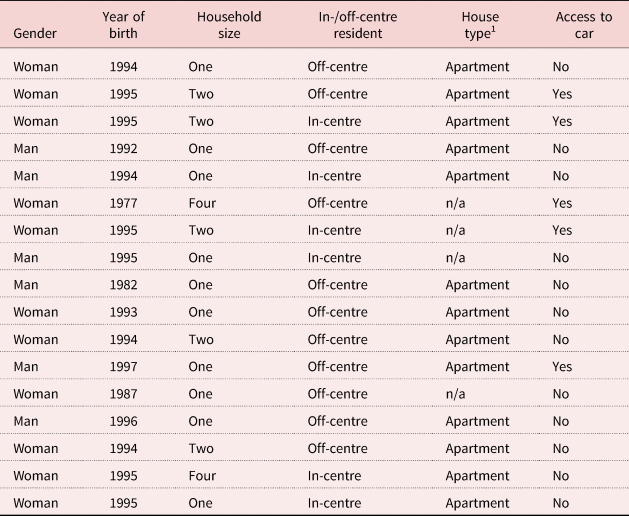
The perceptions of younger consumers were collected (spring 2018) through a qualitative online survey in which participation was voluntary. Besides background information, the survey included open-ended, qualitative research questions on the same themes as in the focus groups (see Table 3). The participants were accustomed to using information technology, and the free-form questions enabled them to express their experiences and perceptions freely without word limits (Smyth et al., Reference Smyth, Olson and Millar2014; Tuomi and Sarajärvi, Reference Tuomi and Sarajärvi2018). The participants (a total of six men and 11 women; see Table 4) were 21–41-year-old university students (average age 26). They formed an appropriate group for comparison with the pensioners because, based on the socio-economic classifications, both groups belonged to the socio-economic group of economically inactive consumers who have time to use for running errands (Official Statistics of Finland, nd-b).
Characteristics of younger participants

Notes: 1. Based on residential area/postcode, data collected in spring 2018. n/a: not available.
Both sets of data were analysed using qualitative content analysis complying with deductive logic (Mayring, Reference Mayring, Flick, von Kardorff and Steinke2004; Tuomi and Sarajärvi, Reference Tuomi and Sarajärvi2018). After thorough readings of the data, the comments were organised, and summaries of the content and meanings were composed according to the typology of the age-friendly city features (WHO, 2007). As the discussion/survey themes did not fully resemble the WHO's typology, the individual elements presented in Table 1 were used as a guideline to analyse the consumers’ perceptions. The perceptions of the physical features were searched from all discussion themes and respective survey questions but particularly from the third section considering the physical shopping environment (Table 3). The social features were mainly identified from the second section considering the typical shopping trip, but the other sections also included valuable data on the social aspects of shopping. In this paper, summaries of the feature-related perceptions and shopping behaviour, divided into physical and social environments, are presented and the age groups are compared. Regarding the background information, the frequencies were used to describe the data.
The study complied with the ethical guidelines drawn up by the Finnish National Board on Research Integrity (TENK, 2019). The researchers respected the autonomy of the participants, and the research did not cause physical or mental harm to the participants. Participation in the research did not deviate from the principle of informed consent. The volunteers were informed of the real content and purpose of the study, the processing of their personal data and how the research will be conducted. Prior to the analysis, the identity of the participants was anonymised to maintain research confidentiality. The pseudonyms (e.g. Woman 65, Man 23) were used when reporting the individual comments in the following section.
Findings
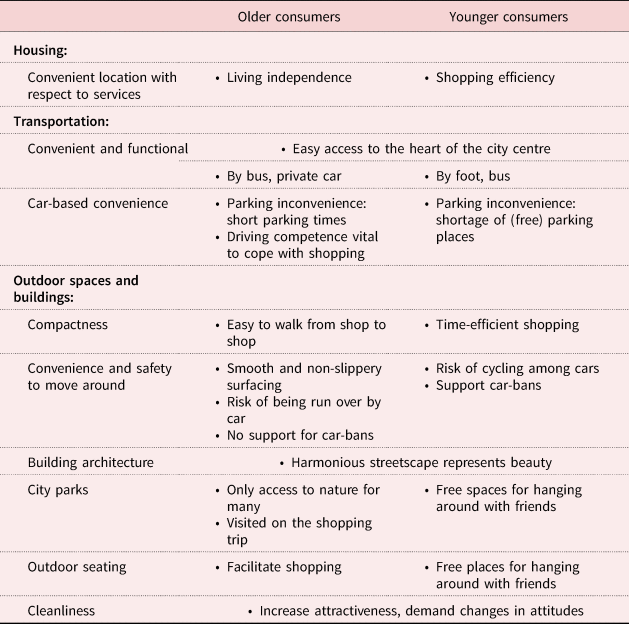
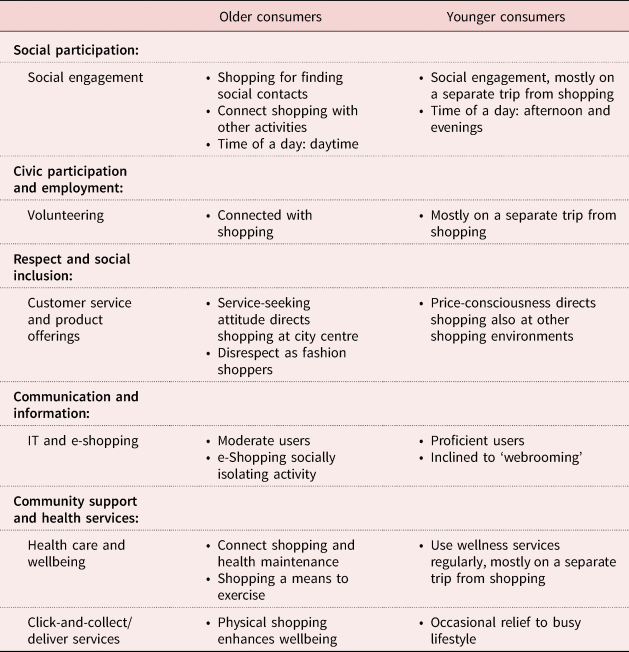
The content and meanings of the physical and social features in the context of shopping are summarised in Tables 5 and 6. For each core feature (e.g. outdoor spaces and buildings), the tables present the main themes (e.g. compactness) revealed in both sets of data and specify the perceptions or behaviour of older and younger consumers relating to these overarching themes (e.g. easy to walk from shop to shop versus time-efficient shopping). The viewpoints of the age groups were different in most of the themes. In this section, relevant background information and the findings on physical features are reported in the order they emerged in the city-shopping trip of the older participants, whereas the social features mainly follow the order of the WHO's typology (Table 1).
The physical features from the viewpoint of older and younger city shoppers

The social features from the viewpoint of older and younger city shoppers

Physical environment
Housing
The older participants started by describing their shopping trips from home. About half of them lived in an apartment in or near the city centre, whereas one-third lived in a terraced or detached house in the suburbs (Table 2). A convenient location of the home with respect to the city-centre services was emphasised (Table 5). They did not have major problems with accessing the services, but they were worried about the future. They hoped to stay healthy and active enough to be able to live in their present home for as long as possible (i.e. ageing in place). One participant highlighted: ‘It's important … that we can go where we want by ourselves… this kind of activity is decreasing; it's highly valuable to maintain this option’ (Woman 82). The younger participants lived in the vicinity of the city centre (Table 4), mainly temporarily in student apartments, and thus they considered the services easily accessible. By a convenient location, they meant quick shopping on the way home from other activities. For example, one participant described: ‘I make the purchases in the centre while going to the university or home’ (Man 23).
Transportation
The city centre was visited regularly, as two-thirds of both age groups did city shopping at least once a week. They highlighted convenience and functionality to easily access the market square, which they considered the heart of the commercial city centre (see Table 5 and Figure 1). Several modes of travel were used, bus and a private car being the most common choices among older consumers. Younger consumers usually walked or took a bus. As there were very few cycle paths or cycle parks in the core centre, those who preferred cycling had to park a few blocks away from the market square. It is worth noting that the data were collected during the seasons when the weather is usually pleasant for travelling with different modes. However, the winter frosts or summer heats rarely prevent outdoor activities, as an older participant said: ‘I visit the city centre whether it's winter or summer, the weather has no effect on that’ (Woman 67).
Although two-thirds of the older participants and one-third of the younger participants had access to a private car (Tables 2 and 4), the bus was considered a more convenient and functional method for travelling to the centre. For the older consumers, the reasons were the low-priced tickets and frequent daytime schedules with direct access to the market square. Both groups found it convenient that the bus terminals were located around the market square. In the open square, the buses were also easy to find. Although the car owners perceived it to be easy to drive to the centre, they usually left their car at home because parking was inconvenient around the market square. Both groups suggested improvements in parking facilities but from different perspectives. For older drivers, inconvenient parking meant that parking times were too short for shopping and, for younger drivers, (free) parking places were hard to find, as stated in the following comments:
I seldom go there [by car] because the [parking] times are so short. (Woman 64)
You need more time [for city shopping] because first you need to find a place for the car. (Woman 41)
The bus ride, however, did not avoid criticism. The older consumers considered carrying purchases on the bus to be inconvenient. When it was necessary to make heavy purchases, some drove to out-of-town stores, but carless seniors had to rely on taxis to get home from the centre. The bus services were considered inaccessible, particularly among mobility-restricted seniors, for whom driving competence was the only means of coping with city shopping independently. One older participant argued: ‘for customers with a rollator, it's difficult to travel by bus … and the buses depart so quickly that many people fall down’ (Woman 67). Several younger consumers complained that on weekends, in particular, the bus services to the city centre were inadequate. One participant pointed out: ‘I have noticed that I don't travel by bus to the centre on Sundays due to the infrequent schedule’ (Woman 24).
Outdoor spaces and buildings
The layout of the city centre was considered to be compact, with a variety of services located a few blocks from the market square. For the older consumers, compactness meant that the distances were short enough for them to walk easily from shop to shop. For the younger consumers, compactness meant, above all, being able to handle their purchases time-efficiently (Table 5). This disparity comes up in the following comments:
As it's so small and compact, it's easy to run errands and to go from one place to another. (Woman 81)
All services are close to each other, and shopping is therefore quick and easy. (Woman 23)
The older consumers emphasised that the city centre is a barrier-free walking environment, and the bricks-and-mortar stores are easy to access. However, referring to cobbled-street pedestrian areas, they wished for smooth and non-slip surfacing to decrease the risk of falling. The younger consumers also found cobblestones unpleasant, but they did not highlight the issues of accessibility in outdoor spaces. This indicates that these issues are at a tolerable level.
Both groups agreed that the city centre is a secure shopping environment regarding crime (social environment). However, they were concerned about traffic. The fear of being run over by a car when crossing the road reduced the feeling of security among the older consumers. One older participant described: ‘cars go through a red light … but if you are careful and make sure that it's a green light, and then running, you manage [to cross the roads]’ (Woman 80). For their part, the younger consumers felt that cycling among traffic was dangerous. For example, one participant demanded that: ‘there should be more cycle paths … it would increase safety’ (Man 36). Despite the perceived safety risk, the older consumers disagreed with the younger that cars should be banned from the centre. As noted regarding transportation, the older consumers wished they were able to drive to the centre by themselves. The younger consumers reinforced their argument by mentioning the unpleasant exhaust fumes.
Regarding the building architecture, both groups paid attention to similar characteristics. In the market square surroundings, the buildings built during the past 60 years were seen as boring, whereas the neoclassical-style theatre and church represented beauty in the architecture. The riverfront, two blocks from the market square (see Figure 1), was considered a harmonious environment with many beautifully restored buildings, elegant examples of their era of architecture. Participants in both age groups agreed with the following comments:
Not on the riverfront, but elsewhere, there's no consistent [architectural] line. (Man 73)
The riverfront is wonderful, but the market square surroundings and shopping street seem somehow grey. (Woman 23)
The riverfront promenade and the city parks were important places for both groups. It was typical of the older consumers to pop into the parks while shopping. They emphasised the importance of preserving these green areas because they are vital for those who are unable to walk in the forests. Thus, the city centre offered convenient space for outdoor activities all year round. For the younger consumers, green areas were important places to spend time with their friends. Thus, they hoped for more lawn-surfaced pedestrian areas. Like the older participants, they also desired more seating. For the younger consumers, parks and public seating areas provided places to hang out with their friends without obligation to buy anything. For the older consumers, seating facilitated their shopping. As they spend time shopping, they need places to rest their feet. They frequented cafés and restaurants, but they also called for benches in the market square, the pedestrian (shopping) street and inside the department stores they patronised. This disparity between the age groups comes up in the following:
There should be benches … I think our mobility is worsening all the time. (Woman 68)
There should be more free spaces for hanging around, especially in winter. In summer, we meet friends in the riverfront and parks. (Woman 23)
Lastly, the issue that both groups had paid attention to in the outdoor environment was the rubbish on the streets, which they considered to decrease the attraction. The following comments indicate that more rubbish bins were suggested, but above all, changes in attitudes:
There is dirt everywhere … but no one can do anything unless people change their attitudes. (Woman 79)
The cleanliness could be better, but it requires that residents and visitors change their attitudes. (Man 21)
Social environment
Social participation
Social engagement (see Table 6) was important for both age groups when visiting the city centre. There was a consensus that there were enough events and activities available. The older participants actively participated in various citizens’ clubs, but the younger participants did not show a similar engagement. Both groups enjoyed the fairs, music and other cultural events, but they wished for more free admissions to allow everyone to participate. In addition, the older consumers regretted that musicals and theatre plays are performed in the evening. Unlike the younger consumers, they avoided the city centre in the evenings due to feelings of insecurity. It was typical that the older consumers engaged in recreational, cultural and spiritual activities on their shopping trip in the city centre. They enjoyed frequenting cafés, restaurants, the library and exhibitions, in particular. For them, city shopping was a vital means of preventing loneliness. Some of them had regular lunches with their friends, for example, but, more often, they went city shopping alone to see other people or find someone with whom to talk. The market square and market hall were pleasant places to keep up these spontaneous relations. One participant described:
Every morning I think about what I need to buy … I eat out, meet people and friends in the market square, pop up clothing stores, buy food … I go to the city centre to look around and spend time. (Woman 81)
On the other hand, the younger consumers did not go shopping in search of the company. They made separate trips to meet their friends in bars and restaurants, usually in the evenings, and at student events. For example, one participant condensed: ‘meetings with friends, participating in events, on a separate trip, in the evening (Man 26). As pointed out in the context of outdoor spaces, frequenting restaurants becomes costly, so city parks and the riverbank offered free sites for hanging around and having a picnic with friends.
Civic participation and employment
Regarding city-shopping behaviour of the older participants, this feature was closely related to social participation. All the older participants were pensioners, and many of them were actively involved in volunteering. They considered it important that the events and clubs where they were volunteering were located in the city centre for ease of access and to make it convenient to shop on the same trip (Table 6). The younger participants were full-time students, and some of them worked part-time. Although some of them were active operators in student activities, volunteering in clubs and so on was not highlighted or connected with the main shopping activity.
Respect and social inclusion
Neither the older nor the younger participants had experienced age-based discrimination by other citizens. The older consumers were pleased that help was available when needed, even from strangers. Because they were looking for social contact, they preferred to shop in the market square and hall where the service was more personal than in the grocery stores. One participant highlighted: ‘there [in the market square/hall] you can have such a social contact that you don't have in large markets, I need that’ (Woman 68). Although older consumers could acquire all necessary products and services from the city centre, they expressed a wish for the fashion retailers to improve their ranges targeted at older adults (Table 6). They added that they did not frequent out-of-town shopping centres because they considered them to be targeted at younger shoppers. Regarding community inclusion, the older participants were pleased that the researchers and the city authorities were interested in their perceptions.
The younger consumers were also satisfied with the offerings of the city centre, but sometimes they directed their shopping to out-of-town centres. They specified that sports-gear selection was much broader in off-centre shopping centres. Although the small city-centre food stores offered efficient shopping, lower prices made them occasionally shop at the off-centre hypermarkets. For example, one participant described: ‘I buy food from [an out-of-town] hypermarket because there are lower prices than in the city centre’ (Woman 23). Regarding economic inclusion, although both students and pensioners are entitled to special discounts from services, the younger participants, contrary to the older, repeatedly highlighted the importance of low prices or free entrances.
Communication and information
Most of the older participants had appropriate devices and the know-how to use information technology, acquire information and run their errands through e-channels. They used health and bank e-services rather competently and regularly bought travel and theatre tickets. However, they did regret that many service providers, banks in particular, have reduced the number of physical service counters. Apart from tickets, the older consumers seldom shopped online. They considered e-shopping to be a socially isolating activity (Table 6), and even spontaneous meetings in the centre were vital for staying connected with society. One participant said: ‘I don't e-buy because it's a nice experience when you shop in a [physical] store’ (Woman 66).
The younger participants were experienced with technology, frequently shopping online to get products unavailable elsewhere, to make shopping easy and to find competitive prices. The products they usually bought online were tickets, books, electronics and clothes. Although the younger consumers were accustomed to e-shopping, their perceptions indicated ‘webrooming’ behaviour. They used the web to find information and to make price comparisons, but the bricks-and-mortar stores were still their main shopping channel, as one participant described: ‘e-shopping is usually pleasant. I don't need special contact with personnel, but I don't want to buy, e.g. clothes, without trying’ (Woman 23).
Community support and health services
The older participants regularly used health and wellness services (e.g. hairdressing, manicures) in the city centre. On the same trip, they did their shopping, frequented cafés and so on. One participant described:
It is a pastime [to shop] in the centre, and those pampering places are there, I use those [services] once a month, also the doctor … and usually afternoon coffee with my friend. (Woman 67)
This kind of multipurpose activity was seen to increase physical and mental wellbeing (Table 6). They highly appreciated that click-and-collect/delivery services have increased, but they still wanted to do their shopping without home help for as long as possible. They considered physical shopping to be a means of getting exercise – and that the city centre offers a convenient and appealing environment for this purpose (cf. outdoor spaces and buildings).
The younger participants did not mention health services, probably due to the off-centre location of the student health-care services. Regarding wellness services, they were pleased that there were many hairdressing/barber services at affordable prices in the centre. One participant pointed out: ‘there are at least a million cheap barbers in the centre, and they offer discounts for students’ (Man 23). In addition, gyms were regular destinations for many, but also these services were usually used on a separate trip from main shopping. Regarding home-delivery services or e-shopping in general, the younger consumers considered them to alleviate their busy schedules.
Discussion and conclusions
The current study focused on the age-friendliness of the city-centre shopping environment from the perspective of older consumers but also compared their perceptions to those of younger consumers to gain an understanding of how to develop city centres to become friendly for different ages. The comparative research setting also highlighted the uniqueness of older people as consumers. Taking into consideration that this consumer segment is increasingly important for the city-centre retailers and the vitality of city centres, very few academic studies have focused on older city shoppers. According to the authors’ knowledge, this study was the first to utilise the age-friendly city framework (WHO, 2007) in the context of shopping. Given the purpose of the study, the typology of age-friendly city features turned out to be applicable. The physical features were rich in perceptions, and all the social features had connections to shopping activity, especially among older consumers. The study revealed new content and meanings to the existing features. In terms of social features, in particular, perspectives, which have not gained much attention in retailing studies, were revealed. The study highlighted the fact that shopping activity plays a significant role in the age-friendly city centre. Supporting the active/healthy ageing and independent living of older people have been policy priorities in ageing societies. The findings confirmed that shopping outside the home is a fundamental activity for ageing citizens to maintain physical and mental wellbeing (cf. Hovbrandt et al., Reference Hovbrandt, Ståhl, Iwarsson, Horstmann and Carlsson2007); thus, it is essential to support this opportunity and implement the age-friendly-oriented policy and practice.
Consistent with prior studies (e.g. Meneely et al., Reference Meneely, Strugnell and Burns2009; Lesakova, Reference Lesakova2016), the physical features of the environment, as well as the social aspects of shopping, were found to be important to older consumers. This indicates that physical and social environments are strongly interconnected in the city centre, and thus should not be considered separately (cf. WHO, 2007; Steels, Reference Steels2015). The out-of-town shopping centre, for example, may be easily accessible by private car or public transportation and offer a physically barrier-free shopping environment under one roof. However, citing social features, unlike the city centre, neither the out-of-town shopping centres nor online stores were perceived as attractive environments for the older consumers in the current study. The study showed that city centres are vital shopping destinations for older consumers, but they should offer more than just places to shop. It is not only the services provided or the physical features which facilitate shopping but also the social aspects that affect older consumers’ patronage behaviour. The external shopping environment, in particular, turned out to be the asset of the city centre as compared to the aforementioned enclosed competitors. The main responsibility for developing the external shopping environment has been on the urban planning authorities, whereas the internal store environment has been managed by the retailers. To increase the age-friendliness of the city-centre shopping environment, the current study calls for established procedures that contribute far-reaching co-operation with different sectors – working in concert results in greater outcomes than would be achieved separately.
The vital city-centre shopping environment supports the independent living of older citizens, but it also attracts younger shoppers to the city centre. It turned out that the older city shoppers highlighted the same themes as their younger counterparts (Tables 5 and 6). However, the age groups differed in their shopping behaviour and used the same city spaces in dissimilar ways and partly at different times of the day. Because the age groups viewed the age-friendly city features through different lenses, the feature-related perceptions of the older consumers diverged from those of the younger. Taking convenience as an example, which has been identified as an important criterion in shopping destination choices (e.g. Wrigley and Lambiri, Reference Wrigley and Lambiri2015; Parker et al., Reference Parker, Ntounis, Millington, Quin and Castillo-Villar2017), both age groups highlighted this characteristic in the shopping environment, but for the older consumers, convenience meant independence, whereas for the younger consumers it meant efficiency. Convenient access and convenience of moving around – with different modes of travel – characterised the age-friendly city-centre shopping environment. Social engagement, as another example, was also highlighted in both groups, but among the older consumers it was strongly attached to shopping activity. The older participants were daytime shoppers who prefer to connect shopping, e.g. with recreational activities (e.g. frequenting cafés and restaurants). However, by providing a competitive offer, several city centres have recently put effort into specialising in recreational activities offered mostly in the evening (Teller et al., Reference Teller, Wood and Floh2016). In an age-friendly city centre, these activities are also provided in the daytime to cater to senior shoppers who aim to fill their social vacuum (cf. Wallin, Reference Wallin2019). To sum up, older consumers emphasised shopping independence highly; they were more service-oriented and more frequently connected shopping with social networking. The younger consumers were more price-sensitive and tended to do their main shopping, time-efficiently, on a separate trip from other activities.
In many respects, the suggestions for improvements were similar, which indicates that the same measures for developing the city-centre shopping environment do benefit consumers of different ages but for different reasons. This disparity is essential for different actors in city-centre retailing and urban planning to understand in order to satisfy the needs and wants of consumers of different ages. Outdoor seating, for example, is an easily actualised means of increasing city-centre attractiveness at a relatively low cost. The younger consumers called for places to hang out with their friends without obligation to buy anything. In contrast, older consumers wished to have proper seating for resting their feet and enjoying the atmosphere while shopping.
The current study revealed practical actions to be realised in achieving an age-friendly city-centre shopping environment. However, implementing these actions requires awareness of age-friendly issues also at the policy-making level. Older people should be considered valued resources not only as citizens but also as consumers. The decisions should be made with an understanding of their heterogeneous characteristics and needs. Thus, integrating academic research in the decision-making process as well as in the actions of practitioners is valuable. Taking older people's perceptions into account is one of the principles in designing age-friendly communities (WHO, 2007). In a favourable living environment, everyone has the right to participate (Finlex, 1999). As the older city shoppers proved to have unique perceptions and be a significant customer segment for city centres, they should not be treated as outsiders in development projects (cf. Buffel et al., Reference Buffel, Phillipson and Scharf2012; Buffel, Reference Buffel2018). However, participation methods appropriate for older people should be used. By acknowledging older city shoppers, societies can also be better prepared for the ageing of younger generations.
Due to its novelty, the study was descriptive and offered a new perspective on responding to the challenges that consumer ageing poses to Western cities. Although the findings were limited to a medium-sized city, and some of them were location-specific, the fundamental challenges of ageing are similar irrespective of city type (cf. WHO, 2007; Lux and Sunega, Reference Lux and Sunega2014). However, a comparative study between several cities is recommended. For example, contrary to the findings of the WHO (2007), maintaining driving competence was here found to be vital to the older participants. This indicates that the planning policy that promotes total car bans does not contribute to the age-friendly city-centre shopping environment. However, evidence from other cities would reveal whether this finding was location-specific and/or shopping-related.
The datasets in the study were comparable despite the different methods of collection. Several studies have revealed that older people prefer interviewer-administered methods, whereas young adults prefer to express their feelings via the Web (e.g. Smyth et al., Reference Smyth, Olson and Millar2014). Using focus groups proved to be successful with the older participants because reading and writing turned out to be challenging for many. Thus, to increase community inclusion among older citizens, more interactive means than Web-based platforms should be utilised. However, the anonymity of a Web-survey allowed the younger consumers to express openly their concerns about money, for example, whereas the focus-group participants did not share their thoughts on this topic. Talking about money may be a taboo for older generations, but the findings supported the evidence that older consumers value service(s) over price (e.g. Kohijoki and Marjanen, Reference Kohijoki and Marjanen2013). Finally, the study focused on two significant consumer segments – the current and the future seniors – for the city-centre vitality. Middle-aged consumers and those with children, in particular, were purposefully excluded from this study. To form a more comprehensive understanding of city shoppers, studies with a focus on several stages of life are recommended. Using ‘walk-along’ interviews on shoppers’ interaction with the city space in which they move would target the actions on the right places and at the right time of the day.
Acknowledgements
The authors would like to thank the Foundation for Economic Education for supporting this study, and the editors and the anonymous reviewers for their helpful feedback. Special thanks are given to the consumers who participated in the study.
Author contributions
Both authors made a substantial contribution to the conception and design, data collection, analysis and interpretation of data, and the drafting and revising of the article.
Financial support
This work was supported by the Foundation for Economic Education in Finland.
Conflict of interest
The authors declare no conflicts of interest.
Ethical standards
The study complied with the ethical guidelines of the Finnish National Board on Research Integrity (TENK, 2019). The Ethics Committee for Human Sciences at the University of Turku (Humanities and Social Sciences Division, 19 May 2020) has stated that this research did not meet any of the criteria that would have required ethical review from the Committee.