In recent years, the international community is increasingly coping with catastrophic scenarios such as human and nonhuman related disasters, conflicts, or social events. In 2015, the Third UN Word Conference on Disaster Risk Reduction showed that such disasters have caused worldwide more than 700,000 of casualties and 1.4 million of injured. Reference Murray1 Moreover, it has been estimated that more than 1.5 billion people have been affected by disasters, with economic losses higher than 1.3 $ billions, Reference Murray1
Therefore, providing adequate, rapid, and sustainable responses to the affected populations has become a priority, and the development and the dissemination of the knowledge and the training about the management of catastrophic emergencies is considered crucial.
Simulation training is the cornerstone in the field of modern disaster medicine education, with a strong potential for generating positive learning outcomes. Reference Archer and Seynaeve2 Indeed, the simulation environment, where patients’ lives are not endangered, gives the chance to improve the techniques, to repeat the procedures, and to approach rare or less-known situations. Moreover, it is an opportunity to learn to handle anxiety and develop critical thinking and assessment skills. Reference Archer and Seynaeve2
Simulation is defined as a representation of real-life events that can be presented through different methodologies, such as computer software, case studies, written clinical scenarios, simulated patients (SPs), role-playing, and manikins with basic or advanced functions. Reference Mould, White and Gallagher3 For over 50 years, the technique of real simulation with actors has been used. Reference Wallace, Rao and Haslam4 However, despite their extensive use in disaster medicine simulations, a common standard has not yet been described in literature. A current systematic review about this specific subject is not available.
The present review aims to critically analyze the recent use and the preparation of SPs in the context of simulation in disaster medicine education.
METHODS
Study Design
A systematic review was conducted according to the Preferred Reporting Items for Systematic Reviews and Meta-Analyses (PRISMA) checklist. Reference Liberati, Altman and Tetzlaff5 The review included English, French, and Italian language papers published from January 2006 to December 2017 on PubMed and Google Scholar. Finally, an ancestry search was also performed to identify additional papers on the reference section of the articles.
Data Collection
A combination of the following keywords was used: “mass casualty incident” OR “catastrophe” OR “major event” OR “disaster” OR “multi casualty” OR “patient simulation” OR “live actor” OR “standardized patient” OR “simulated victim” OR “simulated patient” OR “simulated casualty”.
Inclusion Criteria
Articles reporting the use of simulated actors in disaster medicine training.
Exclusion Criteria
We excluded abstracts, citations, thesis, articles not dealing with disaster medicine, and articles not using human actors in simulation.
Data Analysis
One author screened all titles and abstracts of the identified literature. Literature not complying with the inclusion criteria was excluded. The full text was obtained for uncertain articles, and inclusion was subject to consensus among 2 of the authors. We resolved disagreement by third-party reconciliation. Core data elements included the study design, geographic location, type of simulated event, involved professionals (either participant and SP), SP training method, use of victim moulage, description of the strategy to simulate symptoms, measured outcomes and performance improvement at the end of the training event, and SPs involvement in participants assessment.
RESULTS
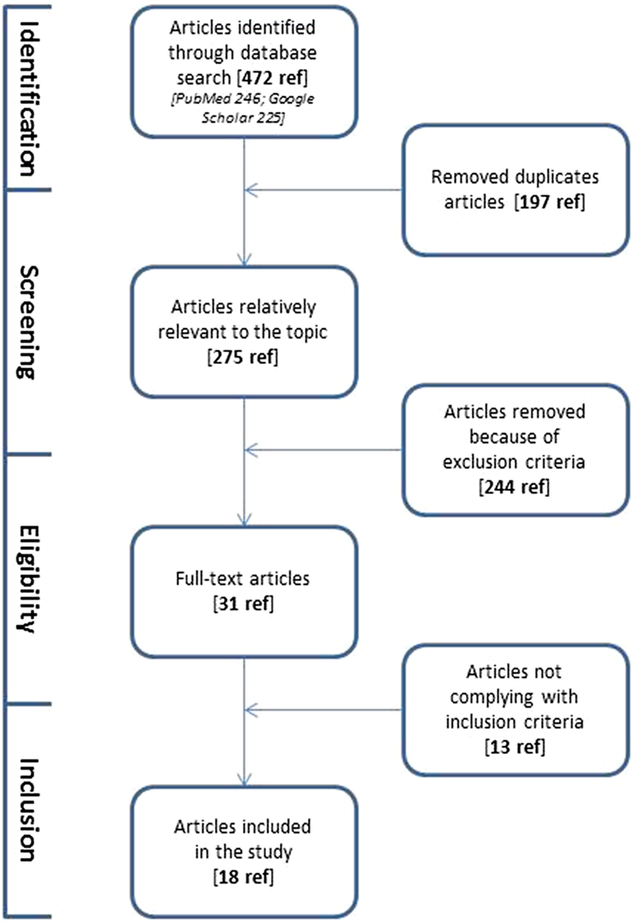
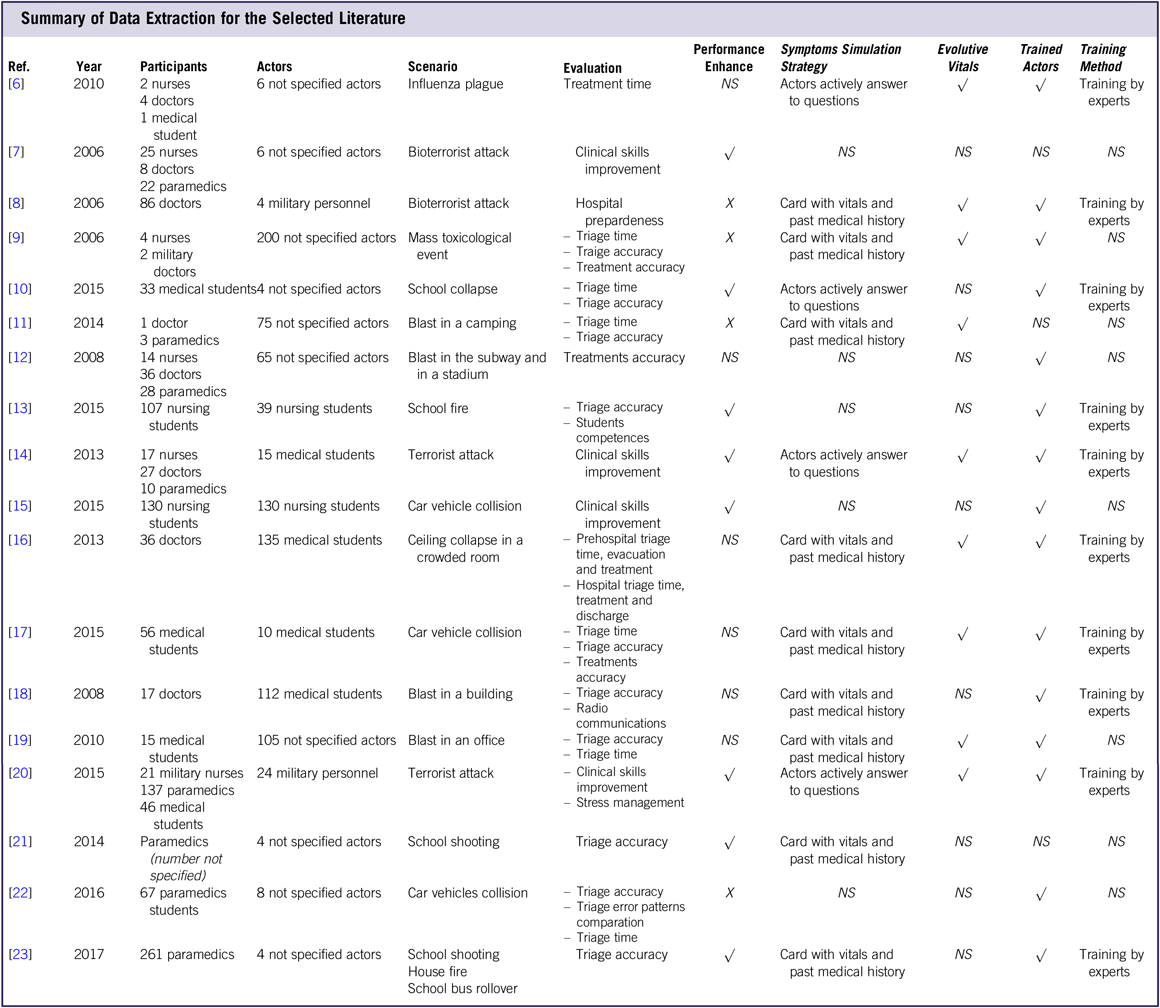
The search strategy yielded a total of 472 references. After exclusion of duplicates, 275 titles were identified for further screening. After applying exclusion criteria, 244 articles were removed. A total of 18 references underwent data extraction Reference Wallace, Gillet and Wright6 - Reference Cicero, Whitfill and Overly23 (Figure 1, Table 1).
Flow Diagram Showing the Selection of Articles Reviewed in Accordance With the Preferred Items for Systemaatic Reviews and Meta-analysis (PRISMA) Guidelines.

Summary of Data Extraction for the Selected Literature

Abbreviations:
 $\surd$
, Yes; X, No; NS, not specified.
The reviewed articles comprised 3 main types of studies and represented research from institutions in 5 different countries. In fact, 9 references were case reports, 6 were randomized controlled trials, and 3 were prospective observational studies. Moreover, 6 studies were conducted in Europe (3 in Italy, 2 in Israel, and 1 in Germany), while the other studies occurred in North America (11 in United States and 1 in Canada).
The training scenario also varied: 10 were represented by accidents, 7 by terrorist attacks, and 1 by an infectious disease outbreak.
All references reported health-care professionals as the target audience of training exercises, of whom 16 (89.4%) were civilian and 2 (10.6%) military. Nearly half of simulation participants were doctors (44.4% civilian and 5.5% military), 38.8% paramedics, and 33.2% nurses (27.7% civilian and 5.5% military). Eight studies included students in the target audience.
Of the articles reviewed that specified who depicted the roles of SPs, 4 studies (22.2%) used medical students, 2 (11.1%) nursing students, and 2 (11.1%) military personnel. Eleven papers (61.1%) specified that moulage was used to recreate wounds or illnesses on SPs to simulate realistic injuries.
Thirteen articles (72.2%) clearly described the method to simulate victim symptoms. In 9 of them, cards were used as method for reporting patient signs, symptoms, vital parameters, and past medical history, while in the remaining 4, the actor responded actively to the rescuer inquiries. Only in 9 studies (50.0%), evolutive vital parameters were used. Ten references (55.5%) reported that the SPs were previously trained by experts in emergency and disaster medicine.
Of the selected articles, 10 (55.5%) indicated the accuracy of triage as measured outcome, 7 (38.8%) the triage time, 5 (27.7%) the clinical skills, 3 (16.6%) the accuracy of treatments, and 2 (11.1%) the treatment time. Other evaluated outcomes were hospital preparedness, medical evacuation time, stress management, and the radio communications usage. Nevertheless, only 8 (44.4%) of the reviewed studies evaluated the impact of the training event in terms of performance enhancement.
Finally, 10 studies (55.5%) report that SPs were involved in the participants performance assessment, and in 9 cases the increase of the skills has been described.
DISCUSSION
This study systematically reviewed the use and preparation of SPs in disaster medicine simulation.
Recently, several deficiencies have been shown in the education in disaster medicine, so preparedness and training have been emphasized and recommended. Reference Djalali, Ingrassia and Corte24 Even though the use of actors who simulate disaster victims is 40-year-old technique, this review shows a persistent lack of uniformity.
Half of the studies included in our review are represented by case reports, and, therefore, have low scientific evidence. All papers were conducted in high-income countries (Europe and North America). There are no investigations on disaster training with the use of SPs in other parts of the world, despite the predominance of such events and consequently the need of health personnel involved in emergency response to be well prepared to deal with mass casualties.
Moreover, our results show that most of the simulations were aimed at the training of professionals, while rarely the students were the beneficiaries. This result can suggest that disaster medicine remains a neglected aspect during the general training of doctors, paramedics, and nurses. Because disasters are events that occur suddenly and violently, it would be important for all figures involved in health management to be trained and prepared to offer the best response. Therefore, for all professionals working in the emergency setting, the training about disaster medicine response remains a priority.
In addition, it has been demonstrated that simulation is conducted, in most cases, by the use of SPs. According to Churchouse and McCafferty, SPs are actors who have been accurately coached before the exercise by physician experts in this given field. Reference Churchouse and McCafferty25 Often the actors were also moulaged. Moreover, to ensure a faithful reproduction of reality, symptoms simulation strategy is also important. It has been obtained through the use of a card hanging from the SP’s neck containing signs, symptoms, vital parameters, and patient history, or through the active response (both verbal and motor) by the actor. Both methods often use evolving signs, symptoms, and vital parameters over time and correlated to the participants performance. Of course, these techniques aim to increase realism in the simulation and allow the participants to be fully involved in the scenario. However, this reproducing reality has different limitations. In fact, physical examination and medical acts are replaced by verbal responses by SPs. Therefore, during the past few years, high-fidelity simulators have been developed, which make it possible to enhance the realism of the scenario. Reference Gillet, Pecker and Sinert12
By applying this simulation strategy with SPs, it is possible to evaluate the accuracy and effectiveness of the provided performance, thus allowing the ability to stimulate the critical reasoning of the participant. From our review, it has been demonstrated that only in 55.5% of cases SPs have been previously trained and educated by medical experts in emergency and disaster medicine, and only in 50% of articles the skills improvement of the participants has been reported. In our vision, the use of trained actors can be useful to assess the performance of the participants during the final debriefing. In fact, simulations in the field of disasters provide complex scenarios with the involvement of huge resources and certainly a good training of the actors. They also may be able to judge the skills acquired by the beneficiaries, helping the instructors to really evaluate the skills improvement of the participants. Moreover, it could reduce the number of observers during the simulations, which could decrease the realism in the drill.
LIMITATIONS
The present study shows some limitations. In fact, this study was restricted to English, French, and Italian language papers, which may have narrowed our search spectrum. Moreover, this review only included articles published over the past 12 years. Related studies that could have supplied relevant information but fell outside this time period were not taken into consideration.
CONCLUSIONS
This systematic literature review revealed several issues about the use of actors in disaster medicine simulations. With this review, we showed a persistent lack of uniformity in the use of SPs in the disaster medicine simulation. Despite that many simulation techniques are currently available in addition to the use of SPs, we hope to understand in the future which role can be played by the use of SPs in the context of disaster medicine education.