Form-focused instruction (FFI) is defined as “any pedagogical effort which is used to draw the learners’ attention to language form either implicitly or explicitly . . . within meaning-based approaches to L2 instruction and in which a focus on language is provided in either spontaneous or predetermined ways” (Spada, Reference Spada1997, p. 73). Form-focused instruction in second language (L2) writing usually takes place in isolation from the actual meaningful writing process (Polio, Reference Polio2012) and is often labeled as isolated FFI—that is, explicit instruction (EI) that acts as “preparation for a communicative activity or after an activity in which students have experienced difficulty with a particular language feature” (Spada & Lightbown, Reference Spada and Lightbown2008, p. 8). A common operationalization of FFI in writing is written corrective feedback. Written corrective feedback is, by definition, postwriting FFI, as it can only take place after a writing task has been completed. Other postwriting FFI includes postwriting language reflections (e.g., Swain & Lapkin, Reference Swain, Lapkin, Fortune and Tedick2008), postwriting oral feedback sessions (Erlam, Ellis, & Batstone, Reference Erlam, Ellis and Batstone2013), and EI followed by learner self-revision (e.g., Shintani & Ellis, Reference Shintani and Ellis2013). Form-focused instruction can also be operationalized as prewriting by providing EI on a preselected language feature as preparation for a subsequent writing task. Researchers have increasingly investigated the role of EI in isolation, not only to examine theoretical issues but also to assess the pedagogical question of whether teaching grammar in isolation from communicative activities is actually effective (Spada & Lightbown, Reference Spada and Lightbown2008).
The effectiveness of postwriting FFI has been demonstrated by a substantial number of studies on written corrective feedback (e.g., Bitchener & Knoch, Reference Bitchener and Knoch2010; Shintani & Ellis, Reference Shintani and Ellis2013; Van Beuningen, De Jong, & Kuiken, Reference Van Beuningen, De Jong and Kuiken2012). However, to date, little research has investigated the effects of providing learners with isolated EI. One such study was conducted by Shintani, Ellis, and Suzuki (Reference Shintani, Ellis and Suzuki2014), who investigated the effect of giving or not giving university English as a foreign language (EFL) students the opportunity to revise their writing after receiving postwriting EI for two grammatical features (indefinite article and postcounterfactual condition). Accuracy of use was measured in new pieces of writing. The results showed that providing explicit information led to increased accuracy for the past-counterfactual conditional but not for the indefinite article; providing the opportunity for revision enhanced the effects, which were durable but reduced over time. This study indicates that postwriting EI for the past-counterfactual conditional structure can lead to accurate production of the feature in a new writing task for EFL learners.
Researchers have shown less interest in prewriting FFI. Some extant studies have investigated the effects of isolated explicit grammar instruction when combined with corrective feedback (e.g., Bitchener & Knoch, Reference Bitchener and Knoch2010; Frantzen, Reference Frantzen1995). These studies have generally shown positive combined effects of EI and corrective feedback on grammatical accuracy in subsequent writing tasks. G. Wang and S.-D. Wang (Reference Wang and Wang2014) provided university students with explicit grammar instruction prior to having them complete a composition task and questionnaire. They reported that the instruction positively impacted the learners’ writing and editing abilities. However, no research, to my knowledge, has examined either the effects of prewriting FFI alone or the comparative effects of pre- and postwriting FFI on grammatical accuracy in L2 writing.
There are two ways to implement prewriting FFI: the metalinguistic information given as FFI can be either available or unavailable for the learners during the subsequent writing task. This continued availability of information might influence the effects of isolated EI, particularly for low-proficiency learners, who might have a limited capacity to utilize information received during the prewriting phase in the actual writing task (Kellogg, Reference Kellogg, Levy and Ransdell1996).
There is a pedagogical need to investigate the timing of FFI and the continued availability of explicit information for writing. Providing explicit information on a problematic grammatical feature to an entire class is more time efficient for teachers than providing written corrective feedback on each individual learner’s written work. This approach might also encourage learners to deductively self-edit their texts by utilizing explicit information. Given that pre-activity grammar teaching is a familiar practice for L2 teachers, it would be intriguing to know when EI should be provided (either before or after a writing task), and whether their students should be allowed to refer to such information during writing tasks.
THEORETICAL ISSUES REGARDING THE TIMING OF ISOLATED FFI ON WRITING
Prewriting FFI
Explicit instruction involves providing learners with explanations about a specific language feature with optional controlled practice using the feature. There is plenty of evidence showing that EI leads to the development of explicit knowledge (e.g., Frantzen, Reference Frantzen1995; Hu, Reference Hu2011), which is defined as “knowledge about language and about the uses to which language can be put” (Ellis, Reference Ellis2004, p. 3). The role of explicit knowledge in L2 writing has been widely acknowledged by L2 researchers (Bitchener, Reference Bitchener2012; Polio, Reference Polio2012; Williams, Reference Williams2012). It has also been supported by researchers advocating for the role of awareness at the level of “understanding” for the subsequent processing of input and the development of L2 knowledge (e.g., Leow, Reference Leow2000; Robinson, Reference Robinson1995; Rosa & O’Neill, Reference Rosa and O’Neill1999; Schmidt, Reference Schmidt and Robinson2001). Skill-acquisition theory (Anderson, Reference Anderson1983) claims that explicit learning can lead to “knowledge that is functionally equivalent to implicit knowledge” (DeKeyser, Reference DeKeyser, VanPatten and Williams2015, p. 106) through the proceduralization and automatization of explicitly learned knowledge. Information processing theory (VanPatten, Reference VanPatten1996, Reference VanPatten, VanPatten and Williams2015; Williams, Reference Williams1999) suggests that learners with less explicit knowledge of a linguistic form might neglect it when processing L2 input. For such learners, processing demands should be reduced by providing explicit information in an isolated manner, followed by activities focusing entirely on processing L2 input.
The model of the writing process also provides some insight into how learners’ explicit knowledge facilitates L2 writing development (Flower & Hayes, Reference Flower, Hayes, Gregg and Steinberg1980; Hayes, Reference Hayes, Levy and Ransdell1996; Kellogg, Reference Kellogg, Levy and Ransdell1996). Writing involves the simultaneous use of multiple cognitive processes such as planning (setting goals and generating and organizing ideas), formulating (translating and producing texts), and revising (comparing a text already written with the writer’s mental representation of the text, at both the linguistic and conceptual levels, and executing the revision) (Flower & Hayes, Reference Flower, Hayes, Gregg and Steinberg1980; Galbraith, Van Waes, & Torrance, Reference Galbraith, Van Waes, Torrance, Torrance, v. Waes and Galbraith2007; Hayes, Reference Hayes, Levy and Ransdell1996; Kellogg, Reference Kellogg, Levy and Ransdell1996). Learners equipped with explicit knowledge before a writing task through prewriting FFI might be better able to formulate and revise their writing, as they will have the opportunity to monitor their grammatical accuracy in production and notice errors in already-written text, possibly leading to error correction. This situation aligns with the theory of transfer-appropriate processing, which claims that language learning involves acquiring not only the knowledge of specific linguistic items but also the cognitive processes that the learner engaged in during learning. Thus, the greater the similarity between the process of learning and the process of future retrieval, the greater the expected success in performance (Blaxton, Reference Blaxton1989; Franks, Bilbrey, Lien, & McNamara, Reference Franks, Bilbrey, Lien and McNamara2000). Prewriting FFI might also promote transfer-appropriate processing in future writing tasks because the learners would already have practice activating their explicit knowledge while writing and revising.
Postwriting FFI
Postwriting FFI involves the learners first completing a writing task, followed by some kind of EI to direct learners’ attention to linguistic form. According to the theoretical underpinnings of postwriting FFI, learning takes place when the FFI provides the learners with input that potentially elicits noticing and allows the learners to make cognitive comparisons between the input and original text (Doughty, Reference Doughty and Robinson2001; Swain, Reference Swain, Cook and Seidelhofer1995), which might lead them to restructure their interlanguage system (Polio, Reference Polio2012; Williams, Reference Williams2012). The process of revision also enables learners to produce the form accurately, which might help proceduralize their explicit knowledge. There is substantial evidence that postwriting FFI in the form of written corrective feedback is effective in guiding learners to revise their original texts and can lead to accurate production in new pieces of writing (Bitchener & Knoch, Reference Bitchener and Knoch2010; Shintani & Ellis, Reference Shintani and Ellis2013; Van Beuningen et al., Reference Van Beuningen, De Jong and Kuiken2012; also see Bitchener & Ferris, Reference Bitchener and Ferris2012; Kang & Han, Reference Kang and Han2015).
In the current study, postwriting FFI took the form of a metalinguistic explanation handout, which learners were asked to refer to while revising their original texts. Providing explicit information only after the learners have completed a writing task might lead them down the garden path (inducing learners to make errors in production that are subsequently corrected; Tomasello & Herron, Reference Tomasello and Herron1988) and may lead to better internalization of information. It might also trigger the process of noticing the hole (becoming aware of a knowledge gap; Doughty & Williams, Reference Doughty, Williams, Doughty and Williams1998), which can prompt the leaners to search for helpful information in future input to resolve the deficiencies in their knowledge. However, it is also possible that learners with limited explicit knowledge prior to the writing task might produce errors, which may be repeated in the task. This potential error cycle may proceduralize erroneous forms, which the learners will then need to restructure when receiving postwriting FFI.
Continued Availability of EI
Providing prewriting FFI and then allowing the learner to access it while writing assists learners in applying the explicit information when formulating texts in actual writing situations. Similar to prewriting FFI, continued access to information is beneficial from the view of transfer-appropriate processing (Blaxton, Reference Blaxton1989; Franks, Bilbrey, Lien, & McNamara, Reference Franks, Bilbrey, Lien and McNamara2000). Additionally, if online availability increases accurate production, it might also increase the opportunity to proceduralize explicit knowledge (DeKeyser, Reference DeKeyser, Doughty and Williams1998). It may also be particularly beneficial for learners with limited ability to actually use the linguistic form. For such learners, prewriting instruction alone might not be sufficient to utilize the information in subsequent writings. Because learners need to simultaneously attend to multiple aspects of language while writing, their working memory may experience overload, rendering them unable to effectively use explicit knowledge in the writing task (Kellogg, Reference Kellogg, Levy and Ransdell1996). It is also possible that the learners may not use their explicit knowledge simply because they prioritize other aspects of writing, such as content and vocabulary use. Allowing learners to access the explicit information during the writing task may potentially make the learners more attentive to linguistic form, which might enhance error detection. The language aptitude–treatment interaction (Robinson, Reference Robinson2001; Snow, Reference Snow1991) suggests that L2 learning might be influenced by the interaction between a learner’s patterns of abilities in relevant areas for L2 processing.
However, little research has been conducted on the effects of prewriting FFI with the continued availability of explicit information, save for a few studies reporting the positive effects of using online dictionaries during composition tasks (e.g., Bruton, Reference Bruton2007; Christianson, Reference Christianson1997).
RESEARCH QUESTIONS
The preceding discussion suggests the necessity of investigating the interaction between learners’ prior knowledge and two dimensions of isolated FFI for writing: the timing of FFI and the continued availability of explicit information. To investigate these issues, the current study adopted three conditions of isolated EI: (a) prewriting EI with the continued availability of explicit information while writing, (b) prewriting EI without the continued availability of explicit information, and (c) postwriting EI with the opportunity to revise after receiving explicit information. To examine whether learners’ prior knowledge had any impact on the effects of the instruction, the study targeted two groups of learners: learners with some prior productive knowledge of the grammatical form and those without any prior knowledge. The following research questions were posed:
-
1. To what extent does the timing of isolated EI (i.e., prewriting vs. postwriting) affect the development of (a) explicit knowledge and (b) accuracy in subsequent writing by learners with or without prior grammatical knowledge of the form?
-
2. To what extent does the continued availability of explicit information after prewriting EI affect the development of (a) explicit knowledge and (b) accuracy in subsequent writing by learners with or without prior grammatical knowledge of the form?
-
3. Do the effects of isolated EI under different conditions vary for learners with or without prior grammatical knowledge of the form?
METHODS
Participants
A total of 123 Japanese learners of English in seven intact intensive English university classes participated in the study. They were second-year students majoring in sociology, economics, English literature, and Japanese literature. They had all obtained a score ranging between 460 and 725 on the paper-based TOEIC before participating in the project. Footnote 1 As described in a later section, the participants were assigned to one of two groups, −Prior Knowledge (n = 64) and +Prior Knowledge (n = 59), based on their ability to produce the linguistic target correctly in the pretreatment writing task. They were further randomly divided into four groups: Pre+During-EI, Pre-EI, Post-EI, and the control group.
Design
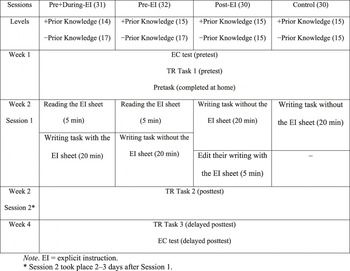
Figure 1 summarizes the research design. During Week 1, all participants took the error correction (EC) test and performed the first text reconstruction (TR) test as a pretest. The scores from the first TR test were also used to divide the participants into the +Prior Knowledge and −Prior Knowledge groups. During Week 2, the participants attended two sessions. In the first session, the four groups completed the writing task in accordance with the different treatments. In the second session (2–3 days later), all participants completed TR Test 2, which served as the posttest. In Week 4, all participants completed TR Test 3 as a delayed posttest and the same EC test taken during the pretest.
Overview of the research project.

Target Structure
The target structure in this study was the past-counterfactual conditional, which expresses the hypothetical outcome of an event that did not occur in the past, and usually consists of an if-clause and a main clause. Celce-Murcia and Larsen-Freeman (Reference Celce-Murcia and Larsen-Freeman1999) argued that acquiring English conditionals is difficult for L2 learners because the structure is complex both syntactically and semantically. They pointed out that the acquisition of this structure requires knowledge of the tense-aspect system, modal auxiliaries, and negation. Izumi, Bigelow, Fujiwara, and Fearnow (Reference Izumi, Bigelow, Fujiwara and Fearnow1999) argued that the difficulty of this structure lies in the fact that it requires learners to encode two functions: hypotheticality and past time reference. Previous studies have shown that university students in Japan, regardless of their major, do not usually have solid control over this structure in writing, despite possessing some explicit knowledge of its construction (Izumi et al., Reference Izumi, Bigelow, Fujiwara and Fearnow1999; Shintani, Reference Shintani2015; Shintani et al., Reference Shintani, Ellis and Suzuki2014).
Treatment Materials and Procedure
Pretask.
Two days before the treatment session, the participants received a pretask to complete at home. This task required the learners to write five English sentences describing five events that had changed their life (e.g., “I went to Australia for homestay when I was in high school”). This served as preparation for students to complete the main task; because participants’ writing ability was limited overall, using such a pretask enabled them to prepare the content and vocabulary necessary to complete the compositions in the main tasks and treatment sessions. Care was taken that all the participants completed the pretask before the main task. None of the participants used the past-counterfactual conditional structure in their pretask sentences.
Main Task.
All participants completed the same writing task in the main task phase. They received a writing sheet with sufficient space to write their composition. The instructions on the sheet asked the participants to write a composition on what would have happened if the five events they came up with in the pretask had not occurred. All groups were allowed to refer to their pretask while writing. They were given 20 min to complete the composition.
EI Sheet.
All participants in the experimental groups received the same EI handout, which contained metalinguistic explanations of the target grammatical structure in Japanese, its meaning, and some example sentences in English (see Appendix A).
In the main task, the three experimental groups were given the EI sheet at different points in time. The Pre+During-EI group and the Pre-EI group received the EI sheet before starting the writing task and were given 5 min to study it. The Pre+During-EI group was allowed to keep the sheet for reference while writing, but the Pre-EI group was not. The Post-EI group received the EI sheet only after they had completed the writing task. Footnote 2 These participants were given 5 min to revise their writing based on the EI sheet. The control group did not receive the EI sheet at all.
Testing Materials and Procedure
TR Test.
Three TR tasks adapted from Shintani et al. (Reference Shintani, Ellis and Suzuki2014) were used to measure the learners’ accurate use of the target structure (i.e., the past-counterfactual conditional) in writing. The prepared materials included (a) an audio-recorded story (185, 199, or 215 words in length), (b) a note-taking sheet, and (c) a TR sheet (see Appendix B for an example). Each story included six past-counterfactual conditional sentences. The participants were given the note-taking sheet and were asked to make notes while listening to an audio-recorded text twice. They were then given the TR sheet and were asked to reconstruct the text within 20 min. The three TR tests were counterbalanced to avoid test bias; the four groups were further divided into three subgroups, each of which completed the three tasks in a different order as pre-, post-, and delayed posttests.
Text reconstructions were chosen because of the necessity to create a context for use of the past-counterfactual conditional. In a free-writing task of the kind used in a number of written corrective feedback studies, learners are likely to avoid the use of such a complex structure. Passage reconstruction, on the other hand, creates contexts for multiple uses of the past-counterfactual conditional, as attested in previous studies (Shintani, Reference Shintani2015; Shintani et al., Reference Shintani, Ellis and Suzuki2014).
EC Test.
The EC test was designed to measure the learners’ explicit knowledge of the past-counterfactual conditional. It consisted of 16 decontextualized sentences, each containing a single error. Eight sentences included errors in the use of the past-counterfactual conditional: four on the use of the auxiliary have and the past participle in the if-clauses, and four on the use of the modal verb, the auxiliary have, and the past participle in the main clauses (see Appendix C). The other eight included other grammatical errors (e.g., definite article, verb tense, and third-person -s) as distractors. Footnote 3 The test asked the learners to first identify the errors in the sentences and then write the correct forms. The same test was conducted as a pretest before the participants started their first piece of writing and as a delayed posttest after the final piece of writing at the end of the study. This was done to avoid exposing the participants to the information in the EC test, which included both correct and incorrect target forms, at any point between the three TR tests.
Data Analysis
Coding and Scoring.
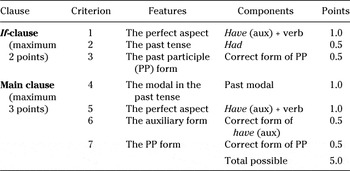
To examine the participants’ behaviors in the writing and TR tests, all writing sheets were first analyzed in terms of the number of past-counterfactual conditional sentences attempted by each learner. When a learner attempted a sentence including an if-clause corresponding to one of the past-counterfactual conditional sentences in the passage, one “attempt” point was awarded regardless of whether or not the sentence was correct. Next, the scoring system used by Shintani et al. (Reference Shintani, Ellis and Suzuki2014) (summarized in Table 1) was used to code for accuracy in both the writing treatment and the three TR tests. Appendix D provides some example sentences that the participants produced, as well as scores. For the Post-EI group, accuracy scores during the treatment session were coded at two time points: before and after self-editing. Accuracy was determined by using the revision history function in Google Docs. The total score for each student was calculated as follows:
 $${{{\rm{Number}}\,{\rm{of}}\,{\rm{points}}\,{\rm{scored}}} \over {{\rm{Number}}\,{\rm{of}}\,{\rm{conditional}}\,{\rm{sentences}}}}$$
Criteria for scoring the past-counterfactual conditional

Grouping Participants.
The +Prior Knowledge and −Prior Knowledge status of the learners was determined based on the pretest scores on the TR test using the following criteria: Learners who demonstrated some ability to accurately produce the past-counterfactual conditional structure were coded as “+Prior Knowledge,” whereas those who did not were coded as “−Prior Knowledge.” More specifically, a participant was classified as +Prior Knowledge if he or she scored points on Criteria 1, 2, 3, 5, 6, or 7 in Table 1 and as −Prior Knowledge if he or she scored 0 or scored points only according to Criterion 4. This decision was made because Criterion 4 is not a unique feature of the past-counterfactual conditional; the hypothetical conditional (the so-called second conditional) also requires the past modal. Izumi et al. (Reference Izumi, Bigelow, Fujiwara and Fearnow1999) reported that Japanese university students had difficulty in accurately marking the perfect aspect (related to Criteria 1, 2, 3, 5, 6, and 7) but rarely failed to provide a past modal in a main clause (Criterion 4). In the current study, −Prior Knowledge learners included 64 participants: 26 who scored 0 and 38 who scored points only on Criterion 4. The +Prior Knowledge learners included the other 59 participants, who scored points on at least one criterion other than Criterion 4 in Table 1.
Data Analysis.
Statistical analyses were conducted using SPSS. Cronbach’s alphas were used to estimate the reliability of the two tests. The alpha for the 16 items on the EC test (pretest) was .95, and those for the 7 categorical items used to score the three TR tasks (pretest) were .92, .85, and .88, respectively; this verified the internal consistency of the tasks. Interrater reliability for the accuracy scores on the two tests was established by having two raters analyze 15% of the data. Cohen’s Kappa was calculated as ranging from k = .71 to k = .98, showing that, overall, the raters achieved a high level of agreement (see Appendix E for the detailed statistical results).
As all the datasets satisfied the assumptions for normality, homogeneity of variances, and independence, the comparative analysis employed a mixed-models ANOVA followed by planned multiple comparisons using Bonferroni adjustments. Partial eta-squared (ηp 2) and Cohen’s d were used to estimate effect sizes.
RESULTS
This section first reports the number times learners attempted to produce the target structure both in the treatment and testing regime, to confirm that the materials were effective in eliciting the target form. Then it presents the results for the EC and TR tests. To allow for an examination of the mediating influence of learners’ prior knowledge, the results for the −Prior Knowledge and +Prior Knowledge learners are reported separately. Finally the section reports the accuracy scores for the treatment regime for the purpose of explaining the test results.
Elicitation of the Target Structure in the Treatment and Test Regime
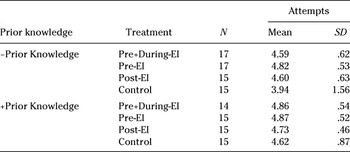
Table 2 reports the number of past-counterfactual conditional sentences the learners attempted in the treatment sessions in which the learners wrote an essay based on five life events. Both the −Prior Knowledge and +Prior Knowledge learners across all four groups showed mean attempts close to five (ranging from 3.94 to 4.87), indicating that the task successfully elicited the target feature. There was no statistically significant interaction effect between prior knowledge and treatment types (see Appendix F for the results of inferential statistics).
Number of past-counterfactual conditional sentences attempted in the treatment task (maximum = 5)

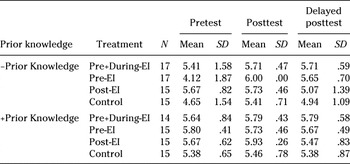
Table 3 shows the number of attempts at past-counterfactual conditional sentences in the three TR tests (pre-, post-, and delayed posttest). The overall high frequency of attempts (ranging from 4.12 to 5.80) on the pretest indicates that the writing test used in this study successfully elicited the target feature. There were no statistically significant interaction effects among any of the three factors (i.e., levels of prior knowledge, different types of treatment, and three repeated tests) (see Appendix F for the results of inferential statistics).
Number of past-counterfactual conditional sentences attempted in the text reconstruction test (maximum = 6)

Results for the EC Tests
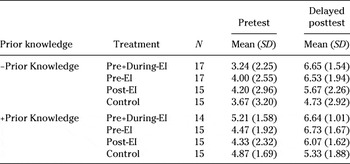
Table 4 shows the descriptive statistics for the EC tests (pretest and delayed posttest). Results of the mixed-models ANOVA showed significant effects for time, F(1, 115) = 82.34, p < .01, ηp 2 = .42, and for Time × Treatment interaction, F(3, 115) = 3.910, p = .01, ηp 2 = .09. The effects for prior knowledge approached statistical significance, F(1, 115) = 3.41, p = .07, ηp 2 = .03. However, there were no significant effects for treatment, F(3, 115) = 1.22, p = .31, ηp 2 = .03, for Time × Prior Knowledge interaction, F(2, 230) = 2.65, p = .11, ηp 2 = .02, for Treatment × Prior Knowledge interaction, F(3, 115) = .31, p = .82, ηp 2 = .01, or for Time × Treatment × Prior Knowledge interaction, F(6, 230) = 1.47, p = .23, ηp 2 = .04. The largest effect was found for time, followed by Time × Treatment interaction. The other effect sizes appeared to be relatively small.
Descriptive statistics for the error correction test (maximum = 8)

Planned pairwise comparisons with Bonferroni adjustment showed some statistically significant within- and between-group differences. For the −Prior Knowledge learners, the three experimental groups significantly improved from pretest to posttest (Pre+During-EI: p < .01, 95% CI [2.36, 4.47], d = 1.74; Pre-EI: p < .01, [1.48, 3.58], d = 1.08; and Post-EI: p = .01, [.35, 2.56], d = .55); the control group also showed improvement close to significance (p = .06, [−.05, 2.19], d = .35). There were notable within-group effect size differences among the three experimental groups: d = .67 between the Pre+During-EI and Pre-EI groups, and d = .57 between the Pre-EI and Post-EI groups. Group differences were only observed on the delayed posttest. The Pre+During-EI group outperformed the control group with a larger effect size (p = .04, [.82, 3.75], d = .87), whereas the other two experimental groups did not.
As for the +Prior Knowledge learners, the three experimental groups improved significantly from pretest to posttest (Pre+During-EI: p = .02, [.27, .259], d = 1.06; Pre-EI: p < .01, [1.15, 3.39], d = 1.25; and Post-EI: p = .01, [.61, 2.85], d = .86). All three experimental groups showed large effect sizes with slight differences; the Pre-EI group showed the largest, followed by the Pre+During-EI and then the Post-EI group. The control group did not show any statistically significant gains (95% CI crossing zero) with a small effect size (p = .41, [−65, 1.59], d = .26). There were no statistically significant differences among any of the groups on either pretest or delayed posttest with marginal effect sizes. All had 95% CI crossing zero.
Results for the TR Tasks
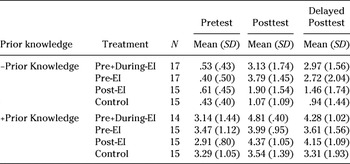
Table 5 presents the descriptive statistics for the three TR tests (pre-, post-, and delayed posttest). The effects were tested by a mixed-model ANOVA. The test revealed significant effects for time, F(2, 230) = 71.60, p < .01, ηp 2 = .39, treatment, F(3, 115) = 6.94, p < .01, ηp 2 = .15, prior knowledge, F(1, 115) = 135.41, p < .01, ηp 2 = .54, Time × Treatment interaction, F(6, 230) = 5.27, p < .01, ηp 2 = .12, Time × Prior Knowledge interaction, F(2, 230) = 9.40, p < .01, ηp 2 = .08, and Time × Treatment × Prior Knowledge interaction, F(6, 230) = 4.13, p = .01, ηp 2 = .10, and a close to significant effect for Treatment × Prior Knowledge interaction, F(3, 115) = 2.47, p = .065, ηp 2 = .06. The strongest effect was found for prior knowledge, followed by time and treatment. Interaction effects were shown to be relatively small. The results of the planned pairwise comparisons with Bonferroni adjustment are reported in the following sections in terms of (a) differences between −Prior Knowledge and +Prior Knowledge learners, (b) −Prior Knowledge learners’ within- and between-group comparisons, and (c) +Prior Knowledge learners’ within- and between-group comparisons.
Descriptive statistics for the text reconstruction task (maximum = 5)

Differences between −Prior Knowledge and +Prior Knowledge Learners.
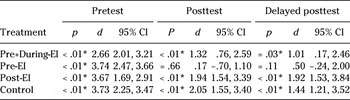
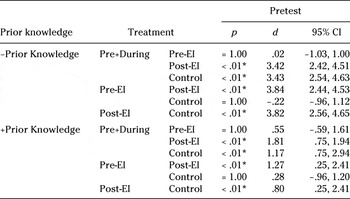
Table 6 presents the test results for the comparisons between −Prior Knowledge and +Prior Knowledge learners. Clear differences appeared between the two groups of learners for all four experimental conditions on the pretest, with effect sizes ranging from 2.66 to 3.74. However, the differences between the − and +Prior Knowledge learners diminished on the two posttests for all four groups, although three of them (i.e., the Pre+During-EI, the Post-EI, and the control) maintained their significant differences. The difference in the Pre-EI condition became statistically nonsignificant on both the posttest (d = .17) and delayed posttest (.50). This suggests that in this condition the difference between the two groups became smaller after the treatment session, although the effect sizes indicate that the +Prior Knowledge learners were still superior to the −Prior Knowledge learners.
The statistical significances (p), effect sizes (d), and 95% confidence intervals (95% CI) for the comparisons between the −Prior Knowledge and +Prior Knowledge learners

* The difference was statistically significant at the .05 level.
−Prior Knowledge Learners.
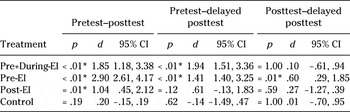
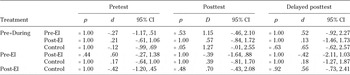
Table 7 shows the statistical results for the within-group differences for the −Prior Knowledge learners. The effect size differences between the pretest and posttest showed that the Pre-EI group had the strongest effects, followed by the Pre+During-EI, Post-EI, and control groups. On the delayed posttest, however, the Pre+During-EI group showed a larger effect size than the Pre-EI group. The three experimental groups significantly improved from pretest to posttest, whereas the control group did not (95% CI crossing zero). The Pre+During-EI group’s performance did not significantly decrease from posttest to delayed posttest, with 95% CI crossing zero. This group maintained significant gains on the delayed posttest as compared to the pretest. The Pre-EI group’s performance, on the other hand, significantly decreased from posttest to delayed posttest, although performance on the delayed posttest was still significantly higher than that on the pretest. The Post-EI group did not lose its significant gains from posttest to delayed posttest, with 95% CI crossing zero. However, this group failed to show significant gains on the delayed posttest as compared to the pretest, although the effect size (.61) indicated a moderate effect associated with this treatment.
Statistical results for the within-group differences for the −Prior Knowledge learners

* The difference was statistically significant at the .05 level.
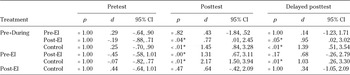
Table 8 shows the results for the between-group comparisons. No statistically significant differences were observed among any of the groups on the pretest (95% CI crossing zero), with effect sizes being marginal to small. On the posttest, the three experimental groups showed different levels of effects. The Pre-EI group showed the largest effect sizes against the control group, followed by the Pre+During-EI group. These two groups’ advantages over the control group were also statistically significant, and these results were maintained on the delayed posttest. These groups significantly outperformed the Post-EI group on the posttest. Although only the Pre+During-EI group maintained the advantage on the delayed posttest, the effect size for the Pre-EI group (.68) indicated some advantages of this condition when compared to the Post-EI condition. No statistically significant differences appeared over the three tests for the Post-EI group or the control group, with CI crossing zero on the two posttests.
Statistical results for the between-group differences for the −Prior Knowledge learners

* The difference was statistically significant at the .05 level.
+Prior Knowledge Learners.
Table 9 shows the results for the within-group comparisons (pre-, post-, and delayed posttest) for the +Prior Knowledge learners. The Pre+During-EI and the Post-EI groups significantly improved from pretest to posttest and from pretest to delayed posttest. Both groups showed similarly large effect sizes. The Pre-EI and control groups did not show any statistically significant changes from the pretest to posttest or delayed posttest, with CI crossing zero. Although the Pre-EI group showed a moderate effect size on the posttest, it fell to marginal on the delayed posttest.
Statistical results for the within-group differences for the +Prior Knowledge learners

* The difference was statistically significant at the .05 level.
As Table 10 shows, no statistically significant group differences appeared for the +Prior Knowledge learners. On all comparisons, 95% CI crossed zero. However, some group comparisons showed notably larger effect sizes than others. The Pre+During-EI group showed a large effect size as compared with the control group, followed by the Post-EI group, which showed a moderate effect size. The Pre-EI group showed small effects against the control group throughout the test regime. The Pre+During-EI group also showed a large effect size as compared with the Pre-EI group.
Statistical results for the between-group differences for the +Prior Knowledge learners

Accurate Production in the Treatment Regime
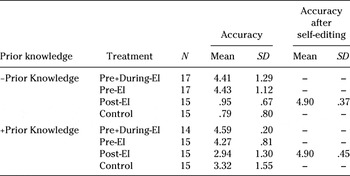
To understand the test results, learners’ accurate production during the treatment regime was also analyzed. Table 11 shows the accuracy scores for the attempted target structure sentences during the treatment. The initial accuracy scores for the Post-EI and the control groups indicate that the +Prior Knowledge group (2.94 and 3.32, respectively) had already acquired some knowledge such that they were able to produce the target form with no assistance during the treatment, whereas the −Prior Knowledge group learners (.95 and .79, respectively) had very limited ability to do so. The right column (“Accuracy after self-editing”) shows that the members of the Post-EI group, after revising their original text based on information from the EI sheet, improved their accuracy to an equal or greater extent than the other groups.
Accuracy scores in the treatment task (maximum = 5)

Differences among the four groups with the two levels of prior knowledge, −Prior Knowledge and +Prior Knowledge, were examined using a two-way ANOVA. Initial accuracy scores were used for analysis of the Post-EI group. The results showed no significant effects for prior knowledge, F(1, 115) = 3.55, p = .156, ηp 2 = .54, and a close to significant effect for treatment, F(3, 115) = 6.66, p = .077, ηp 2 = .87—both with large effect sizes—as well as a significant effect for Prior Knowledge × Treatment interaction, F(3, 115) = 8.32, p < .01, ηp 2 = .18, with a small effect size. Bonferroni pairwise comparisons between the −Prior Knowledge and +Prior Knowledge learners revealed no statistically significant differences for the Pre+During-EI (p = .35, [−.41, 1.16], d = .19) or Pre-EI groups (p = .69, [−.62, .93], d = .17), with small effect sizes. However, the +Prior Knowledge learners outperformed the −Prior Knowledge learners in the Post-EI (p < .01, [1.20, 2.79], d = 2.00) and control groups (p < .01, [1.12, 2.91], d = 2.12), with large effect sizes.
Additionally, as summarized in Table 12, there were no significant differences between the Pre+During-EI and the Pre-EI groups for the −Prior Knowledge learners or the +Prior Knowledge learners. The effect sizes were marginal for the −Prior Knowledge learners and were moderate for the +Prior Knowledge learners. Also, no significant differences were found between the Pre-EI and the control groups for the −Prior Knowledge learners or the +Prior Knowledge learners, with marginal effect sizes. On the other hand, both the Pre+During-EI and the Pre-EI groups significantly outperformed both the Post-EI and control groups both for the −Prior Knowledge learners and for the +Prior Knowledge learners, with large effect sizes.
Statistical results for the group differences between the treatment groups

* The difference was statistically significant at the .05 level.
The preceding tests showed that for both the − and +Prior Knowledge learners, the accuracy scores were higher for the Pre+During-EI and Pre-EI groups than for the Post-EI and control groups, suggesting that the learners in the former groups were able to produce sentences more accurately during the treatment by receiving pretask EI.
DISCUSSION
The study investigated the effect of providing different timings of isolated EI for writing (Research Question 1) with or without its continued availability (Research Question 2) on the L2 development of the past-counterfactual conditional. It also examined whether the effects of these different conditions varied for learners with more or less prior ability to produce the target structure (Research Question 3). The effects were examined in terms of learners’ explicit knowledge of the target structure, as measured by an EC test, and accurate production of the target form in a new writing task, as measured by TR tests.
Overall, positive improvement by the experimental groups compared to the control group suggests that isolated EI was effective in improving learners’ accurate production in subsequent writing tasks, as has been attested in previous research (Bitchener & Ferris, Reference Bitchener and Ferris2012). More specifically, the results revealed the facilitative role of isolated metalinguistic information in shaping performance on a new writing task (Bitchener & Knoch, Reference Bitchener and Knoch2010; Shintani & Ellis, Reference Shintani and Ellis2013; Shintani et al., Reference Shintani, Ellis and Suzuki2014). However, the results revealed notable differences across different conditions of EI, and for learners with different abilities to produce the target structure before the treatment.
Timing of EI and Explicit Knowledge
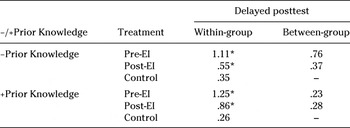
The effect of the different timings of EI (Research Question 1) was examined by comparing the performance of the Pre-EI group (prewriting EI) and the Post-EI group (postwriting EI with revision). The comparative results for the EC tests are summarized in Table 13.
Within- and between-group (against the control group) effect sizes on the EC test for the − or +Prior Knowledge learners in the Pre-EI and Post-EI conditions

Note. Within-group = effect sizes (d) for within-group comparisons (pretest and posttests); between-group = effect sizes (d) for between-group comparisons against the control group.
* The difference was statistically significant at the .05 level.
The overall results suggest that both pre- and postwriting EI helped learners both with and without prior productive knowledge of the target structure improve their explicit knowledge (i.e., the ability to identify and correct errors in the target structure). This supports previous research showing that isolated EI can lead to improvements in learners’ explicit knowledge (Shintani & Ellis, Reference Shintani and Ellis2013).
However, the Pre-EI group demonstrated overall larger within-group effects than the Post-EI group, with substantial effect size differences (.56 for the −Prior Knowledge learners and .39 for the +Prior Knowledge learners), indicating that isolated EI may be more effective when it is provided before the writing task than after. One possible explanation for this result is the cognitive requirements of the two conditions. Although the Pre- and Post-EI groups both had 5 min to study the information on the EI sheet, the Post-EI learners also needed to revise their text. Thus the learners in the Post-EI group might not have had sufficient time to fully understand the explanation on the EI sheet. The effect size differences of the two groups were similar for the − and +Prior Knowledge learners, indicating that the advantage of providing EI before writing was consistent for learners both with and without prior knowledge of the target structure. However, it is also possible that Pre-EI was more beneficial for −Prior Knowledge learners because they received the EI before writing and thus had more time to process the information than the Post-EI group.
Timing of EI and Accuracy in a New Writing Task
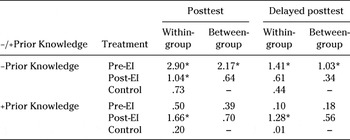
As summarized in Table 14, the results for the TR tests showed different patterns for −Prior Knowledge and +Prior Knowledge learners.
Within- and between-group (against the control group) effect sizes on the TR test for the − or +Prior Knowledge learners in the Pre-EI and Post-EI conditions

Note. Within-group = effect sizes (d) for within-group comparisons (pretest and posttests); between-group = effect sizes (d) for between-group comparisons against the control group.
* The difference was statistically significant at the .05 level.
The results for the −Prior Knowledge learners suggested that the Pre-EI group had overall greater effects compared to the Post-EI group. Whereas the Pre-EI group showed large, durable effect sizes for both within- and between-group comparisons, all of which reached statistical significance, the Post-EI group only showed a significant within-group effect on the posttest; the effect disappeared on the delayed posttest. Additionally, this group did not demonstrate a statistically significant advantage over the control group on either the posttest or delayed posttest. The within-group effect sizes for the two groups notably differed (the differences were 1.86 for the posttest and .80 for the delayed posttest), suggesting that for learners with little or no productive knowledge of the target structure, isolated EI was more helpful when provided before the writing task than after. The result accords with the notion that possessing some explicit knowledge can help learners in the process of formulating and revising their writing (Flower & Hayes, Reference Flower, Hayes, Gregg and Steinberg1980). As highlighted by skill-learning theory (DeKeyser, Reference DeKeyser, VanPatten and Williams2015), developing explicit knowledge before a writing task might help learners produce more accurate sentences, which may in turn assist in the automatization of procedural knowledge.
The TR test results for the +Prior Knowledge learners stood in stark contrast to those for the −Prior Knowledge learners. Under the Pre-EI condition, the development of explicit knowledge (measured by the EC test) did not substantively carry over to accurate production of the target feature in the new writing task. Under the Post-EI condition, on the other hand, learners showed statistically significant improvement from the pretest to the posttest, and from the pretest to the delayed posttest, although the between-group differences (compared to the control group) did not reach statistical significance. Effect sizes for the two groups substantially and continuously differed on both within-group comparisons (group effect size differences of 1.16 for the posttest and 1.18 for the delayed posttest) and between-group comparisons (.31 for the posttest and .38 for the delayed posttest). The results indicate that the +Prior Knowledge learners, who had already started to be able to produce a partially accurate form, seemed to benefit from the opportunity to engage in postwriting EI rather than prewriting EI, and such benefit can be retained over time. This supports the notion that once learners become able to use a linguistic form, noticing the gap between their output and the correct form, followed by retroactive modification, can better facilitate L2 learning than merely developing explicit knowledge (Swain & Lapkin, Reference Swain, Lapkin, Fortune and Tedick2008).
For both − and +Prior Knowledge learners, the Post-EI group’s significant gain on the posttest decreased on the delayed posttest. These results are similar to those of previous studies. According to Shintani et al. (Reference Shintani, Ellis and Suzuki2014), learners who received a metalinguistic explanation after a writing task and revised their original text demonstrated marked improvement in the accuracy in writing from the pretest to the posttest (d = .76) but a significant decrease in the delayed posttest completed 2 weeks later (d = .43). The current study showed larger effects on the posttest than those of Shintani et al.’s study. This might be due to the timing of the posttest; in the present study the posttest was conducted 2 to 3 days after the treatment session, whereas Shintani et al. conducted theirs 7 days after the treatment.
Continued Availability of EI and Explicit Knowledge
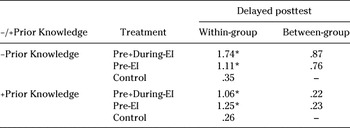
The effects of the continued availability of the EI (Research Question 2) were examined by comparing the test scores for the Pre+During-EI and the Pre-EI groups. The results of the EC tests are summarized in Table 15.
Within- and between-group (against the control group) effect sizes on the EC test for the − or +Prior Knowledge learners in the Pre+During-EI and Pre-EI conditions

Note. Within-group = effect sizes (d) for within-group comparisons (pretest and posttests); between-group = effect sizes (d) for between-group comparisons against the control group.
* The difference was statistically significant at the .05 level.
As shown in Table 15, the −Prior Knowledge learners in the Pre+During-EI and Pre-EI conditions showed similar between-group effect sizes (.87 and .76), which were notably larger than the effect sizes shown by the +Prior Knowledge learners across the same conditions (.22 and .23). Both groups demonstrated significant within-group improvement, whereas the control group did not. This indicates that the prewriting EI, irrespective of its online availability, had more impact on the explicit knowledge of the −Prior Knowledge learners than the +Prior Knowledge learners. Footnote 4
Continued Availability of EI and Accuracy in a New Writing Task
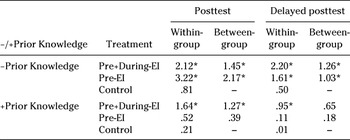
As summarized in Table 16, the TR tests produced results that greatly varied from the EC tests.
Within- and between-group (against the control group) effect sizes on the TR test for the − or +Prior Knowledge learners in the Pre+During-EI and Pre-EI conditions

Note. Within-group = effect sizes (d) for within-group comparisons (pretest and posttests); between-group = effect sizes (d) for between-group comparisons against the control group.
* The difference was statistically significant at the .05 level.
For the −Prior Knowledge learners, both the Pre+During-EI and Pre-EI conditions were found to be beneficial compared to the control. The Pre-EI condition initially showed greater within- and between-group effects than the Pre+During-EI condition, which showed substantially smaller effect sizes on the delayed posttest. The between-group effect sizes were similar on the delayed posttest, indicating that the long-term effects of the two conditions are compatible. The results correspond with those of the EC tests (i.e., both groups similarly acquired explicit knowledge; see Table 10), indicating that prewriting EI, irrespective of online accessibility, helped learners with limited prior knowledge of the grammatical feature develop their explicit knowledge and accurately produce the form in writing.
The +Prior Knowledge learners showed very different results. Significant within- and between-group gains were found only for the Pre+During-EI group. The Pre-EI group did not show any significant gains over time or any advantages over the control group. Both within- and between-group effect sizes for the two groups also differed substantially, indicating that the online availability of the EI had a large effect on accuracy in subsequent writing tasks for learners with some prior knowledge of the structure. The clear difference between the Pre+During-EI and Pre-EI groups is striking given that both had 5 min to study the EI sheet before the writing task; the difference thus lay in the accessibility of the EI during the writing task. This supports the preceding assertion that the improvement in explicit knowledge did not serve as a determining factor for accurate production in writing for these learners. As noted previously, the Pre+During-EI group produced more accurate sentences than the Pre-EI group during the treatment session (with a group effect size difference of .55; see Table 11). Apparently, access to the EI while writing enabled the learners to monitor their accurate use of past-counterfactual conditional sentences and to correct their errors within the task. The subsequent revision based on the EI enabled learners to produce the correct form, increasing the opportunity for production practice using accurate forms; this is thought to be necessary for automatizing procedural knowledge (DeKeyser, Reference DeKeyser, Doughty and Williams1998).
Having an opportunity to apply the EI when monitoring online (Pre+During-EI) or revising writing (Post-EI) seemed particularly important for the +Prior Knowledge learners. Notably, the +Prior Knowledge learners in the Pre+During-EI condition (d = 1.27) demonstrated greater gains against the control group than those in the Post-EI condition (d = .70) on the posttest, dropping to similar levels on the delayed posttest (Pre+During-EI: d = .65; Post-EI: d = 56). The Post-EI group did not show as drastic decreases in their effects over time compared to the Pre+During-EI group. Both groups showed greater effect sizes than the Pre-EI group on the posttest. It might thus be possible to argue that it was the opportunity to monitor or revise the text using the EI that promoted the +Prior Knowledge learners’ accurate production ability. In other words, both “online revision” (the Pre+During-EI condition) and “isolated revision” (the Post-EI condition) developed the +Prior Knowledge learners’ ability to use the target structure in writing, compared to providing isolated EI alone. Revision enabled learners to self-correct their production, a cognitive process that is thought to facilitate L2 learning (Doughty, Reference Doughty and Robinson2001).
The Differences between the −Prior Knowledge and +Prior Knowledge Learners
The results indicate that the isolated EI used in this study was more effective at enhancing the accurate production of learners with less prior productive knowledge of the form. It thus seems that gaining explicit knowledge is particularly helpful for those with limited ability in producing the form in actual writing. This finding is in support of skill-learning theory, which claims that declarative knowledge (i.e., explicit knowledge) helps learners develop procedural knowledge (DeKeyser, Reference DeKeyser, VanPatten and Williams2015).
The preceding analyses on the timing and online accessibility of EI identified different patterns for each group that more accurately explain the results. Notably, the −Prior Knowledge learners benefited more from the opportunity to thoroughly acquire explicit knowledge, whereas, comparatively, the +Prior Knowledge learners benefited from the opportunity to revise their texts, either during (i.e., the Pre+During-EI group) or after (i.e., the Post-EI group) the writing tasks, by consulting the EI sheet. This may have been due to the opportunity to make comparisons between the EI and their in-progress or already written texts, which in turn helped the learners produce the form accurately in a new writing task. The learners in the Pre+During-EI group had the opportunity to immediately solve their linguistic problems by consulting the EI, as evidenced by their highly accurate production (see Table 11). This was particularly reflected in the posttest scores, in which learners developed the ability to produce the correct form to the greatest extent. To fully benefit from the trial-and-error process in the Post-EI condition, the learners seemingly needed to have previously acquired some knowledge of the form, which possibly explains why the opportunities for revision did not matter as much for the −Prior Knowledge learners.
CONCLUSION
The findings of the current study suggest that isolated EI involves different cognitive processes in L2 writing depending on when, how, and to whom it is provided. The results suggest that providing EI prewriting can aid in the development of explicit knowledge, especially for learners with less ability to produce the linguistic form. On the other hand, providing EI postwriting furnishes the opportunity for revision, which is helpful for those who have already acquired some knowledge of the target form. The availability of explicit information online had the greatest influence on the writing accuracy of learners with some prior knowledge of the form. The findings suggest that learners who have started to produce a grammatical structure may benefit from opportunities to notice the form during and after writing, allowing them to confirm/revise their original production rather than trying to improve their initial understanding of the grammatical rules. The study showed that the cognitive processes involved in L2 writing are influenced by both learner-external (e.g., the design of the instruction) and learner-internal (e.g., learners’ language knowledge) factors (Flower & Hayes, Reference Flower, Hayes, Gregg and Steinberg1980; Kellogg, Reference Kellogg, Levy and Ransdell1996). It also suggests that improvement in accuracy in L2 writing is not linear, which is consistent with the idea that improving in the early stages by acquiring explicit knowledge of problematic grammatical structures is easy, but development slows over time because sustained improvement requires repeated production practice for automatization to occur (DeKeyser, Reference DeKeyser, Doughty and Williams1998).
The study had some limitations. First, the sample size was relatively small for a 2 × 4 factorial, three-repeated-measures design. Thus, the findings should be interpreted with some caution. Second, the study only included one type of test for each of the investigated variables (i.e., explicit knowledge and accuracy in writing). The EC test required the ability to identify and correct errors in discrete sentences. Text reconstructions were used to elicit the target sentences, but they also required the ability to comprehend oral input and take notes based on it. The findings would be more valid if multiple measurements, including metalinguistic explanation and free-writing tasks, were employed. Third, it might have been more pedagogically fair for the Post-EI groups if the writing tasks were repeated multiple times, or if more time was given for studying the EI and using it to revise their text. Finally, it might have been ecologically more valid if the Pre-EI groups had completed the writing task a few days after receiving the EI. These issues call for further research and a refined design.
Future research should expand on the current study in a number of ways. One possible study could involve task repetition. Studies have shown that repetitive writing tasks result in different performance (Baba & Nitta, Reference Baba and Nitta2014). It would be interesting to see whether isolated EI influences learners differently using repeated tasks. Another important aspect is the effect of FFI on other types of language features. The past-counterfactual conditional is a complex and salient feature (Izumi et al., Reference Izumi, Bigelow, Fujiwara and Fearnow1999). Roehr (Reference Roehr2008, Reference Roehr2010) suggested that difficulty with learning grammatical rules explicitly varies based on the schematicity, conceptual complexity, technicality, truth value, stability, and context independency of grammatical structures. Explicit instruction on features with different difficulties might thus result in different outcomes. Finally, individual learner differences require further research with regard to noticing in writing (Sachs & Polio, Reference Sachs and Polio2007), working memory capacity (Kellogg, Reference Kellogg, Levy and Ransdell1996), and language analytical ability (Shintani & Ellis, Reference Shintani and Ellis2013), given that these factors may mediate the effects of a metalinguistic explanation on writing development.
APPENDIX A
EXPLICIT INSTRUCTION (EI) SHEET
The original Japanese version is available online.
Grammar Rule Explanation
Expressions for people who tend to regret their past
You might sometimes wonder what would have happened if something that happened in the past had not occurred. For example, you might have thought, “If I had left 10 minutes earlier, I might have caught the last train.” In English such expressions require a special form. Let’s take a look at the four steps for composing such sentences.
-
1. Think about the meaning of the sentence you would like to produce. You can use this structure when you hypothesize (explain something against past facts) such as “if . . . had (not). . . .”
-
2. The sentence consists of two clauses.
-
1) If I had left 10 minutes earlier
If-clause, “If . . .”: In the case of the above sentence— If I had left 10 minutes earlier (If I had left 10 minutes earlier)
-
2) I would have caught the last train
Main clause “would have”: I would have caught the last train (I would have caught the last train)
-
1) An if-clause includes had + past particle
-
2) A main clause contains a past modal (would/should/could/might) + have + past particle. The past modal helps you express regret. The following perfect aspect (have + past particle) expresses that this is about the past.
-
-
3. Either the if-clause or the main clause can come first. So either of the following sentences is correct.
If I had left ten minutes earlier, I would have caught the last train.
I would have caught the last train if I had left ten minutes earlier.
APPENDIX B
TEXT RECONSTRUCTION TEST
Listening Text
A boring job
When he was young, Koji Nakano did not know what job he wanted to do. His first idea was to become a lawyer. But he failed the entrance test for the university. If he had become a lawyer he might have dealt with an important court case. His next plan was to become an English teacher. But he found he was too shy to speak English. If he had become a teacher he would have enjoyed long holidays every year. His parents wanted him to become a doctor. But Koji was afraid of blood. If he had become a doctor he would have earned a lot of money. Koji then thought maybe he could become a vet. But he found that he had animal allergies. If he had become a vet he would have been very happy. Next he thought about a musician. But he just wasn’t very musical. If he had studied music he might have joined an orchestra. His next idea was to become an astronaut. But he was frightened of heights. If he had become an astronaut, he would have been very famous in Japan. Finally he decided to study economics and became a tax officer.
Note-Taking Sheet
The original Japanese version is available online.
Task 2
You will listen to an English paragraph twice. Take notes in the following box. You can take notes either in Japanese or in English. Then you will reconstruct the text as accurately as possible based on the notes you have taken.

Word meaning
vet:獣医
astronaut:宇宙飛行士
Writing Task Sheet
The original Japanese version is available online.
Name: Student number
Boring job
When he was young, Koji Nakano did not know what job he wanted to do.
__
. . .
APPENDIX C
ERROR CORRECTION TEST
The original Japanese version is available online.

Rewrite the underlined part correctly in the following spaces.

APPENDIX D
EXAMPLE SENTENCES AND THE CALCULATED SCORES

APPENDIX E
SCORES FOR COHEN’S KAPPA

APPENDIX F
INFERENTIAL STATISTICAL RESULTS FOR THE NUMBER OF ATTEMPTS
Differences in the Attempts in the Treatment Task (a Two-Way ANOVA)

Differences in the Attempts in the Text Reconstruction Test (a Mixed-Model ANOVA)