Introduction
Superior semi-circular canal dehiscence syndrome is a relatively newly recognised disorder,Reference Minor, Solomon, Zinreich and Zee1 characterised by auditory and vestibular symptoms that appear to have a large impact on patients’ quality of life.Reference Powell, Khalil and Saeed2 The symptoms are related to a breach (or dehiscence) in the normal anatomy of the otic capsule. The otic capsule houses two sensory organ systems that are both activated following fluid movement relative to sensory hair cells. The otic capsule is the densest bone in the body, with two strategically placed lateral openings, the oval and round window. These features are pivotal to maximising capture of environmental sounds, while reducing interference from louder and more proximally generated body sounds. Dehiscence of the otic capsule may produce symptoms that relate to abnormal activation of the vestibular system (Tullio's phenomenon) and over-sensitisation to internal acoustic signals (autophony).
In addition to the patient-reported symptoms described above, the diagnosis is supported with specific vestibular and radiological investigations. Ocular and cervical vestibular evoked myogenic potentials are measures of the vestibulo-ocular or vestibulo-collic reflexes, respectively.Reference Brantberg, Bergenius, Mendel, Tribukait and Ygge3 They measure the auditory threshold at which the vestibular apparatus is activated, which in a normal patient is between 85 and 100 dB.
In those with superior semi-circular canal dehiscence syndrome, the sound thresholds required to activate the otolith organs and thus the relevant reflex is lowered as sound can more easily activate the labyrinth through the dehiscence in the otic capsule.Reference Manzari, Burgess, MacDougall and Curthoys4 A recent study demonstrated higher sensitivity and specificity of ocular vestibular evoked myogenic potentials (90 per cent and 100 per cent, respectively) compared with cervical vestibular evoked myogenic potentials (80 and 100 per cent, respectively) in patients with superior semi-circular canal dehiscence syndrome because ocular vestibular evoked myogenic potentials produce a greater change in threshold activation.Reference Zuniga, Janky, Nguyen, Welgampola and Carey5 Radiological investigation includes cone-beam (0.1 mm cuts) computerised tomography (CT) reformatted in the plane of the superior semi-circular canal, which can positively predict the presence of superior semi-circular canal dehiscence in 93 per cent of cases, with significantly reduced radiation exposure.Reference Belden, Weg, Minor and Zinreich6
Once the condition is diagnosed, for patients who are symptomatic and desire intervention, surgery is the only treatment available. Several surgical strategies have been developed to reduce abnormal movement of the fluid within the otic capsule, including reinforcing the round window,Reference Silverstein, Kartush, Parnes, Poe, Babu and Levenson7 resurfacing the dehiscence in the semi-circular canalReference Vlastarakos, Proikas, Tavoulari, Kikidis, Maragoudakis and Nikolopoulos8 and plugging the semi-circular canal.Reference Kirtane, Sharma and Satwalekar9 Surgery can either be undertaken using a traditional open mid-cranial fossa approach,Reference Minor10 endoscopic mid-cranial fossa approachReference Shaia and Diaz11 or transmastoid approaches.Reference Amoodi, Makki, McNeil and Bance12 A recent meta-analysis across these methods found a success rate of 94 per cent with no statistically significant differences in outcome between surgery type.Reference Gioacchini, Alicandri-Ciufelli, Kaleci, Scarpa, Cassandro and Re13
Superior semi-circular canal dehiscence syndrome is associated with multiple symptoms, the severity of which do not correlate well with objective measures such as pure tone audiometry or vestibular evoked myogenic potentials.Reference Noij, Wong, Duarte, Masud, Dewyer and Herrmann14 Yet there are still no validated disease-specific quality of life measures. To the best of our knowledge, there is only a single previous study that has measured quality of life in patients with superior semi-circular canal dehiscence syndrome, and this study used a generic quality of life measure (36-Item Short Form survey).Reference Jung, Lookabaugh, Owoc, McKenna and Lee15 Others have used individual symptom severity questionnaires such as the Dizziness Handicap Inventory,Reference Jung, Lookabaugh, Owoc, McKenna and Lee15–Reference Crane, Minor and Carey17 and the Autophony Index.Reference Minor10,Reference Jung, Lookabaugh, Owoc, McKenna and Lee15,Reference Allsopp, Kim, Robbins, Page and Dornhoffer18,Reference Crane, Lin, Minor and Carey19 An attempt to create a unified symptom severity questionnaire has been made, but this tool remains unvalidated.Reference Silverstein, Kartush, Parnes, Poe, Babu and Levenson7 There is, therefore, a pressing need to develop a disease-specific quality of life questionnaire that can identify patient symptoms and severity. This is crucial to capture symptom change following intervention and for standardising outcome measures in future studies for novel treatment.
The primary aim of this study was to inform this process by exploring additional outcomes that could be incorporated into a disease-specific questionnaire through semi-structured interviews with patients with superior semi-circular canal dehiscence syndrome. A secondary aim was to add to the existing literature base on pre-existing symptom severity questionnaires pre- and post-surgery for superior semi-circular canal dehiscence syndrome. This will build on previous work.Reference Powell, Khalil and Saeed2
Materials and methods
Cohort
The initial cohort included all consecutive patients with superior semi-circular canal dehiscence syndrome seen by the senior authors (SRS and SK) in their tertiary care otology practice, including 17 patients described previously.Reference Powell, Khalil and Saeed2 Patients had routine workup to confirm the diagnosis; this included detailed history, pure tone audiograms, tympanometry, a high resolution CT scan of the temporal bone and ocular vestibular evoked myogenic potentials. Patients with confirmed superior semi-circular canal dehiscence syndrome who wanted intervention underwent transmastoid superior semi-circular canal resurfacing or plugging. Operative details have been described previously.Reference Powell, Khalil and Saeed2 Given our previous experience of either plugging or resurfacing of the superior semi-circular canal,Reference Powell, Khalil and Saeed2 we chose to treat subsequent patients with combined plugging and resurfacing. Only the 36 patients on whom we undertook the current treatment of single stage combined transmastoid superior semi-circular canal plugging and resurfacing surgical procedures are included here. Post-operatively, all 36 patients had a hearing test at three months in clinic with subsequent follow up via telephone.
Patient reported outcome measures
Of the 36 patients, a sub-cohort of 19 consecutive patients (December 2016 to April 2017, not previously described) were asked to complete 3 symptom severity and 1 quality of life questionnaire before and 1 year after their surgery. The three symptom severity questionnaires included questionnaires for autophony, hypersensitivity and the only available composite symptom severity score at the time of the study.
Symptom severity questionnaires
The Autophony Index is a 26-item questionnaire graded on a 4-point scale and scored between 0–104, with higher scores suggesting more severe symptoms (Appendix 1).Reference Crane, Minor and Carey17
The Questionnaire on Hypersensitivity to Sound is an English translation of the German Geräuschüberempfindlichkeit questionnaire (Appendix 2).Reference Nelting, Rienhoff, Hesse and Lamparter20 The original questionnaire was made up of 27 statements looking into patient distress related to their hypersensitivity to sound. The English translation is made up of 15 statements that were shown to have the most consistency and reliability through statistical analysis.Reference Bläsing, Goebel, Flötzinger, Berthold and Kröner-Herwig21 The 15 statements are rated on a 4-point scale with scores of 0 suggesting no impact and scores of 45 suggesting severe impact of symptoms on life.
The superior semi-circular canal dehiscence syndrome symptom questionnaire was designed by Silverstein et al.Reference Silverstein, Kartush, Parnes, Poe, Babu and Levenson7 for looking at symptom relief after surgery for superior semi-circular canal dehiscence syndrome (Appendix 3). This is a non-validated questionnaire with nine questions, each related to a symptom specific to superior semi-circular canal dehiscence syndrome. Each symptom is then graded on a 7-point Likert scale, with a total score of 9 meaning the symptoms are not intrusive and a score of 45 meaning the patient is completely disabled by the symptoms.
Quality of life questionnaire
The abbreviated World Health Organization Quality of Life questionnaire (Appendix 4) is a self-reported patient outcome measure that can be used across a diverse range of conditions and cultures.Reference Skevington and McCrate22 It looks at four main domains: (1) physical health, (2) psychological health and wellbeing, (3) social relationships, and (4) environment. Psychometric analysis of the questionnaire has shown it to be a high quality patient-centred generic tool that is suitable for clinical use. The instrument includes 25 items that are rated on a 5-point scale. A scaling method is used to score each of the 4 domains on a 0–100 scale, with higher scores suggesting better quality of life, within those domains.
Data were found to be normally distributed (based on skewness being between −0.5 and 0.5). Paired student's t-test was used to analyse the results of the validated questionnaires. A p-value less than 0.05 was selected as the cut-off point for significance.
Semi-structured interviews
A study team that included one patient, three surgeons and two audiological scientists discussed topics that needed further scientific exploration. The consensus was that the pre-existing questionnaires described earlier and objective hearing outcomes were insufficient in capturing the complexity of the patient experience, both in disease and following treatment. Seven questions were subsequently developed by consensus amongst the study team to develop a deeper understanding of the patient experience.
All superior semi-circular canal dehiscence syndrome patients were offered a semi-structured interview during routine telephone follow ups. Thirty-one patients provided verbal consent. Those that agreed were contacted at a mutually agreed time and asked the following questions, to which they were allowed to answer free form, with notes taken by the interviewer contemporaneously: Which symptoms were most troublesome to you prior to intervention? How had superior semi-circular canal dehiscence syndrome affected your life the most? Which symptoms did you think were most important that treatment control? Overall do you think you are better, about the same or worse now than before your surgery? What, if anything has improved? What ongoing troublesome symptoms do you have? How do these affect you? Do you think your quality of life is worse, about the same or better?
A thematic analysis was performed. Recorded interviews were transcribed by researchers. Two researchers independently coded the transcript into themes (the process by which raw data are gradually converted into usable data through the identification of themes, concepts or ideas that have some connection with each other).Reference Castleberry and Nolen23 Initially, codes were attached to small units of data (i.e. phrases). Then this was repeated for sentences and then paragraphs. Each unit of data could have multiple codes associated with it, depending on how it was embedded within the emerging themes. An a priori thematic schema based on the physiology of the condition (balance, hearing, tinnitus) and quality of life domains (personal, social, professional) was created.
The researchers met and compared their coding schemas. Through consensus, we developed definitions of codes and then revisited and recoded the transcripts. The process was iterated until no further codes were generated and the coding schema did not change. Discussions led to certain themes being combined while others were rephrased. The emerging conceptual framework was reviewed by the study team.
Results
Cohort
The senior authors undertook 70 surgical procedures in 60 patients for superior semi-circular canal dehiscence between July 2012 and March 2019 (17 patients from May 2011 to February 2015 have been reported previously).Reference Powell, Khalil and Saeed2 Of these, 36 patients received transmastoid resurfacing and plugging of their superior semi-circular canal and were included in this study (Figure 1).
Cohort composition and study flow diagram. SSCC = superior semi-circular canal dehiscence syndrome; PROMS = Patient-reported outcome measures

Hearing test outcomes after surgery
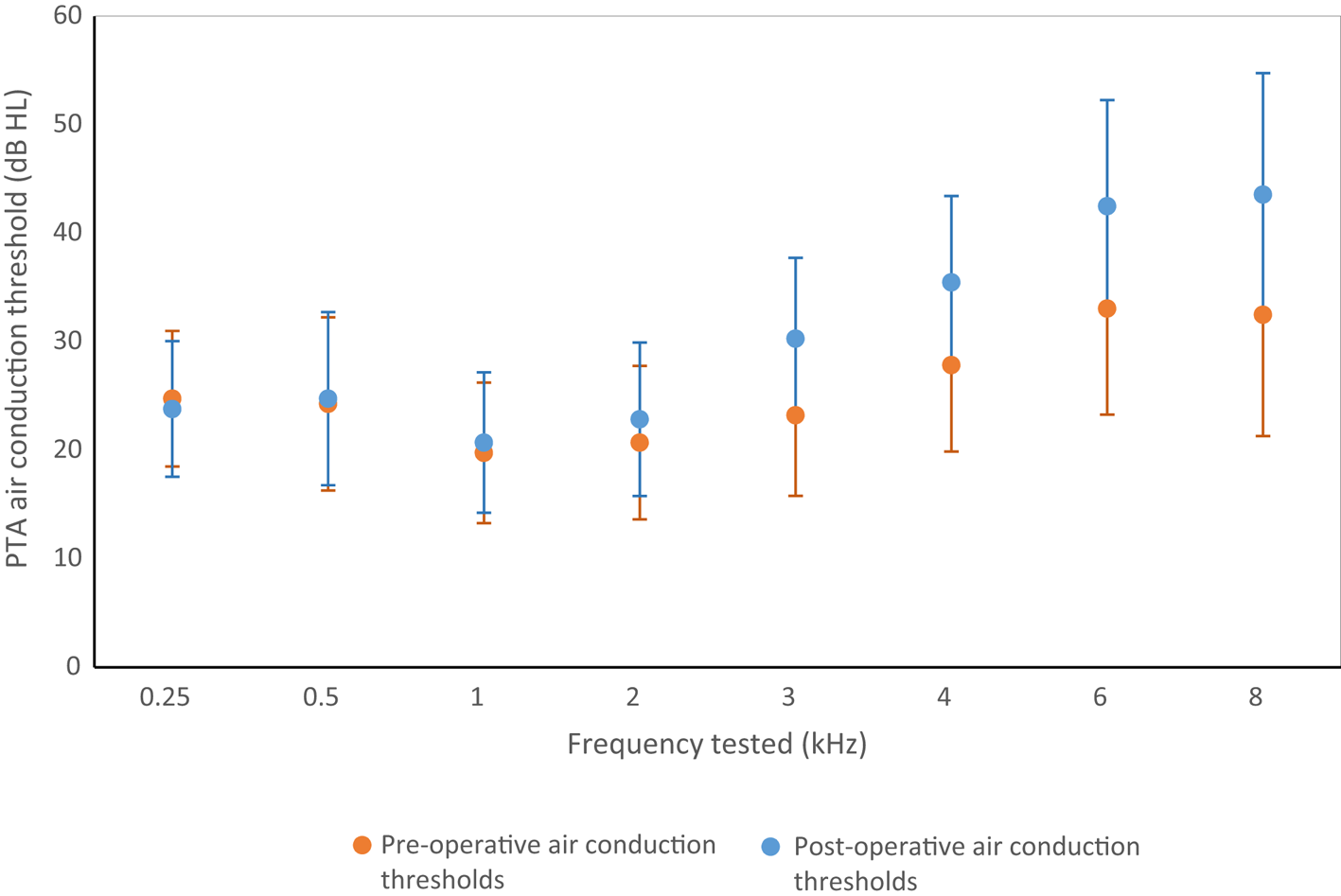
Hearing test results are shown in Figure 2 and discussed below. Hearing tests show pre-operative mean air conduction thresholds of 21.1 dB (95 per cent CI = 19.04–23.30) and mean bone conduction thresholds of 14.08 dB (95 per cent CI = 11.61–16.56). Post-operatively, mean air conduction threshold was 23.65 dB (95 per cent CI = 20.85–26.44) and mean bone conduction threshold was 16.90 dB (95 per cent CI = 14.16–19.64). Paired sample t-test did not show a statistically significant difference between pre- and post-operative air conduction and bone conduction.
Graph of mean audiometric thresholds. The black line denotes mean pre-operative thresholds of the 36 patients undergoing resurfacing and plugging. Orange and blue dots correspond to mean pre- and post-operative thresholds. Bars in corresponding colours represent upper and lower bounds. PTA = pure tone audiometry

Patient reported outcome measures
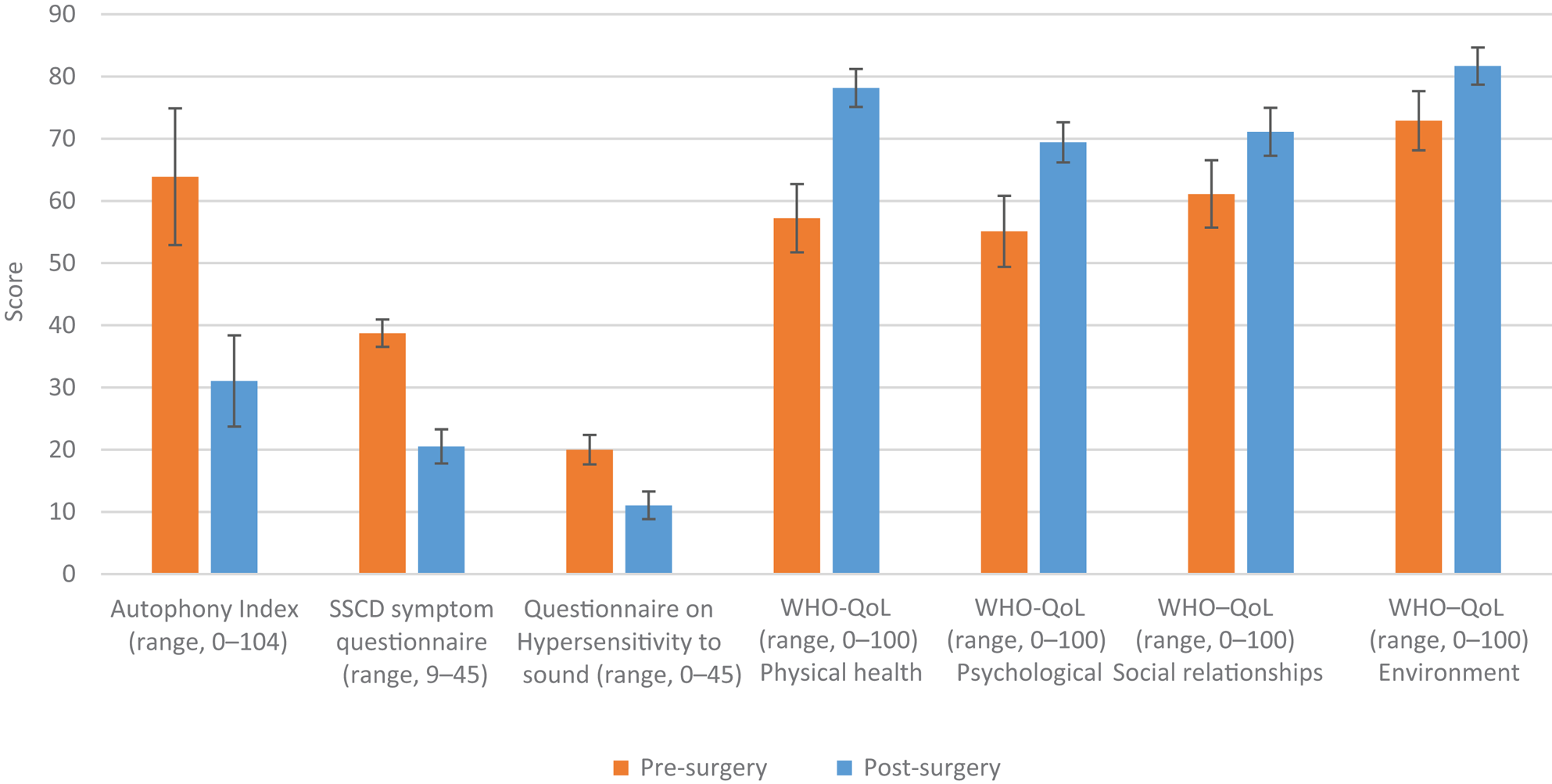
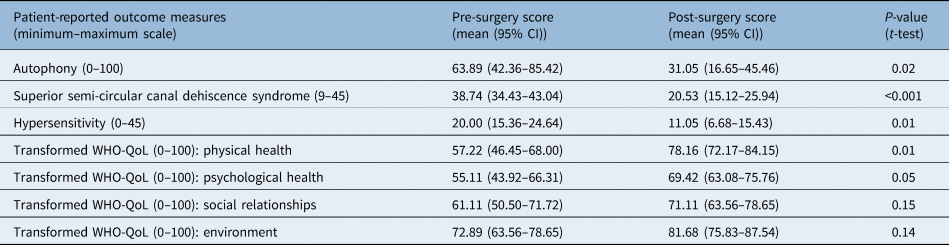
Results of self-reported symptom severity and quality of life questionnaires are shown in Table 1 and Figure 3 and are discussed below.
Results of patient-reported outcome measures. Higher scores for Autophony Index, superior semi-circular canal dehiscence syndrome questionnaire and Hypersensitivity to Sound questionnaire indicate worse symptom burden whereas higher scores in all four quality of life questionnaires indicate better quality of life. SSCDS = superior semi-circular canal dehiscence syndrome; WHO-QoL = World Health Organization-Quality of Life

Patient-reported outcome measures results

WHO-QoL = World Health Organization-Quality of Life
For the Autophony Index, mean scores significantly reduced following surgery from 63.89 (95 per cent CI = 42.36–85.42) to 31.05 (95 per cent CI = 16.65–43.46) (t-test, p = 0.02).
For the superior semi-circular canal dehiscence syndrome symptom severity score, mean scores significantly reduced following surgery from 38.74 (95 per cent CI = 34.43–43.04) to 20.53 (95 per cent CI = 15.12–25.94) (t-test, p < 0.001).
For the Hypersensitivity to Sound questionnaire, mean scores significantly reduced following surgery from 20 (95 per cent CI = 15.36–24.64) to 11.05 (95 per cent CI = 6.68–15.43), (t-test, p = 0.01).
For the abbreviated World Health Organization Quality of Life questionnaire following surgery, mean scores significantly increased for physical and psychological health: physical health scores increased from 57.22 (95 per cent CI = 46.45–68.00) to 78.16 (95 per cent CI = 72.12–84.15) (t-test, p = 0.01) and psychological health increased from 55.11 (95 per cent CI = 43.92–66.31) to 69.42 (95 per cent CI = 63.08–75.76) (t-test, p = 0.05). There was no statistical difference in the domains of social and environmental health.
Semi-structured interviews
Thematic analysis on 31 patient responses to questions about their condition was performed with responses coded into symptom themes and quality of life themes. While there was considerable overlap between symptoms, three distinct symptom themes emerged: auditory hypersensitivity, dysequilibrium and headfog. Three distinct quality of life themes were used as per an a priori framework: personal, social and professional impacts on quality of life.
Transcripts relating to symptom profile prior to surgery
Auditory hypersensitivity
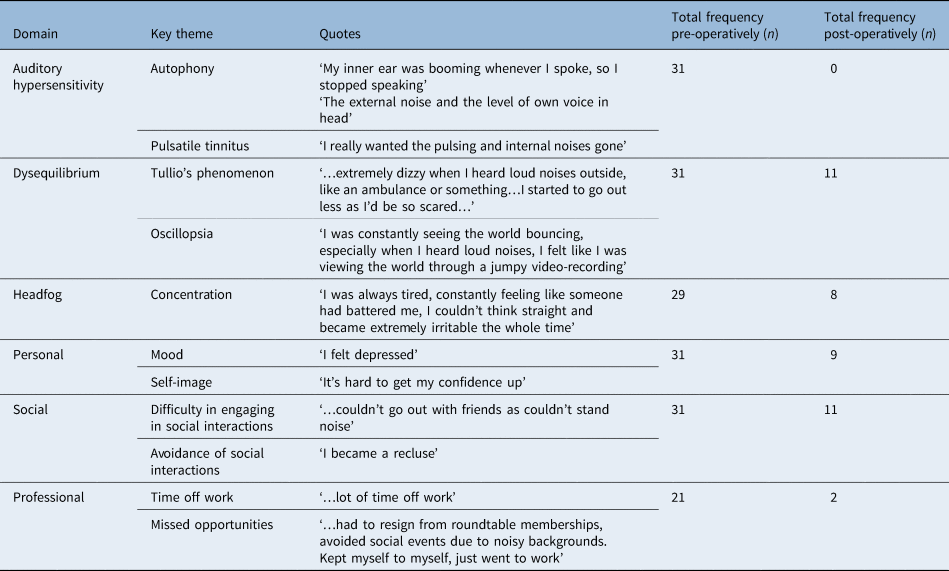
All patients self-reported some symptoms that were coded as auditory hypersensitivity. Three main descriptions were included within this theme: autophony (‘My inner ear was booming whenever I spoke, so I stopped speaking’), pulsatile tinnitus (‘I really wanted the pulsing and internal noises gone’), severe discomfort from (and fear of) loud sounds (‘Loud sounds would go through me like a knife’). Contrary to the a priori hypothesis, hearing and tinnitus symptoms rarely existed in isolation and were brought together under this theme.
Dysequilibrium
All patients self-reported some symptoms that were coded as dysequilibrium. Two main symptoms were brought together under this theme: Tullio's phenomenon (‘…extremely dizzy when I heard loud noises outside, like an ambulance or something…I started to go out less as I'd be so scared…’) and oscillopsia (‘I was constantly seeing the world bouncing, especially when I heard loud noises, I felt like I was viewing the world through a jumpy video-recording’).
Headfog
This theme was not part of the a priori schema, but it became evident that it was present in most of our patients (n = 29) and a distinct entity to other themes. Patients frequently described a consistent problem with concentration (‘I was always tired … constantly feeling like someone had battered me’. ‘I couldn't think straight and became extremely irritable the whole time’).
Personal
All patients reported an impact of their condition on their personal lives. Two main symptom types were present in all patients and were grouped together into the personal theme: mood changes (‘I felt depressed’, ‘…I was always irritable’) or changes in self-image (‘I lost all confidence in myself’).
Social
All participants either described symptoms of difficulty hearing (‘…I'd keep missing what my friends said and I was embarrassed…’) or participating in social interactions (‘I couldn't follow their conversation anymore, it was just too exhausting, so it became pointless seeing them’) or avoidance of social interactions (‘I became a recluse’).
Professional
All 31 patients were or recently had been in education or employment. Many, but not all patients self-reported the impact of their condition on their careers (n = 21). These were reported as either time taken off work (‘lot [sic] time off work’) or missed opportunities (‘…had to resign from roundtable memberships … and was overlooked for jobs time and again’) (Table 2).
Thematic analysis of patient responses from semi-structured interviews

Transcripts relating to symptom profile after surgery
The majority of patients (n = 30 of 31) reported generally feeling better following treatment (‘I'm definitely in a better place than I was before’). When asked about their individual symptoms, they reported improvements (not resolution) in many of their initial symptoms (auditory hypersensitivity, 31 of 31; dysequilibrium, 20 of 31; headfog, 21 of 29; personal 22 of 31; and professional 19 of 21). Dysequilibrium symptoms were least likely to improve in our cohort following treatment with 11 of 31 reporting ongoing symptoms (‘… the bouncing world still hasn't stopped…’). Overall, the transcripts demonstrated a nuanced improvement in their quality of life (‘Don't get me wrong, I'm not complaining, I'm better, but I'm still not normal’, ‘It's hard to get my confidence up’, ‘I still get a little dizzy and don't have the courage to go for a run’).
Discussion
Superior semi-circular canal dehiscence syndrome is a relatively newly described condition that causes a wide range of symptoms and has a large impact on quality of life. The patient perspective is difficult to capture and summarise, and previous studies have reduced the complicated interplay of symptoms, both in disease and following treatment, to simple descriptions of discrete outcomes or to objective measures.
Our study supports previous work showing that autophony, a characteristic symptom of superior semi-circular canal dehiscence syndrome, decreases or disappears in the majority of patients following successful surgical intervention.Reference Powell, Khalil and Saeed2,Reference Silverstein, Kartush, Parnes, Poe, Babu and Levenson7,Reference Jung, Lookabaugh, Owoc, McKenna and Lee15,Reference Crane, Lin, Minor and Carey19 In our cohort, we also found that Tullio's phenomenon improved after surgery, which also supports previous research.Reference Nelting, Rienhoff, Hesse and Lamparter20
Our semi-structured interview was able to highlight more nuanced symptoms and explore patient-centred concerns. This process showed that surgery was associated with worsening or no improvement of balance and dysequilibrium. This supports previous work by Jung et al.,Reference Jung, Lookabaugh, Owoc, McKenna and Lee15 who reported similar prevalence of dizziness following superior semi-circular canal dehiscence syndrome surgery. There are validated quality of life outcome measures for dizziness, such as the Dizziness Handicap Inventory score; however, this has been developed for vestibular disorders in general and not specifically for superior semi-circular canal dehiscence syndrome.Reference Jacobson and Newman24
A unified and validated patient-reported outcome measure for superior semi-circular canal dehiscence syndrome is still elusive. In this study, through semi-structured interviews, we have identified key symptom and quality of life themes that are prominent features of superior semi-circular canal dehiscence syndrome. This approach was patient-led and has highlighted areas of morbidity that need to be considered when developing a validated patient-reported outcome measure for superior semi-circular canal dehiscence syndrome. We are advocating for the development of a comprehensive tool as has been formulated for numerous other chronic conditions in medicine.
For the first time, we have shown an in-depth analysis of outcomes from transmastoid surgery for superior semi-circular canal dehiscence syndrome using objective test scores, validated symptom questionnaires and quality of life outcome measures as well as more in-depth analysis through semi-structured interviews. Our results demonstrated that the majority of patients interviewed following surgery report an overall improvement in symptom scores (autophony and hypersensitivity) and overall quality of life scores. However, our thematic analysis demonstrated that some symptoms persist, with dysequilibrium being among the most recalcitrant.
• Superior semi-circular canal dehiscence syndrome is a relatively newly recognised disorder with a large impact on patients’ quality of life (QoL)
• Few studies focus on QoL measures in patients with superior semi-circular canal dehiscence syndrome
• Three elements were identified as prominent in this condition: auditory hypersensitivity, dysequilibrium and headache, and concentration difficulties
• This study highlights the need for a disease-specific QoL instrument to capture the patient experience and measure treatment effects
• This study supports previous work that demonstrates surgery results in improvement of Tullio's phenomenon and autophony, but disequilibrium can persist
Our study is not without limitations. Firstly, our semi-structured interview questions have not been validated and were generated by consensus amongst our team. Further work is needed to validate these questions for future use, and the significance of these findings should be considered with caution until then. Similarly, the superior semi-circular canal dehiscence syndrome symptom questionnaire used in this study is also not validated. Secondly, the majority of the patients underwent transmastoid approach surgery; therefore, conclusions from this study may not be generalisable to other surgical approaches. This would be an important consideration in future studies. Thirdly, the patient numbers who underwent the validated pre- and post-surgical symptom and quality of life questionnaires were small (n = 19) as were those who agreed to the semi-structured interview (n = 31). However, this needs to be considered in the context of superior semi-circular canal dehiscence syndrome being an uncommon and under-recognised disorder.
Superior semi-circular canal dehiscence syndrome is a complicated syndrome that can have debilitating effects across physical, social and psychological domains. Our results support previous research that surgical intervention provides an overall improvement in symptoms. However, our study demonstrated that a unified disease-specific outcome measure is needed to capture symptoms and severity and measure treatment effects. Understanding the impact of surgery across different symptoms is essential to inform shared decision making between surgeons and patients.
Competing interests
None declared.
Appendix 1. Autophony index. Each item is rated on a 5-point scale between 0 and 4Reference Crane, Lin, Minor and Carey19

Appendix 2. Questionnaire on hypersensitivity to soundReference Nelting, Rienhoff, Hesse and Lamparter20

Appendix 3. Superior semicircular canal dehiscence questionnaireReference Silverstein, Kartush, Parnes, Poe, Babu and Levenson7

Appendix 4. UK abbreviated World Health Organization Quality of Life questionnaire