Introduction
Schistosomiasis is a serious public health problem affecting more than 240 million people worldwide, with another 700–800 million living in areas at risk of infection (Gryseels et al., Reference Gryseels, Polman, Clerinx and Kestens2006; Steinmann et al., Reference Steinmann, Keiser, Bos, Tanner and Utzinger2006; Colley et al., Reference Colley, Bustinduy, Secor and King2014). Given the chronic and debilitating character of the disease, the Global Burden of Disease Study estimated that schistosomiasis contributed to 3.51 million disability-adjusted life years (DALYs) in 2015 and led to 10.1 million deaths in 2016 (WHO, 2016; GBD, 2017). In Brazil, the most recent national survey on the prevalence of intestinal schistosomiasis and geohelminths (INPEG 2010–2015) showed that positivity rates for schistosomiasis ranged from 0.02% to 3.5%, with the highest positivity rates found in the southeast (3.5%) and the northeast (1.27%) of the Brazilian territory (Katz, Reference Katz2018).
Decisions about individual treatment, morbidity studies, identification of communities at risk of infection, cure control and follow-up of control programs are actions that depend primarily on the accuracy of the diagnostic tests (Utzinger et al., Reference Utzinger, N'Goran, N'Dri, Lengeler and Tanner2000; Amaral et al., Reference Amaral, Tauil, Lima and Engels2006). Therefore, the development of simple, low-cost, and sensitive diagnostic methods that can be used in population studies is of fundamental interest for control (Utzinger et al., Reference Utzinger, Booth, N'goran, Muller, Tanner and Lengeler2001; Enk et al., Reference Enk, Lima, Drummond, Schall and Coelho2008). The Kato-Katz (KK) technique is the parasitological method recommended by the World Health Organization to confirm intestinal schistosomiasis infection and is a quantitative, low-cost and easy to perform test (WHO, 1993; WHO, 2002). This method is very efficient to diagnose moderate and intense infections. However, its low sensitivity for the diagnosis of individuals with low parasite loads was considered to be an important drawback (Engels et al., Reference Engels, Sinzinkayo and Gryseels1996; Kongs et al., Reference Kongs, Marks, Verlé and Van Der Stuyft2001; Berhe et al., Reference Berhe, Medhin, Erko, Smith, Gedamu, Bereded, Moore, Habte, Redda, Gebre-Michael and Gundersen2004; Bergquist et al., Reference Bergquist, Johansen and Utzinger2009). Therefore, this method underestimated the prevalence of Schistosoma mansoni infection in areas of low endemicity (prevalence less than 10%) or in treatment-reinfection studies (Utzinger et al., Reference Utzinger, Booth, N'goran, Muller, Tanner and Lengeler2001; Ferrari et al., Reference Ferrari, Coelho, Antunes, Tavares and Da Cunha2003; Enk et al., Reference Enk, Lima, Drummond, Schall and Coelho2008; Coelho et al., Reference Coelho, Jurberg, Oliveira and Katz2009; Siqueira et al., Reference Siqueira, Gomes, Oliveira, de Oliveira, de Oliveira, Enk, Carneiro, Rabello and Coelho2015; Oliveira et al., Reference Oliveira, Magalhães, Elias, de Castro, Favero, Lindholz, Oliveira, Barbosa, Gil, Gomes, Teixeira, Enk, Carneiro, Negrão-Correa and Geiger2018). As an alternative, immunological tests, such as the point-of-care rapid urine test for the detection of S. mansoni circulating cathodic antigen (POC-CCA®) are commercially available. The POC-CCA® test is fast, easy to perform, and showed better sensitivity than the KK technique in different regions of Africa and Asia (Stothard et al., Reference Stothard, Sousa-Figueiredo, Standley, Van Dam, Knopp, Utzinger, Ameri, Khamis, Khamis, Deelder, Mohammed and Rollinson2009; Standley et al., Reference Standley, Lwambo, Lange, Kariuki, Adriko and Stothard2010; Colley et al., Reference Colley, Binder and Campell2013). However, results obtained with the POC-CCA® in low endemicity areas disagreed to a significant degree with other more sensitive parasitological tests (Siqueira et al., Reference Siqueira, Couto, Taboada, Oliveira, Carneiro, Oliveira, Coelho and Katz2016; Oliveira et al., Reference Oliveira, Magalhães, Elias, de Castro, Favero, Lindholz, Oliveira, Barbosa, Gil, Gomes, Teixeira, Enk, Carneiro, Negrão-Correa and Geiger2018).
Molecular approaches and the use of polymerase chain reaction (PCR) were also used for the detection of human schistosomiasis in fecal (Pontes et al., Reference Pontes, Dias-Neto and Rabello2002; Allam et al., Reference Allam, Kader, Zaki, Shehab and Farag2009; Gomes et al., Reference Gomes, Dos Santos Marques, Enk, de Oliveira, Coelho and Rabello2010; Oliveira et al., Reference Oliveira, Santos, Gonçalves, Barreto and Peralta2010; Carvalho et al., Reference Carvalho, Marques, Gomes, Rabello, Ribeiro, Scopel, Tibirica, Coimbra and Abramo2012; Carneiro et al., Reference Carneiro, Saramago Peralta, Cunha Pinheiro, de Oliveira, Peralta and Bezerra2013; Espirito-Santo et al., Reference Espirito-Santo, Alvarado-Mora, Dias-Neto, Botelho-Lima, Moreira, Amorim, Pinto, Heath, Castilho, Goncalves, Luna, Carrilho, Pinho and Gryschek2014; Siqueira et al., Reference Siqueira, Gomes, Oliveira, de Oliveira, de Oliveira, Enk, Carneiro, Rabello and Coelho2015; Senra et al., Reference Senra, Gomes, Siqueira, Coelho, Rabello and Oliveira2018), plasma (Wichmann et al., Reference Wichmann, Panning, Quack, Kramme, Burchard, Grevelding and Drosten2009), serum (Pontes et al., Reference Pontes, Dias-Neto and Rabello2002; Espirito-Santo et al., Reference Espirito-Santo, Alvarado-Mora, Dias-Neto, Botelho-Lima, Moreira, Amorim, Pinto, Heath, Castilho, Goncalves, Luna, Carrilho, Pinho and Gryschek2014), or urine samples (Enk et al., Reference Enk, Oliveira e Silva and Rodrigues2012). In these PCR-based assays, different targets were used to detect Schistosoma DNA; among them, a tandem repeat sequence of 121 base pairs (bp) successfully used in a PCR system to detect the parasite in snails and for the monitoring of cercariae in water bodies (Hamburger et al., Reference Hamburger, Turetski, Kapeller and Deresiewicz1991, Reference Hamburger, Xu, Ramzy, Jourdane and Ruppel1998a, Reference Hamburger, Xu, Ramzy, Jourdane and Ruppelb). Different studies, which used this sequence for detection of intestinal schistosomiasis, showed encouraging results, with high levels of sensitivity and specificity to identify S. mansoni infection (Pontes et al., Reference Pontes, Oliveira, Katz, Dias-Neto and Rabello2003; Gomes et al., Reference Gomes, Dos Santos Marques, Enk, de Oliveira, Coelho and Rabello2010; Carneiro et al., Reference Carneiro, Saramago Peralta, Cunha Pinheiro, de Oliveira, Peralta and Bezerra2013; Siqueira et al., Reference Siqueira, Gomes, Oliveira, de Oliveira, de Oliveira, Enk, Carneiro, Rabello and Coelho2015). Therefore, especially in low endemicity settings and in individuals with a low parasite burden real-time PCR (RT-PCR) might be a valuable tool to be considered and applied. However, accuracy evaluation of this technique is still required in an epidemiological setting and needs to be compared with a robust reference standard, e.g. in comparison with different and extensive parasitological tests to detect active infection. Therefore, the aim of this study was to evaluate and compare the efficacy of RT-PCR for the detection of active schistosomiasis infection in an endemic setting and with a special focus on individuals with low parasite loads.
Material and methods
Ethical considerations
This study was approved by the Ethics Committees of the René Rachou Institute (FIOCRUZ) and the Federal University of Minas Gerais and all project details have been registered on the Brazilian Platform for Research with Human Subjects (Plataforma Brasil) under the following number: CAAE#21824513.9.0000.5091. As such, the information presented in this paper is part of an inter-institutional research project, performed in three different Brazilian states (Minas Gerais, Maranhão, and Pará), with the scope to provide data on the performance of parasitological, immunological and serological tests for the diagnosis of intestinal schistosomiasis and geo-helminth infections under different eco-epidemiological situations and up to 1 year after chemotherapy.
An informed consent form was read and signed by the participants and by the parents or legal guardians of minors before enrollment. Literate children were also asked to read and sign an adapted informed consent form. Pregnant and breastfeeding women were excluded from the study. Infected individuals were treated for schistosomiasis with Praziquantel (40 mg kg−1 for adults and 60 mg kg−1 for children), Albendazole (400 mg single dose) for intestinal helminths, and Metronidazole (250 mg/2x/5 days) for control of parasitic protozoa.
Study design
A cross-sectional population-based study was carried out in the rural area of Brejo do Amparo (Fig. 1), in the municipality of Januária, in the northern area of the state of Minas Gerais, Brazil (15° 29′ 16′′ S 44° 21′ 43′′ O). This rural community is located along the margins of the Tocantins brook, where populations of Biomphalaria glabrata snails were found during malacological surveys. According to the Brazilian Schistosomiasis Control Program and local health authorities, the estimated prevalence of schistosomiasis in this area was 20% in 2010, and no control interventions have been put into place in the locality in the two years prior to the present study. The 257 individuals studied herein were previously evaluated in a study that investigated parasitological and immunological diagnostic techniques for the detection of schistosomiasis in an endemic area with low parasite loads (Oliveira et al., Reference Oliveira, Magalhães, Elias, de Castro, Favero, Lindholz, Oliveira, Barbosa, Gil, Gomes, Teixeira, Enk, Carneiro, Negrão-Correa and Geiger2018).
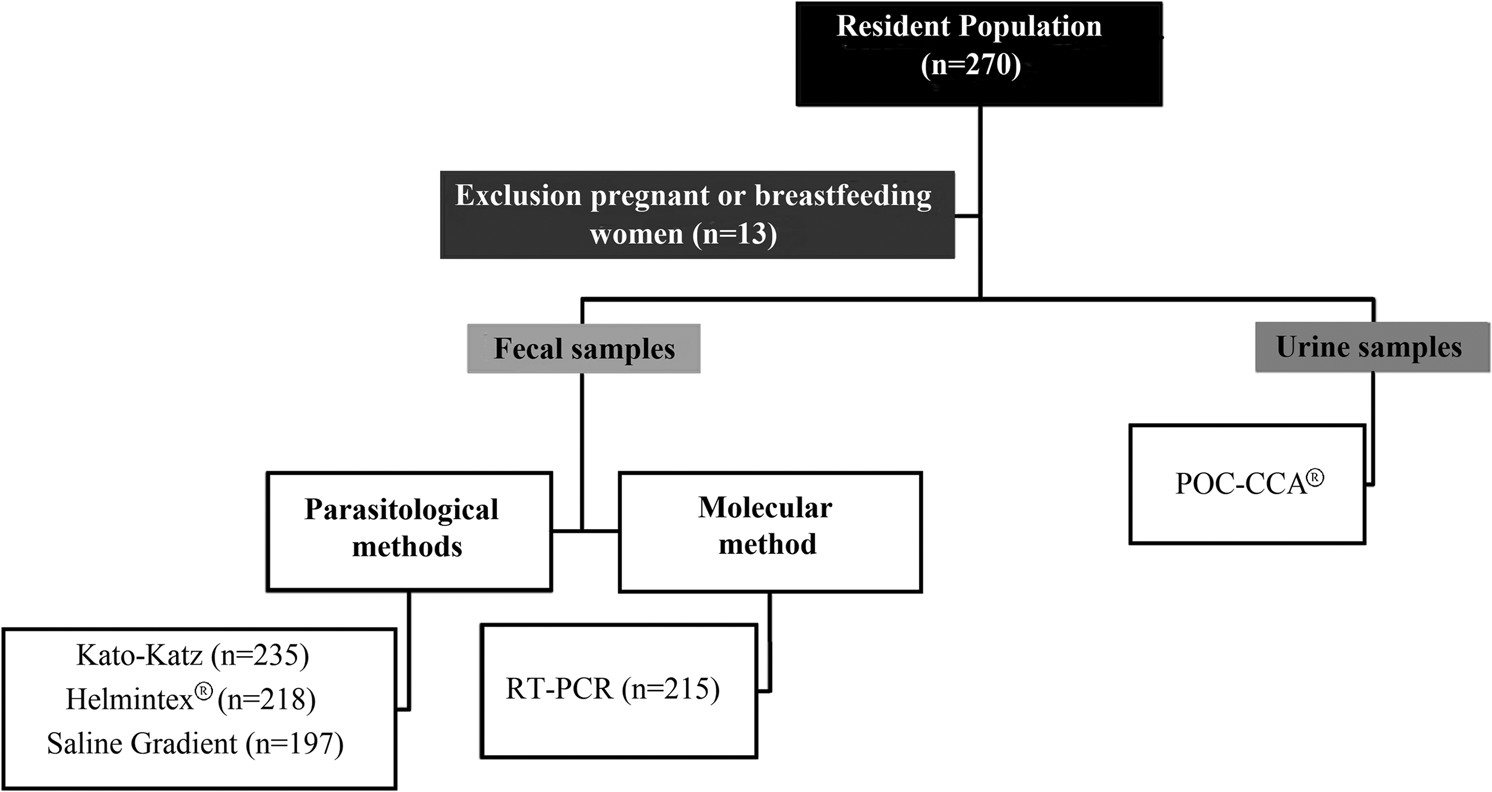
Flow diagram describing the endemic population enrolled in the study and the diagnostic methods applied to detect intestinal schistosomiasis. The Kato-Katz (KK) technique, saline gradient, modified Helmintex technique®, real-time polymerase chain reaction (RT-PCR) and rapid urine test (POC-CCA®) were also applied.

As detailed by Oliveira et al. (Reference Oliveira, Magalhães, Elias, de Castro, Favero, Lindholz, Oliveira, Barbosa, Gil, Gomes, Teixeira, Enk, Carneiro, Negrão-Correa and Geiger2018), three fecal samples were collected on consecutive days. The samples were received at the field laboratory in Januária, homogenized and processed for evaluation. At least 50 grams of feces were collected in the first fecal sample using a 500 mL plastic container. From this first fecal sample, subsamples were retrieved to perform the KK technique (14 slides approximately 41.7 mg), Saline gradient (500 mg) and a modified Helmintex technique® (30 g). Also, an additional 500 mg sample was sieved through the mesh and stored at −20°C until molecular testing was performed. The second and third fecal samples were collected in the following days in 80 mL plastic cups and were used to perform additional KK slides (2 slides each). A first-morning urine sample was also collected from the participants and used to detect circulating antigen of S. mansoni (POC-CCA® urine test), as previously described (Oliveira et al., Reference Oliveira, Magalhães, Elias, de Castro, Favero, Lindholz, Oliveira, Barbosa, Gil, Gomes, Teixeira, Enk, Carneiro, Negrão-Correa and Geiger2018). The diagnostic methods applied to detect intestinal schistosomiasis are described in the flow diagram in Fig. 1. The intensity of infection was estimated by multiplying the mean number of S. mansoni eggs found in the two slides of KK prepared with the first stool sample by 24 to determine the number of eggs per gram of feces (EPG). According to the World Health Organization (WHO, 2002), the intensity of S. mansoni infection can be categorized as light (1–99 EPG), moderate (100–399 EPG), or heavy (⩾400 EPG). Individuals who showed a positive result for S. mansoni infection in either the Helmintex® technique or the Saline gradient, but were negative in the two KK slides, were classified as infected with a parasite burden of less than 12 EPG.
For a more accurate diagnosis of schistosomiasis a combination of different parasitological methods was defined (KK, Saline gradient, Helmintex®). The results of this combination (Consolidated Reference Standard) showed that among the 257 individuals, 118 (45.9%) had active S. mansoni infection. The prevalence of schistosomiasis estimated by each parasitological method was as follows: the modified Helmintex technique showed 40.4% of prevalence (88/218); Saline gradient was 21.3% (42/197) and KK method with 18 slides of tree stool samples was 34.5% (81/235). However, when we evaluated KK technique using the two first slides of one fecal sample (based on the WHO recommendation), the prevalence was 20.4% (48/235) (Oliveira et al., Reference Oliveira, Magalhães, Elias, de Castro, Favero, Lindholz, Oliveira, Barbosa, Gil, Gomes, Teixeira, Enk, Carneiro, Negrão-Correa and Geiger2018).
DNA extraction from the fecal samples and RT-PCR
Total DNA was extracted from 500 mg of stool from the first fecal sample of each participant using the commercial QIAamp® DNA Stool Mini Kit, following the manufacturer's instructions (Qiagen GmbH, Hilden, Germany). To improve the accuracy of the molecular test, DNA from fecal samples were amplified using a set of primers and probes complementary to a 90-bp DNA fragment contained within the 121-bp tandem repeat sequence of S. mansoni strain Sm 1–7 (GenBank accession number M61098) described by Hamburger et al. (Reference Hamburger, Turetski, Kapeller and Deresiewicz1991). The primers forward 5′-CCG ACC AAC CGT TCT ATG A-3′ and reverse 5′-CAC GCT CTC GCA AAT AAT CTA AA-3′ and the probe 5′-6[FAM]/TCG TTG TAT CTC CGA AAC CAC TGG ACG/[(3BHQ1)] were synthesized by Sigma Life Sciences (Woodlands, Texas, USA). The amplification reaction was performed in a final volume of 25 μL containing: 12.5 μL of TaqMan® Universal PCR Master Mix (Life Technologies, Thermo Fisher Scientific Inc., USA), 0.1 μ m of each S. mansoni primer, 0.25 μ m of probe, BSA 0.1 μg/μL; 2 m MgCl2; 4 μL of 5-fold diluted DNA. For each run, positive (DNA extracted from adult worms) and negative (no DNA template) controls were performed. The amplification reaction was conducted on the StepOnePlus™ RT-PCR System (Thermo Fisher Scientific Inc., USA) using the universal cycling protocol with 45 cycles and annealing temperature of 60°C. As an internal quality control of DNA isolation and of the absence of PCR reaction inhibitors, all clinical samples were RT-PCR-amplified for the human β-actin gene (ACTB). For that, the forward 5′-CCA TCT ACG AGG GGT ATG-3′ and reverse 3′GGT GAG GAT CTT CAT GAG GTA-5′ primers and the 56-JOE/CCT GCG TCT GGA CCT GGC TG/[(3BHQ1)] probe were used. The cut-off cycle threshold (C t) for positive and negative samples was defined based on a standard curve established with serial dilutions of S. mansoni DNA extracted from adult worms. Samples presenting internal control JOE (β-actin probe) amplification and FAM (Schisto probe) target with C t undetermined and C t > 42 were classified as negative, while samples presenting internal control JOE (β-actin probe) amplification and FAM (Schisto probe) with C t ⩽ 42 were classified as positive. Samples that did not show internal control JOE amplification were classified as invalid and excluded from further analysis.
Data entry and statistical analysis
Data were processed with Open Epi, version 3.01 (Dean et al., Reference Dean, Sullivan and Soe2013) and GraphPad Prism, version 5.0 (La Jolla, CA, USA). In order to evaluate the performance of the different diagnostic tests, a consolidated reference standard (CRS) was established, which included a combination of methods: the KK technique with 18 slides from three stool samples, saline gradient (500 mg) and the modified Helmintex technique® (up to 30 g of feces).
Data normality was verified by the Shapiro-Wilk test. The Kruskal–Wallis test was used to compare the means of continuous variables, with P values ⩽0.05 considered significant. The overall prevalence of S. mansoni infection in the endemic area was calculated by dividing the number of egg-positive individuals found by CRS by the total number of participants.
The intensity of infection was determined according to the C t value observed by RT-PCR (which reflects fecal parasite-specific DNA load), or by microscopy, as determined by the EPG counts observed in two KK slides from the first stool sample. Spearman's correlation coefficient was used to calculate the concordance between the intensity of infection values established by microscopy and RT-PCR. Statistically significant differences were considered at P ⩽ 0.05.
Sensitivity, specificity, positive likelihood ratio, positive (PPV) and negative predictive values (NPV), and concordance (kappa statistics) were calculated for comparison of the performance and accuracy of the tests. The degree of concordance between the different tests was established according to the following categorization: (1) κ < 0.01, no agreement; (2) 0.01 ⩽ κ ⩽ 0.20, bad agreement; (3) 0.21 ⩽ κ ⩽ 0.40, weak agreement; (4) 0.41 ⩽ κ ⩽ 0.60, moderate agreement; (5) 0.61 ⩽ κ ⩽ 0.80, good agreement; and (6) κ > 0.81, excellent agreement (Landis and Koch, Reference Landis and Koch1977).
Results
Characterization of the study population
The 257 individuals analysed in the present study were between 2 and 88 years of age, with a median age of 32 years old (interquartile range 15–51 years). No statistically significant difference was observed in the distribution between males (47.5%) and females (52.5%).
Among these 118 individuals, 86.4% (n = 102) presented less than 100 EPG, 10.2% (n = 12) had a moderate infection (100–399 EPG), and 3.4% (n = 4) were heavily infected (⩾400 EPG). Seventy-four (62.7%) infected individuals presented only S. mansoni infection, while 44 (37.3%) were co-infected with other parasites. The parasitological techniques also identified 23 (8.9%) individuals eliminating eggs of hookworms; eight (3.4%) individuals with Enterobius vermicularis, one (0.4%) infected with Trichuris trichiura, and one (0.4%) infected with Strongyloides stercoralis. Of all the 118 individuals infected with S. mansoni, ten (8.5%) were coinfected with hookworms and five (4.2%) with Enterobius vermicularis.
Molecular test results
Among the 215 individuals for which the RT-PCR assay was performed, 117 showed positive results, representing a prevalence of 54.4% (95% CI 47.7–60.9). In comparison to the CRS, the present study demonstrated RT-PCR with 91.4% of sensitivity, 80.2% of specificity, and a positive likelihood ratio of 4.6 (95% CI 4.2–5.0). The concordance between the RT-PCR and the CRS, evaluated by kappa statistics, was 0.71 (95% CI 0.58–0.85) and diagnostic accuracy 85.6% (95%CI 80.3 −89.7), with 95 (44.2%) individuals showing positive results and 89 (41.4%) individuals showing negative results in all the methods. The PPV was 81.2% (95% CI 73.2–87.2).
Only 9 individuals that were recorded with eggs in any of the parasitological exams showed no reactivity in the RT-PCR assay. On the other hand, RT-PCR showed a DNA sequence compatible with S. mansoni in 22 individuals that were considered egg negative in all the parasitological techniques (Table 1).
Performance of the real-time polymerase chain reaction (RT-PCR) in comparison with a consolidated reference standard (CRS)

Data shows the Sens. %: Sensitivity; Esp. %: Specificity; PPV: positive predictive value; LR+: Likelihood ratio for positive results, accuracy and kappa statistic. Consolidated standard reference (CSR) was used as a reference test.
Given the low parasite load observed in the population (<100 EPG), we described the performance of the RT-PCR in relation to the parasite load (high, moderate and low). As shown in Table 2, RT-PCR readily detected all infected individuals with moderate or heavy intensity infections, i.e. patients eliminating more than 100 EPG. Among infected individuals with low parasite load, the RT-PCR also detected 100% of the individuals with a parasite load between 50 and 99 EPG (4/4) and between 12 and 49 EPG (25/25) (Table 2). Moreover, the RT-PCR assay detected the S. mansoni infection in 87% (n = 53) of the individuals eliminating less than 12 EPG. Noteworthy, six of the nine individuals that had parasite eggs in at least one parasitological test, but showed a negative result by RT-PCR, were identified as egg positive only by the Helmintex® technique. The other three individuals were diagnosed egg positive only by the KK technique with an increased number of slides (12 slides in the first stool sample), or when three consecutive fecal samples were analysed with six different slides.
Sensitivity (%) of the real-time PCR (RT-PCR) and the point-of-care rapid urine test (POC-CCA®) for the detection of schistosomiasis in relation to the individual parasitic load, as defined by quantitative egg counts from two slides Kato-Katz (KK)

Data show the sensitivity (%) of each diagnostic method and the number of individuals detected positive for intestinal schistosomiasis vs the total number of examined individuals (in brackets), according to parasite load classification. *Individuals with a light infection were arbitrarily divided into three subgroups with egg counts of 99–50 eggs per gram of feces (EPG), 49–12 EPG and less than 12 EPG.
In addition, when we evaluated the possibility of cross-reactivity with other intestinal helminths, only four (18.2%) of the 22 individuals that were positive only by RT-PCR had a hookworm infection.
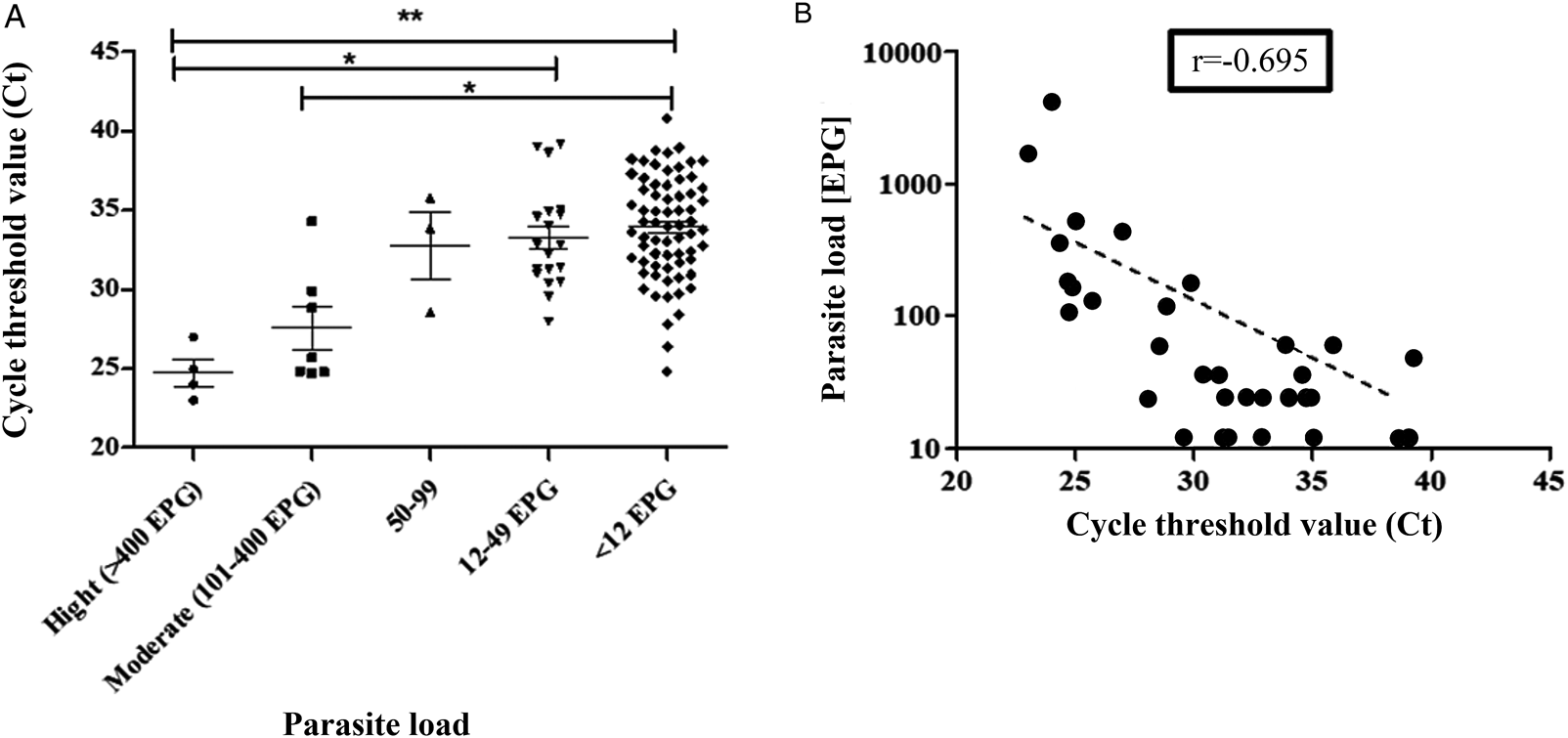
Fig. 2, demonstrated that RT-PCR intensity (Ct amplification cycles) is correlated with parasite load of individuals with high/medium/low parasite load. The samples from individuals infected with high (>400 EPG) or moderate (100–400 EPG) parasitic burden required a significantly lower number of PCR-amplification cycles (C t = 24.6 ± 1.7 and 28.2 ± 3.5, respectively) for detection of Schistosoma DNA (Fig. 2A). In contrast, samples from individuals infected with very low parasite load (<12 EPG) needed a higher number of PCR-amplification cycles (C t = 33.8 ± 3.7). As a result, a highly significant inverse correlation was observed between individual egg counts and the C t values (r = −0.66, P < 0.001) (Fig. 2B).
A. Infection intensities, as determined by parasite load (EPG values) in relation to the number of cycle threshold (C t) values for the detection of S. mansoni DNA. The solid line indicates the median and interquartile range of C t values. B. Correlation between individual parasite load (EPG values) and C t values for amplification of S. mansoni DNA in fecal samples (P < 0.0001).

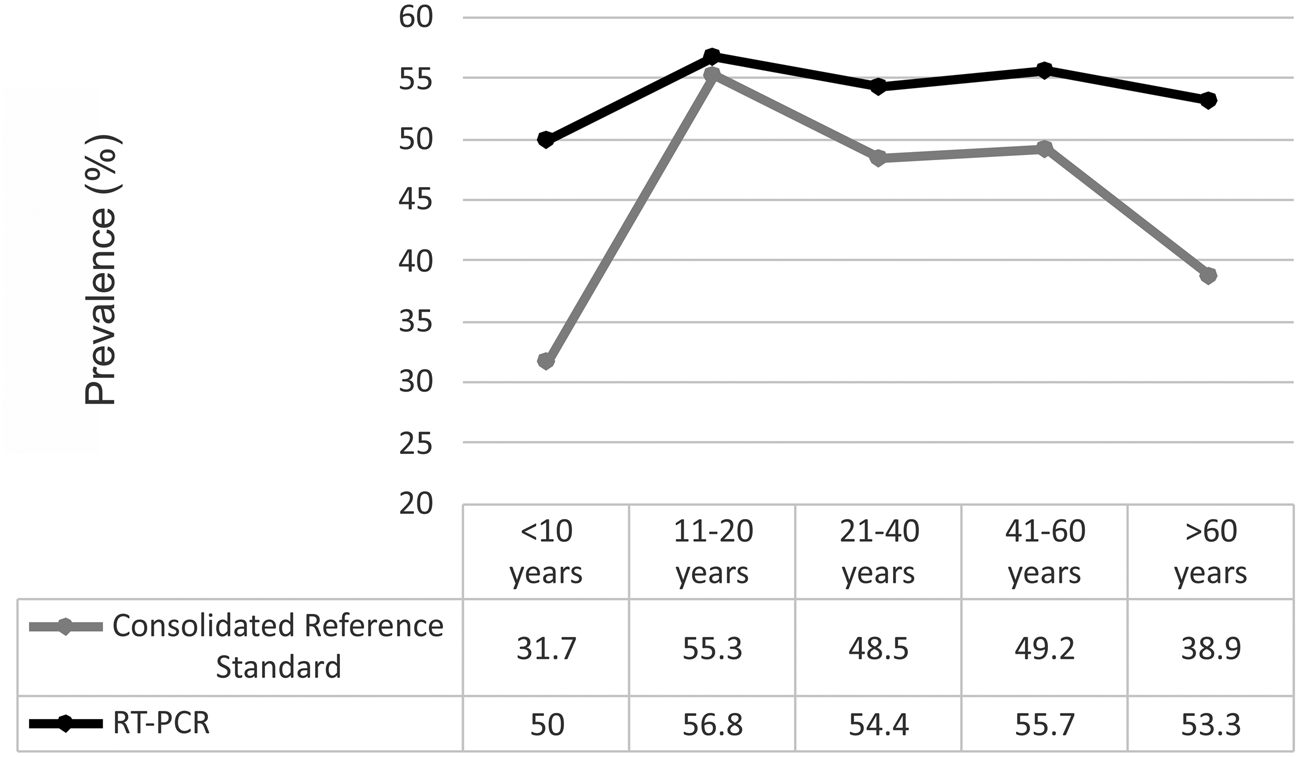
As for the RT-PCR results for the different age groups, the positivity rate was higher among younger children and in individuals over 60 years of age when compared with the CRS (Fig. 3). Thus, the prevalence per age group increased from 31.7% to 38.9% found through the parasitological techniques (CRS) to 50.0% and 53.3% by RT-PCR, respectively (Fig. 3).
Prevalence profile of intestinal schistosomiasis in an endemic population divided by age, according to a parasitological consolidated reference standard and to real-time PCR analysis of one fecal samples (500 mg).

Among the 215 individuals who underwent the RT-PCR test, all individuals provided samples to perform the two-slide KK (SPL1 K1-K2), 172 for the KK six slides of three fecal samples (SPL1-3 K1- K2) and 194 for the Helmintex®. The performance of these parasitological methods was compared with RT-PCR (Table 3) The two KK slides, which corresponded to 83.4 mg of feces, revealed low sensitivity (36.0%; 95% CI 27.8–45.1); accuracy (64.6%; 95% CI 57.8–70.8) and kappa statistics (0.33; 95% CI 0.23–0.44). The KK six slides of three fecal samples, which corresponded to 500 mg of feces (41.7 mg × 6 = 250 mg), demonstrated increased sensitivity and concordance (kappa statistics). The modified Helmintex® technique (30 g of feces) demonstrated sensitivity of 68.3% (95% CI 58.8–76.4), concordance of 0.60 (95% CI 0.47–0.74) and diagnostic accuracy 79.9% (95%CI 73.7- 84.9).
Performance of different parasitological and immunochromatographic methods for the detection of intestinal schistosomiasis in comparison with real-time PCR (RT-PCR)

TP, true positive; FP, false positive; FN, false negative; TN, true negative.
Data show the Sens. %, Sensitivity; Esp. %, Specificity; PPV, positive predictive value; LR+, Likelihood ratio for positive results, accuracy and kappa statistic of concordance for the Kato-Katz technique obtained with the analysis of one fecal sample using two slides (SPL1 K1-K2) or obtained from two slides prepared from each of three fecal samples (SPL1-3 K1-K2), or Helmintex®, or with POC-CCA® methods. RT-PCR (real-time polymerase chain reaction) was used as reference test.
We also compared the performance of POC-CCA and RT-PCR. Among the 215 individuals evaluated by RT-PCR, 196 provided samples for the rapid urine test. Of these, 70 (35.7%) were positive by RT-PCR and reactive by POC-CCA® and 64 (32.7%) were negative in both tests. Interestingly, 24 (12.2%) individuals negative by RT-PCR were reactive in the rapid urine test and were classified as with either trace results or with weak reactivity. In addition, 38 (19.4%) individuals were not reactive by the POC-CCA® test but showed S. mansoni-specific DNA amplification in RT-PCR from fecal samples (Table 3). As such, the concordance between the POC-CCA® test and the RT-PCR was considered weak (κ = 0.37). Further evaluation of the POC-CCA® test indicated low sensitivity (64.8%) when compared to the RT-PCR. The specificity was 72.7%, the likelihood ratio for a positive result was 2.38, and the PPV was 74.5% (Table 3). As shown in Table 2, the lack of concordance between RT-PCR and POC-CCA® was mainly due to the low agreement of the latter diagnostic test in identifying infected individuals with less than 50 EPG. From the 112 infected individuals who were identified by parasitological tests, the POC-CCA® detected 77.8% of the individuals eliminating 12–49 EPG and only 50.8% of those eliminating less than 12 EPG.
Discussion
In the current study, we demonstrated that RT-PCR of DNA isolated from fecal samples using primer pairs targeted to a 90-base pair sequence inside of the highly repeated 121-base pair sequence of S. mansoni showed high sensitivity (91.4%) to identify infection and good concordance (k = 0.71) with an accurate parasitological reference standard. In addition, the RT-PCR showed better performance in identifying cases with low (<100 EPG) and very low (<12 EPG) parasite loads than when compared with POC-CCA® (100% vs 77.8% and 86.9%; vs 50.8%).
Molecular tests have been used as alternative diagnostic methods for the detection of Schistosoma species (Pontes et al., Reference Pontes, Oliveira, Katz, Dias-Neto and Rabello2003; Lier et al., Reference Lier, Simonsen, Haaheim, Hjelmevoll, Vennervald and Johansen2006; Allam et al., Reference Allam, Kader, Zaki, Shehab and Farag2009; Gomes et al., Reference Gomes, Marques, Enk, Coelho and Rabello2009; Lier et al., Reference Lier, Simonsen, Wang, Lu, Haukland, Vennervald, Hegstad and Johansen2009). In these PCR-based assays, different targets have been used to detect Schistosoma DNA, including the ribosomal subunits 18 s rDNA, 28 s rDNA and SSU-rRNA (Gomes et al., Reference Gomes, Melo, Werkhauser and Abath2006; Sandoval et al., Reference Sandoval, Siles-Lucas, Perez-Arellano, Carranza, Puente, Lopez-Aban and Muro2006), mitochondrial genes (nicotinamide adenine dinucleotide hydrogen – NADH-I, NADH-3 and nternal transcriber-spacer-2 sequence – ITS2), and the cytochrome c oxidase -COX I (Ten Hove et al., Reference ten Hove, Verweij, Vereecken, Polman, Dieye and van Lieshout2008; Lier et al., Reference Lier, Simonsen, Wang, Lu, Haukland, Vennervald, Hegstad and Johansen2009). Among them, Gordon et al. (Reference Gordon, Acosta, Gobert, Olveda, Ross, Williams, Gray, Harn, Li and McManus2015) applied RT-PCR assay, utilizing primers which amplify a fragment of the NADH dehydrogenase I (nad1) mitochondrial gene, to identify S. japonicum DNA in feces of 560 individuals living in six small villages in the municipality of Palapag, Philippines. The authors showed that the RT-PCR assay was positive in 90.2% of the study population, while only 22.9% of them showed parasite egg in feces examined by KK method, suggesting that prevalence of S. japonicum was much higher in the area. Similarly, Meurs and collaborators (Reference Meurs, Brienen, Mbow, Ochola, Mboup, Karanja, Secor, Polman and van Lieshout2015), using ITS2-based multiplex RT-PCR, detected 13–15% more positive individuals than with conventional KK stool exams in fecal samples of individuals of endemic areas from Senegal and Kenya. These data indicated that the molecular approach would increase the sensibility of the schistosmiasis diagnosis in areas where the intensity of infection is low and it could currently control efforts to eliminate the disease. In addition, RT-PCR has been suggested as a useful and more sensitive tool for detecting animal hosts and for controlling transmission of zoonotic schistosomiasis (Van Dorssen et al., Reference Van Dorssen, Gordon, Li, Williams, Wang, Luo, Gobert, You, McManus and Gray2017; He et al., Reference He, Gordon, Williams, Li, Wang, Hu, Gray, Ross, Harn and McManus2018).
Aside from the DNA sequences discussed above, a tandem repeat sequence of 121 base pairs (bp) has also been successfully used in PCR-based approaches for the detection of the parasite in snails and for the monitoring of cercariae in water bodies (Hamburger et al., Reference Hamburger, Turetski, Kapeller and Deresiewicz1991, Reference Hamburger, Xu, Ramzy, Jourdane and Ruppel1998a, Reference Hamburger, Xu, Ramzy, Jourdane and Ruppelb). The amplification of this sequence has been adapted for the diagnosis of Schistosoma in human feces and some published data showed high sensitivity and specificity of these molecular approach to identify S. mansoni infection (Pontes et al., Reference Pontes, Dias-Neto and Rabello2002, Reference Pontes, Oliveira, Katz, Dias-Neto and Rabello2003; Gomes et al., Reference Gomes, Dos Santos Marques, Enk, de Oliveira, Coelho and Rabello2010; Carneiro et al., Reference Carneiro, Saramago Peralta, Cunha Pinheiro, de Oliveira, Peralta and Bezerra2013; Siqueira et al., Reference Siqueira, Gomes, Oliveira, de Oliveira, de Oliveira, Enk, Carneiro, Rabello and Coelho2015). The authors argued that given the high number of copies of this repeat region, the technique enables the detection of fractions of a single S. mansoni-derived cell, in contrast to the microscope detection, which requires the presence of entire eggs, and regardless of the differences in the number of eggs (EPG) in fecal samples (Pontes et al., Reference Pontes, Dias-Neto and Rabello2002).
In agreement with the results using the others DNA-target, studies also showed that -molecular diagnosis using as target the 121-bp tandem repeat DNA sequence of Schistosoma, similar target that we used in current study, were more sensible compared to the KK parasitological technique to identify S. mansoni infection (Rabello et al., Reference Rabello, Pontes and Dias-Neto2002; Pontes et al., Reference Pontes, Oliveira, Katz, Dias-Neto and Rabello2003; Gomes et al., Reference Gomes, Marques, Enk, Coelho and Rabello2009; Gomes et al., Reference Gomes, Dos Santos Marques, Enk, de Oliveira, Coelho and Rabello2010). As an example, Carvalho et al. (Reference Carvalho, Marques, Gomes, Rabello, Ribeiro, Scopel, Tibirica, Coimbra and Abramo2012) reported that a conventional PCR system detected 4.8 times more infected individuals than with two KK-slides among individuals from low endemic areas. In addition, other studies which used a RT-PCR to amplify the same DNA-target showed a positivity rate 12 times higher than the conventional KK or spontaneous sedimentation techniques (Espirito-Santo et al., Reference Espirito-Santo, Alvarado-Mora, Dias-Neto, Botelho-Lima, Moreira, Amorim, Pinto, Heath, Castilho, Goncalves, Luna, Carrilho, Pinho and Gryschek2014). However, most of the studies testing PCR-based assays as a diagnostic tool for schistosomiasis in individuals with low parasite load compare their data with conventional KK-method. Given the known low sensibility of the conventional KK-method to identify individuals with low-intensity infections, this method should not be used as a reference test to assess the accuracy of a new diagnostic strategy for Schistosoma infection. In the current study, we had, for the first time, used an extensive combination of parasitological tests to allow robust evaluation of RT-PCR performance to diagnose S.mansoni infection in individuals with low-intensity infection. In addition, we also optimized the RT-PCR reaction by selecting as target a smaller fragment of DNA (90 bp) inside the repeated 121-bp sequence. Our data clearly showed that this RT-PCR technique allowed to identify 100% of infected individuals with more than 12 EPG, that is the lowest parasite load that could be identified by 2 slides of KK, and about 87% of infected individuals eliminating less than 12 EPG, who were identified only by more extensive parasitological analysis obtained through the Consolidated Reference Standard. Therefore, the RT-PCR assay employed in current study showed high sensibility (91.4%) and good accuracy (85.6%) to diagnose active S. mansoni infection in low-intensity infected individuals of endemic area. A good performance of PCR-assay using the 121 bp tandem repeat DNA sequence to diagnose S. mansoni infection was also reported by Senra and collaborators (Reference Senra, Gomes, Siqueira, Coelho, Rabello and Oliveira2018) who evaluated the performance of a PCR-ELISA system. The authors reported that the PCR-estimated prevalence of schistosomiasis (25.2%) was only slightly higher than that observed by examining 12 KK slides (18.4%), with sensitivity and specificity of 97.4% and 91.1%, respectively.
In the analysis of concordance, nine individuals were identified as positive by the consolidated reference standard but were undetected by the RT-PCR. The disagreement between false-negative individuals by RT-PCR may be associated with the very low parasite load, which may result in the lack of eggs and sufficient genetic material in the small amount of feces (500 mg) analysed by the molecular test. This is in agreement with the parasitological exams since the majority of the infected individuals were identified by tests that used a higher amount of feces (30 grams Helmintex technique®) or a higher number of fecal samples or slides (three fecal samples collected in consecutive days for KK). Former studies of RT-PCR using as target the 121-bp tandem repeat estimated that the assay was able to amplify minimum amounts of egg DNA in fecal samples and estimated that the assay would detect as low as 0.2 (Gomes et al., Reference Gomes, Dos Santos Marques, Enk, de Oliveira, Coelho and Rabello2010) or 2.4 EPG (Pontes et al., Reference Pontes, Dias-Neto and Rabello2002); however this sensibility is lower than the limitation of Helminthex (1 egg in 30 g feces). Also, a specific RT-PCR developed to target the 28S ribosomal RNA gene was validated for the detection of different Schistosoma species in international travelers and migrants and demonstrated high analytical sensitivity and a detection limit of 0.2 EPG (Cnops et al., Reference Cnops, Tannich, Polman, Clerinx and Esbroeck2012). Pontes et al. (Reference Pontes, Oliveira, Katz, Dias-Neto and Rabello2003) and Gomes et al. (Reference Gomes, Marques, Enk, Coelho and Rabello2009) obtained false-negative results using conventional PCR and attributed those to the following: (1) the presence of amplification inhibitors in fecal samples; (2) variations in distribution and release of S. mansoni eggs in the feces (Engels et al., Reference Engels, Sinzinkayo and Gryseels1996); and (3) DNA degradation during sample transport from the endemic area to the laboratory (Gomes et al., Reference Gomes, Marques, Enk, Coelho and Rabello2009). However, in our study, we were able to exclude the latter possibility, since our internal control (the human β-actin gene) was amplified.
On the other hand, for the 22 infected individuals identified by RT-PCR and not by the CRS, two hypotheses should be considered. First, a superior sensitivity of the RT-PCR, which allows the identification of individuals with low parasite loads. As discussed above, the previous study estimated that RT-PCR assays were able to identify as low as 0.2 EPG (Gomes et al., Reference Gomes, Dos Santos Marques, Enk, de Oliveira, Coelho and Rabello2010; Cnops et al., Reference Cnops, Tannich, Polman, Clerinx and Esbroeck2012), a sensibility higher than most of the parasitological test, but not the Helmintex. As such, a study by Allam et al. (Reference Allam, Kader, Zaki, Shehab and Farag2009) showed the high sensitivity of the real-time PCR system, which diagnosed 23% of samples as positive among individuals living in a hypoendemic area that were identified as egg negative for S. mansoni infection, using the conventional KK technique. In addition, the possibility of cell-free parasite DNA (cfDNA) detection in the RT-PCR assay should be considered. The cfDNA is released from schistosome stages (schistosomula, adult worms and eggs), and could be the result of dead or decaying parasites within the circulation and tissues, active shedding from the parasite or from disintegrating inactive eggs (Cnops et al., Reference Cnops, Tannich, Polman, Clerinx and Esbroeck2012; Weerakoon et al., Reference Weerakoon, Gordon, Gobert, Cai and McManus2016; Weerakoon et al., Reference Weerakoon, Gordo and McManus2018). cfDNA can be detected in serum, plasma and bio-fluids such as urine, saliva and cerebrospinal fluid (Pontes et al., Reference Pontes, Dias-Neto and Rabello2002; Wichmann et al., Reference Wichmann, Panning, Quack, Kramme, Burchard, Grevelding and Drosten2009; Weerakoon et al., Reference Weerakoon, Gordon, Gobert, Cai and McManus2016, Reference Weerakoon, Gordon, Williams, Cai, Gobert, Olveda, Ross, Olveda and McManus2017). Moreover, it was shown that cfDNA can be readily detected in active, low-intensity infections and low prevalence schistosomiasis areas, using Droplet Digital PCR (ddPCR) and RT-PCR (Weerakoon et al., Reference Weerakoon, Gordon, Williams, Cai, Gobert, Olveda, Ross, Olveda and McManus2017, Reference Weerakoon, Gordo and McManus2018). The detection of cfDNA released from different stages of Schistosoma development by the RT-PCR assay would also allow the diagnose of the infection before the egg elimination.
The second hypothesis is that the false-positive results by RT-PCR may be due to cross-reactions with other helminth parasites. However, the high specificity of this technique was demonstrated by the absence of amplification in individuals infected with other helminths. The primers used in the PCR to diagnose schistosomiasis mansoni are genus-specific and were shown to not cross amplify DNA from Ascaris lumbricoides, hookworm, Taenia solium, or Trichuris trichiura (Pontes et al., Reference Pontes, Dias-Neto and Rabello2002; Gomes et al., Reference Gomes, Dos Santos Marques, Enk, de Oliveira, Coelho and Rabello2010; Senra et al., Reference Senra, Gomes, Siqueira, Coelho, Rabello and Oliveira2018).
When the performance of POC-CCA® was compared with that of the RT-PCR, the rapid urine test presented lower sensitivity (64.8%), lower specificity (72.7%) and a low agreement was observed between the methods (κ = 0.37). Our previous study with the same population resulted in a similar poor performance when POC-CCA® was compared with the consolidated reference standard based on the detection of S. mansoni eggs by different parasitological methods (Oliveira et al., Reference Oliveira, Magalhães, Elias, de Castro, Favero, Lindholz, Oliveira, Barbosa, Gil, Gomes, Teixeira, Enk, Carneiro, Negrão-Correa and Geiger2018). The relatively high percentage of results classified as false positive and false negative in the POC-CCA® might be explained by the discontinuous distribution of eggs in the fecal matter, intermittent egg excretion, a small number of female worms or ageing worms (Engels et al., Reference Engels, Sinzinkayo and Gryseels1996; Berhe et al., Reference Berhe, Medhin, Erko, Smith, Gedamu, Bereded, Moore, Habte, Redda, Gebre-Michael and Gundersen2004; Gryseels et al., Reference Gryseels, Polman, Clerinx and Kestens2006) and cross-reactivity with other intestinal helminths or even other clinical conditions that may lead to a false positive POC-CCA® result (van Dam et al., Reference Van Dam, Bergwerff, Thomas-Oates, Rotmano, Kamerling, Vliegenthard and Deelder1994; Colley et al., Reference Colley, Binder and Campell2013; Coelho et al., Reference Coelho, Siqueira, Grenfell, Almeida, Katz, Almeida, Carneiro and Oliveira2016).
This study presents a few limitations. Stool samples for RT-PCR were collected on a single day (first sample). The performance of the RT-PCR test could likely be improved if fecal sample collection would have been performed on 2 or 3 consecutive days, which would have reduced the variation in egg production in infected individuals. We did not perform this in the present study due to the high costs for the test and the considerable number of examined individuals. The choice of a molecular test for diagnosing Schistosoma infection in endemic settings will depend on different factors, including the available infrastructure and the cost-effectiveness (Gomes et al., Reference Gomes, Melo, Werkhauser and Abath2006). Nevertheless, here, the molecular technique was tested in a restricted setting and not on a large epidemiological basis. Therefore, evaluation of its applicability, cost-effectiveness and comparisons with other methods in a larger epidemiological setting and with increased numbers of tested individuals are still in need.
Current strategies for controlling schistosomiasis in Brazil are based on the diagnosis and treatment of positive individuals. Since the goals for schistosomiasis control have shifted from morbidity control to transmission control and eradication (Bergquist et al., Reference Bergquist, Zhou, Rollinson, Reinhard-Rupp and Klohe2017), it is of extreme importance to identify individuals with reduced parasite loads, who would continue undiagnosed if only the commonly applied parasitological methods were used and would, therefore, easily contribute to the maintenance of the disease in endemic areas. In conclusion, the RT-PCR methodology presented herein showed high sensitivity to identify active S. mansoni infection in individuals with very low parasite loads (<12 EPG) and resulted in a good concordance with a Consolidated Reference Standard, which consisted of different and very extensive parasitological exams.
Acknowledgements
The authors would like to thank the people from the communities of Pé da Serra, Tocantins, and Santana for their collaboration and the warm reception during the field activities. They are also thankful to the municipal government of Januária for the logistic support during the field studies and to the technicians from the Schistosomiasis Control Program. They also thank Dra. Liliane Maria Vidal Siqueira (Fiocruz) for the training and supervision provided during the molecular analyses.
Author Contributions
MC, PMZC, SMG, DN-C, CG-T and MJE conceptualized the study. FM, SR, SMG and CG-T collected the sample. EO, FM, SR and CS performed experiments. SR, FM, EO, MC, FCM, DN-C and MC analysed the data. Resources and project administration were supervised by SMG, DN-C, PMZC and CG-T. Elaboration of the manuscript was done by FCM, DN-C, SMG and MC.
Financial Support
The authors received financial support from the National Brazilian Research Council (CNPq) for research in neglected tropical diseases, DECIT program 2012 #404405/2012-6. DN-C received financial support from Fundação de Amparo à Pesquisa de Minas Gerais (FAPEMIG), within the Edital of PP-SUS and grant #APQ 01637-17. FCM thanks the Coordenação de Aperfeiçoamento de Pessoal de Nível Superior (CAPES-Brazil), Programa de Pós-Graduação em Parasitologia, for PhD-scholarship. MC would like to thank the Fundação de Amparo à Pesquisa de Minas Gerais (FAPEMIG – Brazil) for the grant within the Pesquisador Mineiro program (PPM-2016) and CNPq for her research fellowship.
Conflict of interest
None to declare
Ethical standards
This study was approved by the Ethics Committees of the René Rachou Institute (FIOCRUZ) and the Federal University of Minas Gerais and is registered at the Brazilian Platform for Research with Human Subjects (Plataforma Brasil) under the following number: CAAE#21824513.9.0000.5091. Informed consent form was read and signed by the participants and by the parents or legal guardians of minors before enrollment. Literate children were also asked to read and sign an adapted informed consent form.