Egg size is a fundamental life history trait. Hatchlings from larger eggs typically exhibit higher fitness (Fox and Czesak Reference Fox and Czesak2000). However, because the resources females can allocate to reproduction are finite, a trade-off between egg size and number is expected (Fox and Czesak Reference Fox and Czesak2000).
In herbivorous insects, it is commonly observed that different host plants are used at different times of the season, when abiotic conditions may vary. Seasonal environmental heterogeneity associated with variation in host plants or abiotic factors (e.g., temperature) may favour plasticity in maternal allocation of resources to eggs (Awmack and Leather Reference Awmack and Leather2002; Moreau et al. Reference Moreau, Desouhant, Louâpre, Goubault, Rajon and Jarrige2017). However, few studies have tested whether egg size and number vary among generations associated with different host plants (Nakasuji and Kimura Reference Nakasuji and Kimura1984; Mizumoto and Nakasuji Reference Mizumoto and Nakasuji2007).
If egg size has diversified across seasons, this diversification may have been accompanied by changes in egg shape corresponding to geometric constraints. One such constraint involves the physical limitations imposed by female anatomy: larger eggs may need to be more elongated to facilitate easier passage through the genital tract or ovipositor (Church et al. Reference Church, Donoughe, de Medeiros and Extavour2019; Boisseau and Woods Reference Boisseau and Woods2024). Another constraint involves the energetic cost of eggshell production: larger eggs might need to be more spherical to reduce the amount of eggshell material required per unit volume (Church et al. Reference Church, Donoughe, de Medeiros and Extavour2019). Despite these possibilities, very few studies have examined seasonal variation in egg shape in herbivorous insects (Noriyuki et al. Reference Noriyuki, Kishi and Nishida2010).
Elasmostethus nubilus (Dallas) (Hemiptera: Acanthosomatidae) is a bivoltine herbivorous shield bug that lacks maternal care (Tsai et al. Reference Tsai, Kudo and Yoshizawa2015). Overwintered females (referred to as the first generation) oviposit on host plants in the Araliaceae family in early spring, where their offspring develop into adults (Yamamoto et al. Reference Yamamoto, Hayashi and Kudo2009). The newly emerged adults (referred to as the second generation) migrate to and reproduce on other Araliaceae species in the autumn (Yamamoto et al. Reference Yamamoto, Hayashi and Kudo2009).
Here, we first tested whether reproductive traits, that is, female body size, egg size, clutch size, and egg shape, differ between generations of E. nubilus associated with different host plants. We then assessed whether a phenotypic trade-off between egg size and clutch size exists in each generation. Finally, to assess whether intergenerational variation in egg shape reflects the geometric constraints described above, we examined the allometric relationship between egg size and shape within each generation.
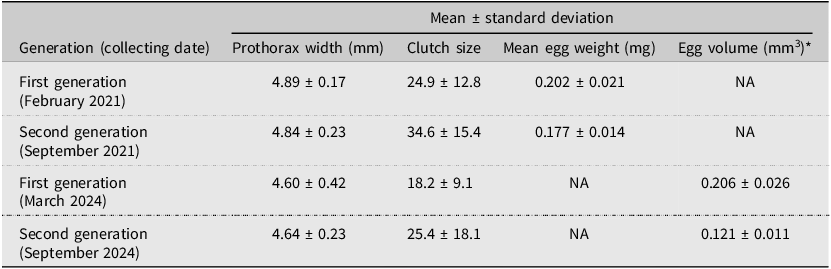
We collected gravid E. nubilus females from Takashima Island, Tokushima, Japan (34° 12′ 08″ N, 134° 36′ 17″ E, approximately 4 m elevation). In this population, the first generation uses Fatsia japonica (Thunberg) Decaisne and Planchon (Araliaceae) as a host plant, and the second generation switches to Dendropanax trifidus (Thunberg) Makino ex Hara (Araliaceae). Females from both generations were sampled in 2021 and 2024 (Table 1). Voucher specimens were deposited at the Department of Biology, Naruto University of Education, Tokushima, Japan.
Summary of reproductive traits associated with resource allocation in the first and second generations of Elasmostethus nubilus.

Table 1. Long description
The table presents data on reproductive traits of Elasmostethus nubilus collected from Takashima Island, Tokushima, Japan. It includes measurements from the first and second generations in the years 2021 and 2024. The table has four rows and five columns. Column headers are Prothorax width (mm), Clutch size, Mean egg weight (mg), Egg volume (mm^3), and Generation (collecting date). Row labels are First generation (February 2021), Second generation (September 2021), First generation (March 2024), and Second generation (September 2024). Row 1: Prothorax width 4.89 ± 0.17, Clutch size 24.9 ± 12.8, Mean egg weight 0.202 ± 0.021, Egg volume NA. Row 2: Prothorax width 4.84 ± 0.23, Clutch size 34.6 ± 15.4, Mean egg weight 0.177 ± 0.014, Egg volume NA. Row 3: Prothorax width 4.60 ± 0.42, Clutch size 18.2 ± 9.1, Mean egg weight NA, Egg volume 0.206 ± 0.026. Row 4: Prothorax width 4.64 ± 0.23, Clutch size 25.4 ± 18.1, Mean egg weight NA, Egg volume 0.121 ± 0.011.
*Egg volume was averaged within each clutch, and means and standard deviations were then calculated across clutches.
Each female was housed individually in a plastic Petri dish (9 cm diameter, 3 cm height) lined with filter paper and was provided with host plant stems, leaves, and fruits. The number of females in the first and second generations was 32 and 31 in 2021 and 30 and 23 in 2024, respectively. Rearing conditions were maintained at 15 °C (2021) or 17 °C (2024) with a 12-hour:12-hour light:dark photoperiod for the first generation and 27 °C (2021) or 25 °C (2024) with a 13-hour:11-hour light:dark photoperiod for the second generation. Relative humidity and light intensity were not measured. Females were checked for oviposition at approximately 24-hour intervals, and the first egg mass (clutch) laid by each female was used for trait measurements.
We first recorded the total number of eggs in the clutch (clutch size). In 2021, we measured the total weight of 5–10 arbitrarily selected eggs per clutch using an electronic balance (BP210D; Sartorius AG, Göttingen, Germany) and calculated the mean egg weight as an estimate of egg size. Sample sizes were 300 eggs from 32 clutches (first generation) and 303 eggs from 31 clutches (second generation). In 2024, we arbitrarily sampled 3–5 eggs per clutch and measured the length and width of each egg (Supplementary material, Figure S1), using a digital sight imaging controller incorporated into a binocular microscope (Nikon DS-L2; Nikon, Tokyo, Japan). Egg volume, as an estimate of egg size, was then calculated by approximating the eggs as spheroids. Sample sizes were 150 eggs from 30 clutches (first generation) and 112 eggs from 23 clutches (second generation). In both years, prothorax width was measured as an index of female body size using the same system.
All statistical analyses were performed in R, version 4.4.2 (R Core Team 2024). Datasets from 2021 and 2024 were analysed separately. To compare female body size between generations, we fitted a linear model, with generation as the explanatory variable. Mean egg weight was compared using a linear model, with generation as the explanatory variable. Egg volume was compared using a linear mixed-effects model, with generation as the explanatory variable and female ID as a random intercept. Clutch size was compared using a generalised linear model, with a quasi-Poisson error distribution and a log-link function to account for overdispersion. Finally, to test for generational variation in egg shape, we fitted a linear mixed-effects model, with egg length as the response variable and egg width, generation, and their interaction as explanatory variables, and with female ID included as a random intercept. Linear mixed-effects models were fitted using the lmer function implemented in the lme4 package (Bates et al. Reference Bates, Mächler, Bolker and Walker2015).
We tested for a trade-off between egg size (mean egg weight in 2021 or mean egg volume per clutch in 2024) and clutch size for each generation using partial correlation analysis, with female body size as the control variable. This analysis was conducted using the pcor.test function implemented in the ppcor package (Kim Reference Kim2015).
To examine the allometric relationship between egg size and shape within each generation, we first calculated the mean egg length and width for each female. To control for female body size, we regressed natural log-transformed egg length and width against natural log-transformed female body size using linear models and obtained the residuals (relative egg length and relative egg width). We then regressed relative egg length on relative egg width and evaluated whether the slope differed from 1 (i.e., isometry) using 95% confidence intervals. A slope greater than 1 would support the hypothesis of physical limitations imposed by female anatomy, whereas a slope less than 1 would support the hypothesis of energetic cost associated with eggshell production.
In E. nubilus, patterns of intergenerational variation in female body size, egg size, and clutch size were consistent over the two years studied (Table 1). Female body size in the first generation did not differ from that in the second generation (2021: estimate ± standard error = 0.051 ± 0.051, t = 0.99, P = 0.32; 2024: estimate ± standard error = −0.036 ± 0.098, t = −0.36, P = 0.72). Eggs from the first generation were significantly larger than those from the second generation in mean egg weight (2021: estimate ± standard error = 0.025 ± 0.005, t = 5.71, P < 0.001) and egg volume (2024: estimate ± standard error = 0.086 ± 0.006, t = 14.8, P < 0.001). Clutch sizes from the first generation were smaller than those from the second generation, although the difference was statistically marginal in 2024 (2021: estimate ± standard error = −0.33 ± 0.12, t = −2.71, P = 0.008; 2024: estimate ± standard error = −0.33 ± 0.17, t = −1.96, P = 0.055). After controlling for egg width, eggs from the first generation were significantly longer than those from the second generation (estimate ± standard error = 0.083 ± 0.013, t = 6.26, P < 0.001; Supplementary material, Table S1; Fig. 1).
Comparison of egg shape between eggs of the first generation (filled circles; n = 150) and those of the second generation (open circles; n = 112) in Elasmostethus nubilus. Regression lines correspond to the analyses presented in Supplementary material, Table S1.

After controlling for female body size, no phenotypic trade-off between egg size and clutch size was detected in either generation in 2021 (first generation: partial r = −0.16, P = 0.39; second generation: partial r = 0.13, P = 0.48) or in 2024 (first generation: partial r = 0.15, P = 0.43; second generation: partial r = −0.34, P = 0.12).
After controlling for female body size, the allometric relationship between egg length and width was isometric in the first generation (β ± standard error = 0.76 ± 0.18, confidence interval [0.38, 1.13]; Fig. 2A) and negatively allometric in the second generation (β ± standard error = 0.58 ± 0.19, confidence interval [0.18, 0.97]; Fig. 2B).
Allometric relationship between egg length and width across Elasmostethus nubilus females, accounting for female body size: A and B correspond to the first generation and the second generation, respectively. The regression line is shown with a shaded 95% confidence interval. The dashed line represents the 1:1 relationship (isometry).

We found that maternal resource allocation differs between the first and second generations of the herbivorous shield bug, E. nubilus, which are associated with different host plants. Females of the first generation, which use F. japonica, laid larger but fewer eggs than those of the second generation, which use D. trifidus, despite no difference in female body size (Table 1). We have previously reported variation in egg size and clutch size between generations using different host plants in another shield bug, Elasmucha putoni Scott (Acanthosomatidae) (Masamoto and Kudo Reference Masamoto and Kudo2024). The ultimate and proximate factors underlying intergenerational plasticity in egg and clutch size are discussed below.
The observed intergenerational plasticity in resource allocation may represent an adaptive response to differences in host plants. Nymphs of E. nubilus feed by inserting their stylets into host fruits to extract nutrients from the seeds. When the quantity and quality of host fruits (seeds) vary among plants, selection may favour larger eggs containing more resources on nutritionally poor hosts (Rizkawati et al. Reference Rizkawati, Sakai, Tsuchiya and Tsukada2023). However, it should be noted that the nutritional quality of host fruits can influence the condition of ovipositing females and, consequently, their reproductive output and the allocation of resources to eggs (Moreau et al. Reference Moreau, Desouhant, Louâpre, Goubault, Rajon and Jarrige2017). In addition, if morphological defences of fruits against nymphal feeding (e.g., fruit tissue thickness) vary among host plants, larger eggs, and consequently larger hatchlings with greater feeding ability (e.g., larger mandibles or longer stylets), may be favoured on well-defended hosts that are difficult for hatchlings to exploit (Nakasuji Reference Nakasuji1987; Fox et al. Reference Fox, Thakar and Mousseau1997). Additional factors, including competition over food resources and predation risk, may also contribute to the variation in resource allocation (Fox and Czesak Reference Fox and Czesak2000).
The two generations that we studied differed not only in host plant use but also in the climatic conditions during oviposition. In Tokushima, first-generation E. nubilus females experience markedly lower monthly mean temperatures during the reproductive period (February 2021: 8.6 °C; March 2024: 9.9 °C) than second-generation females did (September 2021: 24.9 °C; September 2024: 28.0 °C; Japan Meteorological Agency 2026). To reflect these natural conditions, we reared first-generation females under cooler conditions with a short photoperiod and second-generation females under warmer conditions with a long photoperiod. The production of larger eggs by the first generation may represent an adaptive response to cooler temperatures during oviposition (Fischer et al. Reference Fischer, Brakefield and Zwaan2003). For example, at the lower temperatures, where growth is slower, selection may favour larger eggs that mature sooner, reducing their exposure to sources of mortality (Yampolsky and Scheiner Reference Yampolsky and Scheiner1996). If this is the case, insects may use temperature itself, other seasonal factors such as photoperiod, or a combination of these as cues to predict environmental conditions (Seko and Nakasuji Reference Seko and Nakasuji2006). On the other hand, larger eggs at the lower temperatures may also arise as a nonadaptive physiological response (Fox and Czesak Reference Fox and Czesak2000; Fischer et al. Reference Fischer, Brakefield and Zwaan2003). For example, the rate of oocyte production relative to the rate of oocyte growth may vary with temperature, potentially affecting egg size and number (Van der Have and De Jong Reference Van der Have and de Jong1996; Ernsting and Isaaks Reference Ernsting and Isaaks1997, Reference Ernsting and Isaaks2000). To disentangle proximate and ultimate causes and to isolate interacting factors, future studies should employ controlled experiments that incorporate intergenerational environmental variables that influence egg and clutch size.
No phenotypic trade-off between egg size and clutch size was detected in either generation of E. nubilus after controlling for female body size in the present study. Females of this iteroparous species acquire the nutrients required for continuous egg production by feeding on host fruits. Such an iteroparous reproductive strategy may increase among-female variation in the total resources invested per oviposition event, potentially obscuring a trade-off between egg size and clutch size (Kudo et al. Reference Kudo, Harano, Tsai, Yoshizawa and Kutsukake2024). In contrast, we previously detected a trade-off between egg size and clutch size within a generation of the semelparous acanthosomatid bug, E. putoni, which provides maternal care (Masamoto and Kudo Reference Masamoto and Kudo2024).
We also detected intergenerational variation in egg shape in E. nubilus. Specifically, at any given egg width, eggs from the first generation were longer than those from the second generation (Supplementary material, Table S1; Fig. 1), indicating that the former were more elongated. In insects, it has been proposed that larger eggs tend to be more elongated to facilitate their passage through narrow openings or the ovipositor during oviposition (Church et al. Reference Church, Donoughe, de Medeiros and Extavour2019; Donoughe Reference Donoughe2022). Large-scale comprehensive analyses by Church et al. (Reference Church, Donoughe, de Medeiros and Extavour2019) revealed an association between larger egg size and higher aspect ratios across insects, although this relationship varied markedly among subclades. Furthermore, Boisseau and Woods (Reference Boisseau and Woods2024) showed that, in stick and leaf insects, species with narrower abdomens relative to body size produce more elongated eggs. However, within insect species, few studies have assessed the extent to which female anatomy constrains egg shape in relation to egg size (Noriyuki et al. Reference Noriyuki, Kishi and Nishida2010).
In the present study on the shield bug, E. nubilus, we found no evidence that egg shape is constrained by female anatomy (Fig. 2). This finding may be attributable to the absence of clear morphological features in the females of this species that would constrain egg width, such as a rigid, tubular ovipositor or a narrow body form. Similarly, Noriyuki et al. (Reference Noriyuki, Kishi and Nishida2010) reported that in the bivoltine butterfly, Ypthima multistriata Butler (Lepidoptera: Satyridae), egg elongation was not associated with, or increased only slightly with, egg size relative to female body size within each generation, suggesting that females have little need to produce elongated eggs in response to anatomical constraints.
Besides anatomical constraints, natural selection driven by ecological and behavioural factors, such as oviposition habitats and modes, may influence the diversification of insect egg shapes (Church et al. Reference Church, Donoughe, de Medeiros and Extavour2019; Boisseau and Woods Reference Boisseau and Woods2024). For instance, parental guarding has been shown to drive egg shape variation both within (Masamoto et al. Reference Masamoto, Hosokawa and Kudo2026) and among species (Kudo et al. Reference Kudo, Harano, Tsai, Yoshizawa and Kutsukake2025) of acanthosomatid bugs. However, E. nubilus females do not exhibit such parental care in any generation. Consequently, the selective factors underlying the intergenerational differences in egg shape for E. nubilus remain unknown. Further study is required to understand the factors contributing to this intergenerational variation from the perspectives of both adaptation and constraint.
Supplementary material
The supplementary material for this article can be found at https://doi.org/10.4039/tce.2026.10066.
Acknowledgements
The authors thank C. Koshio, D. Shido, and T. Ota for their assistance in the field. They are also grateful to the two anonymous reviewers for their constructive comments, which helped to improve the discussion. This study was supported in part by a grant-in-aid (JSPS KAKENHI: JP21K06335) from the Japan Society for the Promotion of Science.
Competing interests
The authors declare that they have no competing interests.