




No CrossRef data available.
Mining code changes undermine biodiversity conservation in Brazil
Published online by Cambridge University Press: 10 August 2017
Extract
Protected areas (PAs) are vital for the conservation of Brazil's biodiversity (Barber et al.2014). However, they are at risk of a downgrade in legal status due to economic pressures on natural resources (Bernard et al.2014; De Marques & Perez 2014; Pack et al.2016). Mining is one of the most urgent environmental threats in Brazil (Ferreira et al.2014; El Bizri et al.2016), with plans in place for a 10-fold increase in the number of mining projects in c. 8 years. If all were developed, the Brazilian territory occupied by mining would increase 23-fold in the near future. Currently, 12 697 projects covering 98 × 105 ha are planned within PAs. Licensing and exploitation of 53% of this land will depend on the approval of three bills that intend to authorize mining in areas where it was formerly forbidden. Here, we analyse the potential consequences of the approval of these new policies for conservation.
Keywords
Information
- Type
- Comment
- Information
- Environmental Conservation , Volume 45 , Issue 1: Thematic section. Humans and Island Environments , March 2018 , pp. 96 - 99
- Copyright
- Copyright © Foundation for Environmental Conservation 2017
References
Barber, C.P., Cochrane, M.A., Souza, C.M. & Laurance, W.F. (2014) Roads, deforestation, and the mitigating effect of protected areas in the Amazon. Biological Conservation
177: 203–209.Google Scholar
Barreto, M.L. (2003) Formalização da mineração de pequena escala (MPE) na América Latina e Caribe. [www document]. URL http://www.redeaplmineral.org.br/biblioteca/formalizacao-da-mineracao-a-pequena-escala-mpe-na-america-latina-e-caribe/at_download/arquivo
Google Scholar
Bernard, E., Penna, L.A.O., & Araújo, E. (2014) Downgrading, downsizing, degazettement, and reclassification of protected areas in Brazil. Conservation Biology
28: 939–950.Google Scholar
Castilhos, Z., Rodrigues-Filho, S., Cesar, R., Rodrigues, A.P., Villas-Bôas, R., de Jesus, I., Lima, M., Faial, K., Miranda, A., Brabo, E., Beinhoff, C. & Santos, E. (2015) Human exposure and risk assessment associated with mercury contamination in artisanal gold mining areas in the Brazilian Amazon. Environmental Science and Pollution Research
22: 11255–11264.CrossRefGoogle ScholarPubMed
CBD (2010) The strategic plan for biodiversity 2011–2020 and the Aichi biodiversity targets. [www document]. URL http://www.cbd.int/doc/decisions/cop-10/cop-10-dec-02-en.pdf
Google Scholar
De Marques, A.A.B. & Perez, C.A. (2014) Pervasive legal threats to protected areas in Brazil. Oryx
49: 25–29.Google Scholar
El Bizri, H.R., Macedo, J.C.B., Paglia, A.P. & Morcatty, T.Q. (2016) Mining undermining Brazil's environment. Science
353: 228.Google Scholar
Escobar, H. (2015) Mud tsunami wreaks ecological havoc in Brazil. Science
350: 1138–1139.Google Scholar
Ferreira, J., Aragão, L.E.O.C., Barlow, J., Barreto, P., Berenguer, E., Bustamante, M., Gardner, T.A., Lees, A.C., Lima, A., Louzada, J., Pardini, R., Parry, L., Peres, C.A., Pompeu, P.S., Tabarelli, M. & Zuanon, J. (2014) Brazil's environmental leadership at risk. Science
346: 706–707.CrossRefGoogle ScholarPubMed
Haslam, P.A. & Tanimoune, N.A. (2016) The determinants of social conflict in the Latin American mining sector: new evidence with quantitative data. World Development
78: 401–419.Google Scholar
Hilson, G. (2002) An overview of land use conflicts in mining communities. Land Use Policy
19: 65–73.Google Scholar
IBAMA (2004) Instrução Normativa n° 31, de 27 de maio de 2004 [www document]. URL http://www.mma.gov.br/estruturas/pnf/_arquivos/in_ibama_31_04.pdf
Google Scholar
ICMM (2013) O setor de mineração no Brasil: fortalecimento institucional para o desenvolvimento sustentável [www document]. URL http://www.opml.co.uk/sites/default/files/ICMM%20mining%20sector%20in%20Brazil%20case%20study%20-%20portuguese%20version_0.pdf
Google Scholar
Laurance, W.F., Goosem, M. & Laurance, S.G. (2009) Impacts of roads and linear clearings on tropical forests. Trends in Ecology & Evolution
24: 659–669.CrossRefGoogle ScholarPubMed
Meira, R.M., Peixoto, A.L., Coelho, M.A., Ponzo, A.P., Esteves, V.G., Silva, M.C., Câmara, P.E.A.S. & Meira-Neto, J.A. (2016) Brazil's mining code under attack: giant mining companies impose unprecedented risk to biodiversity. Biodiversity and Conservation
2: 407–409.Google Scholar
Pack, S.M., Ferreira, M.N., Krithivasan, R., Murrow, J., Bernard, E. & Mascia, M.B. (2016) Protected area downgrading, downsizing, and degazettement (PADDD) in the Amazon. Biological Conservation
197: 32–39.Google Scholar
Rolla, A. & Ricardo, F. (2013) Mineração em Terras Indígenas na Amazônia Brasileira 2013. São Paulo, Brazil: ISA.Google Scholar
Ricardo, F. & Rolla, A. (2006) Mineração em Unidades de Conservação na Amazônia Brasileira. São Paulo, Brazil: ISA.Google Scholar
Sayuri, L., Sugai, M., Ochoa-Quintero, J.M., Costa-pereira, R. & Roque, F.O. (2015) Beyond aboveground. Biodiversity and Conservation
24: 2109–2112.Google Scholar
Schulman, L., Ruokolainen, K., Junikka, L., Sääksjärvi, I.E., Salo, M., Juvonen, S.-K., Salo, J. & Higgins, M. (2007) Amazonian biodiversity and protected areas: do they meet? Biodiversity and Conservation
16: 3011–3051.Google Scholar
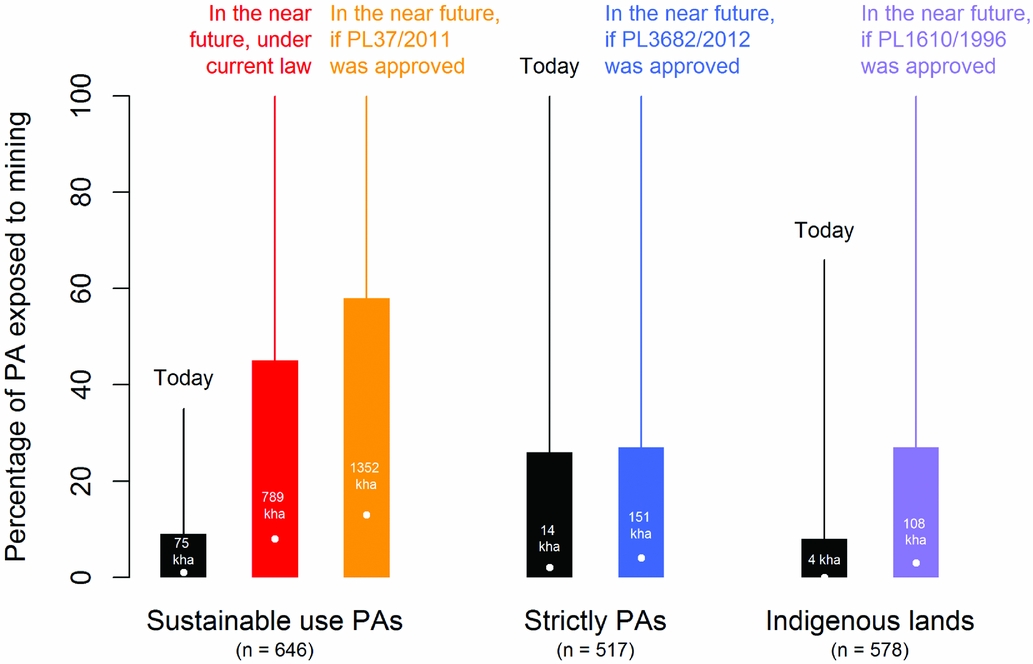
Figure 1 Impact of mining on Brazilian PAs today (black bars) and as planned for the near future under four legal scenarios (red, orange, blue and purple bars). The percentage land that is/could be impacted by mining is represented by means (white points), standard errors (boxes) and maximum values (whiskers); the average absolute impacted areas are shown by white numbers. Impact is defined as the spatial extent occupied by mining. Planned projects are estimated to be developed within 8 years. n = total number of PAs; PA = protected area.
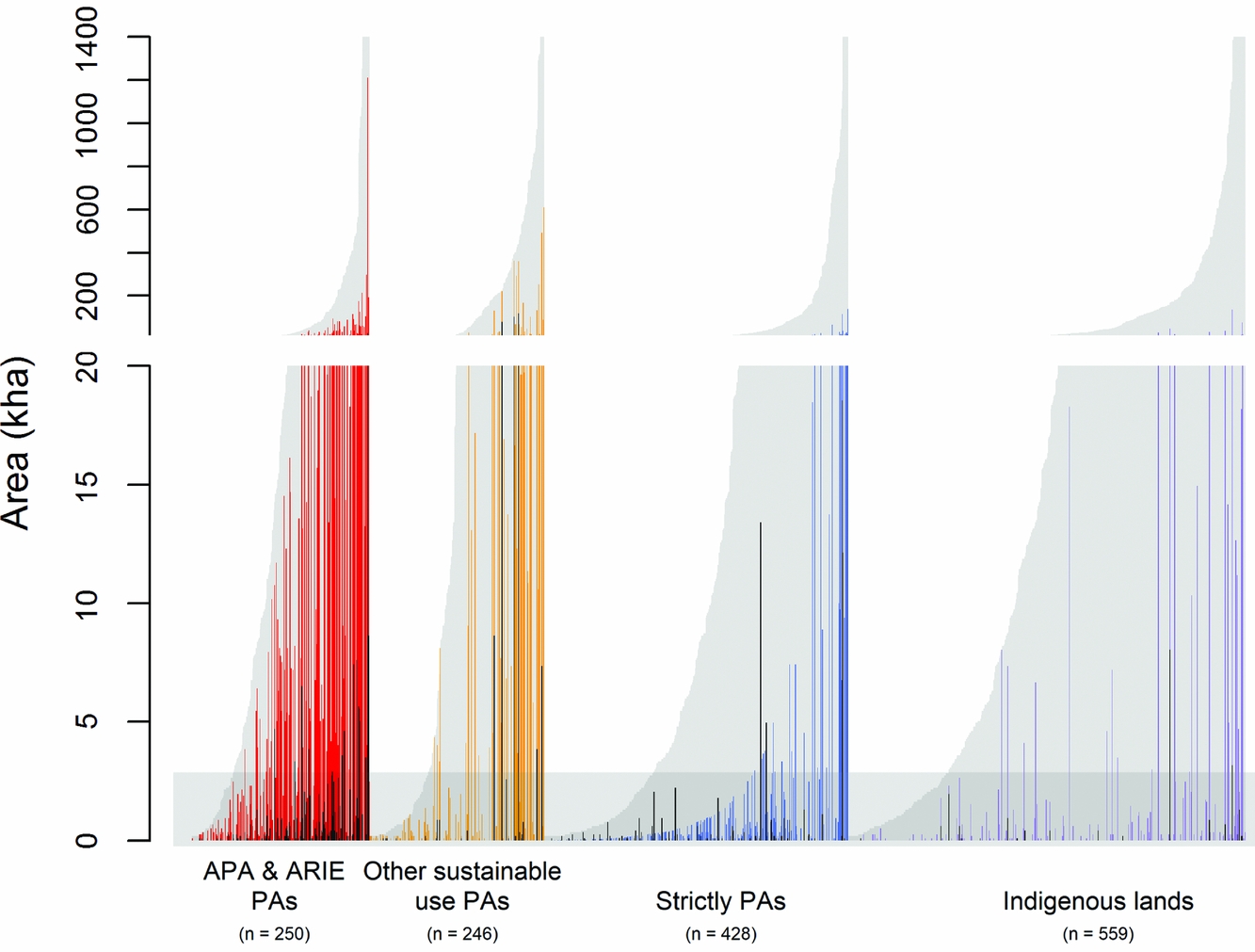
Figure 2 Total extent of Brazilian PAs (grey) and area occupied by mining today (black) and as planned for the near future under four legal scenarios (from left to right): if any new law was approved (red); if PL37/2011 was approved (orange); if PL3682/2012 was approved (blue); and if PL1610/1996 was approved (purple). Each bar represents one single PA. Planned projects are estimated to be developed within 8 years. n = number of protected areas represented in the figure; protected areas with extents of ≤85 ha are excluded; PA = protected area. See Fig. S2 for more details corresponding to the grey rectangle in this figure.

Villén-Pérez supplementary material
Villén-Pérez supplementary material

PDF
708.6 KB
 You have
Access
- 24
- Cited by
Protected areas (PAs) are vital for the conservation of Brazil's biodiversity (Barber et al. Reference Barber, Cochrane, Souza and Laurance2014). However, they are at risk of a downgrade in legal status due to economic pressures on natural resources (Bernard et al. Reference Bernard, Penna and Araújo2014; De Marques & Perez Reference De Marques and Perez2014; Pack et al. Reference Pack, Ferreira, Krithivasan, Murrow, Bernard and Mascia2016). Mining is one of the most urgent environmental threats in Brazil (Ferreira et al. Reference Ferreira, Aragão, Barlow, Barreto, Berenguer, Bustamante, Gardner, Lees, Lima, Louzada, Pardini, Parry, Peres, Pompeu, Tabarelli and Zuanon2014; El Bizri et al. Reference El Bizri, Macedo, Paglia and Morcatty2016), with plans in place for a 10-fold increase in the number of mining projects in c. 8 years. If all were developed, the Brazilian territory occupied by mining would increase 23-fold in the near future. Currently, 12 697 projects covering 98 × 105 ha are planned within PAs. Licensing and exploitation of 53% of this land will depend on the approval of three bills that intend to authorize mining in areas where it was formerly forbidden. Here, we analyse the potential consequences of the approval of these new policies for conservation.
Brazil has a number of legal categories for land protection, including strict PAs, sustainable-use PAs and indigenous lands. Mining is only permitted in some sustainable-use PAs (named APAs and ARIEs from their initials in Portuguese; see Supplementary Material, available online). Today, 1195 mining projects covering 1.6 × 10⁵ ha are established in these areas, while 367 projects covering 4.2 × 10⁵ ha are working in PAs where mining is theoretically not allowed (Figs 1 and 2). The large impacted area in lands regulated as mining-free has various explanations. For some PAs, the law allows mining works to continue when they were approved prior to the establishment of the PA (IBAMA 2004). For the others, diverse misinterpretations of current law have led to improper mining concessions and subsequent judicial battles (Ricardo & Rolla Reference Ricardo and Rolla2006). In addition to direct habitat loss and the frequent destruction of caves (Ferreira et al. Reference Ferreira, Aragão, Barlow, Barreto, Berenguer, Bustamante, Gardner, Lees, Lima, Louzada, Pardini, Parry, Peres, Pompeu, Tabarelli and Zuanon2014; Sayuri et al. Reference Sayuri, Sugai, Ochoa-Quintero, Costa-pereira and Roque2015), mining causes a range of secondary impacts. The massive migration of workers to low-populated areas, as well as the infrastructure associated with the project, further increases habitat loss and opens up intact wild areas to illegal forest colonization and exploitation (Laurance et al. Reference Laurance, Goosem and Laurance2009). Mining activity itself also has an impact beyond its frontiers: rivers downstream may be polluted (Castilhos et al. Reference Castilhos, Rodrigues-Filho, Cesar, Rodrigues, Villas-Bôas, de Jesus, Lima, Faial, Miranda, Brabo, Beinhoff and Santos2015) and threatened by environmental accidents, such as the mining dam collapse that devastated the Doce River and the Southeast Brazilian coast in November 2015 (Escobar Reference Escobar2015). Finally, mining has often resulted in social problems and conflicts with nearby communities (Hilson Reference Hilson2002; Haslam & Tanimoune Reference Haslam and Tanimoune2016), such as the confrontation between miners and the Cinta Larga indigenous tribe (Rolla & Ricardo Reference Rolla and Ricardo2013).
Impact of mining on Brazilian PAs today (black bars) and as planned for the near future under four legal scenarios (red, orange, blue and purple bars). The percentage land that is/could be impacted by mining is represented by means (white points), standard errors (boxes) and maximum values (whiskers); the average absolute impacted areas are shown by white numbers. Impact is defined as the spatial extent occupied by mining. Planned projects are estimated to be developed within 8 years. n = total number of PAs; PA = protected area.
Total extent of Brazilian PAs (grey) and area occupied by mining today (black) and as planned for the near future under four legal scenarios (from left to right): if any new law was approved (red); if PL37/2011 was approved (orange); if PL3682/2012 was approved (blue); and if PL1610/1996 was approved (purple). Each bar represents one single PA. Planned projects are estimated to be developed within 8 years. n = number of protected areas represented in the figure; protected areas with extents of ≤85 ha are excluded; PA = protected area. See Fig. S2 for more details corresponding to the grey rectangle in this figure.
NEW BILLS MEAN ‘CARTE BLANCHE’ TO MINING IN PROTECTED AREAS
There are three parliamentary bills that consider the establishment of mining in PAs where it is currently forbidden. Each of the bills is directed at one type of PA. Bill PL37/2011 is proposed to allow mining in all types of sustainable-use PAs without restrictions on the percentage of the PA extension to be impacted. PL3682/2012 may allow mining covering up to 10% of each strict PA, and PL1610/1996 would allow the development of mining activities in indigenous lands without extension restrictions. PL1610/1996 is currently under consideration, while PL37/2011 and PL3682/2012 were recently retracted. Nonetheless, they could be brought back up at any time, especially given the scenario of political instability in Brazil. Moreover, mining enterprises appear to be preparing for the approval of the three bills. The government has recently received nearly 2400 applications for mining exploration or licensing within PAs in which mining is currently not permitted.
WOULD NEW POLICIES MAKE A DIFFERENCE?
In accordance with current jurisprudence, only mining planned at APAs and ARIEs could be licensed. There are more than 11 200 projects planned in these areas to date. Following their establishment, the area affected by mining in these units would expand 30-fold. This would increase the direct impact of mining on sustainable areas (Figs 1 and 2).
However, if the three bills pass, the mining impact in all other PAs could increase 13-fold (5 million ha) within 8 years, resulting in a total impact of 10 million ha by mining in Brazilian PAs (Fig. 2). The approval of PL37/2011 would open the possibility for extraction in sustainable-use PAs where mining is currently forbidden, in which 46 projects are planned. If this bill were approved, the development of these projects would increase the total impact of mining in these lands from the current 3 × 10⁵ ha to 40 × 105 ha. The approval of PL3682/2012 would imply the official release of strict PAs, where 1851 projects have already been planned. If these projects were developed, even considering the areal restrictions of the bill, the total impact of mining in strict PAs would expand from the current 0.7 × 10⁵ ha to 8 × 10⁵ ha. Finally, the approval of PL1610/1996 would mean a victory of mining enterprises over indigenous interests after a 20-year legal battle (e.g. Rolla & Ricardo Reference Rolla and Ricardo2013). The 114 million ha of indigenous lands that protect both biodiversity and indigenous rights would be available for mining without extension restrictions. To date, 541 projects have been planned in indigenous lands, meaning that the current impact of mining on these lands (0.2 × 10⁵ ha) could rise to 6 × 10⁵ ha.
Supporters of downgrading PAs argue that the total amount of land affected would be quite small compared to the large extents of Brazilian PAs (see Fig. S1). However, the average percentage of land impacted (Fig. 1) suffers from the fallacy of the average. There are many areas in which mining enterprises have not shown any interest yet, either because there are no exploitable resources or because benefits do not outweigh transportation costs due to geographical isolation. When averaging, areas with zero impact may overshadow large impacts on others, where mining already occupies up to 100% of the PA (Figs 1 and 2). However, impacts are relevant at the scale of individual PAs, as each one aims to preserve endemic biotas, landscapes or cultures of special interest (Schulman et al. Reference Schulman, Ruokolainen, Junikka, Sääksjärvi, Salo, Juvonen, Salo and Higgins2007). Therefore, mining development and subsequent environmental damage may compromise species, ecosystems and human populations with restricted distributions. Moreover, our results only refer to direct impacts within project limits, so the real consequences of mining, including secondary effects, may be underestimated. In addition, the impacts shown here are added to those of illegal mining, which in Brazil accounts for up to 90% of artisanal mines (Barreto Reference Barreto2003). Such changes in the mining legislation may also hinder the compliance of Brazilian international agreements both to preserve 17% of its territory with effective PA networks and to reduce the extinction risk of endangered species by 2020 (Aichi goals; CBD 2010).
Here we have shown how changes in the Brazilian mining code may affect the PAs of the country in the short-term, considering projects that are in the planning phase. The velocity at which mining will impact Brazilian biodiversity in the mid-term is uncertain, although a change in the mining code may further stimulate the interest of companies in currently unexplored PAs. Mining is an important economic activity in Brazil (ICMM 2013), but extending it across current PAs via any PA downgrading, downsizing and degazettement mechanism (Pack et al. Reference Pack, Ferreira, Krithivasan, Murrow, Bernard and Mascia2016) is not compatible with the sustainable development of the country (Meira et al. Reference Meira, Peixoto, Coelho, Ponzo, Esteves, Silva, Câmara and Meira-Neto2016). New bills are neglecting the importance of PAs, as mining jeopardizes water resources and ecological services maintenance, climate change prevention and indigenous well-being and culture preservation. Mining companies are waiting for the open season to exploit new lands, while the parliament now has the opportunity to avoid further degradation of the PAs that may be the last refuge for Brazilian biodiversity.
ACKNOWLEDGEMENTS
We thank Luis Mauricio Bini and Adriano Pereira Paglia for useful comments on the manuscript.
FINANCIAL SUPPORT
Sara Villén-Pérez and Poliana Mendes are supported by CNPq fellowships (437509/2016-8 and 403347/2014-9, respectively). Paulo De Marco Junior is supported by a continuous CNPq productivity grant (308694/2015-5).
Supplementary material
To view supplementary material for this article, please visit https://doi.org/10.1017/S0376892917000376