Introduction
Temporomandibular disorder or temporomandibular joint (TMJ) dysfunction affects between 5 and 70 per cent of the Caucasian population, and is commonly seen in otolaryngology out-patient clinics.Reference Ferendiuk, Zajdel and Pihuyt 1 – Reference Sharma, Gupta, Pal and Jurel 4 Although not classically an ENT problem, temporomandibular disorder often causes otolaryngological symptoms. This leads to ENT referral for further investigation.Reference Sharma, Gupta, Pal and Jurel 4
This literature review gives guidance in identifying when otolaryngological symptoms are secondary to temporomandibular disorder and advises on appropriate management from an otolaryngologist's perspective.
Materials and methods
A search of Medline (Embase) and PubMed was performed from the date of each database inception to 30 March 2015, with an update on 1 July 2015. The search was performed using the following combinations of key words: ‘temporomandibular disorder’ together with ‘diagnostic criteria’, ‘symptoms’, ‘otolaryngology’, ‘management’, ‘physiotherapy’, ‘radiography’, ‘classification’, ‘prognosis’, ‘ear, nose and throat’ and ‘type’.
The inclusion criteria were: abstracts, case reports, case series, literature reviews, retrospective analyses, clinical trials, randomised controlled trials and systematic reviews (written in English language only) that discussed temporomandibular disorder in conjunction with otolaryngological symptoms; if appropriate, these needed to describe interventions. The treatment methods needed to be conservative, well described and reproducible in an ENT out-patient setting.
Studies were excluded if: there was no consideration of otolaryngological symptoms; there were no specific investigation or management recommendations made (where appropriate); conservative management had previously failed and further conservative options were not pursued; or the only management options described fell outside the scope of an otolaryngologist's consulting room (i.e. requiring surgical intervention). These criteria were considered exclusively and in combination with one another.
Following amalgamation of the current data and previous reviews, this review aimed to provide a streamlined, evidence-based approach to management of temporomandibular disorder in an otolaryngologist out-patient setting.
Results
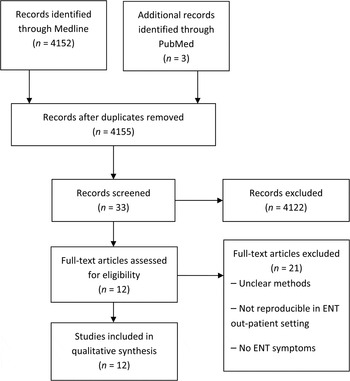
The combined searches yielded a total of 4155 different studies. The majority of studies on temporomandibular disorder had been conducted by oral and maxillofacial surgeons or dentists. There were few studies on temporomandibular disorder that were relevant to otolaryngologists. After further evaluating titles and abstracts, a total of 33 studies were considered potentially relevant. The final review of all 33 publications identified a total of 12 papers that met the inclusion and exclusion criteria;Reference Ferendiuk, Zajdel and Pihuyt 1 – Reference Richardson, Gonzalez, Crow and Sussman 12 these were included in the systematic literature review on temporomandibular disorder in otolaryngology. The flow diagram for study selection is shown in Figure 1.
Flow diagram for study selection

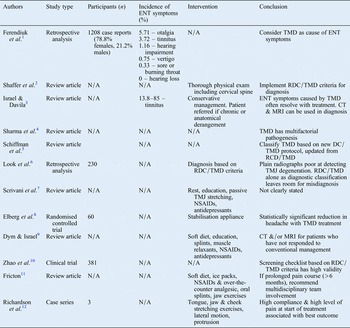
The characteristics of included studies are demonstrated in Table I. Of the 12 studies, 7 were systematic reviews, 2 were retrospective analyses, 1 was a randomised controlled trial, 1 was a clinical trial and 1 was a case series.Reference Ferendiuk, Zajdel and Pihuyt 1 – Reference Richardson, Gonzalez, Crow and Sussman 12
Characteristics of included studies

N/A = not available; TMD = temporomandibular disorder; RDC/TMD = Research Diagnostic Criteria for Temporomandibular Disorders; CT = computed tomography; MRI = magnetic resonance imaging; DC/TMD = Diagnostic Criteria for Temporomandibular Disorders; TMJ = temporomandibular joint; NSAIDs = non-steroidal anti-inflammatory drugs
In general, the included reviews were of poor quality. All the included reviews lacked detail regarding the method of literature collection and analysis, and instead were based more on expert opinion. The included publications were lacking in: detail regarding the method of information collection and synthesis, clear and descriptive management options, and discussion regarding included study quality. The case series had small sample sizes. The retrospective analysis, the clinical trial and the randomised controlled trial had larger patient numbers and provided clear detail as to how they reached their conclusion.
The distinct lack of high quality trials in the area upon which this review is based was very restrictive. Nevertheless, the authors have compiled recommendations and findings, and presented them in a format that can be followed in an otolaryngologist's consulting room setting.
Discussion
Defining temporomandibular disorder
Temporomandibular disorder involves pain and dysfunction to the TMJ, jaw, and the muscles controlling these structures.Reference Israel and Davila 3
There are a variety of criteria to classify temporomandibular disorder; the more commonly mentioned tool is the Diagnostic Criteria for Temporomandibular Disorders.Reference Schiffman, Ohrbach, Truelove, Look, Anderson and Goulet 5 This considers temporomandibular disorder across two axes. Axis I represents physical dysfunction and axis II reflects the psychological impact of temporomandibular disorder. Both are important to consider as they influence management options and prognosis.Reference Look, Schiffman, Truelove and Ahmad 6 The Diagnostic Criteria for Temporomandibular Disorders tool encompasses four categories. Each person can have only one diagnosis from each category, but can have diagnoses from multiple categories. These categories are divided into the following: (1) TMJ disorders; (2) masticatory muscle disorders; (3) headache attributed to temporomandibular disorder; and (4) problems with associated structures.Reference Schiffman, Ohrbach, Truelove, Look, Anderson and Goulet 5
Temporomandibular joint disorders describe anatomical dysfunction of the joint. Such derangement can cause synovitis, pain over the TMJ, a popping noise upon disc reduction, and limited range of motion with mouth opening and jaw locking.Reference Shaffer, Brismee, Sizer and Courtney 2 , Reference Look, Schiffman, Truelove and Ahmad 6 , Reference Scrivani, Keith and Kaban 7
Masticatory muscle disorders usually have no evidence of anatomical pathology. They cause symptoms including facial pain, masticatory muscle point tenderness, jaw dysfunction, otolaryngological symptoms and muscle stiffness.Reference Look, Schiffman, Truelove and Ahmad 6 , Reference Scrivani, Keith and Kaban 7 These symptoms are commonly associated with TMJ dysfunction. Otolaryngological symptoms, stress and anxiety are more commonly associated with masticatory muscle disorders than anatomical TMJ derangement.Reference Shaffer, Brismee, Sizer and Courtney 2 , Reference Israel and Davila 3 , Reference Scrivani, Keith and Kaban 7
The precise association between headache and temporomandibular disorder is unclear. It is known that temporomandibular disorder and headache can occur concurrently, that increased temporomandibular disorder symptoms can worsen headache, and that treatment of temporomandibular disorder can result in reduced headache severity.Reference Schiffman, Ohrbach, Truelove, Look, Anderson and Goulet 5 , Reference Elberg, Vallon and Nilner 8
Cervical spine pathology can result in: deranged mobility of the TMJ,Reference Shaffer, Brismee, Sizer and Courtney 2 referred pain to the TMJ and surrounding structures, otalgia, vertigo, and tinnitus.Reference Kraus 13
Prevalence
The prevalence of temporomandibular disorder is 5–70 per cent.Reference Ferendiuk, Zajdel and Pihuyt 1 , Reference Shaffer, Brismee, Sizer and Courtney 2 , Reference Sharma, Gupta, Pal and Jurel 4 Pain is a major symptom in 40 per cent of patients.Reference Ferendiuk, Zajdel and Pihuyt 1 It has been reported that 40–75 per cent of the population have one sign of temporomandibular disorder and 33 per cent have one symptom.Reference Scrivani, Keith and Kaban 7 It is a disease of young to middle-aged females, with a female-to-male ratio ranging from 3:1 to 9:1. Incidence decreases in both sexes after the age of 55 years.Reference Scrivani, Keith and Kaban 7 , Reference Dym and Israel 9
Referred ENT symptoms
Temporomandibular disorder presents with symptoms related to muscular pain and/or mechanical joint dysfunction. It is common for associated ENT symptoms to occur.Reference Ferendiuk, Zajdel and Pihuyt 1 , Reference Ramirez, Ballesteros and Sandoval 14 In these cases, otolaryngologists may become involved following referral from general practitioners or other sources. ENT symptoms have been reported at varying frequencies, with otalgia ranging from 5 to 30 per cent and tinnitus from 30 to 85 per cent. Tinnitus and facial pain are more common in temporomandibular disorder patients with depressive symptoms.Reference Ferendiuk, Zajdel and Pihuyt 1 , Reference Israel and Davila 3 ENT symptoms are more common in patients who present with myofascial pain rather than intra-articular disc disorder. Otolaryngological symptoms are more common in patients with temporomandibular disorder than in the normal population.Reference Israel and Davila 3 A review by Ramirez et al. found that common otological symptoms, in order of frequency, are: otalgia, tinnitus, aural fullness, vertigo and subjective hearing impairment.Reference Ramirez, Ballesteros and Sandoval 14
The mechanism behind TMJ dysfunction producing otalgia and other otolaryngological symptoms remains unclear. The masseter muscles, the facial muscles and the ear muscles (tensor palate and tensor tympani) have a common embryonic origin from the first pharyngeal pouch, and share innervation with the TMJ.Reference Pasha and Golub 15 This may allow pain referral from the TMJ to the ear, and potentially explains why otological symptoms occur more frequently with myofascial pain.Reference Ferendiuk, Zajdel and Pihuyt 1 , Reference Israel and Davila 3
Cervical spine pathology can cause referred otological symptoms and pain in the TMJ and orofacial areas. This is due to the anatomical proximity of the cervical spine and otological or TMJ nerve root synapse,Reference Kraus 13 and because of the cervical spine musculature's contribution to TMJ stability and movement.Reference Shaffer, Brismee, Sizer and Courtney 2 Contraction of the cervical spine muscles activates nerve roots, leading to referral of pain or other symptoms. Cervical spine pathology can result in myofascial TMJ pain. This is possibly secondary to muscle contraction around the cervical spine, resulting in sustained contraction of the masticatory muscles, initiating or perpetuating myofascial pain.Reference Schiffman, Ohrbach, Truelove, Look, Anderson and Goulet 5 , Reference Kraus 13
Diagnosis and differentiation from other causes
Diagnosis of temporomandibular disorder can be difficult: temporomandibular disorder presents with a variety of symptoms, and the presenting symptoms are not exclusive to temporomandibular disorder. The Diagnostic Criteria for Temporomandibular Disorders tool was developed based on recommended criteria for a more accurate diagnosis.Reference Schiffman, Ohrbach, Truelove, Look, Anderson and Goulet 5 , Reference Look, Schiffman, Truelove and Ahmad 6 The most common diagnoses are divided into two categories: myofascial pain and joint disorders. These are not mutually exclusive, and patients commonly exhibit features of both categories.Reference Dym and Israel 9 Myofascial pain symptoms and signs include: pain in the masticatory muscles and structures (temple, front of ear, jaw), functionally and in response to palpation; pain reproducible on palpation; and generalised pain of insidious onset. Joint disorder signs and symptoms include: clicking on jaw opening and closing; jaw locking and limited opening; an inability to close the jaw without specific manoeuvres; joint crepitus or clicking; acute onset, well-localised pain; and limited jaw opening, lateral movement or protrusion.Reference Israel and Davila 3 , Reference Schiffman, Ohrbach, Truelove, Look, Anderson and Goulet 5 , Reference Dym and Israel 9
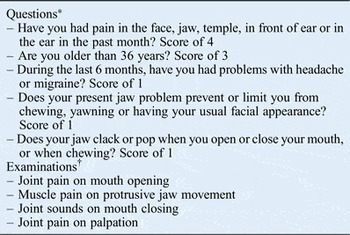
In patients who are referred to an otolaryngologist for investigation of ENT symptoms known to occur in temporomandibular disorder, a screening tool, proposed by Zhao et al., can be used to determine if temporomandibular disorder is likely (Table II).Reference Zhao, Evans, Byth, Murray and Peck 10
Temporomandibular disorder screening checklistReference Zhao, Evans, Byth, Murray and Peck 10

*If the total questions score is less than 3, it is predicted that there is no temporomandibular joint (TMJ) dysfunction; if the total score is 3 or more, the listed examinations are performed. †If none of the examination findings are positive, it is likely that there is no TMJ dysfunction; otherwise, it is predicted that TMJ is present.
In the case of a positive screening test, exploring the symptomatology further can allow patients to be classified as having either myofascial or joint disturbance. Intra-articular pain is well localised and acute, whilst myofascial pain is more generalised and of insidious onset.Reference Israel and Davila 3 , Reference Dym and Israel 9 A history of mandibular parafunction, including jaw clenching or bruxism, is known to contribute to temporomandibular disorder. Temporomandibular disorder, particularly the myofascial variant, and cervical spine pain co-exist in up to 70 per cent of cases.Reference Kraus 13 Thus, cervical spine pathology must also be considered in temporomandibular disorder patients. Systemic features of illness must be explored, as connective tissue and neurological disorders can cause TMJ discomfort.Reference Israel and Davila 3 , Reference Scrivani, Keith and Kaban 7
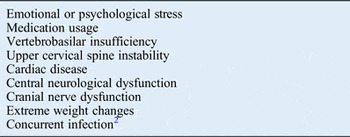
Any ‘red flag’ symptoms must be identified to allow further investigation of an alternative diagnosis as a cause of the otolaryngological or TMJ symptoms (Table III). Tinnitus can be a symptom of many otolaryngological diseases, such as Ménière's disease, cerebellopontine angle tumours and otosclerosis, and so strong clinical suspicion must be maintained.Reference Israel and Davila 3
‘Red flag’ symptoms

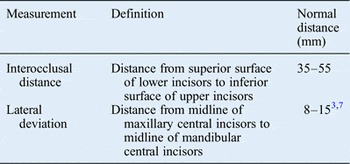
A thorough ENT examination must be conducted to exclude any true otolaryngological conditions. Additional examination for temporomandibular disorder involves examination of the neck, cervical spine, and extraoral and intraoral structures. General observation of the patient for jaw asymmetry and tension is the initial step. Wear patterns on the teeth can give an indication of asymmetrical loading. The TMJs are palpated for pain, as can occur in synovial inflammation. The muscles of mastication are palpated, as tenderness of these areas is associated with myofascial pain.Reference Israel and Davila 3 , Reference Sharma, Gupta, Pal and Jurel 4 Passive mandibular movement is measured in terms of interocclusal distance, lateral deviation and protrusion (Table IV). Examination must finish with cranial nerve examination and sensory examination. Any patient describing sensory loss needs to have this mapped out. Sensory loss in myalgia tends not to be in an anatomical distribution. If it follows a sensory nerve, further investigation into an underlying cause for the sensory loss (e.g. neoplasia) must be completed.Reference Shaffer, Brismee, Sizer and Courtney 2 – Reference Sharma, Gupta, Pal and Jurel 4 , Reference Scrivani, Keith and Kaban 7
Normal mandibular movement measurements

Further investigation is based on symptomatology. Audiometry is indicated if otological symptoms are present. Look et al.,Reference Look, Schiffman, Truelove and Ahmad 6 and Israel and Davila,Reference Israel and Davila 3 found that computed tomography (CT) scanning was useful in detecting hard tissue pathology and magnetic resonance imaging (MRI) was useful in identifying soft tissue pathology. These methods were significantly more sensitive and specific than panoramic films in detecting TMJ pathology.Reference Look, Schiffman, Truelove and Ahmad 6 Orthopantomography is useful only in detecting significant bony deformity, and will not identify intra-articular TMJ pathology.Reference Sharma, Gupta, Pal and Jurel 4 The use of CT and MRI needs to be tailored to each patient, and is generally only indicated when patients fail simple pharmacological treatment or if there is evidence of underlying pathology (e.g. neoplasia).Reference Israel and Davila 3 , Reference Dym and Israel 9 In these cases, referral to oral and maxillofacial surgeons or dentists may be appropriate.
Treatment options for otolaryngologists
The literature suggests that successful treatment of temporomandibular disorder leads to resolution of the otolaryngological symptoms.Reference Ferendiuk, Zajdel and Pihuyt 1 , Reference Israel and Davila 3 , Reference Scrivani, Keith and Kaban 7
Treatment is determined by symptomatology. However, it can be difficult to determine if facial muscle pain is primary or a result of intra-articular joint dysfunction. In most cases, muscular pain and joint dysfunction occur concurrently.Reference Israel and Davila 3 Patient education is an essential first step in management.Reference Israel and Davila 3 , Reference Fricton 11 Areas to cover include awareness and reduction of exacerbating habits; for example, jaw clenching at times of stress, or eating hard foods that place greater load on the muscles of mastication. Management includes a soft diet, heat pack application to the site of pain, relaxation techniques and use of passive jaw movement devices to prevent TMJ muscular atrophy.Reference Schaffer, Brismee, Sizer and Courtney 16 Referral to dentists for interventions including jaw splints and movement devices to prevent clenching, overuse and muscle atrophy is appropriate.
Physiotherapy and TMJ exercises can be used in the recovery process.Reference Dym and Israel 9 , Reference Fricton 11 The most important factors to consider when prescribing an exercise programme are repetition, compliance and involvement of affected musculature. Richardson et al. found that in patients with myofascial pain, those who repeated the exercises the most frequently were the patients who reported the greatest reduction in jaw pain.Reference Richardson, Gonzalez, Crow and Sussman 12
Multiple studies based on TMJ exercises have been conducted. Populations and exercise methods are varied, and so drawing conclusions regarding the most effective mobility exercises is problematic. Additionally, the exercises are described in such limited detail that reproducing them in a clinician's office is difficult.Reference Fricton 11 Their common features are stretching and movement of the masticatory muscles to prevent atrophy.Reference Dym and Israel 9 , Reference Fricton 11 Pain control is a crucial step in management, to avoid the development of allodynia and chronic pain.Reference Fricton 11 Regular non-steroidal anti-inflammatory drug (NSAID) use for 7–14 days, accompanied by a soft, no-chew diet, is effective in reducing intra-articular inflammation.Reference Israel and Davila 3 , Reference Dym and Israel 9 , Reference Fricton 11 In patients who do not respond to NSAIDs, a short course of oral steroid can be effective. Chronic neuropathic pain can be managed with a trial of gabapentin or tricyclic antidepressant.Reference Sharma, Gupta, Pal and Jurel 4 , Reference Scrivani, Keith and Kaban 7 If these options fail, it is unlikely that the symptoms will resolve with non-surgical intervention,Reference Israel and Davila 3 and so referral to oral and maxillofacial surgeons can be considered. Patients who develop significant psychological stress should be referred to psychology.Reference Fricton 11
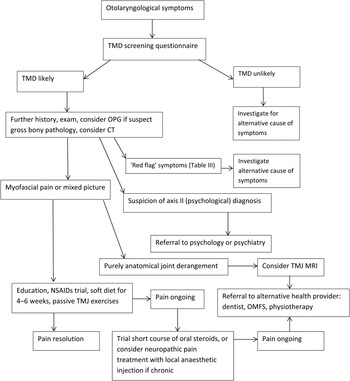
Based on the literature review, the authors propose a management pathway for otolaryngologists, to correctly differentiate temporomandibular disorder from other otolaryngological conditions, and to initiate effective treatment for temporomandibular disorder in collaboration with other health professionals (Figure 2). The authors recognise the limitations of these recommendations, given that a single author performed the literature search, that minimal data are sourced from randomised controlled trials and that the available reviews on the topic are of poor quality.
-
• Temporomandibular disorder is common in ENT given the relationship between temporomandibular disorder and otolaryngological symptoms
-
• Diagnosis and further investigation can be performed by a treating otolaryngologist
-
• There are conservative management options with high likelihood of symptom resolution that otolaryngologists can prescribe, prior to dentist or oral and maxillofacial surgeon referral
Proposed management pathway for suspected temporomandibular disorder. TMD = temporomandibular disorder; OPG = orthopantomography; CT = computed tomography; TMJ = temporomandibular joint; MRI = magnetic resonance imaging; NSAIDs = non-steroidal anti-inflammatory drugs; OMFS = oral and maxillofacial surgery

Prognosis
Prognosis is variable depending on the form of temporomandibular disorder the patient has. Forty per cent of cases resolve spontaneouslyReference Scrivani, Keith and Kaban 7 and 70–90 per cent of cases resolve with conservative management.Reference Dym and Israel 9 , Reference Rocabado and Iglarsh 17 If initial medical management with NSAIDs fails, patients are unlikely to improve with further non-surgical intervention.Reference Israel and Davila 3
Conclusion
The prevalence of otolaryngological symptoms in temporomandibular disorder makes it paramount for otolaryngologists to differentiate temporomandibular disorder from true otolaryngological causes of the symptoms. After diagnosis of temporomandibular disorder is established, simple pharmacological management, counselling and TMJ exercise can be initiated by otolaryngologists. The involvement of other health professionals, including dentists, oral and maxillofacial surgeons, physiotherapists, and psychologists, is crucial if initial treatment fails. Further research into the benefit of specific jaw exercises and conservative management with a randomised controlled trial is an essential next step in determining ‘gold standard’ management of temporomandibular disorder.