1. INTRODUCTION
The French of France has still received less attention within the variationist paradigm than Canadian French or, of course, varieties of English. This lack of empirical data means that it can be difficult to assess the validity of general theories for this variety. Tying in with the interest in recent years in contrasting metropolitan and colonial varieties, this article seeks to compare patterns of consonant cluster simplification with previous studies, such as that of Kemp et al. (Reference Kemp, Pupier, Yaeger, Shuy and Shnukal1980) on Canadian French, and discuss how cross-linguistic principles of variation apply in northern, standardised metropolitan French varieties.
The feature of central concern is the variable deletion of the liquids /l/ and /R/Footnote 2 in word-final obstruent-liquid clusters (OLC reduction hereafter), as in capable, realised [kapab] or [kapabl], and cidre, pronounced [sid] or [sidʁ]. Work on Montreal French (Kemp et al., Reference Kemp, Pupier, Yaeger, Shuy and Shnukal1980) has shown that in that community, OLC reduction is a stable sociolinguistic marker: ‘a linguistic variable which shows social stratification and style stratification’ (Trudgill, Reference Trudgill2003: 85). The existing studies on metropolitan French suggest that the variable has both social and stylistic importance in this variety as well, although retention rates are globally much higher in France than in Montreal (see for example Laks, Reference Laks1983; Léon & Tennant, Reference Léon and Tennant1990; Armstrong, Reference Armstrong1993; Pooley, Reference Pooley1996; Hornsby, Reference Hornsby2006; Villeneuve, Reference Villeneuve2010). However, due to the nature of the corpora on which work on metropolitan French has been based, it has been difficult to demonstrate unequivocally the status of word-final OLC reduction and whether it is stable rather than undergoing change in this variety. These will be key questions in the present article. A further matter for examination is the effect of the phonological context (a consonant, a vowel, or a silent pause) following the OLC. In Montreal, deletion rates according to following context co-vary with social factors such as level of education (Kemp et al., Reference Kemp, Pupier, Yaeger, Shuy and Shnukal1980). It has been suggested that this is also the case in metropolitan French, where, in addition, the nature of the following context may affect the social evaluation of the OLC reduction (Gadet, Reference Gadet1992; Léon, Reference Léon1993; Léon & Léon, Reference Léon and Tennant1997). A broader aim of this analysis is to offer a cross-linguistic comparison with studies of variable morpheme-final consonant clusters in dialects of English, and thereby to provide corroborating evidence of a ‘vernacular universal’ or ‘primitive’ dialect feature (Chambers, Reference Chambers2009: 251, 258).
The structure of this article is as follows. First, an overview of previous research and a description of the present corpus and methods are provided. The central section presents the results, with respect to regional origin, social class, gender, age, style, and the correlation between social variables and following phonological context. The final section offers a comparative discussion of findings in Montreal French, a partially analogous case of cluster simplification in English, and the nature of the liquid deletion variable in the light of the metropolitan French context.
2. BACKGROUND: HISTORY, CONNOTATIONS AND PREVIOUS FINDINGS
Previous quantitative work has implied that word-final OLC reduction is socially and stylistically significant in both (northern) metropolitan and Canadian French. Moreover, accent recognition studies carried out in France (Armstrong & Boughton, Reference Armstrong and Boughton1998; Boughton, Reference Boughton2003) have suggested that some listeners associate perceived working-class speech with elisions. Liquid consonants occur frequently. Coveney (Reference Coveney2001: 15, citing Wioland, Reference Wioland1985: 13) observes, for instance, that /R/ is the most frequent and /l/ the third most frequent consonant in discourse in French. Both are particularly vulnerable to deletion in OLCs word-finally, in part because final position is generally weak and because such clusters involve an increase in sonority within the syllable (Pustka, Reference Pustka2007: 197–8), violating the Sonority Sequencing Principle.Footnote 3
The variable has a long history. According to Lodge (Reference Lodge2004: 134), although it is not overtly censured by grammarians in the sixteenth century, the linguistic commentator Henri Estienne condemns related hypercorrect forms used by both the uneducated masses and by courtiers in Paris (Randell, Reference Randell2008: 78; cf. Estienne, Reference Estienne and Smith1578: 157–8). In the seventeenth century, OLC reduction attracts prescriptive comment from codifiers such as Richelet (cf. Thurot, Reference Thurot1883: 278), and occurs in literary representations of the speech of peasants and servants, such as those in Molière's Le Médecin malgré lui (1666) who have notte and votte for notre and votre (cf. Ayres-Bennett, Reference Ayres-Bennett, Green and Ayres-Bennett1990: 167, citing Oudin, Reference Oudin1633). Forms such as chambe and poude for chambre and poudre are found in Jean Héroard's transcriptions (1605–10) of the speech of Louis XIII as a young child (Ernst, Reference Ernst1985: 49–53, 55). At the start of the eighteenth century, deletion was the norm even in aristocratic society (Cohen, Reference Cohen1973: 378; Gadet, Reference Gadet1989: 101). By the nineteenth century, the pronunciation of OLCs was restored and had become standard, under the influence of orthography (Cohen, Reference Cohen1973: 378). Reduction became associated with the upper and lower extremes of the social hierarchy: ‘la simplification faisant peuple ou vieil aristocrate’ or, in other words, with those who were either uninstructed or above any linguistic insecurity.
More recent sociolinguistic research confirms this variable's long ‘social sensitivity’. Chevrot et al. (Reference Chevrot, Beaud and Varga2000: 92) remark on its unfavourable social-indexical meaning and state that, in addition to the fact that deletion of word-final post-obstruent /R/ in the French of children and adolescents in France is socially differentiated, it is more frequent pre-consonantally than before a vowel or a pause. It also occurs more in Interview than in Reading Style. OLC reduction has also been reported in other varieties, such as Belgian and Canadian French (cf. Francard, Reference Francard, Hintze, Pooley and Judge2001: 252; Hambye, Reference Hambye2005; Kemp et al., Reference Kemp, Pupier, Yaeger, Shuy and Shnukal1980; Hume, Reference Hume and Ferrara1988). In the latter, much higher rates of deletion have been observed than for metropolitan French; Hume (Reference Hume and Ferrara1988: 144, 146) even suggests that ‘/R/-deletion is a Canadian phenomenon’.
In metropolitan French, the variable is associated with informal, ‘everyday’ French (français familier, or ordinaire (Gadet, Reference Gadet1989)), as well as with traditional working-class usage (français populaire) where this type of cluster reduction is one of the most salient (i.e. immediately socially diagnostic) pronunciation phenomena (Gadet, Reference Gadet1992: 40–2; Reference Gadet and Moreau1997: 78). It is also very frequent in the informal speech of all socioeconomic groups, and Valdman (Reference Valdman1982: 227) goes so far as to say that it is in no way populaire, as it may occur even in situations where quite careful (‘refined’) speech is appropriate (cf. Léon & Tennant (Reference Léon and Tennant1990), whose data were taken from the highbrow TV discussion programme, Apostrophes). The feature is stereotypically associated with lower-class usage; but is there a quantitative or qualitative point at which it crosses a hypothetical line between familier and populaire, between a stylistic and a sociolectal feature? For Gadet (Reference Gadet1992: 41), this demarcation lies in the phonological context: preconsonantally, it is simply informal, but if it is prevocalic or prepausal, it is ‘stigmatised’ and therefore populaire (see also Léon & Léon, Reference Léon and Léon1997: 107–8). The difference may also be quantitative, related to the frequency of deletion (Léon, Reference Léon1993: 206–8). In addition, the relative formality of the situation constrains evaluation: reduction is unremarkable in ordinary conversation, but perceived as lower class if it occurs in a public context, such as a meeting (Léon & Léon, Reference Léon and Léon1997: 107).
Existing studies tend to support such impressionistic observations: simplification appears to co-vary with both social and stylistic variables. For example, Laks (Reference Laks1983) examined deletion of /R/ in this position in his pioneering study of working-class adolescent males in Paris, and observed a correlation between high deletion rates and non-mainstream attitudes and behaviour, as well as an approximate 10% style shift between individual and group interviews.
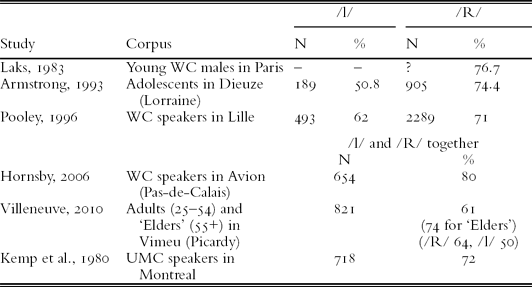
Table 1 shows deletion rates observed in conversational speech in some previous studies in different parts of northern France, and Canada. Where /l/ and /R/ are treated separately, i.e. by Armstrong and Pooley, deletion rates are lower for /l/; rates for /R/ range between 71% and 77%, showing a consistent pattern, as do rates for /l/ and /R/ treated together, ranging from 61% in Villeneuve's (Reference Villeneuve2010) Vimeu corpus (although the rate for ‘Elders’ fits better with the general picture, at 74%), to 80% for the working-class speakers in Avion studied by Hornsby (Reference Hornsby2006).Footnote 4 As to social differentiation, most of these studies are characterised by a rather narrow range in their speaker samples. Armstrong does not comment on it, while Pooley found higher deletion for less educated speakers, males, and those over the age of 45. Hornsby (Reference Hornsby2006: 78) reports similar correlations with age and gender, while Villeneuve (Reference Villeneuve2010) finds age the most significant factor, linked with status as bilingual in Picard (although data were analysed for only ten speakers and only three bilingual elders, and age is related to length of time spent in education). With regard to stylistic variation, both Laks and Armstrong observed a significant shift between conversational and interview style; in neither study were more closely monitored scripted styles elicited.
Word-final post-obstruent liquid deletion rates found in previous studies in France and Canada

Kemp et al.'s Montreal results broadly fit in with the general deletion rates summarised above: 72% deletion in liquid-final clusters, as opposed to 23% for non-liquid-final clusters (such as /st/ in communiste). However, 72% is a (very) low deletion rate in Canadian French, which can be attributed to the social profile of their informants: a sub-sample of four highly educated professionals, two male and two female, from a larger group of 45 (taken in turn from the Sankoff-Cedergren corpus of 120 speakers), as these were among the few informants who simplified less than 80% of such clusters. Emphasising the much higher rates of deletion in Canadian than in metropolitan French, Kemp et al. speak in terms of conservation rather than deletion, since ‘it is final cluster conservation that is socially marked’ (1980: 17). They estimate that ‘in everyday conversation over 80% of the population would conserve less than 10% of their final cluster tokens’ (p. 16). As to social variables, Kemp et al. found a strong correlation between conservation and degree of integration into the ‘linguistic market’ for 45 informants: the lower the speaker's linguistic market score, the higher the deletion rate. They observed some interaction between age and speech style among low-index speakers, as the reading passage showed higher conservation by younger speakers than by older ones, but did not conclude for change in progress. Rather, they attribute the increase in conserved tokens in the reading style (but not conversation) of younger speakers partly to increased education. Their conclusion is that the variable remains a stable sociolinguistic marker: despite the high overall deletion rate, OLC reduction was not about to become categorical in Montreal French (1980: 33–4).
3. CORPUS
The present analysis is based on data from a large corpus of urban dialect surveys carried out in Nancy and Rennes in 1997–98. Almost exactly equidistant from Paris, the source of the standard language, the two cities share similar demographic and cultural characteristics, and are both located in northern Romance dialect substrate areas (lorrain roman and gallo respectively).
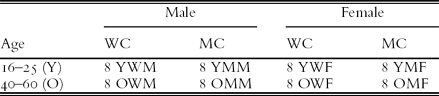
The gathering of data by a single fieldworker in not one, but two, urban centres is relatively unusual and was intended to investigate the extent of uniformity in pronunciation in a large part of northern France. The fieldwork was therefore designed with a view to making regional comparisons, though the focus of this article is principally social. Speakers were contacted mainly by the ‘snowball’ method (Milroy and Gordon, Reference Milroy and Gordon2003: 32). In addition to gender, they were stratified by age (‘younger’, 16–25 years, and ‘older’, 40–60) and socio-economic status. Participants were categorised as broadly working class (WC) or middle class (MC) according to whether their occupation (or parents’ occupation in the case of younger people not yet in employment) was manual (‘blue collar’) or non-manual (‘white collar’) (cf. Trudgill, Reference Trudgill1974; Chambers & Trudgill, Reference Chambers and Trudgill1998: 49). Although this evidently represents a simplification of the various factors that may determine socioeconomic group, there is general agreement among social scientists that occupation is ‘the best single indicator’ of social class (Chambers, Reference Chambers2009: 51). An additional selection criterion was nativeness: all informants were born in their city, or had lived there since before the age of five. This procedure resulted in two equivalent samples of 32 informants from each of Nancy and Rennes, consisting of eight cells of four speakers, and thus an overall sample of 64, as shown in Table 2.
Size and structure of speaker sample in the Nancy–Rennes corpus
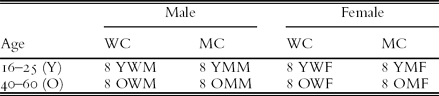
Key: YWM = Younger Working-Class Male, OMF = Older Middle-Class Female, etc., where W = manual/blue-collar and M = non-manual/white-collar occupation
Speech was recorded in semi-structured interviews with the author, a completely fluent non-native speaker. The informal conversational style elicited, while close to the everyday vernacular observed for some informants, is nevertheless labelled Interview Style (IS hereafter), as it is not assumed to represent the most casual speech of the majority of participants. This unscripted style accounted for the bulk of each interview, which lasted a minimum of 45 minutes. It was complemented by reading tasks (prose and word lists) to replicate more formal styles and elicit a wide range of potential phonetic and phonological variants (see Boughton, Reference Boughton2003 for further detail), labelled RPS (Reading Passage Style) and WLS (Word List Style) hereafter.
In Rennes, participants also listened to extracts of interviews recorded in Nancy and were asked to identify the speakers’ regional and social origin as well as offer a general evaluation of what they heard (see Armstrong & Boughton, Reference Armstrong and Boughton1998; Boughton, Reference Boughton2003). Of relevance here are comments made by some respondents when asked to elaborate on their (usually accurate) judgement of a speaker as working class. In general, listeners were unable to comment on specific pronunciation features, but there were recurring remarks implying perception of elision, such as il bouffe les mots ‘he eats his words’ or elle abrège ‘she shortens it’.
4. RESULTS
To investigate the sociolinguistic patterning of word-final post-obstruent /l/ and /R/ in the corpus, data for 32 speakers, 16 from each of Nancy and Rennes (four from each of the cells shown in Table 2), were analysed. In IS, the total number of tokens was 1,494, almost equally divided by location: 706 from the Nancy sub-sample, and 788 from Rennes. The phono-lexical context, i.e. the word in which the token occurred and the following word(s), was noted and tokens recorded as either ‘liquid present’ or ‘liquid deleted’. The number of occurrences per speaker of any given word was not limited, but invariable collocations were excluded from the results: /R/ was categorically conserved in quatre-vingts (N = 45), centre-ville (N = 20), quatre ans (N = 26) and quatre heures (N = 3), and categorically deleted in quatre ou cinq (N = 7) and quatre, cinq (N = 6). Since the vast majority of these 107 excluded tokens involved categorical conservation, the effect was a global rise in deletion rates. The results for the remaining variable tokens are presented below. First, we summarise the social and socio-stylistic patterns, then focus in more detail on the interaction between the social variables and following phonological context.
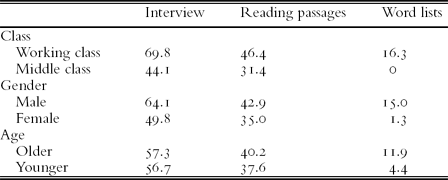
Analysis of liquid deletion in IS according to the major extralinguistic variables of social class, gender and age revealed clear results; rather less expected was a considerable difference according to region (Boughton, forthcoming). Setting aside this regional difference, both sub-samples nevertheless show the same broad patterns of social variation: the working-class speakers delete on average 26% more liquids than the MC speakers (WC 69.8%, MC 44.1%), and males delete 14% more than females (M 64.1%, F 49.8%). In contrast, there is virtually no age differentiation: a mere 0.6% separates the averages for younger and older informants (16–25 years: 56.7%, 40–60 years: 57.3%). These results are in line with the expected pattern for a variable of this type, where the standard variant reflects the ‘long’ citation form or spelling pronunciation, and the non-standard variant is a ‘short’ form. Such results strongly suggest that the variable is stable, as in Montreal (Kemp et al., Reference Kemp, Pupier, Yaeger, Shuy and Shnukal1980, discussed above): the classic sociolinguistic gender pattern (Fasold, Reference Fasold1990: 92) is evident and as Labov (Reference Labov2001: 266) has stated, this regularly characterises stable variables. Its stability is also signalled by the negligible age-related difference as well as the long history of attestation of the feature (cf. Labov, Reference Labov2001: 86).
The gender difference observed may nevertheless be surprising in view of Posner's (Reference Posner1997: 79) claim that ‘there is less general support in French-speaking countries for the contention that women's speech differs substantively from men's’ (cf. also Armstrong et al., Reference Armstrong, Bauvois, Beeching and Bruyninckx2001; Bauvois, Reference Bauvois2002). Coveney's (Reference Coveney2002: 86) results for retention of the negative particle ne in his Picardy corpus support this, as he observed a gender difference of only 1.3%. Some studies of phonological variation (e.g. Armstrong & Unsworth, Reference Armstrong and Unsworth1999, where, crucially, a linguistic change is involved) have found significant male–female differences, although Pooley (Reference Pooley1996: 231–3) observed only a marginally significant gender pattern in word-final OLC reduction (males c. 78%, females c. 75%), quite in contrast to the Nancy–Rennes result. The smaller effect of gender in Pooley's findings may stem from the narrower social range in his corpus. The results of the present study support Armstrong's (Reference Armstrong2001: 70) suggestion that ‘social class can often be a more important differentiating variable than gender in French’. To link back to Labov's statement above, it is possible that this reflects generalised relative stablility in the phonological variation found in metropolitan French: if there were more changes ongoing, we might expect more results of the type reported by Armstrong and Unsworth (Reference Armstrong and Unsworth1999) and Armstrong and Low (Reference Armstrong and Low2008), where (younger) females appear to be adopting innovative variants at a more rapid rate than their male counterparts.
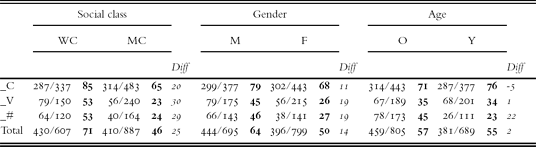
Table 3 shows the deletion rates for social class, gender and age (for Nancy and Rennes aggregated) correlated with speech style (cf. Boughton, Reference Boughton, Abecassis, Ayosso and Vialleton2008). As mentioned in section 3, two scripted styles were elicited, RPS and WLS, as well as the spontaneous IS. A caveat is that the numbers of tokens per speaker are small in RPS (N = 7) and WLS (N = 5), though when multiplied by the 16 speakers in each group (for example, females), the totals are 112 in RPS and 80 in WLS (cf. 1,494 in IS).
Word-final post-obstruent liquid deletion by speech style and social factors
Table 3 shows style shifting in addition to the social class differentiation already noted, which demonstrates clearly that word-final post-obstruent liquid deletion is indeed a sociolinguistic marker in metropolitan French (cf. Armstrong (Reference Armstrong2001: 69), where this status is speculated, and Chevrot et al. (Reference Chevrot, Beaud and Varga2000: 92), summarised above). The pattern observed, common among stable variables, is consistent with gradient or fine (as opposed to sharp) social and stylistic stratification (cf. Chambers & Trudgill, Reference Chambers and Trudgill1998: 71; Labov, Reference Labov2001: 81–2): as formality of contextual style (or degree of attention paid to monitoring pronunciation) increases, there is a greater tendency for both working-class and middle-class speakers to realise word-final post-obstruent liquids.
To compare with the partially analogous English (ng) variable, the stratification shown in Table 3 evokes that found for (ng) in New York (Labov, Reference Labov1966: 274) rather than the sharp stratification pattern observed in Norwich (Trudgill, Reference Trudgill1974: 92), though admittedly, it would be difficult to demonstrate sharp stratification with only two broad class groups; the results may in fact mask class-internal differences. For Trudgill (Reference Trudgill1974: 93), the discontinuity between the grouped working- and middle-class speakers underlines the importance of this class division in UK society, which is less sharp in the US (Labov, Reference Labov2001: 81). It may also be less sharp in France, though there is a marked divide between the two class groups studied here, probably owing to the related effect of level of education and the need to command standard phonology in most white-collar occupations. In this regard, it is noteworthy that the middle-class informants have 0% deletion in WLS, showing a categorical shift in behaviour when most attention is paid to pronunciation (in contrast, Chambers and Trudgill (Reference Chambers and Trudgill1998: 99) state that (ng) ‘is a marker only in terms of frequency’, not categoricity). A second difference in the behaviour of the two class groups is seen in the greater style shift of the working-class speakers between the spontaneous style, IS, and the scripted style, RPS (a 23.4% shift for the working-class group versus 12.7% for the middle-class speakers), again reminiscent of, if not exactly parallel to, Trudgill's result for (ng) in Norwich where the Upper Working Class group, an interior social class, showed the greatest stylistic variation, especially between Formal Style and RPS (cf. also Labov's (Reference Labov1966: 157–61) findings in New York, e.g. for (r)).
With regard to gender and style, we observe further confirmation of the marker status of this variable, as both males and females show increased cluster conservation as degree of monitoring increases, while females show lower rates of deletion than males in all styles. A pattern consistent with gradient stratification is again apparent here; the main difference between class and gender lies in the lesser division in deletion scores between males and females as compared with the two social class groups. This echoes Hornsby's (Reference Hornsby2006: 78) finding that gender-related differences in post-obstruent liquid deletion were ‘far less marked’ than those for some of the other variables he analysed, namely the vocalic variables (a), (a/_R) and (E/_R).
In contrast to class and gender, very little age differentiation was observed: both generations shift style as expected, and in almost exactly the same proportions, although the younger speakers have slightly lower deletion rates in the scripted styles, particularly WLS. No very strong claims can be made about this as the number of tokens is small, but a similar result was found for Montreal (Kemp et al., Reference Kemp, Pupier, Yaeger, Shuy and Shnukal1980: 32) and attributed in that case partly to increased schooling.Footnote 5 The role of lengthier (and more recent) education and literacy is a plausible explanation here too, especially since it is predominantly older, working-class males, some of whom left school at fourteen, who delete any liquids in WLS.
4.1 The effect of following phonological context
Finally, we examine the interaction between social class, gender, age and following phonological context. Final cluster reduction is strongly conditioned phonologically, and not only in French. In English, for example, preconsonantal simplification, as in pos(t) card, occurs in many dialects, but is less common prevocalically, as in post office. Such evidence illustrates the probably universal tendency to simplify word-final clusters in triconsonantal sequences (Chambers & Trudgill, Reference Chambers and Trudgill1998: 133, 135; cf. Chambers, Reference Chambers2009: 251), especially where these go against phonotactic constraints in a given language.
As to the effect of following context in French, it has been suggested that while preconsonantal reduction, as in quatre personnes ‘four people’ [katpɛʀsɔn], is unremarkable, it is impossible preceding a vowel, as in quatre amis ‘four friends’ *?[katami] (Walter, Reference Walter1977: 48). However, previous studies refute this observation. Pooley (Reference Pooley1996: 139, 143), for example, found reduction to vary prevocalically, though this context was significantly less favourable than prepausal or preconsonantal position. Armstrong (Reference Armstrong1993: 160) also found that prepausal and preconsonantal contexts patterned together, with ‘very similar rates’ in /R/-deletion, while prevocalic deletion rates were much lower in IS. Armstrong therefore treated prepausal and preconsonantal environments as a ‘unitary phonological context’. In contrast to the above two studies, Hornsby (Reference Hornsby2006: 78) found preconsonantal position particularly favourable to cluster reduction, with no marked difference between prepausal and prevocalic environments. In Sobotta's study, a clear distinction emerged between the prevocalic and preconsonantal contexts, with average reduction rates of 28% and 54% respectively; prepausal rates are not given (2006: 220). However, these global scores mask important group differences: the deletion rates for speakers from Guadeloupe were 66% and 79% respectively, while for those from the Aveyron, they were 0% and 11%. Of greater relevance for the present overview of deletion rates in northern varieties are those for Sobotta's group of Parisian speakers, with 63% preconsonantal and 20% prevocalic cluster simplification. Likewise, Villeneuve's (Reference Villeneuve2010) study of Vimeu (Picardy) French also confirms that prevocalic deletion is indeed possible, particularly for ‘elders’ (55 years and above). As mentioned above, the global simplification rate observed for the ten speakers analysed by Villeneuve was 61%, but an analysis of following environment revealed a distinction between the favourable preconsonantal context (rate of 74%) and the disfavouring prevocalic and prepausal contexts (rates of 47% and 43% respectively). When the speakers were divided by age, a further distinction emerged. Both ‘adults’ (25–54 years) and ‘elders’ had high rates of preconsonantal deletion (70% and 77% respectively), but their behaviour diverged in the prevocalic (21% deletion against 64%) and prepausal (30% against 48%) contexts. Villeneuve thus concludes that ‘in the elders’ system, vowels have less of a disfavouring effect and a significantly higher rate of simplification than pauses’ (2010: 139–40) and that therefore prevocalic deletion is less stigmatised for this group than for their younger counterparts and for speakers in some other regions.Footnote 6
It was noted above that deletion rates in Canadian French tend to be much higher than in metropolitan French, and that Kemp et al. (Reference Kemp, Pupier, Yaeger, Shuy and Shnukal1980) therefore studied just four ‘high-index’ speakers (‘bourgeois’, well-educated professionals) who conserve a relatively high number of clusters. They also found the prevocalic–preconsonantal split to be an important conditioning factor, with all members of this sub-group showing a high level of sensitivity to it: the rate of preconsonantal deletion was 81%, but fell to 51% before a vowel (p. 19). Unsurprisingly, Kemp et al. conclude that prevocalic context strongly favours cluster conservation. In RPS the authors also observed an interaction between phonological environment and socioeconomic status. The average deletion rates of high- and low-index speakers were 67% and 78% respectively, but in prevocalic context, the rate for high-index speakers dropped sharply to 27%. For low-index speakers there was very little change, with 76% prevocalic simplification. This result indicates that following context had much less impact on the behaviour of the low-index speakers, even when monitoring their speech more closely (p. 32).
It appears then that there is considerable variation in the impact of following phonological context, both according to the variety of French studied and the characteristics of the speaker groups sampled.Footnote 7 Moreover, the social connotations of this variable in metropolitan French seem at least partly dependent on context (cf. section 2): prevocalic and (perhaps especially) prepausal cluster reduction are negatively evaluated or stigmatised as working class, while preconsonantal simplification may be perceived as simply informal (Gadet, Reference Gadet1992: 41). This would certainly merit further investigation, since a study of attitudes to various non-standard features in Montreal found very little negative comment about the pronunciation of être as [ɛt] and libre as [lib] at the end of an utterance (Laberge & Chiasson-Lavoie, Reference Laberge, Chiasson-Lavoie and Darnell1971). While the results presented below do not allow a direct examination of perceptions of deletion according to context, they may indirectly indicate evaluations through the social patterning revealed.
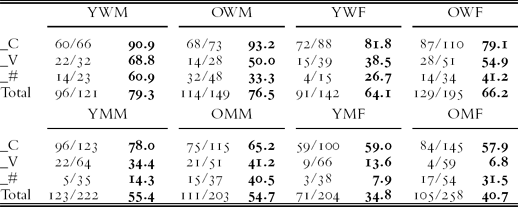
In the present analysis of liquid deletion in IS, the phonological environment was coded according to the nature of the following segment, whether or not the cluster was simplified, as either preconsonantal, where the following word began with a consonant, as in quatre personnes ‘four people’ [katpɛʀsɔn], prevocalic, as in quatre amis ‘four friends’ [katami], or prepausal, as in (il) y en a quatre ‘there are four of them’ [j nakat], before a silent pause or utterance boundary (cf. Chambers & Trudgill, Reference Chambers and Trudgill1998: 134). This context was somewhat less frequent than the first two, perhaps owing in part to speakers’ tendency to fill a hesitation with euh, or mark the end of an utterance with hein; such tokens were counted as prevocalic (cf. Armstrong, Reference Armstrong1993: 146; Kemp et al., Reference Kemp, Pupier, Yaeger, Shuy and Shnukal1980: 22). To respond as fully as possible to previous findings with regard to variation according to phonological context, as well as its apparent social evaluation, the three contexts were analysed separately; we should therefore be able to ascertain how speakers treat clusters before a silent pause. In Table 4, the two regional sub-groups have been aggregated within the categories of social class, gender and age, as our primary focus here is on the social correlates of deletion according to phonological context.
Word-final post-obstruent liquid deletion by following phonological context and speaker group
In Table 4, observed frequencies are given alongside percentage deletion rates for each of the eight speaker groups or cells in the sample. Each cell consists of four speakers sharing very similar demographic profiles, two from each of Nancy and Rennes. Certain general trends emerge very clearly. First, the rates are higher for liquids in preconsonantal context overall than for either prevocalic or prepausal context; the latter seems to disfavour deletion most strongly, though for some groups there is no very marked difference between the prevocalic and prepausal rate (for example, 41.2% versus 40.5% for the Older Middle-Class Males). The Older Middle-Class Females stand apart from this, with near-categorical prevocalic conservation (just four out of a possible 59 tokens are reduced), but 31.5% reduction before a silent pause. There is no ready explanation for this apparent anomaly, but with regard to the general pattern of lower deletion rates in prepausal context, we might conclude that speakers have a greater level of awareness of an utterance boundary than of other contexts, which occur within the stream of speech (cf. Hambye, Reference Hambye2005: 346). Secondly, we observe the expected broad social trends associated with stable variables: the Working-Class Males have the highest deletion rates in all three contexts (93.2% preconsonantal deletion for the Older Working-Class Males, closely followed by the Younger Working-Class Males with 90.9%; the latter also have the highest prevocalic and prepausal deletion rates, at 68.8% and 60.9% respectively); their behaviour is in stark contrast to that of the Middle-Class Females, who show the lowest rates of the non-standard variant across the board: the Older Middle-Class Females have the lowest preconsonantal rate, with 57.9% deletion, and near-categorical avoidance of prevocalic reduction, at 6.8%; similarly, the Younger Middle-Class Females show near-categorical conservation before a pause, with only three of 38 tokens reduced (7.9%). The sociolinguistic gender pattern, often observed in quantitative studies of phonological variation, is therefore readily seen.
Overall, there is striking regularity in the behaviour of the four broad groups divided by gender and class (i.e., leaving aside age) in the total deletion rates observed for all contexts taken together. The Working-Class Males behave very similarly regardless of age (79.3% and 76.5% deletion), as do the Working-Class Females (64.1% and 66.2%) and the Middle-Class Males (55.4% and 54.7%). While there is some difference in the global deletion rates for the two groups of Middle-Class Females, they are united in having the lowest overall rates of the eight groups (34.8% and 40.7%, in conformity with expected patterns) and near identical preconsonantal deletion rates (59% and 57.9% respectively).
To draw out further tendencies in the effect of following context, in Table 5, the speakers are grouped according to the three major social variables sampled: class, gender and age. Both regions are subsumed within these, which means that there are 16 individuals in each cell (i.e., 16 working-class speakers, 16 males, etc.). This gives larger overall numbers of tokens; observed frequencies are shown alongside rounded percentage deletion rates according to each social variable in the three phonological contexts.
Word-final post-obstruent liquid deletion by following phonological context and social variables
As before, there are some impressively regular patterns. Both classes, as well as males and females, have near-identical deletion rates in prevocalic and prepausal context (for example, 53% in both for working-class speakers; 26% and 27% respectively for females), similar to Hornsby's (Reference Hornsby2006) findings, summarised above. Furthermore, the class and gender patterns already observed are evident again: middle-class speakers and females prefer the standard variant in all contexts, though we observe the greatest shift between groups in the behaviour of the two classes in prevocalic/prepausal context, where deletion rates are 30% lower for middle-class speakers. This result is mirrored in the difference between males and females, where the gap in prevocalic/prepausal context nears 20%, almost double that for preconsonantal context. Observing this pattern is one thing; explaining it quite another. It appears that members of higher socioeconomic groups, defined here by white-collar occupation, where use and command of the standard language is a daily necessity, as well as females, show greater sensitivity to prevocalic and prepausal deletion than do males and those in blue-collar occupations. It was noted above that cluster reduction in these contexts is more likely to be negatively evaluated, and subconscious awareness of potential stigmatisation may have an impact on behaviour, even if also subconscious. Preconsonantal simplification is rather more ‘legitimate’ in that it allows a speaker to avoid a phonotactically awkward sequence of three consonants, and is therefore tacitly sanctioned; the alternative would be to insert a schwa which is not normally pronounced in standardised (northern) French. On the other hand, deletion in prevocalic or prepausal context is likely to be unnecessary from a phonotactic viewpoint (cf. Hambye, Reference Hambye, Beeching, Armstrong and Gadet2009: 36).
The results for age stand apart once more. While the overall deletion rates for older and younger speakers are similar, at 57% and 55%, this headline result masks the differing effects of phonological context. There is not the same consistency of treatment according to prevocalic and prepausal context by either group (for example, 35% and 45% respectively for older speakers, as compared with 53% in both contexts for working-class speakers). On the other hand, the effect of prevocalic context is almost identical for both age groups: 35% for older speakers and 34% for younger ones; deletion in preconsonantal context is also similar. What distinguishes the two age groups is the impact of a following silent pause, where deletion rates are 22% lower for the younger speakers. It is not obvious why, especially as the prevocalic difference is so marginal. Perhaps it is reasonable to suggest as above that the greater perceptual salience of the end of an utterance has a more marked effect on the behaviour of the younger speakers, most of who were still in education or training at the time of interview and thus likely to be exposed much more regularly to the standard spoken and written language.
5. DISCUSSION AND CONCLUSION
Previous quantitative studies of word-final post-obstruent liquid deletion in metropolitan French have largely been based on speaker samples with a narrow social range (e.g., working-class informants only, or adolescents only), or where only one style was elicited. This renders it difficult to draw conclusions about what type of variable it is, with reference to Labov's tripartite division of indicators, markers and stereotypes, theorised as successive stages in the development of a sound change (1972: 178–80; see also Chambers and Trudgill, Reference Chambers and Trudgill1998: 70–6). The results reported here demonstrate conclusively that final OLC reduction is indeed a marker in northern, standardised metropolitan French, as we observe clear patterns of both social and stylistic stratification, but that it does not appear to be an ongoing linguistic change. This mirrors the conclusion of Kemp et al.'s (Reference Kemp, Pupier, Yaeger, Shuy and Shnukal1980: 34) Montreal study, thus providing cross-dialectal evidence that it functions as a stable sociolinguistic marker in French more broadly.
As to the key linguistic constraint of following phonological context, the results confirm empirically the impressionistic observations of Gadet (Reference Gadet1992: 41), among others, that there is an important social-class difference in both behaviour and its evaluation according to whether simplification is preconsonantal or prevocalic/prepausal. We may add that females have a greater tendency to produce the standard variant, and that the two age groups differ in their treatment of prepausal clusters. Kemp et al. (Reference Kemp, Pupier, Yaeger, Shuy and Shnukal1980: 33–4) analysed the preference of younger speakers to conserve more clusters in RPS as evidence of ‘readjustment’ in the patterns of variation in Montreal; this may also be the case in metropolitan French, though the parity of behaviour in spontaneous speech for the two age groups suggests no change is occurring, even incipient.
Our analysis sheds light on the nature of marker variables more generally. The categorisation of variables as indicators, markers or stereotypes is linked to the level of awareness of them in the speech community. Markers are particularly interesting from this viewpoint, as they occupy a somewhat nebulous middle ground. To what extent does OLC reduction in French fit with markers previously observed and theorised, which are in the main variable features of English? Trudgill (Reference Trudgill2003: 85) notes that markers are ‘typically involved in change from below’ (meaning from below the level of conscious awareness or intervention), but the present variable exhibits patterns associated with stable variation, which more often characterises indicators (Chambers & Trudgill, Reference Chambers and Trudgill1998: 72) since speakers tend to be more aware of the social meaning of variants involved in a linguistic change. Social and stylistic stratification are nevertheless clear in our analysis, so speakers are sufficiently aware of it that they modify their behaviour in closely-monitored speech. However, unlike English (ng), a classic example of a marker, the level of awareness is not so high that speakers openly discuss the variable, or have a name for it: whereas in English, there is widespread (though not universal) understanding that ‘dropping your gs’ is to be avoided in formal speech, in French, ‘dropping (or ‘swallowing’) your rs and ls’ is not the subject of overt criticism (or at least not to the same extent) and this therefore cannot explain the style shift observed.
Trudgill (Reference Trudgill1986: 10–11; cf. Chambers & Trudgill, Reference Chambers and Trudgill1998: 72–5) lists reasons why speakers may be more aware of some variables than others, or which may lead to greater awareness and thus represent ‘tipping points’ on the continuum from indicator to marker. The first is overt stigmatisation, mentioned above, often triggered by the existence of a high-status variant represented in the orthography, from which the low-status variant thus deviates. The second is that the variable is involved in a current linguistic change; greater awareness here may result from the use of different variants by older and younger people within the same social network. Thirdly, Trudgill suggests that greater awareness attaches to ‘variables whose variants are phonetically radically different’. Finally, variables which involve phonological contrast (as opposed to phonetic variation) elicit greater awareness.
We have already noted that the second of these explanations does not readily apply here, but as to the third, the presence or absence of the liquid could be interpreted as a radical phonetic difference between the variants, to which still greater salience may attach owing to the representation of the standard variant in the orthography (cf. the first explanatory factor above, and the example of English (h) given by Trudgill (Reference Trudgill1986: 45)). Spelling pronunciation certainly seems relevant. It is ‘a phenomenon due to a combination of literacy and linguistic insecurity in which the original pronunciation of a word is replaced by a newer pronunciation which more closely resembles the spelling’ (Trudgill, Reference Trudgill2003: 126). This echoes the restitution of the liquids in final obstruent-liquid clusters in nineteenth-century French, reported above, during the period when mass literacy became established through universal primary education following the Ferry reforms of the 1880s. This makes it all the more curious that, in common with French phonological variables more generally, it is not widely discussed or named (cf. the ‘dropping’ of t, g and h in English), especially in view of the importance accorded to correctness in written and, by extension, spoken French (cf. Martinet, Reference Martinet, Green and Ayres-Bennett1990: 14; Posner, Reference Posner1997: 61).
English (ng) provides a useful point of comparison in several respects. Widespread in spoken usage, it is a marker in various dialects of British and American English. The patterns of socio-stylistic stratification in Table 3 are notably similar to those for (ng) in Norwich (Trudgill, Reference Trudgill1974: 92) and New York (Labov, Reference Labov1966: 274). Like the present variable, (ng) also has a long history: its non-standard variant has been attested since the fourteenth century, and was used by all social classes until its stigmatisation as a deviation from the spelling pronunciation in the 1820s, resulting in its being marked as uneducated and proscribed by grammarians and teachers (Labov, Reference Labov1966: 271; Wyld, Reference Wyld1936: 289–90, who also notes hypercorrect forms such as kushing (‘cushion’; 1539) and fashing (‘fashion’; 1664), mirroring the bouticle and musicle examples).
Labov (Reference Labov1966: 270) describes (ng) as ‘a case of stigmatisation without change’, where the (orthographically, but not phonetically) ‘short’ form is considered incorrect and yet has ‘a well-defined place in the overall scheme of English usage’ (p. 272). This applies equally well to OLC reduction in French, which, to echo Walter's (Reference Walter, Green and Ayres-Bennett1990) comment on mute-e, seems to be ‘une variable qui ne veut pas mourir’. There are perhaps some subtle differences between the two nonetheless. Whereas the French variable was overtly discussed in the past, and the short form proscribed, this does not seem to be the case nowadays; rather, a sort of tolerance and tacit awareness has developed. This is illustrated by the patterns of behaviour set out above, and by the following anecdotal example. An Older Middle-Class Female from Nancy, who had the lowest overall IS deletion rate in the sample (13.7%), produced the following utterance when asked to imitate a typical accent lorrain: ‘Ah, mon! L'autre, hein?’,Footnote 8 [a m ː lot
 ]. The pertinent feature here is the elision of the prevocalic liquid in autre, especially noteworthy as this speaker deleted /R/ in this context at a rate of only 9% (3/35 tokens) yet had recourse to it when asked to mimic the local accent, which she had previously linked to low social status. Added to the qualitative data mentioned above, where respondents in the perceptual test linked ‘shortening of words’ to lower status, we might conclude that awareness of this feature lies just ‘under the radar’: it is high enough to lead to modification of behaviour according to style, but not high enough to trigger overt discussion and the stigmatisation which would lead to change from above (cf. Labov, Reference Labov1972: 179). Perhaps it is precisely this apparent lack of conscious social awareness which maintains the stability of the variable in the system.
One final subtlety is the continuing impact of following phonological context on both behaviour and evaluation: the widespread use and tolerance of final liquid deletion has its limits. Prevocalic/prepausal deletion is considerably more likely to be avoided by middle-class speakers (and by females), and there may be an increasing tendency on the part of younger speakers to avoid prepausal reduction. This interaction between social and linguistic factors calls to mind Chambers’ (2009: 251–2) discussion of variable morpheme-final consonant clusters, (CC), in connection with general principles of articulatory economy. Chambers notes that all social groups are affected by the phonetic motivation to reduce clusters, ‘a highly natural process because it simplifies articulatory gestures in the stream of speech [. . .] but that the constraints consistently differ’: in middle-class speech, (CC) is motivated by the simplification of triconsonantal clusters (preconsonantal context in the present analysis), whereas in the vernaculars of groups below the middle class, biconsonantal as well as triconsonantal clusters are simplified (cf. the rates of prevocalic and prepausal deletion in Table 5). These behaviours are characterised as standard and non-standard (CC) respectively. Chambers labels (CC) one of five ‘primitives of vernacular dialects in the sense that they recur ubiquitously all over the world’, and are linked to speakers’ general linguistic competence and features of the ‘innate system’ (p. 263). The others are (ng), ‘probably the most-studied variable in sociolinguistics’, default singulars, conjugation regularisation and multiple negation (p. 258). It is notable that the examples of studies of (CC) Chambers lists are all based on varieties of English; indeed, he goes on to observe (pp. 265–6) that:
If the ubiquity of variables such as (CC) [. . .] resides in the fact that they are somehow privileged or primitive linguistic processes, then they cannot be English-specific. Instead, they must belong to the language faculty in the most general sense. They must have counterparts in the vernaculars of other languages. No one has yet deliberately searched for cross-linguistic generalisations at this level. Sociolinguistic research has reached the point where we can confidently make cross-dialect generalisations [. . .]. Cross-language generalisations make a logical next step.
With regard to Montreal French, Kemp et al. (Reference Kemp, Pupier, Yaeger, Shuy and Shnukal1980: 30) have stated that ‘final cluster reduction is an integral part of the vernacular’. As to metropolitan French, Guiraud (Reference Guiraud1965: 108; cf. Gadet, Reference Gadet and Moreau1997: 78) notes that the elision of unstressed vowels and the reduction of consonant clusters ‘constituent les caractères les plus remarquables de la prononciation populaire’, and it has been suggested more recently that one of the phonological characteristics of the French spoken in the socially-marginalised banlieues outside Paris is very extensive reduction of clusters (cf. Conein & Gadet, Reference Conein, Gadet, Androutsopoulos and Scholtz1998: 108). The results presented here allow us to add to these remarks a detailed portrait of a variable which would seem to provide strong cross-linguistic evidence, of the type called for by Chambers, of consonant cluster reduction as a general ‘primitive’ feature of vernacular dialects.