According to Carmines and Stimson (Reference Carmines and Stimson1989), the Democratic Party has been the haven for racial equality and liberalism since the 1960s. Since the presidential election of 1964, the Democratic Party has been more committed to establishing and maintaining the rights of blacks than the Republican Party. The Democratic Party has also been more supportive of governmental intervention in promoting the general welfare of blacks. As a result, black Americans have become perhaps the largest and most reliable bases of support identifying with the Democratic Party (Tate Reference Tate1993). Black Americans still identify themselves largely as Democrats and the number of black Republicans remains low. According to the 2004 National Election Study, 61% of the blacks sampled self-identified themselves as Democrats and a total of 80% identified themselves with the Democratic Party or leaned Democratic. David Bositis (Reference Bositis2002) of the Joint Center for Political and Economic Studies reports that 63% of the black respondents in a national poll identified themselves as Democrats, 24% Independent, and 10% Republican. Compared with the 2000 National Opinion Poll, the percent of black Democrats has decreased by 11%, while the percent of black Independents increased by 4%, and black Republicans by 6%. Results from the 1996 National Black Election Study (Tate Reference Tate1998) show that 69% of the black respondents identified the Democratic Party as their party of choice. The remaining respondents exhibited a weak attachment for parties other than the Democratic Party (Republicans 4%, neither Democrat nor Republican 27%, or they did not know or refused to answer 2%).
What explains this distribution of party identification among blacks, particularly, their affinity for the Democratic Party? Why do some blacks refrain from stating an allegiance with the Democratic Party when so many others do? This research suggests that the influence of political and voting churches is part of the reason why blacks identify themselves so heavily with the Democratic Party. I posit that attendance at political and voting churches exposes blacks to positive information on the Democratic Party and negative information on other political parties, especially the Republican Party. A political church is a place where one finds political discussions, specifically, talk about the presidential campaign or announcements (Tate Reference Tate1993; Calhoun-Brown Reference Calhoun-Brown1996). Blacks who belong to political churches might learn that the Democratic Party is more amenable to their concerns and interests than other parties and that the Republican Party is not friendly to the race. A voting church is a church or place of worship where members are encouraged to vote. When encouraged to vote, blacks learn implicitly if not explicitly for which candidate or party to vote. As a result, identification with the Democratic Party is enhanced. The effects of political and voting churches are reinforced with greater church attendance. Using the 1996 National Black Election Study (Tate Reference Tate1998), ordinary least squares and logistic regression models are developed to test the effects of church attendance and frequenting political churches on the party identification of blacks.
PREVIOUS RESEARCH
Several scholars have examined black affinity for the Democratic Party concerning voter behavior. Pinderhughes (Reference Pinderhughes and Janet1986), Walters (Reference Walters1988), and Walton (Reference Walton and Morris1990) argue that black support for the Democratic Party is owed to a limited number of viable choices. Because blacks are liberal overwhelmingly, the Democratic Party is their only real option for party identification. The liberalism exhibited by blacks is too far to the left to gain any utility in moving to the center between the Democratic and Republican Parties or to believe that becoming political independents would be a wise move. Therefore, these authors concluded that black Americans are “structurally dependent” on the Democratic Party.
According to Tate (Reference Tate1993), although there is some discussion of the correlates associated potentially with the party identification of blacks, research examining this phenomenon has not explained why most blacks identify themselves as Democrats. Only a couple of works seek to explain this result empirically. Tate (Reference Tate1993) finds that just three characteristics distinguish black Democrats and black Republicans: age, sex, and race identification. She finds that young blacks are less likely to identify themselves as Democrats than older blacks. Her analysis also found that black women and blacks who identified with the race were more likely to be Democrats than black men and blacks who do not identify themselves with the race. Dawson (Reference Dawson1994) argues that blacks' support for a political party is based on the perception of which party is most sensitive to the concerns of blacks. That is, he demonstrates that blacks identify themselves with the political party they believe has the interests of the black community most at heart.
According to Tate (Reference Tate1993) and Dawson (Reference Dawson1994), it is the importance of racial concerns, individual and group, that under girds the party loyalties of black Americans. However, an omission in the literature for explaining the party identification of blacks is an examination of the effects of church. This investigation seeks to fill that void by explaining the effects of church on the party identification of black Americans.
MODELING BLACK PARTY IDENTIFICATION
The underlying processes that connect church context to the relationship blacks have with a political party have not been examined to date. The church may facilitate or hinder identification with the Democratic Party. It may foster or impede black identification with the Republican Party. Also, it could encourage or discourage affiliation with other parties. The literature does not tell us, so the goal of this research is to examine the church's influence on blacks' party identification. Toward this end, borrowing from social network theory, I develop and test models of the effects of church on the full range of party identification. That is, I estimate party identification on a seven-point scale. Additionally, because of the skewed distribution of party identification among blacks, I also estimate binary measures of party identification in terms of the Democratic Party, the Republican Party, and neither major party.
Social Network Theory
According to the social network theory, citizens are embedded in social networks that effect them. Social networks include family, friends, the neighborhood, work, school, and the church, to name a few. These people and institutions in part constitute the influential factors that shape thought and action. Social networks diffuse influence, information, and opinions. The church provides an institutional setting where people of common and various identities engage in frequent social interaction and are exposed to similar messages, making for a shared outlook on life and religion (Cavendish, Welch and Leege Reference Cavendish, Welch and Leege1998), and as a result, an identical political orientation.
Knoke (Reference Knoke1990) provides evidence that politicized networks foster political participation. His contention is that the more often individuals discuss politics, the more likely they will become more interested in politics, which leads to political activity. He also argues that communication leads to persuasion in politicized social networks because the listener is likely to believe the source of political information is credible and trustworthy. Knoke continues to state that shared thoughts and beliefs by members of the network facilitate conformity and uniformity. The consequence of interaction with members of the (politicized) social network is shared political opinions and party identification, potentially. Regarding social influence processes, Wald, Owen and Samuel (Reference Wald, Owen and Samuel1988) suggest that “the conditions that promote consensus among inhabitants of a common environment are likely to be present in formal organizations that encourage face-to-face interaction. Churches possess many characteristics that should maximize behavioral contagion and are thus fertile ground for the dissemination of common political outlooks” (531). Churches can send political messages and offer opportunities for congregants to learn acceptable beliefs and behaviors to conform to them. The scholars conclude that churches possess considerable potential to influence politics.
Not to be forgotten, however, is the realization there may be pressure to conform to the belief systems of others at one's place of worship. Fear of being ostracized, withdrawal of approval, or being the subject of rumors may cause some dissenters to agree with what fellow congregants believe. Speaking out against policies or candidates considered beneficial to blacks may not be acceptable. In some sense, church limits or constrains personal autonomy of thought and action. The argument being made is that the recurring messages, interaction, and exposure to other blacks are believed to encourage identification with the Democratic Party, and a lack of identification with other parties. Also, not to be omitted is the notion of self-selection. It very well may be the case that congregants are attracted to a church that advances shared political viewpoints. Conversely, congregants might be inclined to leave a church that emphasizes political beliefs with which they disagree.
DATA AND METHODS
This scholarship uses ordinary least squares regression and logistic regression to analyze data taken from the 1996 National Black Election Study. Both the seven-point party identification measure (data analyzed using ordinary least squares) and a series of dichotomous dependent variables (data analyzed using logistic regression) are estimated to gain an accurate understanding of the party identification of blacks. The National Black Election Study is a telephone survey and is still the premiere data set for research on black politics. Random-digit dialing was used to interview black households during the 1996 presidential election. Eligibility for respondents was if they were black and at least 18 years old by the time of the election.
The National Black Election Study is a significant substantive and methodological contribution to address the small numbers of blacks included in the American National Election Study and General Social Survey. It consists of 1,216 black respondents in the pre-election phase and 854 in the post-election phase (the response rate was 65% in the pre election wave and 70% in the post election wave). Prior studies were hindered by a small number of black respondents. This data set is valuable, for it has a large number of cases to examine the party identification of blacks and avoids the problems that come with a small sample size that makes estimation and analysis unreliable if done empirically.
While the 1996 National Black Election Study is a major contribution, it does have its shortcomings. The data are twelve years old. This might be a problem, but it is still the premier data set on black opinions and the one most appropriate for testing the concepts above. On the other hand, black opinions and attitudes regarding politics, religion, and church may not have changed drastically in such a short time period. Substantively, omitted from the data set are items capturing the effects of church size, demographic composition, and denomination. One could argue that a small religious church or place of worship that is predominantly black would yield different effects from what would be associated with one that is large or a church or place of worship that is much more diverse.
Furthermore, partisan differences among congregants might be shaped by their denominational affiliation. Some parishioners might identify themselves with a certain party as a result of their religious denomination. These issues would help to determine whether the issue here is church-based politicization or contextual socialization. However, the effects of denomination and orthodoxy are captured to some extent. Members of churches or places of worship whose denominations encourage political activity would state they attend political churches and members of denominations that oppose political activity would state they do not attend political churches.
Key Independent Variables
Incorporated in each model are three key independent variables: Church Attendance, Political Church, and Voting Church. In latter analyses, I construct two additional variables, Attendance × Political Church and Attendance × Voting Church. All these items are important measures, for they tap the salience and presence of the institution in black life. They also reflect religious commitment and capture the contextual effects, and to some extent the social network effects, exerted on the respondent.
The incorporation of attendance at political churches is imperative in this analysis, for Tate (Reference Tate1991, Reference Tate1993) and Calhoun-Brown (Reference Calhoun-Brown1996) both found that blacks who attend such churches are more likely to participate in politics than those who do not. A political church is a church or place of worship where political announcements are made or talk about the presidential campaign takes place (Calhoun-Brown Reference Calhoun-Brown1996). A voting church is a church or place of worship where congregants are encouraged to vote. The Political Church and Voting Church variables are expected to be positively related to identification with the Democratic Party and inversely related to identification with other parties. However, conceivably, the two types of churches can have different effects. Political announcements and discussions about presidential campaigns are different from encouraging others to vote. The former is about political exposure and political interest while the latter is about behavior. Through announcements and discussions, one becomes more knowledgeable, not necessarily active. However, one may identify oneself with a certain party or engage in electoral behavior when mobilized. It is inferred here that when churchgoers are told to vote, they receive signals for whom or for which party to vote, and that most likely is for the Democratic candidate.
Interactive variables that capture the effects of church attendance and attendance at a political church and one for church attendance and attendance at a voting church are also imperative inclusions. Interacting the Church Attendance variable with both the Political Church and Voting Church variable represent the best measures of contextual effects. The idea is that more frequent attendance at such churches or places of worship will increase identification with the Democratic Party more than each of the variables would alone. Conversely, frequent attendance to a non-political church or to a non-voting church should be associated with Republican identification or neither major party.
Control Variables
The party identification of blacks is shaped undoubtedly by forces other than the effects of church. I control for the effects of socioeconomic and demographic characteristics, political ideology, and race identification to prevent spurious relationships. Age is expected to have a positive relationship with Democratic identification and an inverse relationship with Republican identification and with other parties. Younger blacks are most supportive of a black political party (Dawson Reference Dawson1994). Generally, increased levels of education, (family) income, and employment status are related directly to identification with the Republican Party.
Because they are correlated with political participation, marital status (married or not), and home ownership (whether the respondent owns a home) are also included in the models (Leighley and Nagler Reference Leighley and Jonathan1992; Leighley and Vedlitz Reference Leighley and Vedlitz1999). Since women are more likely than men to be Democrats, I expect black women to be as well. Southern blacks are hypothesized to be more Democratic than non-Southern blacks (Dawson Reference Dawson1994). Dawson finds that liberalism is positively related to black Democratic Party identification. Black liberals are hypothesized to identify themselves as Democrats and black conservatives as Republicans. Tate (Reference Tate1993) finds that blacks who are high race identifiers (index measuring closeness to ideas and feelings about blacks, common fate, and salience of race) are more likely to be Democrats than those who were not. Dawson (Reference Dawson1994) shows that blacks select the party that will best advance the interests of the race, which has been the Democratic Party. As a result, I expect a positive relationship between black common fate, and identification with the Democratic Party.
Dependent Variables
Miller and Shanks (Reference Miller and Shanks1996) implore scholars to use psychological, not behavioral indicators, to operationalize party identification. Therefore, three survey items are used to measure Party Identification, ranging in responses from strong Republican (coded 1) to strong Democrat (coded 7). A seven-point party identification scale is the standard way for operationalizing party identification, so it is used in this analysis. However, using ordinary least squares may not be desirable for estimating a regression equation with such a highly skewed dependent variable, hence, I also implement logistic regression.
Mindful of the controversy between traditionalists and revisionists about the most appropriate way to measure party identification without losing its distinctiveness with partisanship (traditionalists hold that the first of the three standard questions measuring party identification indicates party identification and the second and third questions measure partisanship, but revisionists state that all three questions measure party identification), I also estimate party identification using just the first question.
Although Franklin (Reference Franklin1992) confirms the revisionist position, finding that the three survey questions are one “underlying, continuous dimension of party identification” (299), Miller and Shanks (Reference Miller and Shanks1996), of the traditionalist camp, maintain that the first of the three questions is the true measure of party identification, that the followup questions suggest partisanship. Therefore, my treatment of the filter question is to collapse it into three dichotomous variables: Democratic Identification, Republican Identification, and No Major Party Identification. This is an appropriate strategy, for according to the initial party identification question, nearly 69% of the black respondents identified with the Democratic Party, almost 27% are designated as not having identification with either the Democratic or Republican parties, and only 4% of the black respondents identified with the Republican Party. This strategy also allows for the determination of the factors that contribute to black identification with the Democratic Party, Republican Party, and neither. To this end, we learn of some differences between black Democrats and black Republicans. Finally, to examine the party identification in this manner is important given the findings of Dawson (Reference Dawson and Walton1997) that the strength of black party identification with the Democratic Party weakened in the early 1990s, and identification as political independents has been on the rise since 1988. So, while blacks are still identified largely with the Democratic Party, there is potential for blacks to realign or dealign. The church can either thwart or hasten a party realignment or dealignment among blacks.
EMPIRICAL ANALYSIS
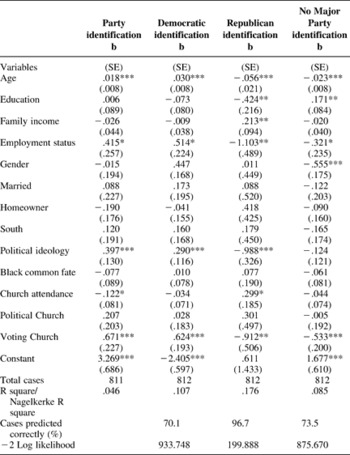
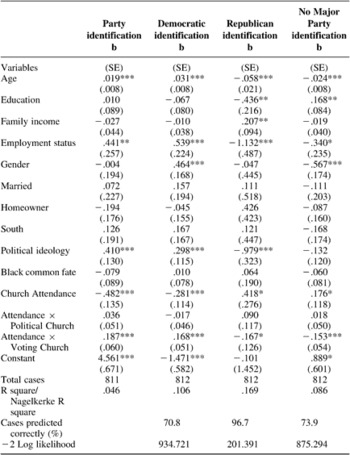
The ordinary least squares regression and logistic regression results are reported in Tables 1 and 2. Displayed in them are unstandardized regression coefficients and standard errors in parentheses. Since the aim of this investigation is to discover whether church shapes the party identification of blacks, discussion will emphasize the performance of the variables used to capture its effects, namely Church Attendance, Political Church, Voting Church, and their products.
In both Tables 1 and 2, Columns 1 and 2, show the regression results of the ordinary least squares and logistic analyses for the Party Identification Model and the Democratic Identification Model, respectively. Columns 3 and 4 of these tables display the logistic results for the Republican Identification and No Major Party Identification Models, respectively. Table 1 presents the four models with the featured church variables without their interactions, Church Attendance, Political Church, and Voting Church. Table 2 exhibits the results from incorporating Church Attendance, the interaction of Church Attendance with Political Church, and the interaction of Church Attendance with Voting Church.
OLS and logistic regression models of party identification

*** = p < .01, one-tailed test.
** = p < .05, one-tailed test.
* = p < .10, one-tailed test.
OLS and logistic regression models of party identification

*** = p < .01, one-tailed test.
** = p < .05, one-tailed test.
* = p < .10, one-tailed test.
The hypothesis that church affects the party identification of blacks is confirmed. The results of Table 1 demonstrate that blacks who attend church increasingly are less likely to identify themselves with the Democratic Party (Column 1) and more likely to identify with the Republican Party. Column 3 also reinforces the conservative influence of attending church. In the Republican Identification Model, blacks who attend church with greater frequency are more likely to identify themselves as Republicans. Blacks who attend a church or place of worship that encouraged them to vote are more likely to identify themselves with the Democratic Party (Columns 1 and 2) and are less likely to identify themselves with the Republican Party (Column 3) and other parties (Column 4). Column 4, the No Major Party Identification, indicates that blacks who attend voting churches are less likely to identify themselves with neither major party. Interestingly, attendance at a political church does not influence party identification. Blacks who attend political churches are no more or less likely to identify themselves with the Democratic, Republican, or other parties.
We now have a baseline. What do the models including the interaction yield? To some extent, they reflect the results above with only a couple of notable differences. Viewing Table 2, as expected, Church Attendance remains significant and negatively related to identification with the Democratic Party (Columns 1 and 2). Blacks who attend church or their place of worship with greater frequency than other blacks are more likely to identify themselves with the Republican Party (Column 3). An additional finding is that blacks who attend church more are also more likely to identify themselves with neither major party (Column 4). These results reverse themselves when we examine the interaction of Church Attendance with Voting Church. The Attendance × Voting Church indicates that blacks who attend voting churches more frequently than other blacks who attend voting churches are more likely to identify themselves with the Democratic Party (Columns 1 and 2), less likely to identify themselves with the Republican Party (Column 3), and less likely to abandon both parties for other parties (Column 4). The church is a conservative institution and blacks are quite conservative on a number of social and moral issues. Couple that with blacks attending churches that are not political or do not encourage voting, then one understands why some blacks state an allegiance to the Republican Party. Conversely, when the church provides a political environment, heightening the importance of improving the state of social, economic, and political affairs of blacks and mobilizing congregants, then one can understand how voting churches encourage blacks to identify themselves with the Democratic Party.
While the Church Attendance, Voting Church, and the Attendance × Voting Church interaction variable have great import to this analysis, attending a political church by itself does not have a relationship to party identification. The Political Church variable, indicating political discussions or announcements about the presidential campaign at church or place of worship, does not achieve statistical significance in any of the models. The effects of attending a political church are muted by Church Attendance, Voting Church, and the Attendance × Voting Church interaction. How often blacks attend church and how often they attend a voting church are the most important factors for understanding the effects of church. The Democratic Party benefits from blacks' church attendance and explicit pleas to vote. Without the political climate embedded in the church and the encouragement to vote, blacks are likely to identify themselves with the Republican Party.
Childs (Reference Childs1980) and Kohut et al. (Reference Kohut, Green, Teeter and Toth2000) suggest that black theology to a certain extent is conservative. Blacks are quite conservative on social and moral issues (Walton and Smith Reference Walton and Smith2003). When on their own and left to deal only with messages of the spiritual brand, blacks are conservative and likely to identify themselves with the Republican Party. Nevertheless, the more the church enters the political realm and encourages and instructs members to participate in politics, the more the Democratic Party benefits. So the basic conclusion is that the theology of the church overall encourages conservatism among blacks that would normally pull them toward the Republican Party on purely religious grounds. However, since material issues and concerns override positions on social and moral issues (Walton and Smith Reference Walton and Smith2003), blacks identify themselves with the Democratic Party. Repeated exposure to political discussions at church favors the Democratic Party. Also, encouragement to vote given at church or place of worship fosters Democratic Party identification. Frequent attendance at voting churches facilitates identification with the Democratic Party among black political churchgoers.
SUMMARY AND CONCLUSIONS
The pursuit to learn whether the effects of the church's context determine whether blacks identify themselves with the Democratic Party, the Republican Party, or neither party led to two important findings. First, church attendance encourages blacks to identify themselves with the Republican Party. This is so because, beyond its politicizing nature, the church emphasizes individual spiritual introspection and the application of universalistic principles. It is also the case because blacks are quite conservative on moral and social issues (Walton and Smith Reference Walton and Smith2003). However, when the church enters the public realm (becomes a voting church), only the Democratic Party benefits. The theology of the church encourages black conservatism generally and blacks' seemingly conservative stance on social and moral issues makes the Republican Party an attractive party. However, material issues supersede social and moral issues; therefore, blacks identify themselves with the Democratic Party.
Second, churches that have an electoral context have the opposite effect of church attendance. Blacks who attend a church or place of worship that encourages them to vote are more likely to be Democrats and less likely to identify themselves with the Republican Party or other parties. When an individual encourages someone to vote, most likely they are trying to garner votes for a particular candidate or party. Pleas to vote are likely to favor Democrats. Therefore, implicitly or explicitly, when the church encourages blacks to participate in politics, it is to the benefit of the Democratic Party, which feeds Democratic Party identification among blacks.
The importance of this investigation is that it advances our understanding of why black Americans are overwhelmingly Democratic. At one end of a continuum, a church or place of worship may not discuss politics and its congregants are not encouraged to vote. It may emphasize the individual and the desire not to get involved to ameliorate problems and inequalities, making the Republican Party a more appealing choice than the Democratic Party. Also, this context is sometimes associated more with identification as an Independent or with no major party at all than with the Democratic Party. Such churches have more political Independents or Republicans than Democrats in their congregations. Thus, the effects of these churches foster political loyalties not with the Democratic Party, but with the Republican Party or members identify themselves as Independents or claim no political affiliation.
At the other end of the continuum, a church or place of worship may discuss politics and its congregants are encouraged to vote. Because these churches emphasize improving one's life, collective action, rectifying social injustice, the atmosphere is conducive to a Democratic partisan bias. As a result, the effects of these churches produce an allegiance with the Democratic Party, not with the Republican Party, and preclude members from identifying themselves as Independents or to claim no political party loyalties. Overall, the church's context encourages identification with the Democratic Party and a lack of identification with other parties.