Introduction
The roles of the spleen are thought to be (1) phagocytosis of particular matter, (2) immunological responses, and (3) blood pooling.Reference Wadenvik and Kutti 1 High-haematocrit blood is known to be squeezed out from the spleen with its contraction, and not only the haematocrit of circulating blood but also the circulating blood volume (BV) is enhanced in situations where oxygen delivery needs to be enhanced, such as apnoea, exercise, or bleeding.Reference Sandler, Kronenberg, Forman, Wolfe, Clanton and Partain 2 – Reference Schagatay, Haughey and Reimers 7 It is interesting that this phenomenon is not observed in patients after undergoing splenectomy.Reference Schagatay, Andersson, Hallen and Palsson 5 In addition, enhancement of the haematocrit of circulating blood in acute hypoxia was not observed in neonates with asplenia.Reference Oka, Itoi and Hamaoka 8 The enhancement of the haematocrit of circulating blood and BV due to splenic contraction seems to be strongly related to sympathetic nerve activation because administration of catecholamine induces splenic contraction.Reference Turner and Hodgetts 9 , Reference Guntheroth 10 The compensatory response of the spleen is based on the huge vascular bed and the large blood pooling in the spleen in the setting of a closed circulatory system. Therefore, in clinical situations of congenital asplenia syndrome, vascular capacitance (vascular bed) and blood pooling may be possibly reduced owing to the absence of the spleen. This may be associated with haemodynamic instability often observed in this syndrome. However, to date, no information is available regarding the vascular capacitance and BV in patients with asplenia syndrome. Concomitant congenital heart diseases generally require Fontan completion as a functionally definitive repair in most patients with asplenia syndrome. Thus, to clarify whether the absence of a spleen in asplenia syndrome is associated with reduced vascular bed and blood pooling, this study examined whether vascular capacitance and BV in patients with asplenia are different from those in patients without asplenia (who had a spleen) after Fontan completion.
Methods
Patients
The study included 19 patients with Fontan circulation who underwent cardiac catheterisation for post-operative evaluation of Fontan haemodynamics. Of these, five patients had asplenia syndrome. No patients have protein-losing enteropathy clinically and biochemically. In all the cases, the diagnosis of asplenia syndrome was made on the basis of the abdominal ultrasonography findings that showed the absence of a spleen and aorto-caval juxtaposition.
Measurements
We calculated the mean circulatory filling pressure (mCFP) by using pressure changes during the Valsalva manoeuvre.Reference Ohishi, Muteki and Shinozaki 11 , Reference Masutani, Kurishima and Yana 12 Circulatory pressures within the ascending aorta (AP) and the inferior caval vein (VP) were recorded at rest and immediately after the Valsalva manoeuvre, and the mCFP was calculated as follows:
 $${\rm{mCFP }} = {\rm{ }}({{\rm{Q}}_{\rm{A}}} + {\rm{ }}{{\rm{Q}}_{\rm{V}}})/({{\rm{C}}_{\rm{A}}} + {\rm{ }}{{\rm{C}}_{\rm{V}}})$$
 $${\rm{AP }} = {\rm{ }}{{\rm{Q}}_{\rm{A}}}/{{\rm{C}}_{\rm{A}}},{\rm{ VP }} = {\rm{ }}{{\rm{Q}}_{\rm{V}}}/{{\rm{C}}_{\rm{V}}}$$
 $${\rm{AP'}} = ({{\rm{Q}}_{\rm{A}}} - \Delta {\rm{Q}})/{{\rm{C}}_{\rm{A}}},{\rm{VP'}} = ({{\rm{Q}}_{\rm{V}}} + \Delta {\rm{Q}})/{{\rm{C}}_{\rm{V}}}$$
where, AP and VP represent the control pressure before the Valsalva manoeuvre; AP’ and VP', pressure after the Valsalva manoeuvre; BV, circulating blood volume; QA, BV in the arterial compartment; QV, BV in the venous compartment; ΔQ, shifting BV during the Valsalva manoeuvre; C, vascular capacitance of the whole body; CA, capacitance of the arterial compartment; and CV, capacitance of the venous compartment.
From these formulas, we can obtain the mCFP as
 $${\rm{mCFP}} = \left( {{\rm{AP'}}*{\rm{VP}} - {\rm{AP}}*{\rm{VP'}}} \right)/\left( {{\rm{AP'}} - {\rm{AP}} + {\rm{VP}}*{\rm{VP'}}} \right)$$
Moreover, the ratio of the pressure differences between the upstream (arterial side: the arterial pressure minus the mCFP) and the downstream (venous side: the mCFP minus the venous pressure) was calculated as the circulatory balance ratio [CBR: (AP − mCFP)/(mCFP – VP)]. The Valsalva manoeuvre was performed via spontaneous breath-holding for 20 seconds (in cases under awake condition) or artificial breath-holding with the airway pressure maintained at 20 cm H2O for 20 seconds (in cases under general anaesthesia and artificial ventilation). We also measured circulatory BV by using the dye dilution technique: injection of indocyanine green at a dose of 0.4 mg/kg (DDG analyzer; Nihon Kohden, Tokyo, Japan).Reference Masutani, Kurishima and Yana 12 By combining the BV and the mCFP, we can obtain the total vascular capacitance (C) as:
 $${\rm{C }} = {\rm{ BV}}/{\rm{mCFP}}$$
The results of all parameters in post-Fontan patients were compared between the asplenia and non-asplenia groups.
Statistical analysis
Data are described as mean ± standard deviation. The samples were compared by using the Student’s t-test. A p value <0.05 was set as the level of statistical significance. Analyses were performed using standard statistical software (SPSS for Windows, version 24; SPSS Inc., IBM Company, Chicago, Illinois, United States of America).
Results
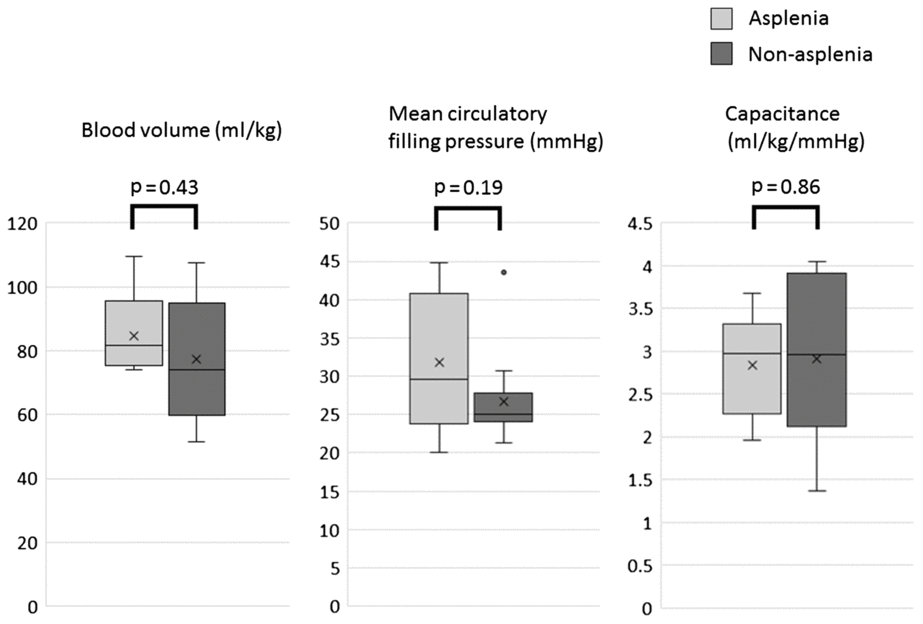
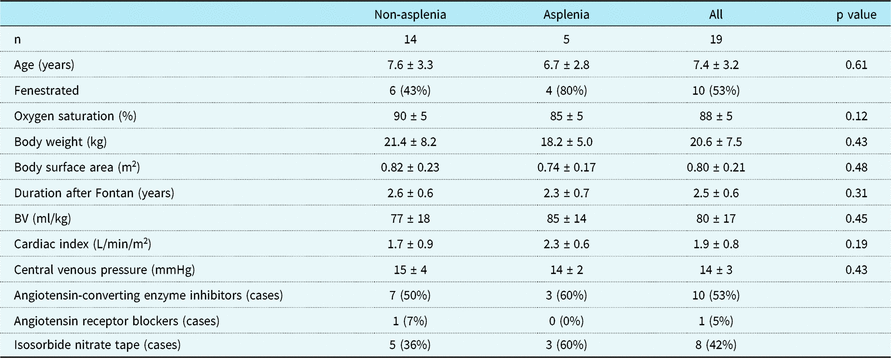
Table 1 shows the patients’ characteristics for each group. The demographic or haemodynamic data were not significantly different between the asplenia and non-asplenia groups. Fig 1 shows the comparisons of parameters for the vascular bed and BV between the two groups. The BV (85 ± 14 versus 77 ± 18 ml/kg, p = 0.43), the mCFP (31 ± 8 versus 27 ± 5, p = 0.19), and the capacitance (2.8 ± 0.6 versus 2.9 ± 0.9 ml/kg/mmHg, p = 0.86) were not significantly different. The circulatory balance ratio tended to be higher in asplenia than in non-asplenia cases (1.9 ± 0.9 versus 3.7 ± 2.6, p = 0.16), but the difference did not reach statistical significance. Multi-variate analysis accounting for age, fenestration, and haemodynamic parameters (the cardiac index and the central venous pressure) also demonstrated no significant differences in vascular and BV parameters between asplenia and non-asplenia cases. In this analysis, older age was associated with increased circulatory balance ratio (p = 0.011).
Comparison of circulatory blood volume, mean circulatory filling pressure and venous capacitance between asplenia and non-asplenia patients.

Patient’s characteristics.

BV=blood volume.
Discussion
In the present study, we found that the circulating BV in Fontan circulation was approximately 80 ml/kg, which is very close to the known normal value.Reference Liang, Senzaki, Kurishima, Sughimoto, Inuzuka and Liu 13 Generally, the pre-load of the ventricle in Fontan circulation is reduced compared with that in normal biventricular circulation. Our results implied that the circulatory BV does not contribute to effective pre-load of the ventricle but is distributed to the peripheral vascular bed as a potential cause of congestion in Fontan circulation. Moreover, the mCFP of approximately 30 mmHg in patients with Fontan circulation (Table 1) seems to be higher than normal two ventricular circulations, wherein the mCFP is reported to be 10–15 mmHg.Reference Liang, Senzaki, Kurishima, Sughimoto, Inuzuka and Liu 13 This is consistent with data from animal experiments, which showed that increased mCFP is necessary in maintaining cardiac output in Fontan circulation.Reference Mace, Dervanian and Bourriez 14 From the data of both the BV and the mCFP, the vascular capacitance of the whole body in patients with Fontan circulation, which was <3 ml/kg/mmHg, should be smaller than normal biventricular circulation. This can be thought as an adaptive mechanism by which ventricular pre-load is maintained in the absence of pulmonary ventricle.Reference Kurishima, Saiki, Masutani and Senzaki 15, Reference Kim, Kuwata and Kurishima 16
However, somewhat unexpectedly, the BV, the mCFP, and the capacitance of patients with asplenia syndrome did not differ from those with non-asplenia syndrome. These results strongly suggest that there is a blood reservoir other than the spleen even in patients with asplenia. Considering the large blood pool of the spleen, the presence of a large symmetrical liver, which is specific to asplenia syndrome, may represent the possible organ functioning as a blood reservoir in asplenia syndrome. If this is indeed the case, there may be a higher risk of hepatic dysfunction due to hepatic congestion in patients with Fontan with asplenia syndrome than in those without, a hypothesis that warrants further investigation.
In the present study, we calculated the ratio of the pressure differences from the mCFP between the up- (arterial side) and downstream (venous side) as the circulatory balance ratio. Interestingly, the circulatory balance ratio had a significant correlation with the age of patients by multi-variate analysis, indicating that decrease in vascular capacitance with aging is more prominent in the arterial side than in the venous side in patients with Fontan circulation, implying the efficacy of arterial vaso-dilative therapy (such as angiotensin-converting enzyme inhibitors or thermal therapy), particularly in elderly patients after Fontan completion.
This study has several potential limitations. First, the present study is primarily limited by the small number of patients; therefore, the results indicating statistically insignificant differences in vascular and BV indexes do not necessarily guarantee that the variables are comparable and need to be confirmed in further studies. Second, a direct comparison of compensatory responses of the spleen between asplenia and non-asplenia patients may be important to understand the pathophysiological influence of asplenic condition in patients with asplenia syndrome. Third, the intrathoracic pressure during the Valsalva manoeuvre may have some effects on the estimation of the mCFP. However, the arterial and venous pressures changed only slightly immediately after the Valsalva manoeuvre was stopped when the intra-thoracic pressure recovered to its control level. In addition, we and other authors previously reported that the mCFP measured using the Valsalva manoeuvre closely correlated with the mCFP measured using the arm equilibrium pressure with rapid vascular occlusion.Reference Masutani, Kurishima and Yana 12 Furthermore, the Valsalva manoeuvre was similarly applied in all the patients; thus, potential bias, if present, should be equally distributed to all the patients. Therefore, we think that the effects of the intra-thoracic pressure on the estimates can be negligible. Lastly, our results relied on the assumption that the dye dilution technique used in the present study was sensitive enough to detect the absence of splanchnic circulation. Although the accuracy and reproducibility of the dye dilution technique used in this study have been previously demonstrated,Reference Goy, Chiu and Loo 17 lack of data on BV in patients after splenectomy as controls may be a limitation of this study.
Financial support
This research received no specific grant from any funding agency, commercial or not-for-profit sectors.
Conflict of interest
None.
Ethical standards
Cardiac catheterisation studies were performed after obtaining written informed consent from the parents of all patients, and the study was approved by the institutional review board on clinical investigation (No. 972 at Saitama Medical Center).