Introduction
Dementia is a common issue facing older adults, their families, and societies in general. Dementia is associated with mortality (Todd et al., Reference Todd, Barr, Roberts and Passmore2013) and disability (Mehta et al., Reference Mehta, Yaffe and Covinsky2002). Indeed, dementia is associated with the highest number of years of life lost due to disability in high-income countries and the second highest worldwide (WHO, 2012). Despite significant efforts, there are no clearly established preventative measures for dementia (Plassman et al., Reference Plassman, Williams, Burke, Holsinger and Benjamin2010). Self-ratings of global health and well-being are associated with dementia, and may predict the development of dementia. These include depressive symptoms (Diniz et al., Reference Diniz, Butters, Albert, Dew and Reynolds2013), self-rated health (Montlahuc et al., Reference Montlahuc2011; St John and Montgomery, Reference St John and Montgomery2013), and frailty (Song et al., Reference Song, Mitnitski and Rockwood2011). These self-ratings of health may be useful in identifying those at risk for dementia, and some may be targets of intervention at both population and individual levels.
LS is a subjective global measure of one's life as a whole at the present time. It differs from quality of life measures that include specific questions of symptoms and disability. LS is related to positive and negative affect, but appears to be distinct from them (McDowell, Reference McDowell2010). It is increasingly advocated as an important measure of societal well-being(Steptoe et al., Reference Steptoe, Deaton and Stone2015). Most older adults in modern societies are satisfied with their lives. A recent report shows decreased LS in middle age (age 45–54 years) and increased LS in older age groups in high-income, English speaking countries (Helliwell et al., Reference Helliwell, Layard and Sachs2015). A high percentage of community living Canadians over age 65 years reported they were satisfied with life (Public Health Agency of Canada, 2010). There are various measures of LS, most of which use rating scales that categorize respondents’ self-perceived level of psychological well-being. Single-item questions have been shown to be as reliable as longer questionnaires in explaining variances in mortality after adjusting for other risk factors (McDowell, Reference McDowell2010). Factors associated with LS in community living older individuals are frailty (St John et al., Reference St John, Tyas and Montgomery2013), cognitive status (St John and Montgomery, Reference St John and Montgomery2010), overall health (St John et al., Reference St John, Tyas, Menec and Tate2014), functional status (Steptoe et al., Reference Steptoe, de Oliveira, Demakakos and Zaninotto2014), and self-esteem (Borg et al., Reference Borg2008). LS predicts five-year mortality in community living older adults and the association between LS and mortality may be highest with a global single-item question (St John et al., Reference St John, Mackenzie and Menec2015).
We have previously demonstrated that dementia is associated with LS in cross-sectional analyses (St John and Montgomery, Reference St John and Montgomery2010). However, the direction of the association is not clear – lower LS may predict dementia, or dementia may be associated with a reduction in LS. Most likely perhaps, is a negative feedback loop, whereby the association is bidirectional in nature, with a vicious circle of declining LS reinforcing cognitive decline. Those with low LS may participate in fewer cognitively enhancing activities, and thereby suffer worsening cognition, which then results in lower LS. This association may be more complicated still, since both LS and cognition are related to general health, which may also be in this causal path. We hypothesized that LS is a predictor of dementia in community-living older adults.
Specifically, our objectives were: (1) to determine whether low LS predicts the development of dementia over a five year period in community-living older adults without cognitive impairment; and (2) to determine if low satisfaction with different aspects of life predict dementia.
Methods
Sample
We conducted a secondary analysis of the Manitoba Study of Health and Aging (MSHA). The MSHA was a population-based prospective cohort study conducted in association with the Canadian Study of Health and Aging (CSHA) (CSHA, 1994). The CSHA was an epidemiological study of 10,263 randomly selected individuals over the age of 65 years, which examined the prevalence of dementia, risk factors for dementia, and caregiving patterns in Canada in 1991–1992. The MSHA is an extension of the Manitoba component of the CSHA with added participants from rural regions, and with additional measures, including measures of LS.
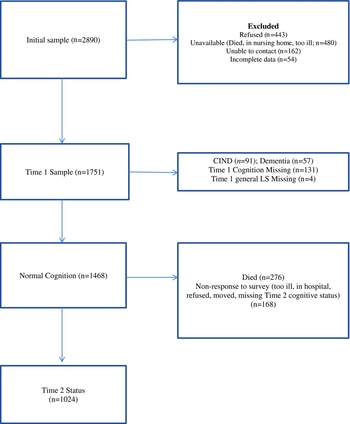
In 1991, the population of Manitobans over age 65 years was 131,206, or approximately 13% of the total population (StatisticsCanada, 1992). The MSHA sample was derived from a group of 2,890 community dwelling individuals over the age of 65 years who were randomly chosen according to health region and age group from the Manitoba Health database, which provides a comprehensive list of residents in Manitoba. Of these, 1,751 participants met the criteria for inclusion and agreed to participate. Participants were interviewed at baseline and again at five years follow-up in 1996–1997.
The present analysis includes a subset of 1,024 participants who were cognitively intact at baseline, whose cognitive status at follow-up was known, and who survived to the follow-up clinical interview five years later (time 2.) The flow of participants is shown in Figure 1. The MSHA received ethics approval by the University of Manitoba research ethics committee and adhered to the Helsinki Declaration. Informed consent was obtained from all participants or their proxies at the time of the original data collection.
Flow of participants.

Measures
Age, gender, and education (maximum number of years in school) were self-reported. We considered age and education as continuous measures. Co-morbid conditions were also measured by self-report. These were asked with a series of questions, and we considered high blood pressure, heart disease, stroke, Parkinson disease, diabetes, and cancer. These were considered as categorical responses (present vs. absent).
LS was evaluated using the Terrible-Delightful scale (Andrews and Withey, Reference Andrews and Withey1976; Michalos, Reference Michalos1980), which assesses LS in various domains using a series of seven-point Likert scales of 12 questions. Interviewers read aloud a descriptive word or phrase to which respondents were asked to describe their feelings in the context of the present time. The scale has good reliability, validity, and correlates well with other scales of well-being and mental health (McDowell, Reference McDowell2006). Value labels of the scale are “terrible,” “very dissatisfying,” “dissatisfying,” “mixed,” “satisfying,” “very satisfying,” and “delightful.” Respondents rated their health, finances, family relations, paid employment, friendships, housing, living partner, recreation activity, religion, self-esteem, transportation, and satisfaction with life as a whole. Since many of the participants were no longer married and no longer worked, we excluded satisfaction with living partner and work. We considered each item individually. We used LS as a continuous variable in the primary analysis. Since some of the items were not normally distributed (particularly LS with finances) in this data set and others (Stinson, Reference Stinson1997) we also dichotomized the responses into good (“satisfying,” “very satisfying,” and “delightful”) versus not good (“terrible,” “very dissatisfying,” “dissatisfying,” and “mixed”). When seeking interactions in the effect of LS, we also used the dichotomized responses in stratified analyses on gender, age group, and education group; and in regression analyses with interaction terms.
Cognitive measure
The primary outcome was dementia at time 2. Cognition was measured at both time 1 and time 2 using the Modified Mini-Mental State Exam (3MS) (Teng and Chui, Reference Teng and Chui1987). The 3MS is an extension of the Mini-Mental State Examination (Folstein et al., Reference Folstein, Folstein and McHugh1975), with extra items and refined scoring. It has a potential score of 100. Those with a score of less than 78 on the 3MS were invited to participate in a clinical exam for a diagnostic assessment of dementia, using the Diagnostic and Statistical Manual of Mental Disorders (Third Edition Revised) criteria.
Since there may be bias introduced by selective mortality, we conducted a sensitivity analysis, with four outcomes: no cognitive loss, cognitive impairment but no dementia (CIND) (Tuokko and Frerichs, Reference Tuokko and Frerichs2000; Tuokko et al., Reference Tuokko, Frerichs and Kristjansson2001), dementia, and death. Those who scored greater than 78 on the 3MS or below 78 on the 3MS but had a clinical exam consistent with normal cognition were categorized as “no cognitive loss.” CIND is defined as those who scored below 78 on the 3MS and had a clinical exam not consistent with dementia or normal cognition; dementia was defined as a score below 78 on the 3MS and a clinical exam consistent with dementia. This diagnostic process followed the CSHA process (CSHA, 1994).
Data analysis
For baseline comparisons, bivariate analyses were conducted using Student's t-tests or Analysis of Variance (ANOVA) for continuous variables and χ 2 tests for categorical variables. To adjust for potential confounding factors and determine if any covariates modified the association between LS and cognition, we conducted a series of stratified analyses, stratifying on age, gender, and education. In the stratified analysis, we considered LS as dichotomous.
We subsequently constructed logistic regression models, with the outcome variable of dementia versus no dementia at time 2. Independent variables entered into the model were LS (continuous), age (continuous), gender (categorical), and education (continuous). From these models, OR; 95% confidence intervals (95%), and adjusted OR (AORs) were determined. In model checking, we also included interaction terms – we considered interactions between gender and the LS item, education and the LS item, and age and the LS item. We conducted model checking (checking for multicollinearity and influential outliers.)We also conducted a sensitivity analysis. Since LS predicts survival, there could be differential loss to follow-up in those with low LS. We therefore constructed multinomial logistic regression models for the outcomes of normal cognition (reference) versus CIND versus dementia versus dead.
Results
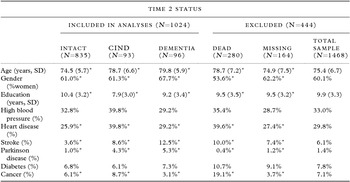
The sample consisted of 1,024 participants. Figure 1 shows the flow of participants. Table 1 shows baseline characteristics of the sample by time 2 status. Baseline mean scores and skewness are presented in supplementary data. Those with dementia at time 2 were older, and had lower education levels. Those who had missing data at time 2, most of whom had died, were also older and had lower education levels. Most individuals had high rates of LS in most domains (supplementary data, Table S1, available as supplementary material attached to the electronic version of this paper at www.journals.cambridge.org/jid_IPG). Indeed, most of the samples were satisfied or very satisfied with all aspects of life, and the mean scores for all items except health were all above 5. As well, the data were right-skewed for most variables, likely reflecting a ceiling effect. Some items; finances in particular, appeared to have a more bimodal distribution, with few participants in the mixed category.
Baseline characteristics of the sample by status at follow-up five years later (n=1,468)

SD is standard deviation.
*Denotes p <0.05.
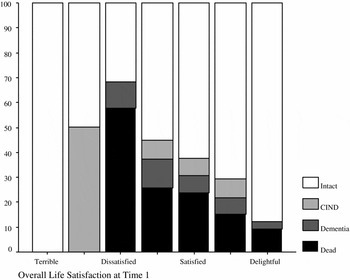
Those with low levels of LS in general were more likely to die, or have cognitive impairment five years later, at time 2. Figure 2 shows the time 1 overall LS on the x-axis plotted against the time 2 outcomes on the y-axis. The cumulative outcomes at time 2 are dead, dementia, CIND and cognitively intact. All adverse outcomes were more likely for those with low levels of LS at time 1. At time 2, less than 30% of those who were dissatisfied with life were alive and cognitively intact five years later, while nearly 90% of those who were delighted with life were alive and cognitively intact (Figure 2). Note that the risk of death was higher than the risk for dementia at all levels of LS. Note also that there were very few participants with terrible or very poor LS. In bivariate analyses, most aspects of LS did not predict dementia, but many were associated with death over the five year interval (supplementary table and figures).
Overall life satisfaction predicts death, CIND, and dementia five years later in cognitively intact older adults. Here, the time 2 outcome is plotted against the time 1 overall life satisfaction. Those with higher levels of LS at time 1 were less likely to die, have CIND or have dementia at time 2. Note that there are very few participants in the “terrible” and “very dissatisfied” categories.

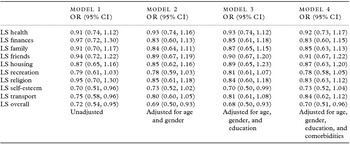
The results of logistic regression models are shown in Table 2. Here, the OR and 95% confidence intervals are presented for the empty model (model 1) and for models adjusting for potential confounding factors. Each item of the LS scale is presented. Overall LS was associated with having dementia five years later in unadjusted models. After adjusting for age, gender, and education, overall LS at time 1 also predicted dementia five years later. In unadjusted models, LS self-esteem and LS transportation predicted dementia five years later, whereas other items did not. However, no item was associated with having dementia five years later after accounting for demographic factors and comorbities. We conducted an additional sensitivity analysis as well where we considered LS as a dichotomous variable by categorizing participants as good (Delightful/very satisfied/satisfied) versus not good (Mixed/dissatisfied/very dissatisfied/terrible). This gave very similar results to those using the full seven-level variable.
Association of life satisfaction with development of dementia five years later

OR is Odds Ratio; 95% CI is 95% confidence interval.
The loss to follow-up was high (particularly through death), and was associated with time 1 LS. We therefore constructed multinomial logistic regression models, which can take into consideration multiple possible outcomes. The outcomes were: cognitively intact, CIND, dementia, dead and missing at time 2. These results were very similar to the results of the logistic regression. For overall LS, increasing LS was associated with a lower risk of adverse outcomes: the AOR was 0.83 (0.60, 1.14) for CIND; 0.70 (0.51, 0.95) for dementia, and 0.60 (0.49, 0.74) for death. In these models, LS self-esteem predicted dementia as well: The AOR was 0.88 (0.61, 1.29) for CIND; 0.70 (0.50, 0.99) for dementia, and 0.85 (0.68, 1.07) for death.
We did not detect any interaction of LS with education, age or gender in these effects, but the power to detect interactions may have been low.
Conclusion
We found that in cognitively intact community dwelling older adults, lower overall LS was associated with an increased risk of dementia five years later. Measures of individual domains of LS were not associated with development of dementia with the exception of LS with self-esteem. Here, the association was not consistently seen in sensitivity analyses. We also found that LS overall is a very strong predictor of death over five years, which we have previously reported (St John et al., Reference St John, Mackenzie and Menec2015). Indeed, the risk of dying over the five year period considerably exceeded the risk of dementia. We also found that most older adults were satisfied with most aspects of their lives.
The results are perhaps not surprising, as depressive symptoms have been shown to predict dementia in several prospective cohort studies (Diniz et al., Reference Diniz, Butters, Albert, Dew and Reynolds2013). However, the concept of LS is broader than simply a reflection of depressive symptoms. Moreover, the simplicity of the single-item measure is appealing, and supports the central importance of broad, self-reports of well-being in clinical care.
The general overall question of LS predicted dementia, but no single aspect of LS predicted dementia consistently in both primary and sensitivity analyses. In particular, LS with health did not predict dementia. This is somewhat surprising, since self-rated health predicts dementia in this and other data sets (Montlahuc et al, Reference Montlahuc2011; St John & Montgomery, Reference St John and Montgomery2013). There are several possible explanations for this. First, the competing risk from death was very high. LS health and self-rated health are extremely strong predictors of death, and very few of the participants with low LS survived. Second, LS with individual aspects of one's life may not be as important as the general overall assessment – this also appeared to be the case for the prediction of mortality in this data set, where overall LS was more strongly associated with death than any particular item (St John et al, Reference St John, Mackenzie and Menec2015). Third, it may be difficult to rate each item specifically on a long series of questions.
The causal nature of the association between LS and the development of dementia cannot be determined from this study. LS may negatively influence a person's motivation to engage in positive health behaviors, such as exercise, social interaction, and cognitively enhancing activities. Alternatively, low LS may be a prodrome or preclinical manifestation of cognitive decline and dementia. It may also be a reflection of concern in relation to their perception of cognitive decline. People with early cognitive loss may have difficulty dealing with things in their life and this may impair their subjective LS. Finally, low LS may be confounded by other unmeasured factors – general overall health and disease, which may themselves be risk factors for dementia. We did not have the power to include these factors as potential confounding factors.
There are several weaknesses that are inherent in this study. First, this is a secondary analysis of data that was collected two decades earlier. Societal changes that occur over years may have an effect on citizens’ LS in ways that we cannot adjust for. Second, there was a significant loss to follow-up. Most of this was due to death. It is likely that this differential loss to follow-up would result in the association between LS and dementia appearing weaker than it is. As well, we attempted to account for this effect in sensitivity analyses with multinomial logistic regression models. However, it is still possible that persons acquired dementia and died within the five year follow-up. Third, there may be possible confounding factors that we did not consider. The CSHA did not collect biomedical data, such as blood pressure or genotype. We also did not have the power to adjust for some confounding factors which we did measure (such as medical conditions), since there were only 96 people with dementia at time 2. We did consider a model which included some self-reported diseases and risk factors, but there are still a large number of potential confounding factors we cannot consider. Fourth, this is an observational study, so causal conclusions are difficult. Fifth, we considered multiple predictor variables, and some of the associations may have arisen by chance alone. Sixth, while the measure of LS is valid and reliable (McDowell, Reference McDowell2006), it has some limitations for these analyses. The measure is skewed, and may have a ceiling effect. However, skewness in a predictor variable is less problematic in regression models than skewness in an outcome variable. Moreover, in sensitivity analyses where we considered the LS variables as dichotomous, the results were similar to the primary analysis. A final limitation is that we cannot fully assess the full causal loop since there were only two time points. It remains possible; perhaps likely, that there is a bidirectional association between LS and dementia, with lower levels of LS reducing cognition, which in turn reinforces the decline in LS. Very few individuals with dementia survived the five year period, so we could not determine if dementia predicts a decline in LS.
The association between LS and dementia is important. If LS is indeed in the causal pathway, then efforts to improve the LS of individuals and populations may reduce the risk of dementia. Even if the effect is not causal, the association between LS and dementia is important. Clinicians should assess and follow older adults with low levels of LS closely. It is also important to note the low LS predicts a variety of adverse outcomes – not the least of which is death. Indeed, the risk of death considerably exceeds the risk of dementia in this study. When multiple outcomes are considered, the effect of LS is even more apparent. Very few of those with low levels of LS were alive and cognitively intact five years later, while the majority of those with high levels of LS were alive and intact at time 2.
Our findings also underscore the importance of considering numerous competing outcomes in an older population. This is important both methodologically and clinically. Researchers need to consider biases introduced when participants are lost to follow-up from competing events such as death. Clinicians should be aware that those with a risk factor may be at risk for several adverse outcomes, and the cumulative effect of all these outcomes may be considerable. On the other hand, as the case may be here, the risk of dying considerably exceeds the risk of dementia. This may well be the case for other predictors of cognitive decline in older populations. This brings into question the clinical importance of dementia considered as the only potential adverse outcome.
Further study is needed to determine the causal pathways of these associations. Research into the aging process is complex, since there are numerous interacting factors which operate over long time horizons. Large prospective cohort studies of diverse populations are needed over long time periods to tease apart these effects. Further intervention studies are needed as well. Ideally, this approach should focus on both individuals and on populations to determine if there are interventions which can improve LS and to determine if any improvement in LS translates into a lower risk of dementia.
Conflict of interest
None.
Description of authors’ roles
This was completed as a resident research project (Dr Peitsch). All authors conceived the analyses. Dr Peitsch and Dr St John conducted the analyses. Dr Peitsch drafted the manuscript. Dr St John, Tyas, and Menec provided substantial revisions. Dr St John was an investigator for the MSHA and conducted clinical assessments.
Acknowledgments
We would like to thank the participants of the MSHA, and the other investigators. We would particularly like to thank Audrey Blandford for the preparation of the data file for these analyses. As well, we would like to thank Pat Montgomery for comments and suggestions, and the Section of Geriatric Medicine for their constructive comments at section rounds (where these data were first presented). The Manitoba Study of Health and Aging (MSHA) was funded primarily by Manitoba Health, with additional funding provided through the Canadian Study of health and Aging by the Seniors Independence Research Program of the National Health Research and Development Program of Canada (Project No. 6606-3954-MC[S]). The Manitoba Study of Health and Aging (MSHA-2) was funded primarily by Manitoba Health's Health Communities Development Fund with additional funding provided through the Canadian Study of Health and Aging by the Seniors Independence Research Program of the National Health Research and Development Program of Health Canada (Project No. 6606-3954-MC[S]). No endorsement from these agencies is implied.
Supplementary materials
For supplementary material for this article, please visit http://dx.doi.org/10.1017/S1041610215002422.