Introduction
In patients presenting after aneurysmal subarachnoid hemorrhage (SAH), the initial level of consciousness is one of the most powerful predictors of mortality and long-term functional outcome. Reference Rosengart, Schultheiss, Tolentino and Macdonald1 Patients admitted in poor neurological condition, that is, Hunt and Hess (H&H) Reference Hunt and Hess2 or World Federation of Neurosurgical Societies (WFNS) Reference Teasdale, Drake and Hunt3 grades IV and V, are at high risk for delayed cerebral ischemia (DCI), Reference de Oliveira Manoel, Jaja and Germans4 mortality and unfavorable outcome. Reference de Oliveira Manoel, Mansur and Silva5
The WFNS scale is based on the Glasgow Coma Scale (GCS) Reference Teasdale and Jennett6 and the presence or absence of focal motor deficits. Patients classified as poor grade present with altered mental status (WFNS IV: GCS = 12 – 7) or coma (WFNS V: GCS 6 – 3), regardless of the presence of motor deficits. The GCS is the most widely used scale for assessing the level of consciousness in patients with acute brain injury, including SAH. Reference Rosen and Macdonald7 It comprises three components assessed separately: eye opening, verbal response and motor response. Because many poor-grade SAH patients are intubated, the verbal component cannot be reliably assessed. Consequently, the motor subscore of the GCS (GCSm) has been previously described as capturing nearly all the prognostic value of the total GCS score, Reference Lesko, Jenks and O’Brien8 both in traumatic brain injury (TBI) at the scene Reference Majdan, Steyerberg, Nieboer, Mauritz, Rusnak and Lingsma9 and in SAH upon hospital admission. Reference Starke, Komotar and Otten10
We therefore conducted a retrospective cohort study of poor-grade SAH patients (WFNS grades IV and V) to assess the association between the best GCSm score achieved within 24 h of hospital admission and long-term functional outcome, as measured by the modified Rankin scale (mRS).
Methods
Data
After receiving approval from the local Research Ethics Board, we retrospectively reviewed data from all SAH patients admitted to and managed between 2009 and 2013 in the Trauma and Neurosurgical Intensive Care Unit of a high-volume SAH center in Toronto, Canada. Only patients with poor-grade SAH were included. All patients were treated according to our institutional SAH protocol, Reference de Oliveira Manoel, Goffi, Marotta, Schweizer, Abrahamson and Macdonald11,Reference de Oliveira Manoel, Turkel-Parrella, Duggal, Murphy, McCredie and Marotta12 which is based on the Neurocritical Care Consensus Conference and the American Heart Association/American Stroke Association Guidelines. Reference Connolly, Rabinstein and Carhuapoma13,Reference Diringer, Bleck and Hemphill14
Variable assessment
The GCS and its three components were assessed and recorded by specialized neuroscience registered nurses upon admission and then hourly thereafter. Focal neurological deficits and the GCS score documented immediately before external ventricular drain (EVD) insertion were used to determine the initial neurological status according to the WFNS grade. The best GCS motor score (GCSm) achieved within the first 24 h of hospital admission was also recorded.
Cerebral infarction due to DCI was defined according to the criteria established by Vergouwen et al. Reference Vergouwen, Vermeulen and van15 Notably, hypodensities attributed to aneurysm treatment, EVD insertion or intraparenchymal hemorrhage (ICH) were not considered DCI-related infarctions. All radiological assessments were performed and reported by experienced neuroradiologists for clinical purposes, who were blinded to the study objectives.
Primary outcome
The primary outcome was functional status, assessed using the mRS at any time point beyond three months after the hemorrhage. Outcomes were dichotomized into favorable (mRS ≤ 2) or unfavorable (mRS ≥ 3).
The mRS:
-
• 0 = No symptoms at all
-
• 1 = No significant disability despite symptoms; able to carry out all usual duties and activities
-
• 2 = Slight disability; unable to carry out all previous activities, but able to look after own affairs without assistance
-
• 3 = Moderate disability; requiring some help, but able to walk without assistance
-
• 4 = Moderately severe disability; unable to walk or attend to bodily needs without assistance
-
• 5 = Severe disability; bedridden, incontinent and requiring constant nursing care and attention
-
• 6 = Dead
The mRS was derived retrospectively from the electronic medical records (EMR). Reference Isenberg, Prus, Ramsey and Gentile16 Patients with treated ruptured aneurysms require long-term imaging follow-up due to the risk of aneurysm recanalization and late rebleeding. At our institution, all such patients are followed in a dedicated neurovascular clinic. Reference de Oliveira Manoel, Mansur and Murphy17
As part of the standardized follow-up protocol, all patients undergo serial cerebral vascular imaging to assess for aneurysm recanalization. Specially, patients treated by endovascular coiling undergo magnetic resonance angiography Reference van Amerongen, Boogaarts and de18 in the first week after treatment, and then at 8 weeks, 6 months, 1 year and 3 years. Reference de Oliveira Manoel, Mansur and Murphy17,Reference van Amerongen, Boogaarts and de18 For patients treated with surgical clipping, computed tomography angiography is performed prior to discharge, then at 8 weeks, 1 year, between 3 and 5 years and every 5 years thereafter. Reference de Oliveira Manoel, Mansur and Murphy17
At each follow-up visit, motor and speech deficits, as well as the patient’s ability to perform activities of daily living (ADLs), are assessed and documented in the EMR by the attending neurosurgeon or interventional neuroradiologist. Functional outcomes were retrospectively extracted from EMR documentation using the simplified mRS questionnaire algorithm proposed by Bruno et al. Reference Bruno, Shah and Lin19
Two trained, independent investigators, blinded to the GCSm scores, reviewed the attending physicians’ notes. Discrepancies were resolved by consensus. The standardized EMR data extraction process identified key descriptors related to mobility (e.g., “walks with cane,” “wheelchair-bound”), self-care (e.g., “requires assistance with dressing,” ”independent in ADLs”), living situation (e.g., “returned home,” “requires nursing facility”), speech and cognition (e.g., “communicates independently,” “aphasic but alert”) and occupational status when available (e.g., “returned to work”). Based on functional distinctions across mRS categories, patients were classified using the following functional milestones Reference Bruno, Shah and Lin19 :
-
• Absence of residual symptoms (mRS 0)
-
• Resumption of all pre-SAH activities (mRS ≤ 1)
-
• Independent living (mRS ≤ 2)
-
• Ability to ambulate without assistance (mRS ≤ 3)
-
• Not requiring continuous supervision (mRS ≤ 4)
-
• Nursing home resident or bedridden (mRS = 5)
Statistical analysis
Baseline characteristics between groups were compared using Student’s t-test with Welch’s correction for heteroscedasticity (for continuous variables) and the two-proportion z-test with continuity correction (for dichotomous variables).
The predictive accuracy of the best GCSm score was assessed using a receiver operating characteristic (ROC) curve, and the area under the curve was calculated.
Multivariable logistic regression was performed to identify independent predictors of unfavorable outcome. Variables were selected a priori based on clinical relevance and prior literature, including age, WFNS (IV vs. V) and cerebral infarction. Additional variables included the presence of ICH, EVD placement and GCSm score. GCSm score was categorized into four groups (for values of < 4, 4, 5 or 6).
Although the traditional rule of 10 events per variable (EPV) is commonly cited, Reference Peduzzi, Concato, Kemper, Holford and Feinstein20 more recent evidence suggests this threshold may be overly conservative. Studies have shown that reliable estimates can still be obtained with fewer EPV, particularly when predictors are prespecified and model assumptions are carefully assessed. Reference Vittinghoff and McCulloch21–Reference van Smeden, Moons and de Groot23 To minimize the risk of overfitting, we limited the number of predictors included in the model and confirmed the absence of multicollinearity using variance inflation factors.
Linearity between predictors and outcome was evaluated by inspecting univariate cross plotting. Predictors demonstrating nonlinear relationships were either categorized or modeled using splines. The coefficients were extracted from the model and converted into odds ratios (OR). The reported OR for GCSm score represents the odds of unfavorable outcome associated with a one-category decrease in score (i.e., between GCSm 6 and GCSm 5). All statistical analyses were conducted using the R statistical environment (version 3.2.2).
Results
A total of 179 poor-grade SAH patients were admitted during the study period (mean age 55.9 ± 12.1; 68.2% female). Thirty-three patients (33/179; 18%) died before aneurysm treatment and were excluded from the final analysis. Additionally, one patient had missing GCSm data at 24 h, and 16 patients (16/179; 9%) were lost to follow-up. Thus, 129 patients (129/179; 72%) were included in the final analysis.
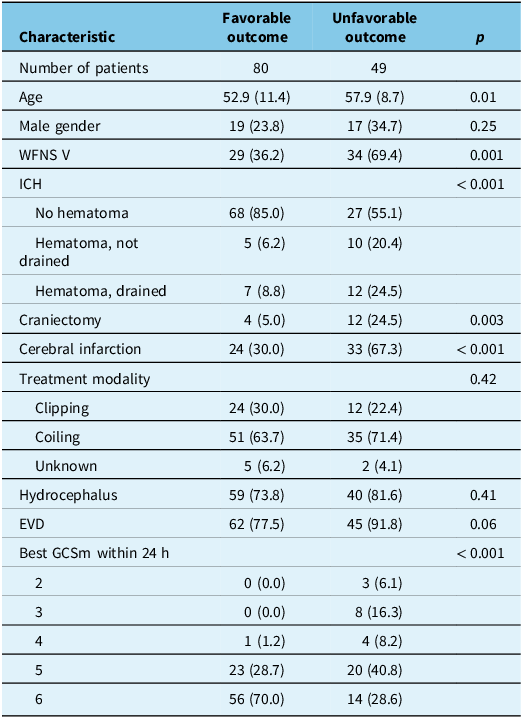
The mRS was assessed at a mean of 16 months after SAH. Among the included patients, 80 (80/129; 62%) had a favorable outcome, while 49 (46/129 − 38%) had an unfavorable outcome. A comparison of baseline characteristics between the favorable and unfavorable outcome groups is presented in Table 1.
Baseline characteristics between favorable and unfavorable groups

Table 1 Long description
A table comparing baseline characteristics between favorable and unfavorable outcome groups. The table has 12 rows and 5 columns. The columns are labeled Characteristic, Favorable outcome, Unfavorable outcome, and p. The characteristics listed include Number of patients, Age, Male gender, WFNS V, ICH, Craniectomy, Cerebral infarction, Treatment modality, Hydrocephalus, EVD, and Best GCSm within 24 h. Each row provides specific data for these characteristics. For example, the Number of patients row shows 80 for Favorable outcome and 49 for Unfavorable outcome. The Age row shows 52.9 (11.4) for Favorable outcome and 57.9 (8.7) for Unfavorable outcome. The table also includes p-values for each characteristic, indicating the statistical significance of the differences observed.
Data are shown as n (%) or mean ± SD. WFNS = World Federation of Neurosurgical Societies; ICH = Intraparenchimal hemorrhage; EVD = external ventricular drain; GCSm = motor Glasgow Coma Scale.
Patients in the unfavorable outcome group were more likely to have been classified as WFNS V (69.4% vs. 36.2%, p = 0.001). They also more frequently presented with ICH (20.4% vs. 6.2%, p < 0.001) and with ICH requiring surgical drainage (24.5% vs. 8.8%, p< 0.001). Furthermore, DCI-related cerebral infarction was significantly more common in the unfavorable outcome group than in the favorable outcome group (67.3% vs. 30%, p < 0.001).
The motor component of Glasgow Coma Scale
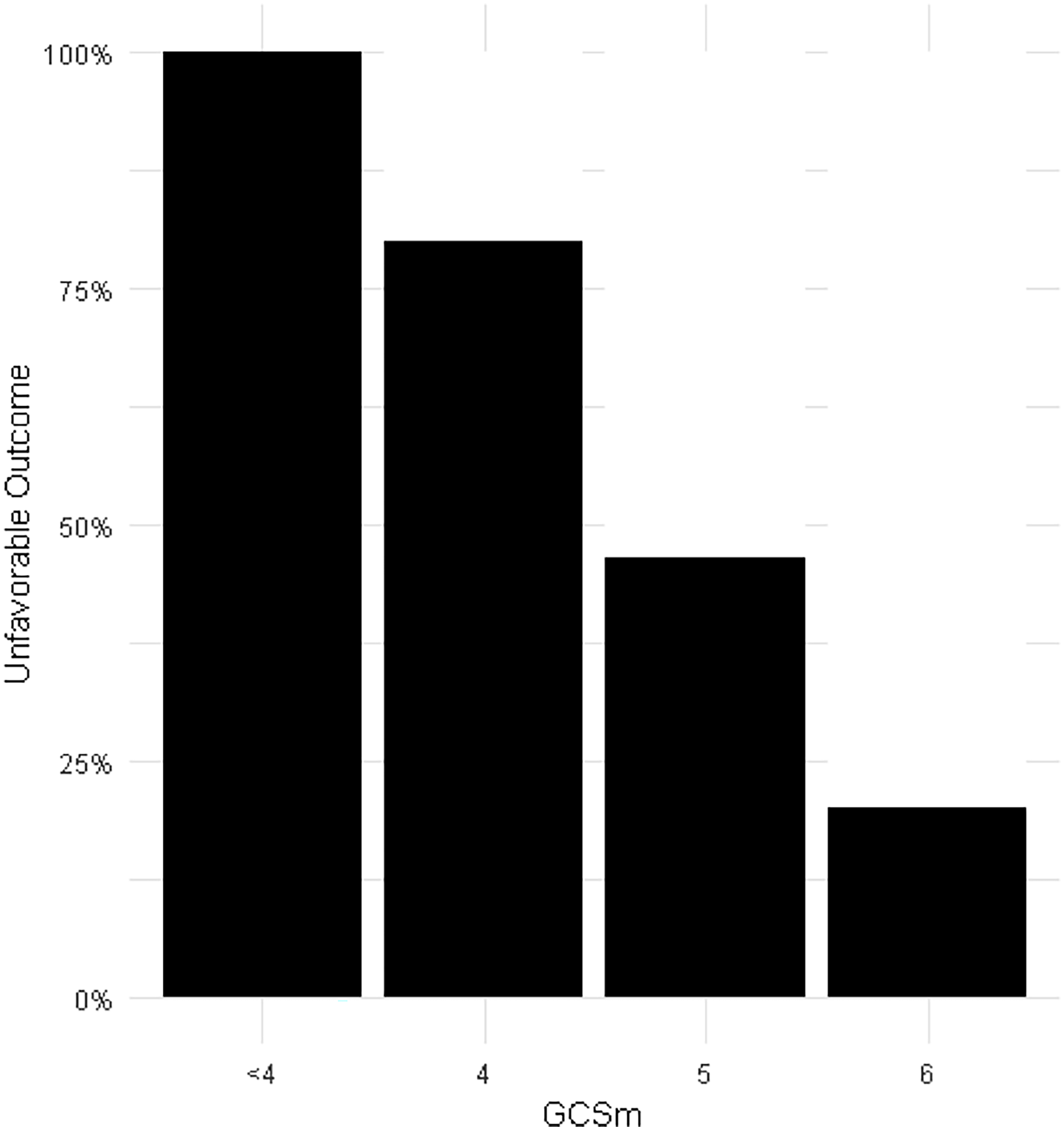
No patients with a GCSm 1, 2 or 3, and only one patient with GCSm of 4 at 24 h, had a favorable outcome (Table 1). When patients were stratified into four GCSm groups (i.e., <4, 4, 5 or 6), there was a stepwise reduction in the proportion of unfavorable outcomes with increasing GCSm scores, as illustrated in Figure 1:
-
• GCSm < 4: 100% unfavorable (11/11)
-
• GCSm = 4: 80% unfavorable (4/5)
-
• GCSm = 5: 46% unfavorable (20/44)
-
• GCSm = 6: 20% unfavorable (14/69)
Occurrence of unfavorable outcome per best GCSm within 24 h.

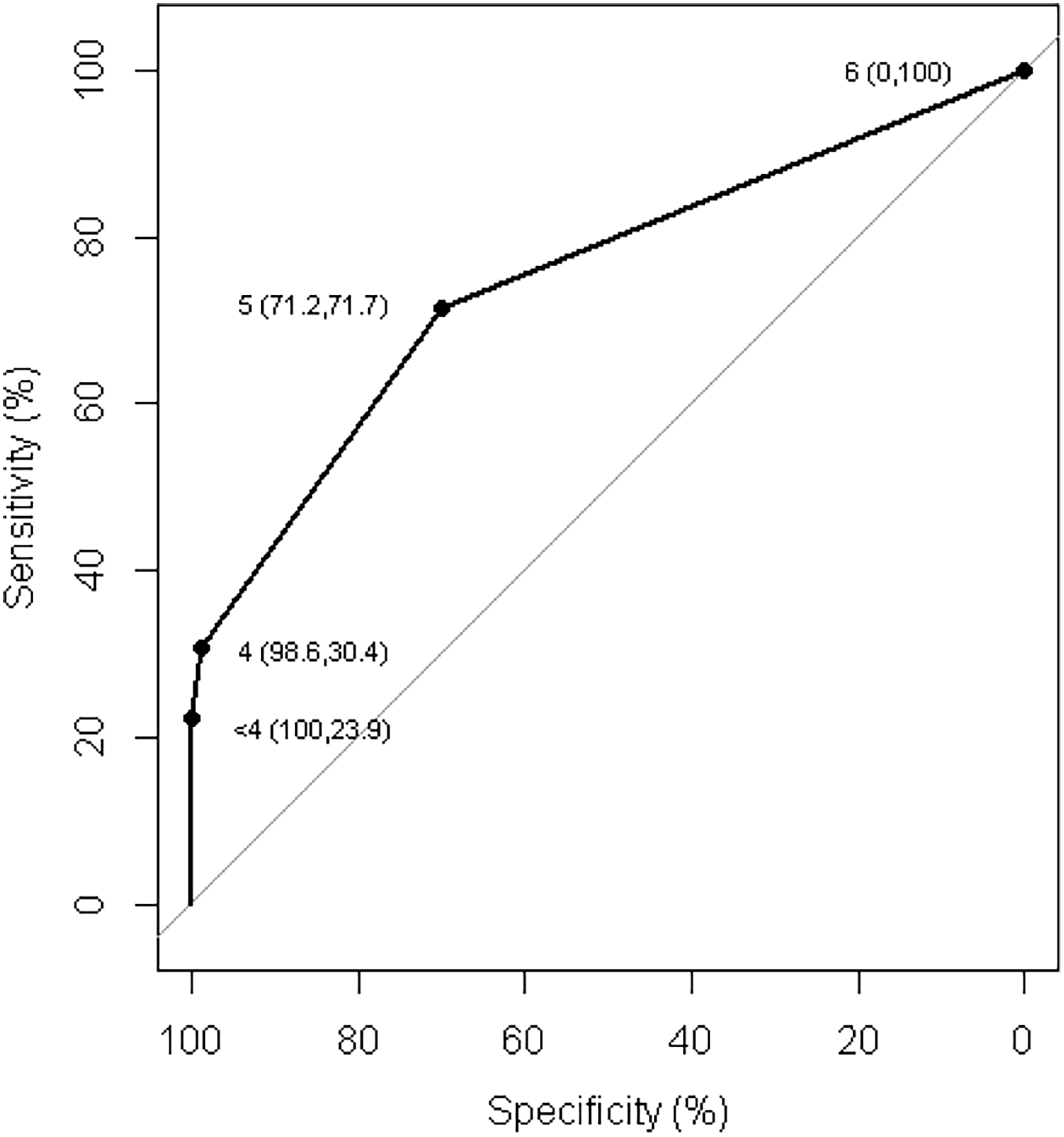
The ROC curve for the best GCSm score within 24 h as a predictor of unfavorable outcome is shown in Figure 2.
ROC curve for best GCSm and unfavorable outcome.

Nearly all patients with favorable outcomes (79/80 − 98%) had achieved a GCSm ≥ 5 within 24 h (Table 1). A GCSm < 4 within 24 h yielded a sensitivity of 22.4%, specificity of 100%, positive predictive value of 100% and negative predictive value of 67.8% for predicting unfavorable outcome.
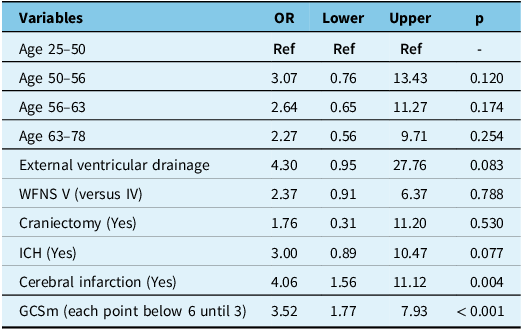
The results of the multivariable logistic regression are presented in Table 2. In this model, only two variables were independently associated with unfavorable outcome:
Logistic regression model

Table 2 Long description
A table with six rows and seven columns comparing different variables with their corresponding odds ratios (OR), lower confidence intervals, upper confidence intervals, and p-values. The variables include age groups, external ventricular drainage, WFNS V (versus IV), craniectomy, ICH, cerebral infarction, and GCSm. The table lists the following data: Row 1: Age 25-50, Ref, Ref, Ref, -. Row 2: Age 50-56, 3.07, 0.76, 13.43, 0.120. Row 3: Age 56-63, 2.64, 0.65, 11.27, 0.174. Row 4: Age 63-78, 2.27, 0.56, 9.71, 0.254. Row 5: External ventricular drainage, 4.30, 0.95, 27.76, 0.083. Row 6: WFNS V (versus IV), 2.37, 0.91, 6.37, 0.788. Row 7: Craniectomy (Yes), 1.76, 0.31, 11.20, 0.530. Row 8: ICH (Yes), 3.00, 0.89, 10.47, 0.077. Row 9: Cerebral infarction (Yes), 4.06, 1.56, 11.12, 0.004. Row 10: GCSm (each point below 6 until 3), 3.52, 1.77, 7.93, < 0.001.
-
• DCI-related cerebral infarction (OR 4.06; 1.56−11.11 95%CI, p = 0.004).
-
• Best GCSm score within 24 h (OR for each one-category decrease from GCSm 6. OR 3.52; 95% CI 1.77–7.92; p <0.001).
Age, WFNS V, EVD insertion, need for decompressive craniectomy and the presence of ICH were not independently associated with functional outcome in the model. Exclusion of patients with missing data on treatment type (n = 7) did not affect the results.
Discussion
In this retrospective study of poor-grade SAH patients treated at a single high-volume center, we found that the best Glasgow Coma Scale motor score (GCSm) achieved within 24 h of hospital admission was an independent predictor of unfavorable functional outcome. Each one-point decrease in GCSm below 6 was associated with an OR of 3.52 (1.77−7.92 95% CI, p = < 0.001) for unfavorable outcome. Notably, no patient with GCSm < 4 within 24 h had a favorable outcome, yielding a specificity of 100% for poor outcome. Only one patient with a GCSm of 4 had a favorable outcome.
Poor-grade SAH, typically defined as H&H or WFNS grades IV and V, accounts for approximately 30% of all SAH cases. Reference de Oliveira Manoel, Mansur and Silva5 These patients are at high risk of aneurysmal rebleeding Reference van den Berg, Foumani and Schröder24 and often die without treatment. Reference Le Roux, Elliott, Newell, Grady and Winn25 Even with aggressive intervention, outcomes remain poor due to DCI, mortality and long-term disability. Nonetheless, as previously shown, approximately one-third of these patients may achieve favorable neurological recovery. Reference de Oliveira Manoel, Mansur and Silva5
Some studies have reported even higher rates of good outcomes, reaching up to 53%. Reference Wen, Zhou, Lv, Shao, Wang and Zhang26,Reference Diaz and Wong27 However, these findings often originate from smaller cohorts, exclude patients who died before aneurysm treatment, and tend to overrepresent patients with WFNS grade IV. Reference Diaz and Wong27
To date, no validated clinical model reliably identifies which poor-grade SAH patients will benefit from early aneurysm treatment and aggressive intensive care management.
Our findings are consistent with those of van den Berg and colleagues, Reference van den Berg, Foumani and Schröder24 who retrospectively studied 126 patients with WFNS grade V admitted between 2000 and 2007 at two centers in the Netherlands. Twenty-eight patients (22.2%) lacked brainstem reflexes and showed no improvement after EVD placement. Fourteen patients (11.1%) died following aneurysm rebleeding and withdrawal of life-sustaining therapy. Among the 61 patients (49.2%) who improved to GCSm ≥ 4, 39% had a favorable outcome at six months. Crucially, all patients with a GCSm value < 4 (38%) had an unfavorable outcome, similar to our findings.
The clinical relevance of the GCSm is further supported by its anatomical and physiological implications. According to the original description by Teasdale and Jennett, Reference Teasdale and Jennett6 a GCSm score of 3 reflects abnormal flexion (decorticate posturing), while a score of 2 reflects extension (decerebrate posturing) and a score of 1 denotes the absence of motor response and flaccidity. These motor patterns reflect progressive brain dysfunction and downward herniation, lending biological plausibility to the absence of favorable outcomes in patients with GCSm < 4.
The GCS remains the most widely used scale to assess consciousness in patients with acute brain injury, including SAH patients. Reference Rosen and Macdonald7 It is simple, reproducible and exhibits high inter- and intra-rater reliability, even among observers with varying levels of experience. Reference Menegazzi, Davis, Sucov and Paris28–Reference Teasdale, Knill-Jones and van der Sande31
Response to external ventricular drain insertion
EVD insertion was not independently associated with functional outcome in our logistic regression model. However, treating acute hydrocephalus with EVD placement may influence GCSm and, consequently, prognosis in this population. The impact of perioperative EVD insertion on long-term outcome remains controversial. Some authors argue that initial hemorrhage severity, intracranial hypertension and cerebral infarction are more significant determinants of outcome than hydrocephalus itself. Reference Le Roux, Elliott, Newell, Grady and Winn25 Conversely, other studies have identified acute hydrocephalus as an independent risk factor for poor outcome Reference Dupont and Rabinstein32 and suggest that patients who improve following EVD insertion may achieve outcomes comparable to those of good-grade SAH patients. Reference Ransom, Mocco and Komotar33
In a small cohort of 59 poor-grade SAH patients (H&H grades 4 – 5), Ransom et al. Reference Ransom, Mocco and Komotar33 found that 19 patients (32%) responded to EVD insertion (defined as an improvement of at least one H&H grade), and 68% of these responders had a favorable outcome (mRS ≤ 3). However, the study was limited by selection bias, as it excluded patients who died before aneurysm treatment, and underrepresented patients with H&H grade 5, who were less likely to improve.
Prognostic role of GCSm at 24 h
Previous studies have demonstrated that both the total GCS and its motor subscore (GCSm) can predict long-term outcome after SAH (10,24,25). Our findings validate and extend this evidence by showing that a GCSm < 4 within 24 h is a highly specific predictor of unfavorable functional outcome. This observation may help guide decisions regarding the intensity and appropriateness of care in comatose SAH patients.
Disability paradox
While we classified mRS ≥ 3 as an unfavorable outcome, consistent with prior neurocritical care literature, we acknowledge that this threshold is subject to debate, particularly in the context of poor-grade SAH. Survival with moderate disability (e.g., mRS 3 or 4) may still be viewed as an acceptable or even favorable outcome by patients and families, depending on personal values and quality-of-life perceptions. Reference Rahme, Zuccarello, Kleindorfer, Adeoye and Ringer34 This notion aligns with findings in patients undergoing decompressive craniectomy for malignant middle cerebral artery infarction, Reference Jüttler, Unterberg and Woitzik35,Reference Sundseth, Sundseth and Thommessen36 where many survivors report acceptable quality of life despite substantial disability, a phenomenon termed the disability paradox. Reference Rahme, Zuccarello, Kleindorfer, Adeoye and Ringer34,Reference Honeybul, Gillett, Ho, Janzen and Kruger37 These observations underscore the complexity of defining meaningful outcomes in severe stroke and the ethical challenges of treatment decisions in poor-grade SAH.
Study limitations
-
1. Limited specificity of GCSm for favorable outcomes: Although a GCSm < 4 was highly specific for predicting unfavorable outcome, a higher GCSm was not reliably predictive of favorable outcome. Thirty-four patients with GCSm ≥ 5 within 24 h still had unfavorable outcome, accounting for nearly 70% of the unfavorable outcome group.
-
2. The ceiling effect of the mRS: The mRS was not designed to detect subtle deficits, particularly in cognitive domains such as memory, executive function and language. As a result, many patients classified as having a favorable outcome may still experience impairments that affect daily functioning. Reference Al-Khindi, Macdonald and Schweizer38
-
3. Nonstandardized GCS assessment: GCS scores were obtained for clinical rather than research purposes, introducing potential variability due to differences in examiner training, stimulus type and assessment conditions. Reference Reith, Brande, Synnot, Gruen and Maas29
-
4. Timing of neurological assessment: Ideally, GCS should be measured after initial cardiopulmonary stabilization. However, we used the best GCSm achieved within 24 h, including post-EVD insertion and resuscitation; so, the impact of this limitation was likely minimal.
-
5. Misclassification due to sedation or intubation: Prehospital administration of sedatives, neuromuscular blockers or intubation may have led to underestimation of neurological function and misclassification of patients as poor grade. Reference Stocchetti, Pagan and Calappi39 Nevertheless, previous studies have shown that both prehospital and admission GCSm scores have comparable prognostic value in TBI. Reference Majdan, Steyerberg, Nieboer, Mauritz, Rusnak and Lingsma9
-
6. Historical dataset (2009–2013): Although our data spans only through 2013, changes in the management of SAH since then have been limited. Some studies suggest that functional outcomes in poor-grade SAH have not consistently improved since the 1990s. Reference de Oliveira Manoel, Mansur and Silva5
-
7. Impact of sedation: Accurate motor assessment requires patients to be off sedation. In our Intensive Care Unit (ICU), daily interruption of sedation is routinely performed unless contraindicated (e.g., refractory intracranial hypertension or status epilepticus). However, the effects of prehospital sedative use could not be ruled out.
-
8. Retrospective mRS assessment from EMR: Functional outcomes were extracted retrospectively using the simplified mRS questionnaire algorithm. Although this method enhances consistency, it may miss subtle deficits due to limitations in clinical documentation and the mRS tool itself.
Conclusion
In this retrospective study of poor-grade SAH patients, the best motor response score on the Glasgow Coma Scale (GCSm) within 24 h of admission was independently associated with long-term functional outcome. A GCSm score < 4 was 100% specific for predicting unfavorable outcome, highlighting its potential utility as a prognostic marker in clinical decision-making. While higher GCSm scores were not uniformly predictive of good outcomes, the absence of favorable outcomes in patients with GCSm < 4 suggests that this threshold may help identify individuals unlikely to benefit from aggressive intervention. These findings underscore the prognostic value of early motor response assessment and support its integration into clinical frameworks for evaluating and managing comatose SAH patients. Our results emphasize the need for a prospective multicenter study on poor-grade SAH to determine whether the best GCSm within 24 h can be reliably used to guide future management decisions in poor-grade SAH.
Author contributions
ALOM contributed to study conception and design, data acquisition and interpretation and wrote the main manuscript text. FGZ was responsible for data management and analysis and designed and drafted the tables and figures. AG and MG contributed to study conception and design, as well as data interpretation. GSS, SBR and TRM contributed to data interpretation and revised the manuscript for intellectual content. All authors reviewed and approved the final version of the manuscript.
Funding statement
This research received no specific grant from any funding agency in the public, commercial or not-for-profit sectors.
Competing interests
The authors have no competing interests to declare.